PROFESSIONAL STUDIES 3A
ayankies@gmail.com
   In the South African
    context, the concept
    of e-Education
    revolves around the
    use of ICTs’
    (Information
    Communication
    Technology) to
    speed-up the
    achievement of
    national education
    goals.
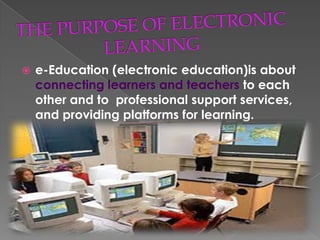
   e-Education (electronic education)is about
    connecting learners and teachers to each
    other and to professional support services,
    and providing platforms for learning.
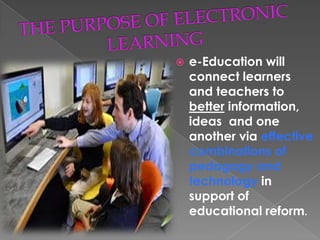
   e-Education will
    connect learners
    and teachers to
    better information,
    ideas and one
    another via effective
    combinations of
    pedagogy and
    technology in
    support of
    educational reform.
 These learners will use ICTs to enhance
  interaction between citizens, governmental
  organizations and public and elected officials
WHY ICTs?
               The challenge is to stretch beyond the
                mere exchange of information or
                indoctrination.
   • a tool for management;
   • an administration tool to increase
    productivity of the staff and lesson
    delivery;
   • a resource for curriculum
    integration;
   • a communication tool (a form if
    interaction);
   • a collaborative tool for teachers
    and learners; and
   • a learning environment that
    advances creativity, communication,
    collaboration and engagement.
 Development in science and technology
  are basically changing the way people live.
 This is because scientific and technological
  uprising reinforces
   i. economic advances
   ii. improvements in health systems
   iii. education and infrastructure
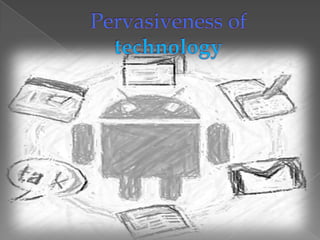
 The pervasiveness of technology has made it
    easier to differentiate between developed
    and developing countries.
 Technology encourages enhancement of the
    learners cognitive thinking.
    Quality education enhances and advances
    technology and the other way round.
   • Norms and Standards for
    Educators are revised to
    include ICT use and
    integration.
   • All pre-service teacher
    training in higher education
    institutions includes basic ICT
    literacy and basic ICT.     ·
   Teachers have access to ICT
    technical support training
   · Teachers have access to
    in-service training on how
    to integrate ICTs into
    teaching and learning
   · Institutional managers
    have access to in-service
    training on how to integrate
    ICTs in management and
    administration.
 · Dedicated expertise are appointed and
  developed at different levels of the system for
  the planning, management, support, monitoring
  and evaluation of ICTs.
 · Ongoing support to managers is provided at
  different levels of the system.
 · Provinces are collaborating and group ICT
  resources where appropriate.
Knowledge society: A human society, in
which knowledge should bring justice,
solidarity, democracy, peace... A
society in which knowledge could be a
force for changing society. A society
which should provide universal and
equitable access to information
(UNESCO).
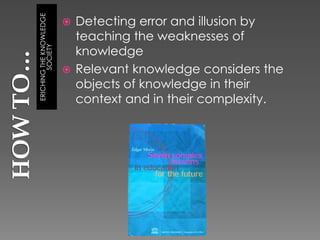
Detecting error and illusion by
ERICHING THE KNOWLEDGE
                         
                           teaching the weaknesses of
        SOCIETY
                           knowledge
                          Relevant knowledge considers the
                           objects of knowledge in their
                           context and in their complexity.
ENRICHING THE KNOWLEDGE
                           Clarifying uncertainties by
        SOCIETY
                            teaching the uncertainties in
                            physics, in biology, in history…
                           Teach mutual understanding
                            and what misunderstanding is
                            between human beings.
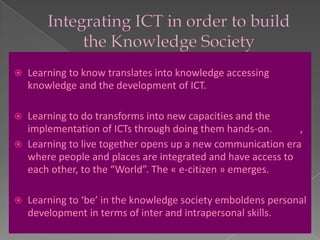
   Learning to know translates into knowledge accessing
    knowledge and the development of ICT.

 Learning to do transforms into new capacities and the
  implementation of ICTs through doing them hands-on.       ,
 Learning to live together opens up a new communication era
  where people and places are integrated and have access to
  each other, to the “World”. The « e-citizen » emerges.

   Learning to ‘be’ in the knowledge society emboldens personal
    development in terms of inter and intrapersonal skills.
   If the executive sphere functions at influential
    levels of the education system, goals are to be
    carried out well and successfully. Therefore, it is
    necessary that information of high value is
    accessible at all times to advise decision making.
    This calls for the need of a dependable
    information system that delivers defined
    objectives and the right information to the right
    people, at the right time and in the right way.
 Sometimes, educational leaders do not yet fully
  appreciate the benefits of e-Learning and e-
  Administration for organizations and for
  provincial and district offices.
 It is important that school staff, dept. of
  education and the law, at all levels of the system
  are provided with the required support to enable
  them to manage the introduction of ICTs and the
  related change processes.
   EDUCATIONAL OUTPUT GOALS
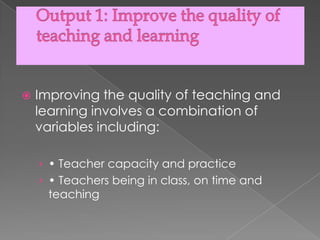
   Improving the quality of teaching and
    learning involves a combination of
    variables including:

    › • Teacher capacity and practice
    › • Teachers being in class, on time and
     teaching
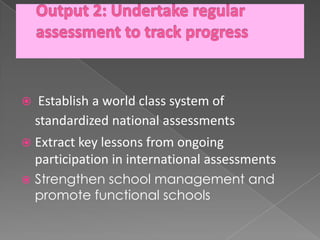
    Establish a world class system of
    standardized national assessments
 Extract key lessons from ongoing
    participation in international assessments
   Strengthen school management and
    promote functional schools
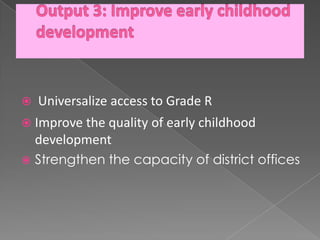
   Universalize access to Grade R
 Improve the quality of early childhood
    development
   Strengthen the capacity of district offices
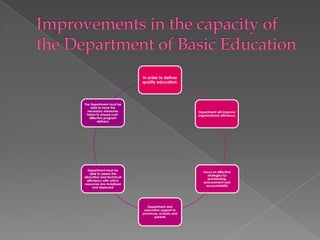
In order to deliver
                           quality education:


The Department must be
     able to have the
  necessary measures                                Department will improve
  taken to ensure cost-                             organizational efficiency
    effective program
         delivery


  Department must be
                                                       focus on effective
    able to assess the
                                                          strategies for
allocation and technical
                                                          provisioning,
  efficiency with which
                                                       procurement and
resources are mobilized
                                                         accountability
      and deployed


                              Department and
                            education support to
                           provinces, schools and
                                  parents
The following are key principles to be followed
  in the professional development programs for
                      teachers:
 Educational goals should be most important.
The focus should not be on providing technical
ICT skills only, but also on the use of ICT to
achieve learning outcomes.
   Teacher development programs should provide teachers
    with situated/contextualized learning experiences.
Programs should be subject-specific and relevant to the
learning areas.
Alexander, D. (2010). Education Strategy 2010-2015. London: Department for
International Development.

    Cornu,B. (2013). Being a Teacher
    in the Knowledge Society. INRP, CNED-EIFAD, France


Motsheka, A, Soorbrayan, B, Surty, E. (2011). Strategic Plan 2011-2014: Sol
Plaatje House.


Roi, A. (2008). Education for All by 2015. Belgium: Brussels.


UNESCO (2002). Information and Communication Technologies in Teacher
Education: A Planning Guide. UNESCO: Paris
:
UNESCO (2002b). Information and Communication Technology in Education:
A Curriculum for Schools and Programme of Teacher Development. UNESCO:
Paris

Ayanda bhokwane 201105042

  • 1.
  • 2.
    In the South African context, the concept of e-Education revolves around the use of ICTs’ (Information Communication Technology) to speed-up the achievement of national education goals.
  • 3.
    e-Education (electronic education)is about connecting learners and teachers to each other and to professional support services, and providing platforms for learning.
  • 4.
    e-Education will connect learners and teachers to better information, ideas and one another via effective combinations of pedagogy and technology in support of educational reform.
  • 5.
     These learnerswill use ICTs to enhance interaction between citizens, governmental organizations and public and elected officials
  • 6.
    WHY ICTs?  The challenge is to stretch beyond the mere exchange of information or indoctrination.
  • 7.
    • a tool for management;  • an administration tool to increase productivity of the staff and lesson delivery;  • a resource for curriculum integration;
  • 8.
    • a communication tool (a form if interaction);  • a collaborative tool for teachers and learners; and  • a learning environment that advances creativity, communication, collaboration and engagement.
  • 10.
     Development inscience and technology are basically changing the way people live.  This is because scientific and technological uprising reinforces i. economic advances ii. improvements in health systems iii. education and infrastructure
  • 11.
     The pervasivenessof technology has made it easier to differentiate between developed and developing countries.  Technology encourages enhancement of the learners cognitive thinking.  Quality education enhances and advances technology and the other way round.
  • 13.
    • Norms and Standards for Educators are revised to include ICT use and integration.  • All pre-service teacher training in higher education institutions includes basic ICT literacy and basic ICT. ·  Teachers have access to ICT technical support training
  • 14.
    · Teachers have access to in-service training on how to integrate ICTs into teaching and learning  · Institutional managers have access to in-service training on how to integrate ICTs in management and administration.
  • 15.
     · Dedicatedexpertise are appointed and developed at different levels of the system for the planning, management, support, monitoring and evaluation of ICTs.  · Ongoing support to managers is provided at different levels of the system.  · Provinces are collaborating and group ICT resources where appropriate.
  • 17.
    Knowledge society: Ahuman society, in which knowledge should bring justice, solidarity, democracy, peace... A society in which knowledge could be a force for changing society. A society which should provide universal and equitable access to information (UNESCO).
  • 18.
    Detecting error andillusion by ERICHING THE KNOWLEDGE  teaching the weaknesses of SOCIETY knowledge  Relevant knowledge considers the objects of knowledge in their context and in their complexity.
  • 19.
    ENRICHING THE KNOWLEDGE  Clarifying uncertainties by SOCIETY teaching the uncertainties in physics, in biology, in history…  Teach mutual understanding and what misunderstanding is between human beings.
  • 20.
    Learning to know translates into knowledge accessing knowledge and the development of ICT.  Learning to do transforms into new capacities and the implementation of ICTs through doing them hands-on. ,  Learning to live together opens up a new communication era where people and places are integrated and have access to each other, to the “World”. The « e-citizen » emerges.  Learning to ‘be’ in the knowledge society emboldens personal development in terms of inter and intrapersonal skills.
  • 22.
    If the executive sphere functions at influential levels of the education system, goals are to be carried out well and successfully. Therefore, it is necessary that information of high value is accessible at all times to advise decision making.  This calls for the need of a dependable information system that delivers defined objectives and the right information to the right people, at the right time and in the right way.
  • 23.
     Sometimes, educationalleaders do not yet fully appreciate the benefits of e-Learning and e- Administration for organizations and for provincial and district offices.  It is important that school staff, dept. of education and the law, at all levels of the system are provided with the required support to enable them to manage the introduction of ICTs and the related change processes.
  • 24.
    EDUCATIONAL OUTPUT GOALS
  • 25.
    Improving the quality of teaching and learning involves a combination of variables including: › • Teacher capacity and practice › • Teachers being in class, on time and teaching
  • 26.
    Establish a world class system of standardized national assessments  Extract key lessons from ongoing participation in international assessments  Strengthen school management and promote functional schools
  • 27.
    Universalize access to Grade R  Improve the quality of early childhood development  Strengthen the capacity of district offices
  • 28.
    In order todeliver quality education: The Department must be able to have the necessary measures Department will improve taken to ensure cost- organizational efficiency effective program delivery Department must be focus on effective able to assess the strategies for allocation and technical provisioning, efficiency with which procurement and resources are mobilized accountability and deployed Department and education support to provinces, schools and parents
  • 29.
    The following arekey principles to be followed in the professional development programs for teachers:  Educational goals should be most important. The focus should not be on providing technical ICT skills only, but also on the use of ICT to achieve learning outcomes.
  • 30.
    Teacher development programs should provide teachers with situated/contextualized learning experiences. Programs should be subject-specific and relevant to the learning areas.
  • 32.
    Alexander, D. (2010).Education Strategy 2010-2015. London: Department for International Development. Cornu,B. (2013). Being a Teacher in the Knowledge Society. INRP, CNED-EIFAD, France Motsheka, A, Soorbrayan, B, Surty, E. (2011). Strategic Plan 2011-2014: Sol Plaatje House. Roi, A. (2008). Education for All by 2015. Belgium: Brussels. UNESCO (2002). Information and Communication Technologies in Teacher Education: A Planning Guide. UNESCO: Paris : UNESCO (2002b). Information and Communication Technology in Education: A Curriculum for Schools and Programme of Teacher Development. UNESCO: Paris

Editor's Notes

  • #5 It supports larger systematic, pedagogical, curricular and assessment reforms that will facilitate improved education and improved use of educational resources such as ICT.
  • #7 To transform e-Education into a range of learning activities that meet educational objectives.
  • #11 Development helps to connect, communicate and transact with intense effects on the economic development.
  • #12 In terms of their level of advancement. This difference is most evident in the education system of each country.
  • #14 Integration into teaching and learning.
  • #19 Teaching the human condition, unity and the complexity of human nature.Earth identity: Teach the history of the planet era and the support/link between parts of the world.
  • #20 Teach ethics for the human genre by exploring the moral beliefs of humanity preparing citizens of the world.