1
E D I
a new business paradigm
2
Components
Definitions
Strategic Importance Initial
Benefits of EDI
Technical Aspects of EDI
Standardisation
Legal Aspects of EDI
Implementation
Summary
3
Definitions
Electronic Commerce (EC)
is the paperless exchange of business
information, using Electronic Data Interchange
(EDI), electronic mail, electronic bulletin
boards, electronic funds transfer and other
similar technologies
4
Definitions
Electronic Data Interchange (EDI)
a major part of Electronic Commerce
(EC), is the computer-to-computer
exchange of business data in a standard,
machine-processable format. The
information is generally patterned after a
conventional paper document, such as a
purchase order or invoice. It is a
“paperless trading”
5
Trading Partner
A trading partner is any company, government
department, or commercial or non-commercial
entity with whom an organization regularly
exchanges documents of formatted data (not
just letters or memos).
Definitions
6
Definitions
Trading Partner Agreement
A signed document between trading partners
outlining all the conditions that will allow
electronic communication. The agreement
states that the parties intend to be legally bound
in the same manner as though they were
exchanging paper documents. The signature on
the agreement serves as a substitute for
signatures on paper documents.
7
Definitions
Mapping
The process of taking data from a company-
specific format and fitting it into the EDI
standard electronic format (as defined by a
particular transaction set).
Transaction Set
An EDI standard electronic format for a
business document.
8
Definitions
Translation Software
Software used to take information from a flat
data file and convert it into an EDI standard
electronic format.
9
Definitions
Value Added Network (VAN)
A third party network performing services
beyond the transmission of data. For example,
VANs provide mailbox, data security, and data
archiving services. Many also offer e-mail
services.
10
Definitions
VAN Interconnection
The connection between
two VANS that allows
messages from one
VAN’s customers to be
communicated to the
customers on the other.
11
Strategic Importance Initial
Time
Through the use of EDI, companies able to
improve their response time and decrease their
time to market by accelerating the Purchase
Order-to-Invoice-to-Payment process from
weeks or days to hours, or even minutes. Not
only were they shorter, but they were also more
accurate and reliable.
12
Strategic Importance Initial
Service
Another benefit of these changes was the
improvement in customer service levels.
Market
Companies could then use these advantages to
respond more quickly to new entrants in the
market.
13
Strategic Importance Initial
Costs benefits
Through the use of EDI, innovative business
programs such as Just-In-Time inventory
management were possible. EDI and JIT
allowed companies to have more control over
their inventory levels and reduce their costs by
increasing inventory turns and decreasing
safety stocks.
14
Benefits of EDI
Transactions speed
has greatly increased with the creation of EDI.
EDI drastically reduces this problem by
sending transactions electronically where they
can be sent and received almost simultaneously.
15
Benefits of EDI
Direct transmission
EDI includes the direct transmission of data
between organizations VAN. EDI is not
facsimile transmission (fax) of information nor
is it electronic mail (e-mail). Both of these
transmission types are in “free format” (not
standard format) and, therefore, generally
require rekeying of data into the receiver’s
computer system.
16
Benefits of EDI
Cut down the possibility of human error
EDI would also cut down on the tendency for
"human error”. EDI eliminates this possibility
because the receiving end is a computer that
simply translates the message that has already
been keyed into the system.
17
Benefits of EDI
Reduces the risk of lost data
whether that means the data is physically
unable to be located, or if only part of the data
has been lost through the numerous steps
require to conduct business through the use of
paper.
18
Benefits of EDI
The benefits of EDI include:
Time savings and associated financial savings
accrued,
Improved accuracy,
Improved trading partner relationships and
client interactions,
Improved reconciliation of transactions
exchanged.
19
Technical Aspects of EDI
EDI messages
EDI messages are passed through a Value
Added Network or "VAN." In principle a VAN
is an electronic mail station for holding and
passing messages.
20
Technical Aspects of EDI
Services for a VAN would include:
Storing and forwarding messages
Communications between standard data formats
Detecting and correcting errors
Message decryption and encryption
21
Technical Aspects of EDI
EDI Hardware
EDI transactions can be passed from many
types of computers (i.e. PC, Mac, UNIX,
and mainframe). Trading partners do not
need to use the same type of equipment.
EDI messages are hardware independent,
due in part to the X12 standard. The
transactions are sent via dedicated links,
ISDN or phone lines.
22
Technical Aspects of EDI
EDI software
Translation software takes raw data and
arranges it into the X12 format or the United
Nations EDIFACT standard on the sender's
end.
Mapping software is used to exchange
information between the company's EDI
transactions and its other internal applications
such as inventory, accounts receivable, and
accounting and ordering.
23
Technical Aspects of EDI
Communicating EDI transactions
can be done in several ways. The data can be
transmitted and received via a dedicated
computer system using async, bi-sync, X25,
X.400, Internet or other telecommunication
standards and networks. Depending on the size
of the company and number of trading partners,
these methods can occur in combination with
one another or by themselves.
24
Standardisation
ANSI ASC X12
EDI standard in North America is the ANSI
ASC X12 standard. The X12 committee is
charged with developing "standards to facilitate
electronic interchange relating to order
placement and processing, shipment and
receiving information, invoicing, payment, and
cash application data
T
Standards
Standards
Standards
Standards
25
Standardisation
UN/EDIFACT
the ANSI X12 standards and the European
standards, known as "Guidelines for Trade Data
Interchange" (GTDI). Immediately prior to the
formulation of EDIFACT, European EDI
standards had undergone a process of
reconstruction by the United Nations Economic
Commission for Europe (UNECE)
26
Legal Aspects of EDI
Authenticity
Determining the authenticity of information
transmitted electronically (genuine; true; real;
pure; reliable; trustworthy; having the character
and authority of an original;...competent,
credible, and reliable as evidence).
27
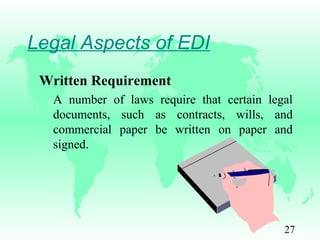
Legal Aspects of EDI
Written Requirement
A number of laws require that certain legal
documents, such as contracts, wills, and
commercial paper be written on paper and
signed.
28
Legal Aspects of EDI
Existing Laws
it is clear that something needs to be done to
clarify the laws with regard to EDI at this time
and especially in the near future.
29
Legal Aspects of EDI
Privacy
Privacy and security issues must be determined
at the outset of an EDI relationship, preferably
in the trade agreement.
30
Implementation
It’s a general idea if EDI can and should
be implemented into your processes.
1. Identify EDI Opportunities
2. Cost-Effectiveness Analysis & Approval
2.1. Estimate Benefits.
2.2. Estimate Investment Costs.
2.3. Estimating Operating Costs.
2.4. Estimate Net Benefits, net costs.
2.5. Establishing EDI Priorities.
31
Summary
Eventually more and more business
transactions will migrate to the World Wide
Web due to the ease of access to this medium.
Deciding which transactions are best suited for
EDI over the Internet will be a function of
accessibility, data security/privacy, and the
means of communication. These three areas
should be studied carefully when proceeding
with large-scale EDI or E-Commerce
initiatives.

Edi ppt

  • 1.
    1 E D I anew business paradigm
  • 2.
    2 Components Definitions Strategic Importance Initial Benefitsof EDI Technical Aspects of EDI Standardisation Legal Aspects of EDI Implementation Summary
  • 3.
    3 Definitions Electronic Commerce (EC) isthe paperless exchange of business information, using Electronic Data Interchange (EDI), electronic mail, electronic bulletin boards, electronic funds transfer and other similar technologies
  • 4.
    4 Definitions Electronic Data Interchange(EDI) a major part of Electronic Commerce (EC), is the computer-to-computer exchange of business data in a standard, machine-processable format. The information is generally patterned after a conventional paper document, such as a purchase order or invoice. It is a “paperless trading”
  • 5.
    5 Trading Partner A tradingpartner is any company, government department, or commercial or non-commercial entity with whom an organization regularly exchanges documents of formatted data (not just letters or memos). Definitions
  • 6.
    6 Definitions Trading Partner Agreement Asigned document between trading partners outlining all the conditions that will allow electronic communication. The agreement states that the parties intend to be legally bound in the same manner as though they were exchanging paper documents. The signature on the agreement serves as a substitute for signatures on paper documents.
  • 7.
    7 Definitions Mapping The process oftaking data from a company- specific format and fitting it into the EDI standard electronic format (as defined by a particular transaction set). Transaction Set An EDI standard electronic format for a business document.
  • 8.
    8 Definitions Translation Software Software usedto take information from a flat data file and convert it into an EDI standard electronic format.
  • 9.
    9 Definitions Value Added Network(VAN) A third party network performing services beyond the transmission of data. For example, VANs provide mailbox, data security, and data archiving services. Many also offer e-mail services.
  • 10.
    10 Definitions VAN Interconnection The connectionbetween two VANS that allows messages from one VAN’s customers to be communicated to the customers on the other.
  • 11.
    11 Strategic Importance Initial Time Throughthe use of EDI, companies able to improve their response time and decrease their time to market by accelerating the Purchase Order-to-Invoice-to-Payment process from weeks or days to hours, or even minutes. Not only were they shorter, but they were also more accurate and reliable.
  • 12.
    12 Strategic Importance Initial Service Anotherbenefit of these changes was the improvement in customer service levels. Market Companies could then use these advantages to respond more quickly to new entrants in the market.
  • 13.
    13 Strategic Importance Initial Costsbenefits Through the use of EDI, innovative business programs such as Just-In-Time inventory management were possible. EDI and JIT allowed companies to have more control over their inventory levels and reduce their costs by increasing inventory turns and decreasing safety stocks.
  • 14.
    14 Benefits of EDI Transactionsspeed has greatly increased with the creation of EDI. EDI drastically reduces this problem by sending transactions electronically where they can be sent and received almost simultaneously.
  • 15.
    15 Benefits of EDI Directtransmission EDI includes the direct transmission of data between organizations VAN. EDI is not facsimile transmission (fax) of information nor is it electronic mail (e-mail). Both of these transmission types are in “free format” (not standard format) and, therefore, generally require rekeying of data into the receiver’s computer system.
  • 16.
    16 Benefits of EDI Cutdown the possibility of human error EDI would also cut down on the tendency for "human error”. EDI eliminates this possibility because the receiving end is a computer that simply translates the message that has already been keyed into the system.
  • 17.
    17 Benefits of EDI Reducesthe risk of lost data whether that means the data is physically unable to be located, or if only part of the data has been lost through the numerous steps require to conduct business through the use of paper.
  • 18.
    18 Benefits of EDI Thebenefits of EDI include: Time savings and associated financial savings accrued, Improved accuracy, Improved trading partner relationships and client interactions, Improved reconciliation of transactions exchanged.
  • 19.
    19 Technical Aspects ofEDI EDI messages EDI messages are passed through a Value Added Network or "VAN." In principle a VAN is an electronic mail station for holding and passing messages.
  • 20.
    20 Technical Aspects ofEDI Services for a VAN would include: Storing and forwarding messages Communications between standard data formats Detecting and correcting errors Message decryption and encryption
  • 21.
    21 Technical Aspects ofEDI EDI Hardware EDI transactions can be passed from many types of computers (i.e. PC, Mac, UNIX, and mainframe). Trading partners do not need to use the same type of equipment. EDI messages are hardware independent, due in part to the X12 standard. The transactions are sent via dedicated links, ISDN or phone lines.
  • 22.
    22 Technical Aspects ofEDI EDI software Translation software takes raw data and arranges it into the X12 format or the United Nations EDIFACT standard on the sender's end. Mapping software is used to exchange information between the company's EDI transactions and its other internal applications such as inventory, accounts receivable, and accounting and ordering.
  • 23.
    23 Technical Aspects ofEDI Communicating EDI transactions can be done in several ways. The data can be transmitted and received via a dedicated computer system using async, bi-sync, X25, X.400, Internet or other telecommunication standards and networks. Depending on the size of the company and number of trading partners, these methods can occur in combination with one another or by themselves.
  • 24.
    24 Standardisation ANSI ASC X12 EDIstandard in North America is the ANSI ASC X12 standard. The X12 committee is charged with developing "standards to facilitate electronic interchange relating to order placement and processing, shipment and receiving information, invoicing, payment, and cash application data T Standards Standards Standards Standards
  • 25.
    25 Standardisation UN/EDIFACT the ANSI X12standards and the European standards, known as "Guidelines for Trade Data Interchange" (GTDI). Immediately prior to the formulation of EDIFACT, European EDI standards had undergone a process of reconstruction by the United Nations Economic Commission for Europe (UNECE)
  • 26.
    26 Legal Aspects ofEDI Authenticity Determining the authenticity of information transmitted electronically (genuine; true; real; pure; reliable; trustworthy; having the character and authority of an original;...competent, credible, and reliable as evidence).
  • 27.
    27 Legal Aspects ofEDI Written Requirement A number of laws require that certain legal documents, such as contracts, wills, and commercial paper be written on paper and signed.
  • 28.
    28 Legal Aspects ofEDI Existing Laws it is clear that something needs to be done to clarify the laws with regard to EDI at this time and especially in the near future.
  • 29.
    29 Legal Aspects ofEDI Privacy Privacy and security issues must be determined at the outset of an EDI relationship, preferably in the trade agreement.
  • 30.
    30 Implementation It’s a generalidea if EDI can and should be implemented into your processes. 1. Identify EDI Opportunities 2. Cost-Effectiveness Analysis & Approval 2.1. Estimate Benefits. 2.2. Estimate Investment Costs. 2.3. Estimating Operating Costs. 2.4. Estimate Net Benefits, net costs. 2.5. Establishing EDI Priorities.
  • 31.
    31 Summary Eventually more andmore business transactions will migrate to the World Wide Web due to the ease of access to this medium. Deciding which transactions are best suited for EDI over the Internet will be a function of accessibility, data security/privacy, and the means of communication. These three areas should be studied carefully when proceeding with large-scale EDI or E-Commerce initiatives.