
NATIONAL
STREATEGY
IMPERATIVE
21 FEBRUARY 2013
KNOWLEDGE SOCIETY AGENDA
 Knowledge society is a human society in
which knowledge should bring justice,
solidarity, democracy, and peace.
 A society in which knowledge could be a
force for changing society..
KNOWLEDGE SOCIETY AGENDA
Integrating ICT to build the knowledge
society ….
 Learning to know
ICT and Knowledge
 Learning to do
New capacities
 Learning to live together
New communication
 Learning to be
In the knowledge society and personal
development
The seven complex lessons in education for
the future by Edgar Morin:
 1. Detecting error and illusion: Teach the weaknesses of knowledge:
what is human knowledge?
 2. Principles of pertinent knowledge: Consider the objects of
knowledge in their context, in their complexity, in their whole.
 3. Teaching the human condition: the unity and the complexity of
human nature.
 4. Earth identity: Teach the history of the planetary era, teach the
solidarity between all the parts of the world.
 5. Confronting uncertainties: Teach the uncertainties in physics, in
biology, in history…
 6. Understanding each other: Teach mutual understanding
between human beings. And teach what misunderstanding is.
 7. Ethics for the human genre: Teach the ethics of humanity
preparing citizens of the world.
As educators we need knowledge for
enabling all children and all people to
access knowledge and to benefit from being
educated.
1. DIGITAL SOLIDARITY
In the field of Education, ICT should help develop “Digital Solidarity”. This
requires strong and joint actions of all stakeholders to guarantee the right of
participation in the digital society for all students in the world.
2. LEARNERS AND LIFELONG LEARNING
In the Knowledge Society, every learner is a lifelong learner. The content
and the methods of initial education must take into account preparation
for lifelong learning. ICT is a key tool for developing lifelong learning.
3. DECISION-MAKING STRATEGIES
In order to help decision-makers and to make decisions meet the real
needs, bridging research, practice, experimentation, innovation with
decision-making is essential. Decision-makers should make better use of the
experience of Practitioners and the findings of Researchers.
Cont.…
4. NETWORKING
The Knowledge Society is networked. Networks in Education offer
many ways to access knowledge, offer many possibilities for
networking people and developing collaborative work and
enhancing the “collective intelligence”
5. RESEARCH
The development of ICT-based education and training processes is a
growing reality. There is therefore a need to continue research work on
the development of these technologies and their applications
6. TEACHERS
Being a teacher in the Knowledge Society requires new specific
competencies: a teacher has to deal with new knowledge, new ways
for accessing knowledge; with a networked world and with new types
of co-operation and collaboration; with a society in which knowledge
plays a crucial role; with lifelong learning.
“EDUCATION FOR ALL”GOALS
Education for all…
 Is a global movement led by
UNESCO, aimed at meeting the learning
needs of all children, youth and adult by
2005.
 But education for all doesn’t necessarily
mean Quality education for all….
 Education is also a very good investment.
Why deprive children from quality
education ?
“Education for all "goals
 April 2000 the international community
met in Dakar, Senegal and set a global
challenge with the potential to change
lives of million children..
 Their challenge was embodied in the six
education for all goals..
Six Education For All goals..
1.Expand early childhood care and education
2. Provide free and compulsory primary education to all
3. Promote learning and life skills for young people and adults
4. Increase adult literacy by 50 %
5. Achieve gender parity by 2005, gender equality by 2015
6. Improve the quality of education
EDUCATION FOR ALL
 A number of the set challenges were not
achieved by 2005, including the issues of
quality education for everyone…
Education for all
 For quality education or learning to become reality
for all, there are crucial factors that have to be
considered…
 such as teacher recruitment, their working
conditions, their appropriate remuneration, as well as
the quality of their initial and continuous
education, to be considered.
 Therefore , The Fast Track initiative plans to include
quality measures such as the monitoring of learning
outcomes as additional criteria for approving FTI
country plans.
 But this growing attention on quality education does
not mean quality is improving, but it indicates that it is
see as being of crucial importance.
And three main challenges in relation to
equality of education remain that….
 Learning outcomes should be monitored.
 Learning environments must be
approved.
 Attracting more and better teachers is
paramount.
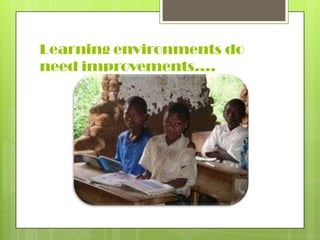
Learning environments do
need improvements….
……..
We need qualified teachers for the
quality of our education…
 . “EI strongly believes that quality
education cannot be achieved without
adequate numbers of properly trained
qualified teachers.”
 governments should play a leading role
in training teachers, who should be
equitably deployed to urban and rural
schools .
 With the intention to improve teachers’
conditions of service, including salaries.
Education for all….
The quality of our
education depends on
properly trained qualified
teachers….!
PERVASIVENESS OF TECHNOLOGY
 “The Information and communication
technologies are to be used to create greater
access to learning opportunities, redress
inequalities, improve the quality of teaching and
learning, and provide personalised learning
experiences.”
 Therefore all teachers will thus require the
knowledge, skills, values, and attitudes, as well as
the necessary support to integrate ICT into
teaching and learning.
PERVASIVENESS OF TECHNOLOGY
THE HOSTILE APPROACH TO TEACHER DEVELOPMENT….
 The development of ICT skills cannot be practised
in isolation from their context.
 The development of ICT skills and knowledge for
teachers should be an integral part of initial and
continuing teacher development programmes.
 This approach has the following three dimensions:
1.A pedagogical dimension, which implies an
understanding and application of the opportunities
of the use of ICT for teaching and learning in a local
curriculum context.
Cont.…
2. A technical dimension, which implies
• An ability to select, use and support a range of ICT
resources as appropriate to enhance personal and
professional effectiveness; and
• The willingness to update skills and knowledge in
the light of new developments.
3. A collaboration and networking dimension, which
includes
• A critical understanding of the added value of
learning networks and collaboration within and
between partners; and
• The ability to create and participate in
communities of practice.
Principles to be followed in the professional
development programmes for teachers….
• Educational goals should be primary.
• Teacher development programmes
should provide teachers with
situated/contextualised learning
experiences.
• Teacher development programmes
should be needs driven
• On- going support should be consistently
available.
Cont...
• Teacher development should be on-
going, due to the changing nature of ICT.
Five development levels…
 Implementing these developments
require guidelines to be followed for the
programmes to be successful….
 Therefore the five development levels we
developed to serve as guide lines for the
teacher development programmes…
 Entry level. The teacher is computer
literate and is able to use computers.
Cont.…
 Adoption level. The teacher is able to use
various ICT, including computers, to support
traditional
management, administration, teaching and
learning, and is able to teach learners how to
use ICT.
 Adaptation level. The teacher is able to use
ICT to support everyday classroom activities
at an appropriate NCS level, assess the
learning that takes place and ensure
progression
Cont.…
 Appropriation level. The teacher has a holistic
understanding of the ways in which ICT
contributes to teaching and learning.
 Innovation level. The teacher is able to
develop entirely new learning environments
that use ICT as a flexible tool, so that learning
becomes collaborative and interactive
Present future national
strategic objectives
Present future national strategic
objectives
 Education is a basic human right; a
pathway to maximise individual
potential, extend freedoms, build
capabilities and open up opportunities.
 And strategic actions need to be taken to
improve the quality of education.
 in the DFID’s Education Strategy 2010–
2015 strategic objectives have been
made to deal with such issues…
The document’s priorities of
action are….
ACCESS, QUALITY AND SKILLS
 pursue a vision of quality basic education for
all.
 Their definition of a good school is one that is
accessible to every child in their locality.
 We will ensure that our education aid is well
aligned to the education MDGs and the
broader EFA goals.
 Girls and boys have equal rights to quality
education
Cont..
 support the whole education sector where
we can, through long-term flexible funding
 We will aim to support at least 5.5 million
children in school globally by 2010, through
our country programme support alone
Read more about these strategic actions in The
DFID’s Education Strategy 2010–2015
Additional notes below
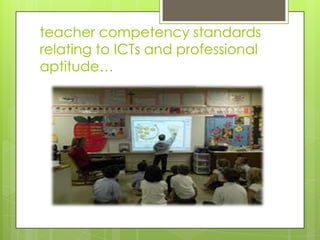
teacher competency standards
relating to ICTs and professional
aptitude…
Standards and performance
indicators
 Effective teachers model and apply the
NETS·S as they design, implement, and
assess learning experiences to engage
students and improve learning
 And all teachers have to meet certain
standards and performance indicators
Standards and performance indicators
 1. Facilitate and Inspire Student Learning and
Creativity
Teachers use their knowledge of subject
matter, teaching and learning, and technology to
facilitate experiences that advance student
learning, and virtual environments.
 2. Design and Develop Digital Age Learning
Experiences and Assessments
Teachers design, develop, and evaluate authentic
learning experiences and assessment incorporating
contemporary tools and resources to maximize
content
learning in context and to develop the knowledge,
skills, and attitudes identified in the NETS·S.
Standards and performance indicators
 3. Model Digital Age Work and Learning
teachers exhibit knowledge, skills, and work
processes representative of an innovative
professional in a global and digital society.
 4. Promote and Model Digital Citizenship
and Responsibility
Teachers understand local and global societal
issues and responsibilities in an evolving digital
culture and exhibit legal and ethical behaviour
in their professional practices
Standards and performance indicators
 5. Engage in Professional Growth and
Leadership
Teachers continuously improve their professional
practice, model lifelong learning, and exhibit
leadership in their school and professional
community by promoting and demonstrating
the effective use of digital tools and resources.
In conclusion
 We need qualified teachers
 To enforce knowledge society
 And skilled teachers in using ICT IN
TEACHING AND LEARNING
 To improve the quality and equality of
education
THANK YOU…..
REFERENCES
 DOE: Guidelines for Teacher Training and
Professional Development in ICT (2007)
 EI analysis .Education For All by 2015: Education
International’s Response to the Global Monitoring
Report (2008)
 Learning For All: DFID’s Education Strategy (2010–
2015)
 NETST.PDF. Standards and performance indicators.
(2008)
 NPC National development plan. Version for 2030

National streategy imperative presentation

  • 1.
  • 2.
    KNOWLEDGE SOCIETY AGENDA Knowledge society is a human society in which knowledge should bring justice, solidarity, democracy, and peace.  A society in which knowledge could be a force for changing society..
  • 3.
  • 4.
    KNOWLEDGE SOCIETY AGENDA IntegratingICT to build the knowledge society ….  Learning to know ICT and Knowledge  Learning to do New capacities  Learning to live together New communication  Learning to be In the knowledge society and personal development
  • 5.
    The seven complexlessons in education for the future by Edgar Morin:  1. Detecting error and illusion: Teach the weaknesses of knowledge: what is human knowledge?  2. Principles of pertinent knowledge: Consider the objects of knowledge in their context, in their complexity, in their whole.  3. Teaching the human condition: the unity and the complexity of human nature.  4. Earth identity: Teach the history of the planetary era, teach the solidarity between all the parts of the world.  5. Confronting uncertainties: Teach the uncertainties in physics, in biology, in history…  6. Understanding each other: Teach mutual understanding between human beings. And teach what misunderstanding is.  7. Ethics for the human genre: Teach the ethics of humanity preparing citizens of the world.
  • 6.
    As educators weneed knowledge for enabling all children and all people to access knowledge and to benefit from being educated. 1. DIGITAL SOLIDARITY In the field of Education, ICT should help develop “Digital Solidarity”. This requires strong and joint actions of all stakeholders to guarantee the right of participation in the digital society for all students in the world. 2. LEARNERS AND LIFELONG LEARNING In the Knowledge Society, every learner is a lifelong learner. The content and the methods of initial education must take into account preparation for lifelong learning. ICT is a key tool for developing lifelong learning. 3. DECISION-MAKING STRATEGIES In order to help decision-makers and to make decisions meet the real needs, bridging research, practice, experimentation, innovation with decision-making is essential. Decision-makers should make better use of the experience of Practitioners and the findings of Researchers.
  • 7.
    Cont.… 4. NETWORKING The KnowledgeSociety is networked. Networks in Education offer many ways to access knowledge, offer many possibilities for networking people and developing collaborative work and enhancing the “collective intelligence” 5. RESEARCH The development of ICT-based education and training processes is a growing reality. There is therefore a need to continue research work on the development of these technologies and their applications 6. TEACHERS Being a teacher in the Knowledge Society requires new specific competencies: a teacher has to deal with new knowledge, new ways for accessing knowledge; with a networked world and with new types of co-operation and collaboration; with a society in which knowledge plays a crucial role; with lifelong learning.
  • 8.
  • 9.
    Education for all… Is a global movement led by UNESCO, aimed at meeting the learning needs of all children, youth and adult by 2005.  But education for all doesn’t necessarily mean Quality education for all….  Education is also a very good investment. Why deprive children from quality education ?
  • 10.
    “Education for all"goals  April 2000 the international community met in Dakar, Senegal and set a global challenge with the potential to change lives of million children..  Their challenge was embodied in the six education for all goals..
  • 11.
    Six Education ForAll goals.. 1.Expand early childhood care and education 2. Provide free and compulsory primary education to all 3. Promote learning and life skills for young people and adults 4. Increase adult literacy by 50 % 5. Achieve gender parity by 2005, gender equality by 2015 6. Improve the quality of education
  • 12.
    EDUCATION FOR ALL A number of the set challenges were not achieved by 2005, including the issues of quality education for everyone…
  • 13.
    Education for all For quality education or learning to become reality for all, there are crucial factors that have to be considered…  such as teacher recruitment, their working conditions, their appropriate remuneration, as well as the quality of their initial and continuous education, to be considered.  Therefore , The Fast Track initiative plans to include quality measures such as the monitoring of learning outcomes as additional criteria for approving FTI country plans.  But this growing attention on quality education does not mean quality is improving, but it indicates that it is see as being of crucial importance.
  • 14.
    And three mainchallenges in relation to equality of education remain that….  Learning outcomes should be monitored.  Learning environments must be approved.  Attracting more and better teachers is paramount.
  • 15.
  • 16.
  • 17.
    We need qualifiedteachers for the quality of our education…  . “EI strongly believes that quality education cannot be achieved without adequate numbers of properly trained qualified teachers.”  governments should play a leading role in training teachers, who should be equitably deployed to urban and rural schools .  With the intention to improve teachers’ conditions of service, including salaries.
  • 18.
    Education for all…. Thequality of our education depends on properly trained qualified teachers….!
  • 19.
  • 20.
    PERVASIVENESS OF TECHNOLOGY “The Information and communication technologies are to be used to create greater access to learning opportunities, redress inequalities, improve the quality of teaching and learning, and provide personalised learning experiences.”  Therefore all teachers will thus require the knowledge, skills, values, and attitudes, as well as the necessary support to integrate ICT into teaching and learning.
  • 21.
  • 22.
    THE HOSTILE APPROACHTO TEACHER DEVELOPMENT….  The development of ICT skills cannot be practised in isolation from their context.  The development of ICT skills and knowledge for teachers should be an integral part of initial and continuing teacher development programmes.  This approach has the following three dimensions: 1.A pedagogical dimension, which implies an understanding and application of the opportunities of the use of ICT for teaching and learning in a local curriculum context.
  • 23.
    Cont.… 2. A technicaldimension, which implies • An ability to select, use and support a range of ICT resources as appropriate to enhance personal and professional effectiveness; and • The willingness to update skills and knowledge in the light of new developments. 3. A collaboration and networking dimension, which includes • A critical understanding of the added value of learning networks and collaboration within and between partners; and • The ability to create and participate in communities of practice.
  • 24.
    Principles to befollowed in the professional development programmes for teachers…. • Educational goals should be primary. • Teacher development programmes should provide teachers with situated/contextualised learning experiences. • Teacher development programmes should be needs driven • On- going support should be consistently available.
  • 25.
    Cont... • Teacher developmentshould be on- going, due to the changing nature of ICT.
  • 26.
    Five development levels… Implementing these developments require guidelines to be followed for the programmes to be successful….  Therefore the five development levels we developed to serve as guide lines for the teacher development programmes…  Entry level. The teacher is computer literate and is able to use computers.
  • 27.
    Cont.…  Adoption level.The teacher is able to use various ICT, including computers, to support traditional management, administration, teaching and learning, and is able to teach learners how to use ICT.  Adaptation level. The teacher is able to use ICT to support everyday classroom activities at an appropriate NCS level, assess the learning that takes place and ensure progression
  • 28.
    Cont.…  Appropriation level.The teacher has a holistic understanding of the ways in which ICT contributes to teaching and learning.  Innovation level. The teacher is able to develop entirely new learning environments that use ICT as a flexible tool, so that learning becomes collaborative and interactive
  • 29.
  • 30.
    Present future nationalstrategic objectives  Education is a basic human right; a pathway to maximise individual potential, extend freedoms, build capabilities and open up opportunities.  And strategic actions need to be taken to improve the quality of education.  in the DFID’s Education Strategy 2010– 2015 strategic objectives have been made to deal with such issues…
  • 31.
    The document’s prioritiesof action are…. ACCESS, QUALITY AND SKILLS  pursue a vision of quality basic education for all.  Their definition of a good school is one that is accessible to every child in their locality.  We will ensure that our education aid is well aligned to the education MDGs and the broader EFA goals.  Girls and boys have equal rights to quality education
  • 32.
    Cont..  support thewhole education sector where we can, through long-term flexible funding  We will aim to support at least 5.5 million children in school globally by 2010, through our country programme support alone Read more about these strategic actions in The DFID’s Education Strategy 2010–2015 Additional notes below
  • 33.
    teacher competency standards relatingto ICTs and professional aptitude…
  • 34.
    Standards and performance indicators Effective teachers model and apply the NETS·S as they design, implement, and assess learning experiences to engage students and improve learning  And all teachers have to meet certain standards and performance indicators
  • 35.
    Standards and performanceindicators  1. Facilitate and Inspire Student Learning and Creativity Teachers use their knowledge of subject matter, teaching and learning, and technology to facilitate experiences that advance student learning, and virtual environments.  2. Design and Develop Digital Age Learning Experiences and Assessments Teachers design, develop, and evaluate authentic learning experiences and assessment incorporating contemporary tools and resources to maximize content learning in context and to develop the knowledge, skills, and attitudes identified in the NETS·S.
  • 36.
    Standards and performanceindicators  3. Model Digital Age Work and Learning teachers exhibit knowledge, skills, and work processes representative of an innovative professional in a global and digital society.  4. Promote and Model Digital Citizenship and Responsibility Teachers understand local and global societal issues and responsibilities in an evolving digital culture and exhibit legal and ethical behaviour in their professional practices
  • 37.
    Standards and performanceindicators  5. Engage in Professional Growth and Leadership Teachers continuously improve their professional practice, model lifelong learning, and exhibit leadership in their school and professional community by promoting and demonstrating the effective use of digital tools and resources.
  • 38.
    In conclusion  Weneed qualified teachers  To enforce knowledge society  And skilled teachers in using ICT IN TEACHING AND LEARNING  To improve the quality and equality of education
  • 39.
  • 40.
    REFERENCES  DOE: Guidelinesfor Teacher Training and Professional Development in ICT (2007)  EI analysis .Education For All by 2015: Education International’s Response to the Global Monitoring Report (2008)  Learning For All: DFID’s Education Strategy (2010– 2015)  NETST.PDF. Standards and performance indicators. (2008)  NPC National development plan. Version for 2030

Editor's Notes

  • #5 KNOWLEDGE SOCIETY AGENDAKnowledge society is a human society in which knowledge should bring justice, solidarity, democracy, peace and also a society in which knowledge could be a force for changing society and a society which provide universal and equitable access to information. Integrating ICT in order to build the knowledge society consist of the following;Learning to know ICT and KnowledgeLearning to do New capacities Learning to live together New communicationLearning to be In the knowledge society and personal development ICT change knowledge itself: Each discipline, its concepts, processes, methods, resources available
  • #6 The knowledge society needs new kinds of knowledge that cannot reduce to traditional disciplines, transverse knowledge and complex knowledge for example the seven complex lessons in education for the future by Edgar Morin:1. Detecting error and illusion: Teach the weaknesses of knowledge: what is human knowledge?2. Principles of pertinent knowledge: Consider the objects of knowledge in their context, in their complexity, in their whole.3. Teaching the human condition: the unity and the complexity of human nature.4. Earth identity: Teach the history of the planetary era, teach the solidarity between all the parts of the world.5. Confronting uncertainties: Teach the uncertainties in physics, in biology, in history…6. Understanding each other: Teach mutual understanding between human beings. And teach what misunderstanding is.7. Ethics for the human genre: Teach the ethics of humanity preparing citizens of the world.
  • #7 As educatorswe need knowledge, enabling all children and all people to access knowledge and to benefit from being educated. Knowledge is a key issue in the knowledge society, and educators have a major mission. There are six major areas that will shape a beneficial use of ICT in education:1. DIGITAL SOLIDARITYIn the field of Education, ICT should help develop “Digital Solidarity”. This requires strong and joint actions of all stakeholders to guarantee the right of participation in the digital society for all students in the world.2. LEARNERS AND LIFELONG LEARNINGIn the Knowledge Society, every learner is a lifelong learner. The content and the methods of initial education must take into account preparation for lifelong learning. ICT is a key tool for developing lifelong learning. 3. DECISION-MAKING STRATEGIESIn order to help decision-makers and to make decisions meet the real needs, bridging research, practice, experimentation, innovation with decision-making is essential. Decision-makers should make better use of the experience of Practitioners and the findings of Researchers.4. NETWORKINGThe Knowledge Society is networked. Networks in Education offer many ways to access knowledge, offer many possibilities for networking people and developing collaborative work and enhancing the “collective intelligence”5. RESEARCHThe development of ICT-based education and training processes is a growing reality. There is therefore a need to continue research work on the development of these technologies and their applications6. TEACHERSBeing a teacher in the Knowledge Society requires new specific competencies: a teacher has to deal with new knowledge, new ways for accessing knowledge; with a networked world and with new types of co-operation and collaboration; with a society in which knowledge plays a crucial role; with lifelong learning.
  • #12  “EDUCATION FOR ALL” GOALSA couple of years ago ( April 2000) the international community met in Dakar, Senegal set itself a global challenge with the potential to change the lives of millions of children and their challenge is embodied in the six Education For All goals ,which are:1. Expand early childhood care and education2. Provide free and compulsory primary education to all3. Promote learning and life skills for young people and adults4. Increase adult literacy by 50 %5. Achieve gender parity by 2005, gender equality by 20156. Improve the quality of education
  • #18 With the set challenges by the international community, it must be acknowledged that midway through the process significant measurable progress has been accomplished in many aspects, such as increased enrolment and expansion of free primary education. However it is stated that EI is concerned that the goal of achieving gender parity by 2005 was not met. Nor have the financing commitments met the needs: indeed the aid funds for adequate basic education actually diminished in 2005, and the issue of quality education for everyone has not been addressed. For quality education or learning to become reality for all, there are crucial factors such as teacher recruitment, their working conditions, their appropriate remuneration, as well as the quality of their initial and continuous education, to be considered. The Fast Track initiative plans to include quality measures such as the monitoring of learning outcomes as additional criteria for approving FTI country plans, and other several new initiatives focus on education quality and so on, but this growing attention on quality education does not mean quality is improving, but it indicates that it is see as being of crucial importance. Two main policy dilemmas remain ahead: how to combine quality and equality and how to measure quality. There are three main challenges in relation to equality of educationLearning outcomes should be monitored.Learning environments must be approved.Attracting more and better teachers is paramount. The 2007 EFA Global Monitoring Report highlighted the compelling case for early childhood education and care. ECE programmes contribute to young children’s physical, mental, social and emotional development, eliminate disadvantage and prepare children for formal schooling. The GMR also acknowledges a fundamental principle of learning- that the intersection between the student and the teacher is the key determinant of the quality of education programmes but the shortage of qualified teachers threaten the achievement of quality education for all. “EI strongly believes that quality education cannot be achieved without adequate numbers of properly trained qualified teachers.”The Education International believes that governments should play a leading role in training teachers, who should be equitably deployed to urban and rural schools and they also believe that there is a need to improve teachers’ conditions of service, including salaries, which I believe will also improve the quality and equality of the education programmes and also help illiteracy rate among woman
  • #21 “The White Paper on e-Education, published in 2004, guides the Department of Education's approach to e-education and the integration of information and communication technologies (ICT) into teaching and learning. The Information and communication technologies are to be used to create greater access to learning opportunities, redress inequalities, improve the quality of teaching and learning, and provide personalised learning experiences.”Schools that implement e-Education are characterised as institutions that have learners who use ICT to enhance learning, access to ICT resources that support the curriculum etc., therefore all teachers will thus require the knowledge, skills, values, and attitudes, as well as the necessary support to integrate ICT into teaching and learning.
  • #23 The approach to teacher development in ICT is reflected as a hostile approach and it acknowledges that the development of ICT skills cannot be practised in isolation from their context and that the development of ICT skills and knowledge for teachers should be an integral part of initial and continuing teacher development programmes. This approach to teacher development has the following three dimensions: A pedagogical dimension, which implies an understanding and application of the opportunities of the use of ICT for teaching and learning in a local curriculum context. A technical dimension, which implies• An ability to select, use and support a range of ICT resources as appropriate to enhance personal and professional effectiveness; and• The willingness to update skills and knowledge in the light of new developments. A collaboration and networking dimension, which includes• A critical understanding of the added value of learning networks and collaboration within and between partners; and• The ability to create and participate in communities of practice
  • #25 There are also principles for ICT in teacher developments that are to be followed in the professional development programmes for teachers and they are as follow:• Educational goals should be primary. The focus should not be on providing technical ICT skills only, but on the use of ICT to achieve learning outcomes.• Teacher development programmes should provide teachers with situated/contextualised learning experiences. Programmes should be subject-specific and relevant to the learning areas.• Teacher development programmes should be needs driven. Programmes should respond to the requirements of subjects such as Computer Application Technology, Information Technology, Geography, Design and Accounting.• Ongoing support should be consistently available. This includes pedagogic support (particularly from subject advisers), technical support and creating communities of practice.
  • #27 These development programmes will then be implemented properly following certain guidelines that would make the development programmes a success and taking into consideration the following five development levels:Entry level. The teacher is computer literate and is able to use computers.Adoption level. The teacher is able to use various ICT, including computers, to support traditional management, administration, teaching and learning, and is able to teach learners how to use ICT.Adaptation level. The teacher is able to use ICT to support everyday classroom activities at an appropriate NCS level, assess the learning that takes place and ensure progression.Appropriation level. The teacher has a holistic understanding of the ways in which ICT contributes to teaching and learning.Innovation level. The teacher is able to develop entirely new learning environments that use ICT as a flexible tool, so that learning becomes collaborative and interactive.Like any other programmes this programme also has its own skills level and how these will be achieved and what resources must be used to make the development programme a success.
  • #31 Education is a basic human right; a pathway to maximise individual potential, extend freedoms, build capabilities and open up opportunities.And strategic actions need to be taken to improve the quality of education. in the DFID’s Education Strategy 2010–2015 strategic objectives have been made to deal with issues such as the quality and equality of education worldwide, and they are as follows:ACCESS, QUALITY AND SKILLS1. We will pursue a vision of quality basic education for all. This will be coupled with a new determination to develop skills and expertise for development beyond basic education .2. Our definition of a good school is one that is accessible to every child in their locality. Distance and cost should not prevent children from attending regularly year on year, from primary to lower secondary.3.To support improved access to good quality basic education for all children DFID will: allocate most of our bilateral education aid to basic education – at about 70%; focus on the 72 million primary aged children out of school, including expanding investments in fragile and conflict affected states, to around 50% of our bilateral programmes; where we have education programmes, support the expansion of basic education to lower secondary at affordable costs, including through innovative partnerships with non-state providers; where we have education programmes, support supply and demand side strategies. These will include helping to construct 15,000 classrooms a year, increasing access to water and sanitation in schools and removing primary school fees. 4.We will ensure that our education aid is well aligned to the education MDGs and the broader EFA goals. About 70% of our education aid will be allocated to basic education, as defined by UNESCO’s Global Monitoring Report on Education for All and as measured by the OECD’s Development Assistance Committee. 5.Greater effort is needed to reach those currently marginalised from education if the MDG and EFA goals are to be achieved. There are often complex patterns of multiple disadvantages, where different circumstances require different solutions. 6.Girls and boys have equal rights to quality education. The fact that 39 million girls fail to attend primary school is both a tragedy for the girls themselves and a disaster for development. 7.We will support the whole education sector where we can, through long-term flexible funding. This best enables partner governments to align resources to their policy priorities and to support long-term recurrent costs, including teachers’ salaries .( Learning For All: DFID’s Education Strategy 2010–2015 )