







Reshav
Mahajan
Application of
computers
in modern Business
(presentation)
Introduction
The advent of the World Wide Web (WWW) has created a dynamic shift in
the way businesses compete in the marketplace. The WWW allows companies,
small and large, to vie for customers on an international level playing
field. Establishing a web presence is essential to continued growth and
development; however, there are several considerations to take into
account. Some challenges facing companies transitioning into the world of e-
commerce include: website design, development, hardware, software and
strategic planning.
Initial
StepsThe first step in creating an e-commerce business is to create an internet
marketing plan. This is the strategic plan that a company follows to capitalize
off of its existing resources while taking advantage of the additional
opportunities offered by the WWW. A business should examine its
mission/vision and re-purpose it for the web. A comparative analysis should be
made of competing businesses’ websites and internet marketing strategies. A
successful e-commerce business will integrate new and emergent strategies
with best practices of classical strategic planning traditionally used for brick-
and-mortar companies. An e-commerce business must be flexible enough to
adjust the constant innovations in technology that may affect its online
operations and customer relationship management tools.
Initial
Steps
Secondly, with a solid internet marketing plan in hand, an e-commerce business
needs to design and develop a functional website. Website design and
development has many elements. Of course the site itself should function
within the identified mission/vision of the organization it represents. This
means that all of its content should be clear, understandable and logical
information relevant only to the products and/or services the company desires
to promote.
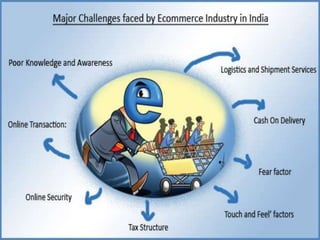
The eCommerce industry in India is growing at a remarkable pace due to high
penetration of internet and sophisticated electronic devices. However, the
recent growth rate of ecommerce in India is far lagging behind than other
developed countries. There are many big problems and challenged on the way
of an online merchant. Factors like safety and security of online money
transaction being the biggest problem along with others, have curb the smooth
expansion of the online industry in the country.
Although, major portion of e-business sectors who are affected are now
overcoming
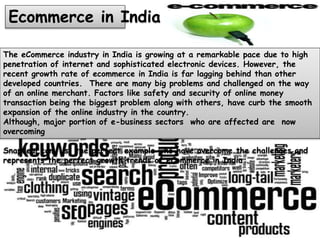
Snapdeal.com is the perfect example who have overcome the challenges and
represents the perfect growth trends of eCommerce in India .
Ecommerce in India
When it comes to ratio of internet consumers, scenario is not so admirable one. Majority of
Indian rural population are unaware of internet and it uses. Surprisingly, most of internet savvies
or urban population are also suffering from poor knowledge on online business and its
functionalities. Very few are aware of the online corruption and fraud and thus darkness still
exists. A reliable survey reveals that 50% of Indian online users are unaware of the solution of
online security.
Poor Knowledge and
Awareness
Most of Indian customers do not possess plastic money, credit card,
debit card and net banking system, which is one of the prime reasons
to curtail the growth of ecommerce. Nevertheless, in recent years,
some of the nationalized banks have started to issue debit cards to all
its account holders. This is undoubtedly a positive sign for Indian online
entrepreneurs.
Online
Transaction
Cash on Delivery (COD) has evolved out of less penetration of credit card in
India. Most of Indian E-commerce companies are offering COD as one of mode
of payment for the buyers. 30%-50% of buyers are also taking advantage of
this mode of payment while making purchase of any product and service over
internet. COD has been introduced to counter the payment security issues of
online transaction, but this mode has been proving to be loss and expensive to
the companies. It is seen that majority of the customers denied to make the
payment at the time of delivery of the product. Hence, companies tend to lose
the sale along with product transit fees. In order to curb the problem of COD,
online companies should take some judicial steps; otherwise basic logic behind
the ecommerce business will be at risk.
Cash On
Delivery
Online
Security
In case of start up and small business, Business owners are ignoring the
importance of authentic software due to budget constraints. They are even
failing to take the initial steps to secure and protect their online business
through installation of authentic protection services like antivirus and firewall
protection, which indeed a crucial step for successful online business players.In
India, maximum number of business entrepreneurs used unauthorized software
in their server, which usually does not come with upgraded online security.
Such pirated software leaves room for virus, malwares and Trojan attacks and
it is highly risky task to make online transactions in the systems, which may
disclose or leak sensitive details of credit cards and online banking of the
users. These kinds of droopiness should be banned in Indian ecommerce
sectors. Affiliation to SSL certificate should be imposed as a mandatory action
for every owner.
In India, logistics and courier services required lots of improvement.
While, perfect and strong logistics service is one of the key reasons
behind the success of any online company, India is lagging far behind in
this sector as most of the town and small villages are still not covered
under serviceable area of many of the courier and logistic companies.
Ecommerce is hampered in a big way owing to the limited services
offered by the courier service companies.
Logistics and Shipment Services
Tax rate system of Indian market is another factor for lesser growth
rate of eCommerce in India in comparison to other developed countries
like USA and UK. In those countries, tax rate is uniform for all
sectors whereas tax structure of India varies from sector to sector.
This factor creates accounting problems for the Indian online business
companies.
Tax Structure
Fear factor
Fear of making online payment is a universal psychological factor of
Indian customers. With the spread of knowledge on online transactions
and its reliability, some percentages of customers have overlooked this
fear and they are fearlessly engaging themselves in online shopping.
But still, majority of customers are not aware of online transactions
and its security. They often reluctant to disclose their credit card and
bank details and preferred to stay away from online world of shopping.
Indian customers are more comfortable in buying products physically.
They tend to choose the product by touching the product directly.
Thereby, Indian buyers are more inclined to do ticketing and booking
online in Travel sectors, books and electronics. Companies dealing with
products like apparel, handicrafts, jewelry have to face challenges to
sell their products as the buyers want to see and touch before they
buy these stuffs.
‘Touch and Feel’ factors
Thankyou
Ecommerce business in India is still growing
with an alarming rate , so how can I put a
fullstop …

Problems in ecommerce

  • 1.
  • 2.
    Introduction The advent ofthe World Wide Web (WWW) has created a dynamic shift in the way businesses compete in the marketplace. The WWW allows companies, small and large, to vie for customers on an international level playing field. Establishing a web presence is essential to continued growth and development; however, there are several considerations to take into account. Some challenges facing companies transitioning into the world of e- commerce include: website design, development, hardware, software and strategic planning.
  • 4.
    Initial StepsThe first stepin creating an e-commerce business is to create an internet marketing plan. This is the strategic plan that a company follows to capitalize off of its existing resources while taking advantage of the additional opportunities offered by the WWW. A business should examine its mission/vision and re-purpose it for the web. A comparative analysis should be made of competing businesses’ websites and internet marketing strategies. A successful e-commerce business will integrate new and emergent strategies with best practices of classical strategic planning traditionally used for brick- and-mortar companies. An e-commerce business must be flexible enough to adjust the constant innovations in technology that may affect its online operations and customer relationship management tools.
  • 5.
    Initial Steps Secondly, with asolid internet marketing plan in hand, an e-commerce business needs to design and develop a functional website. Website design and development has many elements. Of course the site itself should function within the identified mission/vision of the organization it represents. This means that all of its content should be clear, understandable and logical information relevant only to the products and/or services the company desires to promote.
  • 6.
    The eCommerce industryin India is growing at a remarkable pace due to high penetration of internet and sophisticated electronic devices. However, the recent growth rate of ecommerce in India is far lagging behind than other developed countries. There are many big problems and challenged on the way of an online merchant. Factors like safety and security of online money transaction being the biggest problem along with others, have curb the smooth expansion of the online industry in the country. Although, major portion of e-business sectors who are affected are now overcoming Snapdeal.com is the perfect example who have overcome the challenges and represents the perfect growth trends of eCommerce in India . Ecommerce in India
  • 8.
    When it comesto ratio of internet consumers, scenario is not so admirable one. Majority of Indian rural population are unaware of internet and it uses. Surprisingly, most of internet savvies or urban population are also suffering from poor knowledge on online business and its functionalities. Very few are aware of the online corruption and fraud and thus darkness still exists. A reliable survey reveals that 50% of Indian online users are unaware of the solution of online security. Poor Knowledge and Awareness
  • 9.
    Most of Indiancustomers do not possess plastic money, credit card, debit card and net banking system, which is one of the prime reasons to curtail the growth of ecommerce. Nevertheless, in recent years, some of the nationalized banks have started to issue debit cards to all its account holders. This is undoubtedly a positive sign for Indian online entrepreneurs. Online Transaction
  • 10.
    Cash on Delivery(COD) has evolved out of less penetration of credit card in India. Most of Indian E-commerce companies are offering COD as one of mode of payment for the buyers. 30%-50% of buyers are also taking advantage of this mode of payment while making purchase of any product and service over internet. COD has been introduced to counter the payment security issues of online transaction, but this mode has been proving to be loss and expensive to the companies. It is seen that majority of the customers denied to make the payment at the time of delivery of the product. Hence, companies tend to lose the sale along with product transit fees. In order to curb the problem of COD, online companies should take some judicial steps; otherwise basic logic behind the ecommerce business will be at risk. Cash On Delivery
  • 11.
    Online Security In case ofstart up and small business, Business owners are ignoring the importance of authentic software due to budget constraints. They are even failing to take the initial steps to secure and protect their online business through installation of authentic protection services like antivirus and firewall protection, which indeed a crucial step for successful online business players.In India, maximum number of business entrepreneurs used unauthorized software in their server, which usually does not come with upgraded online security. Such pirated software leaves room for virus, malwares and Trojan attacks and it is highly risky task to make online transactions in the systems, which may disclose or leak sensitive details of credit cards and online banking of the users. These kinds of droopiness should be banned in Indian ecommerce sectors. Affiliation to SSL certificate should be imposed as a mandatory action for every owner.
  • 12.
    In India, logisticsand courier services required lots of improvement. While, perfect and strong logistics service is one of the key reasons behind the success of any online company, India is lagging far behind in this sector as most of the town and small villages are still not covered under serviceable area of many of the courier and logistic companies. Ecommerce is hampered in a big way owing to the limited services offered by the courier service companies. Logistics and Shipment Services
  • 13.
    Tax rate systemof Indian market is another factor for lesser growth rate of eCommerce in India in comparison to other developed countries like USA and UK. In those countries, tax rate is uniform for all sectors whereas tax structure of India varies from sector to sector. This factor creates accounting problems for the Indian online business companies. Tax Structure
  • 14.
    Fear factor Fear ofmaking online payment is a universal psychological factor of Indian customers. With the spread of knowledge on online transactions and its reliability, some percentages of customers have overlooked this fear and they are fearlessly engaging themselves in online shopping. But still, majority of customers are not aware of online transactions and its security. They often reluctant to disclose their credit card and bank details and preferred to stay away from online world of shopping.
  • 15.
    Indian customers aremore comfortable in buying products physically. They tend to choose the product by touching the product directly. Thereby, Indian buyers are more inclined to do ticketing and booking online in Travel sectors, books and electronics. Companies dealing with products like apparel, handicrafts, jewelry have to face challenges to sell their products as the buyers want to see and touch before they buy these stuffs. ‘Touch and Feel’ factors
  • 16.
    Thankyou Ecommerce business inIndia is still growing with an alarming rate , so how can I put a fullstop …