NEP 2020 : NEW FEATURES
Dr.C.Thanavathi
M.A.(His.), M.Phil. (His.), B.A. (Eng.), M.Ed., M.Phil. (Edn.)
DGT., DCA, SET (Edn.), CTE, PGDHE, Ph.D. (Edn.), Ph.D. (His.)
Assistant Professor of History,
V.O.C. College of Education,
Thoothukudi – 628008.
9629256771
thanavathic@thanavathi-edu.in,
http://thanavathi-edu.in/index.html
C3: Teaching and Learning
NEP-2020 Context:
Challenges in India Higher Education Ecosystem
• A severely fragmented higher educational ecosystem;
• Less emphasis on the development of cognitive skills and learning outcomes;
• A rigid separation of disciplines, with early specialization and streaming of students
into narrow areas of study;
• Limited access particularly in socio-economically disadvantaged areas, with few HEIs
that teach in local languages;
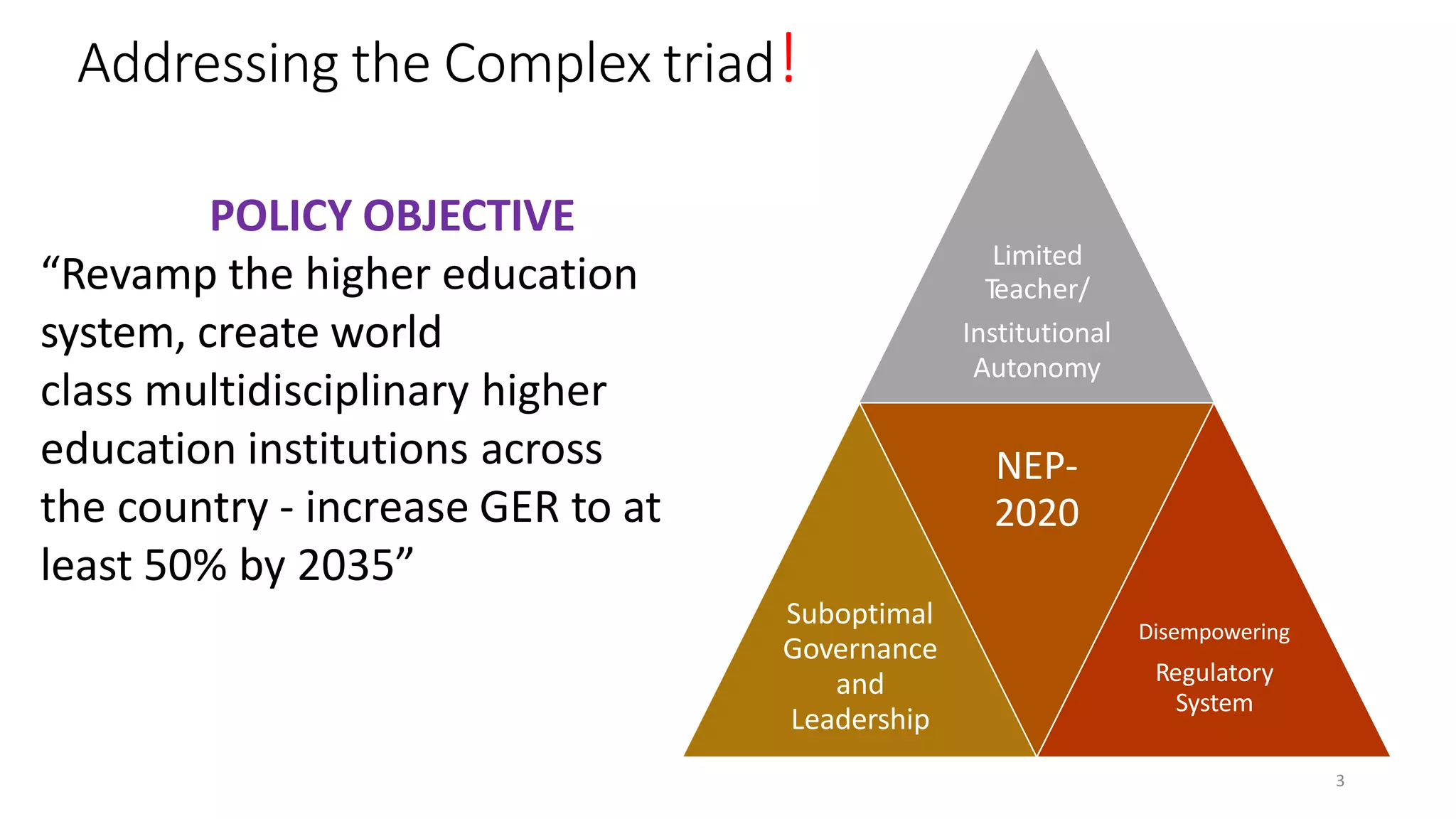
• Limited teacher and institutional autonomy;
• Inadequate mechanisms for merit-based career management and progression of
faculty and institutional leaders;
• Lesser emphasis on research at most universities and colleges, and lack of competitive
peer-reviewed research funding across disciplines;
• Suboptimal governance and leadership of HEIs;
• An ineffective regulatory system; and
• Large affiliating universities resulting in low standards of undergraduate education.
2
Addressing the Complex triad!
Limited
Teacher/
Institutional
Autonomy
Suboptimal
Governance
and
Leadership
NEP-
2020
Disempowering
Regulatory
System
3
POLICY OBJECTIVE
“Revamp the higher education
system, create world
class multidisciplinary higher
education institutions across
the country - increase GER to at
least 50% by 2035”
Implementation Roadmap
National/
Central
Government
State
Government
Institutional Individual
Ministry of Education
6
•University Education Commission (1948-49)
•Secondary Education Commission (1952-53)
•Education Commission (1964-66) under Dr. D.S. Kothari
•National Policy on Education, 1968
•42nd Constitutional Amendment,1976-Education in Concurrent List
•National Policy on Education (NPE), 1986
•NPE 1986 Modified in 1992 (Program of Action, 1992)
• T.S.R. Subramaniam Committee Report (27 May, 2016)
• Dr. K. Kasturirangan Committee Report (31 May, 2019)
Evolution of Education Policy
7
Dr K Kasturirangan Committee Members :
S.No Name of the Member Contact No. Email
1 Dr. K. Kasturirangan
(Chairman)
9845007998 (Personal)
O: 080-23610522 (Direct Line- Dr
Kasturirangan)
krangank@gmail.com
2 Dr. Vasudha Kamat 9821310081(M), kamatvasudhav@gmail.com
3 Dr. Manjul Bhargava +609 2584192 bhargava@math.princeton.edu
4 Dr. Ram Shankar Kureel 07324-274 377, 9871450315(M) drrskureel@gmail.com
5 Prof. T.V. Kattimani 9599292424(M), 9425331399(M)
07629269710
tvkattimani@gmail.com
vcigntu@gmail.com
6 Shri Krishna Mohan
Tripathy
9415822107(M) kmtripathiknp@gmail.com
7 Dr. Mazhar Asif 9435118077(M), 03612672683 mazharassam@gmail.com
8 Dr. M.K. Sridhar 9845222573(M), 8048068027(M)
Escort
9900086660
bharathwaasi@gmail.com
9 Shri Rajendra Pratap
Gupta
09223344303(M) advisor.healthminister@gov.in
office.rajendra@gmail.com
8
• Online : www.MyGov.in (26.01.2015 – 31.10.2015)
• Nearly 2.5 lakhs Gram Panchayats, 6600 Blocks, 6000 ULBs, 676 Districts (May-
Oct. 2015)
•In May 2016, ‘Committee for Evolution of the New Education Policy’ under
the Chairmanship of Late Shri T.S.R. Subramanian, Former Cabinet Secretary,
submitted its report.
•Based on this, the Ministry prepared ‘Some Inputs for the Draft National
Education Policy, 2016’.
NEP 2020 : Consultation Process
• In June2017 a ‘Committee for the Draft National Education Policy’ was
constituted under the Chairmanship of eminent scientist Padma
Vibhushan, Dr. K. Kasturirangan, which submitted the Draft National
Education Policy, 2019 to the Hon’ble Human Resource Development
Minister on 31 May, 2019.
• Draft NEP, 2019 Summary in 22 languages/Audio Book
• Education Dialogue with MPs (AP, Kerala, Telangana, TN, Puducherry,
Karnataka & Odisha)
• Special Meeting of CABE (21.09.2019)
• Parliamentary Standing Committee on HRD on 07.11.2019
• The Draft National Education Policy 2019 was uploaded on MHRD’s website
and at ‘MyGov Innovate’ portal eliciting views/suggestions/comments of
stakeholders, including public.
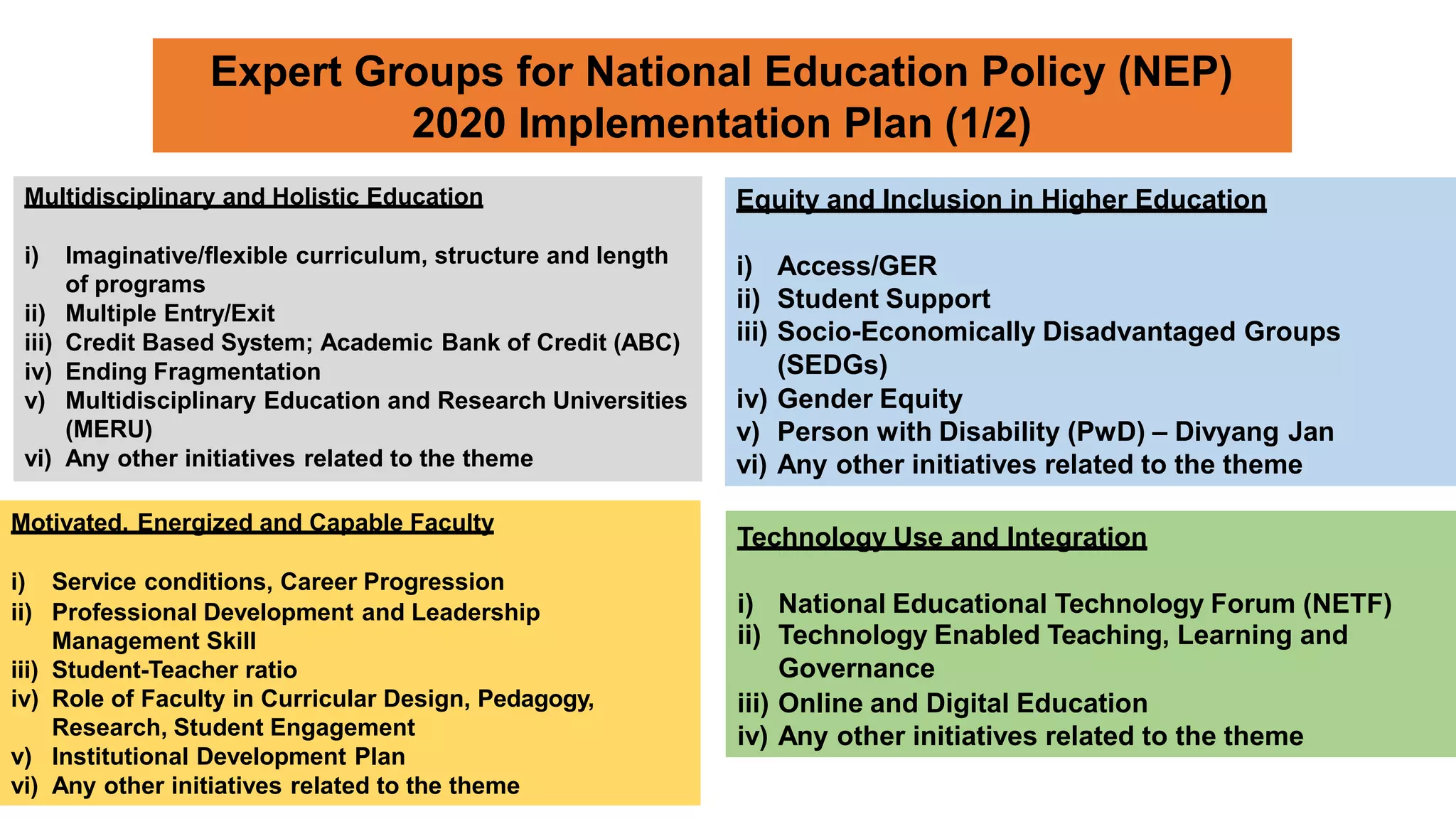
Expert Groups for National Education Policy (NEP)
2020 Implementation Plan (1/2)
Multidisciplinary and Holistic Education
i) Imaginative/flexible curriculum, structure and length
of programs
ii) Multiple Entry/Exit
iii) Credit Based System; Academic Bank of Credit (ABC)
iv) Ending Fragmentation
v) Multidisciplinary Education and Research Universities
(MERU)
vi) Any other initiatives related to the theme
Motivated, Energized and Capable Faculty
i) Service conditions, Career Progression
ii) Professional Development and Leadership
Management Skill
iii) Student-Teacher ratio
iv) Role of Faculty in Curricular Design, Pedagogy,
Research, Student Engagement
v) Institutional Development Plan
vi) Any other initiatives related to the theme
Equity and Inclusion in Higher Education
i) Access/GER
ii) Student Support
iii) Socio-Economically Disadvantaged Groups
(SEDGs)
iv) Gender Equity
v) Person with Disability (PwD) – Divyang Jan
vi) Any other initiatives related to the theme
Technology Use and Integration
i) National Educational Technology Forum (NETF)
ii) Technology Enabled Teaching, Learning and
Governance
iii) Online and Digital Education
iv) Any other initiatives related to the theme
Global Outreach of Higher Education
i) Credit Recognition / Transfer
ii) International Students’Office at each HEI
iii) Campuses of Indian HEIs abroad and vice-versa
iv) Any other initiatives related to the theme
Integrated Higher Education System
i) Teacher Education
ii) Vocational Education; Skill; Employability
iii) Professional Education
iv) Any other initiatives related to the theme
Research, Innovation and Rankings
i) National Research Foundation (NRF)
ii) Internships
iii) Start-ups
iv) Any other initiatives related to the theme
Promotion of Indian Knowledge Systems, Languages, Culture and Values
i) Holistic Individuals
ii) Skills & Values
iii) Culture & Arts
iv) Indian Languages
Governance and Regulation
i) HECI
ii) Graded Accreditation
iii) Graded Autonomy
iv) Affiliation
v) Curbing Commercialization of Education
Expert Groups for National Education Policy (NEP)
2020 Implementation Plan (2/2)
New features in school
education
ECCE for all by 2030: NCF
for ECCE
Achieve 100% Gross
Enrolment Ratio in school
education by 2030
New curricular and
pedagogical framework
of 5+3+3+4
Medium of instruction
mother tongue/local
language/regional
language at least upto
grade 5
Preparatory
class/Balvatika for 5-6
year olds
Special Education Zones
(SEZ)
No hard separation of
curricular/extra and co-
curricular/arts and
science and
vocational/sports and
academics
Exams in 3, 5 and 8 , in
addition to Board exams
in 10 and 12
National Foundational
Literacy and Numeracy
Mission
Gender Inclusion fund;
KGBVs upto class 12
Curriculum to integrate
Indian culture and ethos
at all levels
Board exams: Modular,
low stakes, based on
conceptual knowledge
and its applications
School Preparation
module for all class 1
entrants
Bal Bhavans Reduction in curriculum
to core concepts
National Assessment
Center – PARAKH
Utilize unused capacity of
schools as Samajik
Chetna Kendras
Tracking students, as well
as their learning levels;
universalisation of
secondary education
Holistic Report card – use
AI for identifying specific
aptitude of child
Identify life skills to be
attained in each grade as
a part of NCF
Vocational education from
middle stage
Teacher recruitment based on
TET, NTA test and teaching
demonstration
TEIs to move to
multidisciplinary colleges and
universities by 2030
10 days bagless internship with
local trades/craftsperson
TET mandatory for teaching in
pre-primary to 12
Non-performing TEIs –
stringent action
Lok Vidya – local artistes as
master instructors in schools
Minimum 50 hours of in-
service training per
teacher/year
Minimum degree qualification
for teaching will be a 4-year
integrated B.Ed. degree by
2030
Aim: every child learns at least
one vocation and is exposed to
several more
National Professional
Standards for Teachers (NPST)
by 2022
ICT integration: for teaching-
learning, evaluation, teacher
preparation and professional
development, educational
access, educational
planning/management/adminis
tration including admissions,
attendance, assessments
Special provisions for Gifted
children
IT and data based predictive
planning for requirement of
students in TEIs
Mandatory for every PhD
student to do a module on
teacher education
Engagement of social workers,
alumni, volunteers with
schools
State Department to look after
policy making
Adult education: focus upon
technology based solutions;
NCF for AE
School complex/clusters for
resource sharing
Directorate of Education to
look after operations
Open school – NIOS to expand
to include vocational courses
and courses for grades, 3, 5
and 8 also
Random sampling of students
for continuous online feedback
on self-disclosure
SCERT to look after academics Alternative model of schools to
be encouraged to adopt NCF
Book promotion policy and
digital libraries
State School Standards
Authority to set minimal
standards for online self-
disclosure by all schools –
public and private
Innovative pedagogies –
experience and activity-based,
integrating Indian art, sports
and IT
National
Curricular and
Pedagogical
Framework for
Early
Childhood Care
and Education
(NCPFECCE)
for children
up to the
age of 8
National Curricular Framework for
School Education, NCFSE 2020-21
National Curriculum Framework for Teacher Education,
NCFTE 2021
Public and private
schools assessed and
accredited on the same
criteria, benchmarks,
and processes
energizing breakfast
in addition to midday
meals.
National Mentorship
programme with a large pool
of outstanding senior/retired
faculty
high-quality bilingual
textbooks for science
and mathematics
Indian Sign
Language (ISL)
will be
standardized
National repository of
high-quality resources
on foundational
literacy and numeracy
All school children to
undergo regular health
check-ups and health
cards will be issued
New features in Higher
education
HEIs will be transformed
into large
multidisciplinary
universities, colleges, and
HEI clusters/Knowledge
Hubs
Rationalised
institutional
architecture for
higher education
Research-intensive
Universities, Teaching-
intensive Universities
and Autonomous
degree-granting
Colleges (ACs)
Phasing out the
system of ‘affiliated
colleges’ over a period
of fifteen years
through a system of
graded autonomy
broad-based
multi-
disciplinary
holistic
education at the
undergraduate
level
integrated, exposure to
science, arts, humanities,
mathematics and
professional fields with
flexible curricular structures,
creative combinations,
integration of vocational
education
Undergraduate
degree either 3 or
4-year duration-
multiple exit
options
Certificate after
completing 1 year in a
discipline
Diploma after
2 years of
study,
Bachelor’s degree
after a 3-year
programme
4-year
multidisciplinary
Bachelor's programme
–preferred options
Academic Bank of Credit
(ABC) shall be established
which would digitally
store the academic
credits earned
Multidisciplinary
Education and
Research Universities
(MERUs) will be set up
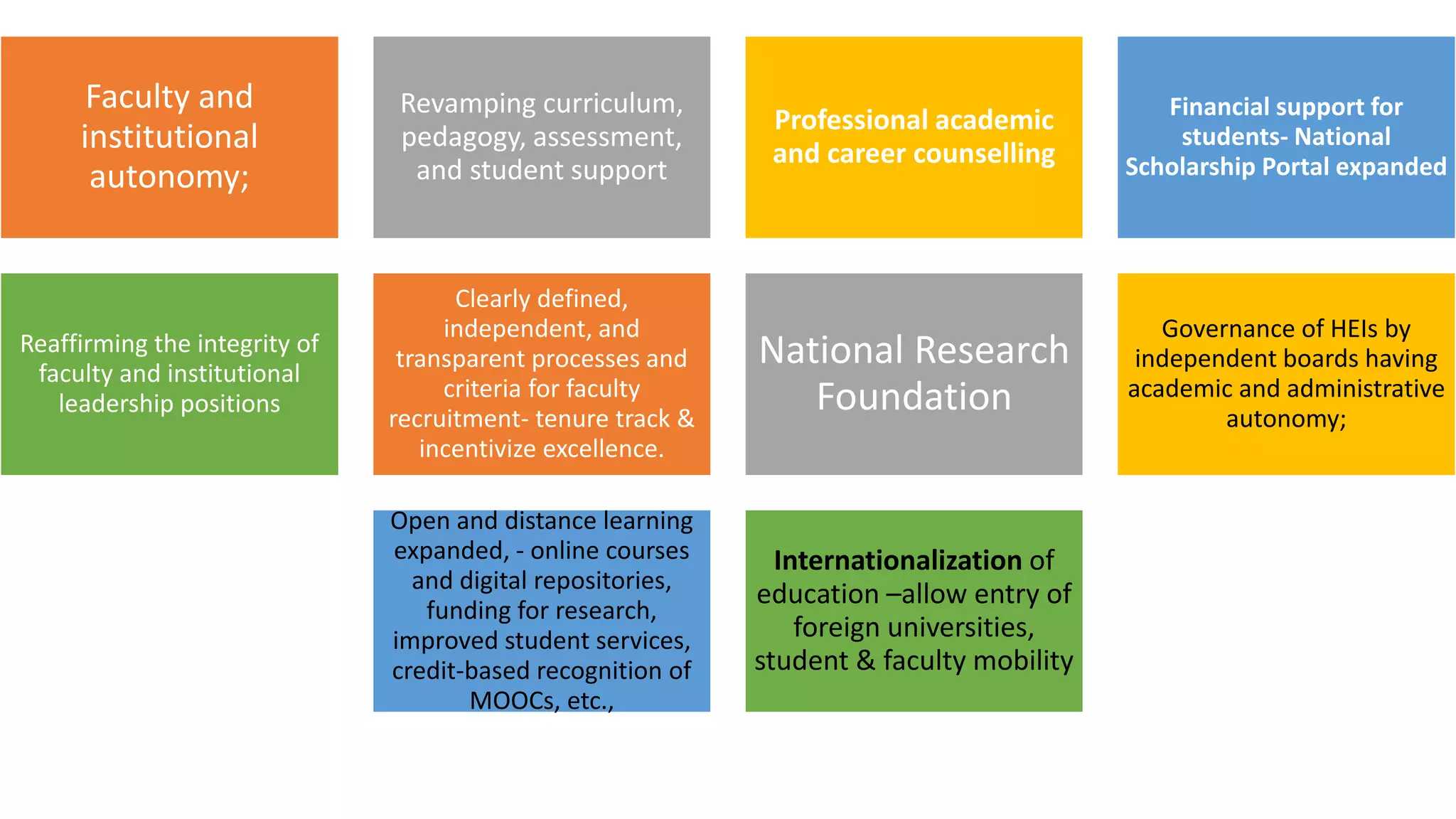
Faculty and
institutional
autonomy;
Revamping curriculum,
pedagogy, assessment,
and student support
Professional academic
and career counselling
Financial support for
students- National
Scholarship Portal expanded
Reaffirming the integrity of
faculty and institutional
leadership positions
Clearly defined,
independent, and
transparent processes and
criteria for faculty
recruitment- tenure track &
incentivize excellence.
National Research
Foundation
Governance of HEIs by
independent boards having
academic and administrative
autonomy;
Open and distance learning
expanded, - online courses
and digital repositories,
funding for research,
improved student services,
credit-based recognition of
MOOCs, etc.,
Internationalization of
education –allow entry of
foreign universities,
student & faculty mobility
“Light but tight” regulation
by a single overarching
umbrella body for
promotion of higher
education
Higher Education Commission
of India (HECI)-the Umbrella
architecture body with four
independent bodies for
Standard setting, Funding,
Accreditation and Standard
setting
Standard setting-the
General Education
Council and Professional
Standard Setting Bodies
(PSSBs)
Funding- Higher
Education Grants
Council (HEGC);
Accreditation- National
Accreditation Council
(NAC);
Regulation- National
Higher Education
Regulatory Council
(NHERC).
Financial probity and public-
spiritedness- transparent self-
disclosure ,faceless intervention
through technology ,powers to
penalise HEIs not conforming to
norms and standards
Public and private higher
education institutions
governed by the same set of
norms for regulation,
accreditation and academic
standards
Professional education -
integral part of the higher
education system
Stand-alone technical
universities, health science
universities, legal and
agricultural universities, -aim
to become multi-disciplinary
institutions
Autonomous body, the
National Educational
Technology Forum (NETF), to
be created
Integration of technology -to
improve classroom processes,
support teacher professional
development, enhance
educational access for
disadvantaged groups and
streamline educational planning,
administration and management
Promote online
and digital
education
Indian Institute of
Translation and
Interpretation (IITI) to be
established.
Sanskrit and all Indian language
institutes and departments
across the country will be
significantly strengthened.
National Institute (or Institutes)
for Pali, Persian and Prakrit will
be set up.
Efforts to preserve and promote
all Indian languages including
classical, tribal and endangered
languages will be undertaken
Multiple mechanisms with
checks and balances will combat
and stop the commercialization
of higher education.
All education institutions will be
held to similar standards of
audit and disclosure
Central Advisory Board of
Education will be strengthened
,remodelled and rejuvenated for
developing, articulating,
evaluating, and revising the
vision of education
Desirable to re-designate MHRD
as the Ministry of Education
(MoE)
Higher Education Commission of India (HECI):
Four Independent Verticals
• National Higher Education Council (NHEC): Single point regulatory (Excluding Medical and
Law), “Light but tight”.
• Ensure integrity, transparency, and resource efficiency of the educational system through
audit and public disclosure while encouraging innovation and out-of-the-box ideas through
autonomy, good governance, and empowerment
• National Accreditation Council (NAC): Graded accreditation, IDPs, Highest level of
accreditation in next 15 years, Self –governing degree – granting institutions/clusters, Binary
process.
• Higher Education Grants Council (HEGC): Funding and financing based on transparent
criteria, Scholarships and developmental funds for launching new focus area.
• General Education Council (GEC): Frame expected learning outcomes (Graduate attributes).
• “In the next academic session we'll be having one single Higher Education Commission of India…”
• – Shri. Amit Khare, Higher education secretary (11/12/2020)
• “benchmarking will happen based on performance instead of taking into account the governance structure”
9
• Focus on Literature & Scientific Vocabulary of Indian Languages
• Language Faculty
• Research on Languages
• Strengthening National Institutes for promotion of Classical
Languages & Literature
• Indian Institute of Translation and Interpretation (IITI)
• Cultural Awareness of our Indian Knowledge Systems
• Promoting Traditional Arts / Lok Vidya
• HEI / School or School Complex to have Artist(s)-in-Residence
23
Indian Knowledge Systems, Languages, Culture and Values
• Use of Technology in
• Education Planning
• Teaching, Learning & Assessment
• Administration & Management
• Regulation - Self Disclosure & Minimum Human Interface
• Increasing Access for Disadvantaged Groups
• Divyang Friendly Education Software
• e-Content in Regional Languages
• Virtual Labs
• National Educational Technology Forum (NETF)
• Digitally Equipping Schools, Teachers and Students
24
Use of Technology
Higher Education Institutions (HEIs)
• Governance – Independent BoGs
• Institutional Development Plans (IDPs) – Of the Institution, by the institution and
for the (actors) in the institution – Short, mid and long-term plans
• Identify priority areas/focus
• Research-intensive; Teaching-intensive and Degree awarding autonomous college
• Recognizing, identifying, and fostering the unique capabilities of each student,
by sensitizing teachers as well as parents to promote each student’s holistic
development in both academic and non-academic spheres;
• Flexibility, so that learners have the ability to choose their learning trajectories
and programmes, and thereby choose their own paths in life according to their
talents and interests;
• Multidisciplinarity and a holistic education across the sciences, social sciences,
arts, humanities, and sports for a multidisciplinary world in order to ensure the
unity and integrity of all knowledge;
Individual actors in HEIs
• As teachers and researchers:
• Teachers and faculty as the heart of the learning process – own the policy and implement
the same
• Extensive use of technology in teaching and learning, removing language barriers,
• increasing access for Divyang students, and educational planning and management
• Promoting applied research
• Emphasis on conceptual understanding rather than rote learning and learning-for-exams;
• Creativity and critical thinking to encourage logical decision-making and innovation;
• Life skills such as communication, cooperation, teamwork, and resilience;
• Focus on regular formative assessment for learning rather than the summative
• assessment that encourages today’s ‘coaching culture’; and
• No hard separations between arts and sciences, between curricular and extra-curricular
• activities, between vocational and academic streams, etc. in order to eliminate harmful
• hierarchies among, and silos between different areas of learning.
1. What are the salient features of new Education policy 2020
• All higher education institutions, except legal and medical colleges, to be governed by a single regulator​.
• Common norms to be in place for private and public higher education institutions.
• MPhil courses to be discontinued.
• Board exams to be based on knowledge application.
• Home language, mother tongue or regional language to be medium of instruction up to class 5.
• Common entrance exams to be held for admission to universities and higher education institutions.
• School curriculum to be reduced to core concepts; integration of vocational education from class 6.
• Multilingualism is the underlying principle of this policy.
• Using the power of language for integration and for understanding of Indian culture and values is the intended objective.
• In Grades 6-8, focus is on vocational studies in school- level, which includes carpentry, electric work, metal work, gardening,
pottery making etc., as decided by States and local communities.
• Experiential learning including arts-integrated and sports-integrated education as well as story-telling-based pedagogy.
• The existing 10+2 structure in school education will be modified with a new pedagogical and curricular restructuring of
5+3+3+4 covering ages 3-18. This means the first five years of school will comprise of the foundation stage. The next three
years will be divided into a preparatory stage from classes 3 to 5. Later, there will be three years of middle stage
(classes 6 to 8), and four years of secondary stage (classes 9 to 12).
1(a) what are the basic differences in the challenges of Primary sector and tertiary education.
Primary Education:
• The primary education in India is divided into two parts, namely Lower Primary (Class I-IV) and Upper Primary
(Middle school, Class V-VIII).
• Emphasis is more on primary education (Class I-VIII) also referred to as elementary education, to children aged 6 to 14
Years old. Because education laws are given by the states, duration of primary school visit alters between the states.
• The government has also banned child labour in order to ensure that the children do not enter unsafe working conditions.
• However, both free education and the ban on child labour are difficult to enforce due to economic disparity and social
conditions.
• 80% of all recognized schools at the elementary stage are government run or supported, making it the largest provider of
education in the country.
Tertiary Education:
• Tertiary education, also referred to as third-level, third-stage or post-secondary education, is the educational level following
the completion of secondary education.
The World Bank, defines tertiary education as including universities as well as trade schools and colleges.
• The main governing body at the tertiary level is the University Grants Commission (India) (UGC), which enforces its
standards, advises the government, and helps co-ordinate between the centre and the state up to Post graduation and
Doctorate (Ph.D.).
• Accreditation for higher learning is overseen by 12 autonomous institutions established by the University Grants
Commission.
2. How many policies we had so far and what was the fundamental objective of each which makes every policy unique.
Education Under British Rule
• The education system was first developed in the three presidencies (Bombay, Calcutta and Madras). By linking entrance and
advancement in government service to academic education, colonial rule contributed to the legacy of an education system
geared to preserving the position and prerogatives of the more privileged.
• In the early 1900’s, the Indian National Congress called for national education, placing an emphasis on technical and
vocational training.
• In 1920 Congress initiated a boycott of government-aided and government-controlled schools and founded several
‘national’ schools and colleges.
Nehru’s Vision for Education
• Following Independence, school curricula were imbued with the twin themes of inclusiveness and national pride.
• The most notable feature is the entrenchment of the pluralist/secularist perspective in the minds of the Indian people.
• Subsidized quality higher education through institutions such as the IITs and IIMs formed a major contribution to the
Nehruvian vision of a self-reliant and modern Indian state.
• In addition, policies of positive discrimination in education and employment furthered the case for access by hitherto
unprivileged social groups to quality education.
The Kothari Commission
• Education for modernization, national unity and literacy drawing on Nehru’s vision, and articulating most of his key themes,
the Kothari Commission (1964–1966) was set up to formulate a coherent education policy for India.
• According to the commission, education was intended to increase productivity, develop social and national unity,
consolidate democracy, modernize the country and develop social, moral and spiritual values.
• To achieve this, the main pillar of Indian education policy was to be free and compulsory education for all children up to
the age of 14.
• Other features included the development of languages (Hindi, Sanskrit, regional languages and the three-language formula)
equality of educational opportunities (regional, tribal and gender imbalances to be addressed) and the development and
prioritization of scientific education and research.
• The commission also emphasized the need to eradicate illiteracy and provide adult education.
National Policy on Education
• In 1986, a new education policy, ‘the National Policy on Education (NPE)’ was announced, which was intended to prepare
India for the 21st century.
• The policy emphasized the need for change: ‘Education in India stands at the crossroads today. Neither normal linear
expansion nor the existing pace and nature of improvement can meet the needs of the situation.’
• According to the new policy, the 1968 policy goals had largely been achieved: more than 90 per cent of the country’s rural
population were within a kilometer of schooling facilities and most states had adopted a common education structure.
• The prioritization of science and mathematics had also been effective. However, change was required to increase financial
and organizational support for the education system to tackle problems of access and quality.
Other Important Initiatives:
• Operation Blackboard (1987–8) aimed to improve the human and physical resources available in primary schools.
• Restructuring and Reorganization of Teacher Education (1987) created a resource for the continuous upgrading of teachers’
knowledge and competence
• Minimum Levels of Learning (1991) laid down levels of achievement at various stages and revised textbooks
• National Programme for Nutritional Support to Primary Education (1995) provided a cooked meal every day for children in
Classes 1–5 of all government, government-aided and local body schools.
• District Primary Education Programme (DPEP) (1993) emphasized decentralized planning and management, improved
teaching and learning materials, and school effectiveness.
• Movement to Educate All (2000) aimed to achieve universal primary education by 2010 through microplanning and
school-mapping exercises, bridging gender and social gaps.
• Fundamental Right (2001) involved the provision of free and compulsory education, declared to be a basic right for children
aged between 6 and 14 years.
3. Annual Status of Education Report (ASER) and latest conclusion
• More than 20 per cent of students in Standard I are less than six
• 36 per cent students in Standard 1 are older than the RTE-mandated age of six – close to five crore children currently in
elementary school do not have foundational literacy and numeracy skills
• Gender gap in schooling: Parents choose government schools for girl students in the age group of 4 to 8 years while for
boys, they prefer private schools – among 4-5-year-old children, 56.8 per cent girls and 50.4 per cent boys are enrolled in
government schools or pre-schools, while 43.2 per cent girls and 49.6 per cent boys are enrolled in private pre-schools or
schools
• Across all age groups enrolled in standard I, girls in private schools are performing better than their male counterparts.
The emphasis, as ASER 2019 emphasises, should be on “developing problem-solving faculties and building memory of
children, and not content knowledge”.
• The report says that among children in the early years (ages 0-8), those with mothers who had completed eight or fewer
years of schooling are more likely to be attending anganwadis or government pre-primary classes, whereas their peers
whose mothers had studied beyond the elementary stage are more likely to be enrolled in private LKG/UKG classes.
• ASER 2019 also shows how, among 4- and 5-year-olds who were administered a four-piece puzzle and 6- to 8-year-olds who
were asked to solve a 6-piece puzzle, those whose mothers had completed Class 11 or more had a higher chance of solving
these cognitive tasks.
4. How NEP is linked with Sustainable development goals.
The new national Education Policy and Sustainable Development Goal 4 share the goals of universal quality education and
lifelong learning.
Targets
• By 2030, ensure that all girls and boys complete free, equitable and quality primary and secondary education leading to
relevant and Goal-4 effective learning outcomes.
• By 2030, ensure that all girls and boys have access to quality early childhood development, care and pre-primary education
so that they are ready for primary education.
• By 2030, ensure equal access for all women and men to affordable and quality technical, vocational and tertiary education,
including university.
• By 2030, substantially increase the number of youth and adults who have relevant skills, including technical and vocational
skills, for employment, decent jobs and entrepreneurship.
• By 2030, eliminate gender disparities in education and ensure equal access to all levels of education and vocational training
for the vulnerable, including persons with disabilities, indigenous peoples and children in vulnerable situations.
• By 2030, ensure that all youth and a substantial proportion of adults, both men and women, achieve literacy and numeracy.
• By 2030, ensure that all learners acquire the knowledge and skills needed to promote sustainable development, including,
among others, through education for sustainable development and sustainable lifestyles, human rights, gender equality,
promotion of a culture of peace and non-violence, global citizenship and appreciation of cultural diversity and of culture’s
contribution to sustainable development.
• Build and upgrade education facilities that are child, disability and gender sensitive and provide safe, nonviolent, inclusive
and effective learning environments for all.
• By 2020, substantially expand globally the number of scholarships available to developing countries, in particular least
developed countries, small island developing states and African countries, for enrolment in higher education, including
vocational training and information and communications technology, technical, engineering and scientific programmes,
in developed countries and other developing countries.
• By 2030, substantially increase the supply of qualified teachers, including through international co-operation for teacher
training in developing countries, especially least developed countries and small island developing states.
• The target of NEP 2020 is by 2025 at least 50% of learners through the school and higher education system shall have
exposure to vocational education, for which a clear action plan with targets and timelines will be developed. This is in
alignment with Sustainable Development Goal 4.4 and will help to realize the full potential of India ’s demographic
dividend.
5. How vocational education is given importance in the new education policy
• Vocational education is education that prepares people to work as a technician or to take up employment in a skilled craft
or trade i.e. trades person or artisan.
Vocational education is sometimes referred to as career and technical education.
• The policy talks about introducing vocational courses in secondary schools “in a phased manner over the next decade”.
NEP also talks about setting up “skill labs” in collaboration with polytechnics and local industries. There is also a proposal to
set up vocational courses through online mode.
• NEP states: “A concerted national effort will be made to ensure universal access and affordable opportunity to all children
of the country to obtain quality holistic education–including vocational education - from preschool to Class 12.”
• The introduction of vocational courses with internships would help streamline vocational education in India.
6. What are the contentious provisions.
Language policy:
• The provision for education in mother tongue till class 5 could pose challenges to the mobility of students in a large and
diverse country like India.
• The option to study in a language like English or Hindi that enables a transfer nationally needs adequate attention.
Resentment by states:
• The idea of a National Higher Education Regulatory Council as an apex control organisation and a national body for aptitude
tests is bound to be resented by States.
• In a federal system, any educational reform can be implemented only with support from the States, and the Centre has the
task of building a consensus on the ambitious plans.
Other challenges:
• The lack of popularity of vocational training and the ‘blue-collarisation’ of vocations in the society act as obstacles in the
introduction of vocational training in school.
• The shift to a four-year undergraduate college degree system may lead to a situation where overzealous parents may
stream their children into professions at the earliest thus burdening the students further.
• There will be legal complexities surrounding the applicability of two operative policies namely The Right to Education Act,
2009 and the New Education Policy, 2020.
• Certain provisions such as the age of starting schooling will need to be deliberated upon, in order to resolve any
conundrum between the statute and the recently introduced policy in the longer run.
7. India is said to be the demographic dividend capital of world. How this NEP will help us to use this population.
• The NEP is expected to deliver the much-awaited demographic dividend that experts have long spoken about.
India has one of the youngest populations in the world and an asset called the “demographic dividend,” which
has been extensively studied by researchers and academics alike.
• A 2017 Bloomberg News analysis of UN population data showed that India will have the world’s largest workforce by
2027 – more than one billion people, accounting for 18 per cent of the global labour force.
• Demographically, India is the youngest country in the world – half its population is under 25 and two-thirds are younger
than 35. Just as China’s current 50-years-plus generation helped lift it from poverty to middle-income status over the past
three decades, India’s youth will have to deliver for India over the next three.
• Universalization from ECCE to Secondary Education by 2030, aligning with
SDG4
• Attaining Foundational Learning & Numeracy Skills through National Mission
by 2025
• 100% GER in Pre-School to Secondary Level by 2030
• Bring Back 2 Cr Out of School Children
• Teachers to be prepared for assessment reforms by 2023
• Inclusive & Equitable Education System by 2030
• Board Exams to test core concepts and application of knowledge
• Every Child will come out of School adept in at least one Skill
• Common Standards of Learning in Public & Private Schools
40
Outcomes of NEP 2020
NEP 2020
NEW FEATURES
Dr.C.Thanavathi
M.A.(His.), M.Phil. (His.), B.A. (Eng.), M.Ed., M.Phil. (Edn.)
DGT., DCA, SET (Edn.), CTE, PGDHE, Ph.D. (Edn.), Ph.D. (His.)
Assistant Professor of History,
V.O.C. College of Education,
Thoothukudi – 628008.
9629256771
thanavathic@thanavathi-edu.in,
http://thanavathi-edu.in/index.html

Nep 2020

  • 1.
    NEP 2020 :NEW FEATURES Dr.C.Thanavathi M.A.(His.), M.Phil. (His.), B.A. (Eng.), M.Ed., M.Phil. (Edn.) DGT., DCA, SET (Edn.), CTE, PGDHE, Ph.D. (Edn.), Ph.D. (His.) Assistant Professor of History, V.O.C. College of Education, Thoothukudi – 628008. 9629256771 thanavathic@thanavathi-edu.in, http://thanavathi-edu.in/index.html C3: Teaching and Learning
  • 2.
    NEP-2020 Context: Challenges inIndia Higher Education Ecosystem • A severely fragmented higher educational ecosystem; • Less emphasis on the development of cognitive skills and learning outcomes; • A rigid separation of disciplines, with early specialization and streaming of students into narrow areas of study; • Limited access particularly in socio-economically disadvantaged areas, with few HEIs that teach in local languages; • Limited teacher and institutional autonomy; • Inadequate mechanisms for merit-based career management and progression of faculty and institutional leaders; • Lesser emphasis on research at most universities and colleges, and lack of competitive peer-reviewed research funding across disciplines; • Suboptimal governance and leadership of HEIs; • An ineffective regulatory system; and • Large affiliating universities resulting in low standards of undergraduate education. 2
  • 3.
    Addressing the Complextriad! Limited Teacher/ Institutional Autonomy Suboptimal Governance and Leadership NEP- 2020 Disempowering Regulatory System 3 POLICY OBJECTIVE “Revamp the higher education system, create world class multidisciplinary higher education institutions across the country - increase GER to at least 50% by 2035”
  • 4.
  • 5.
  • 6.
    6 •University Education Commission(1948-49) •Secondary Education Commission (1952-53) •Education Commission (1964-66) under Dr. D.S. Kothari •National Policy on Education, 1968 •42nd Constitutional Amendment,1976-Education in Concurrent List •National Policy on Education (NPE), 1986 •NPE 1986 Modified in 1992 (Program of Action, 1992) • T.S.R. Subramaniam Committee Report (27 May, 2016) • Dr. K. Kasturirangan Committee Report (31 May, 2019) Evolution of Education Policy
  • 7.
    7 Dr K KasturiranganCommittee Members : S.No Name of the Member Contact No. Email 1 Dr. K. Kasturirangan (Chairman) 9845007998 (Personal) O: 080-23610522 (Direct Line- Dr Kasturirangan) krangank@gmail.com 2 Dr. Vasudha Kamat 9821310081(M), kamatvasudhav@gmail.com 3 Dr. Manjul Bhargava +609 2584192 bhargava@math.princeton.edu 4 Dr. Ram Shankar Kureel 07324-274 377, 9871450315(M) drrskureel@gmail.com 5 Prof. T.V. Kattimani 9599292424(M), 9425331399(M) 07629269710 tvkattimani@gmail.com vcigntu@gmail.com 6 Shri Krishna Mohan Tripathy 9415822107(M) kmtripathiknp@gmail.com 7 Dr. Mazhar Asif 9435118077(M), 03612672683 mazharassam@gmail.com 8 Dr. M.K. Sridhar 9845222573(M), 8048068027(M) Escort 9900086660 bharathwaasi@gmail.com 9 Shri Rajendra Pratap Gupta 09223344303(M) advisor.healthminister@gov.in office.rajendra@gmail.com
  • 8.
    8 • Online :www.MyGov.in (26.01.2015 – 31.10.2015) • Nearly 2.5 lakhs Gram Panchayats, 6600 Blocks, 6000 ULBs, 676 Districts (May- Oct. 2015) •In May 2016, ‘Committee for Evolution of the New Education Policy’ under the Chairmanship of Late Shri T.S.R. Subramanian, Former Cabinet Secretary, submitted its report. •Based on this, the Ministry prepared ‘Some Inputs for the Draft National Education Policy, 2016’. NEP 2020 : Consultation Process
  • 9.
    • In June2017a ‘Committee for the Draft National Education Policy’ was constituted under the Chairmanship of eminent scientist Padma Vibhushan, Dr. K. Kasturirangan, which submitted the Draft National Education Policy, 2019 to the Hon’ble Human Resource Development Minister on 31 May, 2019. • Draft NEP, 2019 Summary in 22 languages/Audio Book • Education Dialogue with MPs (AP, Kerala, Telangana, TN, Puducherry, Karnataka & Odisha) • Special Meeting of CABE (21.09.2019) • Parliamentary Standing Committee on HRD on 07.11.2019 • The Draft National Education Policy 2019 was uploaded on MHRD’s website and at ‘MyGov Innovate’ portal eliciting views/suggestions/comments of stakeholders, including public.
  • 10.
    Expert Groups forNational Education Policy (NEP) 2020 Implementation Plan (1/2) Multidisciplinary and Holistic Education i) Imaginative/flexible curriculum, structure and length of programs ii) Multiple Entry/Exit iii) Credit Based System; Academic Bank of Credit (ABC) iv) Ending Fragmentation v) Multidisciplinary Education and Research Universities (MERU) vi) Any other initiatives related to the theme Motivated, Energized and Capable Faculty i) Service conditions, Career Progression ii) Professional Development and Leadership Management Skill iii) Student-Teacher ratio iv) Role of Faculty in Curricular Design, Pedagogy, Research, Student Engagement v) Institutional Development Plan vi) Any other initiatives related to the theme Equity and Inclusion in Higher Education i) Access/GER ii) Student Support iii) Socio-Economically Disadvantaged Groups (SEDGs) iv) Gender Equity v) Person with Disability (PwD) – Divyang Jan vi) Any other initiatives related to the theme Technology Use and Integration i) National Educational Technology Forum (NETF) ii) Technology Enabled Teaching, Learning and Governance iii) Online and Digital Education iv) Any other initiatives related to the theme
  • 11.
    Global Outreach ofHigher Education i) Credit Recognition / Transfer ii) International Students’Office at each HEI iii) Campuses of Indian HEIs abroad and vice-versa iv) Any other initiatives related to the theme Integrated Higher Education System i) Teacher Education ii) Vocational Education; Skill; Employability iii) Professional Education iv) Any other initiatives related to the theme Research, Innovation and Rankings i) National Research Foundation (NRF) ii) Internships iii) Start-ups iv) Any other initiatives related to the theme Promotion of Indian Knowledge Systems, Languages, Culture and Values i) Holistic Individuals ii) Skills & Values iii) Culture & Arts iv) Indian Languages Governance and Regulation i) HECI ii) Graded Accreditation iii) Graded Autonomy iv) Affiliation v) Curbing Commercialization of Education Expert Groups for National Education Policy (NEP) 2020 Implementation Plan (2/2)
  • 12.
    New features inschool education
  • 13.
    ECCE for allby 2030: NCF for ECCE Achieve 100% Gross Enrolment Ratio in school education by 2030 New curricular and pedagogical framework of 5+3+3+4 Medium of instruction mother tongue/local language/regional language at least upto grade 5 Preparatory class/Balvatika for 5-6 year olds Special Education Zones (SEZ) No hard separation of curricular/extra and co- curricular/arts and science and vocational/sports and academics Exams in 3, 5 and 8 , in addition to Board exams in 10 and 12 National Foundational Literacy and Numeracy Mission Gender Inclusion fund; KGBVs upto class 12 Curriculum to integrate Indian culture and ethos at all levels Board exams: Modular, low stakes, based on conceptual knowledge and its applications School Preparation module for all class 1 entrants Bal Bhavans Reduction in curriculum to core concepts National Assessment Center – PARAKH Utilize unused capacity of schools as Samajik Chetna Kendras Tracking students, as well as their learning levels; universalisation of secondary education Holistic Report card – use AI for identifying specific aptitude of child Identify life skills to be attained in each grade as a part of NCF
  • 14.
    Vocational education from middlestage Teacher recruitment based on TET, NTA test and teaching demonstration TEIs to move to multidisciplinary colleges and universities by 2030 10 days bagless internship with local trades/craftsperson TET mandatory for teaching in pre-primary to 12 Non-performing TEIs – stringent action Lok Vidya – local artistes as master instructors in schools Minimum 50 hours of in- service training per teacher/year Minimum degree qualification for teaching will be a 4-year integrated B.Ed. degree by 2030 Aim: every child learns at least one vocation and is exposed to several more National Professional Standards for Teachers (NPST) by 2022 ICT integration: for teaching- learning, evaluation, teacher preparation and professional development, educational access, educational planning/management/adminis tration including admissions, attendance, assessments Special provisions for Gifted children IT and data based predictive planning for requirement of students in TEIs Mandatory for every PhD student to do a module on teacher education
  • 15.
    Engagement of socialworkers, alumni, volunteers with schools State Department to look after policy making Adult education: focus upon technology based solutions; NCF for AE School complex/clusters for resource sharing Directorate of Education to look after operations Open school – NIOS to expand to include vocational courses and courses for grades, 3, 5 and 8 also Random sampling of students for continuous online feedback on self-disclosure SCERT to look after academics Alternative model of schools to be encouraged to adopt NCF Book promotion policy and digital libraries State School Standards Authority to set minimal standards for online self- disclosure by all schools – public and private Innovative pedagogies – experience and activity-based, integrating Indian art, sports and IT
  • 16.
    National Curricular and Pedagogical Framework for Early ChildhoodCare and Education (NCPFECCE) for children up to the age of 8 National Curricular Framework for School Education, NCFSE 2020-21 National Curriculum Framework for Teacher Education, NCFTE 2021 Public and private schools assessed and accredited on the same criteria, benchmarks, and processes energizing breakfast in addition to midday meals. National Mentorship programme with a large pool of outstanding senior/retired faculty high-quality bilingual textbooks for science and mathematics Indian Sign Language (ISL) will be standardized National repository of high-quality resources on foundational literacy and numeracy All school children to undergo regular health check-ups and health cards will be issued
  • 17.
    New features inHigher education
  • 18.
    HEIs will betransformed into large multidisciplinary universities, colleges, and HEI clusters/Knowledge Hubs Rationalised institutional architecture for higher education Research-intensive Universities, Teaching- intensive Universities and Autonomous degree-granting Colleges (ACs) Phasing out the system of ‘affiliated colleges’ over a period of fifteen years through a system of graded autonomy broad-based multi- disciplinary holistic education at the undergraduate level integrated, exposure to science, arts, humanities, mathematics and professional fields with flexible curricular structures, creative combinations, integration of vocational education Undergraduate degree either 3 or 4-year duration- multiple exit options Certificate after completing 1 year in a discipline Diploma after 2 years of study, Bachelor’s degree after a 3-year programme 4-year multidisciplinary Bachelor's programme –preferred options Academic Bank of Credit (ABC) shall be established which would digitally store the academic credits earned Multidisciplinary Education and Research Universities (MERUs) will be set up
  • 19.
    Faculty and institutional autonomy; Revamping curriculum, pedagogy,assessment, and student support Professional academic and career counselling Financial support for students- National Scholarship Portal expanded Reaffirming the integrity of faculty and institutional leadership positions Clearly defined, independent, and transparent processes and criteria for faculty recruitment- tenure track & incentivize excellence. National Research Foundation Governance of HEIs by independent boards having academic and administrative autonomy; Open and distance learning expanded, - online courses and digital repositories, funding for research, improved student services, credit-based recognition of MOOCs, etc., Internationalization of education –allow entry of foreign universities, student & faculty mobility
  • 20.
    “Light but tight”regulation by a single overarching umbrella body for promotion of higher education Higher Education Commission of India (HECI)-the Umbrella architecture body with four independent bodies for Standard setting, Funding, Accreditation and Standard setting Standard setting-the General Education Council and Professional Standard Setting Bodies (PSSBs) Funding- Higher Education Grants Council (HEGC); Accreditation- National Accreditation Council (NAC); Regulation- National Higher Education Regulatory Council (NHERC). Financial probity and public- spiritedness- transparent self- disclosure ,faceless intervention through technology ,powers to penalise HEIs not conforming to norms and standards Public and private higher education institutions governed by the same set of norms for regulation, accreditation and academic standards Professional education - integral part of the higher education system Stand-alone technical universities, health science universities, legal and agricultural universities, -aim to become multi-disciplinary institutions
  • 21.
    Autonomous body, the NationalEducational Technology Forum (NETF), to be created Integration of technology -to improve classroom processes, support teacher professional development, enhance educational access for disadvantaged groups and streamline educational planning, administration and management Promote online and digital education Indian Institute of Translation and Interpretation (IITI) to be established. Sanskrit and all Indian language institutes and departments across the country will be significantly strengthened. National Institute (or Institutes) for Pali, Persian and Prakrit will be set up. Efforts to preserve and promote all Indian languages including classical, tribal and endangered languages will be undertaken Multiple mechanisms with checks and balances will combat and stop the commercialization of higher education. All education institutions will be held to similar standards of audit and disclosure Central Advisory Board of Education will be strengthened ,remodelled and rejuvenated for developing, articulating, evaluating, and revising the vision of education Desirable to re-designate MHRD as the Ministry of Education (MoE)
  • 22.
    Higher Education Commissionof India (HECI): Four Independent Verticals • National Higher Education Council (NHEC): Single point regulatory (Excluding Medical and Law), “Light but tight”. • Ensure integrity, transparency, and resource efficiency of the educational system through audit and public disclosure while encouraging innovation and out-of-the-box ideas through autonomy, good governance, and empowerment • National Accreditation Council (NAC): Graded accreditation, IDPs, Highest level of accreditation in next 15 years, Self –governing degree – granting institutions/clusters, Binary process. • Higher Education Grants Council (HEGC): Funding and financing based on transparent criteria, Scholarships and developmental funds for launching new focus area. • General Education Council (GEC): Frame expected learning outcomes (Graduate attributes). • “In the next academic session we'll be having one single Higher Education Commission of India…” • – Shri. Amit Khare, Higher education secretary (11/12/2020) • “benchmarking will happen based on performance instead of taking into account the governance structure” 9
  • 23.
    • Focus onLiterature & Scientific Vocabulary of Indian Languages • Language Faculty • Research on Languages • Strengthening National Institutes for promotion of Classical Languages & Literature • Indian Institute of Translation and Interpretation (IITI) • Cultural Awareness of our Indian Knowledge Systems • Promoting Traditional Arts / Lok Vidya • HEI / School or School Complex to have Artist(s)-in-Residence 23 Indian Knowledge Systems, Languages, Culture and Values
  • 24.
    • Use ofTechnology in • Education Planning • Teaching, Learning & Assessment • Administration & Management • Regulation - Self Disclosure & Minimum Human Interface • Increasing Access for Disadvantaged Groups • Divyang Friendly Education Software • e-Content in Regional Languages • Virtual Labs • National Educational Technology Forum (NETF) • Digitally Equipping Schools, Teachers and Students 24 Use of Technology
  • 25.
    Higher Education Institutions(HEIs) • Governance – Independent BoGs • Institutional Development Plans (IDPs) – Of the Institution, by the institution and for the (actors) in the institution – Short, mid and long-term plans • Identify priority areas/focus • Research-intensive; Teaching-intensive and Degree awarding autonomous college • Recognizing, identifying, and fostering the unique capabilities of each student, by sensitizing teachers as well as parents to promote each student’s holistic development in both academic and non-academic spheres; • Flexibility, so that learners have the ability to choose their learning trajectories and programmes, and thereby choose their own paths in life according to their talents and interests; • Multidisciplinarity and a holistic education across the sciences, social sciences, arts, humanities, and sports for a multidisciplinary world in order to ensure the unity and integrity of all knowledge;
  • 26.
    Individual actors inHEIs • As teachers and researchers: • Teachers and faculty as the heart of the learning process – own the policy and implement the same • Extensive use of technology in teaching and learning, removing language barriers, • increasing access for Divyang students, and educational planning and management • Promoting applied research • Emphasis on conceptual understanding rather than rote learning and learning-for-exams; • Creativity and critical thinking to encourage logical decision-making and innovation; • Life skills such as communication, cooperation, teamwork, and resilience; • Focus on regular formative assessment for learning rather than the summative • assessment that encourages today’s ‘coaching culture’; and • No hard separations between arts and sciences, between curricular and extra-curricular • activities, between vocational and academic streams, etc. in order to eliminate harmful • hierarchies among, and silos between different areas of learning.
  • 27.
    1. What arethe salient features of new Education policy 2020 • All higher education institutions, except legal and medical colleges, to be governed by a single regulator​. • Common norms to be in place for private and public higher education institutions. • MPhil courses to be discontinued. • Board exams to be based on knowledge application. • Home language, mother tongue or regional language to be medium of instruction up to class 5. • Common entrance exams to be held for admission to universities and higher education institutions. • School curriculum to be reduced to core concepts; integration of vocational education from class 6. • Multilingualism is the underlying principle of this policy. • Using the power of language for integration and for understanding of Indian culture and values is the intended objective. • In Grades 6-8, focus is on vocational studies in school- level, which includes carpentry, electric work, metal work, gardening, pottery making etc., as decided by States and local communities.
  • 28.
    • Experiential learningincluding arts-integrated and sports-integrated education as well as story-telling-based pedagogy. • The existing 10+2 structure in school education will be modified with a new pedagogical and curricular restructuring of 5+3+3+4 covering ages 3-18. This means the first five years of school will comprise of the foundation stage. The next three years will be divided into a preparatory stage from classes 3 to 5. Later, there will be three years of middle stage (classes 6 to 8), and four years of secondary stage (classes 9 to 12).
  • 29.
    1(a) what arethe basic differences in the challenges of Primary sector and tertiary education. Primary Education: • The primary education in India is divided into two parts, namely Lower Primary (Class I-IV) and Upper Primary (Middle school, Class V-VIII). • Emphasis is more on primary education (Class I-VIII) also referred to as elementary education, to children aged 6 to 14 Years old. Because education laws are given by the states, duration of primary school visit alters between the states. • The government has also banned child labour in order to ensure that the children do not enter unsafe working conditions. • However, both free education and the ban on child labour are difficult to enforce due to economic disparity and social conditions. • 80% of all recognized schools at the elementary stage are government run or supported, making it the largest provider of education in the country. Tertiary Education: • Tertiary education, also referred to as third-level, third-stage or post-secondary education, is the educational level following the completion of secondary education. The World Bank, defines tertiary education as including universities as well as trade schools and colleges.
  • 30.
    • The maingoverning body at the tertiary level is the University Grants Commission (India) (UGC), which enforces its standards, advises the government, and helps co-ordinate between the centre and the state up to Post graduation and Doctorate (Ph.D.). • Accreditation for higher learning is overseen by 12 autonomous institutions established by the University Grants Commission. 2. How many policies we had so far and what was the fundamental objective of each which makes every policy unique. Education Under British Rule • The education system was first developed in the three presidencies (Bombay, Calcutta and Madras). By linking entrance and advancement in government service to academic education, colonial rule contributed to the legacy of an education system geared to preserving the position and prerogatives of the more privileged. • In the early 1900’s, the Indian National Congress called for national education, placing an emphasis on technical and vocational training. • In 1920 Congress initiated a boycott of government-aided and government-controlled schools and founded several ‘national’ schools and colleges.
  • 31.
    Nehru’s Vision forEducation • Following Independence, school curricula were imbued with the twin themes of inclusiveness and national pride. • The most notable feature is the entrenchment of the pluralist/secularist perspective in the minds of the Indian people. • Subsidized quality higher education through institutions such as the IITs and IIMs formed a major contribution to the Nehruvian vision of a self-reliant and modern Indian state. • In addition, policies of positive discrimination in education and employment furthered the case for access by hitherto unprivileged social groups to quality education. The Kothari Commission • Education for modernization, national unity and literacy drawing on Nehru’s vision, and articulating most of his key themes, the Kothari Commission (1964–1966) was set up to formulate a coherent education policy for India. • According to the commission, education was intended to increase productivity, develop social and national unity, consolidate democracy, modernize the country and develop social, moral and spiritual values. • To achieve this, the main pillar of Indian education policy was to be free and compulsory education for all children up to the age of 14.
  • 32.
    • Other featuresincluded the development of languages (Hindi, Sanskrit, regional languages and the three-language formula) equality of educational opportunities (regional, tribal and gender imbalances to be addressed) and the development and prioritization of scientific education and research. • The commission also emphasized the need to eradicate illiteracy and provide adult education. National Policy on Education • In 1986, a new education policy, ‘the National Policy on Education (NPE)’ was announced, which was intended to prepare India for the 21st century. • The policy emphasized the need for change: ‘Education in India stands at the crossroads today. Neither normal linear expansion nor the existing pace and nature of improvement can meet the needs of the situation.’ • According to the new policy, the 1968 policy goals had largely been achieved: more than 90 per cent of the country’s rural population were within a kilometer of schooling facilities and most states had adopted a common education structure. • The prioritization of science and mathematics had also been effective. However, change was required to increase financial and organizational support for the education system to tackle problems of access and quality.
  • 33.
    Other Important Initiatives: •Operation Blackboard (1987–8) aimed to improve the human and physical resources available in primary schools. • Restructuring and Reorganization of Teacher Education (1987) created a resource for the continuous upgrading of teachers’ knowledge and competence • Minimum Levels of Learning (1991) laid down levels of achievement at various stages and revised textbooks • National Programme for Nutritional Support to Primary Education (1995) provided a cooked meal every day for children in Classes 1–5 of all government, government-aided and local body schools. • District Primary Education Programme (DPEP) (1993) emphasized decentralized planning and management, improved teaching and learning materials, and school effectiveness. • Movement to Educate All (2000) aimed to achieve universal primary education by 2010 through microplanning and school-mapping exercises, bridging gender and social gaps. • Fundamental Right (2001) involved the provision of free and compulsory education, declared to be a basic right for children aged between 6 and 14 years.
  • 34.
    3. Annual Statusof Education Report (ASER) and latest conclusion • More than 20 per cent of students in Standard I are less than six • 36 per cent students in Standard 1 are older than the RTE-mandated age of six – close to five crore children currently in elementary school do not have foundational literacy and numeracy skills • Gender gap in schooling: Parents choose government schools for girl students in the age group of 4 to 8 years while for boys, they prefer private schools – among 4-5-year-old children, 56.8 per cent girls and 50.4 per cent boys are enrolled in government schools or pre-schools, while 43.2 per cent girls and 49.6 per cent boys are enrolled in private pre-schools or schools • Across all age groups enrolled in standard I, girls in private schools are performing better than their male counterparts. The emphasis, as ASER 2019 emphasises, should be on “developing problem-solving faculties and building memory of children, and not content knowledge”. • The report says that among children in the early years (ages 0-8), those with mothers who had completed eight or fewer years of schooling are more likely to be attending anganwadis or government pre-primary classes, whereas their peers whose mothers had studied beyond the elementary stage are more likely to be enrolled in private LKG/UKG classes. • ASER 2019 also shows how, among 4- and 5-year-olds who were administered a four-piece puzzle and 6- to 8-year-olds who were asked to solve a 6-piece puzzle, those whose mothers had completed Class 11 or more had a higher chance of solving these cognitive tasks.
  • 35.
    4. How NEPis linked with Sustainable development goals. The new national Education Policy and Sustainable Development Goal 4 share the goals of universal quality education and lifelong learning. Targets • By 2030, ensure that all girls and boys complete free, equitable and quality primary and secondary education leading to relevant and Goal-4 effective learning outcomes. • By 2030, ensure that all girls and boys have access to quality early childhood development, care and pre-primary education so that they are ready for primary education. • By 2030, ensure equal access for all women and men to affordable and quality technical, vocational and tertiary education, including university. • By 2030, substantially increase the number of youth and adults who have relevant skills, including technical and vocational skills, for employment, decent jobs and entrepreneurship. • By 2030, eliminate gender disparities in education and ensure equal access to all levels of education and vocational training for the vulnerable, including persons with disabilities, indigenous peoples and children in vulnerable situations. • By 2030, ensure that all youth and a substantial proportion of adults, both men and women, achieve literacy and numeracy.
  • 36.
    • By 2030,ensure that all learners acquire the knowledge and skills needed to promote sustainable development, including, among others, through education for sustainable development and sustainable lifestyles, human rights, gender equality, promotion of a culture of peace and non-violence, global citizenship and appreciation of cultural diversity and of culture’s contribution to sustainable development. • Build and upgrade education facilities that are child, disability and gender sensitive and provide safe, nonviolent, inclusive and effective learning environments for all. • By 2020, substantially expand globally the number of scholarships available to developing countries, in particular least developed countries, small island developing states and African countries, for enrolment in higher education, including vocational training and information and communications technology, technical, engineering and scientific programmes, in developed countries and other developing countries. • By 2030, substantially increase the supply of qualified teachers, including through international co-operation for teacher training in developing countries, especially least developed countries and small island developing states. • The target of NEP 2020 is by 2025 at least 50% of learners through the school and higher education system shall have exposure to vocational education, for which a clear action plan with targets and timelines will be developed. This is in alignment with Sustainable Development Goal 4.4 and will help to realize the full potential of India ’s demographic dividend.
  • 37.
    5. How vocationaleducation is given importance in the new education policy • Vocational education is education that prepares people to work as a technician or to take up employment in a skilled craft or trade i.e. trades person or artisan. Vocational education is sometimes referred to as career and technical education. • The policy talks about introducing vocational courses in secondary schools “in a phased manner over the next decade”. NEP also talks about setting up “skill labs” in collaboration with polytechnics and local industries. There is also a proposal to set up vocational courses through online mode. • NEP states: “A concerted national effort will be made to ensure universal access and affordable opportunity to all children of the country to obtain quality holistic education–including vocational education - from preschool to Class 12.” • The introduction of vocational courses with internships would help streamline vocational education in India. 6. What are the contentious provisions. Language policy: • The provision for education in mother tongue till class 5 could pose challenges to the mobility of students in a large and diverse country like India. • The option to study in a language like English or Hindi that enables a transfer nationally needs adequate attention.
  • 38.
    Resentment by states: •The idea of a National Higher Education Regulatory Council as an apex control organisation and a national body for aptitude tests is bound to be resented by States. • In a federal system, any educational reform can be implemented only with support from the States, and the Centre has the task of building a consensus on the ambitious plans. Other challenges: • The lack of popularity of vocational training and the ‘blue-collarisation’ of vocations in the society act as obstacles in the introduction of vocational training in school. • The shift to a four-year undergraduate college degree system may lead to a situation where overzealous parents may stream their children into professions at the earliest thus burdening the students further. • There will be legal complexities surrounding the applicability of two operative policies namely The Right to Education Act, 2009 and the New Education Policy, 2020. • Certain provisions such as the age of starting schooling will need to be deliberated upon, in order to resolve any conundrum between the statute and the recently introduced policy in the longer run.
  • 39.
    7. India issaid to be the demographic dividend capital of world. How this NEP will help us to use this population. • The NEP is expected to deliver the much-awaited demographic dividend that experts have long spoken about. India has one of the youngest populations in the world and an asset called the “demographic dividend,” which has been extensively studied by researchers and academics alike. • A 2017 Bloomberg News analysis of UN population data showed that India will have the world’s largest workforce by 2027 – more than one billion people, accounting for 18 per cent of the global labour force. • Demographically, India is the youngest country in the world – half its population is under 25 and two-thirds are younger than 35. Just as China’s current 50-years-plus generation helped lift it from poverty to middle-income status over the past three decades, India’s youth will have to deliver for India over the next three.
  • 40.
    • Universalization fromECCE to Secondary Education by 2030, aligning with SDG4 • Attaining Foundational Learning & Numeracy Skills through National Mission by 2025 • 100% GER in Pre-School to Secondary Level by 2030 • Bring Back 2 Cr Out of School Children • Teachers to be prepared for assessment reforms by 2023 • Inclusive & Equitable Education System by 2030 • Board Exams to test core concepts and application of knowledge • Every Child will come out of School adept in at least one Skill • Common Standards of Learning in Public & Private Schools 40 Outcomes of NEP 2020
  • 41.
    NEP 2020 NEW FEATURES Dr.C.Thanavathi M.A.(His.),M.Phil. (His.), B.A. (Eng.), M.Ed., M.Phil. (Edn.) DGT., DCA, SET (Edn.), CTE, PGDHE, Ph.D. (Edn.), Ph.D. (His.) Assistant Professor of History, V.O.C. College of Education, Thoothukudi – 628008. 9629256771 thanavathic@thanavathi-edu.in, http://thanavathi-edu.in/index.html