
 DEPARTMENT OF BUSINESS AND LAW STUDIES – UNIVERSITY OF
SIENA
Prof. Riccardo Mussari – Professor of Public financial management
Higher Education and
Governance
 Introduction
 The governance issue
 Governance in Higher education
 Cooperation in Higher education governance field
 Capacity building project and governance
improvement
Agenda
 One of the oldest in
Europe
 Located in a Mediaval
city
in the Centre of Italy
www.unisi.it
The University of Siena
• Analysis and evaluation of accounting systems
• Management control systems and tools
• Performance measurement
• Corporate and public governance
• Public policies evaluation
• Higher education governance
The Department of Business and Law
School of Economics and Management
www.disag.unisi.it
• A very ancient origin: from Latin gubernare, from
Greek kybernan or kubernentes, meaning
“helmsman of ships” (who indicate the route)
• Closely related to the idea of steering
• Nowadays it is a multidimensional concept that
includes many other aspects beyond the idea of
steering
• Difficult to identify a shared definition in the
literature that includes them all
• Governance vs government
The Governance issue
Pollitt states that “because of its broad scope, great
flexibility and positive ‘spin’ we dub it ‘magic’
concepts”. He identifies 4 features:
• Broadness
• Normative attractiveness (hard to be “against”)
• Implication of consensus
• Global marketability
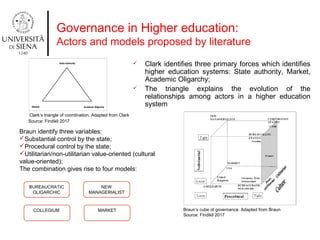
 Clark identifies three primary forces which identifies
higher education systems: State authority, Market,
Academic Oligarchy;
 The triangle explains the evolution of the
relationships among actors in a higher education
system
Governance in Higher education:
Actors and models proposed by literature
Clark’s triangle of coordination. Adapted from Clark
Source: Findikli 2017
Braun’s cube of governance. Adapted from Braun
Source: Findikli 2017
Braun identify three variables:
Substantial control by the state;
Procedural control by the state;
Utilitarian/non-utilitarian value-oriented (cultural
value-oriented);
The combination gives rise to four models:
BUREAUCRATIC
OLIGARCHIC
NEW
MANAGERIALIST
COLLEGIUM MARKET
Governance in Higher education:
Actors and models proposed by literature
HE governance shifts in four countries
Source: De Boer
De Boer, Enders and Schimank model: Five dimensions
driving changes in the HEI governance model
STATE
REGULATION
ACADEMIC SELF-
GOVERNANCE
STAKEHOLDER
GUIDANCE
MANAGERIAL
SELF-
GOVERNANCE
COMPETITION
Dobbins model: 3 ideal-type models
STATE CENTRED
MODEL
MARKET
ORIENTED
MODEL
HUMBOLD
MODEL
Governance in Higher education:
Actors and models
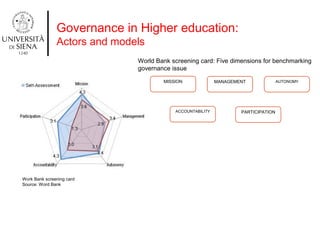
Work Bank screening card
Source: Word Bank
World Bank screening card: Five dimensions for benchmarking
governance issue
MISSION AUTONOMYMANAGEMENT
ACCOUNTABILITY PARTICIPATION
Cooperation in Higher education
governance field
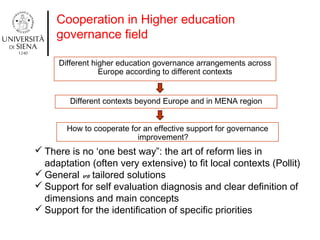
Different higher education governance arrangements across
Europe according to different contexts
Different contexts beyond Europe and in MENA region
How to cooperate for an effective support for governance
improvement?
 There is no ‘one best way”: the art of reform lies in
adaptation (often very extensive) to fit local contexts (Pollit)
 General vs tailored solutions
 Support for self evaluation diagnosis and clear definition of
dimensions and main concepts
 Support for the identification of specific priorities
The UniGov diagnostic tool
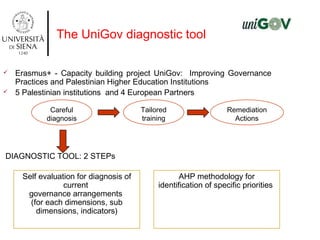
 Erasmus+ - Capacity building project UniGov: Improving Governance
Practices and Palestinian Higher Education Institutions
 5 Palestinian institutions and 4 European Partners
DIAGNOSTIC TOOL: 2 STEPs
Careful
diagnosis
Tailored
training
Remediation
Actions
Self evaluation for diagnosis of
current
governance arrangements
(for each dimensions, sub
dimensions, indicators)
AHP methodology for
identification of specific priorities
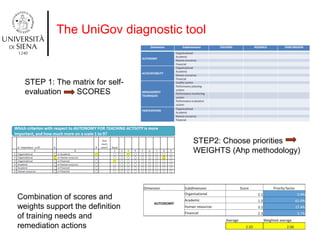
The UniGov diagnostic tool
Combination of scores and
weights support the definition
of training needs and
remediation actions
STEP2: Choose priorities
WEIGHTS (Ahp methodology)
STEP 1: The matrix for self-
evaluation SCORES
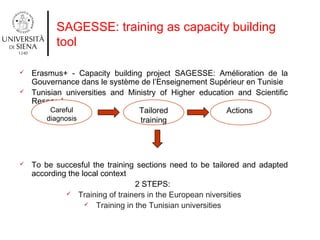
 Erasmus+ - Capacity building project SAGESSE: Amélioration de la
Gouvernance dans le système de l’Enseignement Supérieur en Tunisie
 Tunisian universities and Ministry of Higher education and Scientific
Research
 To be succesful the training sections need to be tailored and adapted
according the local context
2 STEPS:
 Training of trainers in the European niversities
 Training in the Tunisian universities
SAGESSE: training as capacity building
tool
Careful
diagnosis
Tailored
training
Actions
Thank you for your attention

Higher Education and Governance

  • 1.
     DEPARTMENT OFBUSINESS AND LAW STUDIES – UNIVERSITY OF SIENA Prof. Riccardo Mussari – Professor of Public financial management Higher Education and Governance
  • 2.
     Introduction  Thegovernance issue  Governance in Higher education  Cooperation in Higher education governance field  Capacity building project and governance improvement Agenda
  • 3.
     One ofthe oldest in Europe  Located in a Mediaval city in the Centre of Italy www.unisi.it The University of Siena
  • 4.
    • Analysis andevaluation of accounting systems • Management control systems and tools • Performance measurement • Corporate and public governance • Public policies evaluation • Higher education governance The Department of Business and Law School of Economics and Management www.disag.unisi.it
  • 5.
    • A veryancient origin: from Latin gubernare, from Greek kybernan or kubernentes, meaning “helmsman of ships” (who indicate the route) • Closely related to the idea of steering • Nowadays it is a multidimensional concept that includes many other aspects beyond the idea of steering • Difficult to identify a shared definition in the literature that includes them all • Governance vs government The Governance issue
  • 6.
    The Governance issue Pollittstates that “because of its broad scope, great flexibility and positive ‘spin’ we dub it ‘magic’ concepts”. He identifies 4 features: • Broadness • Normative attractiveness (hard to be “against”) • Implication of consensus • Global marketability
  • 7.
     Clark identifiesthree primary forces which identifies higher education systems: State authority, Market, Academic Oligarchy;  The triangle explains the evolution of the relationships among actors in a higher education system Governance in Higher education: Actors and models proposed by literature Clark’s triangle of coordination. Adapted from Clark Source: Findikli 2017 Braun’s cube of governance. Adapted from Braun Source: Findikli 2017 Braun identify three variables: Substantial control by the state; Procedural control by the state; Utilitarian/non-utilitarian value-oriented (cultural value-oriented); The combination gives rise to four models: BUREAUCRATIC OLIGARCHIC NEW MANAGERIALIST COLLEGIUM MARKET
  • 8.
    Governance in Highereducation: Actors and models proposed by literature HE governance shifts in four countries Source: De Boer De Boer, Enders and Schimank model: Five dimensions driving changes in the HEI governance model STATE REGULATION ACADEMIC SELF- GOVERNANCE STAKEHOLDER GUIDANCE MANAGERIAL SELF- GOVERNANCE COMPETITION Dobbins model: 3 ideal-type models STATE CENTRED MODEL MARKET ORIENTED MODEL HUMBOLD MODEL
  • 9.
    Governance in Highereducation: Actors and models Work Bank screening card Source: Word Bank World Bank screening card: Five dimensions for benchmarking governance issue MISSION AUTONOMYMANAGEMENT ACCOUNTABILITY PARTICIPATION
  • 10.
    Cooperation in Highereducation governance field Different higher education governance arrangements across Europe according to different contexts Different contexts beyond Europe and in MENA region How to cooperate for an effective support for governance improvement?  There is no ‘one best way”: the art of reform lies in adaptation (often very extensive) to fit local contexts (Pollit)  General vs tailored solutions  Support for self evaluation diagnosis and clear definition of dimensions and main concepts  Support for the identification of specific priorities
  • 11.
    The UniGov diagnostictool  Erasmus+ - Capacity building project UniGov: Improving Governance Practices and Palestinian Higher Education Institutions  5 Palestinian institutions and 4 European Partners DIAGNOSTIC TOOL: 2 STEPs Careful diagnosis Tailored training Remediation Actions Self evaluation for diagnosis of current governance arrangements (for each dimensions, sub dimensions, indicators) AHP methodology for identification of specific priorities
  • 12.
    The UniGov diagnostictool Combination of scores and weights support the definition of training needs and remediation actions STEP2: Choose priorities WEIGHTS (Ahp methodology) STEP 1: The matrix for self- evaluation SCORES
  • 13.
     Erasmus+ -Capacity building project SAGESSE: Amélioration de la Gouvernance dans le système de l’Enseignement Supérieur en Tunisie  Tunisian universities and Ministry of Higher education and Scientific Research  To be succesful the training sections need to be tailored and adapted according the local context 2 STEPS:  Training of trainers in the European niversities  Training in the Tunisian universities SAGESSE: training as capacity building tool Careful diagnosis Tailored training Actions
  • 14.
    Thank you foryour attention