“Efficient Variable Size Template Matching
Using Fast Normalized Cross Correlation on
           Multicore Processors”
Durgaprasad Gangodkar, Sachin Gupta, Gurbinder Gill,
           Padam Kumar, Ankush Mittal


Department of Electronics and Computer Engineering
   INDIAN INSTITUTE OF TECHNOLOGY
                     Roorkee
                      India
                                                       1
Contents
1. Introduction

2. NVIDIA’s Compute Unified Device Architecture

3. Normalized and Fast Normalized Cross Correlation
4. Parallel Implementation of Fast Normalized Cross
  Correlation

5. Experimental Details and Performance Evaluation

6. Conclusion
                                                      2
1. Introduction
 Template Matching has its applications in image and signal
processing like image registration, object detection, pattern
matching etc. Given a source image and a template, the
matching algorithm finds the location of template within the
image in terms of specific measures.
• Full search (FS) or exhaustive search algorithms consider
  every pixel in the block to find out the best match --
  computationally very expensive.
• Though there are different measures proposed. An empirical
  study found NCC provides the best performance in all image
  categories in the presence of various image distortions [9].
  NCC is also more robust against image variations such as
  illumination changes then widely used SAD and MAD .
                                                           3
• However NCC is computationally very expensive
  than SAD or MAD, which is a significant drawback in
  its real-time application.

• In this paper we propose the parallel
  implementation of template matching using Full
  Search using NCC as a measure using the concept of
  pre-computed sum-tables [10][11] referred to as
  FNCC for high resolution images on NVIDIA’s
  Graphics Processing Units (GP-GPU’s)


                                                   4
2. NVIDIA’s Compute Unified Device Architecture
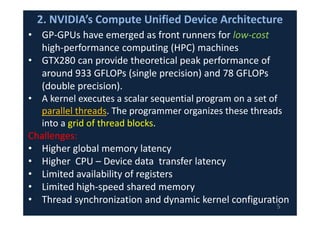
• GP-GPUs have emerged as front runners for low-cost
  high-performance computing (HPC) machines
• GTX280 can provide theoretical peak performance of
  around 933 GFLOPs (single precision) and 78 GFLOPs
  (double precision).
• A kernel executes a scalar sequential program on a set of
  parallel threads. The programmer organizes these threads
  into a grid of thread blocks.
Challenges:
• Higher global memory latency
• Higher CPU – Device data transfer latency
• Limited availability of registers
• Limited high-speed shared memory
• Thread synchronization and dynamic kernel configuration
                                                        5
Main contributions of this paper:
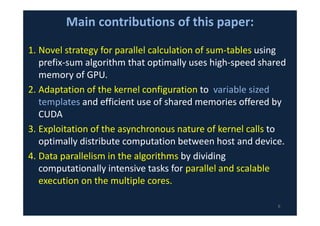
1. Novel strategy for parallel calculation of sum-tables using
   prefix-sum algorithm that optimally uses high-speed shared
   memory of GPU.
2. Adaptation of the kernel configuration to variable sized
   templates and efficient use of shared memories offered by
   CUDA
3. Exploitation of the asynchronous nature of kernel calls to
   optimally distribute computation between host and device.
4. Data parallelism in the algorithms by dividing
   computationally intensive tasks for parallel and scalable
   execution on the multiple cores.

                                                            6
3. Normalized and Fast Normalized Cross Correlation
  • NCC has been commonly used as a metric to evaluate the
    similarity (or dissimilarity) measure between two
    compared images[8][9].
  • Template of size ܰ‫	ݕܰ × ݔ‬is matched with an image of
    size ‫.ݕܯ × ݔܯ‬
  • The position (‫)ݏ݋݌ݒ ,	ݏ݋݌ݑ‬of the template ‫ ݐ‬in image ݂ is
    determined by calculating the NCC value at every step.
  • The basic equation for NCC is as given in (1)

                  ∑         ( f ( x, y) − fu,v )(t( x − u, y − v) − t )
    γ u,v =          x, y
                                                                                     (1)
              ∑
              x, y
                     ( f ( x, y) − f u,v )   2
                                                 ∑
                                                 x, y
                                                        (t( x − u, y − v) −t )   2


                                                                                           7
u+N       −1 v + N       −1
                 1              x              y

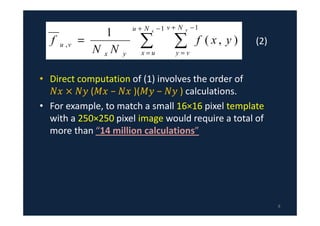
  f   u ,v   =             ∑             ∑          f (x, y)   (2)
               N xN   y    x=u           y=v


• Direct computation of (1) involves the order of
  ܰ‫ )	ݕܰ −	ݕܯ() ݔܰ − ݔܯ(	ݕܰ × ݔ‬calculations.
• For example, to match a small 16×16 pixel template
  with a 250×250 pixel image would require a total of
  more than “14 million calculations”


                                                                     8
Fast Normalized Cross Correlation (FNCC)
• Calculation of the denominator of equation using the
  concept of sum-tables[10][11].
• ‫ݒ ,ݑ(ݏ‬ሻ	ܽ݊݀	‫2ݏ‬ሺ‫ݒ ,ݑ‬ሻ are sum tables over image
  function and image energy respectively.
• The sum-tables of image function and image energy
  are computed recursively as given below:
                                                 (1)

                                                 (2)

                                                 (3)


                                                 (4)
                                                         9
4. Parallel Implementation of Template
                     Matching
• Though FNCC reduces computational time for low
  resolution images, incurs substantial time for high
  resolution images.
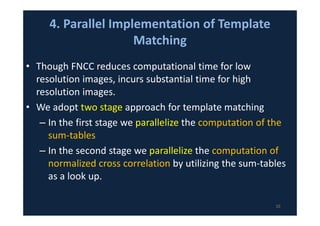
• We adopt two stage approach for template matching
   – In the first stage we parallelize the computation of the
     sum-tables
   – In the second stage we parallelize the computation of
     normalized cross correlation by utilizing the sum-tables
     as a look up.

                                                          10
Computation of Sum-Tables
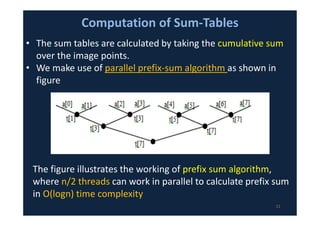
• The sum tables are calculated by taking the cumulative sum
  over the image points.
• We make use of parallel prefix-sum algorithm as shown in
  figure


 The figure illustrates the working of prefix sum algorithm,
 where n/2 threads can work in parallel to calculate prefix sum
 in O(logn) time complexity
                                                           11
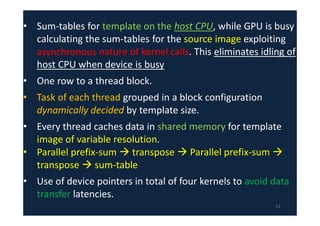
• Sum-tables for template on the host CPU, while GPU is busy
  calculating the sum-tables for the source image exploiting
  asynchronous nature of kernel calls. This eliminates idling of
  host CPU when device is busy
• One row to a thread block.
• Task of each thread grouped in a block configuration
  dynamically decided by template size.
• Every thread caches data in shared memory for template
  image of variable resolution.
• Parallel prefix-sum transpose Parallel prefix-sum
  transpose sum-table
• Use of device pointers in total of four kernels to avoid data
  transfer latencies.
                                                           12
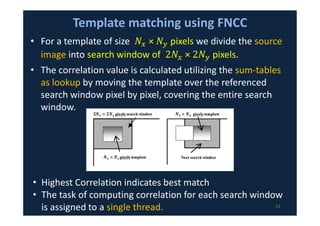
Template matching using FNCC
• For a template of size ܰ௫ × ܰ௬ pixels we divide the source
  image into search window of 2ܰ௫ × 2ܰ௬ pixels.
• The correlation value is calculated utilizing the sum-tables
  as lookup by moving the template over the referenced
  search window pixel by pixel, covering the entire search
  window.


• Highest Correlation indicates best match
• The task of computing correlation for each search window
  is assigned to a single thread.                        13
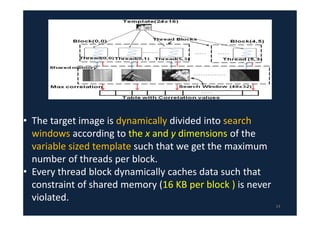
• The target image is dynamically divided into search
  windows according to the x and y dimensions of the
  variable sized template such that we get the maximum
  number of threads per block.
• Every thread block dynamically caches data such that
  constraint of shared memory (16 KB per block ) is never
  violated.
                                                            14
5. Experimental Details and Performance
                Evaluation
• Execution time and speedup of proposed parallel
  implementation FCC algorithm evaluated on benchmark
  dataset .
• Sequential code implemented on Intel Xeon 3.2 GHz
  processor with 1 GB of DRAM and 32 bit Windows XP OS.
• Parallel code was implemented on NVIDIA GTX 280 having
  1 GB of DDR3 onboard Intel Xeon 3.2 GHz processor with 1
  GB of DRAM and 32 bit Windows XP OS.


                                                      15
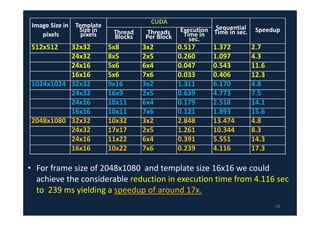
CUDA
 Image Size in   Template                                   Sequential
                  Size in    Thread    Threads    Execution Time in sec.    Speedup
    pixels         pixels    Blocks   Per Block    Time in
                                                     sec.
512x512   32x32             5x8       3x2         0.517     1.372          2.7
          24x32             8x5       2x5         0.260     1.097          4.3
          24x16             5x6       6x4         0.047     0.543          11.6
          16x16             5x6       7x6         0.033     0.406          12.3
1024x1024 32x32             9x16      3x2         1.311     6.170          4.8
          24x32             16x9      2x5         0.639     4.773          7.5
          24x16             10x11     6x4         0.179     2.518          14.1
          16x16             10x11     7x6         0.121     1.893          15.6
2048x1080 32x32             10x32     3x2         2.848     13.474         4.8
          24x32             17x17     2x5         1.261     10.344         8.3
          24x16             11x22     6x4         0.391     5.551          14.3
          16x16             10x22     7x6         0.239     4.116          17.3

• For frame size of 2048x1080 and template size 16x16 we could
  achieve the considerable reduction in execution time from 4.116 sec
  to 239 ms yielding a speedup of around 17x.
                                                                                  16
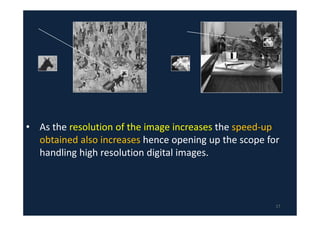
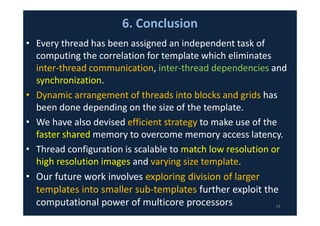
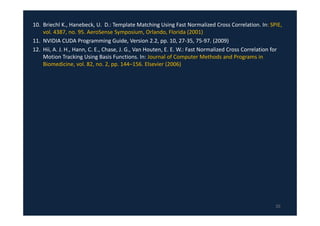
• As the resolution of the image increases the speed-up
  obtained also increases hence opening up the scope for
  handling high resolution digital images.


                                                       17
6. Conclusion
• Every thread has been assigned an independent task of
  computing the correlation for template which eliminates
  inter-thread communication, inter-thread dependencies and
  synchronization.
• Dynamic arrangement of threads into blocks and grids has
  been done depending on the size of the template.
• We have also devised efficient strategy to make use of the
  faster shared memory to overcome memory access latency.
• Thread configuration is scalable to match low resolution or
  high resolution images and varying size template.
• Our future work involves exploring division of larger
  templates into smaller sub-templates further exploit the
  computational power of multicore processors               18
References
1. Ryan, T. W.: The Prediction of Cross-Correlation Accuracy in Digital Stereo-Pair Images. PhD thesis,
   University of Arizona (1981)
2. Burt, P. J., Yen, C., Xu, X.: Local Correlation Measures for Motion Analysis: A Comparative Study. In:
   IEEE Conf. Pattern Recognition and Image Processing, pp. 269-274. IEEE Press, Las Vegas (1982).
3. Essannouni, L., Ibn-Elhaj, E., Aboutajdine, D.: Fast Cross-Spectral Image Registration Using New
   Robust Correlation. In: Journal of Real-Time Image Processing, vol. 1, no. 2, pp. 123-12. Springer
   (2006)
4. Minoru, M., Kunio, K.: Fast Template Matching Based on Normalized Cross Correlation Using
   Adaptive Block Partitioning and Initial Threshold Estimation. In: IEEE International Symposium on
   Multimedia, pp. 196 – 203. IEEE Press, Taichung, Taiwan (2010)
5. Luo, J., Konofagou, E. E.: A Fast Normalized Cross-Correlation Calculation Method for Motion
   Estimation. In: IEEE Trans. on Ultrasonics, Ferroelectrics and Frequency Control, vol. 57, no. 6, pp.
   1347 – 1357. (2010)
6. Zhu, S., Ma, K. K.: A New Diamond Search Algorithm for Fast Block Matching Motion Estimation. In:
   IEEE Trans. Image Processing, vol. 9, no. 2, pp. 287–290. (2000)
7. Tham, J. Y., Ranganath, S., Ranganath, M., Kassim, A. A.: A Novel Unrestricted Center-Biased
   Diamond Search Algorithm for Block Motion Estimation. In: IEEE Trans. Circuits Syst. Video
   Technol., vol. 8, no. 4, pp. 369–377. (1998)
8. Zhu, C., Lin, X., Chau, L.: Hexagon-Based Search Pattern for Fast Block Motion Estimation. In: IEEE
   Trans. Circuits Syst. Video Technol., vol. 12, no. 5, pp. 349-355. (2002)
9. Lewis, J. P.: Fast Template Matching. In: Vision Interface 95, Canadian Image Processing and Pattern
   Recognition Society, pp. 120–123. Quebec City, Canada (1995)
                                                                                                    19
10. Briechl K., Hanebeck, U. D.: Template Matching Using Fast Normalized Cross Correlation. In: SPIE,
    vol. 4387, no. 95. AeroSense Symposium, Orlando, Florida (2001)
11. NVIDIA CUDA Programming Guide, Version 2.2, pp. 10, 27-35, 75-97. (2009)
12. Hii, A. J. H., Hann, C. E., Chase, J. G., Van Houten, E. E. W.: Fast Normalized Cross Correlation for
    Motion Tracking Using Basis Functions. In: Journal of Computer Methods and Programs in
    Biomedicine, vol. 82, no. 2, pp. 144–156. Elsevier (2006)


                                                                                                      20
Thank You

            21

Efficient Variable Size Template Matching Using Fast Normalized Cross Correlation on Multicore Processors

  • 1.
    “Efficient Variable SizeTemplate Matching Using Fast Normalized Cross Correlation on Multicore Processors” Durgaprasad Gangodkar, Sachin Gupta, Gurbinder Gill, Padam Kumar, Ankush Mittal Department of Electronics and Computer Engineering INDIAN INSTITUTE OF TECHNOLOGY Roorkee India 1
  • 2.
    Contents 1. Introduction 2. NVIDIA’sCompute Unified Device Architecture 3. Normalized and Fast Normalized Cross Correlation 4. Parallel Implementation of Fast Normalized Cross Correlation 5. Experimental Details and Performance Evaluation 6. Conclusion 2
  • 3.
    1. Introduction TemplateMatching has its applications in image and signal processing like image registration, object detection, pattern matching etc. Given a source image and a template, the matching algorithm finds the location of template within the image in terms of specific measures. • Full search (FS) or exhaustive search algorithms consider every pixel in the block to find out the best match -- computationally very expensive. • Though there are different measures proposed. An empirical study found NCC provides the best performance in all image categories in the presence of various image distortions [9]. NCC is also more robust against image variations such as illumination changes then widely used SAD and MAD . 3
  • 4.
    • However NCCis computationally very expensive than SAD or MAD, which is a significant drawback in its real-time application. • In this paper we propose the parallel implementation of template matching using Full Search using NCC as a measure using the concept of pre-computed sum-tables [10][11] referred to as FNCC for high resolution images on NVIDIA’s Graphics Processing Units (GP-GPU’s) 4
  • 5.
    2. NVIDIA’s ComputeUnified Device Architecture • GP-GPUs have emerged as front runners for low-cost high-performance computing (HPC) machines • GTX280 can provide theoretical peak performance of around 933 GFLOPs (single precision) and 78 GFLOPs (double precision). • A kernel executes a scalar sequential program on a set of parallel threads. The programmer organizes these threads into a grid of thread blocks. Challenges: • Higher global memory latency • Higher CPU – Device data transfer latency • Limited availability of registers • Limited high-speed shared memory • Thread synchronization and dynamic kernel configuration 5
  • 6.
    Main contributions ofthis paper: 1. Novel strategy for parallel calculation of sum-tables using prefix-sum algorithm that optimally uses high-speed shared memory of GPU. 2. Adaptation of the kernel configuration to variable sized templates and efficient use of shared memories offered by CUDA 3. Exploitation of the asynchronous nature of kernel calls to optimally distribute computation between host and device. 4. Data parallelism in the algorithms by dividing computationally intensive tasks for parallel and scalable execution on the multiple cores. 6
  • 7.
    3. Normalized andFast Normalized Cross Correlation • NCC has been commonly used as a metric to evaluate the similarity (or dissimilarity) measure between two compared images[8][9]. • Template of size ܰ‫ ݕܰ × ݔ‬is matched with an image of size ‫.ݕܯ × ݔܯ‬ • The position (‫)ݏ݋݌ݒ , ݏ݋݌ݑ‬of the template ‫ ݐ‬in image ݂ is determined by calculating the NCC value at every step. • The basic equation for NCC is as given in (1) ∑ ( f ( x, y) − fu,v )(t( x − u, y − v) − t ) γ u,v = x, y (1) ∑ x, y ( f ( x, y) − f u,v ) 2 ∑ x, y (t( x − u, y − v) −t ) 2 7
  • 8.
    u+N −1 v + N −1 1 x y f u ,v = ∑ ∑ f (x, y) (2) N xN y x=u y=v • Direct computation of (1) involves the order of ܰ‫ ) ݕܰ − ݕܯ() ݔܰ − ݔܯ( ݕܰ × ݔ‬calculations. • For example, to match a small 16×16 pixel template with a 250×250 pixel image would require a total of more than “14 million calculations” 8
  • 9.
    Fast Normalized CrossCorrelation (FNCC) • Calculation of the denominator of equation using the concept of sum-tables[10][11]. • ‫ݒ ,ݑ(ݏ‬ሻ ܽ݊݀ ‫2ݏ‬ሺ‫ݒ ,ݑ‬ሻ are sum tables over image function and image energy respectively. • The sum-tables of image function and image energy are computed recursively as given below: (1) (2) (3) (4) 9
  • 10.
    4. Parallel Implementationof Template Matching • Though FNCC reduces computational time for low resolution images, incurs substantial time for high resolution images. • We adopt two stage approach for template matching – In the first stage we parallelize the computation of the sum-tables – In the second stage we parallelize the computation of normalized cross correlation by utilizing the sum-tables as a look up. 10
  • 11.
    Computation of Sum-Tables •The sum tables are calculated by taking the cumulative sum over the image points. • We make use of parallel prefix-sum algorithm as shown in figure The figure illustrates the working of prefix sum algorithm, where n/2 threads can work in parallel to calculate prefix sum in O(logn) time complexity 11
  • 12.
    • Sum-tables fortemplate on the host CPU, while GPU is busy calculating the sum-tables for the source image exploiting asynchronous nature of kernel calls. This eliminates idling of host CPU when device is busy • One row to a thread block. • Task of each thread grouped in a block configuration dynamically decided by template size. • Every thread caches data in shared memory for template image of variable resolution. • Parallel prefix-sum transpose Parallel prefix-sum transpose sum-table • Use of device pointers in total of four kernels to avoid data transfer latencies. 12
  • 13.
    Template matching usingFNCC • For a template of size ܰ௫ × ܰ௬ pixels we divide the source image into search window of 2ܰ௫ × 2ܰ௬ pixels. • The correlation value is calculated utilizing the sum-tables as lookup by moving the template over the referenced search window pixel by pixel, covering the entire search window. • Highest Correlation indicates best match • The task of computing correlation for each search window is assigned to a single thread. 13
  • 14.
    • The targetimage is dynamically divided into search windows according to the x and y dimensions of the variable sized template such that we get the maximum number of threads per block. • Every thread block dynamically caches data such that constraint of shared memory (16 KB per block ) is never violated. 14
  • 15.
    5. Experimental Detailsand Performance Evaluation • Execution time and speedup of proposed parallel implementation FCC algorithm evaluated on benchmark dataset . • Sequential code implemented on Intel Xeon 3.2 GHz processor with 1 GB of DRAM and 32 bit Windows XP OS. • Parallel code was implemented on NVIDIA GTX 280 having 1 GB of DDR3 onboard Intel Xeon 3.2 GHz processor with 1 GB of DRAM and 32 bit Windows XP OS. 15
  • 16.
    CUDA Image Sizein Template Sequential Size in Thread Threads Execution Time in sec. Speedup pixels pixels Blocks Per Block Time in sec. 512x512 32x32 5x8 3x2 0.517 1.372 2.7 24x32 8x5 2x5 0.260 1.097 4.3 24x16 5x6 6x4 0.047 0.543 11.6 16x16 5x6 7x6 0.033 0.406 12.3 1024x1024 32x32 9x16 3x2 1.311 6.170 4.8 24x32 16x9 2x5 0.639 4.773 7.5 24x16 10x11 6x4 0.179 2.518 14.1 16x16 10x11 7x6 0.121 1.893 15.6 2048x1080 32x32 10x32 3x2 2.848 13.474 4.8 24x32 17x17 2x5 1.261 10.344 8.3 24x16 11x22 6x4 0.391 5.551 14.3 16x16 10x22 7x6 0.239 4.116 17.3 • For frame size of 2048x1080 and template size 16x16 we could achieve the considerable reduction in execution time from 4.116 sec to 239 ms yielding a speedup of around 17x. 16
  • 17.
    • As theresolution of the image increases the speed-up obtained also increases hence opening up the scope for handling high resolution digital images. 17
  • 18.
    6. Conclusion • Everythread has been assigned an independent task of computing the correlation for template which eliminates inter-thread communication, inter-thread dependencies and synchronization. • Dynamic arrangement of threads into blocks and grids has been done depending on the size of the template. • We have also devised efficient strategy to make use of the faster shared memory to overcome memory access latency. • Thread configuration is scalable to match low resolution or high resolution images and varying size template. • Our future work involves exploring division of larger templates into smaller sub-templates further exploit the computational power of multicore processors 18
  • 19.
    References 1. Ryan, T.W.: The Prediction of Cross-Correlation Accuracy in Digital Stereo-Pair Images. PhD thesis, University of Arizona (1981) 2. Burt, P. J., Yen, C., Xu, X.: Local Correlation Measures for Motion Analysis: A Comparative Study. In: IEEE Conf. Pattern Recognition and Image Processing, pp. 269-274. IEEE Press, Las Vegas (1982). 3. Essannouni, L., Ibn-Elhaj, E., Aboutajdine, D.: Fast Cross-Spectral Image Registration Using New Robust Correlation. In: Journal of Real-Time Image Processing, vol. 1, no. 2, pp. 123-12. Springer (2006) 4. Minoru, M., Kunio, K.: Fast Template Matching Based on Normalized Cross Correlation Using Adaptive Block Partitioning and Initial Threshold Estimation. In: IEEE International Symposium on Multimedia, pp. 196 – 203. IEEE Press, Taichung, Taiwan (2010) 5. Luo, J., Konofagou, E. E.: A Fast Normalized Cross-Correlation Calculation Method for Motion Estimation. In: IEEE Trans. on Ultrasonics, Ferroelectrics and Frequency Control, vol. 57, no. 6, pp. 1347 – 1357. (2010) 6. Zhu, S., Ma, K. K.: A New Diamond Search Algorithm for Fast Block Matching Motion Estimation. In: IEEE Trans. Image Processing, vol. 9, no. 2, pp. 287–290. (2000) 7. Tham, J. Y., Ranganath, S., Ranganath, M., Kassim, A. A.: A Novel Unrestricted Center-Biased Diamond Search Algorithm for Block Motion Estimation. In: IEEE Trans. Circuits Syst. Video Technol., vol. 8, no. 4, pp. 369–377. (1998) 8. Zhu, C., Lin, X., Chau, L.: Hexagon-Based Search Pattern for Fast Block Motion Estimation. In: IEEE Trans. Circuits Syst. Video Technol., vol. 12, no. 5, pp. 349-355. (2002) 9. Lewis, J. P.: Fast Template Matching. In: Vision Interface 95, Canadian Image Processing and Pattern Recognition Society, pp. 120–123. Quebec City, Canada (1995) 19
  • 20.
    10. Briechl K.,Hanebeck, U. D.: Template Matching Using Fast Normalized Cross Correlation. In: SPIE, vol. 4387, no. 95. AeroSense Symposium, Orlando, Florida (2001) 11. NVIDIA CUDA Programming Guide, Version 2.2, pp. 10, 27-35, 75-97. (2009) 12. Hii, A. J. H., Hann, C. E., Chase, J. G., Van Houten, E. E. W.: Fast Normalized Cross Correlation for Motion Tracking Using Basis Functions. In: Journal of Computer Methods and Programs in Biomedicine, vol. 82, no. 2, pp. 144–156. Elsevier (2006) 20
  • 21.