Background Subtraction Based on Phase and Distance
     Transform Under Sudden Illumination Change


             Authors: Gengjian Xue, Jun Sun, Li Song
                       Reporter: Li Song


                 Shanghai Jiao Tong University


2012-09-27                                             1
Outline
     Introduction


     Background subtraction based on phase
     feature and distance transform


     Experimental results


     Conclusion

2012-09-27                                   2
Introduction (1)

     Moving object detection is an active
     research subject in computer vision.


     Foreground detection under sudden
     illumination change is still a challenging
     problem.


2012-09-27                                        3
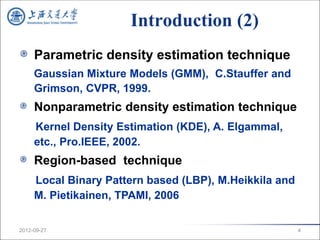
Introduction (2)
     Parametric density estimation technique
     Gaussian Mixture Models (GMM), C.Stauffer and
     Grimson, CVPR, 1999.
     Nonparametric density estimation technique
     Kernel Density Estimation (KDE), A. Elgammal,
     etc., Pro.IEEE, 2002.
     Region-based technique
     Local Binary Pattern based (LBP), M.Heikkila and
     M. Pietikainen, TPAMI, 2006

2012-09-27                                              4
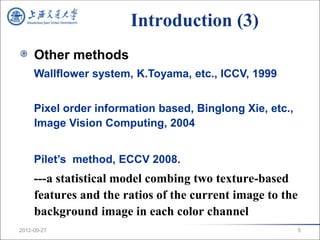
Introduction (3)
     Other methods
     Wallflower system, K.Toyama, etc., ICCV, 1999


     Pixel order information based, Binglong Xie, etc.,
     Image Vision Computing, 2004


     Pilet’s method, ECCV 2008.
     ---a statistical model combing two texture-based
     features and the ratios of the current image to the
     background image in each color channel
2012-09-27                                                 5
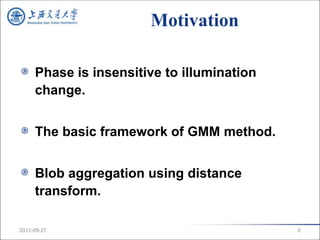
Motivation

     Phase is insensitive to illumination
     change.


     The basic framework of GMM method.


     Blob aggregation using distance
     transform.

2012-09-27                                  6
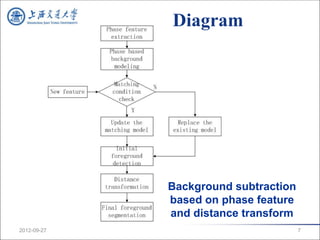
Diagram


             Background subtraction
             based on phase feature
             and distance transform
2012-09-27                            7
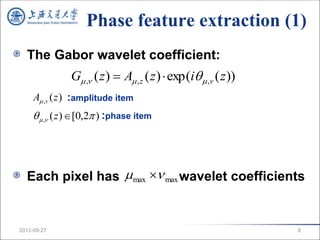
Phase feature extraction (1)
  The Gabor wavelet coefficient:
               G , ( z )  A , z ( z )  exp(i  ,v ( z ))
     A ,v ( z ) :amplitude item
      , ( z ) [0,2 ) :phase item


  Each pixel has max  max wavelet coefficients


2012-09-27                                                       8
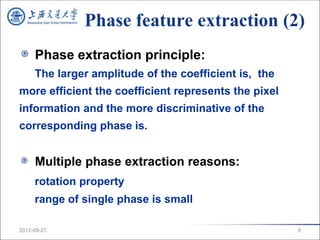
Phase feature extraction (2)
     Phase extraction principle:
     The larger amplitude of the coefficient is, the
more efficient the coefficient represents the pixel
information and the more discriminative of the
corresponding phase is.


     Multiple phase extraction reasons:
     rotation property
     range of single phase is small

2012-09-27                                             9
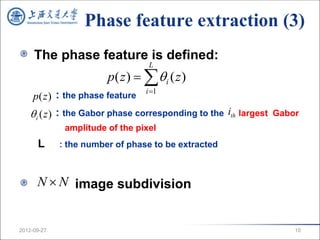
Phase feature extraction (3)
     The phase feature is defined:
                                  L
                        p( z )   i ( z )
                                 i 1
     p(z ) : the phase feature
    i (z ) : the Gabor phase corresponding to the ith largest   Gabor
              amplitude of the pixel
      L      : the number of phase to be extracted


      N  N image subdivision


2012-09-27                                                           10
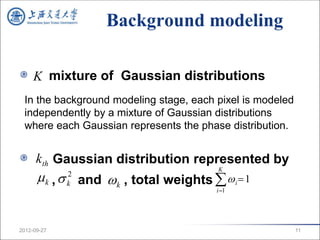
Background modeling

     K mixture of Gaussian distributions
 In the background modeling stage, each pixel is modeled
 independently by a mixture of Gaussian distributions
 where each Gaussian represents the phase distribution.


      kth Gaussian distribution represented by
       k ,  and  k , total weights   i  1
                                        K
             2
             k
                                        i 1


2012-09-27                                                 11
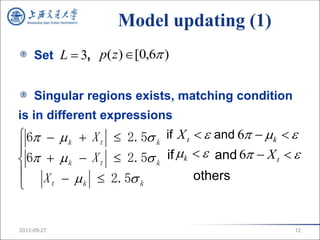
Model updating (1)
     Set L  3, p( z ) [0,6 )


     Singular regions exists, matching condition
is in different expressions
 6  k  X t  2.5 k if X t   and 6  k  

 6  k  X t  2.5 k if  k   and 6  X t  
 X    2.5                  others
    t    k         k


2012-09-27                                         12
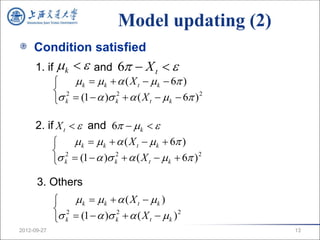
Model updating (2)
     Condition satisfied
     1. if  k   and 6  X t  
               k   k   ( X t   k  6 )
           2
           k  (1   ) k2   ( X t   k  6 ) 2

     2. if X t   and 6  k  
                k   k   ( X t   k  6 )
           2
           k  (1   ) k2   ( X t   k  6 ) 2

      3. Others
                 k  k   ( X t  k )
              2
              k  (1   ) k2   ( X t   k ) 2
2012-09-27                                               13
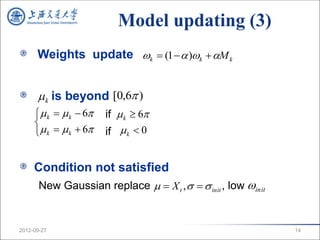
Model updating (3)
      Weights update k  (1   )k  M k


       k is beyond [0,6 )
      k   k  6   if  k  6
     
      k   k  6   if  k  0


     Condition not satisfied
       New Gaussian replace   X t ,    init , low init


2012-09-27                                                     14
Foreground detection

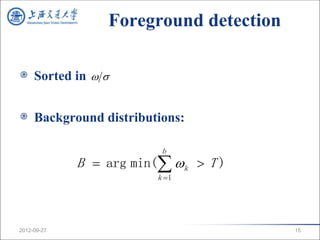
     Sorted in  


     Background distributions:

                          b
             B  arg min( k  T )
                         k 1


2012-09-27                              15
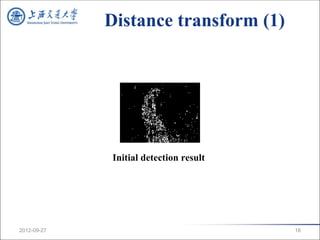
Distance transform (1)


             Initial detection result


2012-09-27                              16
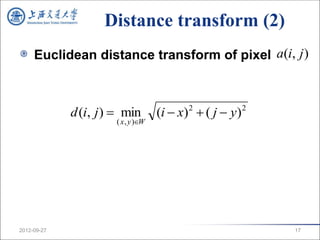
Distance transform (2)
     Euclidean distance transform of pixel a(i, j )


             d (i, j )  min        (i  x) 2  ( j  y) 2
                      ( x , y )W


2012-09-27                                                   17
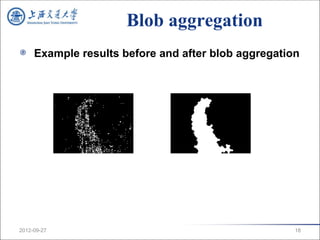
Blob aggregation
     Example results before and after blob aggregation


2012-09-27                                           18
Experiments (1)
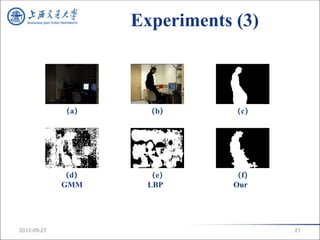
     Several sequences for testing.


     GMM and LBP methods are employed for
     comparison.


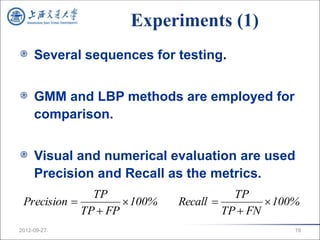
     Visual and numerical evaluation are used
     Precision and Recall as the metrics.
               TP                        TP
 Precision           100%   Recall           100%
             TP  FP                   TP  FN
2012-09-27                                          19
Experiments (2)
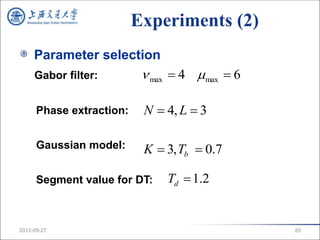
     Parameter selection
     Gabor filter:          max  4 max  6

      Phase extraction:    N  4, L  3

      Gaussian model:      K  3, Tb  0.7

      Segment value for DT:    Td  1.2


2012-09-27                                      20
Experiments (3)


             (a)    (b)       (c)


             (d)    (e)        (f)
             GMM    LBP        Our


2012-09-27                           21
Experiments (4)


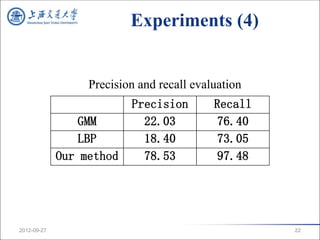
                  Precision and recall evaluation
                          Precision        Recall
                 GMM        22.03           76.40
                 LBP        18.40           73.05
             Our method     78.53           97.48


2012-09-27                                          22
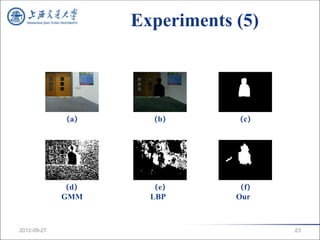
Experiments (5)


             (a)     (b)       (c)


             (d)     (e)       (f)
             GMM     LBP       Our


2012-09-27                           23
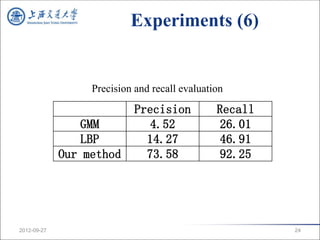
Experiments (6)


                  Precision and recall evaluation

                            Precision          Recall
                 GMM          4.52             26.01
                 LBP          14.27            46.91
             Our method       73.58            92.25


2012-09-27                                              24
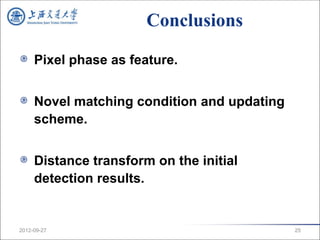
Conclusions

     Pixel phase as feature.


     Novel matching condition and updating
     scheme.


     Distance transform on the initial
     detection results.


2012-09-27                                   25

Background Subtraction Based on Phase and Distance Transform Under Sudden Illumination Change

  • 1.
    Background Subtraction Basedon Phase and Distance Transform Under Sudden Illumination Change Authors: Gengjian Xue, Jun Sun, Li Song Reporter: Li Song Shanghai Jiao Tong University 2012-09-27 1
  • 2.
    Outline Introduction Background subtraction based on phase feature and distance transform Experimental results Conclusion 2012-09-27 2
  • 3.
    Introduction (1) Moving object detection is an active research subject in computer vision. Foreground detection under sudden illumination change is still a challenging problem. 2012-09-27 3
  • 4.
    Introduction (2) Parametric density estimation technique Gaussian Mixture Models (GMM), C.Stauffer and Grimson, CVPR, 1999. Nonparametric density estimation technique Kernel Density Estimation (KDE), A. Elgammal, etc., Pro.IEEE, 2002. Region-based technique Local Binary Pattern based (LBP), M.Heikkila and M. Pietikainen, TPAMI, 2006 2012-09-27 4
  • 5.
    Introduction (3) Other methods Wallflower system, K.Toyama, etc., ICCV, 1999 Pixel order information based, Binglong Xie, etc., Image Vision Computing, 2004 Pilet’s method, ECCV 2008. ---a statistical model combing two texture-based features and the ratios of the current image to the background image in each color channel 2012-09-27 5
  • 6.
    Motivation Phase is insensitive to illumination change. The basic framework of GMM method. Blob aggregation using distance transform. 2012-09-27 6
  • 7.
    Diagram Background subtraction based on phase feature and distance transform 2012-09-27 7
  • 8.
    Phase feature extraction(1) The Gabor wavelet coefficient: G , ( z )  A , z ( z )  exp(i  ,v ( z )) A ,v ( z ) :amplitude item   , ( z ) [0,2 ) :phase item Each pixel has max  max wavelet coefficients 2012-09-27 8
  • 9.
    Phase feature extraction(2) Phase extraction principle: The larger amplitude of the coefficient is, the more efficient the coefficient represents the pixel information and the more discriminative of the corresponding phase is. Multiple phase extraction reasons: rotation property range of single phase is small 2012-09-27 9
  • 10.
    Phase feature extraction(3) The phase feature is defined: L p( z )   i ( z ) i 1 p(z ) : the phase feature  i (z ) : the Gabor phase corresponding to the ith largest Gabor amplitude of the pixel L : the number of phase to be extracted N  N image subdivision 2012-09-27 10
  • 11.
    Background modeling K mixture of Gaussian distributions In the background modeling stage, each pixel is modeled independently by a mixture of Gaussian distributions where each Gaussian represents the phase distribution. kth Gaussian distribution represented by  k ,  and  k , total weights   i  1 K 2 k i 1 2012-09-27 11
  • 12.
    Model updating (1) Set L  3, p( z ) [0,6 ) Singular regions exists, matching condition is in different expressions  6  k  X t  2.5 k if X t   and 6  k     6  k  X t  2.5 k if  k   and 6  X t    X    2.5 others  t k k 2012-09-27 12
  • 13.
    Model updating (2) Condition satisfied 1. if  k   and 6  X t     k   k   ( X t   k  6 )  2  k  (1   ) k2   ( X t   k  6 ) 2 2. if X t   and 6  k     k   k   ( X t   k  6 )  2  k  (1   ) k2   ( X t   k  6 ) 2 3. Others  k  k   ( X t  k )  2  k  (1   ) k2   ( X t   k ) 2 2012-09-27 13
  • 14.
    Model updating (3) Weights update k  (1   )k  M k  k is beyond [0,6 )  k   k  6 if  k  6   k   k  6 if  k  0 Condition not satisfied New Gaussian replace   X t ,    init , low init 2012-09-27 14
  • 15.
    Foreground detection Sorted in   Background distributions: b B  arg min( k  T ) k 1 2012-09-27 15
  • 16.
    Distance transform (1) Initial detection result 2012-09-27 16
  • 17.
    Distance transform (2) Euclidean distance transform of pixel a(i, j ) d (i, j )  min (i  x) 2  ( j  y) 2 ( x , y )W 2012-09-27 17
  • 18.
    Blob aggregation Example results before and after blob aggregation 2012-09-27 18
  • 19.
    Experiments (1) Several sequences for testing. GMM and LBP methods are employed for comparison. Visual and numerical evaluation are used Precision and Recall as the metrics. TP TP Precision   100% Recall   100% TP  FP TP  FN 2012-09-27 19
  • 20.
    Experiments (2) Parameter selection Gabor filter:  max  4 max  6 Phase extraction: N  4, L  3 Gaussian model: K  3, Tb  0.7 Segment value for DT: Td  1.2 2012-09-27 20
  • 21.
    Experiments (3) (a) (b) (c) (d) (e) (f) GMM LBP Our 2012-09-27 21
  • 22.
    Experiments (4) Precision and recall evaluation Precision Recall GMM 22.03 76.40 LBP 18.40 73.05 Our method 78.53 97.48 2012-09-27 22
  • 23.
    Experiments (5) (a) (b) (c) (d) (e) (f) GMM LBP Our 2012-09-27 23
  • 24.
    Experiments (6) Precision and recall evaluation Precision Recall GMM 4.52 26.01 LBP 14.27 46.91 Our method 73.58 92.25 2012-09-27 24
  • 25.
    Conclusions Pixel phase as feature. Novel matching condition and updating scheme. Distance transform on the initial detection results. 2012-09-27 25