ImageNet Classification with Deep
Convolutional Neural Networks
신우철
Introduction
1. Trained one of the largest CNN on ImageNet data. The advantages of CNN
are 1) CNN’s prior knowledge, which are stationarity of statistics and
locality of pixel dependencies, 2) its easiness to be controlled, varying its
depth and breath, contributing to fewer parameters and easier training.
2. Implemented highly-optimized GPU implementation to facilitate the
training of large CNNs on high resolution images.
3. Introduced new features to improve performance, reduce training time,
and prevent overfitting.
Dataset
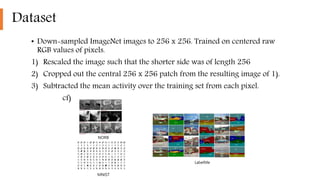
• Down-sampled ImageNet images to 256 x 256. Trained on centered raw
RGB values of pixels.
1) Rescaled the image such that the shorter side was of length 256
2) Cropped out the central 256 x 256 patch from the resulting image of 1).
3) Subtracted the mean activity over the training set from each pixel.
cf)
NORB
MNIST
LabelMe
Architecture
• 8 layers = 5 Convolutional + 3 Fully-connected
• Newly introduced features
1) ReLU Nonlinearity
• Much faster to train since it is non-saturating
• Nonlinear |tanh(x)| function focuses on preventing overfitting, while ReLU
focuses on fast learning of large models on large datasets
Architecture
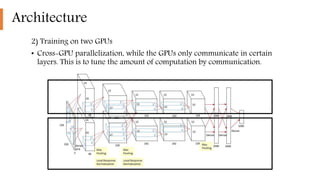
2) Training on two GPUs
• Cross-GPU parallelization, while the GPUs only communicate in certain
layers. This is to tune the amount of computation by communication.
Architecture
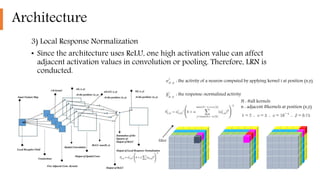
3) Local Response Normalization
• Since the architecture uses ReLU, one high activation value can affect
adjacent activation values in convolution or pooling. Therefore, LRN is
conducted.
filter
: the activity of a neuron computed by applying kernel i at position (x,y)
: the response-normalized activity
N : #all kernels
n : adjacent #kernels at position (x,y)
Architecture
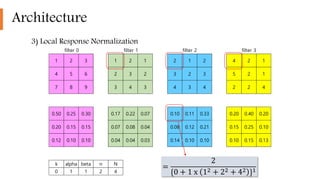
3) Local Response Normalization
filter 0 filter 1 filter 2 filter 3
1 2 3 1 2 1 2 1 2 4 2 1
4 5 6 2 3 2 3 2 3 5 2 1
7 8 9 3 4 3 4 3 4 2 2 4
0.50 0.25 0.30 0.17 0.22 0.07 0.10 0.11 0.33 0.20 0.40 0.20
0.20 0.15 0.15 0.07 0.08 0.04 0.08 0.12 0.21 0.15 0.25 0.10
0.12 0.10 0.10 0.04 0.04 0.03 0.14 0.10 0.10 0.10 0.15 0.13
k alpha beta n N
0 1 1 2 4
=
2
{0 + 1 x 12 + 22 + 42 }1
Architecture
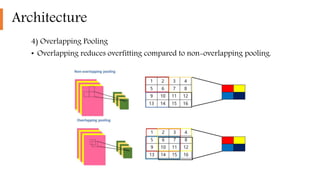
4) Overlapping Pooling
• Overlapping reduces overfitting compared to non-overlapping pooling.
Architecture
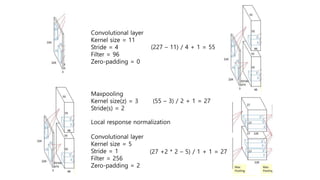
5) Overall architecture
Convolutional layer
Kernel size = 11
Stride = 4
Filter = 96
Zero-padding = 0
(227 – 11) / 4 + 1 = 55
Maxpooling
Kernel size(z) = 3
Stride(s) = 2
Convolutional layer
Kernel size = 5
Stride = 1
Filter = 256
Zero-padding = 2
(55 – 3) / 2 + 1 = 27
(27 +2 * 2 – 5) / 1 + 1 = 27
Local response normalization
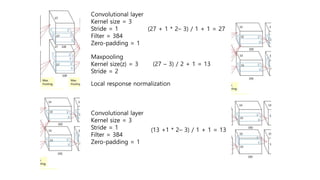
Convolutional layer
Kernel size = 3
Stride = 1
Filter = 384
Zero-padding = 1
(27 + 1 * 2– 3) / 1 + 1 = 27
Convolutional layer
Kernel size = 3
Stride = 1
Filter = 384
Zero-padding = 1
(13 +1 * 2– 3) / 1 + 1 = 13
Maxpooling
Kernel size(z) = 3
Stride = 2
(27 – 3) / 2 + 1 = 13
Local response normalization
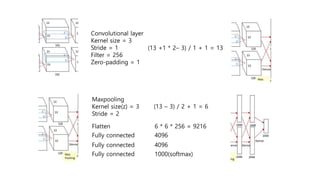
Convolutional layer
Kernel size = 3
Stride = 1
Filter = 256
Zero-padding = 1
(13 +1 * 2– 3) / 1 + 1 = 13
Maxpooling
Kernel size(z) = 3
Stride = 2
(13 – 3) / 2 + 1 = 6
Flatten 6 * 6 * 256 = 9216
Fully connected 4096
Fully connected 1000(softmax)
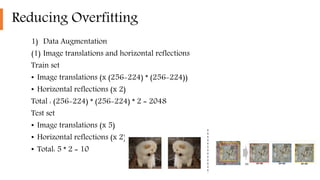
Reducing Overfitting
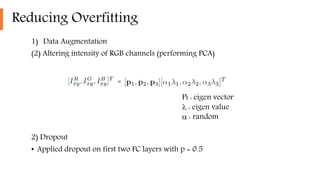
1) Data Augmentation
(1) Image translations and horizontal reflections
Train set
• Image translations (x (256-224) * (256-224))
• Horizontal reflections (x 2)
Total : (256-224) * (256-224) * 2 = 2048
Test set
• Image translations (x 5)
• Horizontal reflections (x 2)
• Total: 5 * 2 = 10
Reducing Overfitting
1) Data Augmentation
(2) Altering intensity of RGB channels (performing PCA)
2) Dropout
• Applied dropout on first two FC layers with p = 0.5
Pi : eigen vector
 : eigen value
 : random
=
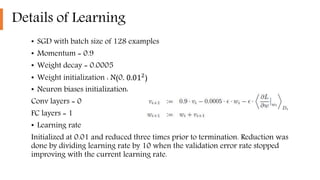
Details of Learning
• SGD with batch size of 128 examples
• Momentum = 0.9
• Weight decay = 0.0005
• Weight initialization : N(0, 0.012
)
• Neuron biases initialization:
Conv layers = 0
FC layers = 1
• Learning rate
Initialized at 0.01 and reduced three times prior to termination. Reduction was
done by dividing learning rate by 10 when the validation error rate stopped
improving with the current learning rate.
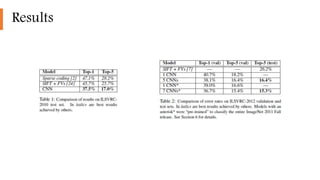
Results
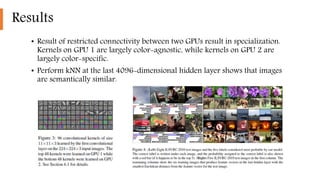
Results
• Result of restricted connectivity between two GPUs result in specialization.
Kernels on GPU 1 are largely color-agnostic, while kernels on GPU 2 are
largely color-specific.
• Perform kNN at the last 4096-dimensional hidden layer shows that images
are semantically similar.

ImageNet classification with deep convolutional neural networks(2012)

  • 1.
    ImageNet Classification withDeep Convolutional Neural Networks 신우철
  • 2.
    Introduction 1. Trained oneof the largest CNN on ImageNet data. The advantages of CNN are 1) CNN’s prior knowledge, which are stationarity of statistics and locality of pixel dependencies, 2) its easiness to be controlled, varying its depth and breath, contributing to fewer parameters and easier training. 2. Implemented highly-optimized GPU implementation to facilitate the training of large CNNs on high resolution images. 3. Introduced new features to improve performance, reduce training time, and prevent overfitting.
  • 3.
    Dataset • Down-sampled ImageNetimages to 256 x 256. Trained on centered raw RGB values of pixels. 1) Rescaled the image such that the shorter side was of length 256 2) Cropped out the central 256 x 256 patch from the resulting image of 1). 3) Subtracted the mean activity over the training set from each pixel. cf) NORB MNIST LabelMe
  • 4.
    Architecture • 8 layers= 5 Convolutional + 3 Fully-connected • Newly introduced features 1) ReLU Nonlinearity • Much faster to train since it is non-saturating • Nonlinear |tanh(x)| function focuses on preventing overfitting, while ReLU focuses on fast learning of large models on large datasets
  • 5.
    Architecture 2) Training ontwo GPUs • Cross-GPU parallelization, while the GPUs only communicate in certain layers. This is to tune the amount of computation by communication.
  • 6.
    Architecture 3) Local ResponseNormalization • Since the architecture uses ReLU, one high activation value can affect adjacent activation values in convolution or pooling. Therefore, LRN is conducted. filter : the activity of a neuron computed by applying kernel i at position (x,y) : the response-normalized activity N : #all kernels n : adjacent #kernels at position (x,y)
  • 7.
    Architecture 3) Local ResponseNormalization filter 0 filter 1 filter 2 filter 3 1 2 3 1 2 1 2 1 2 4 2 1 4 5 6 2 3 2 3 2 3 5 2 1 7 8 9 3 4 3 4 3 4 2 2 4 0.50 0.25 0.30 0.17 0.22 0.07 0.10 0.11 0.33 0.20 0.40 0.20 0.20 0.15 0.15 0.07 0.08 0.04 0.08 0.12 0.21 0.15 0.25 0.10 0.12 0.10 0.10 0.04 0.04 0.03 0.14 0.10 0.10 0.10 0.15 0.13 k alpha beta n N 0 1 1 2 4 = 2 {0 + 1 x 12 + 22 + 42 }1
  • 8.
    Architecture 4) Overlapping Pooling •Overlapping reduces overfitting compared to non-overlapping pooling.
  • 9.
  • 10.
    Convolutional layer Kernel size= 11 Stride = 4 Filter = 96 Zero-padding = 0 (227 – 11) / 4 + 1 = 55 Maxpooling Kernel size(z) = 3 Stride(s) = 2 Convolutional layer Kernel size = 5 Stride = 1 Filter = 256 Zero-padding = 2 (55 – 3) / 2 + 1 = 27 (27 +2 * 2 – 5) / 1 + 1 = 27 Local response normalization
  • 11.
    Convolutional layer Kernel size= 3 Stride = 1 Filter = 384 Zero-padding = 1 (27 + 1 * 2– 3) / 1 + 1 = 27 Convolutional layer Kernel size = 3 Stride = 1 Filter = 384 Zero-padding = 1 (13 +1 * 2– 3) / 1 + 1 = 13 Maxpooling Kernel size(z) = 3 Stride = 2 (27 – 3) / 2 + 1 = 13 Local response normalization
  • 12.
    Convolutional layer Kernel size= 3 Stride = 1 Filter = 256 Zero-padding = 1 (13 +1 * 2– 3) / 1 + 1 = 13 Maxpooling Kernel size(z) = 3 Stride = 2 (13 – 3) / 2 + 1 = 6 Flatten 6 * 6 * 256 = 9216 Fully connected 4096 Fully connected 4096 Fully connected 1000(softmax)
  • 13.
    Reducing Overfitting 1) DataAugmentation (1) Image translations and horizontal reflections Train set • Image translations (x (256-224) * (256-224)) • Horizontal reflections (x 2) Total : (256-224) * (256-224) * 2 = 2048 Test set • Image translations (x 5) • Horizontal reflections (x 2) • Total: 5 * 2 = 10
  • 14.
    Reducing Overfitting 1) DataAugmentation (2) Altering intensity of RGB channels (performing PCA) 2) Dropout • Applied dropout on first two FC layers with p = 0.5 Pi : eigen vector  : eigen value  : random =
  • 15.
    Details of Learning •SGD with batch size of 128 examples • Momentum = 0.9 • Weight decay = 0.0005 • Weight initialization : N(0, 0.012 ) • Neuron biases initialization: Conv layers = 0 FC layers = 1 • Learning rate Initialized at 0.01 and reduced three times prior to termination. Reduction was done by dividing learning rate by 10 when the validation error rate stopped improving with the current learning rate.
  • 16.
  • 17.
    Results • Result ofrestricted connectivity between two GPUs result in specialization. Kernels on GPU 1 are largely color-agnostic, while kernels on GPU 2 are largely color-specific. • Perform kNN at the last 4096-dimensional hidden layer shows that images are semantically similar.