TIME MANAGEMENT
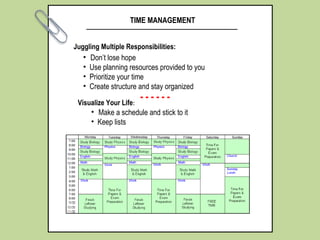
Juggling Multiple Responsibilities:
• Don’t lose hope
• Use planning resources provided to you
• Prioritize your time
• Create structure and stay organized
- - - - - -Visualize Your Life:
• Make a schedule and stick to it
• Keep lists
TIME MANAGEMENT
PROCRASTINATIO
N
MY DEFINITION
The refined art of laziness coupled with a relentless
need to wander around freely– that is until one
finally realizes that he or she has only just a few
minutes left to complete a large task which
ultimately results in that person running around
like a chicken with their head cut off.
WEBSTERS’ DEFINITION
To put off intentionally and habitually; to put off
intentionally the doing of something that should
be done.
TIME MANAGEMENT
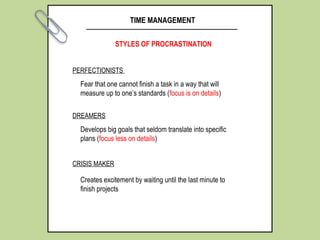
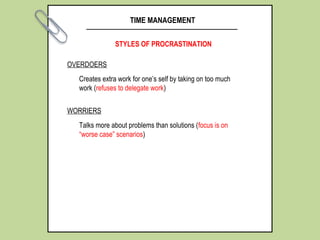
STYLES OF PROCRASTINATION
PERFECTIONISTS
DREAMERS
CRISIS MAKER
Fear that one cannot finish a task in a way that will
measure up to one’s standards (focus is on details)
Develops big goals that seldom translate into specific
plans (focus less on details)
Creates excitement by waiting until the last minute to
finish projects
TIME MANAGEMENT
STYLES OF PROCRASTINATION
OVERDOERS
Creates extra work for one’s self by taking on too much
work (refuses to delegate work)
WORRIERS
Talks more about problems than solutions (focus is on
“worse case” scenarios)
TIME MANAGEMENT
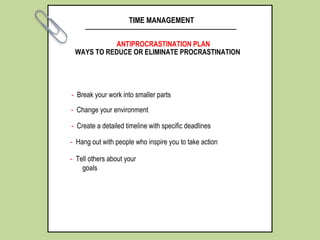
WAYS TO REDUCE OR ELIMINATE PROCRASTINATION
ANTIPROCRASTINATION PLAN
- Break your work into smaller parts
- Tell others about your
goals
- Change your environment
- Create a detailed timeline with specific deadlines
- Hang out with people who inspire you to take action
;’
TIME MANAGEMENT
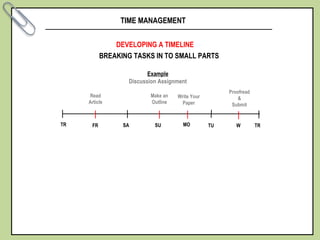
BREAKING TASKS IN TO SMALL PARTS
DEVELOPING A TIMELINE
TR FR SA SU MO TU W TR
Example
Discussion Assignment
Read
Article
Make an
Outline
Write Your
Paper
Proofread
&
Submit
TIME MANAGEMENT
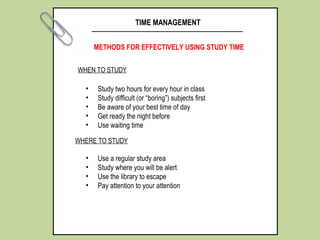
METHODS FOR EFFECTIVELY USING STUDY TIME
• Study two hours for every hour in class
• Study difficult (or “boring”) subjects first
• Be aware of your best time of day
• Get ready the night before
• Use waiting time
WHEN TO STUDY
WHERE TO STUDY
• Use a regular study area
• Study where you will be alert
• Use the library to escape
• Pay attention to your attention
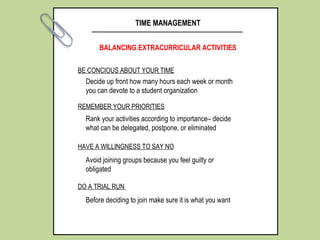
BE CONCIOUS ABOUT YOUR TIME
TIME MANAGEMENT
BALANCING EXTRACURRICULAR ACTIVITIES
REMEMBER YOUR PRIORITIES
HAVE A WILLINGNESS TO SAY NO
DO A TRIAL RUN
Decide up front how many hours each week or month
you can devote to a student organization
Rank your activities according to importance– decide
what can be delegated, postpone, or eliminated
Avoid joining groups because you feel guilty or
obligated
Before deciding to join make sure it is what you want
TIME MANAGEMENT
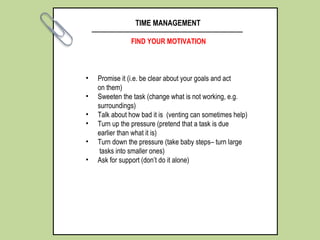
FIND YOUR MOTIVATION
• Promise it (i.e. be clear about your goals and act
on them)
• Sweeten the task (change what is not working, e.g.
surroundings)
• Talk about how bad it is (venting can sometimes help)
• Turn up the pressure (pretend that a task is due
earlier than what it is)
• Turn down the pressure (take baby steps– turn large
tasks into smaller ones)
• Ask for support (don’t do it alone)
TIME MANAGEMENT
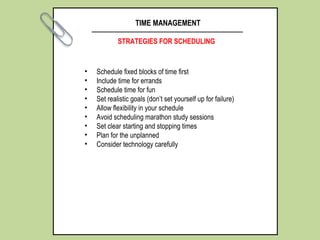
STRATEGIES FOR SCHEDULING
• Schedule fixed blocks of time first
• Include time for errands
• Schedule time for fun
• Set realistic goals (don’t set yourself up for failure)
• Allow flexibility in your schedule
• Avoid scheduling marathon study sessions
• Set clear starting and stopping times
• Plan for the unplanned
• Consider technology carefully
TIME MANAGEMENT
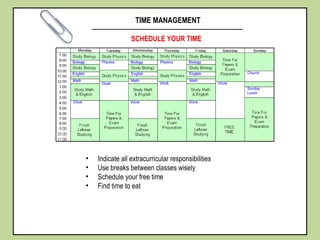
SCHEDULE YOUR TIME
• Indicate all extracurricular responsibilities
• Use breaks between classes wisely
• Schedule your free time
• Find time to eat
TIME MANAGEMENT
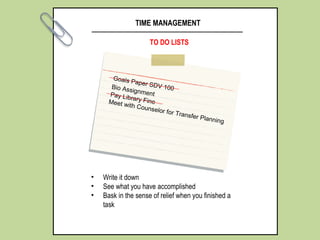
TO DO LISTS
• Write it down
• See what you have accomplished
• Bask in the sense of relief when you finished a
task
Goals Paper SDV 100Bio AssignmentPay Library FineMeet with Counselor for Transfer Planning
TIME MANAGEMENT
TAKE CARE OF YOURSELF
• Don’t put pressure on yourself to finish everything
at one time
• Take breaks between studying
• Eat healthy throughout the day
• Take a walk or exercise when you need to relax
MANAGE YOUR STRESS

Time Management

  • 2.
    TIME MANAGEMENT Juggling MultipleResponsibilities: • Don’t lose hope • Use planning resources provided to you • Prioritize your time • Create structure and stay organized - - - - - -Visualize Your Life: • Make a schedule and stick to it • Keep lists
  • 3.
    TIME MANAGEMENT PROCRASTINATIO N MY DEFINITION Therefined art of laziness coupled with a relentless need to wander around freely– that is until one finally realizes that he or she has only just a few minutes left to complete a large task which ultimately results in that person running around like a chicken with their head cut off. WEBSTERS’ DEFINITION To put off intentionally and habitually; to put off intentionally the doing of something that should be done.
  • 4.
    TIME MANAGEMENT STYLES OFPROCRASTINATION PERFECTIONISTS DREAMERS CRISIS MAKER Fear that one cannot finish a task in a way that will measure up to one’s standards (focus is on details) Develops big goals that seldom translate into specific plans (focus less on details) Creates excitement by waiting until the last minute to finish projects
  • 5.
    TIME MANAGEMENT STYLES OFPROCRASTINATION OVERDOERS Creates extra work for one’s self by taking on too much work (refuses to delegate work) WORRIERS Talks more about problems than solutions (focus is on “worse case” scenarios)
  • 6.
    TIME MANAGEMENT WAYS TOREDUCE OR ELIMINATE PROCRASTINATION ANTIPROCRASTINATION PLAN - Break your work into smaller parts - Tell others about your goals - Change your environment - Create a detailed timeline with specific deadlines - Hang out with people who inspire you to take action
  • 7.
    ;’ TIME MANAGEMENT BREAKING TASKSIN TO SMALL PARTS DEVELOPING A TIMELINE TR FR SA SU MO TU W TR Example Discussion Assignment Read Article Make an Outline Write Your Paper Proofread & Submit
  • 8.
    TIME MANAGEMENT METHODS FOREFFECTIVELY USING STUDY TIME • Study two hours for every hour in class • Study difficult (or “boring”) subjects first • Be aware of your best time of day • Get ready the night before • Use waiting time WHEN TO STUDY WHERE TO STUDY • Use a regular study area • Study where you will be alert • Use the library to escape • Pay attention to your attention
  • 9.
    BE CONCIOUS ABOUTYOUR TIME TIME MANAGEMENT BALANCING EXTRACURRICULAR ACTIVITIES REMEMBER YOUR PRIORITIES HAVE A WILLINGNESS TO SAY NO DO A TRIAL RUN Decide up front how many hours each week or month you can devote to a student organization Rank your activities according to importance– decide what can be delegated, postpone, or eliminated Avoid joining groups because you feel guilty or obligated Before deciding to join make sure it is what you want
  • 10.
    TIME MANAGEMENT FIND YOURMOTIVATION • Promise it (i.e. be clear about your goals and act on them) • Sweeten the task (change what is not working, e.g. surroundings) • Talk about how bad it is (venting can sometimes help) • Turn up the pressure (pretend that a task is due earlier than what it is) • Turn down the pressure (take baby steps– turn large tasks into smaller ones) • Ask for support (don’t do it alone)
  • 11.
    TIME MANAGEMENT STRATEGIES FORSCHEDULING • Schedule fixed blocks of time first • Include time for errands • Schedule time for fun • Set realistic goals (don’t set yourself up for failure) • Allow flexibility in your schedule • Avoid scheduling marathon study sessions • Set clear starting and stopping times • Plan for the unplanned • Consider technology carefully
  • 12.
    TIME MANAGEMENT SCHEDULE YOURTIME • Indicate all extracurricular responsibilities • Use breaks between classes wisely • Schedule your free time • Find time to eat
  • 13.
    TIME MANAGEMENT TO DOLISTS • Write it down • See what you have accomplished • Bask in the sense of relief when you finished a task Goals Paper SDV 100Bio AssignmentPay Library FineMeet with Counselor for Transfer Planning
  • 14.
    TIME MANAGEMENT TAKE CAREOF YOURSELF • Don’t put pressure on yourself to finish everything at one time • Take breaks between studying • Eat healthy throughout the day • Take a walk or exercise when you need to relax MANAGE YOUR STRESS