DEPARTMENT OF FARM ENGINEEERING
INSTITUTE OFAGRICULTURAL SCIENCES
BANARAS HINDU UNIVERSITY
VARANASI
PRESENTED BY
SNEHIL
ID. PF-24011
WATER EROSION PREDICTION PROJECT
WEPP MODEL
 The WEPP watershed model is a process-based, continuous simulation erosion prediction model built as an
extension of the WEPP hillslope model.
 Developed by USDA as a next-generation process-based soil erosion prediction model.
 Based on fundamentals of infiltration theory,hydrology,soil physics,plant science, hydraulics and erosion
mechanics.
 The WEPP erosion model computes soil loss along a slope and sediment yield at the end of a hill slope.
 Estimates spatial and temporal distribution of soil loss (daily, monthly, or annual)
 Applicable for Conservation planning,Project-level design and evaluation,Soil erosion inventory and
assessment
Continuation
 Simulates key processes such as:
i. Rill and interrill erosion.
ii. Sediment transport and deposition.
iii. Infiltration, runoff, and soil consolidation.
iv. Plant growth, residue effects, tillage operations, and soil roughness.
v. Snowmelt, frozen soil processes, and surface sealing.
 Allows routing of water and sediment through channels and impoundments.
 Supports evaluation of sediment control structures (ponds, terraces, check dams, etc.)
 Useful for soil conservation planning, erosion assessment, and land management
decisions.
 Interrill and rill erosion processes are considered,and it uses a steady-state sediment
continuity equation as a basis for the erosion computations.
WEPP Model scope and limitations:
 Applicable in areas dominated by overland flow.
 Does not simulate classical gully erosion.
 Applicability depends on topography and land use influencing channel
density.
SOFTWARE CHARACTERISTICS:-
 Designed to run on personal computers.
 Allows quick evaluation of alternative management scenarios
WEPP predicts:
Soil loss along a hillslope
Sediment yield at the hillslope outlet
Continuation
 Simulates two major erosion processes:
1.Interrill erosion – soil detachment by raindrop impact and transport by sheet flow
2.Rill erosion – controlled by flow shear stress, sediment load, and transport capacity
Erosion calculations assume steady-state conditions at peak
runoff rate.
Output: runoff volume, peak discharge, soil detachment, sediment
delivery
Continuation
Continuation
 Sediment detachment and deposition determined by:-
 Flow shear stress relative to critical shear stress.
 Sediment load relative to transport capacity
 An advantage of WEPP over UniversalSoilLossEquation(USLE) is that the
soil loss and deposition of sediment is estimated spatially along a profile.
 WEPP Model flexibility includes options for:
• Single storm events.
• Continuous long-term simulation.
• Single crop or crop rotations.
• Irrigated and rainfed systems.
• Tillage and conservation practices such as contour farming and strip cropping.
WEPP Model Components
WEPP consists of 9 integrated simulation components, including:-
 Climate generation
 Winter processes (Frozen soil processes, Snow accumulation and melt)
 Irrigation simulation
 Infiltration and overland flow hydraulics.
 Water balance and hydrology
 Plant growth modelling
 Residue decomposition
 Soil disturbance from tillage (Soil consolidation)
 Erosion and deposition processes
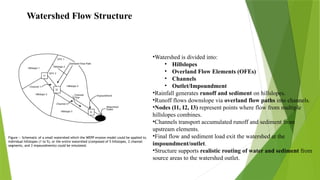
•Watershed is divided into:
• Hillslopes
• Overland Flow Elements (OFEs)
• Channels
• Outlet/Impoundment
•Rainfall generates runoff and sediment on hillslopes.
•Runoff flows downslope via overland flow paths into channels.
•Nodes (I1, I2, I3) represent points where flow from multiple
hillslopes combines.
•Channels transport accumulated runoff and sediment from
upstream elements.
•Final flow and sediment load exit the watershed at the
impoundment/outlet.
•Structure supports realistic routing of water and sediment from
source areas to the watershed outlet.
Watershed Flow Structure
Figure :- Schematic of a small watershed which the WEPP erosion model could be applied to.
Individual hillslopes (1 to 5), or the entire watershed (composed of 5 hillslopes, 2 channel
segments, and 3 impoundments) could be simulated.
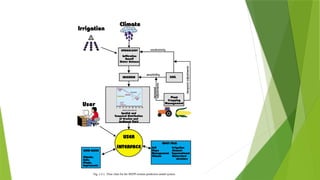
Inputs to the Model
These come from following major sources:
Climate:-Rainfall,Temperature,Wind,Snowmelt,Climate (affects infiltration, runoff,
evaporation, and plant growth).
Soil:-Texture,Structure,Hydraulic conductivity,Erodibility,Soil properties influence water
infiltration and erosion resistance.
Plant and Cropping Management:-Crop rotation,Residue cover,Tillage practices(this
determines surface cover, infiltration rate, and soil disturbance, affecting erosion).
Irrigation:-Type of irrigation,Schedule,Water quantity
Adds water to the system and influences runoff and infiltration.
Internal Model Components
 After receiving inputs, WEPP performs simulations in two key process blocks:
➡ Hydrology Component
Includes:
 Infiltration
 Runoff computation
 Soil water balance
 Hydrology determines how much rainfall becomes runoff.
➡ Erosion Component
 Uses hydrology output to simulate:
 Rill erosion
 Interrill erosion
 Sediment transport and deposition
 Soil erodibility values from the soil database and timing of management operations influence erosion prediction.
Model Feedback Loops
 Soil and plant management change over time → modifies infiltration and erodibility
 Hydrology outputs → influence erosion rate
 Erosion processes → depend on sediment supply and transport capacity
 This allows WEPP to simulate erosion dynamically over time, not just event-based.
User Interaction System
•Users enter input files (soil, slope, climate, management, irrigation, channel, watershed
structure).
•WEPP retrieves additional info from internal databases.
•Model processes data and generates spatial and temporal erosion and sediment yield
outputs.
Final Output
 Spatial and temporal distribution of erosion and sediment yield
The model provides:
 Maps of erosion hotspots
 Sediment yield at watershed outlet
 Runoff pattern over time
Runoff Framework
 Runoff occurs when precipitation exceeds infiltration.
 Uses modified Green–Ampt Mein-Larson infiltration equation.
 Accounts for land cover, soil moisture, slope & management practice.
 Runoff is based on:
 Rainfall intensity distribution
 Infiltration
 Soil hydraulic properties
 WEPP uses a continuous simulation approach.
Infiltration Model in WEPP
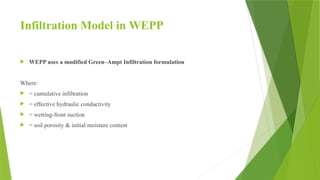
 WEPP uses a modified Green–Ampt Infiltration formulation
Where:
 = cumulative infiltration
 = effective hydraulic conductivity
 = wetting-front suction
 = soil porosity & initial moisture content
Runoff Calculation
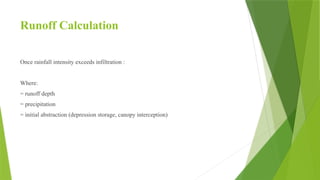
Once rainfall intensity exceeds infiltration :
Where:
= runoff depth
= precipitation
= initial abstraction (depression storage, canopy interception)
Peak Runoff Estimation
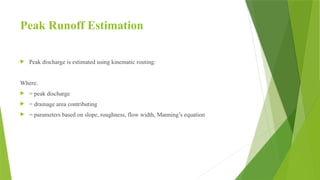
 Peak discharge is estimated using kinematic routing:
Where:
 = peak discharge
 = drainage area contributing
 = parameters based on slope, roughness, flow width, Manning’s equation
Sediment Detachment Processes
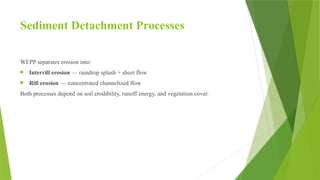
WEPP separates erosion into:
 Interrill erosion — raindrop splash + sheet flow
 Rill erosion — concentrated channelized flow
Both processes depend on soil erodibility, runoff energy, and vegetation cover.
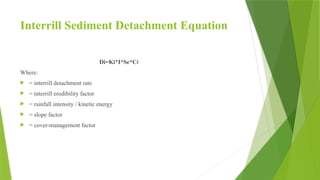
Interrill Sediment Detachment Equation
Di​
=Ki​
*I*Se​
*C​
f
Where:
 = interrill detachment rate
 = interrill erodibility factor
 = rainfall intensity / kinetic energy
 = slope factor
 = cover-management factor
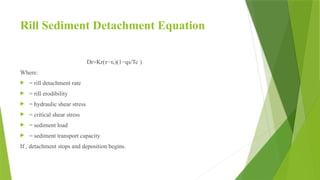
Rill Sediment Detachment Equation
Dr​
=Kr​
(τ−τc​
)(1−​
qs​
​
/Tc​)
Where:
 = rill detachment rate
 = rill erodibility
 = hydraulic shear stress
 = critical shear stress
 = sediment load
 = sediment transport capacity
If , detachment stops and deposition begins.
Sediment Transport & Deposition
 Transport capacity equation used:
Where:
 = maximum sediment transport
 = discharge
 = slope
 = empirical constants
Deposition occurs when:
Watershed Sediment Yield Output
•WEPP integrates:
i. Hillslope detachment/deposition
ii. Channel routing and sediment transport
•Final Output:
•Runoff hydrograph
•Delivered sediment yield (Mg/ha/yr)
•Spatial erosion maps (rill hotspots, deposition zones)
Thankyou

soil erosion MODEL for computing soil erosion.pptx

  • 1.
    DEPARTMENT OF FARMENGINEEERING INSTITUTE OFAGRICULTURAL SCIENCES BANARAS HINDU UNIVERSITY VARANASI PRESENTED BY SNEHIL ID. PF-24011 WATER EROSION PREDICTION PROJECT
  • 2.
    WEPP MODEL  TheWEPP watershed model is a process-based, continuous simulation erosion prediction model built as an extension of the WEPP hillslope model.  Developed by USDA as a next-generation process-based soil erosion prediction model.  Based on fundamentals of infiltration theory,hydrology,soil physics,plant science, hydraulics and erosion mechanics.  The WEPP erosion model computes soil loss along a slope and sediment yield at the end of a hill slope.  Estimates spatial and temporal distribution of soil loss (daily, monthly, or annual)  Applicable for Conservation planning,Project-level design and evaluation,Soil erosion inventory and assessment
  • 3.
    Continuation  Simulates keyprocesses such as: i. Rill and interrill erosion. ii. Sediment transport and deposition. iii. Infiltration, runoff, and soil consolidation. iv. Plant growth, residue effects, tillage operations, and soil roughness. v. Snowmelt, frozen soil processes, and surface sealing.  Allows routing of water and sediment through channels and impoundments.  Supports evaluation of sediment control structures (ponds, terraces, check dams, etc.)  Useful for soil conservation planning, erosion assessment, and land management decisions.  Interrill and rill erosion processes are considered,and it uses a steady-state sediment continuity equation as a basis for the erosion computations.
  • 4.
    WEPP Model scopeand limitations:  Applicable in areas dominated by overland flow.  Does not simulate classical gully erosion.  Applicability depends on topography and land use influencing channel density. SOFTWARE CHARACTERISTICS:-  Designed to run on personal computers.  Allows quick evaluation of alternative management scenarios WEPP predicts: Soil loss along a hillslope Sediment yield at the hillslope outlet Continuation
  • 5.
     Simulates twomajor erosion processes: 1.Interrill erosion – soil detachment by raindrop impact and transport by sheet flow 2.Rill erosion – controlled by flow shear stress, sediment load, and transport capacity Erosion calculations assume steady-state conditions at peak runoff rate. Output: runoff volume, peak discharge, soil detachment, sediment delivery Continuation
  • 6.
    Continuation  Sediment detachmentand deposition determined by:-  Flow shear stress relative to critical shear stress.  Sediment load relative to transport capacity  An advantage of WEPP over UniversalSoilLossEquation(USLE) is that the soil loss and deposition of sediment is estimated spatially along a profile.  WEPP Model flexibility includes options for: • Single storm events. • Continuous long-term simulation. • Single crop or crop rotations. • Irrigated and rainfed systems. • Tillage and conservation practices such as contour farming and strip cropping.
  • 7.
    WEPP Model Components WEPPconsists of 9 integrated simulation components, including:-  Climate generation  Winter processes (Frozen soil processes, Snow accumulation and melt)  Irrigation simulation  Infiltration and overland flow hydraulics.  Water balance and hydrology  Plant growth modelling  Residue decomposition  Soil disturbance from tillage (Soil consolidation)  Erosion and deposition processes
  • 8.
    •Watershed is dividedinto: • Hillslopes • Overland Flow Elements (OFEs) • Channels • Outlet/Impoundment •Rainfall generates runoff and sediment on hillslopes. •Runoff flows downslope via overland flow paths into channels. •Nodes (I1, I2, I3) represent points where flow from multiple hillslopes combines. •Channels transport accumulated runoff and sediment from upstream elements. •Final flow and sediment load exit the watershed at the impoundment/outlet. •Structure supports realistic routing of water and sediment from source areas to the watershed outlet. Watershed Flow Structure Figure :- Schematic of a small watershed which the WEPP erosion model could be applied to. Individual hillslopes (1 to 5), or the entire watershed (composed of 5 hillslopes, 2 channel segments, and 3 impoundments) could be simulated.
  • 9.
    Inputs to theModel These come from following major sources: Climate:-Rainfall,Temperature,Wind,Snowmelt,Climate (affects infiltration, runoff, evaporation, and plant growth). Soil:-Texture,Structure,Hydraulic conductivity,Erodibility,Soil properties influence water infiltration and erosion resistance. Plant and Cropping Management:-Crop rotation,Residue cover,Tillage practices(this determines surface cover, infiltration rate, and soil disturbance, affecting erosion). Irrigation:-Type of irrigation,Schedule,Water quantity Adds water to the system and influences runoff and infiltration.
  • 10.
    Internal Model Components After receiving inputs, WEPP performs simulations in two key process blocks: ➡ Hydrology Component Includes:  Infiltration  Runoff computation  Soil water balance  Hydrology determines how much rainfall becomes runoff. ➡ Erosion Component  Uses hydrology output to simulate:  Rill erosion  Interrill erosion  Sediment transport and deposition  Soil erodibility values from the soil database and timing of management operations influence erosion prediction.
  • 11.
    Model Feedback Loops Soil and plant management change over time → modifies infiltration and erodibility  Hydrology outputs → influence erosion rate  Erosion processes → depend on sediment supply and transport capacity  This allows WEPP to simulate erosion dynamically over time, not just event-based.
  • 12.
    User Interaction System •Usersenter input files (soil, slope, climate, management, irrigation, channel, watershed structure). •WEPP retrieves additional info from internal databases. •Model processes data and generates spatial and temporal erosion and sediment yield outputs.
  • 13.
    Final Output  Spatialand temporal distribution of erosion and sediment yield The model provides:  Maps of erosion hotspots  Sediment yield at watershed outlet  Runoff pattern over time
  • 15.
    Runoff Framework  Runoffoccurs when precipitation exceeds infiltration.  Uses modified Green–Ampt Mein-Larson infiltration equation.  Accounts for land cover, soil moisture, slope & management practice.  Runoff is based on:  Rainfall intensity distribution  Infiltration  Soil hydraulic properties  WEPP uses a continuous simulation approach.

  • 16.
    Infiltration Model inWEPP  WEPP uses a modified Green–Ampt Infiltration formulation Where:  = cumulative infiltration  = effective hydraulic conductivity  = wetting-front suction  = soil porosity & initial moisture content
  • 17.
    Runoff Calculation Once rainfallintensity exceeds infiltration : Where: = runoff depth = precipitation = initial abstraction (depression storage, canopy interception)
  • 18.
    Peak Runoff Estimation Peak discharge is estimated using kinematic routing: Where:  = peak discharge  = drainage area contributing  = parameters based on slope, roughness, flow width, Manning’s equation
  • 19.
    Sediment Detachment Processes WEPPseparates erosion into:  Interrill erosion — raindrop splash + sheet flow  Rill erosion — concentrated channelized flow Both processes depend on soil erodibility, runoff energy, and vegetation cover.
  • 20.
    Interrill Sediment DetachmentEquation Di​ =Ki​ *I*Se​ *C​ f Where:  = interrill detachment rate  = interrill erodibility factor  = rainfall intensity / kinetic energy  = slope factor  = cover-management factor
  • 21.
    Rill Sediment DetachmentEquation Dr​ =Kr​ (τ−τc​ )(1−​ qs​ ​ /Tc​) Where:  = rill detachment rate  = rill erodibility  = hydraulic shear stress  = critical shear stress  = sediment load  = sediment transport capacity If , detachment stops and deposition begins.
  • 22.
    Sediment Transport &Deposition  Transport capacity equation used: Where:  = maximum sediment transport  = discharge  = slope  = empirical constants Deposition occurs when:
  • 23.
    Watershed Sediment YieldOutput •WEPP integrates: i. Hillslope detachment/deposition ii. Channel routing and sediment transport •Final Output: •Runoff hydrograph •Delivered sediment yield (Mg/ha/yr) •Spatial erosion maps (rill hotspots, deposition zones)
  • 24.