EFFECTIVE
INTERVIEWING
(Phase I)
THE RECRUITMENT
LANDSCAPE
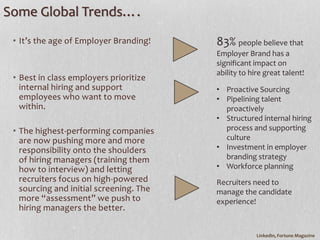
Some Global Trends….
• It’s the age of Employer Branding!
• Best in class employers prioritize
internal hiring and support
employees who want to move
within.
• The highest-performing companies
are now pushing more and more
responsibility onto the shoulders
of hiring managers (training them
how to interview) and letting
recruiters focus on high-powered
sourcing and initial screening. The
more “assessment” we push to
hiring managers the better.
83% people believe that
Employer Brand has a
significant impact on
ability to hire great talent!
• Proactive Sourcing
• Pipelining talent
proactively
• Structured internal hiring
process and supporting
culture
• Investment in employer
branding strategy
• Workforce planning
Recruiters need to
manage the candidate
experience!
LinkedIn, Fortune Magazine
(Phase I)
TRAINING AGENDA &
OBJECTIVES
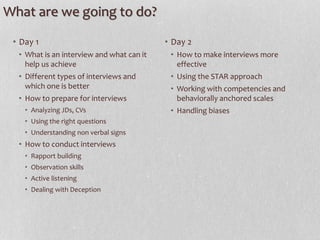
What are we going to do?
• Day 1
• What is an interview and what can it
help us achieve
• Different types of interviews and
which one is better
• How to prepare for interviews
• Analyzing JDs, CVs
• Using the right questions
• Understanding non verbal signs
• How to conduct interviews
• Rapport building
• Observation skills
• Active listening
• Dealing with Deception
• Day 2
• How to make interviews more
effective
• Using the STAR approach
• Working with competencies and
behaviorally anchored scales
• Handling biases
(Phase II)
INTERVIEWING
LANDSCAPE
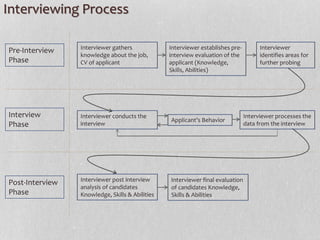
Interviewing Process
Interview
Phase
Pre-Interview
Phase
Post-Interview
Phase
Interviewer gathers
knowledge about the job,
CV of applicant
Interviewer establishes pre-
interview evaluation of the
applicant (Knowledge,
Skills, Abilities)
Interviewer
identifies areas for
further probing
Interviewer conducts the
interview
Applicant’s Behavior
Interviewer processes the
data from the interview
Interviewer post interview
analysis of candidates
Knowledge, Skills & Abilities
Interviewer final evaluation
of candidates Knowledge,
Skills & Abilities
Definition & Characteristics of an ‘Interview’
“A professional conversation conducted with a specific
purpose or goal in mind.”
• It is one of the tools for assessment (and selection for
a job)
• It is a fact gathering exercise; collecting evidence
• It is neither coaching nor mentoring, and nor an
interrogation
• A job interview is a process that allows an
interviewer to assess (and to some extent predict) the
future potential for success of a candidate (in a given
organization at a given role)
Types of Job Interviews
• Traditional
• Asking questions like: ‘tell me about yourself?’; ‘What would you do in a
XYZ situation?’
• The candidate can get away easily as there is no criteria to assess against
• Unstructured
• Interviewer goes with the flow of the candidate, a casual conversation
• There is no criteria to judge, no reliability but a lot of personal bias
• Behavioral
• Asking questions that elicit specific behaviors that are important for the
job at hand
• Past behavior is the best predictor of the future behavior: One can identify
how the candidate will act in a future scenario
• Structured
• Each candidate goes through the same sequence and questions, less
interviewer discretion
• One can easily compare objectively one candidate with another or one
interviewer’s assessment with another
Conducting Interviews
Assuming that the main interview will last for 1 hour,
the approximate times for each step of the interview
could be:
• Introduction; Job Preview; Rapport building (20 minutes)
• Main Interview (60 minutes)
• Closing/Summarizing; Candidate Questions; Way forward
(10 minutes)
Making Interviews Effective
• Focus on objectively defined success behaviors (i.e.,
competencies)
• Focus on ‘hard-to-learn’ attributes and ‘Hit-The-Ground-
Running’ management/technical skills
• Use the 80/20 principle (focus on a few competencies
demonstrated consistently over time)
• Ask open-ended questions, listen, encourage & probe
(instead of talking & telling)
• Gather evidence about performance from real success
stories (not hearsay or opinions)
• Determine what an applicant actually did to succeed
(vs. what they think should be done!)
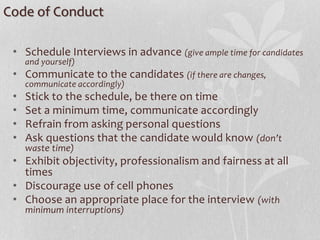
Code of Conduct
• Schedule Interviews in advance (give ample time for candidates
and yourself)
• Communicate to the candidates (if there are changes,
communicate accordingly)
• Stick to the schedule, be there on time
• Set a minimum time, communicate accordingly
• Refrain from asking personal questions
• Ask questions that the candidate would know (don’t
waste time)
• Exhibit objectivity, professionalism and fairness at all
times
• Discourage use of cell phones
• Choose an appropriate place for the interview (with
minimum interruptions)
(Phase III)
BUILDING
INTERVIEWING
COMPETENCIES
Building Interviewing Competencies
• Rapport Building
• Asking the right questions
• Active Listening
• Observation Skills
• Note Taking
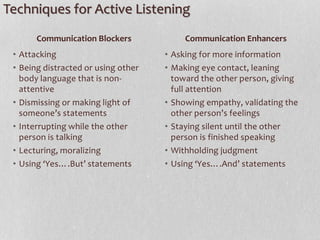
Techniques for Active Listening
• Attacking
• Being distracted or using other
body language that is non-
attentive
• Dismissing or making light of
someone’s statements
• Interrupting while the other
person is talking
• Lecturing, moralizing
• Using ‘Yes….But’ statements
• Asking for more information
• Making eye contact, leaning
toward the other person, giving
full attention
• Showing empathy, validating the
other person’s feelings
• Staying silent until the other
person is finished speaking
• Withholding judgment
• Using ‘Yes….And’ statements
Communication Blockers Communication Enhancers
(Phase IV)
PREPARING FOR THE
INTERVIEW
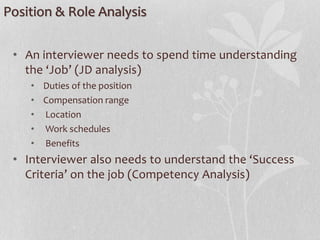
Position & Role Analysis
• An interviewer needs to spend time understanding
the ‘Job’ (JD analysis)
• Duties of the position
• Compensation range
• Location
• Work schedules
• Benefits
• Interviewer also needs to understand the ‘Success
Criteria’ on the job (Competency Analysis)
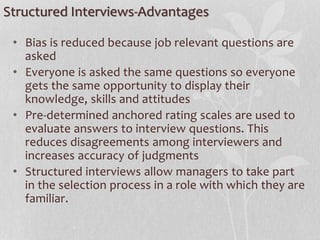
Structured Interviews-Advantages
• Bias is reduced because job relevant questions are
asked
• Everyone is asked the same questions so everyone
gets the same opportunity to display their
knowledge, skills and attitudes
• Pre-determined anchored rating scales are used to
evaluate answers to interview questions. This
reduces disagreements among interviewers and
increases accuracy of judgments
• Structured interviews allow managers to take part
in the selection process in a role with which they are
familiar.
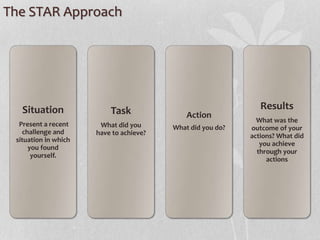
The STAR Approach
Situation
Present a recent
challenge and
situation in which
you found
yourself.
Task
What did you
have to achieve?
Action
What did you do?
Results
What was the
outcome of your
actions? What did
you achieve
through your
actions
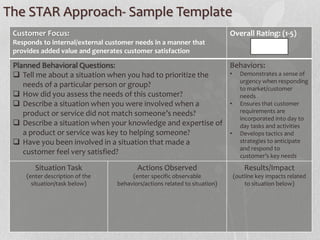
The STAR Approach- Sample Template
Customer Focus:
Responds to internal/external customer needs in a manner that
provides added value and generates customer satisfaction
Overall Rating: (1-5)
Planned Behavioral Questions:
 Tell me about a situation when you had to prioritize the
needs of a particular person or group?
 How did you assess the needs of this customer?
 Describe a situation when you were involved when a
product or service did not match someone’s needs?
 Describe a situation when your knowledge and expertise of
a product or service was key to helping someone?
 Have you been involved in a situation that made a
customer feel very satisfied?
Behaviors:
• Demonstrates a sense of
urgency when responding
to market/customer
needs
• Ensures that customer
requirements are
incorporated into day to
day tasks and activities
• Develops tactics and
strategies to anticipate
and respond to
customer’s key needs
Situation Task
(enter description of the
situation/task below)
Actions Observed
(enter specific observable
behaviors/actions related to situation)
Results/Impact
(outline key impacts related
to situation below)
Thank you!

Effective interviewing skills

  • 1.
  • 2.
  • 3.
    Some Global Trends…. •It’s the age of Employer Branding! • Best in class employers prioritize internal hiring and support employees who want to move within. • The highest-performing companies are now pushing more and more responsibility onto the shoulders of hiring managers (training them how to interview) and letting recruiters focus on high-powered sourcing and initial screening. The more “assessment” we push to hiring managers the better. 83% people believe that Employer Brand has a significant impact on ability to hire great talent! • Proactive Sourcing • Pipelining talent proactively • Structured internal hiring process and supporting culture • Investment in employer branding strategy • Workforce planning Recruiters need to manage the candidate experience! LinkedIn, Fortune Magazine
  • 4.
  • 5.
    What are wegoing to do? • Day 1 • What is an interview and what can it help us achieve • Different types of interviews and which one is better • How to prepare for interviews • Analyzing JDs, CVs • Using the right questions • Understanding non verbal signs • How to conduct interviews • Rapport building • Observation skills • Active listening • Dealing with Deception • Day 2 • How to make interviews more effective • Using the STAR approach • Working with competencies and behaviorally anchored scales • Handling biases
  • 6.
  • 7.
    Interviewing Process Interview Phase Pre-Interview Phase Post-Interview Phase Interviewer gathers knowledgeabout the job, CV of applicant Interviewer establishes pre- interview evaluation of the applicant (Knowledge, Skills, Abilities) Interviewer identifies areas for further probing Interviewer conducts the interview Applicant’s Behavior Interviewer processes the data from the interview Interviewer post interview analysis of candidates Knowledge, Skills & Abilities Interviewer final evaluation of candidates Knowledge, Skills & Abilities
  • 8.
    Definition & Characteristicsof an ‘Interview’ “A professional conversation conducted with a specific purpose or goal in mind.” • It is one of the tools for assessment (and selection for a job) • It is a fact gathering exercise; collecting evidence • It is neither coaching nor mentoring, and nor an interrogation • A job interview is a process that allows an interviewer to assess (and to some extent predict) the future potential for success of a candidate (in a given organization at a given role)
  • 9.
    Types of JobInterviews • Traditional • Asking questions like: ‘tell me about yourself?’; ‘What would you do in a XYZ situation?’ • The candidate can get away easily as there is no criteria to assess against • Unstructured • Interviewer goes with the flow of the candidate, a casual conversation • There is no criteria to judge, no reliability but a lot of personal bias • Behavioral • Asking questions that elicit specific behaviors that are important for the job at hand • Past behavior is the best predictor of the future behavior: One can identify how the candidate will act in a future scenario • Structured • Each candidate goes through the same sequence and questions, less interviewer discretion • One can easily compare objectively one candidate with another or one interviewer’s assessment with another
  • 10.
    Conducting Interviews Assuming thatthe main interview will last for 1 hour, the approximate times for each step of the interview could be: • Introduction; Job Preview; Rapport building (20 minutes) • Main Interview (60 minutes) • Closing/Summarizing; Candidate Questions; Way forward (10 minutes)
  • 11.
    Making Interviews Effective •Focus on objectively defined success behaviors (i.e., competencies) • Focus on ‘hard-to-learn’ attributes and ‘Hit-The-Ground- Running’ management/technical skills • Use the 80/20 principle (focus on a few competencies demonstrated consistently over time) • Ask open-ended questions, listen, encourage & probe (instead of talking & telling) • Gather evidence about performance from real success stories (not hearsay or opinions) • Determine what an applicant actually did to succeed (vs. what they think should be done!)
  • 12.
    Code of Conduct •Schedule Interviews in advance (give ample time for candidates and yourself) • Communicate to the candidates (if there are changes, communicate accordingly) • Stick to the schedule, be there on time • Set a minimum time, communicate accordingly • Refrain from asking personal questions • Ask questions that the candidate would know (don’t waste time) • Exhibit objectivity, professionalism and fairness at all times • Discourage use of cell phones • Choose an appropriate place for the interview (with minimum interruptions)
  • 13.
  • 14.
    Building Interviewing Competencies •Rapport Building • Asking the right questions • Active Listening • Observation Skills • Note Taking
  • 15.
    Techniques for ActiveListening • Attacking • Being distracted or using other body language that is non- attentive • Dismissing or making light of someone’s statements • Interrupting while the other person is talking • Lecturing, moralizing • Using ‘Yes….But’ statements • Asking for more information • Making eye contact, leaning toward the other person, giving full attention • Showing empathy, validating the other person’s feelings • Staying silent until the other person is finished speaking • Withholding judgment • Using ‘Yes….And’ statements Communication Blockers Communication Enhancers
  • 16.
  • 17.
    Position & RoleAnalysis • An interviewer needs to spend time understanding the ‘Job’ (JD analysis) • Duties of the position • Compensation range • Location • Work schedules • Benefits • Interviewer also needs to understand the ‘Success Criteria’ on the job (Competency Analysis)
  • 18.
    Structured Interviews-Advantages • Biasis reduced because job relevant questions are asked • Everyone is asked the same questions so everyone gets the same opportunity to display their knowledge, skills and attitudes • Pre-determined anchored rating scales are used to evaluate answers to interview questions. This reduces disagreements among interviewers and increases accuracy of judgments • Structured interviews allow managers to take part in the selection process in a role with which they are familiar.
  • 19.
    The STAR Approach Situation Presenta recent challenge and situation in which you found yourself. Task What did you have to achieve? Action What did you do? Results What was the outcome of your actions? What did you achieve through your actions
  • 20.
    The STAR Approach-Sample Template Customer Focus: Responds to internal/external customer needs in a manner that provides added value and generates customer satisfaction Overall Rating: (1-5) Planned Behavioral Questions:  Tell me about a situation when you had to prioritize the needs of a particular person or group?  How did you assess the needs of this customer?  Describe a situation when you were involved when a product or service did not match someone’s needs?  Describe a situation when your knowledge and expertise of a product or service was key to helping someone?  Have you been involved in a situation that made a customer feel very satisfied? Behaviors: • Demonstrates a sense of urgency when responding to market/customer needs • Ensures that customer requirements are incorporated into day to day tasks and activities • Develops tactics and strategies to anticipate and respond to customer’s key needs Situation Task (enter description of the situation/task below) Actions Observed (enter specific observable behaviors/actions related to situation) Results/Impact (outline key impacts related to situation below)
  • 21.