The Information
Flows in The
Organization
Presented by
Sugiharto, SH. MM

© SUGIHARTO, SH.MM GICI Business School
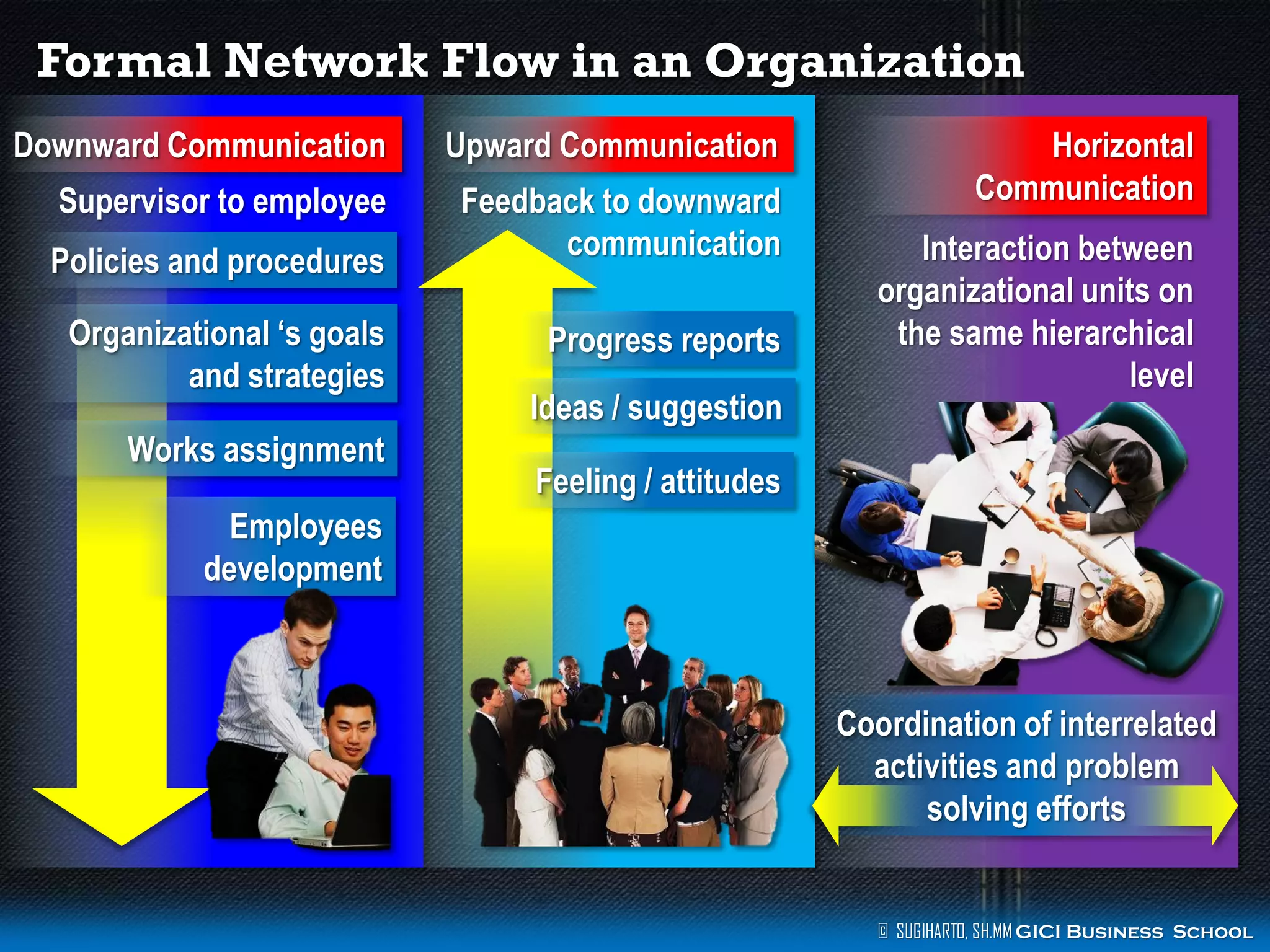
Formal Network Flow in an Organization
Downward Communication

Upward Communication

Supervisor to employee

Feedback to downward
communication

Policies and procedures
Organizational ‗s goals
and strategies
Works assignment

Progress reports
Ideas / suggestion

Horizontal
Communication
Interaction between
organizational units on
the same hierarchical
level

Feeling / attitudes

Employees
development

Coordination of interrelated
activities and problem
solving efforts

© SUGIHARTO, SH.MM GICI Business School
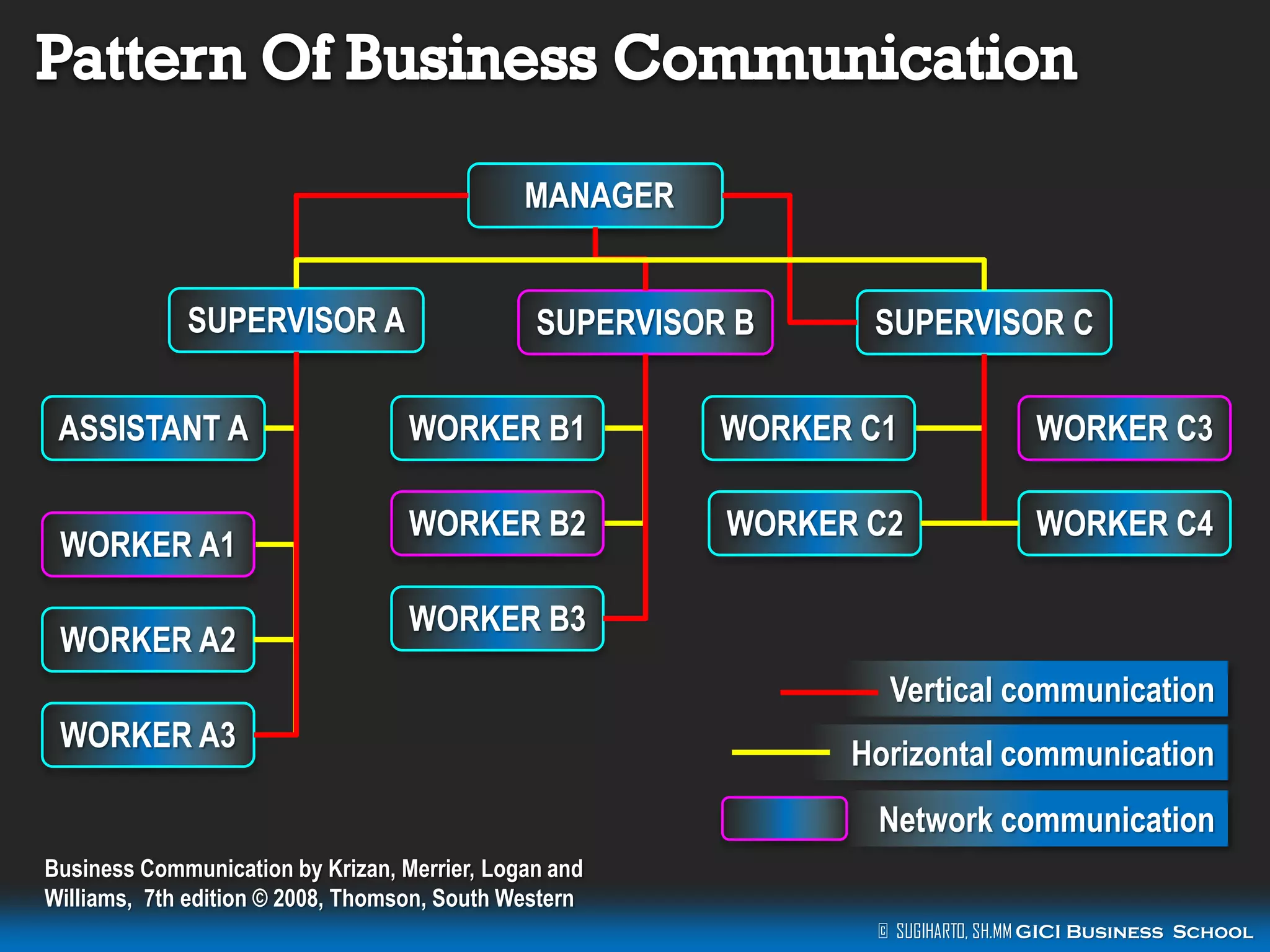
MANAGER
SUPERVISOR A
ASSISTANT A
WORKER A1
WORKER A2

SUPERVISOR B

SUPERVISOR C

WORKER B1

WORKER C1

WORKER C3

WORKER B2

WORKER C2

WORKER C4

WORKER B3
Vertical communication

WORKER A3

Horizontal communication
Network communication

Business Communication by Krizan, Merrier, Logan and
Williams, 7th edition © 2008, Thomson, South Western
© SUGIHARTO, SH.MM GICI Business School
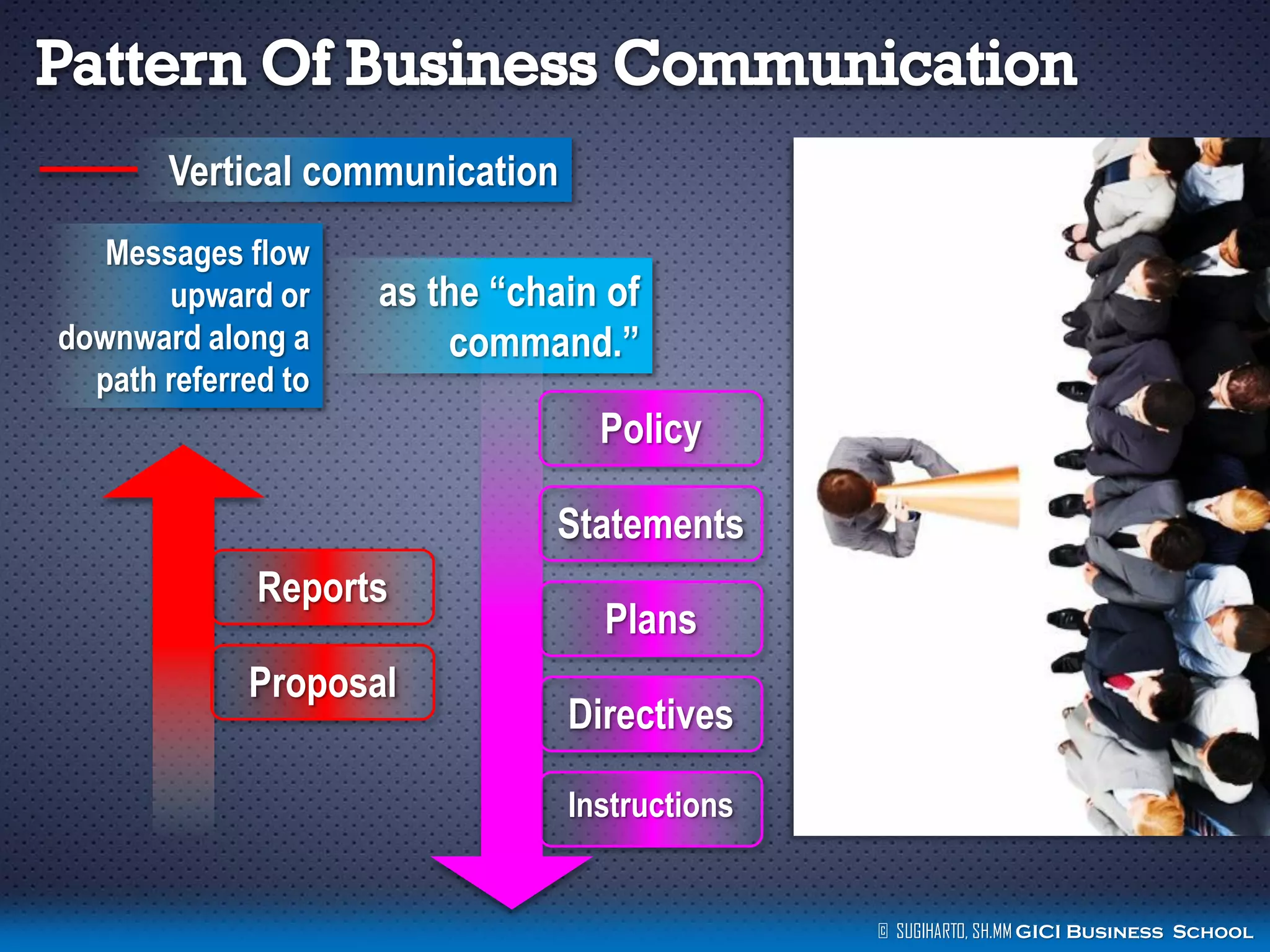
Vertical communication
Messages flow
upward or
downward along a
path referred to

as the ―chain of
command.‖
Policy

Statements
Reports

Proposal

Plans

Directives
Instructions

© SUGIHARTO, SH.MM GICI Business School
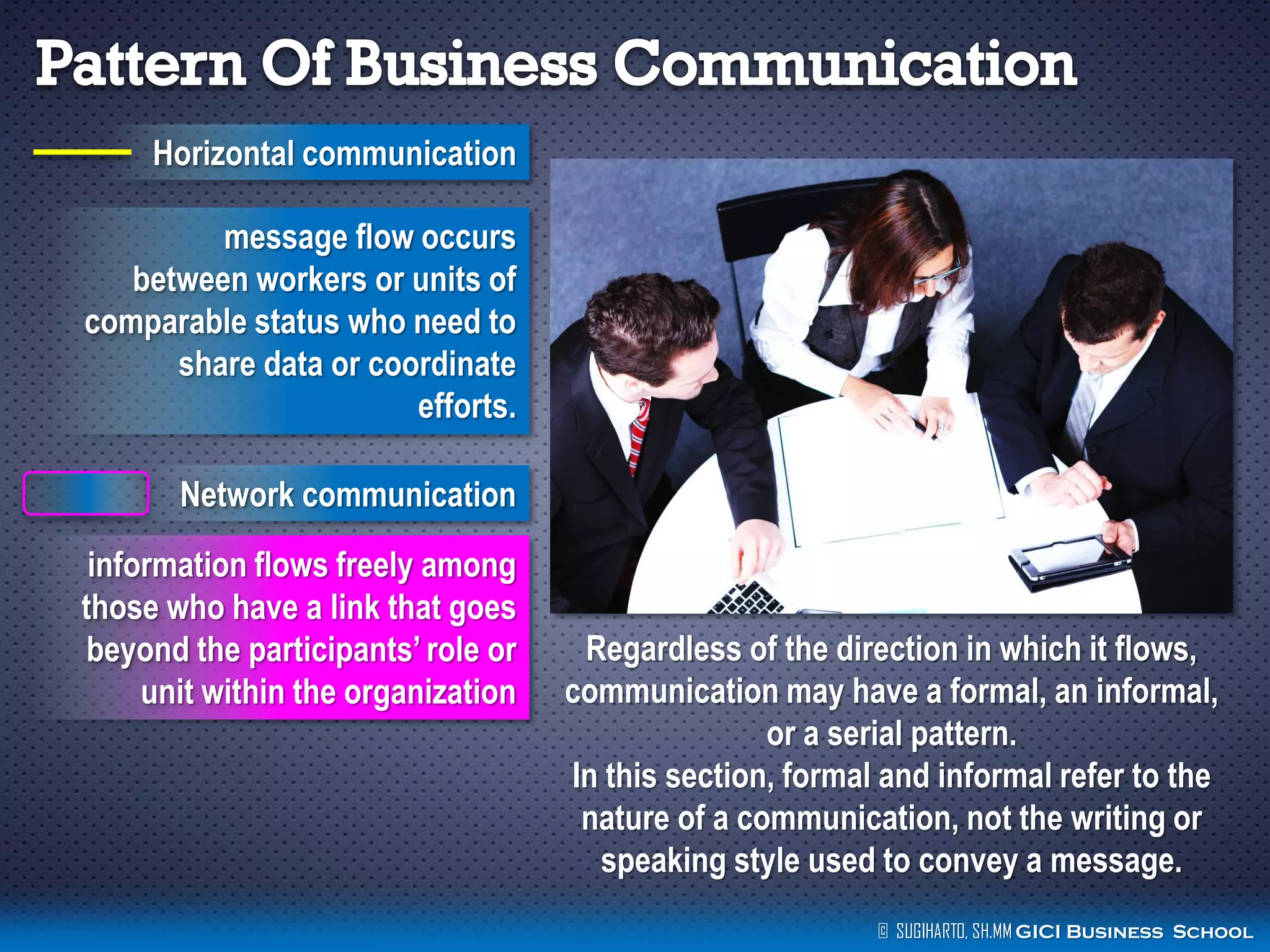
Horizontal communication
message flow occurs
between workers or units of
comparable status who need to
share data or coordinate
efforts.
Network communication
information flows freely among
those who have a link that goes
beyond the participants‘ role or
unit within the organization

Regardless of the direction in which it flows,
communication may have a formal, an informal,
or a serial pattern.
In this section, formal and informal refer to the
nature of a communication, not the writing or
speaking style used to convey a message.
© SUGIHARTO, SH.MM GICI Business School
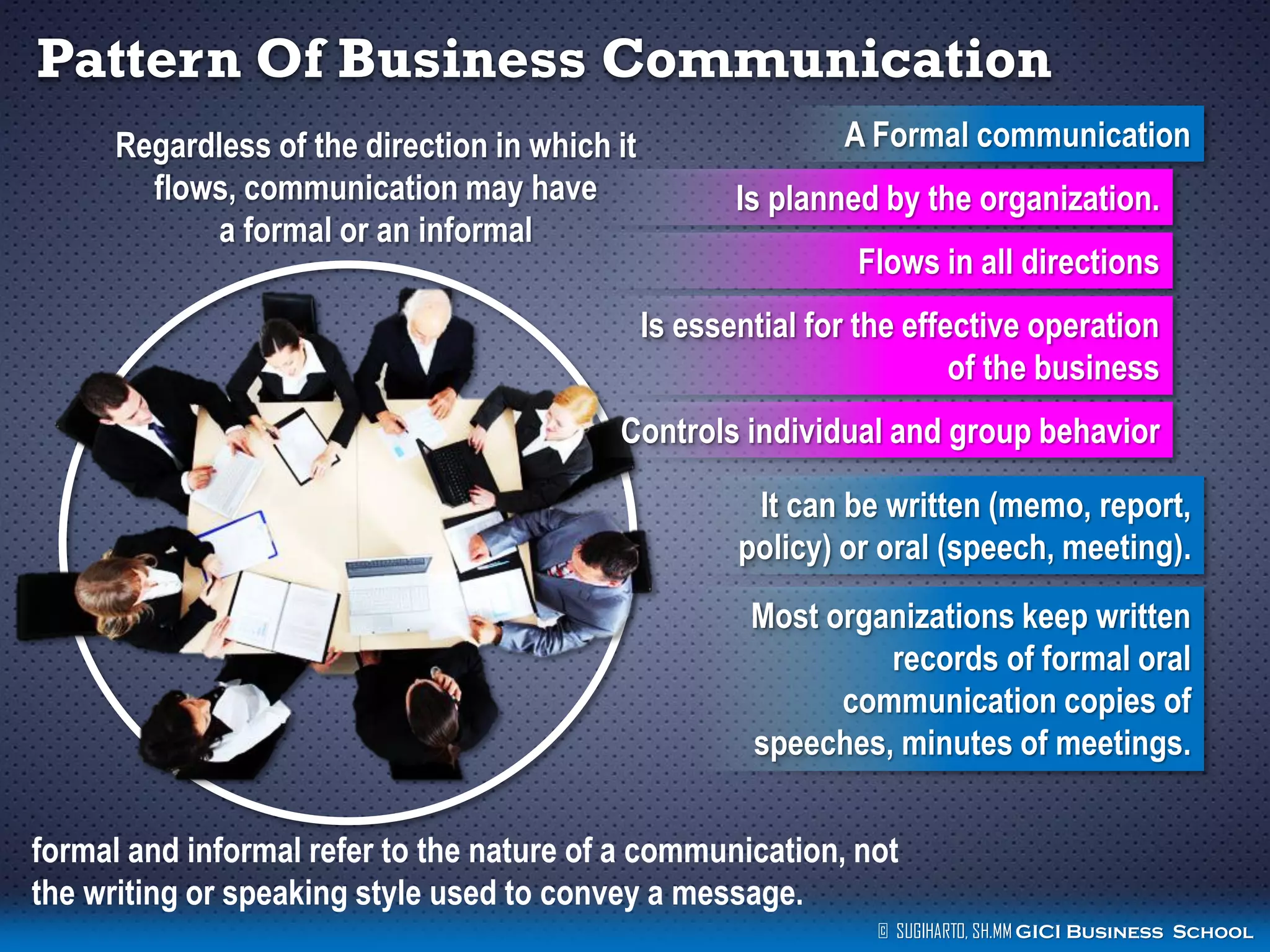
Pattern Of Business Communication
Regardless of the direction in which it
flows, communication may have
a formal or an informal

A Formal communication
Is planned by the organization.

Flows in all directions
Is essential for the effective operation
of the business

Controls individual and group behavior
It can be written (memo, report,
policy) or oral (speech, meeting).
Most organizations keep written
records of formal oral
communication copies of
speeches, minutes of meetings.
formal and informal refer to the nature of a communication, not
the writing or speaking style used to convey a message.
© SUGIHARTO, SH.MM GICI Business School
Pattern Of Business Communication
consists of both business-related and

An informal communication personal information
Is not planned by the organization.
Flows in all directions

Develops and maintains
positive human relationships
Most informal communication is oral, but widespread
use of e-mail has made informal written
communication more popular.

An informal communication flows in the organization
Develops as people interact within the formal
communication system and certain behavior patterns
emerge—patterns that accommodate social and
psychological needs
© SUGIHARTO, SH.MM GICI Business School
Pattern Of Business Communication
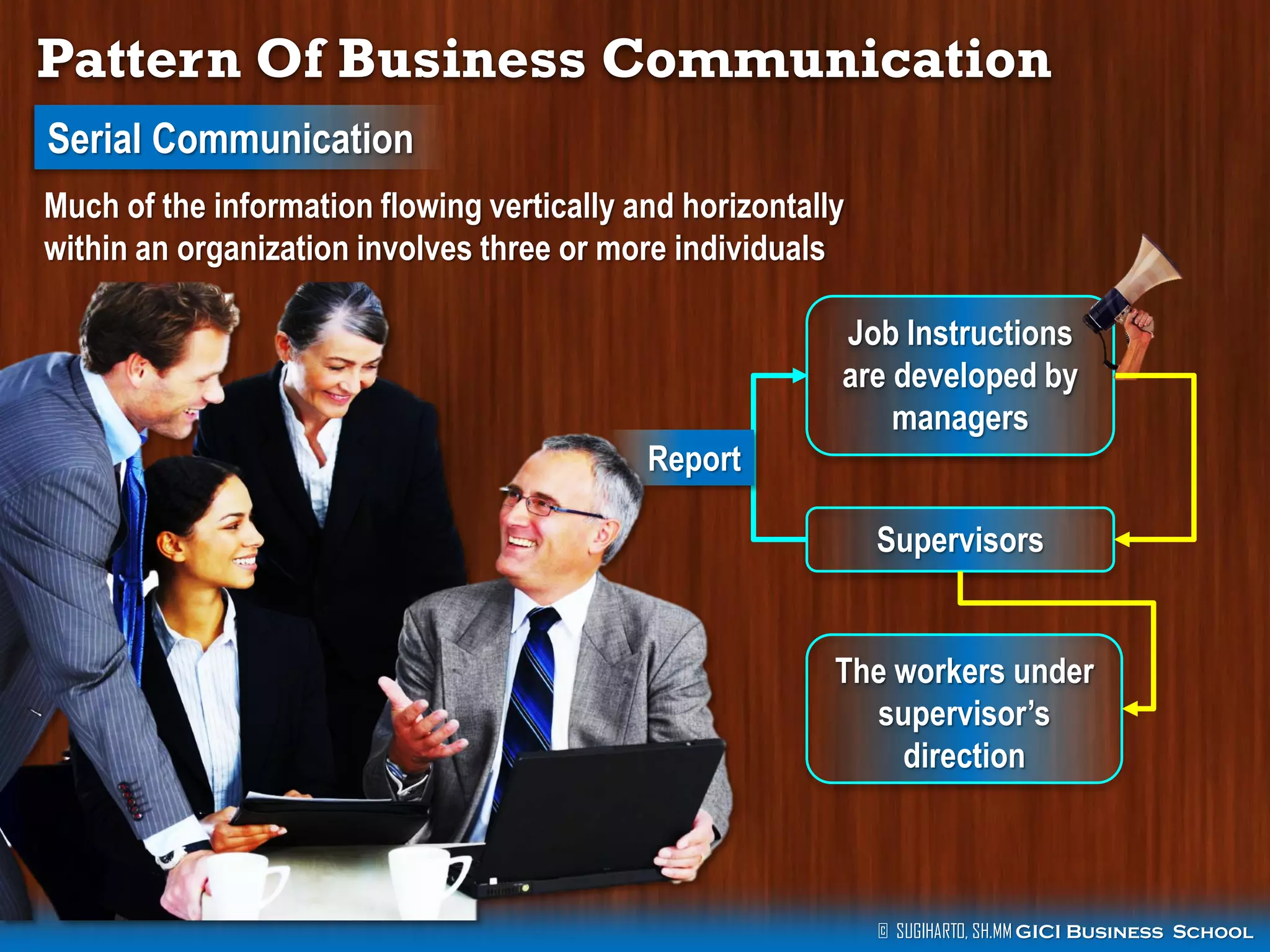
Serial Communication
Much of the information flowing vertically and horizontally
within an organization involves three or more individuals
Job Instructions
are developed by
managers
Report
Supervisors

The workers under
supervisor‘s
direction

© SUGIHARTO, SH.MM GICI Business School
Pattern Of Business Communication
Serial Communication
In serial communication, messages are usually changed,
sometimes dramatically as they are sent from one
member of the chain to another
Each sender may…

Add details

Special precautions
are necessary
Take notes

Receiver

Repeat the messages

Sender

Keep the message simple
Request feedback
© SUGIHARTO, SH.MM GICI Business School
Pattern Of Business Communication
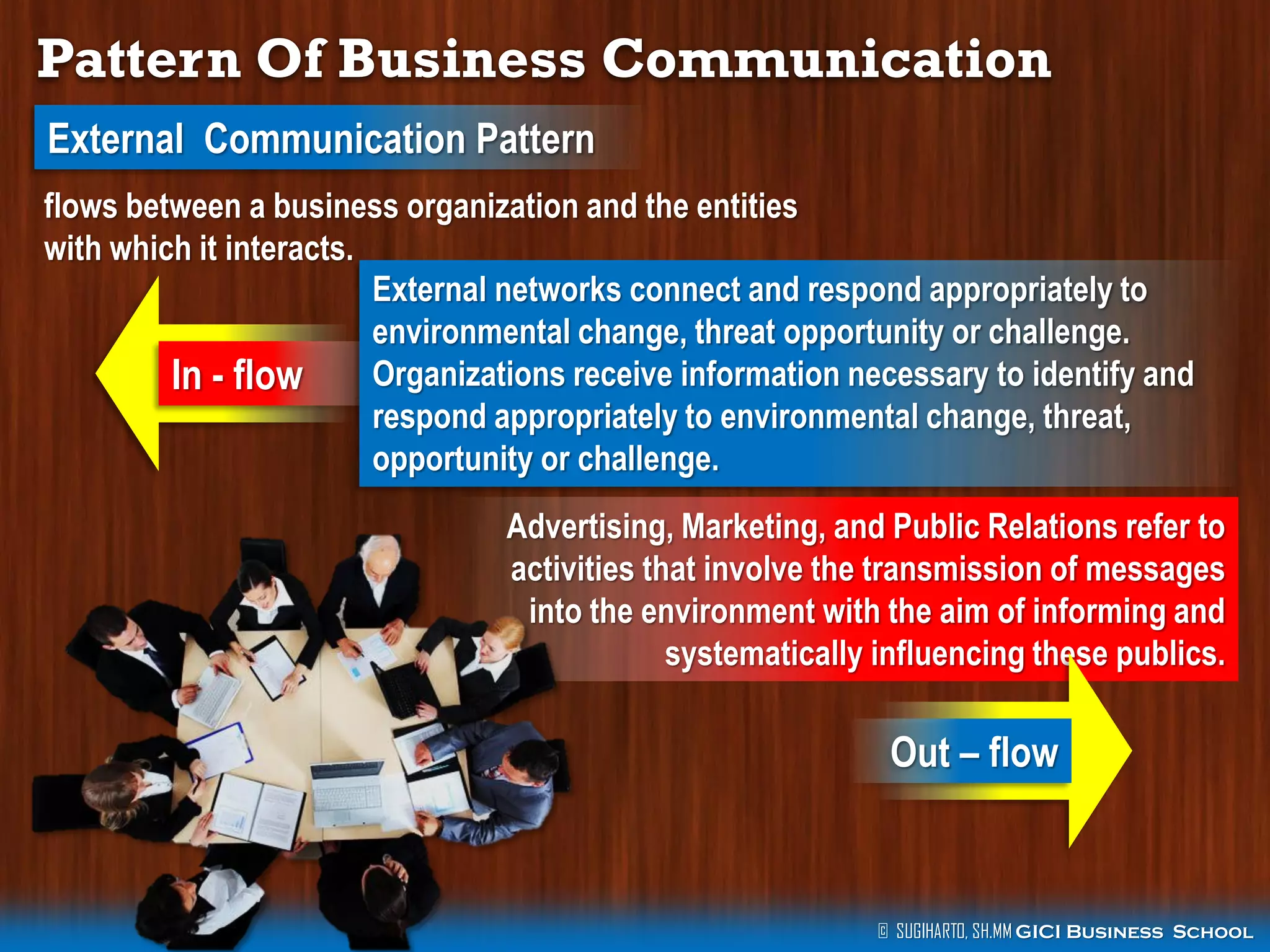
External Communication Pattern
flows between a business organization and the entities
with which it interacts.
External networks connect and respond appropriately to
environmental change, threat opportunity or challenge.
Organizations receive information necessary to identify and
In - flow
respond appropriately to environmental change, threat,
opportunity or challenge.
Advertising, Marketing, and Public Relations refer to
activities that involve the transmission of messages
into the environment with the aim of informing and
systematically influencing these publics.

Out – flow

© SUGIHARTO, SH.MM GICI Business School
Pattern Of Business Communication
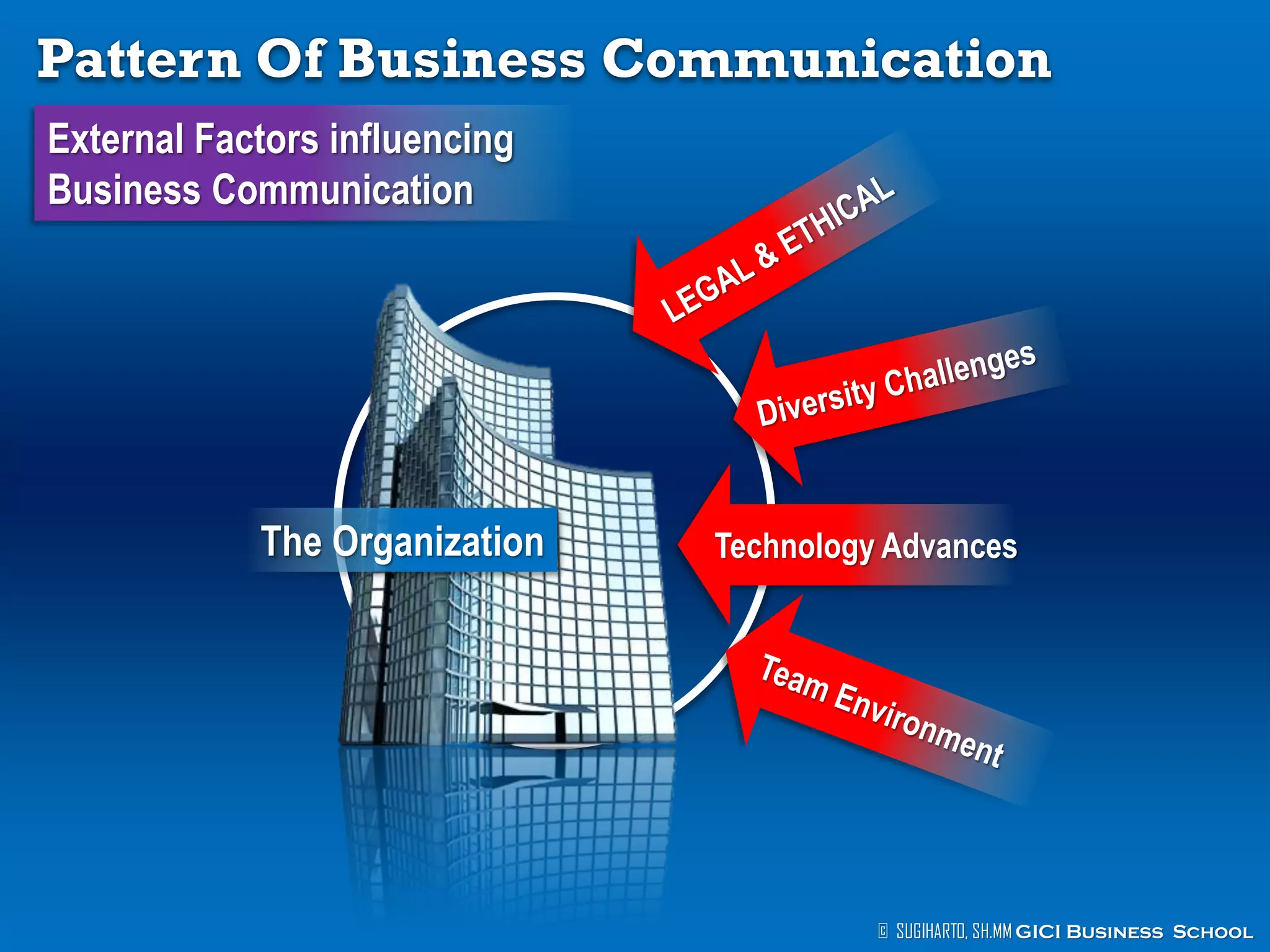
External Factors influencing
Business Communication

The Organization

Technology Advances

© SUGIHARTO, SH.MM GICI Business School
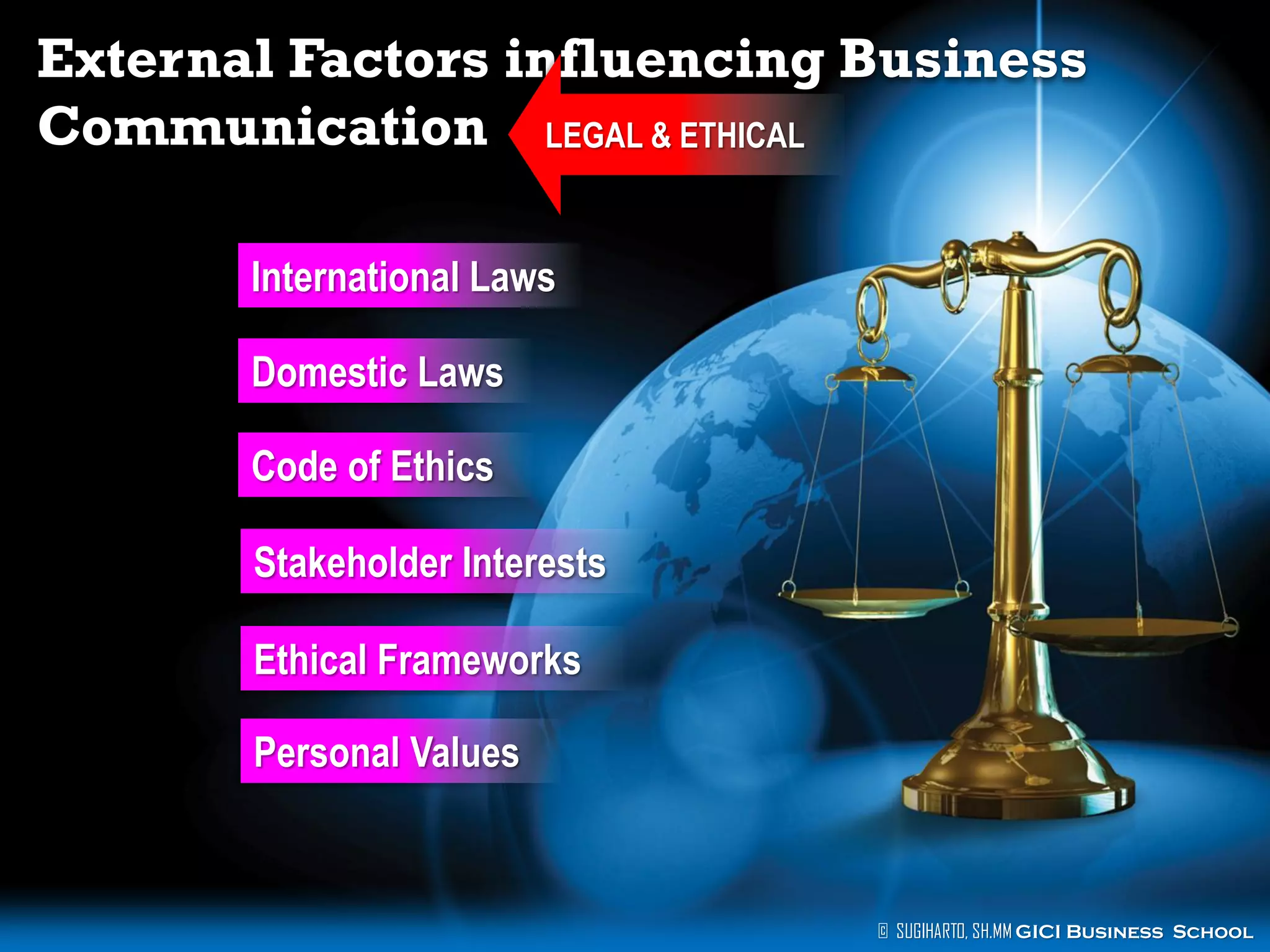
External Factors influencing Business
Communication LEGAL & ETHICAL
International Laws
Domestic Laws
Code of Ethics
Stakeholder Interests
Ethical Frameworks
Personal Values

© SUGIHARTO, SH.MM GICI Business School
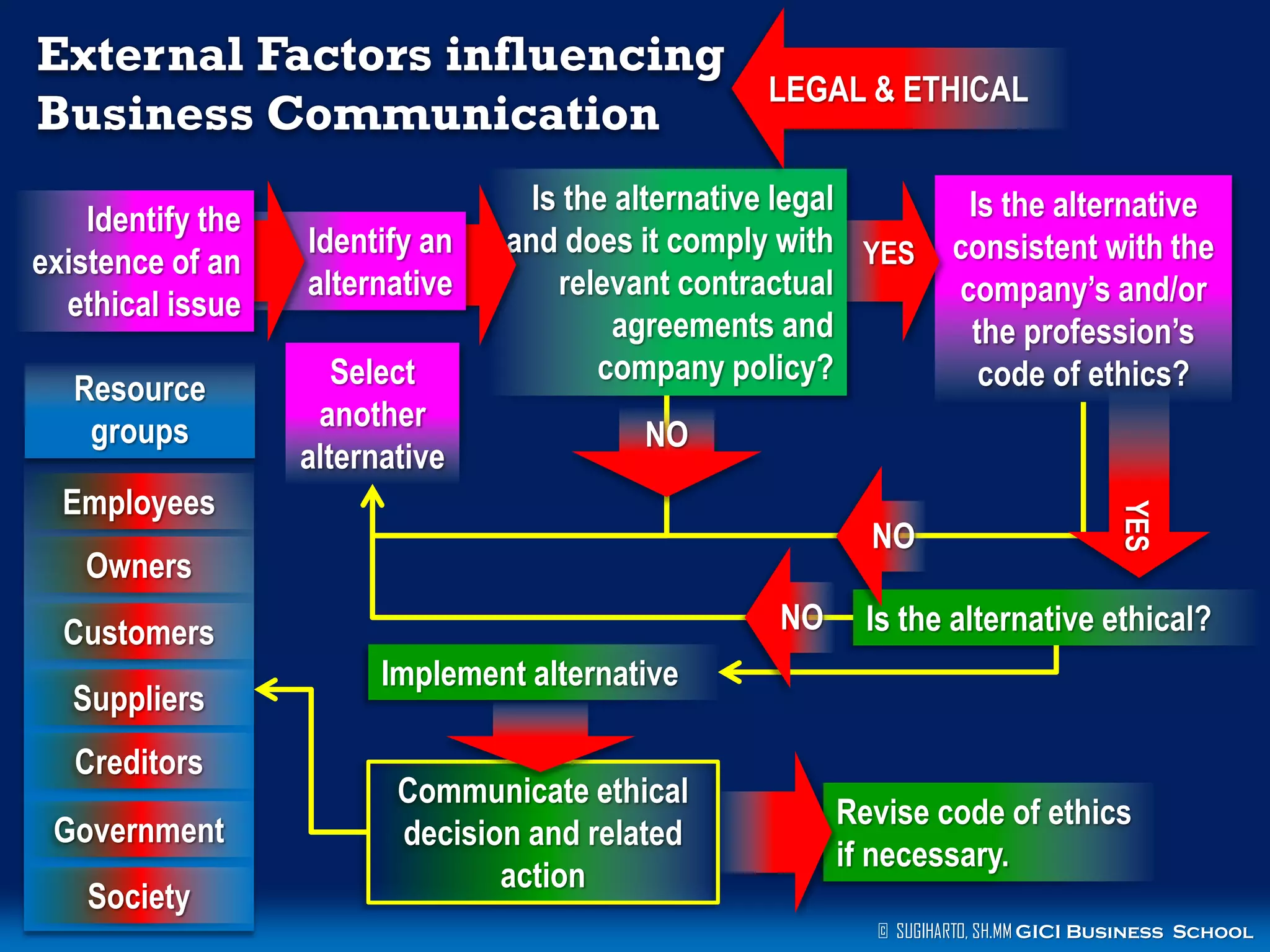
External Factors influencing
Business Communication
Identify the
existence of an
ethical issue

Identify an
alternative

Resource
groups

Select
another
alternative

LEGAL & ETHICAL

Is the alternative legal
and does it comply with YES
relevant contractual
agreements and
company policy?
NO
NO

Owners
NO

Customers

Creditors
Government
Society

YES

Employees

Suppliers

Is the alternative
consistent with the
company‘s and/or
the profession‘s
code of ethics?

Is the alternative ethical?

Implement alternative
Communicate ethical
decision and related
action

Revise code of ethics
if necessary.
© SUGIHARTO, SH.MM GICI Business School
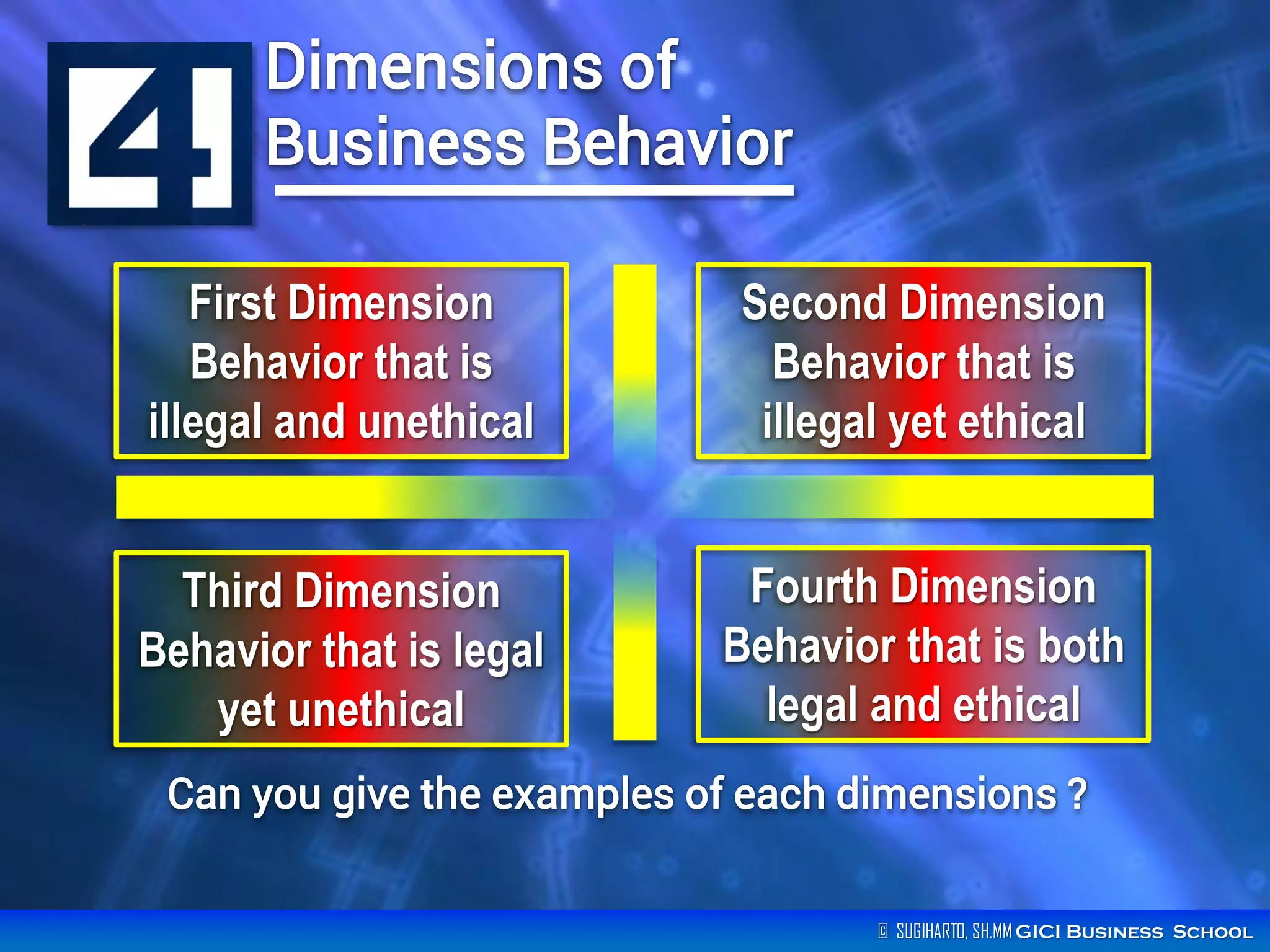
Dimensions of
Business Behavior
First Dimension
Behavior that is
illegal and unethical

Second Dimension
Behavior that is
illegal yet ethical

Third Dimension
Behavior that is legal
yet unethical

Fourth Dimension
Behavior that is both
legal and ethical

Can you give the examples of each dimensions ?
© SUGIHARTO, SH.MM GICI Business School
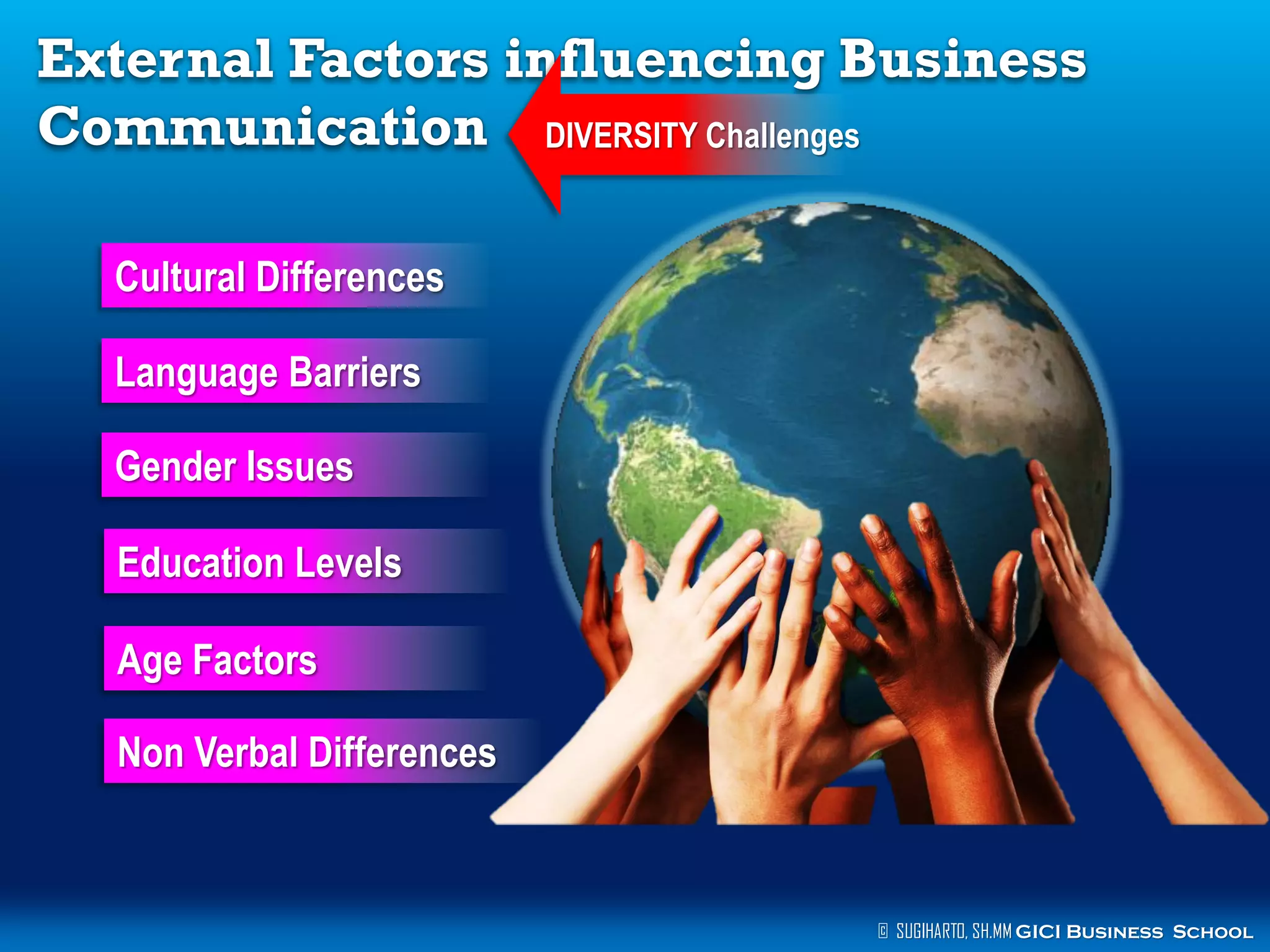
External Factors influencing Business
Communication DIVERSITY Challenges
Cultural Differences
Language Barriers
Gender Issues
Education Levels
Age Factors
Non Verbal Differences

© SUGIHARTO, SH.MM GICI Business School
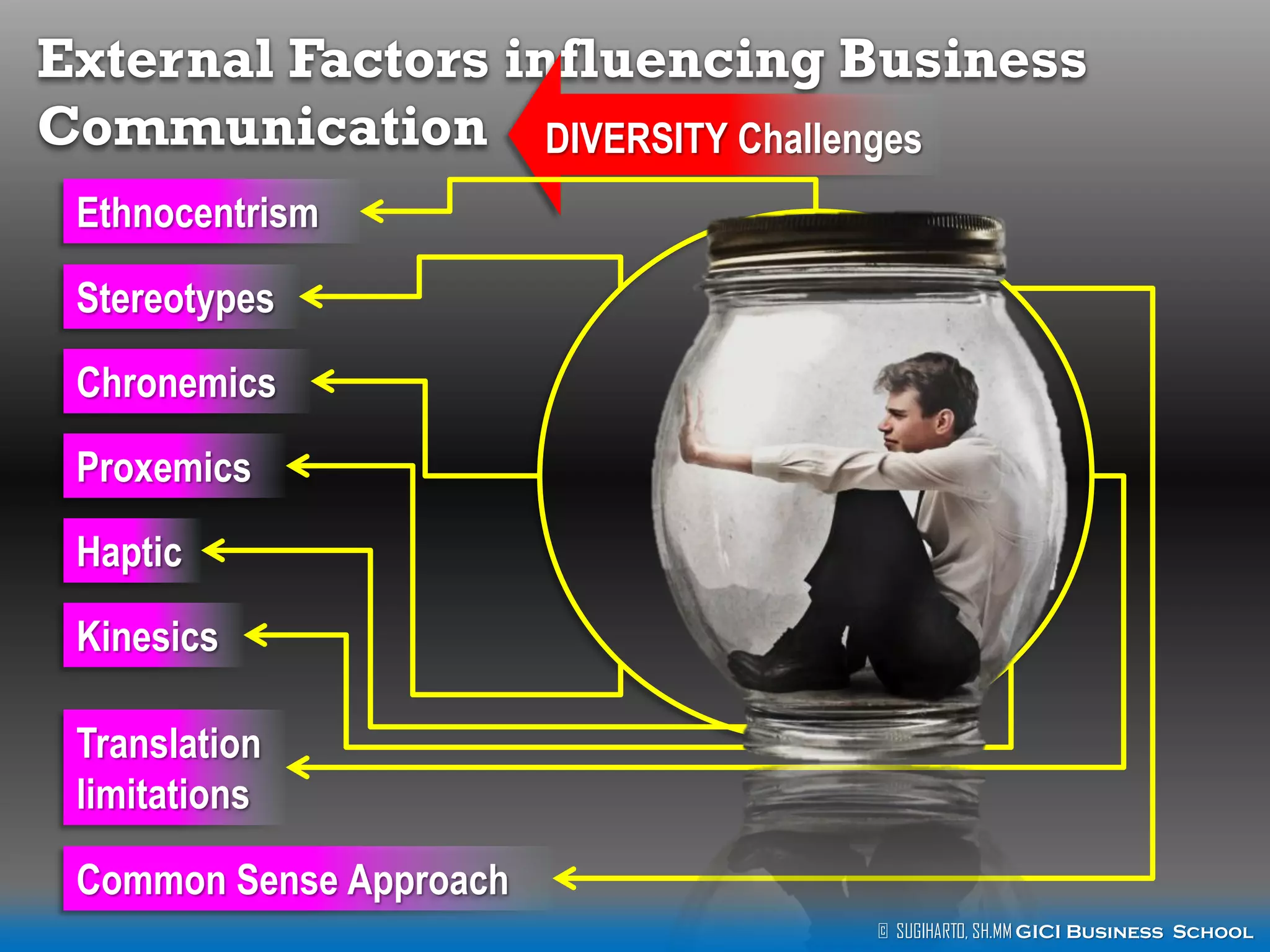
External Factors influencing Business
Communication DIVERSITY Challenges
Ethnocentrism
Stereotypes
Chronemics
Proxemics
Haptic
Kinesics
Translation
limitations
Common Sense Approach
© SUGIHARTO, SH.MM GICI Business School
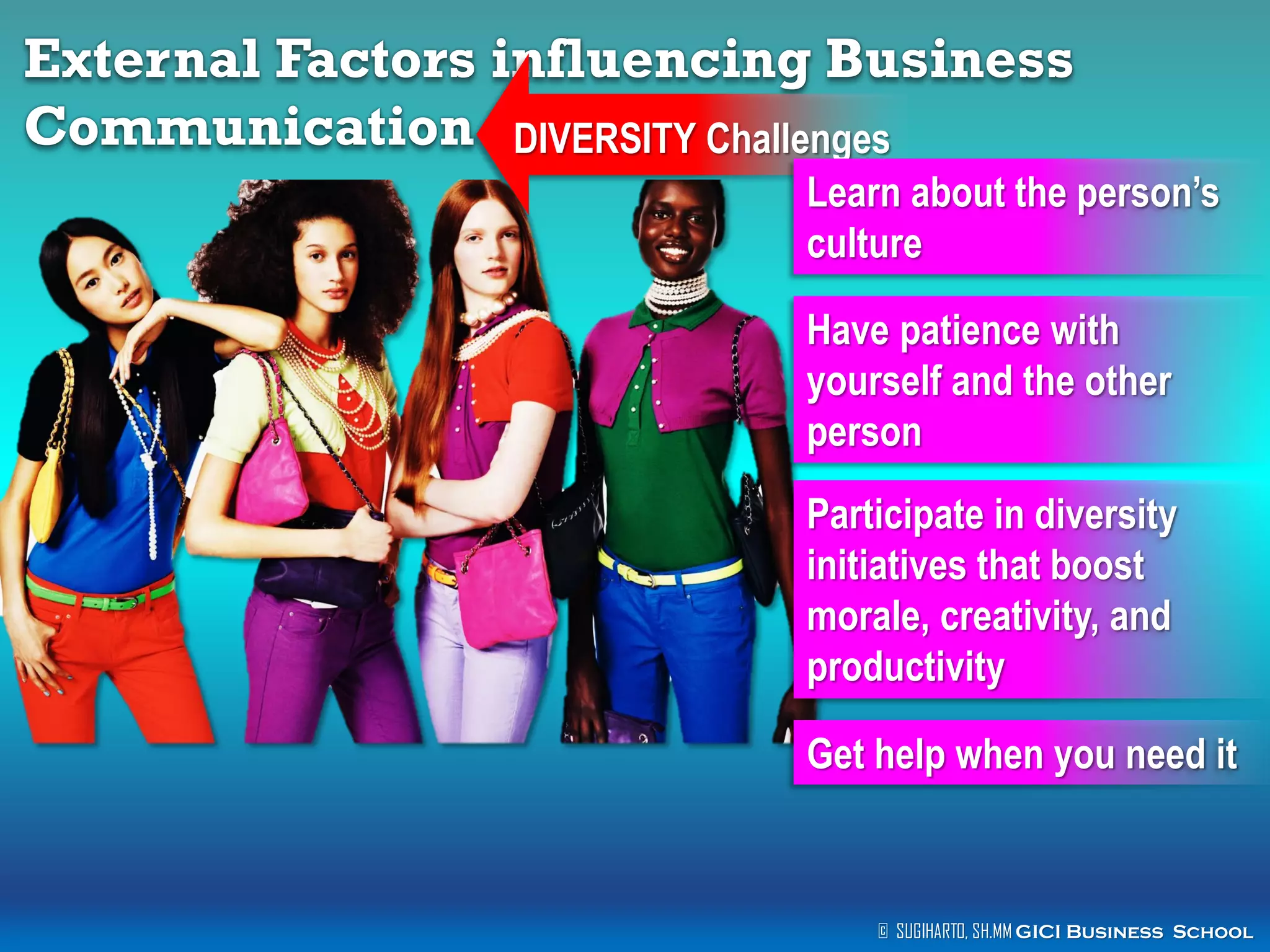
External Factors influencing Business
Communication DIVERSITY Challenges
Learn about the person‘s
culture
Have patience with
yourself and the other
person
Participate in diversity
initiatives that boost
morale, creativity, and
productivity
Get help when you need it

© SUGIHARTO, SH.MM GICI Business School
External Factors influencing Business
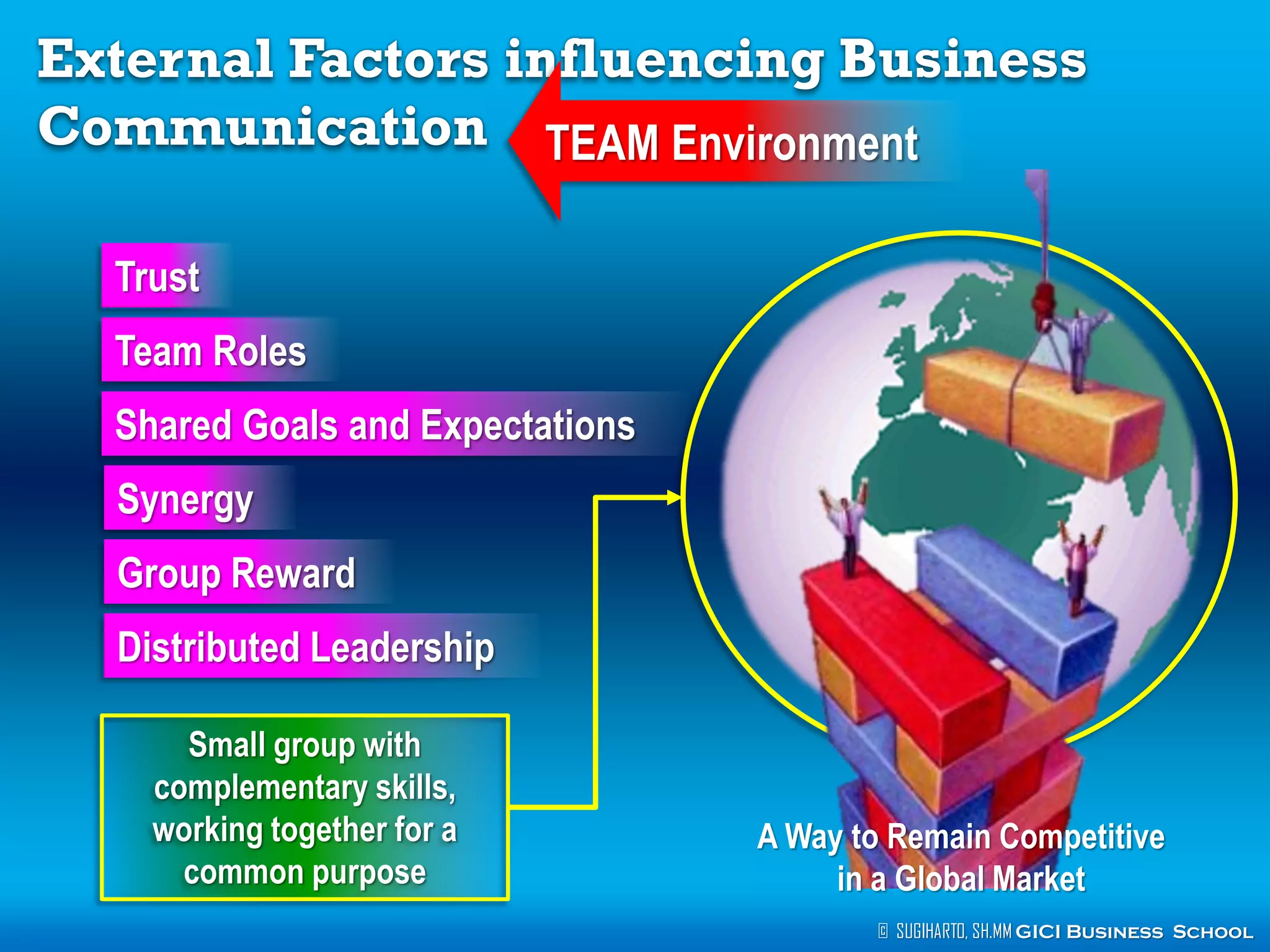
Communication TEAM Environment
Trust
Team Roles

Shared Goals and Expectations
Synergy
Group Reward
Distributed Leadership
Small group with
complementary skills,
working together for a
common purpose

A Way to Remain Competitive
in a Global Market
© SUGIHARTO, SH.MM GICI Business School
External Factors influencing Business
Communication TEAM Environment
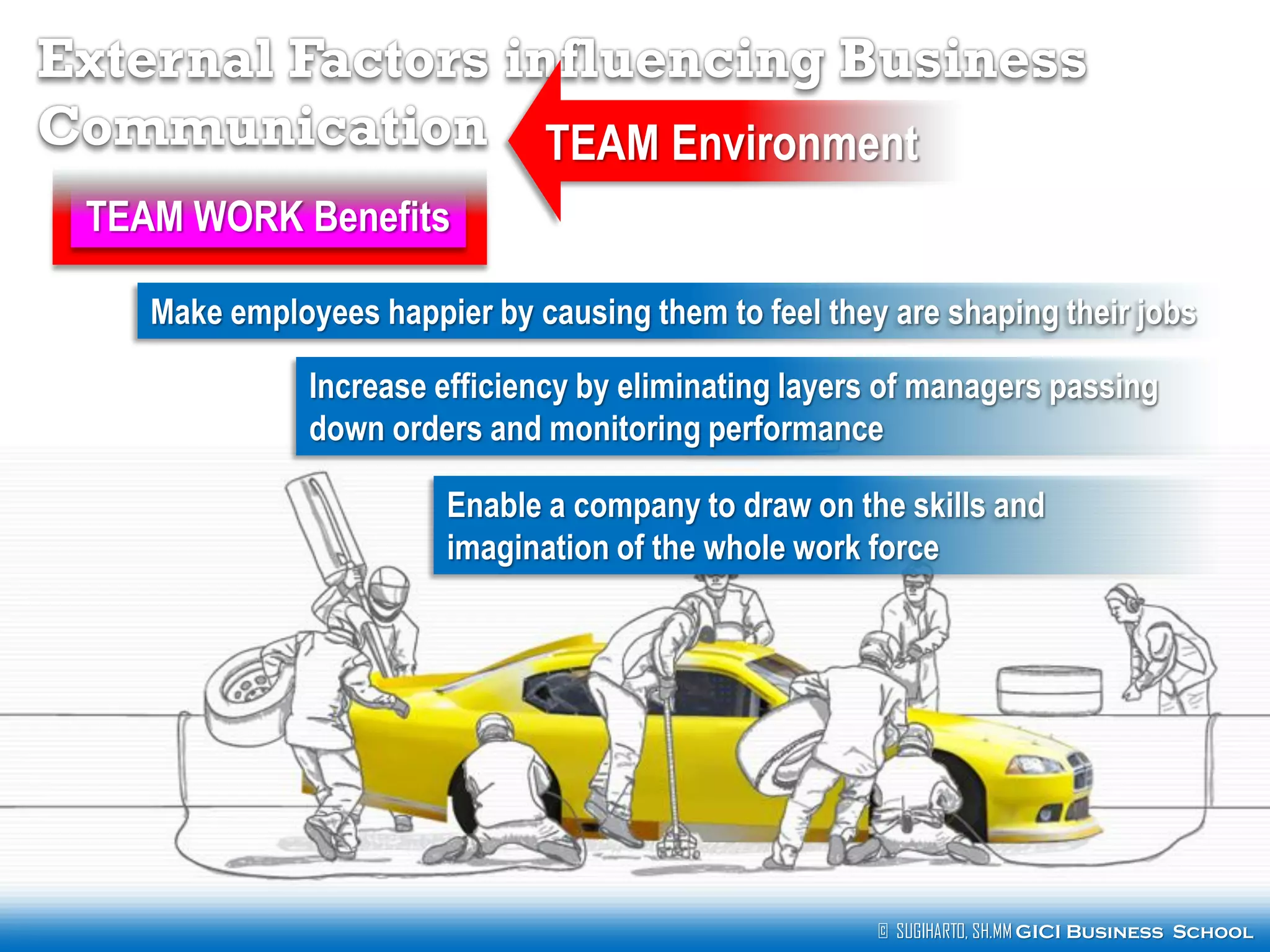
TEAM WORK Benefits
Make employees happier by causing them to feel they are shaping their jobs

Increase efficiency by eliminating layers of managers passing
down orders and monitoring performance
Enable a company to draw on the skills and
imagination of the whole work force

© SUGIHARTO, SH.MM GICI Business School
External Factors influencing Business
Communication TEAM Environment
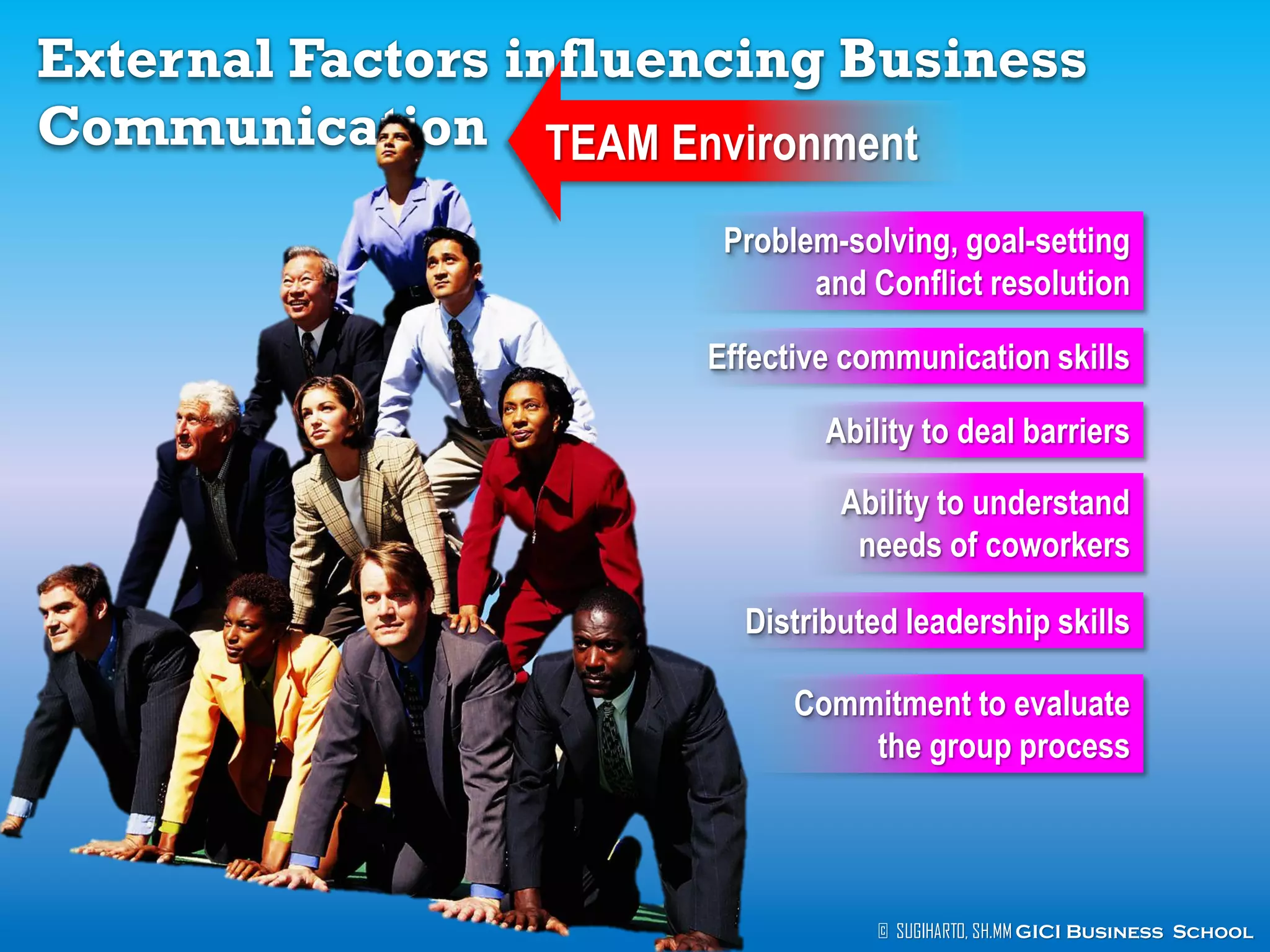
Problem-solving, goal-setting
and Conflict resolution
Effective communication skills

Ability to deal barriers
Ability to understand
needs of coworkers
Distributed leadership skills
Commitment to evaluate
the group process

© SUGIHARTO, SH.MM GICI Business School
Communication Patterns
for Successful Teams

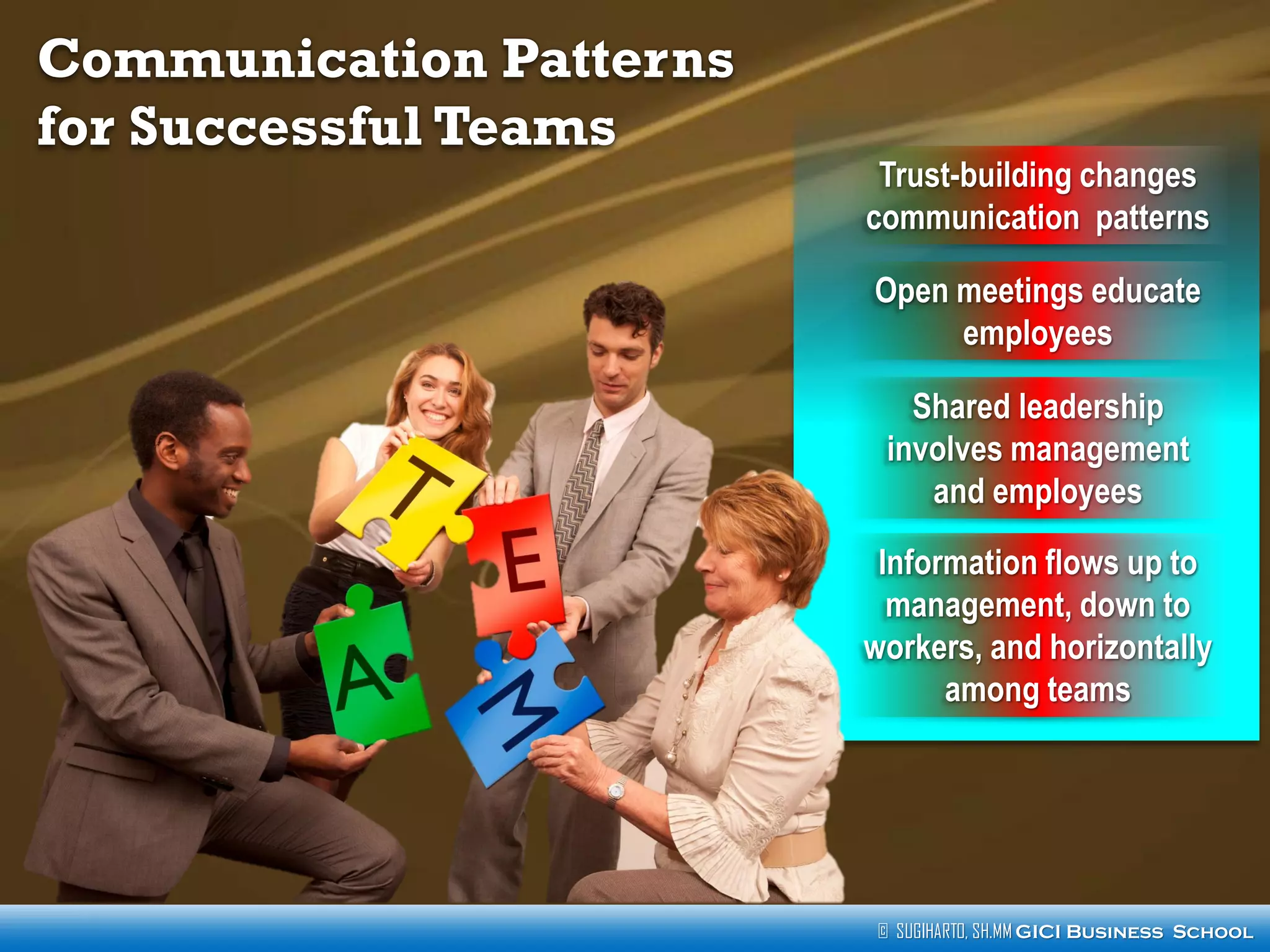
Trust-building changes
communication patterns
Open meetings educate
employees
Shared leadership
involves management
and employees
Information flows up to
management, down to
workers, and horizontally
among teams

© SUGIHARTO, SH.MM GICI Business School
External Factors influencing Business
Communication Technology Advances
Accuracy and Security Issues
Telecommunications
Shared Goals and Expectations
Software Applications
Telecommuting
Databases

© SUGIHARTO, SH.MM GICI Business School
External Factors influencing Business
Communication Technology Advances
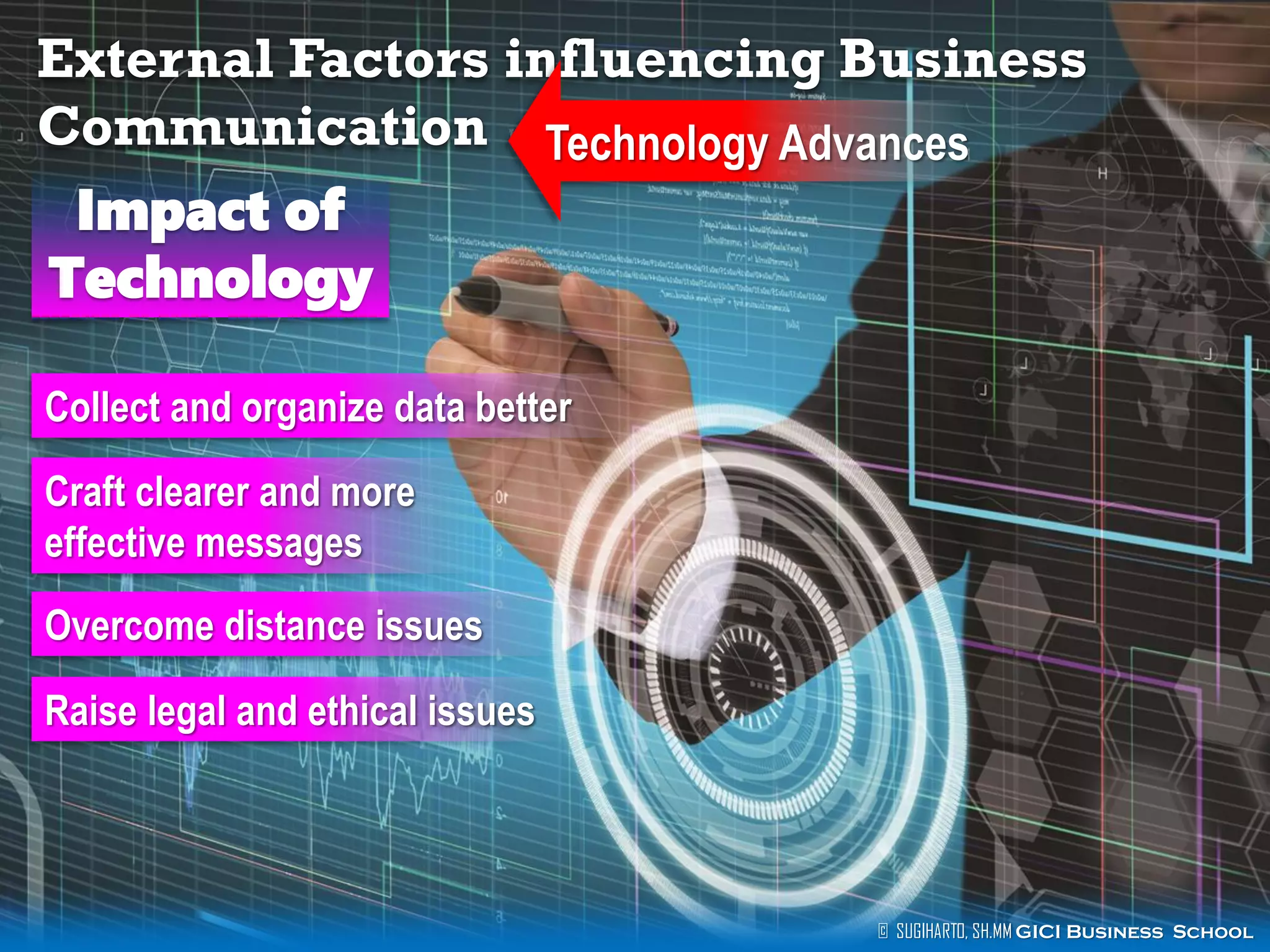
Impact of
Technology
Collect and organize data better
Craft clearer and more
effective messages
Overcome distance issues
Raise legal and ethical issues

© SUGIHARTO, SH.MM GICI Business School
External Factors influencing Business
Communication Technology Advances

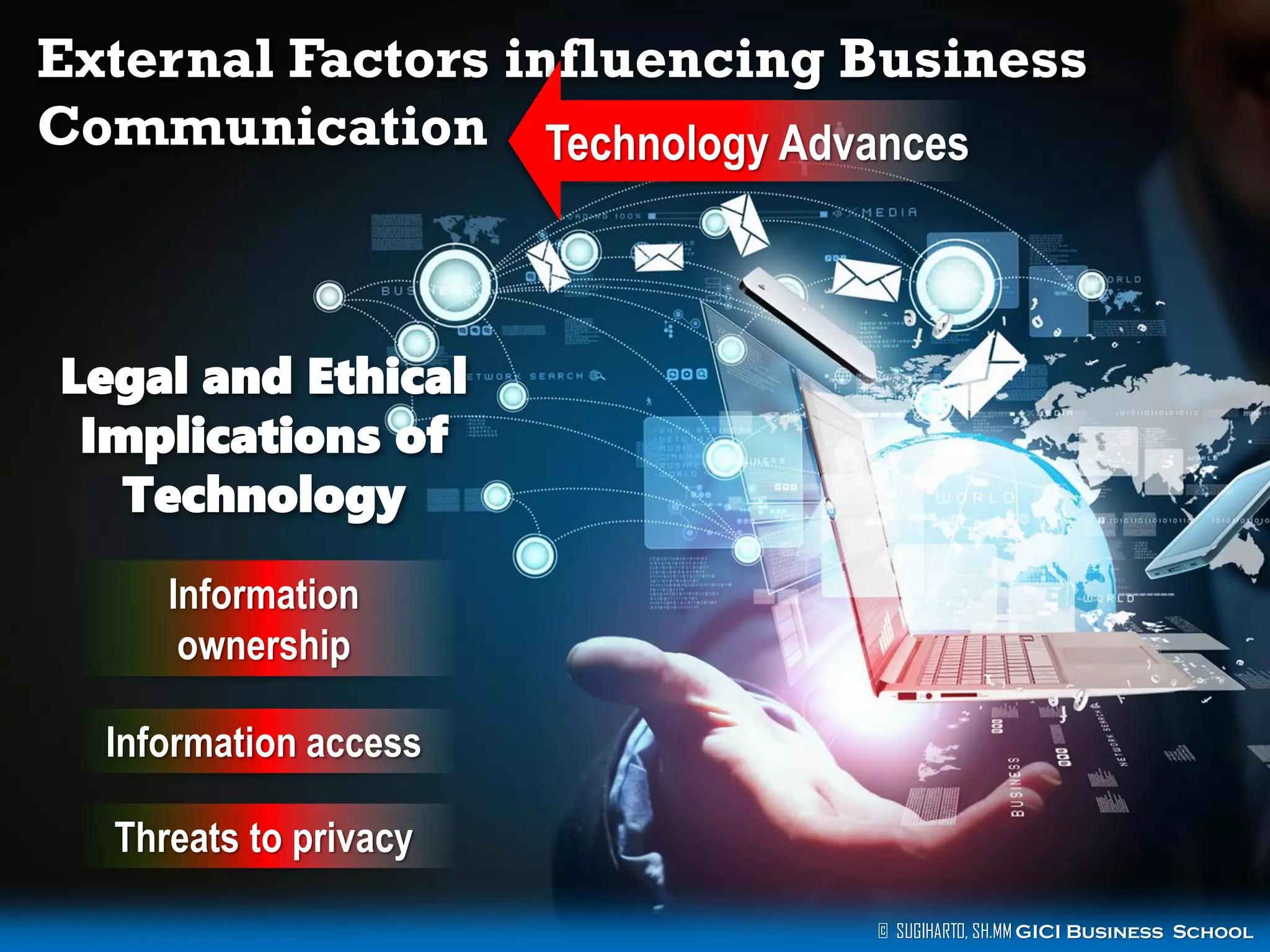
Legal and Ethical
Implications of
Technology
Information
ownership
Information access
Threats to privacy
© SUGIHARTO, SH.MM GICI Business School
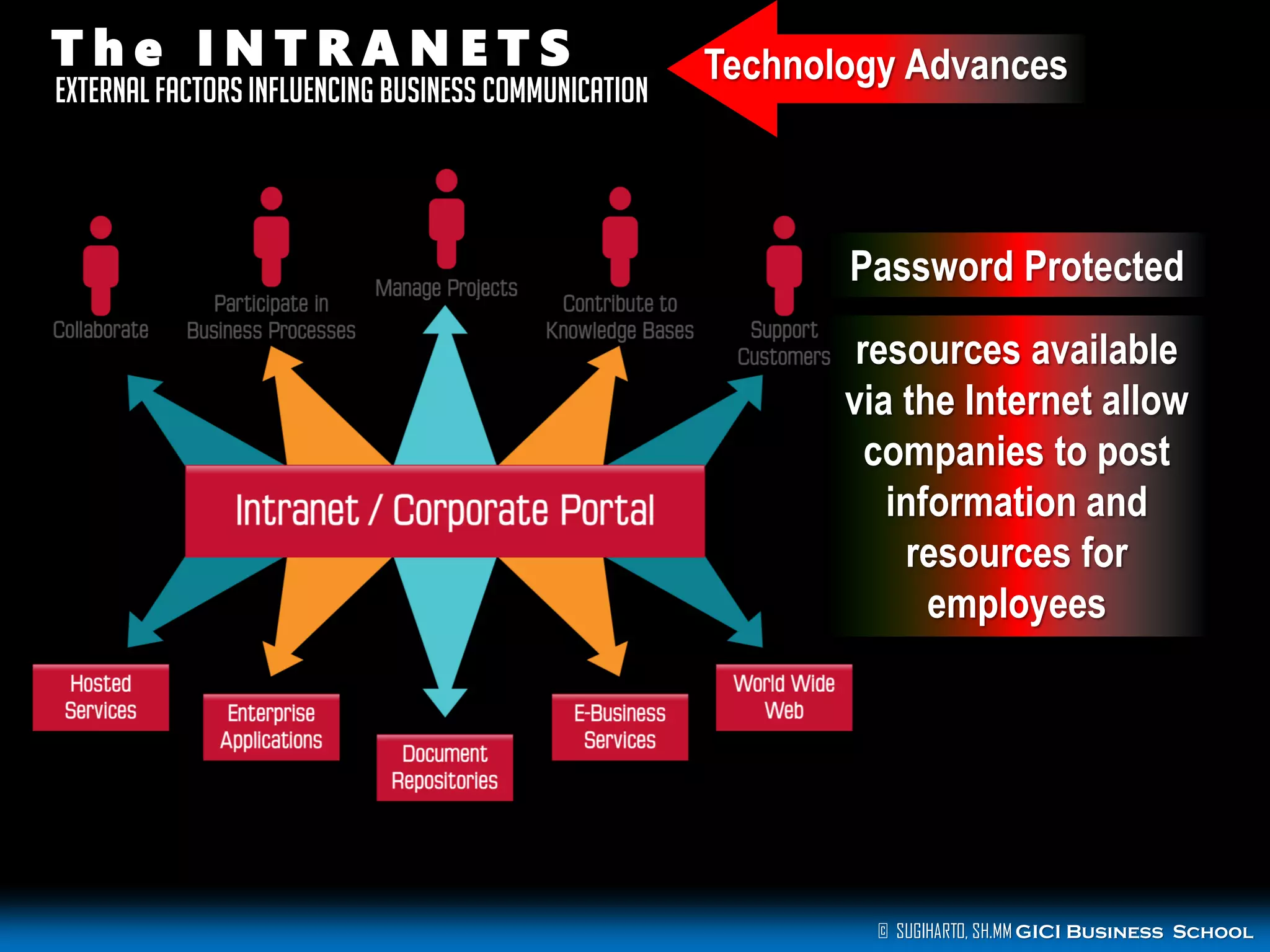
The INTRANETS

External Factors influencing Business Communication

Technology Advances

Password Protected
resources available
via the Internet allow
companies to post
information and
resources for
employees

© SUGIHARTO, SH.MM GICI Business School
The EXTRANETS

External Factors influencing Business Communication

Technology Advances

Protected information and
resources on company
site are made available to:
Customers
Partners

Or others with
need to know

© SUGIHARTO, SH.MM GICI Business School
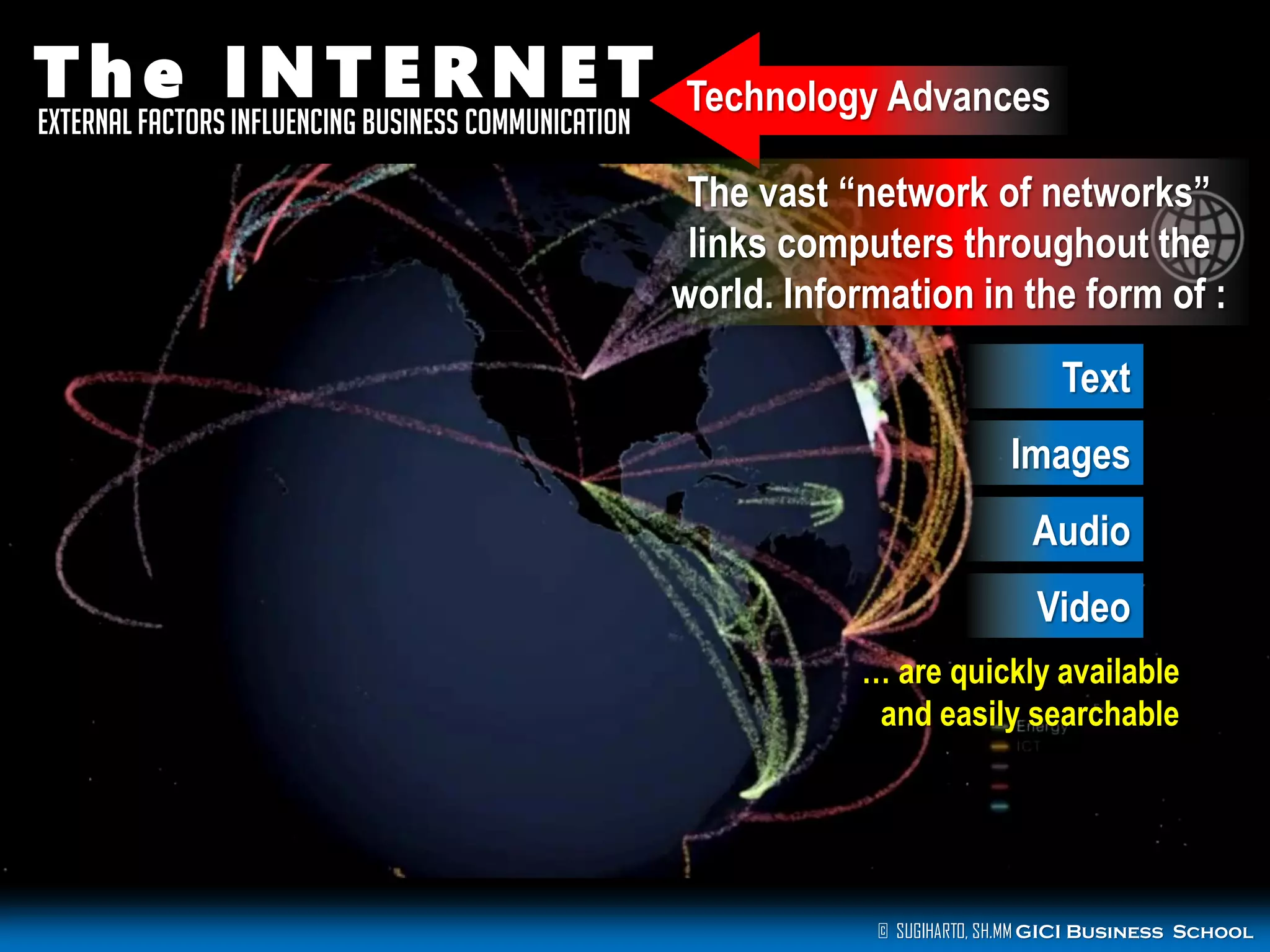
The INTERNET
External Factors influencing Business Communication

Technology Advances
The vast ―network of networks‖
links computers throughout the
world. Information in the form of :
Text
Images
Audio
Video
… are quickly available
and easily searchable

© SUGIHARTO, SH.MM GICI Business School
External Factors influencing Business
Communication Technology Advances
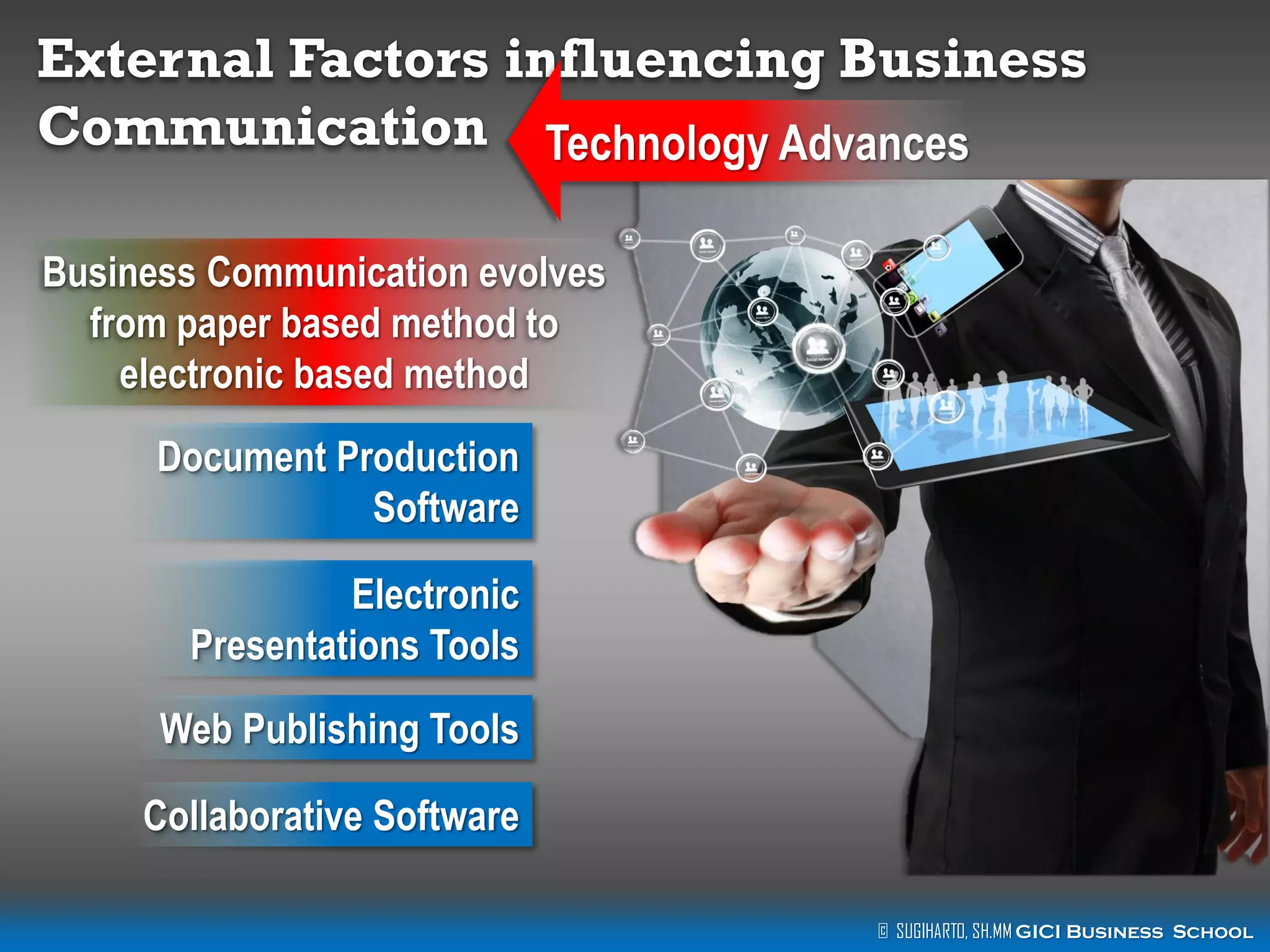
Business Communication evolves
from paper based method to
electronic based method
Document Production
Software

Electronic
Presentations Tools
Web Publishing Tools
Collaborative Software
© SUGIHARTO, SH.MM GICI Business School
THANK YOU FOR LISTENING
3nd Meeting
Business Communication

Presented by
Sugiharto, SH. MM
STIE GICI Business School

October 2013
Background image provide by
slide Factory.blogspot.com
Twitter @Hotslides
c

Presentation created by
Ace 013/ugik Slides factory
© MCX 2013
© SUGIHARTO, SH.MM GICI Business School

Effective business communication development 3

  • 1.
    The Information Flows inThe Organization Presented by Sugiharto, SH. MM © SUGIHARTO, SH.MM GICI Business School
  • 2.
    Formal Network Flowin an Organization Downward Communication Upward Communication Supervisor to employee Feedback to downward communication Policies and procedures Organizational ‗s goals and strategies Works assignment Progress reports Ideas / suggestion Horizontal Communication Interaction between organizational units on the same hierarchical level Feeling / attitudes Employees development Coordination of interrelated activities and problem solving efforts © SUGIHARTO, SH.MM GICI Business School
  • 3.
    MANAGER SUPERVISOR A ASSISTANT A WORKERA1 WORKER A2 SUPERVISOR B SUPERVISOR C WORKER B1 WORKER C1 WORKER C3 WORKER B2 WORKER C2 WORKER C4 WORKER B3 Vertical communication WORKER A3 Horizontal communication Network communication Business Communication by Krizan, Merrier, Logan and Williams, 7th edition © 2008, Thomson, South Western © SUGIHARTO, SH.MM GICI Business School
  • 4.
    Vertical communication Messages flow upwardor downward along a path referred to as the ―chain of command.‖ Policy Statements Reports Proposal Plans Directives Instructions © SUGIHARTO, SH.MM GICI Business School
  • 5.
    Horizontal communication message flowoccurs between workers or units of comparable status who need to share data or coordinate efforts. Network communication information flows freely among those who have a link that goes beyond the participants‘ role or unit within the organization Regardless of the direction in which it flows, communication may have a formal, an informal, or a serial pattern. In this section, formal and informal refer to the nature of a communication, not the writing or speaking style used to convey a message. © SUGIHARTO, SH.MM GICI Business School
  • 6.
    Pattern Of BusinessCommunication Regardless of the direction in which it flows, communication may have a formal or an informal A Formal communication Is planned by the organization. Flows in all directions Is essential for the effective operation of the business Controls individual and group behavior It can be written (memo, report, policy) or oral (speech, meeting). Most organizations keep written records of formal oral communication copies of speeches, minutes of meetings. formal and informal refer to the nature of a communication, not the writing or speaking style used to convey a message. © SUGIHARTO, SH.MM GICI Business School
  • 7.
    Pattern Of BusinessCommunication consists of both business-related and An informal communication personal information Is not planned by the organization. Flows in all directions Develops and maintains positive human relationships Most informal communication is oral, but widespread use of e-mail has made informal written communication more popular. An informal communication flows in the organization Develops as people interact within the formal communication system and certain behavior patterns emerge—patterns that accommodate social and psychological needs © SUGIHARTO, SH.MM GICI Business School
  • 8.
    Pattern Of BusinessCommunication Serial Communication Much of the information flowing vertically and horizontally within an organization involves three or more individuals Job Instructions are developed by managers Report Supervisors The workers under supervisor‘s direction © SUGIHARTO, SH.MM GICI Business School
  • 9.
    Pattern Of BusinessCommunication Serial Communication In serial communication, messages are usually changed, sometimes dramatically as they are sent from one member of the chain to another Each sender may… Add details Special precautions are necessary Take notes Receiver Repeat the messages Sender Keep the message simple Request feedback © SUGIHARTO, SH.MM GICI Business School
  • 10.
    Pattern Of BusinessCommunication External Communication Pattern flows between a business organization and the entities with which it interacts. External networks connect and respond appropriately to environmental change, threat opportunity or challenge. Organizations receive information necessary to identify and In - flow respond appropriately to environmental change, threat, opportunity or challenge. Advertising, Marketing, and Public Relations refer to activities that involve the transmission of messages into the environment with the aim of informing and systematically influencing these publics. Out – flow © SUGIHARTO, SH.MM GICI Business School
  • 11.
    Pattern Of BusinessCommunication External Factors influencing Business Communication The Organization Technology Advances © SUGIHARTO, SH.MM GICI Business School
  • 12.
    External Factors influencingBusiness Communication LEGAL & ETHICAL International Laws Domestic Laws Code of Ethics Stakeholder Interests Ethical Frameworks Personal Values © SUGIHARTO, SH.MM GICI Business School
  • 13.
    External Factors influencing BusinessCommunication Identify the existence of an ethical issue Identify an alternative Resource groups Select another alternative LEGAL & ETHICAL Is the alternative legal and does it comply with YES relevant contractual agreements and company policy? NO NO Owners NO Customers Creditors Government Society YES Employees Suppliers Is the alternative consistent with the company‘s and/or the profession‘s code of ethics? Is the alternative ethical? Implement alternative Communicate ethical decision and related action Revise code of ethics if necessary. © SUGIHARTO, SH.MM GICI Business School
  • 14.
    Dimensions of Business Behavior FirstDimension Behavior that is illegal and unethical Second Dimension Behavior that is illegal yet ethical Third Dimension Behavior that is legal yet unethical Fourth Dimension Behavior that is both legal and ethical Can you give the examples of each dimensions ? © SUGIHARTO, SH.MM GICI Business School
  • 15.
    External Factors influencingBusiness Communication DIVERSITY Challenges Cultural Differences Language Barriers Gender Issues Education Levels Age Factors Non Verbal Differences © SUGIHARTO, SH.MM GICI Business School
  • 16.
    External Factors influencingBusiness Communication DIVERSITY Challenges Ethnocentrism Stereotypes Chronemics Proxemics Haptic Kinesics Translation limitations Common Sense Approach © SUGIHARTO, SH.MM GICI Business School
  • 17.
    External Factors influencingBusiness Communication DIVERSITY Challenges Learn about the person‘s culture Have patience with yourself and the other person Participate in diversity initiatives that boost morale, creativity, and productivity Get help when you need it © SUGIHARTO, SH.MM GICI Business School
  • 18.
    External Factors influencingBusiness Communication TEAM Environment Trust Team Roles Shared Goals and Expectations Synergy Group Reward Distributed Leadership Small group with complementary skills, working together for a common purpose A Way to Remain Competitive in a Global Market © SUGIHARTO, SH.MM GICI Business School
  • 19.
    External Factors influencingBusiness Communication TEAM Environment TEAM WORK Benefits Make employees happier by causing them to feel they are shaping their jobs Increase efficiency by eliminating layers of managers passing down orders and monitoring performance Enable a company to draw on the skills and imagination of the whole work force © SUGIHARTO, SH.MM GICI Business School
  • 20.
    External Factors influencingBusiness Communication TEAM Environment Problem-solving, goal-setting and Conflict resolution Effective communication skills Ability to deal barriers Ability to understand needs of coworkers Distributed leadership skills Commitment to evaluate the group process © SUGIHARTO, SH.MM GICI Business School
  • 21.
    Communication Patterns for SuccessfulTeams Trust-building changes communication patterns Open meetings educate employees Shared leadership involves management and employees Information flows up to management, down to workers, and horizontally among teams © SUGIHARTO, SH.MM GICI Business School
  • 22.
    External Factors influencingBusiness Communication Technology Advances Accuracy and Security Issues Telecommunications Shared Goals and Expectations Software Applications Telecommuting Databases © SUGIHARTO, SH.MM GICI Business School
  • 23.
    External Factors influencingBusiness Communication Technology Advances Impact of Technology Collect and organize data better Craft clearer and more effective messages Overcome distance issues Raise legal and ethical issues © SUGIHARTO, SH.MM GICI Business School
  • 24.
    External Factors influencingBusiness Communication Technology Advances Legal and Ethical Implications of Technology Information ownership Information access Threats to privacy © SUGIHARTO, SH.MM GICI Business School
  • 25.
    The INTRANETS External Factorsinfluencing Business Communication Technology Advances Password Protected resources available via the Internet allow companies to post information and resources for employees © SUGIHARTO, SH.MM GICI Business School
  • 26.
    The EXTRANETS External Factorsinfluencing Business Communication Technology Advances Protected information and resources on company site are made available to: Customers Partners Or others with need to know © SUGIHARTO, SH.MM GICI Business School
  • 27.
    The INTERNET External Factorsinfluencing Business Communication Technology Advances The vast ―network of networks‖ links computers throughout the world. Information in the form of : Text Images Audio Video … are quickly available and easily searchable © SUGIHARTO, SH.MM GICI Business School
  • 28.
    External Factors influencingBusiness Communication Technology Advances Business Communication evolves from paper based method to electronic based method Document Production Software Electronic Presentations Tools Web Publishing Tools Collaborative Software © SUGIHARTO, SH.MM GICI Business School
  • 29.
    THANK YOU FORLISTENING 3nd Meeting Business Communication Presented by Sugiharto, SH. MM STIE GICI Business School October 2013 Background image provide by slide Factory.blogspot.com Twitter @Hotslides c Presentation created by Ace 013/ugik Slides factory © MCX 2013 © SUGIHARTO, SH.MM GICI Business School