Cracking The ‘Business Communication’ Code
Building Blocks to Achieving Organisation’s Goals
The role of effective communication in the
smooth running of operations in the workplace
cannot be overemphasized. From boardrooms
to virtual meetings, emails to face-to-face
interactions, effective communication fuels
successful business models, propelling
organisations toward their goals with purpose.
Understanding
Business Communication…
Business communication, whether
written or verbal, refers to the way you
influence your employees and guide
their activities, speak to customers and
clients or the way employees provide
feedback necessary for management to
make smart decisions.
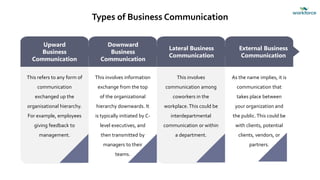
This refers to any form of
communication
exchanged up the
organisational hierarchy.
For example, employees
giving feedback to
management.
This involves information
exchange from the top
of the organizational
hierarchy downwards. It
is typically initiated by C-
level executives, and
then transmitted by
managers to their
teams.
This involves
communication among
coworkers in the
workplace.This could be
interdepartmental
communication or within
a department.
As the name implies, it is
communication that
takes place between
your organization and
the public.This could be
with clients, potential
clients, vendors, or
partners.
Upward
Business
Communication
Downward
Business
Communication
Lateral Business
Communication
External Business
Communication
Types of Business Communication
Importance of Effective Business Communication
Communication helps your
organisation build rapport
among employees and
managers. It also encourages
teamwork and collaboration.
Effective communication skills
can benefit your business and
employees in a number of
ways, including;
Boost motivation
and morale
Minimise
conflicts
Proper planning
Increase
productivity
Build better
teams
Efficient
functioning of
the business
Click here to read: Leveraging Behavioral Competencies for Building Successful Organisations
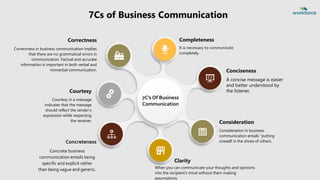
7Cs of Business Communication
7C’s Of Business
Communication
Completeness
It is necessary to communicate
completely.
Conciseness
A concise message is easier
and better understood by
the listener.
Consideration
Consideration in business
communication entails “putting
oneself in the shoes of others.
Clarity
When you can communicate your thoughts and opinions
into the recipient’s mind without them making
assumptions.
Concreteness
Concrete business
communication entails being
specific and explicit rather
than being vague and generic.
Courtesy
Courtesy in a message
indicates that the message
should reflect the sender’s
expression while respecting
the receiver.
Correctness
Correctness in business communication implies
that there are no grammatical errors in
communication. Factual and accurate
information is important in both verbal and
nonverbal communication.
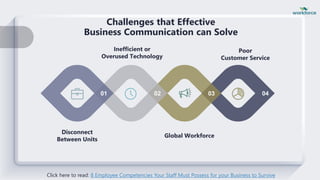
Challenges that Effective
Business Communication can Solve
01 02 03 04
Disconnect
Between Units
Inefficient or
Overused Technology
Global Workforce
Poor
Customer Service
Click here to read: 8 Employee Competencies Your Staff Must Possess for your Business to Survive
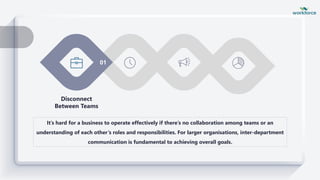
It’s hard for a business to operate effectively if there’s no collaboration among teams or an
understanding of each other’s roles and responsibilities. For larger organisations, inter-department
communication is fundamental to achieving overall goals.
01
Disconnect
Between Teams
While organisations rely on modern technology to create efficiencies and help maintain a
competitive edge, outdated, inefficient or wrongly-deployed technology will cause the business to
suffer. Furthermore, technology is intended to facilitate communication—not replace it.
Inefficient or Overused
Technology
02
Click here to read: Improving Employee Performance – Best Practices
For businesses who have presence across multiple countries or continents, employees who are not in
the same physical space can experience communication challenges. But with the right channels these
challenges can be overcome.
Global
Workforce
03
Poor communication in an organisation leads to two major outcomes with customer service.
Employees in customer-facing roles won’t have the information they need, and customers will sense
low employee morale and have a negative experience. However, with the right communication, there
won’t be room for poor customer service.
Poor
Customer Service
04
Inability to listen to others
Active listening is a
significant component of
effective communication. It is
ideal to pay more attention
to listening than speaking
Cultural
Differences
Understanding cultural
nuances in communication is
critical. Be it management or
employee, you must think
globally.
Lack of Trust
and
Transparency
When there is a lack of trust
and transparency, it is
difficult to express anything.
Workplace Conflicts
Conflict can arise for various
reasons, and when it
happens, it impedes efficient
communication.
Communication
Style
People have unique style
of communicating. Some
people are quite
straightforward, while
others choose to be more
oblique
Barriers to Effective
Communication
“
”
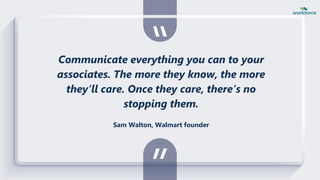
Communicate everything you can to your
associates. The more they know, the more
they’ll care. Once they care, there’s no
stopping them.
Sam Walton, Walmart founder
Key Ways to Drive Business Communication
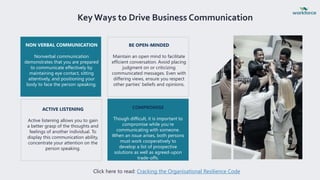
BE OPEN-MINDED
Maintain an open mind to facilitate
efficient conversation. Avoid placing
judgment on or criticizing
communicated messages. Even with
differing views, ensure you respect
other parties’ beliefs and opinions.
NON VERBAL COMMUNICATION
Nonverbal communication
demonstrates that you are prepared
to communicate effectively by
maintaining eye contact, sitting
attentively, and positioning your
body to face the person speaking.
COMPROMISE
Though difficult, it is important to
compromise while you’re
communicating with someone.
When an issue arises, both persons
must work cooperatively to
develop a list of prospective
solutions as well as agreed-upon
trade-offs.
ACTIVE LISTENING
Active listening allows you to gain
a better grasp of the thoughts and
feelings of another individual. To
display this communication ability,
concentrate your attention on the
person speaking.
Click here to read: Cracking the Organisational Resilience Code
READY TO GET
STARTED?
Visit www.workforcegroup.com or
Send an email to -
hello@workforcegroup.com
YOUR BUSINESS YOUR PEOPLE OUR FOCUS
=
Workforce Group
… We go beyond
What we do
We help organisations solve problems around:
Staff Payroll
Management
Performance management
support
Health insurance management
Executive, Experienced and
Graduate Recruitment
Staff onboarding and
training
Staff records
management
Leave and exit
management
Background
verification
Strategy Development and
Execution
Digital Learning Function Specific
Programmes
Leadership
Development
Digital Content Creation and
Conversion
Assessment and
Development centre
Occupational testing
and Success Profiling
Independent Contractor
Management
Assessor skills training
Professional Employer
Organisation
Employer of Record
Recruitment Process
Outsourcing
Workforce by Numbers
17
Year-old Startup
8
Businesses
120+
Consultants
20
African Countries
8000+
Outsourced
Employees
1200-
capacity
Learning Facility
115+
Computer-based
test facility
250+
Clients
10+
Industries Served
36
States in Nigeria

Cracking the Business Communication Code.pptx

  • 1.
    Cracking The ‘BusinessCommunication’ Code Building Blocks to Achieving Organisation’s Goals
  • 2.
    The role ofeffective communication in the smooth running of operations in the workplace cannot be overemphasized. From boardrooms to virtual meetings, emails to face-to-face interactions, effective communication fuels successful business models, propelling organisations toward their goals with purpose.
  • 3.
    Understanding Business Communication… Business communication,whether written or verbal, refers to the way you influence your employees and guide their activities, speak to customers and clients or the way employees provide feedback necessary for management to make smart decisions.
  • 4.
    This refers toany form of communication exchanged up the organisational hierarchy. For example, employees giving feedback to management. This involves information exchange from the top of the organizational hierarchy downwards. It is typically initiated by C- level executives, and then transmitted by managers to their teams. This involves communication among coworkers in the workplace.This could be interdepartmental communication or within a department. As the name implies, it is communication that takes place between your organization and the public.This could be with clients, potential clients, vendors, or partners. Upward Business Communication Downward Business Communication Lateral Business Communication External Business Communication Types of Business Communication
  • 5.
    Importance of EffectiveBusiness Communication Communication helps your organisation build rapport among employees and managers. It also encourages teamwork and collaboration. Effective communication skills can benefit your business and employees in a number of ways, including; Boost motivation and morale Minimise conflicts Proper planning Increase productivity Build better teams Efficient functioning of the business Click here to read: Leveraging Behavioral Competencies for Building Successful Organisations
  • 6.
    7Cs of BusinessCommunication 7C’s Of Business Communication Completeness It is necessary to communicate completely. Conciseness A concise message is easier and better understood by the listener. Consideration Consideration in business communication entails “putting oneself in the shoes of others. Clarity When you can communicate your thoughts and opinions into the recipient’s mind without them making assumptions. Concreteness Concrete business communication entails being specific and explicit rather than being vague and generic. Courtesy Courtesy in a message indicates that the message should reflect the sender’s expression while respecting the receiver. Correctness Correctness in business communication implies that there are no grammatical errors in communication. Factual and accurate information is important in both verbal and nonverbal communication.
  • 7.
    Challenges that Effective BusinessCommunication can Solve 01 02 03 04 Disconnect Between Units Inefficient or Overused Technology Global Workforce Poor Customer Service Click here to read: 8 Employee Competencies Your Staff Must Possess for your Business to Survive
  • 8.
    It’s hard fora business to operate effectively if there’s no collaboration among teams or an understanding of each other’s roles and responsibilities. For larger organisations, inter-department communication is fundamental to achieving overall goals. 01 Disconnect Between Teams
  • 9.
    While organisations relyon modern technology to create efficiencies and help maintain a competitive edge, outdated, inefficient or wrongly-deployed technology will cause the business to suffer. Furthermore, technology is intended to facilitate communication—not replace it. Inefficient or Overused Technology 02 Click here to read: Improving Employee Performance – Best Practices
  • 10.
    For businesses whohave presence across multiple countries or continents, employees who are not in the same physical space can experience communication challenges. But with the right channels these challenges can be overcome. Global Workforce 03
  • 11.
    Poor communication inan organisation leads to two major outcomes with customer service. Employees in customer-facing roles won’t have the information they need, and customers will sense low employee morale and have a negative experience. However, with the right communication, there won’t be room for poor customer service. Poor Customer Service 04
  • 12.
    Inability to listento others Active listening is a significant component of effective communication. It is ideal to pay more attention to listening than speaking Cultural Differences Understanding cultural nuances in communication is critical. Be it management or employee, you must think globally. Lack of Trust and Transparency When there is a lack of trust and transparency, it is difficult to express anything. Workplace Conflicts Conflict can arise for various reasons, and when it happens, it impedes efficient communication. Communication Style People have unique style of communicating. Some people are quite straightforward, while others choose to be more oblique Barriers to Effective Communication
  • 13.
    “ ” Communicate everything youcan to your associates. The more they know, the more they’ll care. Once they care, there’s no stopping them. Sam Walton, Walmart founder
  • 14.
    Key Ways toDrive Business Communication BE OPEN-MINDED Maintain an open mind to facilitate efficient conversation. Avoid placing judgment on or criticizing communicated messages. Even with differing views, ensure you respect other parties’ beliefs and opinions. NON VERBAL COMMUNICATION Nonverbal communication demonstrates that you are prepared to communicate effectively by maintaining eye contact, sitting attentively, and positioning your body to face the person speaking. COMPROMISE Though difficult, it is important to compromise while you’re communicating with someone. When an issue arises, both persons must work cooperatively to develop a list of prospective solutions as well as agreed-upon trade-offs. ACTIVE LISTENING Active listening allows you to gain a better grasp of the thoughts and feelings of another individual. To display this communication ability, concentrate your attention on the person speaking. Click here to read: Cracking the Organisational Resilience Code
  • 15.
    READY TO GET STARTED? Visitwww.workforcegroup.com or Send an email to - hello@workforcegroup.com
  • 16.
    YOUR BUSINESS YOURPEOPLE OUR FOCUS = Workforce Group … We go beyond
  • 17.
    What we do Wehelp organisations solve problems around: Staff Payroll Management Performance management support Health insurance management Executive, Experienced and Graduate Recruitment Staff onboarding and training Staff records management Leave and exit management Background verification Strategy Development and Execution Digital Learning Function Specific Programmes Leadership Development Digital Content Creation and Conversion Assessment and Development centre Occupational testing and Success Profiling Independent Contractor Management Assessor skills training Professional Employer Organisation Employer of Record Recruitment Process Outsourcing
  • 18.
    Workforce by Numbers 17 Year-oldStartup 8 Businesses 120+ Consultants 20 African Countries 8000+ Outsourced Employees 1200- capacity Learning Facility 115+ Computer-based test facility 250+ Clients 10+ Industries Served 36 States in Nigeria