INTRODUCTION TO
BUSINESS
COMMUNICATION
CHAPTER 1
INTRODUCTION TO
BUSINESS COMMUNICATION
 What is Business Communication?
 Purpose of Business Communication
 Types of communication
 Channel of Communication(Flow of
communication)
 Communication Process
 Communication Barriers
DEFINITION
 Your business success depend on your
ability to communicate inside and outside
your organization
 Communication is the process of sending
and receiving messages.
 Process of transferring information and
meaning between senders and receivers,
using one or more written, oral, visual, or
electronic channels.
IMPORTANCE OF
COMMUNICATION
 .Communication is important because it is
about how information is sent and
received within firms.
 . The way information is communicated is
often governed by how firms are
structured.
 . Increase productivity
 . Focus resources
 . Improve morale
EFFECTIVE
COMMUNICATION
Communication is effective only when people:
 Understand the message correctly.
 Respond to the message the way the sender wants
to.
The benefit of effective communication:
 Stronger decision making based on timely, reliable
information
 Faster problem solving
 Earlier warning of potential problems
 Increased productivity and lower costs
 Stronger business relationships
 Clearer and more persuasive marketing messages
 Enhanced professional images for both employers
and companies.
 Communication connects an
organization with all its stakeholders (
customers, employees, shareholders,
suppliers, neighbours, the community
and the nation).
 To make your message effective,
make them
Practical : provide practical information
Factual : give facts rather than impression
Concise: clarify and condense information
Clear about expectation: state precise
responsibilities
Persuasive : persuade other and offer
recommendation
WHAT IS BUSINESS
COMMUNICATION?
 Forms of communication that occur within an
organization( verbal, non-verbal, formal,
informal) in order to carry out the
organizational functions.
Purpose of Business Communication
 It can integrates all the managerial functions of
management such as planning, leading
organizing and controlling.
 Can effect changes and also influences
actions between the internal environment and
external environment.
 To meet organizational needs and goals
TYPES OF COMMUNICATION
 Oral Communication
 Written Communication
 Nonverbal Communication
 Technological Communication
TYPES OF COMMUNICATION
 Oral Communication
 All forms of spoken information; by far the most
preferred type of communication used by
managers.
 Written Communication
 Letters, memos, policy manuals, reports, forms,
and other documents used to share information in
an organization.
TYPES OF COMMUNICATION
 Nonverbal Communication
 Kinesic behavior, or body motion, such as gestures,
facial expressions, and eye behavior.
 Physical characteristics, such as body shape,
physique, posture, height, and weight.
 Paralanguage, such as voice quality, speech rate,
pitch, and laughing.
 Environment, such as building and room design,
furniture, light, noise, and cleanliness.
 Time, such as being late or early, keeping others
waiting.
 Proxemics, such as the way people perceive space,
seating arrangements, and conversational distance.
TYPES OF COMMUNICATION
 Technological Communication
 Telecommuting or “telework”
 The practice of working at a remote site by using a
computer linked to a central office or other employment
location.
 Electronic mail (e-mail)
 Sending messages through computerized text-processing
and communication networks.
 Video conferencing
 An umbrella term for technologies that use live video to
unite widely dispersed company operations.
 The Internet
 Essentially, “everything” can be done on the internet.
FLOWS OF COMMUNICATION
 Messages flow into, through, and out of business
organization in a variety of ways.
 Internal communication takes place between people
inside a company;
 External communication takes place between a
company and outside parties.
 Formal communication network: Ideas and
information flow along the lines of command in the
company’s organization structure.
 Informal communication network: Referred to
as the grapevine, that encompassess all
communication that takes place outside the formal
network.
FLOWS OF COMMUNICATION
 Downward communication
 Messages sent from individuals at higher levels of the
organization to those at lower levels.
 Upward communication
 Messages sent up the line from subordinates to managers.
 Horizontal communication
 The flow of information that occurs both within and between
departments.
 Effective organizations encourage horizontal communication
because it increases:
 Coordination
 Collaboration
 Cooperation
FLOWS OF COMMUNICATION
 Grapevine
 Is the various paths through which informal
communication is passed through an
organization.
 Grapevine patterns:
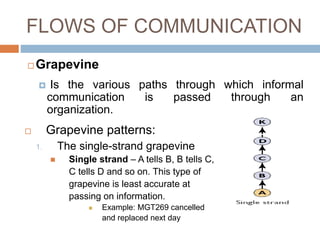
1. The single-strand grapevine
 Single strand – A tells B, B tells C,
C tells D and so on. This type of
grapevine is least accurate at
passing on information.
 Example: MGT269 cancelled
and replaced next day
FLOWS OF COMMUNICATION
2. The Gossip Grapevine
 One person seeks out and tells
everyone the information he has
obtained. This type of grapevine
is often used when information of
an interesting but non-job related
nature is being conveyed.
FLOWS OF COMMUNICATION
3. Probability
 Individual are indifferent about
whom they offer information to.
They tell people at random, and
those people in turn tell others at
random.
FLOWS OF COMMUNICATION
4. Cluster
 Person A conveys the information to
a few selected individuals that he or
she trusts. They are most likely to pass
on information that is interesting to them
and job related. It is a dominant grapevine
pattern in organization
COMMUNICATION PROCESS
 Social Context
 The setting in which the communication takes place.
 Sender
 The sender initiates the communication process by
encoding his or her meaning and sending the
message through a channel.
 Encoding translates the sender’s ideas into a
systematic set of symbols or a language expressing
the communicator’s purpose.
 Messages
 The tangible forms of coded symbols that are
intended to give a particular meaning to the
information or data.
COMMUNICATION PROCESS
 Channel
 The carrier of the message or the means by which the
message is sent.
 Receiver
 The receiving person or group must make sense of
the information received.
 Decoding the translation of received messages into
interpreted meanings.
 Feedback
 The process of verifying messages and the receiver’s
attempts to ensure that the message he or she
decoded is what the sender really meant to convey.
COMMUNICATION PROCESS
 Noise
 Any internal or external interference or distraction
with the intended message that can cause
distortion in the sending and receiving of
messages.
COMMUNICATION BARRIERS
 Cross-cultural diversity
 Trust and credibility
 Information overload
 Language characteristics
 Gender differences
 Other factors
COMMUNICATION BARRIERS
 Cross-Cultural Diversity
 Individuals from different cultures may encode
and decode their messages differently.
 They may have different behaviors, styles, and
ways of looking at things.
 A common problem in cross-cultural
communication is ethnocentrism.
 Ethnocentrism is the tendency to consider one’s
own culture and its values as being superior to
others.
COMMUNICATION BARRIERS
 Trust and Credibility
 A very important barrier to effective communication
is a lack of trust between the sender and the
receiver.
 This lack of trust can cause the receiver to look for
hidden meanings in the sender’s message.
 It can also cause the sender to try and manipulate
the message.
COMMUNICATION BARRIERS
 Information Overload
 Managers and organizations can experience
information overload when the amount of data that
can be processed is exceeded.
 Information overload can lead to:
 Failing to process or ignoring some information.
 Processing information incorrectly.
 Delaying the processing of information until the information
overload abates.
 Searching for people to help process some of the
information.
 Lowering the quality of information processing.
COMMUNICATION BARRIERS
 Language Characteristics
 Many words and phrases in our language are
imprecise. Individuals often use different meanings
or interpretations of the same word and do not
realize it.
 The imprecision and multiple meanings of words
are one reason why jargon develops.
 Jargon is terminology or language specific to a
particular profession or group.
COMMUNICATION BARRIERS
 Gender Differences and Other Factors
 Gender Differences
 Gender differences can result in breakdowns and lead
to distorted communication and misunderstandings
between men and women.
 Other Factors
 Time pressures may cause us to focus on information
that helps us make a choice quickly. Feedback may
be impaired or absent.
THANK YOU!!

Chapter 1 MGT 269

  • 1.
  • 2.
    INTRODUCTION TO BUSINESS COMMUNICATION What is Business Communication?  Purpose of Business Communication  Types of communication  Channel of Communication(Flow of communication)  Communication Process  Communication Barriers
  • 3.
    DEFINITION  Your businesssuccess depend on your ability to communicate inside and outside your organization  Communication is the process of sending and receiving messages.  Process of transferring information and meaning between senders and receivers, using one or more written, oral, visual, or electronic channels.
  • 4.
    IMPORTANCE OF COMMUNICATION  .Communicationis important because it is about how information is sent and received within firms.  . The way information is communicated is often governed by how firms are structured.  . Increase productivity  . Focus resources  . Improve morale
  • 5.
    EFFECTIVE COMMUNICATION Communication is effectiveonly when people:  Understand the message correctly.  Respond to the message the way the sender wants to. The benefit of effective communication:  Stronger decision making based on timely, reliable information  Faster problem solving  Earlier warning of potential problems  Increased productivity and lower costs  Stronger business relationships  Clearer and more persuasive marketing messages  Enhanced professional images for both employers and companies.
  • 6.
     Communication connectsan organization with all its stakeholders ( customers, employees, shareholders, suppliers, neighbours, the community and the nation).  To make your message effective, make them Practical : provide practical information Factual : give facts rather than impression Concise: clarify and condense information Clear about expectation: state precise responsibilities Persuasive : persuade other and offer recommendation
  • 7.
    WHAT IS BUSINESS COMMUNICATION? Forms of communication that occur within an organization( verbal, non-verbal, formal, informal) in order to carry out the organizational functions.
  • 8.
    Purpose of BusinessCommunication  It can integrates all the managerial functions of management such as planning, leading organizing and controlling.  Can effect changes and also influences actions between the internal environment and external environment.  To meet organizational needs and goals
  • 9.
    TYPES OF COMMUNICATION Oral Communication  Written Communication  Nonverbal Communication  Technological Communication
  • 10.
    TYPES OF COMMUNICATION Oral Communication  All forms of spoken information; by far the most preferred type of communication used by managers.  Written Communication  Letters, memos, policy manuals, reports, forms, and other documents used to share information in an organization.
  • 11.
    TYPES OF COMMUNICATION Nonverbal Communication  Kinesic behavior, or body motion, such as gestures, facial expressions, and eye behavior.  Physical characteristics, such as body shape, physique, posture, height, and weight.  Paralanguage, such as voice quality, speech rate, pitch, and laughing.  Environment, such as building and room design, furniture, light, noise, and cleanliness.  Time, such as being late or early, keeping others waiting.  Proxemics, such as the way people perceive space, seating arrangements, and conversational distance.
  • 12.
    TYPES OF COMMUNICATION Technological Communication  Telecommuting or “telework”  The practice of working at a remote site by using a computer linked to a central office or other employment location.  Electronic mail (e-mail)  Sending messages through computerized text-processing and communication networks.  Video conferencing  An umbrella term for technologies that use live video to unite widely dispersed company operations.  The Internet  Essentially, “everything” can be done on the internet.
  • 13.
  • 14.
    FLOWS OF COMMUNICATION Messages flow into, through, and out of business organization in a variety of ways.  Internal communication takes place between people inside a company;  External communication takes place between a company and outside parties.  Formal communication network: Ideas and information flow along the lines of command in the company’s organization structure.  Informal communication network: Referred to as the grapevine, that encompassess all communication that takes place outside the formal network.
  • 15.
    FLOWS OF COMMUNICATION Downward communication  Messages sent from individuals at higher levels of the organization to those at lower levels.  Upward communication  Messages sent up the line from subordinates to managers.  Horizontal communication  The flow of information that occurs both within and between departments.  Effective organizations encourage horizontal communication because it increases:  Coordination  Collaboration  Cooperation
  • 16.
    FLOWS OF COMMUNICATION Grapevine  Is the various paths through which informal communication is passed through an organization.  Grapevine patterns: 1. The single-strand grapevine  Single strand – A tells B, B tells C, C tells D and so on. This type of grapevine is least accurate at passing on information.  Example: MGT269 cancelled and replaced next day
  • 17.
    FLOWS OF COMMUNICATION 2.The Gossip Grapevine  One person seeks out and tells everyone the information he has obtained. This type of grapevine is often used when information of an interesting but non-job related nature is being conveyed.
  • 18.
    FLOWS OF COMMUNICATION 3.Probability  Individual are indifferent about whom they offer information to. They tell people at random, and those people in turn tell others at random.
  • 19.
    FLOWS OF COMMUNICATION 4.Cluster  Person A conveys the information to a few selected individuals that he or she trusts. They are most likely to pass on information that is interesting to them and job related. It is a dominant grapevine pattern in organization
  • 20.
  • 21.
    COMMUNICATION PROCESS  SocialContext  The setting in which the communication takes place.  Sender  The sender initiates the communication process by encoding his or her meaning and sending the message through a channel.  Encoding translates the sender’s ideas into a systematic set of symbols or a language expressing the communicator’s purpose.  Messages  The tangible forms of coded symbols that are intended to give a particular meaning to the information or data.
  • 22.
    COMMUNICATION PROCESS  Channel The carrier of the message or the means by which the message is sent.  Receiver  The receiving person or group must make sense of the information received.  Decoding the translation of received messages into interpreted meanings.  Feedback  The process of verifying messages and the receiver’s attempts to ensure that the message he or she decoded is what the sender really meant to convey.
  • 23.
    COMMUNICATION PROCESS  Noise Any internal or external interference or distraction with the intended message that can cause distortion in the sending and receiving of messages.
  • 24.
    COMMUNICATION BARRIERS  Cross-culturaldiversity  Trust and credibility  Information overload  Language characteristics  Gender differences  Other factors
  • 25.
    COMMUNICATION BARRIERS  Cross-CulturalDiversity  Individuals from different cultures may encode and decode their messages differently.  They may have different behaviors, styles, and ways of looking at things.  A common problem in cross-cultural communication is ethnocentrism.  Ethnocentrism is the tendency to consider one’s own culture and its values as being superior to others.
  • 26.
    COMMUNICATION BARRIERS  Trustand Credibility  A very important barrier to effective communication is a lack of trust between the sender and the receiver.  This lack of trust can cause the receiver to look for hidden meanings in the sender’s message.  It can also cause the sender to try and manipulate the message.
  • 27.
    COMMUNICATION BARRIERS  InformationOverload  Managers and organizations can experience information overload when the amount of data that can be processed is exceeded.  Information overload can lead to:  Failing to process or ignoring some information.  Processing information incorrectly.  Delaying the processing of information until the information overload abates.  Searching for people to help process some of the information.  Lowering the quality of information processing.
  • 28.
    COMMUNICATION BARRIERS  LanguageCharacteristics  Many words and phrases in our language are imprecise. Individuals often use different meanings or interpretations of the same word and do not realize it.  The imprecision and multiple meanings of words are one reason why jargon develops.  Jargon is terminology or language specific to a particular profession or group.
  • 29.
    COMMUNICATION BARRIERS  GenderDifferences and Other Factors  Gender Differences  Gender differences can result in breakdowns and lead to distorted communication and misunderstandings between men and women.  Other Factors  Time pressures may cause us to focus on information that helps us make a choice quickly. Feedback may be impaired or absent.
  • 30.