BCOM 3 Business Communication 3rd Edition Carol
M. Lehman pdf download
https://ebookname.com/product/bcom-3-business-communication-3rd-
edition-carol-m-lehman/
Get Instant Ebook Downloads – Browse at https://ebookname.com
Instant digital products (PDF, ePub, MOBI) available
Download now and explore formats that suit you...
Buruli Ulcer Linda Lehman
https://ebookname.com/product/buruli-ulcer-linda-lehman/
The Responsible Business Reimagining Sustainability and
Success 1st Edition Carol Sanford
https://ebookname.com/product/the-responsible-business-
reimagining-sustainability-and-success-1st-edition-carol-sanford/
Chemistry of High Energy Materials 3 ed 3rd Edition
Klapötke Thomas M.
https://ebookname.com/product/chemistry-of-high-energy-
materials-3-ed-3rd-edition-klapotke-thomas-m/
Deep Learning for Multimedia Processing Applications
Volume Two Signal Processing and Pattern Recognition
1st Edition Uzair Aslam Bhatti
https://ebookname.com/product/deep-learning-for-multimedia-
processing-applications-volume-two-signal-processing-and-pattern-
recognition-1st-edition-uzair-aslam-bhatti/
Uses and Abuses of Plant Derived Smoke Marcello
Pennacchio
https://ebookname.com/product/uses-and-abuses-of-plant-derived-
smoke-marcello-pennacchio/
Structure in Protein Chemistry 2nd Edition Jack Kyte
(Author)
https://ebookname.com/product/structure-in-protein-chemistry-2nd-
edition-jack-kyte-author/
The Quantum Theory of Radiation 3rd edition Edition
Walter Heitler
https://ebookname.com/product/the-quantum-theory-of-
radiation-3rd-edition-edition-walter-heitler/
Marketing to the Social Web How Digital Customer
Communities Build Your Business Second Edition Larry
Weber(Auth.)
https://ebookname.com/product/marketing-to-the-social-web-how-
digital-customer-communities-build-your-business-second-edition-
larry-weberauth/
Essentials of Organic Chemistry For Students of
Pharmacy Medicinal Chemistry and Biological Chemistry
Paul M. Dewick
https://ebookname.com/product/essentials-of-organic-chemistry-
for-students-of-pharmacy-medicinal-chemistry-and-biological-
chemistry-paul-m-dewick/
Notes on Roman Artists of the Middle Ages 1st Edition
A. L. Frothingham
https://ebookname.com/product/notes-on-roman-artists-of-the-
middle-ages-1st-edition-a-l-frothingham/
This is an electronic version of the print textbook. Due to electronic rights
restrictions, some third party content may be suppressed. Editorial
review has deemed that any suppres ed content does not materially
affect the overall learning experience. The publisher reserves the
right to remove content from this title at any time if subsequent
rights restrictions require it. For valuable information on pricing, previous
editions, changes to current editions, and alternate formats, please visit
www.cengage.com/highered to search by ISBN#, author, title, or keyword
for materials in your areas of interest.
s
Copyright 2011 Cengage Learning. All Rights Reserved. May not be copied, scanned, or duplicated, in whole or in part. Due to electronic rights, some third party content may be suppressed from the eBook and/or eChapter(s).
Editorial review has deemed that any suppressed content does not materially affect the overall learning experience. Cengage Learning reserves the right to remove additional content at any time if subsequent rights restrictions require it.
reviewcard/
© 2012 Cengage Learning. All Rights Reserved. May not be scanned, copied or duplicated, or posted to a publicly accessible website, in whole or in part.
C H A P T E R 1
E S TA B L I S H I N G A F R A M E W O R K
F O R B U S I N E S S C O M M U N I C AT I O N
Key Terms
Chronemics the study of how a culture
perceives time and its use
Decoding the process of interpreting a
message
Diversity skills the ability to communi-
cate effectively with both men and women of
all ages, cultures, and minority groups
Downward communication a type of
communication that flows from supervisor to
employee, from policy makers to operating
personnel, or from top to bottom on the
organization chart
Encoding the process of selecting and
organizing a message
Ethics the principles of right and wrong that
guide one in making decisions that consider
the impact of one’s actions on others as well
as on the decision maker
Ethnocentrism the assumption that one’s
own cultural norms are the right way to do
things
External messages messages directed to
recipients outside the organization
Feedback a receiver’s response to a
sender’s message
Formal communication channel
a channel of communication typified by the
formal organization chart; dictated by the
technical, political, and economic environ-
ment of the organization
Grapevine the best-known component of
the informal communication system
Horizontal (or lateral) communica-
tion interactions between organizational
units on the same hierarchical level
Informal communication channel
a channel of communication that continu-
ously develops as people interact within the
formal system to accommodate their social
and psychological needs
Interferences also called barriers; numer-
ous factors that hinder the communication
process
Internal messages messages intended
for recipients within the organization
Kinesics the study of body language, which
is not universal, but instead is learned from
one’s culture
Organizational communication the
movement of information within the com-
pany structure
Learning Objectives
LO1
: Define communication and describe the value of communication in
business.
Communication is the process of exchanging information and meaning between or among
individuals through a common system of symbols, signs, and behavior. Managers spend
most of their time in communication activities.
LO2
: Explain the communication process model and the ultimate objective of
the communication process.
People engaged in
communication encode and
decode messages while
simultaneously serving as
both senders and receivers.
In the communication
process, feedback helps
people resolve possible
misunderstandings and thus
improves communication
effectiveness. Feedback and
the opportunity to observe
nonverbal signs are always
present in face-to-face
communication, the most
complete of the three communication levels.
LO3
: Discusshowinformationflowsinanorganization.
Both formal
and informal
communication
systems exist in
every organization;
the formal system
exists to accomplish
tasks, and the
informal system
serves a personal
maintenance
purpose that
results in people
feeling better
about themselves
and others.
Communication flows
upward, downward,
and horizontally or laterally. These flows often defy formal graphic description, yet each is
a necessary part of the overall communication activity of the organization. Communication
takes place at five levels: intrapersonal (communication within one person), interpersonal
(communication between two people), group (communication among more than two
people), organizational (communication among combinations of groups), and public
(communication from one entity to the greater public).
S E N D E R
R E C E I V E R
Encodes
Message
Encodes
Message
Decodes
Message
Decodes
Message
Selects Channel &
Transmits Message
Selects Channel &
Transmits Message
I
N
T
E
R
F
E
R
E
N
C
E
S
s
UPWARD COMMUNICATION
Progress reports (spoken and written)
• Results/accomplishments
• Problems/clarifications
UPWARD COMMUNICATION
Ideas/suggestions
Feelings/attitudes
HORIZONTAL OR
LATERAL COMMUNICATION
Coordination of interrelated activities
Problem-solving efforts
DOWNWARD COMMUNICATION
Policies and procedures
Organizational goals and strategies
Work assignments
Employee development
• Job role/responsibility
• Performance appraisal
(formal and informal)
• Constructive criticism
• Deserved praise and recognition
© 2012 Cengage Learning. All Rights Reserved. May not be scanned, copied or duplicated, or posted to a publicly accessible website, in whole or in part.
BCOM3_SE cards.indd 3 12/27/10 2:08:50 PM
M o r e r e v i e w t o o l s a t C o u r s e M a t e f o r B C O M 3 . L o g i n a t w w w . c e n g a g e b r a i n . c o m .
Proxemics the study of cultural space
requirements
Stakeholders people inside and outside
the organization who are affected by
decisions
Stereotypes mental pictures that one
group forms of the main characteristics of
another group, creating preformed ideas of
what people in this group are like
Synergy a situation in which the whole is
greater than the sum of the parts
Team a small number of people with
complementary skills who work together for
a common purpose
Telecommuting also called teleworking;
working at home or other remote locations
and sending and receiving work from the
company office electronically
Upward communication a type of com-
munication that is generally a response to
requests from supervisors
LO4
: Explain how legal and ethical constraints, diversity challenges, changing
technology, and team environment act as strategic forces that influence
the process of business communication.
Communication occurs within an environment constrained by legal and ethical
requirements, diversity challenges, changing technology, and team environment
requirements.
• International, federal, state, and local laws impose legal boundaries for business
activity, and ethical boundaries are determined by personal analysis that can be
assisted by application of various frameworks for decision making.
• Communication is critically impacted by diversity in nationality, culture, age, gender,
and other factors that offer tremendous opportunities to maximize talent, ideas, and
productivity but pose significant challenges in interpretation of time, personal space
requirements, body language, and language translation.
• Significant strides have occurred in the development of tools for data collection and
analysis, creation of messages that are clearer and more effective, and quick and easy
communication with audiences in remote locations. The use of technology, however,
poses legal and ethical concerns in regard to ownership, access, and privacy.
• Team environment challenges arise because communication in teams differs from
communication in traditional organizational structures. The result of effective teams is
better decisions, more creative solutions to problems, and higher worker morale.
1.
You
must
learn
to
design
spreadsheets
that
make
financial
information
meaningful
to
users.
2.
Many
online
tools
are
available
that
build
relationships
with
customers.
3.
I
am
submitting
an
employee
testimonial,
which
I
first
posted
to
a
presentations
blog,
to
the
company
website.
4.
More
companies
are
videoconferencing
because
of
the
need
to
reduce
travel
costs
significantly.
5.
You
must
perform
periodic
maintenance
on
your
computer
to
keep
it
operating
efficiently.
6.
Planned
store
improvements
include
widening
the
aisles,
improving
lighting,
and
lowering
shelves
for
a
sophisticated
feel.
or
Planned
store
improvements
include
widened
aisles,
improved
lighting,
and
lowered
shelves
for
a
sophisticated
feel.
Grammar Quiz
Sentence Structure
Identify the weakness in each sentence and write an improved version.
1. It is essential that you learn to design spreadsheets that make financial information
meaningful to users.
2. There are many online tools available that build relationships with customers.
3. I am submitting an employee testimonial to the company website, which I first posted
to a presentation blog.
4. More companies are videoconferencing because of the need to significantly reduce
travel costs.
5. To operate efficiently, you must perform periodic maintenance on your computer.
6. Planned store improvements include widening the aisles, improved lighting, and lower
shelves for a sophisticated feel.
Grammar Quiz Solutions
Chapter In Review Cards in
the back of the Student Edition
provide students a portable study
tool containing all of the pertinent
information for class preparation.
Engaging. Trackable. Affordable.
CourseMate brings course concepts to life with interactive learning,
study, and exam preparation tools that support BCOM3.
FOR STUDENTS:
• Interactive eBook
• Chapter Quizzes
• Assignments & Handouts
• E-Lectures
• Cases
• Chapter In Review Cards
• Flashcards (electronic & printable)
• Games (crossword puzzles & quiz bowl)
• Glossary
• Learning Objectives
• PowerPoint®
• Videos
• Grammar Games
• Style Guides
• Templates
• Model Documents
• Language Review Quizzes
FOR INSTRUCTORS:
• First Day of Class
Instructions
• Custom Options through
4LTR+ Program
• Instructor’s Manual
• Test Bank
• PowerPoint®
Slides
• Instructor Prep Cards
• Engagement Tracker
S T U D E N T T E S T E D , F A C U L T Y A P P R O V E D
THE
SOLUTION
ONLINE RESOURCES INCLUDED!
Students sign in at
www.cengagebrain.com
27776_FM_i-vi_1.indd i
27776_FM_i-vi_1.indd i 1/4/11 11:44:09 AM
1/4/11 11:44:09 AM
Copyright 2011 Cengage Learning. All Rights Reserved. May not be copied, scanned, or duplicated, in whole or in part. Due to electronic rights, some third party content may be suppressed from the eBook and/or eChapter(s).
Editorial review has deemed that any suppressed content does not materially affect the overall learning experience. Cengage Learning reserves the right to remove additional content at any time if subsequent rights restrictions require it.
BCOM3 2011–2012 Edition
Carol M. Lehman
Debbie D. DuFrene
Vice President of Editorial, Business:
Jack W. Calhoun
Editor-in-Chief: Melissa Acuña
Acquisitions Editor: Erin Joyner
Developmental Editor: Dana Freeman,
B-books, Ltd.
Product Developmental Manager,
4LTR Press: Steven E. Joos
Executive Brand Marketing Manager,
4LTR Press: Robin Lucas
Editorial Assistant: Kayti Purkiss
VP/Director of Marketing: Cheryl Costantini
Marketing Manager: Michelle Lockard
Marketing Coordinator: Leigh Smith
Sr. Marketing Communications Manager:
Sarah Greber
Production Director: Amy McGuire,
B-books, Ltd.
Content Project Manager: Darrell Frye
Media Editor: John Rich
Frontlist Buyer, Manufacturing:
Miranda Klapper
Production Service: B-books, Ltd.
Art Director: Stacy Jenkins Shirley
Internal Designer: KeDesign, Mason, OH
Cover Designer: KeDesign, Mason, OH
Cover Image: © Getty Images/Blend
Images/Anderson Ross
Photo Rights Acquisitions Specialist:
Deanna Ettinger
Photo Researcher: Charlotte Goldman
© 2012, © 2011 South-Western, a part of Cengage Learning
ALL RIGHTS RESERVED. No part of this work covered by the copyright
herein may be reproduced, transmitted, stored, or used in any form or by
any means graphic, electronic, or mechanical, including but not limited to
photocopying, recording, scanning, digitizing, taping, web distribution, infor-
mation networks, or information storage and retrieval systems, except as
permitted under Section 107 or 108 of the 1976 United States Copyright Act,
without the prior written permission of the publisher.
For product information and technology assistance, contact us at
Cengage Learning Customer & Sales Support, 1-800-354-9706
For permission to use material from this text or product,
submit all requests online at www.cengage.com/permissions
Further permissions questions can be emailed to
permissionrequest@cengage.com
Library of Congress Control Number: 2010942121
SE ISBN-13: 978-1-111-52777-8
SE ISBN-10: 1-111-52777-6
South-Western
5191 Natorp Boulevard
Mason, OH 45040
USA
Cengage Learning products are represented in Canada by
Nelson Education, Ltd.
For your course and learning solutions, visit www.cengage.com
Purchase any of our products at your local college store or at our
preferred online store www.CengageBrain.com
Printed in the United States of America
1 2 3 4 5 6 7 15 14 13 12 11
27776_FM_i-vi_1.indd ii
27776_FM_i-vi_1.indd ii 1/4/11 11:44:19 AM
1/4/11 11:44:19 AM
Copyright 2011 Cengage Learning. All Rights Reserved. May not be copied, scanned, or duplicated, in whole or in part. Due to electronic rights, some third party content may be suppressed from the eBook and/or eChapter(s).
Editorial review has deemed that any suppressed content does not materially affect the overall learning experience. Cengage Learning reserves the right to remove additional content at any time if subsequent rights restrictions require it.
iii
Communication Foundations 2
1 Establishing a Framework for Business
Communication 2
2 Focusing on Interpersonal and Group
Communication 20
Communication Analysis 36
3 Planning Spoken and Written Messages 36
4 Preparing Spoken and Written Messages 56
Communication Through Voice,
Electronic, and Written Messages 70
5 Communicating Electronically 70
6 Delivering Good- and Neutral-News
Messages 84
7 Delivering Bad-News Messages 102
8 Delivering Persuasive Messages 122
Communication Through Reports and
Business Presentations 140
9 Understanding the Report Process
and Research Methods 140
10 Managing Data and Using Graphics 160
11 Organizing and Preparing Reports
and Proposals 172
12 Designing and Delivering Business
Presentations 194
Communication for Employment 216
13 Preparing Résumés and Application
Messages 216
14 Interviewing for a Job and Preparing
Employment Messages 244
GRAMMAR AND USAGE APPENDIX 260
REFERENCES 275
INDEX 278
Brief Contents
27776_FM_i-vi_1.indd iii
27776_FM_i-vi_1.indd iii 1/4/11 11:44:24 AM
1/4/11 11:44:24 AM
Copyright 2011 Cengage Learning. All Rights Reserved. May not be copied, scanned, or duplicated, in whole or in part. Due to electronic rights, some third party content may be suppressed from the eBook and/or eChapter(s).
Editorial review has deemed that any suppressed content does not materially affect the overall learning experience. Cengage Learning reserves the right to remove additional content at any time if subsequent rights restrictions require it.
Contents
Part 1 Communication
Foundations 2
1 Establishing a Framework for
Business Communication 2
Value of Communication 2
The Communication Process 3
The Sender Encodes the Message 4
The Sender Selects the Channel and Transmits the Message 4
The Receiver Decodes the Message 4
The Receiver Encodes the Message to Clarify 5
Interferences Hinder the Process 5
Communicating within Organizations 5
Communication Flow in Organizations 5
Levels of Communication 9
Strategic Forces Influencing Business
Communication 10
Strategic Force 1: Legal and Ethical Constraints 10
Strategic Force 2: Diversity Challenges 13
Strategic Force 3: Changing Technology 15
Strategic Force 4: Team Environment 17
2 Focusing on Interpersonal
and Group Communication 20
Behavioral Theories that Impact Communication 20
Recognizing Human Needs 20
Stroking 22
Exploring the Johari Window 22
Contrasting Management Styles 23
Nonverbal Communication 23
Metacommunication 23
Kinesic Messages 23
Understanding Nonverbal Messages 24
Listening as a Communication
Skill 25
Listening for a Specific Purpose 25
Bad Listening Habits 26
Group Communication 27
Increasing Focus on Groups 27
Characteristics of Effective Groups 29
Group Roles 30
From Groups to Teams 31
Meeting Management 32
Face-to-Face Meetings 33
Electronic Meetings 33
Suggestions for Effective Meetings 34
Part 2 Communication
Analysis 36
3 Planning Spoken and
Written Messages 36
Step 1: Determining the Purpose and Channel 38
Step 2: Envisioning the Audience 38
Step 3: Adapting the Message to the Audience 40
Focus on the Receiver’s Point of View 40
Communicate Ethically and Responsibly 41
Build and Protect Goodwill 43
Use Contemporary Language 47
Use Simple, Informal Words 47
Communicate Concisely 48
Project a Positive,TactfulTone 49
Step 4: Organizing the Message 52
Outline to Benefit the Sender and the
Receiver 52
Sequence Ideas to Achieve Desired
Goals 52
4 Preparing
Spoken and Written
Messages 56
Prepare the First Draft 56
Craft Powerful Sentences 58
Develop Coherent Paragraphs 60
Revise and Proofread 62
Improve Readability 62
Apply Visual Enhancements to Improve Readability 63
Use Systematic Procedures for Revising and Proofreading 66
Cultivate a Frame of Mind for Effective Revising and
Proofreading 68
on
se 25
27
ups 29
y 41
C o n t e n t s
iv
27776_FM_i-vi_1.indd iv
27776_FM_i-vi_1.indd iv 1/4/11 11:44:35 AM
1/4/11 11:44:35 AM
Copyright 2011 Cengage Learning. All Rights Reserved. May not be copied, scanned, or duplicated, in whole or in part. Due to electronic rights, some third party content may be suppressed from the eBook and/or eChapter(s).
Editorial review has deemed that any suppressed content does not materially affect the overall learning experience. Cengage Learning reserves the right to remove additional content at any time if subsequent rights restrictions require it.
v
C o n t e n t s
Part 3 Communication
Through Voice, Electronic,
and Written Messages 70
5 Communicating
Electronically 70
Electronic Mail
Communication 70
Advantages of Email 70
Guidelines for Preparing
Email Messages 71
Effective Use of Email 72
Instant Messaging 74
Text Messaging 75
Electronic Messages and the Law 77
Web Page Communication 78
Writing for a Website 78
Writing Wikis 79
Writing for Weblogs 79
Voice and Wireless Communication 80
Voice Mail Communication 80
Cell Phone Communication 81
Wireless Communication and the Future 82
Appropriate Use of Technology 82
Determine the Purpose of the Message 83
Determine Whether the Information Is Personal or
Confidential 83
Decide Whether Positive Human Relations Are Sacrificed 83
6 Delivering Good- and
Neutral-News Messages 84
Deductive Organizational Pattern 84
Good-News Messages 86
Positive News 86
Thank-You and Appreciation Messages 88
Routine Claims 90
Claim Message 90
Favorable Response to a Claim Message 90
Routine Requests 93
Routine Request 93
Favorable Response to a
Routine Request 93
Positive Response to a
Favor Request 93
Form Messages
for Routine
Responses 95
Routine Messages about Orders and Credit 95
Acknowledging Customer Orders 97
Providing Credit Information 97
Extending Credit 98
Procedural Messages 100
7 Delivering Bad-News
Messages 102
Choosing an Appropriate
Channel and Organizational
Pattern 102
Channel Choice and Commitment
to Tact 102
Use of the Inductive Approach to
Build Goodwill 104
Exceptions to the Inductive
Approach 105
Developing a Bad-News
Message 105
Writing the Introductory Paragraph 105
Presenting the Facts, Analysis, and Reasons 106
Writing the Bad-News Statement 107
Offering a Counterproposal or“Silver Lining”Idea 108
Closing Positively 108
Refusing a Request 110
Denying a Claim 111
Denying Credit 113
Delivering Constructive Criticism 115
Communicating Negative Organizational News 116
Breaking Bad News 116
Responding to Crisis Situations 118
8 Delivering Persuasive
Messages 122
Persuasion Strategies 122
Plan Before You Write 123
Use the Inductive Approach 124
Apply Sound Writing Principles 124
Sales Messages 126
Gain Attention 126
Generate Interest by Introducing the
Product, Service, or Idea 127
Create Desire by Providing
Convincing Evidence 128
Motivate Action 131
Persuasive Requests 132
Making a Claim 132
Asking a Favor 135
Requesting Information 137
Persuading within an Organization 137
0
2
d the Law 77
ional
tment
ch to
2
h 124
iples 124
ducing the
ea 127
128
37
nization 137
27776_FM_i-vi_1.indd v
27776_FM_i-vi_1.indd v 1/4/11 11:44:39 AM
1/4/11 11:44:39 AM
Copyright 2011 Cengage Learning. All Rights Reserved. May not be copied, scanned, or duplicated, in whole or in part. Due to electronic rights, some third party content may be suppressed from the eBook and/or eChapter(s).
Editorial review has deemed that any suppressed content does not materially affect the overall learning experience. Cengage Learning reserves the right to remove additional content at any time if subsequent rights restrictions require it.
C o n t e n t s
vi
Part 4 Communication
Through Reports
and Business
Presentations 140
9 Understanding the Report
Process and Research
Methods 140
Characteristics of Reports 140
Types of Reports 141
Proposals 143
Basis for Reports: The Problem-Solving Process 143
Recognizing and Defining the Problem 143
Selecting a Method of Solution 145
Collecting and Organizing the Data 149
Arriving at an Answer 155
10 Managing Data and Using
Graphics 160
Communicating
Quantitative
Information 160
Using Graphics 162
Effective and Ethical Use of
Graphics 163
Types of Graphic Aids 163
Including Graphics in Texts 170
Positioning Graphics in Texts 170
11 Organizing and
Preparing Reports and
Proposals 172
Parts of a Formal Report 172
Preliminary Parts of a Report 173
Report Text 176
Report Addenda 177
Organization of Formal Reports 177
Writing Convincing and Effective Reports 178
Choosing a Writing Style for Formal Reports 180
Short Reports 182
Memorandum, Email, and Letter Reports 182
Form Reports 182
Proposals 189
Proposal Structure 189
Proposal Preparation 191
12 Designing and Delivering
Business Presentations 194
Planning an Effective Business Presentation 194
Identify Your Purpose 195
Know Your Audience 196
Organizing the Content 197
Introduction 197
Body 199
Closing 200
Designing Compelling Presentation Visuals 200
Types of Presentation Visuals 200
Design of Presentation Visuals 202
Design Tips for Audience Handouts and
Notes Pages 203
Refining Your Delivery 204
Delivery Method 204
Vocal Qualities 205
Delivery Style 207
Adapting to Alternate Delivery
Situations 210
Culturally Diverse Audiences 210
Team Presentations 212
Distance Presentations 213
Part 5 Communication for
Employment 216
13 Preparing Résumés and
Application Messages 216
Preparing for the Job Search 216
Gathering Essential Information 217
Identifying Potential Career
Opportunities 218
Planning a Targeted
Résumé 221
Standard Parts of a
Résumé 221
Types of Résumés 226
Preparing Résumés for
Print and Electronic
Deliveries 227
Preparing a Print
(Designed)
Résumé 227
Preparing Electronic Résumé Submissions 228
Supplementing a Résumé 234
Professional Portfolios 234
Employment Videos 234
P
Su
ation for
27776_FM_i-vi_1.indd vi
27776_FM_i-vi_1.indd vi 1/4/11 11:44:44 AM
1/4/11 11:44:44 AM
Copyright 2011 Cengage Learning. All Rights Reserved. May not be copied, scanned, or duplicated, in whole or in part. Due to electronic rights, some third party content may be suppressed from the eBook and/or eChapter(s).
Editorial review has deemed that any suppressed content does not materially affect the overall learning experience. Cengage Learning reserves the right to remove additional content at any time if subsequent rights restrictions require it.
Composing Application Messages 237
Persuasive Organization 237
General Writing Guidelines 241
Finishing Touches 242
14
Interviewing
for a Job and
Preparing
Employment
Messages 244
Understanding Types of Employment
Interviews 244
Structured Interviews 244
Unstructured Interviews 246
Stress Interviews 246
Group Interviews 246
Virtual Interviews 246
Preparing for an Interview 247
Research the Company 247
Study Yourself 248
Plan Your Appearance 248
Plan Your Time and Materials 249
Practice 249
Conducting a Successful Interview 249
The Opening Formalities 249
The Information Exchange 250
The Closing 253
Preparing Other Employment Messages 255
Application Forms 255
Follow-Up Messages 255
Thank-You Messages 256
Job-Acceptance Messages 256
Job-Refusal Messages 256
Resignation Messages 258
Recommendation Requests 258
GRAMMAR AND USAGE APPENDIX 260
REFERENCES 275
INDEX 278
ges 237
Empl
pl
pl
ploy
oy
oy
oy
oy
o me
me
me
ent
St
Pl
Pl
Pr
C
C o n t e n t s 1
27776_FM_i-vi_1.indd 1
27776_FM_i-vi_1.indd 1 1/4/11 11:44:50 AM
1/4/11 11:44:50 AM
Copyright 2011 Cengage Learning. All Rights Reserved. May not be copied, scanned, or duplicated, in whole or in part. Due to electronic rights, some third party content may be suppressed from the eBook and/or eChapter(s).
Editorial review has deemed that any suppressed content does not materially affect the overall learning experience. Cengage Learning reserves the right to remove additional content at any time if subsequent rights restrictions require it.
2 P a r t 1 : C o m m u n i c a t i o n F o u n d a t i o n s
Value of Communication
W
e communicate to satisfy needs
in both our work and private
lives. Each of us wants to be
heard, appreciated, and wanted.
We also want to accomplish tasks
and achieve goals. A major value
of communication is to
help people feel good
about themselves and
about their organiza-
tions. Generally peo-
ple communicate for
three basic purposes:
to inform, to persuade,
and to entertain.
What is communication? Communication is the pro-
cess of exchanging information and meaning between or
among individuals through a common system of sym-
bols, signs, and behavior. Other words used to describe
the communication process include conversing, speaking,
corresponding, writing, and listening. Studies indicate that
managers typically spend 60 to 80 percent of their time
involved in communication. In your career activities, you
will communicate in a wide variety of ways, including
• attending meetings and writing reports related to
strategic plans and company policy.
• presenting information to large and small groups in
face-to-face and virtual environments.
• explaining and clarifying management procedures
and work assignments.
• coordinating the work of various employees, depart-
ments, and other work groups.
• evaluating and counseling employees.
• promoting the company’s products/services and image.
O
B
J
E
C
T
I
V
E
S 1 Define communication
and describe the value of
communication in business.
2 Explain the communication
process model and the ultimate
objective of the communication
process.
3 Discuss how information flows in
an organization.
4 Explain how legal and ethical
constraints, diversity challenges,
changing technology, and team
environment act as strategic
forces that influence the process
of business communication.
BCOM
Communication Foundations
Part 1 Chapter 1
Establishing a
Framework for Business
Communication
O B J E C T I V E 1
Define communication
and describe the value
of communication in
business.
©
iStockphoto.com/Alexandr
Tovstenko
27776_ch01_002-019.indd 2
27776_ch01_002-019.indd 2 1/3/11 8:00:12 AM
1/3/11 8:00:12 AM
Copyright 2011 Cengage Learning. All Rights Reserved. May not be copied, scanned, or duplicated, in whole or in part. Due to electronic rights, some third party content may be suppressed from the eBook and/or eChapter(s).
Editorial review has deemed that any suppressed content does not materially affect the overall learning experience. Cengage Learning reserves the right to remove additional content at any time if subsequent rights restrictions require it.
3
C h a p t e r 1 : E s t a b l i s h i n g a F r a m e w o r k f o r B u s i n e s s C o m m u n i c a t i o n
C H A P T E R
The Communication
Process
E
ffective business communication is essen-
tial to success in today’s work environ-
ments. Recent surveys of executives
document that abilities in writing and
speaking are major determinants of career
success in many fields.1
Though essential
to personal and professional success, effective business
communication does not occur automatically. Your
own experiences likely have taught you that a mes-
sage is not interpreted
correctly just because
you transmitted it. An
effective communica-
tor anticipates pos-
sible breakdowns in
the communication
process—the unlim-
ited ways the message
can be misunderstood. This mind-set provides the con-
centration to design the initial message effectively and
to be prepared to intervene at the appropriate time to
ensure that the message received is on target.
1
©
Roger
Wright/Stone/Getty
Images
O B J E C T I V E 2
Explain the
communication process
model and the ultimate
objective of the
communication process.
27776_ch01_002-019.indd 3
27776_ch01_002-019.indd 3 1/3/11 8:00:18 AM
1/3/11 8:00:18 AM
Copyright 2011 Cengage Learning. All Rights Reserved. May not be copied, scanned, or duplicated, in whole or in part. Due to electronic rights, some third party content may be suppressed from the eBook and/or eChapter(s).
Editorial review has deemed that any suppressed content does not materially affect the overall learning experience. Cengage Learning reserves the right to remove additional content at any time if subsequent rights restrictions require it.
4 P a r t 1 : C o m m u n i c a t i o n F o u n d a t i o n s
Consider the communication process model pre-
sented in Figure 1-1. These seemingly simple steps actu-
ally represent a very complex process.
The Sender Encodes the Message
The sender carefully designs a message by selecting
(1) words that clearly convey the message and (2) non-
verbal signals (gestures, posture, facial expression, and
so on) that reinforce the verbal message. The process of
selecting and organizing the message is referred to as
encoding. The sender’s primary objective is to encode
the message in such a way that the message received is
the same (or as close as possible) as the message sent.
Knowledge of the receiver’s educational level, experi-
ence, viewpoints, and other information aids the sender
in encoding the message. If information about the
receiver is unavailable, the sender can use empathy for
the receiver’s position to gain fairly accurate insights to
help in encoding the message.
The Sender Selects the Channel
and Transmits the Message
To increase the likeli-
hood that the receiver will
understand the message,
the sender carefully selects
an appropriate channel for
transmitting the message.
Three typical communication channels are two-way,
face-to-face; two-way, not face-to-face; and one-way,
not face-to-face.
Selecting an inappropriate channel can cause the
message to be misunderstood and can adversely affect
human relations with the receiver. For example, for a
complex subject, a sender might begin with a written
document and follow up with a face-to-face, phone, or
video conference discussion after the receiver has had
an opportunity to study the document. Written docu-
ments are required when legal matters are involved and
written records must be retained.
The Receiver Decodes the Message
The receiver is the destination of the message. The
receiver’s task is to interpret the sender’s message, both
verbal and nonverbal, with as little distortion as pos-
sible. The process of interpreting the message is referred
to as decoding. Because words and nonverbal signals
have different meanings to different people, countless
problems can occur at this point in the communication
process:
• The sender inadequately encodes the original mes-
sage with words not present in the receiver’s vocabu-
lary, ambiguous or nonspecific ideas, or nonverbal
signals that distract the receiver or contradict the
verbal message.
• The receiver is intimidated by the position or author-
ity of the sender, resulting in tension that prevents
effective concentration on the
message and failure to ask for
needed clarification.
• The receiver prejudges the
topic as too boring or dif-
ficult to understand and does
not attempt to understand the
message.
• The receiver is close-minded
and unreceptive to new and
different ideas.
With the infinite number
of breakdowns possible at each
stage of the communication pro-
cess, it is indeed a miracle that
effective communication ever
occurs. The complexity of the
communication process ampli-
fies the importance of the next
stage in the communication
process—feedback to clarify
misunderstandings.
encoding
the process of selecting and
organizing a message
decoding
the process of interpreting a
message
Figure 1-1 The Communication Process Model
S E N D E R
R E C E I V E R
Encodes
Message
Encodes
Message
Decodes
Message
Decodes
Message
Selects Channel &
Transmits Message
Selects Channel &
Transmits Message
I
N
T
E
R
F
E
R
E
N
C
E
S
© Cengage Learning 2010
27776_ch01_002-019.indd 4
27776_ch01_002-019.indd 4 1/3/11 8:00:21 AM
1/3/11 8:00:21 AM
Copyright 2011 Cengage Learning. All Rights Reserved. May not be copied, scanned, or duplicated, in whole or in part. Due to electronic rights, some third party content may be suppressed from the eBook and/or eChapter(s).
Editorial review has deemed that any suppressed content does not materially affect the overall learning experience. Cengage Learning reserves the right to remove additional content at any time if subsequent rights restrictions require it.
5
C h a p t e r 1 : E s t a b l i s h i n g a F r a m e w o r k f o r B u s i n e s s C o m m u n i c a t i o n
The Receiver Encodes
the Message to Clarify
When the receiver responds to the sender’s message, the
response is called feedback. The feedback might prompt
the sender to modify or adjust the original message to
make it clearer to the receiver. Feedback can be verbal or
nonverbal. A remark such as “Could you clarify . . .” or a
perplexed facial expression provides clear feedback to the
sender that the receiver does not yet understand the mes-
sage.Conversely,a confident“Yes,I understand,”and a nod
of the head likely signal understanding or encouragement.
Interferences Hinder the Process
Senders and receivers must learn to deal with the numer-
ous factors that hinder the communication process.These
factors are referred to as interferences or barriers to
effective communication. Previous examples have illus-
trated some of the interferences that might occur at vari-
ous stages of the communication process. For example,
• differences in educational level, experience, cul-
ture, and other characteristics of the sender and the
receiver increase the complexity of encoding and
decoding a message.
• physical interferences occurring in the channel
include a noisy environment, interruptions, and
uncomfortable surroundings.
• mental distractions, such as preoccupation with other
matters and developing a response, rather than listening.
You can surely compile a list of other barriers that
affect your ability to communicate with friends,instructors,
coworkers,supervisors,andothers.Bybeingawareofthem,
you can concentrate on removing these interferences.
Communicating within
Organizations
T
o be successful, organizations must cre-
ate an environment that energizes and
encourages employees to accomplish
tasks by promoting genuine open-
ness and effective communication.
Organizational communication is con-
cerned with the move-
ment of information
within the company
structure. Regardless
of your career or level
within an organiza-
tion, your ability to communicate will affect not only
the success of the organization but also your personal
success and advancement within that organization.
Communication Flow in
Organizations
Communication occurs in a variety of ways within an
organization.Somecommunicationflowsareplannedand
structured;othersarenot.Somecommunicationflowscan
be formally depicted, whereas some defy description.
Formal and Informal Channels
The flow of communication within an organization fol-
lows both formal and informal channels.
• Formal communication channel. This channel is
typified by the formal organization chart, which is
created by management to define individual and
group relationships and to specify lines of responsi-
bility. Essentially, the formal system is dictated by the
technical, political, and economic environment of the
organization. Within this system, people are required
to behave in certain ways simply to get work done.
• Informal communication channel. This channel
continuously develops as people interact within
the formal system to accommodate their social and
psychological needs. Because the informal channel
undergoes continual changes, it cannot be depicted
accurately by any
graphic means.
When employees rely
almost entirely on the for-
mal communication sys-
tem as a guide to behavior,
the system might be iden-
tified as a bureaucracy.
Procedures manuals, job
descriptions, organiza-
tion charts, and other
written materials dictate
the required behavior.
Communication chan-
nels are followed strictly,
and red tape is abundant.
Procedures are generally
followed exactly; terms
such as rules and policies
serve as sufficient rea-
sons for actions. Even the
most formal organiza-
tions, however, cannot
function long before an
O B J E C T I V E 3
Discuss how information
flows in an organization.
feedback
a receiver’s response to a
sender’s message
interferences
also called barriers; numerous
factors that hinder the
communication process
organizational
communication
the movement of information
within the company structure
formal communication
channel
a channel of communication
typified by the formal
organization chart; dictated
by the technical, political, and
economic environment of the
organization
informal
communication
channel
a channel of communication
that continuously develops
as people interact within
the formal system to
accommodate their social and
psychological needs
©
iStockphoto.com/Boris
Yankov
27776_ch01_002-019.indd 5
27776_ch01_002-019.indd 5 1/3/11 8:00:23 AM
1/3/11 8:00:23 AM
Copyright 2011 Cengage Learning. All Rights Reserved. May not be copied, scanned, or duplicated, in whole or in part. Due to electronic rights, some third party content may be suppressed from the eBook and/or eChapter(s).
Editorial review has deemed that any suppressed content does not materially affect the overall learning experience. Cengage Learning reserves the right to remove additional content at any time if subsequent rights restrictions require it.
definite communication channels, the grapevine tends to
develop and operate within all organizations. Consider
these points related to the accuracy and value of grape-
vine communication:
• As a communication channel, the grapevine has a
reputation for being speedy but inaccurate. In the
absence of alarms, the grapevine might be the most
effective way to let occupants know that the building
is on fire. It certainly beats sending an email.
• Although the grapevine often is thought of as a channel
for inaccurate communication, in reality it is no more or
less accurate than other channels. Even formal commu-
nication can become inaccurate and filtered as it passes
from level to level in the organizational hierarchy.
• The inaccuracy of the grapevine has more to do
with the message input than with the output. For
example, the grapevine is noted as a carrier of rumors,
primarily because it carries informal messages. If the
input is a rumor, and nothing more, the output
obviously will be inaccurate. But the output might
be an accurate description of the original rumor.
• In a business office, news about promotions, person-
nel changes, company policy changes, and annual
salary adjustments often is communicated through
the grapevine long before being conveyed through
formal channels. The process works similarly in
colleges, where information about choice instructors
typically is not officially published but is known by
students through the grapevine. How best to prepare
for examinations, instructor attitudes on attendance
and homework, and even faculty personnel changes
are messages that travel over the grapevine.
• A misconception about the grapevine is that the
message passes from person to person until it finally
reaches a person who can’t pass it on—the end of
the line. Actually, the grapevine works as a network
informal communication system emerges. As people
operate within the organized system, they interact on a
person-to-person basis and create an environment con-
ducive to satisfying their personal emotions, prejudices,
likes, and dislikes.
In the college classroom, for example, the student
behavior required to satisfy the formal system is to
attend class, take notes, read the text, complete assign-
ments, and pass exams. On the first day of class, this
behavior is typical of almost all students, particularly if
they did not know one another prior to attending the
class. As the class progresses, however, the informal sys-
tem emerges and overlaps the formal system. Students
become acquainted, sit next to people they particu-
larly like, talk informally, and might even plan ways to
beat the external system by cutting class and borrow-
ing notes, for example. Soon, these behaviors become
norms for class behavior. Students who do not engage
in the informal system might be viewed with disdain
by the others. Obviously, the informal system benefits
people because it is efficient, and it affects the overall
communication of the group in important ways.
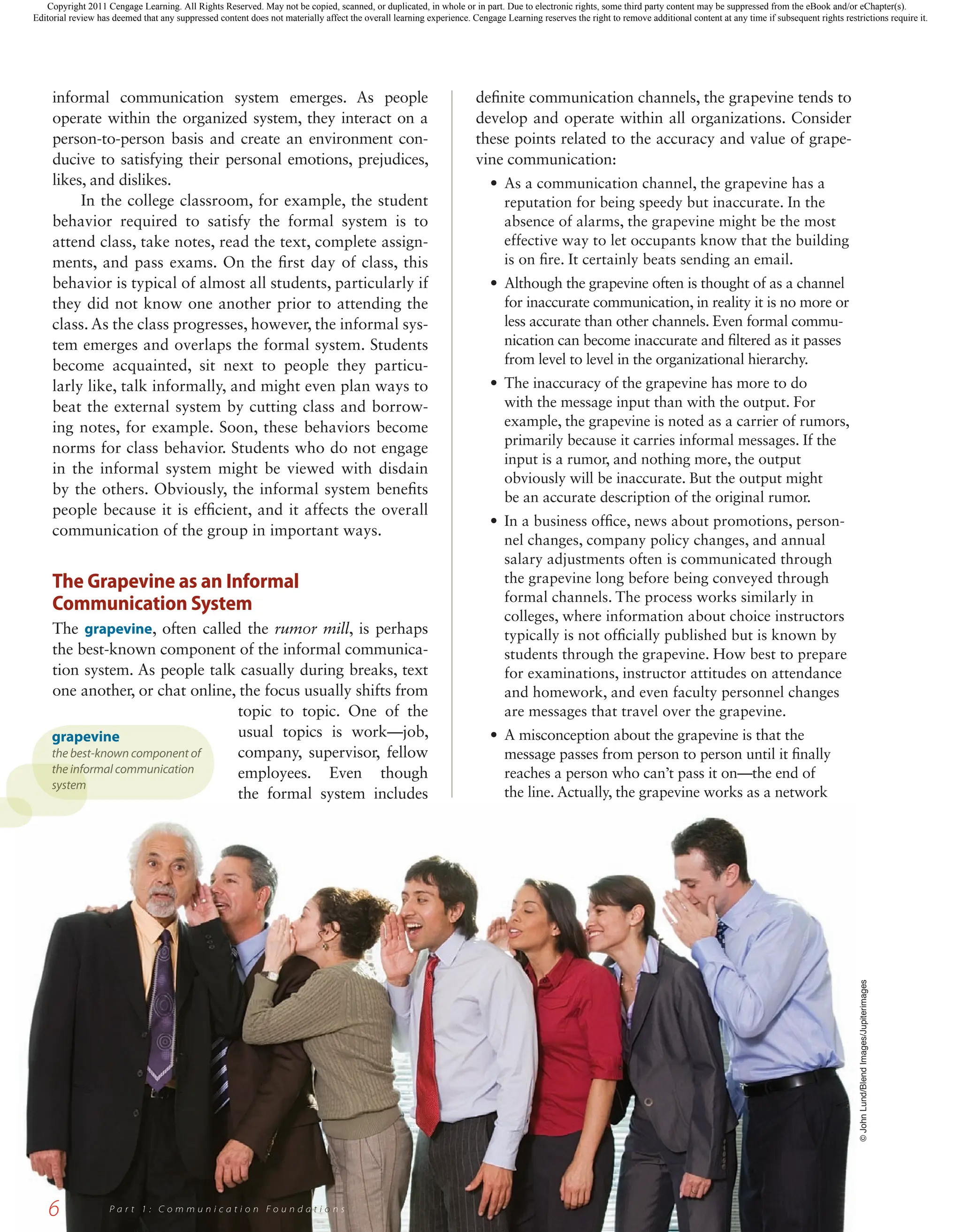
The Grapevine as an Informal
Communication System
The grapevine, often called the rumor mill, is perhaps
the best-known component of the informal communica-
tion system. As people talk casually during breaks, text
one another, or chat online, the focus usually shifts from
topic to topic. One of the
usual topics is work—job,
company, supervisor, fellow
employees. Even though
the formal system includes
grapevine
the best-known component of
the informal communication
system
6 P a r t 1 : C o m m u n i c a t i o n F o u n d a t i o n s
©
John
Lund/Blend
Images/Jupiterimages
27776_ch01_002-019.indd 6
27776_ch01_002-019.indd 6 1/3/11 8:00:24 AM
1/3/11 8:00:24 AM
Copyright 2011 Cengage Learning. All Rights Reserved. May not be copied, scanned, or duplicated, in whole or in part. Due to electronic rights, some third party content may be suppressed from the eBook and/or eChapter(s).
Editorial review has deemed that any suppressed content does not materially affect the overall learning experience. Cengage Learning reserves the right to remove additional content at any time if subsequent rights restrictions require it.
7
C h a p t e r 1 : E s t a b l i s h i n g a F r a m e w o r k f o r B u s i n e s s C o m m u n i c a t i o n
channel. Typically, one person tells two or three others,
who each tell two or three others, who each tell two
or three others, and so on. Thus, the message might
spread to a huge number of people in a short time,
especially now that the grapevine has gone hi-tech and
social networking sites have become “gossip central.”
• The grapevine has no single, consistent source.
Messages might originate anywhere and follow vari-
ous routes.
Due at least in part to widespread downsizing and
corporate scandals during the last few years, employ-
ees in many organizations are demanding to be better
informed. Some companies have implemented new for-
mal ways, such as newsletters and intranets, as well as
informal ways, including blogs and Twitter, for sharing
information with their internal constituents. Company
openness with employees about management decisions
and financial issues means conveying more information
through the formal system rather than risking its miscom-
munication through informal channels. Zappos—named
one of the best companies to work for in America—has
become a model for nurturing employees by following
core values of humility, fun and weirdness, and open and
honest communication. Employees, who describe the cul-
ture as “flat-out fun,” are free to be creative and enjoy
free lunches and spending time with managers at numer-
ous zany team gatherings.2
An informal communication system will emerge
from even the most carefully designed formal system.
Managers who ignore this fact are attempting to manage
blindfolded. Instead of denying or condemning the grape-
vine, the effective manager will learn to use the informal
communication network.The grapevine, for instance, can
be useful in counteracting rumors and false information.
Directions for Communication Flow
The direction in which communication flows in an organi-
zation can be downward, upward, or horizontal, as shown
in Figure 1-2. Because these three terms are used frequently
in communication discussions, they deserve clarification.
Although the concept of flow seems simple, direction has
meaning for those participating in the communication
process.
Figure 1-2 Flow of Information within an Organization
UPWARD COMMUNICATION
Progress reports (spoken and written)
• Results/accomplishments
• Problems/clarifications
UPWARD COMMUNICATION
Ideas/suggestions
Feelings/attitudes
HORIZONTAL OR
LATERAL COMMUNICATION
Coordination of interrelated activities
Problem-solving efforts
DOWNWARD COMMUNICATION
Policies and procedures
Organizational goals and strategies
Work assignments
Employee development
• Job role/responsibility
• Performance appraisal
(formal and informal)
• Constructive criticism
• Deserved praise and recognition
Formal Network Flow
© Cengage Learning 2010
27776_ch01_002-019.indd 7
27776_ch01_002-019.indd 7 1/3/11 8:00:25 AM
1/3/11 8:00:25 AM
Copyright 2011 Cengage Learning. All Rights Reserved. May not be copied, scanned, or duplicated, in whole or in part. Due to electronic rights, some third party content may be suppressed from the eBook and/or eChapter(s).
Editorial review has deemed that any suppressed content does not materially affect the overall learning experience. Cengage Learning reserves the right to remove additional content at any time if subsequent rights restrictions require it.
8
Downward
Communication
Downward Communication. Downward communica-
tion flows from supervisor to employee, from policy
makers to operating personnel, or from top to bot-
tom on the organization chart. A simple policy state-
ment from the top of the organization might grow into
a formal plan for operation at lower levels. Teaching
people how to perform their specific tasks is an element
of downward communication. Another ele-
ment is orientation to a company’s rules,
practices, procedures, history, and goals.
Employees learn about the quality of
their job performance through down-
ward communication.
Downward communication nor-
mally involves both written and spoken
methods and makes use of the following
guidelines:
• People at high levels in the
organization usually have
greater knowledge of the
organization and its goals than
do people at lower levels.
• Both spoken and written
messages tend to become larger
as they move downward through
organizational levels. This
expansion results from attempts
to prevent distortion and is more
noticeable in written messages.
• Spoken messages are subject to
greater changes in meaning than
are written messages.
When a supervisor
sends a message to a subor-
dinate employee who then
asks a question or nods
in agreement, the ques-
tion and the nod are signs
of feedback. Feedback can
flow both downward and
upward in organizational
communication through
traditional as well as infor-
mal channels.
Upward Communication.
Upward communication gen-
erally is feedback to downward communication. When
management requests information from lower organiza-
tional levels, the resulting information becomes feedback
to that request. Employees talk to supervisors about them-
selves, their fellow employees, their work and methods of
doing it, and their perceptions of the organization. These
comments are feedback to the downward flow transmit-
ted in both spoken and written form by group meetings,
procedures or operations manuals,company news releases,
the company intranet, and the grapevine.
Although necessary and valuable, upward com-
munication involves risks. The following factors are
important to consider when upward communication
flow is involved:
• Upward communication is
primarily feedback to requests
and actions of supervisors.
• Upward communication can
be misleading because lower-
level employees often tell their
superiors what they think their
superiors want to hear. Therefore,
their messages might contradict
their true observations and
perceptions.
• Upward communication frequently
involves risk to an employee
and is dependent on trust in the
supervisor.
• Employees will reject superficial
attempts by management to
obtain feedback.
When effectively used, upward
communication keeps manage-
ment informed about the feelings
of lower-level employees, taps the
expertise of employees, helps man-
agement identify both difficult and
potentially promotable employees, and
paves the way for even more effective downward com-
munication. Upward communication is key to keeping
employees engaged and informed and is especially critical
in tapping the power of younger employees who expect to
collaborate rather than to be supervised.3
Horizontal Communication. Horizontal, or lateral,
communication describes interactions between orga-
nizational units on the same hierarchical level. These
viso
bor
then
nod
ques
signs
and is dependent
supervisor.
will re
y man
dback.
Wh
When
en
co
comm
mm
me
ent
nt i
of low
owe
pertise
ment i
potentially p
or
r-
n
ds
s-
• Employees
attempts by
obtain feed
W
o
exp
agem
Upward
Communication
P a r t 1 : C o m m u n i c a t i o n F o u n d a t i o n s
©
iStockphoto.com/Pali
Rao
n
people how to perform their
of downward com
ment is orienta
ti
tice
ces,
s, p
p
pro
roc
mpl
p oyee
es
s l
ei
eir
r job
b pe
ward
rd c
com
Do
D w
mally invol
hods and
lines:
• People at high
organization u
ment
prac
ct
t
Em
the
m
meth
guidel ©
iStockphoto.com/Pali
Rao
downward
communication
a type of communication
that flows from supervisor to
employee, from policy makers
to operating personnel, or
from top to bottom on the
organization chart
upward
communication
a type of communication
that is generally a response to
requests from supervisors
horizontal (or lateral)
communication
interactions between
organizational units on the
same hierarchical level
27776_ch01_002-019.indd 8
27776_ch01_002-019.indd 8 1/3/11 8:00:26 AM
1/3/11 8:00:26 AM
Copyright 2011 Cengage Learning. All Rights Reserved. May not be copied, scanned, or duplicated, in whole or in part. Due to electronic rights, some third party content may be suppressed from the eBook and/or eChapter(s).
Editorial review has deemed that any suppressed content does not materially affect the overall learning experience. Cengage Learning reserves the right to remove additional content at any time if subsequent rights restrictions require it.
9
C h a p t e r 1 : E s t a b l i s h i n g a F r a m e w o r k f o r B u s i n e s s C o m m u n i c a t i o n
interactions reveal one of the major shortcomings of
organizational charts: They do not recognize the role of
horizontal communication when they depict authority
relationships by placing one box higher than another and
define role functions by placing titles in those boxes. Yet
management should realize that horizontal communica-
tion is the primary means of achieving coordination in
a functional organizational structure. Units coordinate
their activities to accomplish task goals just as adjacent
workers in a production line coordinate their activities.
So, for horizontal communication to be maximally effec-
tive, the people in any system or organization should be
available to one another.
Many companies realize that the traditional hier-
archy organized around functional units is inadequate
for competing in increasingly competitive global mar-
kets. They value work teams that integrate work-flow
processes rather than specialists in a single function or
product. Such work teams break down communica-
tion barriers between isolated functional departments,
and communication patterns take on varying forms to
accommodate team activities.
Figure 1-3 Levels of Communication
INTRAPERSONAL
• Communication within oneself
• Not considered by some to be true communication as
it does not involve a separate sender and receiver
EXAMPLES
Individual reminding himself of tasks to
complete or daily schedule
Supervisor and subordinate,
two coworkers
Committee, college class
Company, organization
Media advertisement, website
communication
INTERPERSONAL
• Communication between two people
• Goals are to (1) accomplish task confronting them (task
goal) and (2) feel better about themselves and each
other because of their interaction (maintenance goal)
GROUP
• Communication among more than two people
• Goal of achieving greater output than individual efforts
could produce
ORGANIZATIONAL
• Groups combined in such a way that large tasks may be
accomplished
• Goal of providing adequate structure for groups to
achieve their purposes
PUBLIC
• The organization reaching out to its public to achieve its
goals
• Goal of reaching many with the same message
©
iStockphoto.com/Viorika
Prikhodko
Levels of Communication
Communication can involve sending messages to both
large and small audiences. Internal messages are intended
for recipients within the organization. External messages
are directed to recipients outside the organization. When
considering the intended audience, communication can
be described as taking place on five levels: intrapersonal,
interpersonal, group, organizational, and public. Figure
1-3 depicts the five audi-
ence levels. An effective
communicator has a
clearly defined purpose for
each message and selected
strategies for targeting his
or her intended audience.
internal messages
messages intended for
recipients within the
organization
external messages
messages directed to recipients
outside the organization
©
iStockphoto.com/drfl
et
27776_ch01_002-019.indd 9
27776_ch01_002-019.indd 9 1/3/11 8:00:38 AM
1/3/11 8:00:38 AM
Copyright 2011 Cengage Learning. All Rights Reserved. May not be copied, scanned, or duplicated, in whole or in part. Due to electronic rights, some third party content may be suppressed from the eBook and/or eChapter(s).
Editorial review has deemed that any suppressed content does not materially affect the overall learning experience. Cengage Learning reserves the right to remove additional content at any time if subsequent rights restrictions require it.
Strategic Forces
Influencing Business
Communication
C
ommunication does not take place in
a vacuum, but rather is influenced by a
number of forces at work in the envi-
ronment. The effective communicator
carefully considers each of these influ-
ences and structures communication
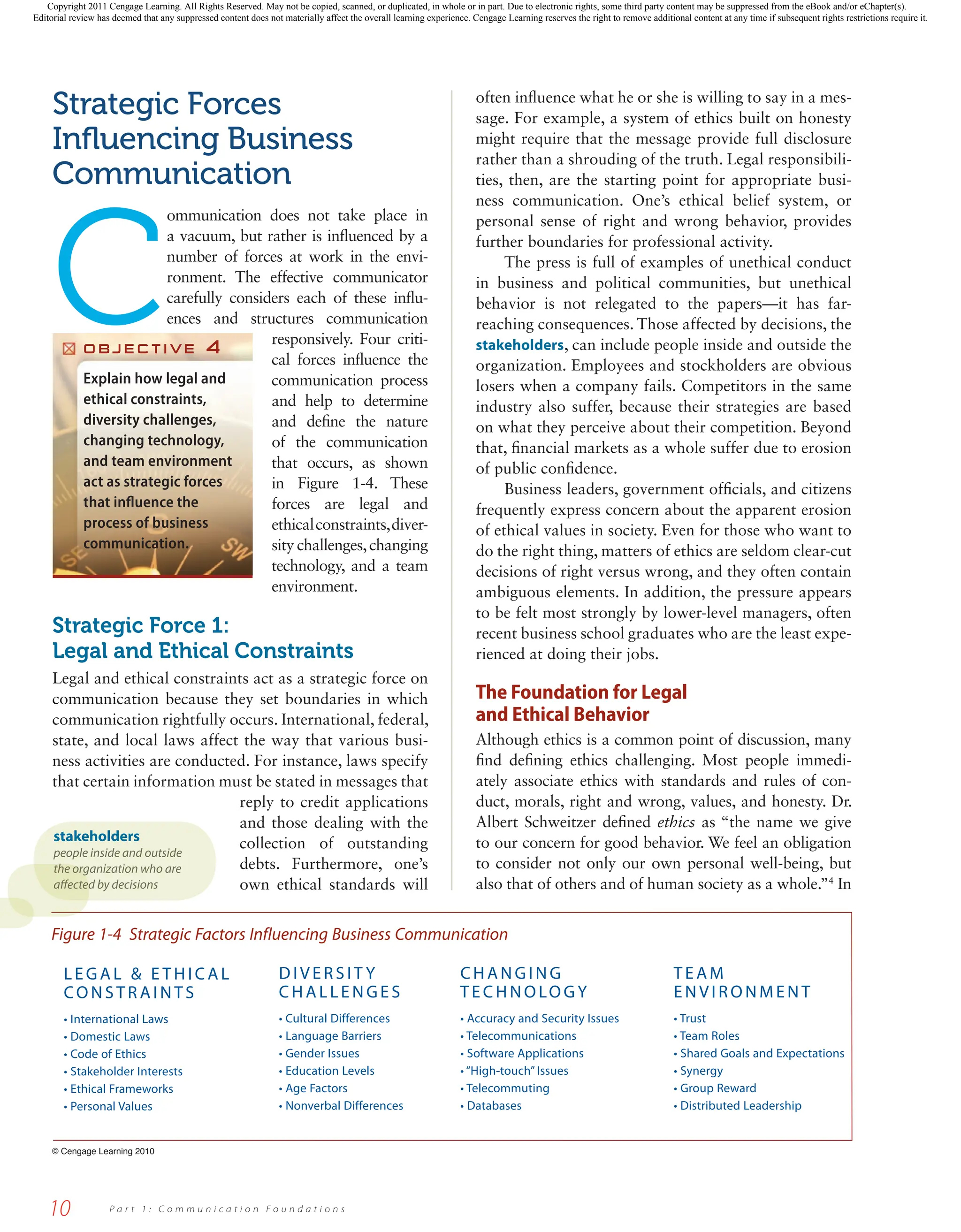
responsively. Four criti-
cal forces influence the
communication process
and help to determine
and define the nature
of the communication
that occurs, as shown
in Figure 1-4. These
forces are legal and
ethicalconstraints,diver-
sity challenges,changing
technology, and a team
environment.
Strategic Force 1:
Legal and Ethical Constraints
Legal and ethical constraints act as a strategic force on
communication because they set boundaries in which
communication rightfully occurs. International, federal,
state, and local laws affect the way that various busi-
ness activities are conducted. For instance, laws specify
that certain information must be stated in messages that
reply to credit applications
and those dealing with the
collection of outstanding
debts. Furthermore, one’s
own ethical standards will
often influence what he or she is willing to say in a mes-
sage. For example, a system of ethics built on honesty
might require that the message provide full disclosure
rather than a shrouding of the truth. Legal responsibili-
ties, then, are the starting point for appropriate busi-
ness communication. One’s ethical belief system, or
personal sense of right and wrong behavior, provides
further boundaries for professional activity.
The press is full of examples of unethical conduct
in business and political communities, but unethical
behavior is not relegated to the papers—it has far-
reaching consequences. Those affected by decisions, the
stakeholders, can include people inside and outside the
organization. Employees and stockholders are obvious
losers when a company fails. Competitors in the same
industry also suffer, because their strategies are based
on what they perceive about their competition. Beyond
that, financial markets as a whole suffer due to erosion
of public confidence.
Business leaders, government officials, and citizens
frequently express concern about the apparent erosion
of ethical values in society. Even for those who want to
do the right thing, matters of ethics are seldom clear-cut
decisions of right versus wrong, and they often contain
ambiguous elements. In addition, the pressure appears
to be felt most strongly by lower-level managers, often
recent business school graduates who are the least expe-
rienced at doing their jobs.
The Foundation for Legal
and Ethical Behavior
Although ethics is a common point of discussion, many
find defining ethics challenging. Most people immedi-
ately associate ethics with standards and rules of con-
duct, morals, right and wrong, values, and honesty. Dr.
Albert Schweitzer defined ethics as “the name we give
to our concern for good behavior. We feel an obligation
to consider not only our own personal well-being, but
also that of others and of human society as a whole.”4
In
P a r t 1 : C o m m u n i c a t i o n F o u n d a t i o n s
10
O B J E C T I V E 4
Explain how legal and
ethical constraints,
diversity challenges,
changing technology,
and team environment
act as strategic forces
that influence the
process of business
communication.
Figure 1-4 Strategic Factors Influencing Business Communication
L E G A L & E T H I C A L
CO N S T R A I N TS
• International Laws
• Domestic Laws
• Code of Ethics
• Stakeholder Interests
• Ethical Frameworks
• Personal Values
C H A N G I N G
T E C H N O LO G Y
• Accuracy and Security Issues
• Telecommunications
• Software Applications
• “High-touch” Issues
• Telecommuting
• Databases
D I V E R S I T Y
C H A L L E N G E S
• Cultural Differences
• Language Barriers
• Gender Issues
• Education Levels
• Age Factors
• Nonverbal Differences
T E A M
E N V I R O N M E N T
• Trust
• Team Roles
• Shared Goals and Expectations
• Synergy
• Group Reward
• Distributed Leadership
stakeholders
people inside and outside
the organization who are
affected by decisions
© Cengage Learning 2010
27776_ch01_002-019.indd 10
27776_ch01_002-019.indd 10 1/3/11 8:00:42 AM
1/3/11 8:00:42 AM
Copyright 2011 Cengage Learning. All Rights Reserved. May not be copied, scanned, or duplicated, in whole or in part. Due to electronic rights, some third party content may be suppressed from the eBook and/or eChapter(s).
Editorial review has deemed that any suppressed content does not materially affect the overall learning experience. Cengage Learning reserves the right to remove additional content at any time if subsequent rights restrictions require it.
other words, ethics refers to the principles of right and
wrong that guide you in making decisions that consider
the impact of your actions on others as well as yourself.
Though the recorded accounts of legal and ethical
misconduct would seem to indicate that businesses are
dishonest and unscrupulous, keep in mind that mil-
lions of business transactions are made daily on the
basis of honesty and concern for others. Why should
a business make ethical decisions? What difference will
it make? James E. Perrella, executive vice president
of Ingersoll-Rand Company, gave a powerful reply to
these questions:5
Many people, including many business leaders,
would argue that such an application of ethics to
business would adversely affect bottom-line per-
formance. I say nay. . . . Good ethics, simply, is
good business. Good ethics will attract investors.
Good ethics will attract good employees. You can
do what’s right. Not because of conduct codes.
Not because of rules or laws. But because you
know what’s right.
Causes of Illegal and Unethical Behavior
Understanding the major causes of illegal and unethical
behavior in the workplace will help you become sen-
sitive to signals of escalating pressure to compromise
your values. Unethical corporate behavior can have a
number of causes:
• Excessive emphasis on profits. Business managers
are often judged and paid on their ability to increase
business profits. This emphasis on profits might
send a message that the end justifies the means.
According to former Federal Reserve Chairman Alan
Greenspan, “infectious greed” ultimately pushed
companies such as Enron, Global Crossing, and
WorldCom into bankruptcy.6
• Misplaced corporate loyalty. A misplaced sense
of corporate loyalty might cause an employee to do
what seems to be in the best interest of the company,
even if the act is illegal or unethical.
• Obsession with personal advancement.
Employees who wish to outperform their peers or
are working for the next promotion might feel that
they cannot afford to fail. They might do whatever
it takes to achieve the objectives assigned to them.
• Expectation of not getting caught. Thinking that
the end justifies the
means, employees
often believe illegal
or unethical activity
will never be discov-
ered. Unfortunately,
a great deal of
improper behavior
“Mirror, Mirror . . .”
Identifying ethical issues in typical workplace situations can be difficult, and coworkers and superiors
might apply pressure for seemingly logical reasons. To illustrate, examine each of the following
workplace situations for a possible ethical dilemma:
• In order to achieve profit expectations of financial analysts, a mortgage lender approves loans to
homebuyers without verifying their ability to repay the loans.
• To prevent an adverse effect on stock prices, corporate officers deliberately withhold information
concerning a planned spinoff.
• To protect his job, a product engineer decides not to question a design flaw in a product that could
lead to possible injuries and even deaths to consumers because the
redesign would cause a delay in product introduction.
• To stay within the departmental budget, a supervisor authorizes a
software program to be installed on 50 office computers when only one
legal copy was purchased.
• Angry at a superior for an unfavorable performance appraisal, an employee
leaks confidential information (e.g., trade secrets or marketing strategies)
to an acquaintance who works for a competitor or posts highly derogative
comments about the company on his or her social networking site.
Your fundamental morals and values provide the foundation for making
ethical decisions. However, as the previous examples imply, even minor
concessions in day-to-day decisions can gradually weaken an individual’s
ethical foundation.
•
•
Y
e
c
e
©
Erik
Dreyer/Stone/Getty
Images
11
C h a p t e r 1 : E s t a b l i s h i n g a F r a m e w o r k f o r B u s i n e s s C o m m u n i c a t i o n
ethics
the principles of right and
wrong that guide one in
making decisions that consider
the impact of one’s actions
on others as well as on the
decision maker
27776_ch01_002-019.indd 11
27776_ch01_002-019.indd 11 1/3/11 8:00:43 AM
1/3/11 8:00:43 AM
Copyright 2011 Cengage Learning. All Rights Reserved. May not be copied, scanned, or duplicated, in whole or in part. Due to electronic rights, some third party content may be suppressed from the eBook and/or eChapter(s).
Editorial review has deemed that any suppressed content does not materially affect the overall learning experience. Cengage Learning reserves the right to remove additional content at any time if subsequent rights restrictions require it.
12 P a r t 1 : C o m m u n i c a t i o n F o u n d a t i o n s
escapes detection in the business world. Believing no
one will ever find out, employees are tempted to lie,
steal, and perform other illegal acts.
• Unethical tone set by top management. If top
managers are not perceived as highly ethical, lower-
level managers might be less ethical as a result.
Employees have little incentive to act legally and
ethically if their superiors do not set an example and
encourage and reward such behavior. The saying “the
speed of the leader is the speed of the pack” illus-
trates the importance of leading by example.
• Uncertainty about whether an action is wrong.
Many times, company personnel are placed in situa-
tions in which the line between right and wrong
is not clearly defined. When caught in this gray
area, the perplexed
employee asks, “How
far is too far?”
• Unwillingness to take
a stand for what is
right. Often employees
know what is right or
wrong but are not willing to
take the risk of challenging a wrong
action. They might lack the confi-
dence or skill needed to con-
front others with sensitive legal
or ethical issues. They might
remain silent and then justify
their unwillingness to act.
Framework for Analyzing
Ethical Dilemmas
Determining whether an action is
ethical can be difficult. Learning to
analyze a dilemma from both legal
and ethical perspectives will help
you find a solution that conforms to
your own personal values. Figure 1-5
shows the four conclusions you might
reach when considering the advisability
of a particular behavior.
Dimension 1: Behavior that is illegal and
unethical. When considering some actions,
you will reach the conclusion that they are
both illegal and unethical. The law specifi-
cally outlines the “black” area—those alter-
natives that are clearly wrong—and your
employer will expect you to become an expert
in the laws that affect your particular area.
When you encounter an unfamiliar area, you
must investigate any possible legal implica-
tions. Obviously, obeying the law is in the best interest
of all concerned: you as an individual, your company,
and society. Contractual agreements between two
parties also offer guidance for legal decision making.
Frequently, your own individual sense of right and
wrong will also confirm that the illegal action is wrong
for you personally. In such situations, decisions about
appropriate behavior are obvious.
Dimension 2: Behavior that is illegal yet ethical.
Occasionally, a businessperson will decide that
even though a specific action is illegal, there is a
justifiable reason to break the law.A case in point
is a law passed in Vermont that makes it illegal
for a pharmaceutical company to give any gift
valued at more than $25 to doctors or their
personnel.7
Those supporting the law charge
that the giving of freebies drives up medical
costs by encouraging doctors to prescribe new,
more expensive brand-name drugs. The law’s
opponents contend that the gifts do not influ-
ence doctors and are merely educational tools
for new products. Although a pharmaceuti-
cal firm and its employees might see nothing
wrong with providing gifts worth in excess of
$25, they would be well advised to consider the
penalty of $10,000 per violation before acting
on their personal ethics. A better course of action
would be to act within the law, possibly while lob-
bying for a change in the law.
Dimension 3: Behavior
that is legal yet unethi-
cal. If you determine that
a behavior is legal and
complies with relevant
contractual agreements
and company policy, your
next step is to consult your
ng to
ing a wrong
the confi-
con-
ve legal
might
ustify
ct.
ing
action is
arning to
oth legal
will help
nforms to
Figure 1-5
you might
e advisability
at is illegal and
ng some actions,
ion that they are
The law specifi-
area—those alter-
wrong—and your
o become an expert
our particular area.
nfamiliar area, you
ible legal implica-
of all concerned: you as an in
and society. Contractual ag
parties also offer guidance fo
Frequently, your own indivi
wrong will also confirm that t
for you personally. In such si
appropriate behavior are obvi
Dimension 2: Behavior tha
Occasionally, a busines
even though a specific a
justifiable reason to bre
is a law passed in Verm
for a pharmaceutical
valued at more than
personnel.7
Those su
that the giving of fr
costs by encouraging
more expensive bran
opponents contend t
ence doctors and are
for new products. A
cal firm and its emp
wrong with providing
$2
$ 5, they would be we
penalty of $10,000 per
on their personal ethics.
would be to act within th
bying for a change in the
c
a
co
co
an
next
©
Stockbyte/Getty
Images
DIMENSION 1
Behavior that is illegal
and unethical
DIMENSION 3
Behavior that is legal
yet unethical
DIMENSION 2
Behavior that is illegal
yet ethical
DIMENSION 4
Behavior that is both
legal and ethical
Figure 1-5 Four Dimensions of Business Behavior
© Cengage Learning 2010
27776_ch01_002-019.indd 12
27776_ch01_002-019.indd 12 1/3/11 8:00:45 AM
1/3/11 8:00:45 AM
Copyright 2011 Cengage Learning. All Rights Reserved. May not be copied, scanned, or duplicated, in whole or in part. Due to electronic rights, some third party content may be suppressed from the eBook and/or eChapter(s).
Editorial review has deemed that any suppressed content does not materially affect the overall learning experience. Cengage Learning reserves the right to remove additional content at any time if subsequent rights restrictions require it.
company’s or profession’s code of ethics. This written
document summarizes the company’s or profession’s
standards of ethical conduct. Some companies refer to
this document as a credo. If the behavior does not vio-
late the code of ethics, then put it to the test of your
own personal integrity. You may at times reject a legal
action because it does not “feel right.” Most Americans
were appalled to learn that mortgage bankers’ reckless
abandonment of traditional lending standards led to
the subprime mortgage meltdown. Although they might
have acted legally, their profiting at the expense of com-
pany employees, stockholders, and the public hardly
seemed ethical. You might be faced with situations in
which you reject a behavior that is legal because you
would not be proud to have your family and commu-
nity know that you engaged in it.
Dimension 4: Behavior that is both legal and ethical.
Decisions in this dimension are easy to make. Such
actions comply with the law, company policies, and
your professional and personal codes of ethics.
The Pagano Model offers a straightforward method
for determining whether a proposed action is advis-
able.8
For this system to work, you must answer the
following six questions honestly:
• Is the proposed action legal? (This is the core starting
point.)
• What are the benefits and costs to the people
involved?
• Would you want this action to be a universal stan-
dard, appropriate for everyone?
• Does the action pass the light-of-day test? That is, if
your action appeared on television or others learned
about it, would you be proud?
• Does the action pass the Golden Rule test? That is,
would you want the same to happen to you?
• Does the action pass the ventilation test? Ask the
opinion of a wise friend with no investment in
the outcome. Does this friend believe the action is
ethical?
Martha Stewart was found guilty of conspiracy,
obstruction of justice, and making false statements
regarding her sale of shares of ImClone stock just
before the company’s downturn. Some have defended
her action as neither illegal nor immoral, while oth-
ers have argued that cracking down on Stewart sent
an important message about stock-market manipu-
lation. “It’s very important for us to protect integrity
of this system,” said David Kelley, the U.S. attorney in
Manhattan, after the verdict.“Failure to do so results in
a flood of corruption.”9
Strategic Force 2:
Diversity Challenges
Diversity in the workplace is another strategic force influ-
encing communication. Differences between the sender
and the receiver in areas such as culture, age, gender, and
education require sensitivity on the part of both parties
so that the intended message is the one that is received.
Understanding how to communicate effectively
with people from other cultures has become more inte-
gral to the work environment as many U.S. companies
are increasingly conducting business with international
companies or becoming multinational. Candy manufac-
turer Jelly Belly learned a great deal about cultural dif-
ferences when the company opened business operations
in Thailand. In Thailand, many more employee ameni-
ties are required than U.S. employers are accustomed to
providing. For example, a Thai employer is expected to
provide transportation to and from work as well as free
meals and a workout facility for its employees.10
When addressing cultural differences, successful
communication must often span barriers of language
and differing world views resulting from societal and
religious beliefs and practices. When a person fails to
consider these factors, communication suffers, and
the result is often embarrassing and potentially costly.
McDonald’s is an example of a large U.S. company
that has expanded its operations to include most major
countries in the world. To be successful on an interna-
tional scale, managers had to be aware of cultural dif-
ferences and be willing to work to ensure that effective
communication occurred despite these barriers.
Occasionally,however,a whopper of an intercultural
communication faux pas occurs. That is what happened
when McDonald’s began its promotional campaign in
Great Britain for the World Cup soccer championship.
It seemed like a clever (and harmless) idea to reproduce
the flags of the 24 nations participating in the event and
print them on packaging—two million Happy Meal
bags, to be exact. What marketing personnel failed to
consider was that words from the Koran are printed on
the Saudi flag. The idea that sacred words from Islam’s
holy book were mass printed to sell a product with the
knowledge that the packages would be thrown into the
trash angered and offended many Muslims, who imme-
diately complained. McDonald’s apologized for the
gaffe and agreed to work with Saudis to find a solution
to the problem.11
This example shows of how much “homework” is
involved in maintaining good relations with custom-
ers or clients from other cultures. The potential barrier
13
C h a p t e r 1 : E s t a b l i s h i n g a F r a m e w o r k f o r B u s i n e s s C o m m u n i c a t i o n
27776_ch01_002-019.indd 13
27776_ch01_002-019.indd 13 1/3/11 8:00:48 AM
1/3/11 8:00:48 AM
Copyright 2011 Cengage Learning. All Rights Reserved. May not be copied, scanned, or duplicated, in whole or in part. Due to electronic rights, some third party content may be suppressed from the eBook and/or eChapter(s).
Editorial review has deemed that any suppressed content does not materially affect the overall learning experience. Cengage Learning reserves the right to remove additional content at any time if subsequent rights restrictions require it.
14 P a r t 1 : C o m m u n i c a t i o n F o u n d a t i o n s
of language is obvious; however, successful managers
know that much more is involved in communicating
with everyone—across cultures, genders, ages, abilities,
and other differences.
Communication Opportunities
and Challenges in Diversity
As world markets continue
to expand, U.S. employees
at home and abroad will
be doing business with
more people from other
countries. You might
find yourself work-
ing abroad for a large
American company,
an international com-
pany with a plant in
the United States, or a
company with an ethni-
cally diverse workforce.
Regardless of the workplace,
your diversity skills—that is,
your ability to communicate effec-
tively with both men and women of
all ages, cultures, and minority groups—
will affect your success in today’s culturally diverse
global economy.
Workplace diversity can lead to misunderstandings
and miscommunications, but it also poses opportunities
to improve both workers and organizations. Managers
must be prepared to communicate effectively with
workers of different nationalities, genders, races, ages,
abilities, and so forth.
Managing a diverse workforce effectively will
require you to communicate with everyone and to help
all employees reach their fullest potential and contrib-
ute to the company’s goals. To lessen miscommunica-
tion, which inevitably occurs, increasing numbers of
companies have undertaken diversity initiatives and
are providing diversity training seminars to help work-
ers understand and appreciate gender and age differ-
ences and the cultures of
coworkers.
Culture and
Communication
Managers with the desire
andtheskilltoconductbusi-
ness in new international
markets and to manage a diverse workforce effectively
will confront problems created by cultural differences.
The way messages are decoded and encoded is not just
a function of the experiences, beliefs, and assumptions
of the person sending or receiving those messages
but also is shaped by the society in which
he or she lives.
People learn patterns of
behavior from their culture.
The culture of a people is the
product of their living expe-
riences within their own
society. Culture could be
described as “the way
of life” of a people and
includes a vast array of
behaviors and beliefs.
These patterns affect
how people perceive the
world, what they value,
andhowtheyact.Differing
patterns can also create bar-
riers to communication.
Barriers to Intercultural
Communication
Because cultures give different definitions of such basics
of interaction as values and norms, people raised in two
different cultures can clash in various ways.
• Ethnocentrism. Problems occur between people of
different cultures primarily because people tend to
assume that their own cultural norms are the right
way to do things. They wrongly believe that the
specific patterns of behavior desired in their own
cultures are universally valued. This belief, known as
enthnocentrism, is certainly natural; but learning
about other cultures and developing sensitivity will
help minimize ethnocentric reactions when dealing
with other cultures.
• Stereotypes. We often form a mental picture of
the main characteristics of another group, creating
preformed ideas of what people in this group are
©
Feng
lei
sh/Imaginechina
via
AP
Images
“Your ability to communicate
effectively with both men and women
of all ages, cultures, and minority
groups will affect your success in
today’s culturally diverse global
economy.”
diversity skills
the ability to communicate
effectively with both men and
women of all ages, cultures,
and minority groups
ethnocentrism
the assumption that one’s
own cultural norms are the
right way to do things
portunities
versity
ntinue
yees
will
h
-
ce.
ace,
hat is,
ate effec-
d women of
i it
but also is shape
he or she liv
Peop
behav
The
pr
r
a
pa
riers
Barriers to
Communicatio
For many U.S. corporations, such as Procter
& Gamble, more than 70 percent of total
sales in recent years has come from
international operations.
27776_ch01_002-019.indd 14
27776_ch01_002-019.indd 14 1/3/11 8:00:48 AM
1/3/11 8:00:48 AM
Copyright 2011 Cengage Learning. All Rights Reserved. May not be copied, scanned, or duplicated, in whole or in part. Due to electronic rights, some third party content may be suppressed from the eBook and/or eChapter(s).
Editorial review has deemed that any suppressed content does not materially affect the overall learning experience. Cengage Learning reserves the right to remove additional content at any time if subsequent rights restrictions require it.
15
C h a p t e r 1 : E s t a b l i s h i n g a F r a m e w o r k f o r B u s i n e s s C o m m u n i c a t i o n
like. These pictures, called stereotypes, influence the
way we interact with members of the other group.
When we observe a behavior that conforms to the
stereotype, the validity of the preconceived notion
is reinforced. We often view the other person as a
representative of a class of people rather than as an
individual. People of all cultures have stereotypes
about other cultural groups they have encountered.
These stereotypes can interfere with communication
when people interact on the basis of the imagined
representative and not the real individual.
• Interpretation of time. The study of how a culture
perceives time and its use is called chronemics. In
the United States, we have a saying that “time is
money.” Canadians, like some northern Europeans
who are also concerned about punctuality, make
appointments, keep them, and complete them, and
waste no time in the process. In some other cultures,
time is the cheapest commodity and an inexhaustible
resource; time represents a person’s span on Earth,
which is only part of eternity. To these cultures,
engaging in long, casual conversations prior to seri-
ous discussions or negotiations is time well spent
in establishing and nurturing relationships. On the
other hand, the time-efficient American businessper-
son is likely to fret about wasting precious time.
• Personal space requirements. Space operates as
a language just as time does. The study of cultural
space requirements is known as proxemics. In all
cultures, the distance between people functions in
communication as “personal space” or “personal ter-
ritory.” In the United States, for example, for intimate
conversations with close friends and relatives, indi-
viduals are willing to stay within about a foot and a
half of each other; for casual conversations, up to two
or three feet; for job interviews and personal business,
four to twelve feet; and for public occasions, more
than twelve feet. However, in many cultures outside
the United States, closer personal contact is accepted,
or greater distance might be the norm.
• Body language. The study of body language is
known as kinesics. Body language is not universal,
but instead is learned from one’s culture. Even the
most basic gestures have varying cultural meanings—
the familiar North American symbol for “okay”
means zero in France, money in Japan, and an
expression of vulgarity in Brazil. Similarly, eye con-
tact, posture, and facial expressions carry different
meanings throughout the world.
• Translation limitations. Words in one language
do not always have an equivalent meaning in other
languages, and the concepts the words describe are
often different as well. Translators can be helpful,
but keep in mind that a translator is working with
a second language and must listen to one language,
mentally cast the words into another language, and
then speak them. This process is difficult and opens
the possibility that the translator will fall victim to
one or more cultural barriers.
Even if you cannot speak or write another language
fluently, people from other cultures will appreciate sim-
ple efforts to learn a few common phrases.
Strategic Force 3:
Changing Technology
Electronic tools have not eliminated the need for basic
communication skills; they can, in fact, create new
obstacles or barriers to communication that must be
Brazil, United States, Other places,
not okay okay better check first
X ?
©
Hemera
Technologies/AbleStock.com
Image/Jupiterimages
stereotypes
mental pictures that one
group forms of the main
characteristics of another
group, creating preformed
ideas of what people in this
group are like
chronemics
the study of how a culture
perceives time and its use
proxemics
the study of cultural space
requirements
kinesics
the study of body language,
which is not universal, but
instead is learned from one’s
culture
27776_ch01_002-019.indd 15
27776_ch01_002-019.indd 15 1/3/11 8:00:52 AM
1/3/11 8:00:52 AM
Copyright 2011 Cengage Learning. All Rights Reserved. May not be copied, scanned, or duplicated, in whole or in part. Due to electronic rights, some third party content may be suppressed from the eBook and/or eChapter(s).
Editorial review has deemed that any suppressed content does not materially affect the overall learning experience. Cengage Learning reserves the right to remove additional content at any time if subsequent rights restrictions require it.
overcome. These tools, however, also create opportuni-
ties, which range from new kinds of communications to
improved quality of the messages themselves. Electronic
tools, such as the Internet, intranets, document produc-
tion software, multimedia presentations, Web publish-
ing tools, and email, can help people in various ways,
such as by (1) collecting and analyzing data, (2) shap-
ing messages to be clearer and more effective, and
(3) communicating quickly and efficiently with others
in geographically dispersed locations.
Using various communication technologies, indi-
viduals can often work in their homes or other remote
locations and send and receive work from the com-
pany office electronically. Telecommuting (also referred
to as teleworking) offers various advantages, includ-
ing reduced travel time and increased work flexibility.
Laptops and smartphones provide computing power
and connectivity for professionals wherever they are.
While the public Internet is
accessible to everyone and
offers a wide array of infor-
mation, private databases
provide specialized and
advanced information on
specific topics. Databases
enable decision makers to obtain information quickly
and accurately and offer these advantages:
• Data organization—the ability to organize large
amounts of data.
• Data integrity—assurance that the data will be
accurate and complete.
• Data security—assurance that the data are secure
because access to a database is controlled through
several built-in data security features.
Internal databases contain proprietary information
that is pertinent to the particular business or organiza-
tion and its employees. External databases (networks)
allow users to access information from remote loca-
tions literally around the world and in an instant trans-
fer that information to their own computers for further
manipulation or storage. Information is available on
general news, stocks, financial markets, sports, travel,
weather, and a variety of publications.
Knowing how to“tunnel”through the vast amounts
of irrelevant information available on the Internet to
find what you want can be overwhelming. The expe-
rience can also be expensive in terms of human time
spent and charges incurred for online time. Locating
information from electronic sources requires that you
telecommuting
also called teleworking;
working at home or other
remote locations and sending
and receiving work from the
company office electronically
Legal and Ethical Implications of Technology
In addition to its many benefits, technology poses some challenges
for the business communicator. For instance, technology raises issues
of ownership, as in the case of difficulties that arise in protecting the
copyright of documents transmitted over the Internet. Technology
poses dilemmas over access, that is, who has the right to certain stored
information pertaining to an individual or a company.
Technology threatens our individual privacy, our right to be left
alone, free from surveillance or interference from other individuals
or organizations. Common invasions of privacy caused by technology
include
• collecting excessive amounts of information for decision making and
maintaining too many files.
• monitoring the exact time employees spend on a specific task and
between tasks and the exact number and length of breaks, and
supervisors’ or coworkers’ reading of another employee’s email and
computer files.
• integrating computer files containing information collected from
more than one agency without permission.12
©
iStockphoto.com/Nghe
Tran
16 P a r t 1 : C o m m u n i c a t i o n F o u n d a t i o n s
27776_ch01_002-019.indd 16
27776_ch01_002-019.indd 16 1/3/11 8:00:53 AM
1/3/11 8:00:53 AM
Copyright 2011 Cengage Learning. All Rights Reserved. May not be copied, scanned, or duplicated, in whole or in part. Due to electronic rights, some third party content may be suppressed from the eBook and/or eChapter(s).
Editorial review has deemed that any suppressed content does not materially affect the overall learning experience. Cengage Learning reserves the right to remove additional content at any time if subsequent rights restrictions require it.
17
C h a p t e r 1 : E s t a b l i s h i n g a F r a m e w o r k f o r B u s i n e s s C o m m u n i c a t i o n
know the search procedures and methods for construct-
ing an effective search strategy.
Effective use of various communication tech-
nologies helps ensure timely, targeted messages and
responses and helps to build interpersonal relation-
ships. This responsiveness leads to positive interactions
with colleagues and strong customer commitment.
Strategic Force 4:
Team Environment
As firms around the world face problems of decreas-
ing productivity, faltering product quality, and worker
dissatisfaction, work teams are seen as a way to help
firms remain globally competitive. Decentralized deci-
sion making enables teams of people to communicate in
a peer-to-peer fashion, rather than following traditional
lines of authority, and new technologies give employees
the ability to communicate easily and openly with one
another and with those outside the firm.
Although worker involvement in the management
process has long been the hallmark of Japanese busi-
ness, many businesses in the United States and else-
where are empowering self-directed work teams to
accomplish various assignments.13
The list of compa-
nies using self-directed work teams is diverse, includ-
ing Hunt-Wesson, the Internal Revenue Service, the
San Diego Zoo, Hewlett-Packard, Southwest Airlines,
Toyota, Motorola, General Electric, and Corning.
WorkTeam Defined
The terms team, work team, group, work group, cross-
functional team, and self-directed team are often used
interchangeably.14
Whatever the title, a team is a small
number of people with complementary skills who work
together for a common purpose. Team members set
their own goals, in cooperation with management, and
plan how to achieve those goals and how their work is
to be accomplished. The central organizing element of
a team is that it has a common purpose and measurable
goals for which the team can be held accountable, inde-
pendent of its individual members. Employees in a self-
directed work team handle a wide array of functions
and work with a minimum of direct supervision.15
A key element in team success is the concept of syn-
ergy, defined as a situation in which the whole is greater
than the sum of the parts. Teams provide a depth of
expertise that is unavailable at the individual level.Teams
open lines of communication that then lead to increased
interaction among employees and between employees
and management. The result is that teams help compa-
nies reach their goals of delivering higher-quality prod-
ucts and services faster and with more cost effectiveness.
Communication Differences inWorkTeams
In the past, most businesses were operated in a hierar-
chical fashion, with most decisions made at the top and
communication following a top-down/bottom-up pat-
tern. Communication patterns are different in success-
ful team environments as compared with traditional
organizational structures:
• Trust building is the primary factor that changes the
organization’s communication patterns.
• Open meetings are an important method for enhanc-
ing communication, as they educate employees about
the business while building bridges of understanding
and trust.
• Shared leadership, which involves more direct and
effective communication between management and
its internal customers,
is common.
• Listening, problem
solving, conflict
resolution, negotia-
tion, and consensus
become important
factors in group
communication.
Some major strengths of teams
are as follows:16
9Teams make workers happier
by causing them to feel that
they are shaping their own
jobs.
9Teams increase efficiency by
eliminating layers of managers
whose job was once to pass
orders downward.
9Teams enable a company
to draw on the skills and
imagination of a whole
workforce.
©
Image
Source
team
a small number of people with
complementary skills who
work together for a common
purpose
synergy
a situation in which the whole
is greater than the sum of the
parts
27776_ch01_002-019.indd 17
27776_ch01_002-019.indd 17 1/3/11 8:00:53 AM
1/3/11 8:00:53 AM
Copyright 2011 Cengage Learning. All Rights Reserved. May not be copied, scanned, or duplicated, in whole or in part. Due to electronic rights, some third party content may be suppressed from the eBook and/or eChapter(s).
Editorial review has deemed that any suppressed content does not materially affect the overall learning experience. Cengage Learning reserves the right to remove additional content at any time if subsequent rights restrictions require it.
Another Random Document on
Scribd Without Any Related Topics
shall look better in a few days.
Har. Better! That's impossible, Sir, you can't look better.
Skin. O Lord, Madam! (Bowing)
Har. (Takes him by the hand) There, there's a Figure; do but view
him. Sir, I never saw a finer Figure for a Shroud and Coffin in my
Life.
Skin. Madam! (starting)
Har. I say, Sir, you are a most enchanting Figure for a Shroud and
Coffin.
Skin. Shroud and Coffin! (He walks off! She after him)
Har. Well I can't help admiring your Intrepidity, Sir Isaac; o' my
Conscience, you have more Courage than half the young Fellows in
Town. Why what a Don Quixot are you to venture that shattered,
shabby, crazy Carcass of yours into a Marriage Bed with a hale
Constitution of Nineteen!
Skin. Why really, Madam——
Har. Why really, Sir, you'll repent it.
Skin. I believe it, I believe it, Madam.
Har. What you, who are a gouty, cholicky, feverish, paralytick,
hydropic, asthmatic, and a thousand Diseases besides, venture to
light Hymen's Torch! Why, Sir, it is perfect Madness; it is making but
one Step from your Wedding to your Grave. Pray Sir, how long do
you expect to live?
Skin. Not long I am sure if I marry you.
Har. You are in the right on't, Sir; it will not be consistent with my
Pleasure or my Interest that you should live above a Fortnight; um—
ay, in about a Fortnight I can do it. Let me see; ay, it is but pulling
away a Pillow in one of your coughing Fits—or speaking properly to
your Apothecary—a very little Ratsbane or Laudanum will do the
Business!
Skin. O monstrous!
Bell. Madam, this is a behaviour unbecoming the Daughter of Lady
Lovewealth, and what I am confident her Ladyship will highly resent.
Har. You are mistaken, Sir; my Lady has consented to his Death in a
Fortnight after our Marriage.
Skin. O lud! O lud!
Har. She begged hard for a Month, but I could not agree to it; so
now the only Dispute between us is whether he shall be poisoned or
strangled.
Skin. O horrid! O terrible! So then it was agreed between you that I
should be sent out of the World one way or t'other.
Har. Yes Sir. What other Treatment could you expect, you who are a
mere walking Hospital! an Infirmary! O shocking! Ha! ha! There's a
Figure to go to bed with. (Pointing at him and bursting into a Laugh)
Skin. I shall choke with Rage. Auh! Auh!
Bell. Madam, I cannot stand by and see this Treatment.—If you use
him thus before Marriage, what ought he to expect after it?
Har. What? Why I have told him, Death! Death! Death!
Skin. Ay, you have indeed, Madam, and I thank you for it, but it shall
never be in your Power, either to strangle or poison me. Auh! Auh! I
(Goes off in a Passion)
(Exit Bellair)
would as soon marry a she Dragon; Nephew, I beg you will turn her
out—see her out of the House, pray.
Bell. Madam, let me beg you will shorten your Visit.
Har. O Sir, with all my Heart; I see you are a Confederate with your
Uncle in this Affair, but I shall insist upon his Promise of Marriage; I
can prove it, and assure yourself, Sir, if there be Law in Westminster
Hall or Doctors Commons, you shall hear from me, and so your
Servant, Sir.
Skin. Dear Nephew, see her out of the House; she has almost
worried me to Death. (Sits down)
(Enter LUCY)
Skin. O Lucy, give me a little Inlap or Hartshorn or something to
raise my Spirits. Had ever Man so happy an Escape?
Lucy. Ay, Sir, you'd say it was a happy Escape indeed, if you knew
all; why Sir, it is whispered everywhere that she had an Intrigue last
Summer at Scarborough with a Captain of Horse.
Skin. I don't in the least doubt it; she who could give Ratsbane or
Laudanum to her Husband, I believe would not hesitate at a little
Fornication.
(SHARK without, dressed like a Fox Hunter, drunk, knocking very
loud and hollowing)
Shar. Haux, haux, haux, my Honies, Heyhe! House, where the Devil
are you all?
Skin. Bless us, who is it knocks so? ([knocking] within)
Lucy. The Lord knows, Sir, some Madman I believe—It is Shark, I
suppose. (Aside)
(Enter SHARK)
Shar. Hey House! Family! Where are you all?
Lucy. What do you want, Sir?
Shar. What's that to you, Hussy? Where's Skinflint?
Lucy. Skinflint!
Shar. Ay, Skinflint.
Lucy. There is my Master, Sir Isaac Skinflint, in that great Chair.
Shar. (Going up to him looking in his Face and laughing) A damned
odd Sort of a Figure: a cursed queer old Fellow to look at. Is your
name Skinflint?
Skin. It is, Sir.
Shar. Then give me you Hand, old Boy. (Shakes him by the Flannels)
Skin. Hold, hold, Sir, you'll kill me if you han't a Care.
Shar. So much the better; the sooner you die the better for me.
Skin. For you? Pray, Sir, who are you?
Shar. Your Nephew who has rid a hundred Miles on purpose to take
Possession of your Estate.
Skin. Are you my Nephew?
Shar. Yes, Sir.
Skin. I am sorry for it.
Shar. My Name is Bumper; my Father, Sir Barnaby Bumper, took to
Wife a Lady who as I have been told was your Sister; which said
Sister, Sir, brought me into the World in less than four Months after
her Marriage.
Skin. In four Months?
Shar. Yes, Sir, My Father was a little displeased with it at first; but
upon his being informed that such forward Births were frequent in
your Family, he was soon reconciled to it.
Skin. They belied our Family, Sir—for our Family—
Shar. Hush! hush! Don't expose them. They were always a damned
whoring Family; I must confess I have frequently blushed at the
quickness of my Mother's conception, for it has often been thrown in
my Teeth; but since it has made me your Heir, that will set me above
the Disgrace.
Skin. My Heir!
Shar. Ay, your Heir, Sir. I am come to Town on purpose to take
Possession. We had an Account in the Country that you were dead.
Skin. And I suppose you are not a little mortified to find the Report
is false, ha?
Shar. Why, I am sorry to find you alive, I must confess. I was in
hopes to have found you stretched out and ready for the black
Gentleman to say Grace over you.
Skin. Sir, your Servant.
Shar. May the strawberry Mare knock up the next hard Chace if I
have not ridden as hard to be at your Earthing as ever I did to be in
at the Death of a Fox.
Skin. It was most affectionately done of you, Nephew, and I shall
remember you for it.—A Villain! I'll not leave him a Groat. (Aside)
Shar. However since you are alive, Uncle, I am glad to see you look
so ill.
Skin. I am very much obliged to you, Nephew. (Aside to Lucy) Was
there ever such a Reprobate, Lucy?
Shar. They tell me you have a damned deal of money that you have
got by Extortion and Usury and Cheating of Widows and Orphans to
whom you have been Guardian and Executor, ha—but I suppose you
intend every Grig of it for me, ha! Old Boy, I'll let it fly. I'll release
the yellow Sinners from their Prisons; they shall never be confined
by me.
Skin. I believe you, Nephew.
Shar. But harkee you, Uncle, my Sister is come to Town too, and she
thinks to come in for Snacks—but not a Grig—d'ye hear—not a Grig
—I must have every Souse—Cousin Bellair too, that Prig, I hear, is
looking out Sharp—But if you leave a Denier to any of them without
my Consent you shall be buried alive in one of your own iron Chests,
and sent as a present to your old Friend Belzebub.
Skin. To be sure, Nephew, you are so very dutiful and affectionate
that I shall be entirely directed by you. Lucy, (Aside to Lucy) I am
afraid this Villain is come to murder me; step in and call Bellair this
Instant. (Exit Lucy) Pray Nephew, how long have you been in Town?
Shar. I came to Town late last Night—and hearing you were alive, I
was resolved I would not sleep 'till I had seen you. So I went
amongst the Coffee Houses at Covent Garden where I made a
charming Riot; I fought a Duel, beat the Watch, kicked the Bawds,
broke their Punch Bowls, clapt an old Market Woman upon her Head
in the middle of a Kennel, bullied a Justice, and made all the Whores
as drunk——
Skin. As yourself, I suppose. Upon my word, Nephew, you have
made good use of your time since you have been in Town.
Shar. Ay, han't I, old Skinflint? Zounds I love a Riot; don't you love a
Riot, Uncle?
Skin. O most passionately.
Shar. Give me your Hand. (Slaps him upon the Shoulder) Old Boy, I
love you for that.
Skin. O, O, O, O, he has killed me; I am murdered.
Shar. Rot your old crazy Carcass, what do you cry out for, ha?
Skin. O, O, O, I can't bear to be touched.
Shar. O, O, Oh! Damn you, why don't you die then? Harkee Uncle,
how long do you intend to live? Ha! I'll allow you but three days, and
if you don't die in that time, dead or alive, I'll have you buried. For I
am resolved not to stir out of Town 'till I see that Bag of Bones of
yours, that old rotten Carcass pailed up between four substantial
Elms and laid twenty foot deep in the Earth, and then light lie the
Turf, and flourish long Bow. Toll, loll, de doll, ha! ha! Uncle, I'll take
care of your safe Passage to Pluto, never fear.
Skin. Had ever Man such a Reprobate Relation? O the Villain!
(Enter Mr. DEATH)
Shar. O Mr. Death, your Servant.
Death. I am come, Sir, according to your Commands; pray which is
the Gentleman I am to take Measure of?
Shar. That old Prig in the Chair there.
Death. Sir, your humble Servant.
Skin. Sir, your Servant. What are your Commands with me?
Death. Sir, my Name is Death.
Skin. Death!
Death. Yes Sir, at your Service, Dismal Death of—pretty well known
in this City.
Skin. And pray Mr. Dismal Death, what do you want with me?
Death. I am come to take measure of you for a Coffin.
Skin. What! How!
Shar. Yes you old Prig, I ordered him to take Measure of you and
Measure he shall take this Instant; do you hear, Mr. Death, measure
him, measure the old Prig; I'll hold him fast.
(SHARK lays hold of him while Mr. DEATH measures him)
Skin. Are you going to murder me? You Villain! Here Lucy, Nephew,
Murder!
(Enter LUCY and BELLAIR)
Bell. How now, what's the matter? Are you going to rob my Uncle?
Death. No, no, Sir, we are only taking Measure of him for a Coffin.
Skin. O Nephew, they have almost killed me! Here is your cousin
Bumper come to take Possession of my Fortune whether I will or no;
and [he] has brought a frightful Fellow to take Measure of me for a
Coffin and Shroud, and swears he will bury me within these three
days, dead or alive.
Bell. Are not you ashamed, Cousin Bumper, to use our Uncle so
inhumanly?
(Exit with Bellair)
Shar. Damn you Prig, have you a mind to resent it? If you have, lug
out, and I'll soon dispatch you. (Draws)
Skin. Was there ever such a bloody minded Villain? Dear Nephew,
come in with me; I'll do his Business for him in a more effectual way
than fighting. I'll swear the Peace against him and make my Will,
without leaving him a Shilling.
Shar. So far the Plow speeds. I think we have done Mr. Bumper's
Business for him. That Obstacle is pretty well removed—We have
nothing to do now but to provide for his Sister the Widow, and then
to contrive some means to frighten the old Fellow into a Will in
favour of my Master.
Lucy. Ay, Shark, that is the chiefest Difficulty, the Masterpiece, and
unless you accomplish that you do nothing.
Shar. I know it, my Dear; here, here (pointing to his head), here,
here—the Embryo is here, and will come forth perfect in less than
ten Minutes. Why Lucy, I have a Genius to Deceit, and wanted
nothing but an Opportunity to shew it.
Lucy. I think you have a very fair one now.
Shar. I have so, and never fear, Girl, I'll engage I make a proper use
of it. Lord, how many great Men have been lost for want of being
thrown into a proper light? On my Conscience, had I been bred in a
Court, I believe I should have made as great a Figure as ever
Cromwell did, for
The Stateman's Skill like mine is all Deceit
What's Policy in him—in me's a Cheat.
Titles and Wealth reward his noble Art,
Cudgels and Bruises mine—sometimes a Cart.
Twas, is and will he, to the End of Time,
That Poverty not Fraud creates the Crime.
(Exeunt)
(Exit [Bellair])
A C T I I
(Enter BELLAIR and LUCY)
Bell. What Coach was that stopt at the Door?
Lucy. My Lady Lovewealth's, Sir. I told her Miss Harriet was gone
home, and that my Master was gone out in a Chair to some of his
Lawyers, for I could not let her see Sir Isaac.
Bell. You were right, Lucy. Where is Shark?
Lucy. In my Room, Sir, dressing for the Widow.
(SKINFLINT within)
Skin. Lucy, why Lucy, ugh, ugh, where are you, Wench?
Bell. I'll leave you with my Uncle, Lucy, while I step up and hasten
Shark.
(Enter SKINFLINT)
Skin. Here, Lucy, tye up me Affairs; they are loose and falling about
my Heels.
Lucy. They are always loose, I think.
Skin. Lucy, did not I send for Monsieur du Maigre, the Apothecary?
Lucy. Yes Sir, and he will be here presently. (Knocking) Hark, this is
he I suppose.
Skin. Go see; if it is, send him up. (Exit Lucy) What an insupportable
Vexation Riches are; all my Relations are watching and hovering
about me like so many Crows about a dead Carrion; even Bellair,
(Exit Lucy)
who behaves the best of them all, has a Hawk's Eye, I see, after my
Will and advises me in a sly indirect manner to the making of it. A
Parent is used by an Heir just as a Virgin is by a Rake; before we
have parted with our Treasure, we are adored, we are Gods and
Goddesses, but as soon as that is over, we become as troublesome
to them as an evil Conscience. I'll keep my money to save my poor
Soul, for to be sure I have got a great deal of it in an unfair manner;
therefore in order to make my Peace hereafter, I'll leave it to build
an Almshouse.
(Enter LUCY)
Lucy. Sir, there's a Lady in deep Mourning below, who says she is
your Niece.
Skin. If she is such a Canary Bird as her Brother that was here today,
she may go to the Devil; however shew her up.
She may be the reverse of him; we ought not to condemn a whole
Family for one bad Person.
(Enter LUCY, showing in SHARK who is dressed in Weeds)
Lucy. Madam, this is your Uncle.
Shar. Sir, I have not the Honour to be known to you, but the Report
of your Death has brought me to Town, to testify the Duty and
Affection of an unworthy Niece for the best of Uncles.
Skin. A good well bred kind of a Woman. (Aside to Lucy) Ay, this is
something like a Relation.
Lucy. I shall hear you sing another tune presently. (Aside)
Skin. Pray Niece, give me leave to salute you. You are welcome to
London. (Kisses him) My Eyes are but bad—yet I think I can discover
a strong Resemblance of my Sister in you. (Peering in his Face)
Shar. Yes Sir, I was reckoned very like my Mama before I was
married, but frequent Child bearing you know, Sir, will alter a
Woman strangely for the worse.
Skin. It will so, Niece; you are a Widow I perceive.
Shar. Yes Sir, an unfortunate Widow (Weeps). I never had a dry Eye
since my Husband died.
Skin. Pray Niece, what did your Husband die of?
Shar. He broke his Neck a Fox Hunting.
Skin. Good lack, good lack! That was dreadful.
Shar. Ay Sir, and tho' I was but one and twenty when he died, he left
me both a Widow and a Mother; so early a Grief you may be sure
must have robbed me of my Bloom and has broke me mightily.
Skin. As you were a Widow, Niece, at one and twenty, I don't
suppose your Husband left you many Children.
Shar. Fifteen, Sir.
Skin. Fifteen, Niece! (Starting)
Shar. Ay, fifteen, Sir; I was married at fourteen.
Skin. That was very young, Niece.
Shar. It was so, Sir; but young Girls can't keep now adays, so I ran
away with him from the Boarding School. I had two Children by him
every ten months for six Years, and I had three by him the seventh.
Skin. Upon my word you are a very good Breeder.
Shar. Yes Sir, I was always accounted so; besides, Sir, I have had
two by him since his Death.
Skin. How, Madam, since his Death.
Shar. Yes Sir, and I am afraid I shall have some more, for a Word in
your Ear, Sir—I find I am coming again, Sir. [3]
Skin. O Fye, Niece, O fye, fye—why Lucy, this Woman is as bad as
her Brother.
Lucy. Indeed Sir, I am afraid so. (Aside)
Skin. But I'll try her a little further. Pray Niece, who has been your
Companion and Bedfellow for these two years past? For I presume
you have not lain alone.
Shar. O Lord, Sir, not for the World! You must know, Uncle, I am
greatly addicted to be afraid of Spirits, Ghosts, Witches, and Fairies,
and so to prevent terrifying Dreams and Apparitions, I took a
Religious Gentleman, a very good Man to bed with me—an Itinerant
Methodist, one Doctor Preach Field.
Skin. Doctor Preach Field. I have heard of him.
Shar. O he's a very good man, Uncle, I assure you, and very full of
the Spirit.
Skin. Lucy, have not I got a hopeful parcel of Relations? (Aside)
Lucy. Indeed Sir, I think this Lady is not extremely modest. (Aside)
Skin. Why she ought to be whipped at the Cart's Tail (Aside); pray
Niece, have not you a Brother in Town?
Shar. Yes Sir; he and I beat the Watch last night at Tom Kings.
Skin. O Monstrous! beat the Watch, Madam!
Shar. Yes Sir, and broke all the Lamps in the Parish.
Skin. Very pretty Employment for a Lady truly, and so, Madam, you
came to Town merely to shew your Duty and Affection to me.
Shar. Yes Sir, and in hopes to be your Heir; we had a Report in the
Country that you was Defunct; and I was in hopes to have found it
true.
Skin. I am obliged to you, Madam.
Shar. There is another thing we have very current in the Country. I
do not know how true it is.
Skin. What is it, I pray?
Shar. I have been told, Uncle, and from very good Hands, that you
are little better than a Thief.
Skin. Madam!
Shar. And that you got all your Fortune by biting and sharping,
extortion and cheating.
Skin. Harkee Madam, get out of my House this Minute, or I will order
somebody to throw you out of the Window.
Shar. I have heard too that for several years past, you have been an
old Fornicator, and that you have led a most wicked Life with this
Girl.
Lucy. With me, Madam?
Shar. Yes, you naughty Creature, and that your Fornication would
have had carnal symptoms, but that he took most unnatural
methods to prevent your Pregnancy.
Skin. Get out of my Doors this Minute.
(Exit Shark)
(Exeunt)
Shar. Sir, you are an uncivil Gentleman to bid me get out, but I find
you are as great a Rogue as the most malicious Report can make
you.
Skin. Get out of my House, I say!
Shar. Well, I'll go, Sir, but depend upon it you shall not live many
Days after this. I'll be the Death of you, if there are no more Uncles
in the World.
Lucy. Slip up the back stairs to my Room and I'll come and undress
you. (Aside to him as she thrusts him off) Get you out, you wicked
Woman, get you out.
Skin. Was ever Man so hope up with such a parcel of Relations!
Make them my Heirs! I would as soon leave my Money to a
Privateer's Crew; and I verily believe they would be as thankful and
make as good a use of it.—I have been so worried and teazed by
them all, that I am not able to support any longer—I must go in and
lye down. Support me, Lucy, or I shall fall; I am quite faint. Oh, oh!
(Enter BELLAIR)
Bell. So! Thus far all goes well. Shark has been as successful in his
Widow as his Fox. We have routed the Family of the Bumpers. There
is nothing now to apprehend from that Quarter. But the main
Difficulty is yet behind, which is to induce him to make his Will, for
without that my Lady Lovewealth's Avarice never will consent to
make my dearest Harriet mine.
(Enter LUCY)
Lucy. O Sir, we are all undone!
Bell. Why what's the matter?
Lucy. Your Uncle, Sir, is dead.
Bell. Dead!
Lucy. Ay, dead, Sir! Shark with his Tricks and Rogueries has so
teazed him that having with much ado got into his Chamber, down
he fell upon the Bed, and there he lies without either Motion, Voice,
Sense, Pulse or Understanding.
Bell. The very means I took to succeed have infallibly ruined me.
(Enter SHARK)
Shar. Is he gone? Is the coast clear?
Bell. So Villain, your Schemes and Plots have a fine Conclusion,
Rascal.
Shar. A fine Conclusion, Rascal! I don't know what conclusion they
have, but I am sure it can't be worse than this Reward; pray Sir,
what has happened?
Bell. Why you have killed my Uncle, Villain, and ruined me forever.
Shar. What! Is the old Fellow dead?
Bell. Yes, Rascal, and without a Will.
Shar. This is now an Instance of the Judgment and Gratitude of
Mankind; if I had succeeded, I should have been a second
Machiavel, and my dear Shark, I shall be ever obliged to you—but
now I am a Rascal and a Son of a Whore, a Blockhead and deserve
my Bones broke.
Bell. Well Sir, no upbraiding now, but tell what is to be done.
Shar. What's to be done? What should be done, Sir. Break open his
Coffers, his Cabinet, his Strong Box, seize upon his Mortgage Deeds,
and Writings, but above all take a particular Care of the Bank Bills,
and the ready Cash. I have a great Veneration for them; they will tell
(Exit Bellair)
no tales to your Fellow Heirs, and as the old Man has bit you, why
do you plunder them. Do you take Possession and I'll engage I
procure a Lawyer who shall prove it to be something more than
eleven points of the Law.
Bell. But then my Harriet, Shark! Without her the Wealth of Mexico is
useless and insipid.
Shar. Upon my Soul, Sir, begging your Pardon, you make as
ridiculous a Figure in this Business as a disappointed Lover in a Play;
why Sir, our Farce is now in the very Height of the Plot, and it is
impossible you can have your Mistress 'till it be ended.
Bell. Nor then either I am afraid.
Shar. Lord, Sir, you are too hasty. You are like the ignorant part of an
Audience the first night of a new Play; you will have things brought
about before their time. Go and take Possession of the Assets, I tell
you, and leave the rest to the Devil and the Law. Get them on our
side, and I'll engage you prosper in any Roguery.
Bell. Well, I'll go—but I see no glimmering of hope from it.
Shar. Lucy, do you shut up all the Windows and lock up
the door.
Lucy. That's impossible, for Mr. Littlewit and Doctor Leatherhead are
below with the Marriage Articles.
Shar. O the Devil! Then we are all ruined again. Hold—ha—ay—I
have a thought. Lucy, do the Lawyers know of the old Man's Death?
Lucy. Not a word. They are but this minute come in.
Shar. Then keep it an entire Secret—I'll clinch the whole Affair this
Instant.—Get me the old Man's Gown—and Cap—his Slippers, his
Pillow, his Flannels and all his Trumpery.
Lucy. Here they all are upon the Table where he shifted.
Shar. Give 'em me, quick, quick—ask no questions—so—now my Cap
—my gouty Slippers, my Flannels for my hands, here, here, pin them
on, pin them on, quick—quick, so! And now my great Chair—and
now I am damnable ill—O sick, sick,—Auh—Auh—Auh! Go and tell
my Master how I am transmogrified, do you hear, and bid him not be
surprized let what will happen, but first send up the Lawyers. (Exit
Lucy) Lawyers have often made false Wills for their own Interests,
and I see no reason now why they mayn't make one for mine. I am
sure I have as good a Title to be a Rogue as any of them all, for my
Father was an Irish Solicitor, my Mother a Yorkshire Gipsy, I was
begotten in Wales, born in Scotland, and brought up at that famous
University of St. Giles pound, and now he who has a better Right to
be a Rogue than me, let him put in his Claim. Tho' I believe nobody
will dispute it with me, it is all my own today; when I come to
Westminster Hall I'll resign.
(Enter BELLAIR, LUCY, Doctor LEATHERHEAD, and Mr. LITTLEWIT,
[with] Pens, Ink, Papers, Candles, etc., etc.)
Shar. So Gentlemen, when I sent for you in the Morning, I was
foolish enough to think of Marriage, but Heaven pardon me, I must
now think of Death, of my poor precious Soul. I must desire you to
get my Will ready as soon as possible, for I fear my poor fleeting Life
is not worth half an Hour's purchase.
Doct. The sooner it is done, the better; it may procure you Ease and
Consolation of mind.
Shar. Dear Doctor Leatherhead, hold your Tongue; the less you talk,
the more it will be to the purpose, I am sure. Nephew, draw near.
Lucy, take those Candles out of my Eyes, and shut that Door.
Lucy. Sir, my Lady Lovewealth has sent her Daughter to wait on you,
and my Lady will be here herself immediately.
(Exit Lucy)
Shar. Very well, let my wife that was to be come up—and let her
know how Affairs are, Lucy. (Aside to Lucy)
Little. (At the Table writing) Um, um, Sir Isaac Skinflint of the Parish
of um—sound sense—um weak in Body—uncertainty of human Life
—um—last Will and Testament—Now Sir, we are ready; I have
finished the Preamble.
Doct. But Sir Isaac, should not this Will be made in Private? We
always choose to have as few Witnesses by as possible.
Shar. I believe you, Doctor Leatherhead, that they may produce the
more Law Suits. Ay, ay, Doctor, I know the tricks of the Law; the
more Grist, the more Toll for the Miller—but you shall not fill your
Bags out of my Sack, you Harpies, you Cormorants, you Devourers!
O you Bloodsuckers! Auh, auh!
Doct. I find Sir Isaac still the same Man.
Little. No matter, Doctor; as it is the last Business we shall do for
him, he shall pay swingingly.
Shar. I will make my Will simple and plain, and before many
Witnesses.
(Enter HARRIET)
So Harriet, you are come to see the last of the old Man—well I
forgive you your Raillery today—come kiss me, Hussy, or I'll
disinherit you. (Kisses her) You had better kiss me as a dying Uncle,
Hussy, than a living Husband, for I shall give you to my Nephew—
and now Gentlemen of the Black Robe, who protect our properties
for us, the first thing you are to do is to fill up the blank in the
Marriage Articles with my Nephew's name instead of mine, for he I
fancy, he will be much properer to manage the young Lady's
Concerns than me. It is over with me; what think you, Harriet? Don't
you think he'll do it better than me, ha? Ah the young Jade, how she
smiles. She knows what I mean, but Gentlemen, before I make my
Will, I have one thing to observe, which is that I am a very
whimsical old Rogue! You all know that, I believe.
Doct. Why you are a little whimsical, Sir Isaac, sometimes, I know.
Shar. And therefore I desire a Bond may immediately be prepared
for me to give my Nephew, which will put it out of my power to
revoke the Will I shall now make in these Presents; for I am so odd
a Fellow, that it is a hundred to one, I shall want to go from it
tomorrow.
Doct. I am afraid, Sir Isaac, such a Bond will not be good in Law.
Little. O yes, Doctor, very good. Doctor, you will hurt the Practice
with your Scruples; what is it to us whether it be a good Bond or
not; it is a new Case, and will be a Bone of Contention to us. The
Gown will get by it, let who will lose. (Aside to the Doctor)
Doct. I believe, Sir Isaac, upon second Thoughts it will be a good
Bond.
Shar. Then draw it up, and now Gentlemen, as to my Will—Inprimis,
let all my Debts be discharged.
Doct. That I believe, Sir Isaac, will be soon done; for I don't suppose
you owe any.
Shar. Yes I owe for the nursing of a Bastard Child at Wandsor.
Doct. Is it possible you ever had a Bastard?
Shar. Several, Doctor, but they were all dropt upon different
Parishes, except that One. Then there are some few dribbling Debts
at Alehouses and Taverns where I used to meet my Wenches—in all
about twenty Pounds.
Doct. I find, Mr. Littlewit, the old Gentleman has been a Cock of the
Game in his time, Good Blood.
Little. Really, Doctor Leatherhead, I think so.
Shar. Item, I do constitute my Nephew Bellair whole and sole
Executor of this my last Will and Testament.
Bell. O my dear Uncle, shall I lose you. (Cries)
Shar. Good natured Boy, how he weeps, disinheriting and cutting off
all other Persons whatsoever—saving those hereafter mentioned.
Lucy. O my dear generous Master. (Cries)
Shar. Poor Girl, she weeps too; I suppose for the same Reason, to
put me in Mind of her; never fear, Lucy. I'll not forget you; you have
been a good Girl and managed my Concerns with great Skill and
Decency.
Doct. Proceed, Sir.
Shar. Unto Harriet Lovewealth my Niece that shall be, I do give—
(Lucy, you know where they are) a set of Diamond Bracelets which
were mortgaged to me and forfeited by the Welch Lady that used to
game so much.
Lucy. I have them in this Casket, Sir.
Shar. Give them to me—there—I give them Harriet, but first kiss me,
Hussy—I will have a Kiss for them. (Kisses her and gives her the
bracelets)
Bell. Impudent Rascal!
Shar. Item, to Lucy who for many years has served me faithfully—
and who used to flatter me in all my little Foibles.
Lucy. Sure never was so generous and grateful a Master. (Cries)
Shar. To her I bequeath, when she marries, one thousand pounds,
provided it be with that honest Lad Shark, not a Farthing else.
Bell. How Sir, a thousand Pounds; it is too much.
Shar. Not at all, Nephew.
Bell. Here's a Dog. (Aside) Consider, Sir, she's a low bred poor
Person.
Shar. Poor is she? Why then, Mr. Littlewit, if the Girl is poor, put her
down another Hundred, but with a Proviso still that she marries
Shark.
Bell. I presume, Sir, you have done now.
Shar. Done! The Gods of Gratitude and Generosity forbid; no I must
remember poor Shark. I must not forget him—Item, to that honest
Fellow Shark, auh, auh!
Bell. O the Rascal; he'll give half the Estate to himself and Lucy.
Shar. To Shark, I say, for his faithful Services.
Bell. Why, Sir, he's the most idle, drunken——
Shar. Hold your Tongue, Nephew, you are deceived in the young
Man—you don't know him so well as I. I have known him many
Years; he is a sober honest Fellow, and has a great Regard for you,
and for that Reason, I leave him two hundred pounds per Annum.
Bell. Two hundred pounds, Sir——
Shar. Pray be silent, Nephew; I know his Virtues and good Qualities;
therefore, Mr. Littlewit, I think you may as well make it two hundred
and fifty.
Bell. Sir! Per Annum! Sir!
Shar. Ay, per Annum, for ten Annums if I please, Sir. Why sure I can
do what I will with my own.
Bell. I beg your Pardon, Sir, it is a great deal too much, I think.
Shar. I think not, and I believe at this Juncture my Thoughts are
more to the purpose than yours.
Bell. But consider, Sir, what can he do with so much money; such a
low poor Fellow that has no Friends.
Shar. No Friends?
Bell. No Sir, a low Friendless Fellow.
Shar. Nay if he is poor—set him down another hundred, Mr. Littlewit.
He shall not want a Friend while I am alive; for he is an honest Lad,
and loves a Bottle and a Wench as well as myself.
Bell. Was there ever such a tricking exorbitant Rascal? (Aside) Sir, I
beg you'll alter that Article that relates to Shark.
Shar. Sir, I beg you'll hold your Tongue. Say another word and I'll
give him a thousand pounds per Annum.
Bell. Sir, I humbly beg Pardon. (Bowing very low)
Shar. Well, beg Pardon and be satisfied. I think you have reason—
here I shall have you Master of six or seven thousand pounds per
Annum, as you call it, and almost a Plumb and a half in ready Cole,
and you are not satisfied; say one Word more and I'll tear my Will,
or leave every Shilling to the Inhabitants of Bedlam or to the Man
that finds out the Longitude.
Bell. I have done, Sir.
Shar. Pray then have done, Sir, and don't fret me.
Bell. An impudent Rogue, but I must not contend with him now.
(Aside)
Shar. Lord, it is as much trouble to give away an Estate as to get it.
Doct. Mr. Bellair, you should not interrupt the Testator; at such a
time his Mind should not be disturbed.
Shar. You are in the right, Doctor Leatherhead. Let me see, have I
no Friend that I care to oblige with two or three thousand—I am in
such a generous Temper that I don't care to leave off yet. I have a
great Mind to give Shark a handful over, but——
Bell. Sir!
Shar. No, I believe I have done.
Doct. Will you please to sign then?
Shar. That I would with all my Heart, but that the Gout and Palsy
prevent me.
Doct. Then we must observe, Mr. Littlewit, that the said Testator
does declare his inability to write.
Shar. Is the Bond to my Nephew ready?
Little. Yes Sir.
Shar. But is it strong, and so well drawn that the old Nick himself
should he turn Pettyfogger could not reverse it?
Doct. It is, Sir.
Shar. Very well.
Doct. There if you please to make your mark by touching the Pen.
(Shark touches the Pen) So, and put the Watch over his Hand, and
let him take off the Seal—so, very well, Sir, you publish and declare
this to be your last Will and Testament, and desire Doctor
Leatherhead and Mr. Littlewit to be Witnesses thereunto?
Shar. I do.
(All the ceremony of signing and sealing and delivering is performed)
Doct. Very well, Sir Isaac, I will take care they shall be properly
registered.
Shar. I beg, good Folks, that you will slip into the next Room for a
few Moments while I compose myself after this intolerable Fatigue;
Nephew, pray shew them in, and do the Honours of my House in the
genteelest Manner.
Bell. I shall, Sir.—Doctor Leatherhead, Mr. Littlewit—will you walk in,
Gentlemen?
Doct. Sir, your Servant, Sir.
Little. Your's; we wish you better.
Shar. Your Servant, your Servant, Gentlemen. Auh, auh—quick,
quick. (Coughs) (Exeunt all but Lucy and Shark) Lucy, off with my
Roguery, and let me appear in my native honesty. I have had
Gibbets and Halters in my Mind a hundred Times, passing and
repassing, since I began this Business. I am horridly afraid that the
Devil and Sir Isaac, for I suppose they are met by this time, will
contrive some means to counterplot us. Tho' I think I shall be a
Match for them, if we can keep the Law on our side, let me but
secure that and I defy the Devil and all his Works. There, there they
are, the precious Robes of Deceit. (Throws down the old Man's
Gown and Cap) I think there has been transacted as ingenious a
Scene of Iniquity in that Gown, within the short space of half an
(Exit Shark)
Hour, as in any Gown that has been trapesed in Westminster Hall
since the ingenious Mr. Wreathcock was transported—Now my dear
Lucy, after all this Fatigue and Bustle (Throws down the old Man's
dress) I think it would not be amiss for you and I to relieve and
solace ourselves in the lawful State of Procreation.
Lucy. Time enough, Fool. Consider Matrimony is a long Journey.
Shar. True, Lucy; therefore the sooner we set out the better; for
Love, my Dear, like Time must be taken by the Forelock.
Lucy. Come, come, this is no time for prating and fooling. Do you
join the Company to avoid Suspicion, and tomorrow Morning put me
in Mind of it. If I am in Humour, I may perhaps walk towards Doctors
Commons and venture at a great Leap in the Dark with you, for so I
think marriage may be justly called.
Shar. Why ay, this is speaking like one that has a mind to Deal.
Here's my hand; it shall stand on my side.
Lucy. And here's my hand. If I can help it, it shall not fail on mine.
Shar. Touch—Buss—I like the Sample and am resolved to purchase
the whole Commodity.
(Monsieur DU MAIGRE within)
Maigre. Mistress Lucy! Mistress Lucy! why you no come when your
Maitre Janie be so very much bad—where be you?
Lucy. Who have we here? Our Apothecary, Monsieur du Maigre! Pray
Heaven the old Man is not come to Life again.
(Enter Monsieur DU MAIGRE)
Maigre. O Mistress Lucy for shame! Pardie, why you no come to your
Maitre! He be dead this one half quartre de Hour, and you no come;
by Gar, he wanta his Gown and his Cap.
(Exeunt)
Lucy. What, is he alive?
Maigre. Yes; he was dead, but I bring him to Life; I bleed a him, and
so he comes from the dead Man to de Life. But come, allons, vite,
vite, he want a de Gown. (Takes up the Gown and Cap)
Lucy. So we have been making a Will to a fine Purpose.
Maigre. Allons, vite, vite, Mistress Lucy, he be very bad indeed—and
he want a you ver much, allons.
(Enter BELLAIR and SHARK)
Shar. Well, Sir, now who is the Fool? the Blockhead? Did not I tell
you we should succeed?
Bell. Yes but, Scoundrel, how did you dare to make such a Will?
Shar. In what respect, Sir?
Bell. In what, Rascal! To Lucy and yourself, how dare you leave so
much money between you?
Shar. For the best reason in the World, Sir, because I knew nobody
dared to contradict me. And had I thought you would have been
angry at it—I assure you, Sir—I should have left as much more. Why
Sir, if you will consider the Affair impartially, you will find I had a
right to be Co-heir with you.
Bell. How so, Sir?
Shar. By the Laws of Roguery, Sir—in which it is a fundamental
Maxim that in Cheats of this Kind, all people are upon a par, and
have a right to an equal Snack.
Bell. Impudent Rascal!
Shar. But if you think, Sir, that I have behaved in this Affair selfishly
or unbecoming a Rogue of Honour, I will send in for Doctor
Leatherhead and Mr. Littlewit, for they are still in the next Room, and
cancel the Will directly.
Bell. No, Rascal, you know my Love to Harriet will not let me consent
to that.
Shar. This is just the way of the great World—the poor Rogues are
Men of parts and do all the Business—and the rich ones not only
arrogate the Merit to themselves, but are for running away with all
the Plunder.
(Enter LUCY)
Lucy. O Sir!
Bell. What's the matter?
Lucy. Oh! Oh! Oh! I can't speak—but your Uncle's alive—that's all.
(Sets down a great Chair)
Shar. And that's enough to hang one, I'm sure.
Bell. Alive!
Lucy. Ay, alive, Sir.
Shar. This comes of your begrudging me my Snack of the Spoil, Sir.
Bell. Why I thought you saw him senseless and dead.
Lucy. I thought so too; but it seems while we were about the Will,
Monsieur du Maigre, the Apothecary, came in and bled him in an
Instant, which has unfortunately recovered him. He is within with
him now, and one Councellour Cormorant who is come upon some
Law Business to him—O here they all come.
(Exit)
Bell. What a malicious turn of Fortune this is.
Shar. Why Sir, if you will not be ungrateful, now I believe I can
secure a Retreat and such a one as the greatest General in Europe in
our Situation would not be ashamed of.
Bell. Dear Shark, I will do anything thou wilt.
Shar. Ay, now it is dear Shark, but know, Sir, you have to deal with
an Englishman, and a Man of Honour who scorns to put an Enemy to
Death when he begs for Quarter—tho' you have been an ungenerous
Ally as ever vowed Fidelity to the Crown of England—but no matter,
I'll serve you still and completely.
Bell. But how, dear Shark?
Shar. I won't tell you—and I defy you to guess now—or anybody else
that's more—I must step into the next Room for a Moment and
whisper the Lawyers, and in the meantime, do you persist in your
Uncle's having made a Will; that's all.—Don't you be like an ignorant
Thief before a noisy Magistrate, confess and hang yourself. And you,
Madam, do you embronze your Countenance, and keep up your
Character to the last.
(Enter SKINFLINT supported by Councellour CORMORANT and
Monsieur DU MAIGRE, LUCY settling his great Chair)
Skin. Auh! auh! gently, gently. Let me down gently, pray. Oh, oh, oh.
(Sits down) O Nephew, how could you let me lie for dead so long
and never come near me?
Bell. Really, Sir, I never heard a word that you were in any Danger of
Dying.
Skin. And Lucy, how could you be so cruel to neglect me so long?
(Exit Lucy)
Lucy. Me! Lord, Sir, I never knew anything of it 'till Monsieur du
Maigre informed me.
Maigre. No, Pardie, she not have any knowledge 'till dat me make
her de Intelligence.
Lucy. I thought you were in a sound Sleep, Sir, and was extremely
glad of it.
Bell. And so was I, I do assure you, Sir.
Skin. I am obliged to you Nephew, but I had like to have slept my
last.
Maigre. It is very true indeed upon my word. But dat Monsieur la
avocat—here—Monsieur la what is your name, si'l vous plait—I
always forget.
Coun. Cormorant, Sir.
Maigre. Mais oui Monsieur la Cormorant—but dat he and I come in
together, just after one another; I believe I come in one, two Minute
before you, Monsieur la Cormorant—I say but dat me come in the
Nick upon a my word, Sir Isaac, you be defunct.—And then I lose my
Annuity upon your Life, and by Gar, dat be very bad for Monsieur du
Maigre.
Skin. I am obliged to you, Monsieur—are the Lawyers come, Lucy?
Mr. Littlewit and Doctor Leatherhead?
Lucy. Yes Sir, they have been here a considerable time.
Skin. Desire them to walk in.
Lucy. So now the Murder's coming out.
Skin. Nephew, I am at last resolved to make my Will; I shall make a
proper provision for you in it. But as our Soul is the immortal part of
us, [4] I must take Care of that the first thing I do. Therefore I am
resolved to appropriate so much of my Fortune as will be sufficient
for that purpose to the building of an Almshouse.
(Enter Doctor LEATHERHEAD, Mr. LITTLEWIT, Lady LOVEWEALTH,
[HARRIET,] SHARK and LUCY)
Skin. So Gentlemen! I have altered my Mind, Mr. Littlewit, since I
saw you last.
Little. Concerning what, Sir?
Skin. My Will, Sir.
Little. It is now too late, Sir; you have put it out of your Power.
Skin. Out of my Power?
Doct. Ay, and out of the Power of Westminster Hall! Sir Isaac, you
know I gave you my Opinion upon it before you made it.
Skin. What, is the man mad?
Doct. No, Sir, I am not mad; and I would advise you not to be foolish
and whimsical as you owned about half an hour since you were
subject to.
Skin. Why the men are drunk or mad, I think.
Maigre. Pardie, somebody be drunk or mad among you, for by gar,
me no understand your Vards.
Skin. Why Gentlemen, I sent for you to make my Will.
Doct. You did so, Sir, and you have made it. And it is registered. And
there is the Copy. Ask your Nephew, and these Ladies, and your
maid Lucy, and the Footman here.
Shar. No pray, Sir, don't bring me into it; I was not here.
Doct. You are right, Friend, I believe you were not here, but ask all
the rest.
Skin. Nephew, do you know anything of all this?
Bell. Upon my word, Sir, what the Doctor says is true.
Skin. How! True, Lucy?
Lucy. Indeed, Sir, you did make a Will before you had your fit, but
you have forgot it, I suppose.
Skin. Why this is all a Contrivance, a Conspiracy, a—pray when did I
make this Will?
Doct. Why, Sir, it is not ten minutes since you signed it, and all these
are Witnesses. (Pointing on their own side of the room)
Shar. No pray, Sir, leave me out. I will be sworn in any Court in
Westminster, Sir Isaac, that I know nothing of the matter.
Maigre. By Gar, this Doctor Leatherhead be one ver great Fripon.—
Harkee, Sir, you say he make de Signature to the Will in these ten a
Minute.
Doct. Yes Sir.
Maigre. By Gar, dat cannot be, fo[r] Monsieur Cormorant and myself
be vid him above thirteen, and he make no Will in that time, Jarnie
bleu.
Coun. It is very true, Gentlemen, that we can attest.
Skin. Pray Doctor, let me see this Will; read it if you please.
Doct. Sir Isaac Skinflint being seated in his great Chair—um
underwritten—Sound Senses tho' infirm in Body.
Welcome to our website – the ideal destination for book lovers and
knowledge seekers. With a mission to inspire endlessly, we offer a
vast collection of books, ranging from classic literary works to
specialized publications, self-development books, and children's
literature. Each book is a new journey of discovery, expanding
knowledge and enriching the soul of the reade
Our website is not just a platform for buying books, but a bridge
connecting readers to the timeless values of culture and wisdom. With
an elegant, user-friendly interface and an intelligent search system,
we are committed to providing a quick and convenient shopping
experience. Additionally, our special promotions and home delivery
services ensure that you save time and fully enjoy the joy of reading.
Let us accompany you on the journey of exploring knowledge and
personal growth!
ebookname.com

BCOM 3 Business Communication 3rd Edition Carol M. Lehman

  • 1.
    BCOM 3 BusinessCommunication 3rd Edition Carol M. Lehman pdf download https://ebookname.com/product/bcom-3-business-communication-3rd- edition-carol-m-lehman/ Get Instant Ebook Downloads – Browse at https://ebookname.com
  • 2.
    Instant digital products(PDF, ePub, MOBI) available Download now and explore formats that suit you... Buruli Ulcer Linda Lehman https://ebookname.com/product/buruli-ulcer-linda-lehman/ The Responsible Business Reimagining Sustainability and Success 1st Edition Carol Sanford https://ebookname.com/product/the-responsible-business- reimagining-sustainability-and-success-1st-edition-carol-sanford/ Chemistry of High Energy Materials 3 ed 3rd Edition Klapötke Thomas M. https://ebookname.com/product/chemistry-of-high-energy- materials-3-ed-3rd-edition-klapotke-thomas-m/ Deep Learning for Multimedia Processing Applications Volume Two Signal Processing and Pattern Recognition 1st Edition Uzair Aslam Bhatti https://ebookname.com/product/deep-learning-for-multimedia- processing-applications-volume-two-signal-processing-and-pattern- recognition-1st-edition-uzair-aslam-bhatti/
  • 3.
    Uses and Abusesof Plant Derived Smoke Marcello Pennacchio https://ebookname.com/product/uses-and-abuses-of-plant-derived- smoke-marcello-pennacchio/ Structure in Protein Chemistry 2nd Edition Jack Kyte (Author) https://ebookname.com/product/structure-in-protein-chemistry-2nd- edition-jack-kyte-author/ The Quantum Theory of Radiation 3rd edition Edition Walter Heitler https://ebookname.com/product/the-quantum-theory-of- radiation-3rd-edition-edition-walter-heitler/ Marketing to the Social Web How Digital Customer Communities Build Your Business Second Edition Larry Weber(Auth.) https://ebookname.com/product/marketing-to-the-social-web-how- digital-customer-communities-build-your-business-second-edition- larry-weberauth/ Essentials of Organic Chemistry For Students of Pharmacy Medicinal Chemistry and Biological Chemistry Paul M. Dewick https://ebookname.com/product/essentials-of-organic-chemistry- for-students-of-pharmacy-medicinal-chemistry-and-biological- chemistry-paul-m-dewick/
  • 4.
    Notes on RomanArtists of the Middle Ages 1st Edition A. L. Frothingham https://ebookname.com/product/notes-on-roman-artists-of-the- middle-ages-1st-edition-a-l-frothingham/
  • 6.
    This is anelectronic version of the print textbook. Due to electronic rights restrictions, some third party content may be suppressed. Editorial review has deemed that any suppres ed content does not materially affect the overall learning experience. The publisher reserves the right to remove content from this title at any time if subsequent rights restrictions require it. For valuable information on pricing, previous editions, changes to current editions, and alternate formats, please visit www.cengage.com/highered to search by ISBN#, author, title, or keyword for materials in your areas of interest. s Copyright 2011 Cengage Learning. All Rights Reserved. May not be copied, scanned, or duplicated, in whole or in part. Due to electronic rights, some third party content may be suppressed from the eBook and/or eChapter(s). Editorial review has deemed that any suppressed content does not materially affect the overall learning experience. Cengage Learning reserves the right to remove additional content at any time if subsequent rights restrictions require it.
  • 7.
    reviewcard/ © 2012 CengageLearning. All Rights Reserved. May not be scanned, copied or duplicated, or posted to a publicly accessible website, in whole or in part. C H A P T E R 1 E S TA B L I S H I N G A F R A M E W O R K F O R B U S I N E S S C O M M U N I C AT I O N Key Terms Chronemics the study of how a culture perceives time and its use Decoding the process of interpreting a message Diversity skills the ability to communi- cate effectively with both men and women of all ages, cultures, and minority groups Downward communication a type of communication that flows from supervisor to employee, from policy makers to operating personnel, or from top to bottom on the organization chart Encoding the process of selecting and organizing a message Ethics the principles of right and wrong that guide one in making decisions that consider the impact of one’s actions on others as well as on the decision maker Ethnocentrism the assumption that one’s own cultural norms are the right way to do things External messages messages directed to recipients outside the organization Feedback a receiver’s response to a sender’s message Formal communication channel a channel of communication typified by the formal organization chart; dictated by the technical, political, and economic environ- ment of the organization Grapevine the best-known component of the informal communication system Horizontal (or lateral) communica- tion interactions between organizational units on the same hierarchical level Informal communication channel a channel of communication that continu- ously develops as people interact within the formal system to accommodate their social and psychological needs Interferences also called barriers; numer- ous factors that hinder the communication process Internal messages messages intended for recipients within the organization Kinesics the study of body language, which is not universal, but instead is learned from one’s culture Organizational communication the movement of information within the com- pany structure Learning Objectives LO1 : Define communication and describe the value of communication in business. Communication is the process of exchanging information and meaning between or among individuals through a common system of symbols, signs, and behavior. Managers spend most of their time in communication activities. LO2 : Explain the communication process model and the ultimate objective of the communication process. People engaged in communication encode and decode messages while simultaneously serving as both senders and receivers. In the communication process, feedback helps people resolve possible misunderstandings and thus improves communication effectiveness. Feedback and the opportunity to observe nonverbal signs are always present in face-to-face communication, the most complete of the three communication levels. LO3 : Discusshowinformationflowsinanorganization. Both formal and informal communication systems exist in every organization; the formal system exists to accomplish tasks, and the informal system serves a personal maintenance purpose that results in people feeling better about themselves and others. Communication flows upward, downward, and horizontally or laterally. These flows often defy formal graphic description, yet each is a necessary part of the overall communication activity of the organization. Communication takes place at five levels: intrapersonal (communication within one person), interpersonal (communication between two people), group (communication among more than two people), organizational (communication among combinations of groups), and public (communication from one entity to the greater public). S E N D E R R E C E I V E R Encodes Message Encodes Message Decodes Message Decodes Message Selects Channel & Transmits Message Selects Channel & Transmits Message I N T E R F E R E N C E S s UPWARD COMMUNICATION Progress reports (spoken and written) • Results/accomplishments • Problems/clarifications UPWARD COMMUNICATION Ideas/suggestions Feelings/attitudes HORIZONTAL OR LATERAL COMMUNICATION Coordination of interrelated activities Problem-solving efforts DOWNWARD COMMUNICATION Policies and procedures Organizational goals and strategies Work assignments Employee development • Job role/responsibility • Performance appraisal (formal and informal) • Constructive criticism • Deserved praise and recognition © 2012 Cengage Learning. All Rights Reserved. May not be scanned, copied or duplicated, or posted to a publicly accessible website, in whole or in part. BCOM3_SE cards.indd 3 12/27/10 2:08:50 PM M o r e r e v i e w t o o l s a t C o u r s e M a t e f o r B C O M 3 . L o g i n a t w w w . c e n g a g e b r a i n . c o m . Proxemics the study of cultural space requirements Stakeholders people inside and outside the organization who are affected by decisions Stereotypes mental pictures that one group forms of the main characteristics of another group, creating preformed ideas of what people in this group are like Synergy a situation in which the whole is greater than the sum of the parts Team a small number of people with complementary skills who work together for a common purpose Telecommuting also called teleworking; working at home or other remote locations and sending and receiving work from the company office electronically Upward communication a type of com- munication that is generally a response to requests from supervisors LO4 : Explain how legal and ethical constraints, diversity challenges, changing technology, and team environment act as strategic forces that influence the process of business communication. Communication occurs within an environment constrained by legal and ethical requirements, diversity challenges, changing technology, and team environment requirements. • International, federal, state, and local laws impose legal boundaries for business activity, and ethical boundaries are determined by personal analysis that can be assisted by application of various frameworks for decision making. • Communication is critically impacted by diversity in nationality, culture, age, gender, and other factors that offer tremendous opportunities to maximize talent, ideas, and productivity but pose significant challenges in interpretation of time, personal space requirements, body language, and language translation. • Significant strides have occurred in the development of tools for data collection and analysis, creation of messages that are clearer and more effective, and quick and easy communication with audiences in remote locations. The use of technology, however, poses legal and ethical concerns in regard to ownership, access, and privacy. • Team environment challenges arise because communication in teams differs from communication in traditional organizational structures. The result of effective teams is better decisions, more creative solutions to problems, and higher worker morale. 1. You must learn to design spreadsheets that make financial information meaningful to users. 2. Many online tools are available that build relationships with customers. 3. I am submitting an employee testimonial, which I first posted to a presentations blog, to the company website. 4. More companies are videoconferencing because of the need to reduce travel costs significantly. 5. You must perform periodic maintenance on your computer to keep it operating efficiently. 6. Planned store improvements include widening the aisles, improving lighting, and lowering shelves for a sophisticated feel. or Planned store improvements include widened aisles, improved lighting, and lowered shelves for a sophisticated feel. Grammar Quiz Sentence Structure Identify the weakness in each sentence and write an improved version. 1. It is essential that you learn to design spreadsheets that make financial information meaningful to users. 2. There are many online tools available that build relationships with customers. 3. I am submitting an employee testimonial to the company website, which I first posted to a presentation blog. 4. More companies are videoconferencing because of the need to significantly reduce travel costs. 5. To operate efficiently, you must perform periodic maintenance on your computer. 6. Planned store improvements include widening the aisles, improved lighting, and lower shelves for a sophisticated feel. Grammar Quiz Solutions Chapter In Review Cards in the back of the Student Edition provide students a portable study tool containing all of the pertinent information for class preparation. Engaging. Trackable. Affordable. CourseMate brings course concepts to life with interactive learning, study, and exam preparation tools that support BCOM3. FOR STUDENTS: • Interactive eBook • Chapter Quizzes • Assignments & Handouts • E-Lectures • Cases • Chapter In Review Cards • Flashcards (electronic & printable) • Games (crossword puzzles & quiz bowl) • Glossary • Learning Objectives • PowerPoint® • Videos • Grammar Games • Style Guides • Templates • Model Documents • Language Review Quizzes FOR INSTRUCTORS: • First Day of Class Instructions • Custom Options through 4LTR+ Program • Instructor’s Manual • Test Bank • PowerPoint® Slides • Instructor Prep Cards • Engagement Tracker S T U D E N T T E S T E D , F A C U L T Y A P P R O V E D THE SOLUTION ONLINE RESOURCES INCLUDED! Students sign in at www.cengagebrain.com 27776_FM_i-vi_1.indd i 27776_FM_i-vi_1.indd i 1/4/11 11:44:09 AM 1/4/11 11:44:09 AM Copyright 2011 Cengage Learning. All Rights Reserved. May not be copied, scanned, or duplicated, in whole or in part. Due to electronic rights, some third party content may be suppressed from the eBook and/or eChapter(s). Editorial review has deemed that any suppressed content does not materially affect the overall learning experience. Cengage Learning reserves the right to remove additional content at any time if subsequent rights restrictions require it.
  • 8.
    BCOM3 2011–2012 Edition CarolM. Lehman Debbie D. DuFrene Vice President of Editorial, Business: Jack W. Calhoun Editor-in-Chief: Melissa Acuña Acquisitions Editor: Erin Joyner Developmental Editor: Dana Freeman, B-books, Ltd. Product Developmental Manager, 4LTR Press: Steven E. Joos Executive Brand Marketing Manager, 4LTR Press: Robin Lucas Editorial Assistant: Kayti Purkiss VP/Director of Marketing: Cheryl Costantini Marketing Manager: Michelle Lockard Marketing Coordinator: Leigh Smith Sr. Marketing Communications Manager: Sarah Greber Production Director: Amy McGuire, B-books, Ltd. Content Project Manager: Darrell Frye Media Editor: John Rich Frontlist Buyer, Manufacturing: Miranda Klapper Production Service: B-books, Ltd. Art Director: Stacy Jenkins Shirley Internal Designer: KeDesign, Mason, OH Cover Designer: KeDesign, Mason, OH Cover Image: © Getty Images/Blend Images/Anderson Ross Photo Rights Acquisitions Specialist: Deanna Ettinger Photo Researcher: Charlotte Goldman © 2012, © 2011 South-Western, a part of Cengage Learning ALL RIGHTS RESERVED. No part of this work covered by the copyright herein may be reproduced, transmitted, stored, or used in any form or by any means graphic, electronic, or mechanical, including but not limited to photocopying, recording, scanning, digitizing, taping, web distribution, infor- mation networks, or information storage and retrieval systems, except as permitted under Section 107 or 108 of the 1976 United States Copyright Act, without the prior written permission of the publisher. For product information and technology assistance, contact us at Cengage Learning Customer & Sales Support, 1-800-354-9706 For permission to use material from this text or product, submit all requests online at www.cengage.com/permissions Further permissions questions can be emailed to permissionrequest@cengage.com Library of Congress Control Number: 2010942121 SE ISBN-13: 978-1-111-52777-8 SE ISBN-10: 1-111-52777-6 South-Western 5191 Natorp Boulevard Mason, OH 45040 USA Cengage Learning products are represented in Canada by Nelson Education, Ltd. For your course and learning solutions, visit www.cengage.com Purchase any of our products at your local college store or at our preferred online store www.CengageBrain.com Printed in the United States of America 1 2 3 4 5 6 7 15 14 13 12 11 27776_FM_i-vi_1.indd ii 27776_FM_i-vi_1.indd ii 1/4/11 11:44:19 AM 1/4/11 11:44:19 AM Copyright 2011 Cengage Learning. All Rights Reserved. May not be copied, scanned, or duplicated, in whole or in part. Due to electronic rights, some third party content may be suppressed from the eBook and/or eChapter(s). Editorial review has deemed that any suppressed content does not materially affect the overall learning experience. Cengage Learning reserves the right to remove additional content at any time if subsequent rights restrictions require it.
  • 9.
    iii Communication Foundations 2 1Establishing a Framework for Business Communication 2 2 Focusing on Interpersonal and Group Communication 20 Communication Analysis 36 3 Planning Spoken and Written Messages 36 4 Preparing Spoken and Written Messages 56 Communication Through Voice, Electronic, and Written Messages 70 5 Communicating Electronically 70 6 Delivering Good- and Neutral-News Messages 84 7 Delivering Bad-News Messages 102 8 Delivering Persuasive Messages 122 Communication Through Reports and Business Presentations 140 9 Understanding the Report Process and Research Methods 140 10 Managing Data and Using Graphics 160 11 Organizing and Preparing Reports and Proposals 172 12 Designing and Delivering Business Presentations 194 Communication for Employment 216 13 Preparing Résumés and Application Messages 216 14 Interviewing for a Job and Preparing Employment Messages 244 GRAMMAR AND USAGE APPENDIX 260 REFERENCES 275 INDEX 278 Brief Contents 27776_FM_i-vi_1.indd iii 27776_FM_i-vi_1.indd iii 1/4/11 11:44:24 AM 1/4/11 11:44:24 AM Copyright 2011 Cengage Learning. All Rights Reserved. May not be copied, scanned, or duplicated, in whole or in part. Due to electronic rights, some third party content may be suppressed from the eBook and/or eChapter(s). Editorial review has deemed that any suppressed content does not materially affect the overall learning experience. Cengage Learning reserves the right to remove additional content at any time if subsequent rights restrictions require it.
  • 10.
    Contents Part 1 Communication Foundations2 1 Establishing a Framework for Business Communication 2 Value of Communication 2 The Communication Process 3 The Sender Encodes the Message 4 The Sender Selects the Channel and Transmits the Message 4 The Receiver Decodes the Message 4 The Receiver Encodes the Message to Clarify 5 Interferences Hinder the Process 5 Communicating within Organizations 5 Communication Flow in Organizations 5 Levels of Communication 9 Strategic Forces Influencing Business Communication 10 Strategic Force 1: Legal and Ethical Constraints 10 Strategic Force 2: Diversity Challenges 13 Strategic Force 3: Changing Technology 15 Strategic Force 4: Team Environment 17 2 Focusing on Interpersonal and Group Communication 20 Behavioral Theories that Impact Communication 20 Recognizing Human Needs 20 Stroking 22 Exploring the Johari Window 22 Contrasting Management Styles 23 Nonverbal Communication 23 Metacommunication 23 Kinesic Messages 23 Understanding Nonverbal Messages 24 Listening as a Communication Skill 25 Listening for a Specific Purpose 25 Bad Listening Habits 26 Group Communication 27 Increasing Focus on Groups 27 Characteristics of Effective Groups 29 Group Roles 30 From Groups to Teams 31 Meeting Management 32 Face-to-Face Meetings 33 Electronic Meetings 33 Suggestions for Effective Meetings 34 Part 2 Communication Analysis 36 3 Planning Spoken and Written Messages 36 Step 1: Determining the Purpose and Channel 38 Step 2: Envisioning the Audience 38 Step 3: Adapting the Message to the Audience 40 Focus on the Receiver’s Point of View 40 Communicate Ethically and Responsibly 41 Build and Protect Goodwill 43 Use Contemporary Language 47 Use Simple, Informal Words 47 Communicate Concisely 48 Project a Positive,TactfulTone 49 Step 4: Organizing the Message 52 Outline to Benefit the Sender and the Receiver 52 Sequence Ideas to Achieve Desired Goals 52 4 Preparing Spoken and Written Messages 56 Prepare the First Draft 56 Craft Powerful Sentences 58 Develop Coherent Paragraphs 60 Revise and Proofread 62 Improve Readability 62 Apply Visual Enhancements to Improve Readability 63 Use Systematic Procedures for Revising and Proofreading 66 Cultivate a Frame of Mind for Effective Revising and Proofreading 68 on se 25 27 ups 29 y 41 C o n t e n t s iv 27776_FM_i-vi_1.indd iv 27776_FM_i-vi_1.indd iv 1/4/11 11:44:35 AM 1/4/11 11:44:35 AM Copyright 2011 Cengage Learning. All Rights Reserved. May not be copied, scanned, or duplicated, in whole or in part. Due to electronic rights, some third party content may be suppressed from the eBook and/or eChapter(s). Editorial review has deemed that any suppressed content does not materially affect the overall learning experience. Cengage Learning reserves the right to remove additional content at any time if subsequent rights restrictions require it.
  • 11.
    v C o nt e n t s Part 3 Communication Through Voice, Electronic, and Written Messages 70 5 Communicating Electronically 70 Electronic Mail Communication 70 Advantages of Email 70 Guidelines for Preparing Email Messages 71 Effective Use of Email 72 Instant Messaging 74 Text Messaging 75 Electronic Messages and the Law 77 Web Page Communication 78 Writing for a Website 78 Writing Wikis 79 Writing for Weblogs 79 Voice and Wireless Communication 80 Voice Mail Communication 80 Cell Phone Communication 81 Wireless Communication and the Future 82 Appropriate Use of Technology 82 Determine the Purpose of the Message 83 Determine Whether the Information Is Personal or Confidential 83 Decide Whether Positive Human Relations Are Sacrificed 83 6 Delivering Good- and Neutral-News Messages 84 Deductive Organizational Pattern 84 Good-News Messages 86 Positive News 86 Thank-You and Appreciation Messages 88 Routine Claims 90 Claim Message 90 Favorable Response to a Claim Message 90 Routine Requests 93 Routine Request 93 Favorable Response to a Routine Request 93 Positive Response to a Favor Request 93 Form Messages for Routine Responses 95 Routine Messages about Orders and Credit 95 Acknowledging Customer Orders 97 Providing Credit Information 97 Extending Credit 98 Procedural Messages 100 7 Delivering Bad-News Messages 102 Choosing an Appropriate Channel and Organizational Pattern 102 Channel Choice and Commitment to Tact 102 Use of the Inductive Approach to Build Goodwill 104 Exceptions to the Inductive Approach 105 Developing a Bad-News Message 105 Writing the Introductory Paragraph 105 Presenting the Facts, Analysis, and Reasons 106 Writing the Bad-News Statement 107 Offering a Counterproposal or“Silver Lining”Idea 108 Closing Positively 108 Refusing a Request 110 Denying a Claim 111 Denying Credit 113 Delivering Constructive Criticism 115 Communicating Negative Organizational News 116 Breaking Bad News 116 Responding to Crisis Situations 118 8 Delivering Persuasive Messages 122 Persuasion Strategies 122 Plan Before You Write 123 Use the Inductive Approach 124 Apply Sound Writing Principles 124 Sales Messages 126 Gain Attention 126 Generate Interest by Introducing the Product, Service, or Idea 127 Create Desire by Providing Convincing Evidence 128 Motivate Action 131 Persuasive Requests 132 Making a Claim 132 Asking a Favor 135 Requesting Information 137 Persuading within an Organization 137 0 2 d the Law 77 ional tment ch to 2 h 124 iples 124 ducing the ea 127 128 37 nization 137 27776_FM_i-vi_1.indd v 27776_FM_i-vi_1.indd v 1/4/11 11:44:39 AM 1/4/11 11:44:39 AM Copyright 2011 Cengage Learning. All Rights Reserved. May not be copied, scanned, or duplicated, in whole or in part. Due to electronic rights, some third party content may be suppressed from the eBook and/or eChapter(s). Editorial review has deemed that any suppressed content does not materially affect the overall learning experience. Cengage Learning reserves the right to remove additional content at any time if subsequent rights restrictions require it.
  • 12.
    C o nt e n t s vi Part 4 Communication Through Reports and Business Presentations 140 9 Understanding the Report Process and Research Methods 140 Characteristics of Reports 140 Types of Reports 141 Proposals 143 Basis for Reports: The Problem-Solving Process 143 Recognizing and Defining the Problem 143 Selecting a Method of Solution 145 Collecting and Organizing the Data 149 Arriving at an Answer 155 10 Managing Data and Using Graphics 160 Communicating Quantitative Information 160 Using Graphics 162 Effective and Ethical Use of Graphics 163 Types of Graphic Aids 163 Including Graphics in Texts 170 Positioning Graphics in Texts 170 11 Organizing and Preparing Reports and Proposals 172 Parts of a Formal Report 172 Preliminary Parts of a Report 173 Report Text 176 Report Addenda 177 Organization of Formal Reports 177 Writing Convincing and Effective Reports 178 Choosing a Writing Style for Formal Reports 180 Short Reports 182 Memorandum, Email, and Letter Reports 182 Form Reports 182 Proposals 189 Proposal Structure 189 Proposal Preparation 191 12 Designing and Delivering Business Presentations 194 Planning an Effective Business Presentation 194 Identify Your Purpose 195 Know Your Audience 196 Organizing the Content 197 Introduction 197 Body 199 Closing 200 Designing Compelling Presentation Visuals 200 Types of Presentation Visuals 200 Design of Presentation Visuals 202 Design Tips for Audience Handouts and Notes Pages 203 Refining Your Delivery 204 Delivery Method 204 Vocal Qualities 205 Delivery Style 207 Adapting to Alternate Delivery Situations 210 Culturally Diverse Audiences 210 Team Presentations 212 Distance Presentations 213 Part 5 Communication for Employment 216 13 Preparing Résumés and Application Messages 216 Preparing for the Job Search 216 Gathering Essential Information 217 Identifying Potential Career Opportunities 218 Planning a Targeted Résumé 221 Standard Parts of a Résumé 221 Types of Résumés 226 Preparing Résumés for Print and Electronic Deliveries 227 Preparing a Print (Designed) Résumé 227 Preparing Electronic Résumé Submissions 228 Supplementing a Résumé 234 Professional Portfolios 234 Employment Videos 234 P Su ation for 27776_FM_i-vi_1.indd vi 27776_FM_i-vi_1.indd vi 1/4/11 11:44:44 AM 1/4/11 11:44:44 AM Copyright 2011 Cengage Learning. All Rights Reserved. May not be copied, scanned, or duplicated, in whole or in part. Due to electronic rights, some third party content may be suppressed from the eBook and/or eChapter(s). Editorial review has deemed that any suppressed content does not materially affect the overall learning experience. Cengage Learning reserves the right to remove additional content at any time if subsequent rights restrictions require it.
  • 13.
    Composing Application Messages237 Persuasive Organization 237 General Writing Guidelines 241 Finishing Touches 242 14 Interviewing for a Job and Preparing Employment Messages 244 Understanding Types of Employment Interviews 244 Structured Interviews 244 Unstructured Interviews 246 Stress Interviews 246 Group Interviews 246 Virtual Interviews 246 Preparing for an Interview 247 Research the Company 247 Study Yourself 248 Plan Your Appearance 248 Plan Your Time and Materials 249 Practice 249 Conducting a Successful Interview 249 The Opening Formalities 249 The Information Exchange 250 The Closing 253 Preparing Other Employment Messages 255 Application Forms 255 Follow-Up Messages 255 Thank-You Messages 256 Job-Acceptance Messages 256 Job-Refusal Messages 256 Resignation Messages 258 Recommendation Requests 258 GRAMMAR AND USAGE APPENDIX 260 REFERENCES 275 INDEX 278 ges 237 Empl pl pl ploy oy oy oy oy o me me me ent St Pl Pl Pr C C o n t e n t s 1 27776_FM_i-vi_1.indd 1 27776_FM_i-vi_1.indd 1 1/4/11 11:44:50 AM 1/4/11 11:44:50 AM Copyright 2011 Cengage Learning. All Rights Reserved. May not be copied, scanned, or duplicated, in whole or in part. Due to electronic rights, some third party content may be suppressed from the eBook and/or eChapter(s). Editorial review has deemed that any suppressed content does not materially affect the overall learning experience. Cengage Learning reserves the right to remove additional content at any time if subsequent rights restrictions require it.
  • 14.
    2 P ar t 1 : C o m m u n i c a t i o n F o u n d a t i o n s Value of Communication W e communicate to satisfy needs in both our work and private lives. Each of us wants to be heard, appreciated, and wanted. We also want to accomplish tasks and achieve goals. A major value of communication is to help people feel good about themselves and about their organiza- tions. Generally peo- ple communicate for three basic purposes: to inform, to persuade, and to entertain. What is communication? Communication is the pro- cess of exchanging information and meaning between or among individuals through a common system of sym- bols, signs, and behavior. Other words used to describe the communication process include conversing, speaking, corresponding, writing, and listening. Studies indicate that managers typically spend 60 to 80 percent of their time involved in communication. In your career activities, you will communicate in a wide variety of ways, including • attending meetings and writing reports related to strategic plans and company policy. • presenting information to large and small groups in face-to-face and virtual environments. • explaining and clarifying management procedures and work assignments. • coordinating the work of various employees, depart- ments, and other work groups. • evaluating and counseling employees. • promoting the company’s products/services and image. O B J E C T I V E S 1 Define communication and describe the value of communication in business. 2 Explain the communication process model and the ultimate objective of the communication process. 3 Discuss how information flows in an organization. 4 Explain how legal and ethical constraints, diversity challenges, changing technology, and team environment act as strategic forces that influence the process of business communication. BCOM Communication Foundations Part 1 Chapter 1 Establishing a Framework for Business Communication O B J E C T I V E 1 Define communication and describe the value of communication in business. © iStockphoto.com/Alexandr Tovstenko 27776_ch01_002-019.indd 2 27776_ch01_002-019.indd 2 1/3/11 8:00:12 AM 1/3/11 8:00:12 AM Copyright 2011 Cengage Learning. All Rights Reserved. May not be copied, scanned, or duplicated, in whole or in part. Due to electronic rights, some third party content may be suppressed from the eBook and/or eChapter(s). Editorial review has deemed that any suppressed content does not materially affect the overall learning experience. Cengage Learning reserves the right to remove additional content at any time if subsequent rights restrictions require it.
  • 15.
    3 C h ap t e r 1 : E s t a b l i s h i n g a F r a m e w o r k f o r B u s i n e s s C o m m u n i c a t i o n C H A P T E R The Communication Process E ffective business communication is essen- tial to success in today’s work environ- ments. Recent surveys of executives document that abilities in writing and speaking are major determinants of career success in many fields.1 Though essential to personal and professional success, effective business communication does not occur automatically. Your own experiences likely have taught you that a mes- sage is not interpreted correctly just because you transmitted it. An effective communica- tor anticipates pos- sible breakdowns in the communication process—the unlim- ited ways the message can be misunderstood. This mind-set provides the con- centration to design the initial message effectively and to be prepared to intervene at the appropriate time to ensure that the message received is on target. 1 © Roger Wright/Stone/Getty Images O B J E C T I V E 2 Explain the communication process model and the ultimate objective of the communication process. 27776_ch01_002-019.indd 3 27776_ch01_002-019.indd 3 1/3/11 8:00:18 AM 1/3/11 8:00:18 AM Copyright 2011 Cengage Learning. All Rights Reserved. May not be copied, scanned, or duplicated, in whole or in part. Due to electronic rights, some third party content may be suppressed from the eBook and/or eChapter(s). Editorial review has deemed that any suppressed content does not materially affect the overall learning experience. Cengage Learning reserves the right to remove additional content at any time if subsequent rights restrictions require it.
  • 16.
    4 P ar t 1 : C o m m u n i c a t i o n F o u n d a t i o n s Consider the communication process model pre- sented in Figure 1-1. These seemingly simple steps actu- ally represent a very complex process. The Sender Encodes the Message The sender carefully designs a message by selecting (1) words that clearly convey the message and (2) non- verbal signals (gestures, posture, facial expression, and so on) that reinforce the verbal message. The process of selecting and organizing the message is referred to as encoding. The sender’s primary objective is to encode the message in such a way that the message received is the same (or as close as possible) as the message sent. Knowledge of the receiver’s educational level, experi- ence, viewpoints, and other information aids the sender in encoding the message. If information about the receiver is unavailable, the sender can use empathy for the receiver’s position to gain fairly accurate insights to help in encoding the message. The Sender Selects the Channel and Transmits the Message To increase the likeli- hood that the receiver will understand the message, the sender carefully selects an appropriate channel for transmitting the message. Three typical communication channels are two-way, face-to-face; two-way, not face-to-face; and one-way, not face-to-face. Selecting an inappropriate channel can cause the message to be misunderstood and can adversely affect human relations with the receiver. For example, for a complex subject, a sender might begin with a written document and follow up with a face-to-face, phone, or video conference discussion after the receiver has had an opportunity to study the document. Written docu- ments are required when legal matters are involved and written records must be retained. The Receiver Decodes the Message The receiver is the destination of the message. The receiver’s task is to interpret the sender’s message, both verbal and nonverbal, with as little distortion as pos- sible. The process of interpreting the message is referred to as decoding. Because words and nonverbal signals have different meanings to different people, countless problems can occur at this point in the communication process: • The sender inadequately encodes the original mes- sage with words not present in the receiver’s vocabu- lary, ambiguous or nonspecific ideas, or nonverbal signals that distract the receiver or contradict the verbal message. • The receiver is intimidated by the position or author- ity of the sender, resulting in tension that prevents effective concentration on the message and failure to ask for needed clarification. • The receiver prejudges the topic as too boring or dif- ficult to understand and does not attempt to understand the message. • The receiver is close-minded and unreceptive to new and different ideas. With the infinite number of breakdowns possible at each stage of the communication pro- cess, it is indeed a miracle that effective communication ever occurs. The complexity of the communication process ampli- fies the importance of the next stage in the communication process—feedback to clarify misunderstandings. encoding the process of selecting and organizing a message decoding the process of interpreting a message Figure 1-1 The Communication Process Model S E N D E R R E C E I V E R Encodes Message Encodes Message Decodes Message Decodes Message Selects Channel & Transmits Message Selects Channel & Transmits Message I N T E R F E R E N C E S © Cengage Learning 2010 27776_ch01_002-019.indd 4 27776_ch01_002-019.indd 4 1/3/11 8:00:21 AM 1/3/11 8:00:21 AM Copyright 2011 Cengage Learning. All Rights Reserved. May not be copied, scanned, or duplicated, in whole or in part. Due to electronic rights, some third party content may be suppressed from the eBook and/or eChapter(s). Editorial review has deemed that any suppressed content does not materially affect the overall learning experience. Cengage Learning reserves the right to remove additional content at any time if subsequent rights restrictions require it.
  • 17.
    5 C h ap t e r 1 : E s t a b l i s h i n g a F r a m e w o r k f o r B u s i n e s s C o m m u n i c a t i o n The Receiver Encodes the Message to Clarify When the receiver responds to the sender’s message, the response is called feedback. The feedback might prompt the sender to modify or adjust the original message to make it clearer to the receiver. Feedback can be verbal or nonverbal. A remark such as “Could you clarify . . .” or a perplexed facial expression provides clear feedback to the sender that the receiver does not yet understand the mes- sage.Conversely,a confident“Yes,I understand,”and a nod of the head likely signal understanding or encouragement. Interferences Hinder the Process Senders and receivers must learn to deal with the numer- ous factors that hinder the communication process.These factors are referred to as interferences or barriers to effective communication. Previous examples have illus- trated some of the interferences that might occur at vari- ous stages of the communication process. For example, • differences in educational level, experience, cul- ture, and other characteristics of the sender and the receiver increase the complexity of encoding and decoding a message. • physical interferences occurring in the channel include a noisy environment, interruptions, and uncomfortable surroundings. • mental distractions, such as preoccupation with other matters and developing a response, rather than listening. You can surely compile a list of other barriers that affect your ability to communicate with friends,instructors, coworkers,supervisors,andothers.Bybeingawareofthem, you can concentrate on removing these interferences. Communicating within Organizations T o be successful, organizations must cre- ate an environment that energizes and encourages employees to accomplish tasks by promoting genuine open- ness and effective communication. Organizational communication is con- cerned with the move- ment of information within the company structure. Regardless of your career or level within an organiza- tion, your ability to communicate will affect not only the success of the organization but also your personal success and advancement within that organization. Communication Flow in Organizations Communication occurs in a variety of ways within an organization.Somecommunicationflowsareplannedand structured;othersarenot.Somecommunicationflowscan be formally depicted, whereas some defy description. Formal and Informal Channels The flow of communication within an organization fol- lows both formal and informal channels. • Formal communication channel. This channel is typified by the formal organization chart, which is created by management to define individual and group relationships and to specify lines of responsi- bility. Essentially, the formal system is dictated by the technical, political, and economic environment of the organization. Within this system, people are required to behave in certain ways simply to get work done. • Informal communication channel. This channel continuously develops as people interact within the formal system to accommodate their social and psychological needs. Because the informal channel undergoes continual changes, it cannot be depicted accurately by any graphic means. When employees rely almost entirely on the for- mal communication sys- tem as a guide to behavior, the system might be iden- tified as a bureaucracy. Procedures manuals, job descriptions, organiza- tion charts, and other written materials dictate the required behavior. Communication chan- nels are followed strictly, and red tape is abundant. Procedures are generally followed exactly; terms such as rules and policies serve as sufficient rea- sons for actions. Even the most formal organiza- tions, however, cannot function long before an O B J E C T I V E 3 Discuss how information flows in an organization. feedback a receiver’s response to a sender’s message interferences also called barriers; numerous factors that hinder the communication process organizational communication the movement of information within the company structure formal communication channel a channel of communication typified by the formal organization chart; dictated by the technical, political, and economic environment of the organization informal communication channel a channel of communication that continuously develops as people interact within the formal system to accommodate their social and psychological needs © iStockphoto.com/Boris Yankov 27776_ch01_002-019.indd 5 27776_ch01_002-019.indd 5 1/3/11 8:00:23 AM 1/3/11 8:00:23 AM Copyright 2011 Cengage Learning. All Rights Reserved. May not be copied, scanned, or duplicated, in whole or in part. Due to electronic rights, some third party content may be suppressed from the eBook and/or eChapter(s). Editorial review has deemed that any suppressed content does not materially affect the overall learning experience. Cengage Learning reserves the right to remove additional content at any time if subsequent rights restrictions require it.
  • 18.
    definite communication channels,the grapevine tends to develop and operate within all organizations. Consider these points related to the accuracy and value of grape- vine communication: • As a communication channel, the grapevine has a reputation for being speedy but inaccurate. In the absence of alarms, the grapevine might be the most effective way to let occupants know that the building is on fire. It certainly beats sending an email. • Although the grapevine often is thought of as a channel for inaccurate communication, in reality it is no more or less accurate than other channels. Even formal commu- nication can become inaccurate and filtered as it passes from level to level in the organizational hierarchy. • The inaccuracy of the grapevine has more to do with the message input than with the output. For example, the grapevine is noted as a carrier of rumors, primarily because it carries informal messages. If the input is a rumor, and nothing more, the output obviously will be inaccurate. But the output might be an accurate description of the original rumor. • In a business office, news about promotions, person- nel changes, company policy changes, and annual salary adjustments often is communicated through the grapevine long before being conveyed through formal channels. The process works similarly in colleges, where information about choice instructors typically is not officially published but is known by students through the grapevine. How best to prepare for examinations, instructor attitudes on attendance and homework, and even faculty personnel changes are messages that travel over the grapevine. • A misconception about the grapevine is that the message passes from person to person until it finally reaches a person who can’t pass it on—the end of the line. Actually, the grapevine works as a network informal communication system emerges. As people operate within the organized system, they interact on a person-to-person basis and create an environment con- ducive to satisfying their personal emotions, prejudices, likes, and dislikes. In the college classroom, for example, the student behavior required to satisfy the formal system is to attend class, take notes, read the text, complete assign- ments, and pass exams. On the first day of class, this behavior is typical of almost all students, particularly if they did not know one another prior to attending the class. As the class progresses, however, the informal sys- tem emerges and overlaps the formal system. Students become acquainted, sit next to people they particu- larly like, talk informally, and might even plan ways to beat the external system by cutting class and borrow- ing notes, for example. Soon, these behaviors become norms for class behavior. Students who do not engage in the informal system might be viewed with disdain by the others. Obviously, the informal system benefits people because it is efficient, and it affects the overall communication of the group in important ways. The Grapevine as an Informal Communication System The grapevine, often called the rumor mill, is perhaps the best-known component of the informal communica- tion system. As people talk casually during breaks, text one another, or chat online, the focus usually shifts from topic to topic. One of the usual topics is work—job, company, supervisor, fellow employees. Even though the formal system includes grapevine the best-known component of the informal communication system 6 P a r t 1 : C o m m u n i c a t i o n F o u n d a t i o n s © John Lund/Blend Images/Jupiterimages 27776_ch01_002-019.indd 6 27776_ch01_002-019.indd 6 1/3/11 8:00:24 AM 1/3/11 8:00:24 AM Copyright 2011 Cengage Learning. All Rights Reserved. May not be copied, scanned, or duplicated, in whole or in part. Due to electronic rights, some third party content may be suppressed from the eBook and/or eChapter(s). Editorial review has deemed that any suppressed content does not materially affect the overall learning experience. Cengage Learning reserves the right to remove additional content at any time if subsequent rights restrictions require it.
  • 19.
    7 C h ap t e r 1 : E s t a b l i s h i n g a F r a m e w o r k f o r B u s i n e s s C o m m u n i c a t i o n channel. Typically, one person tells two or three others, who each tell two or three others, who each tell two or three others, and so on. Thus, the message might spread to a huge number of people in a short time, especially now that the grapevine has gone hi-tech and social networking sites have become “gossip central.” • The grapevine has no single, consistent source. Messages might originate anywhere and follow vari- ous routes. Due at least in part to widespread downsizing and corporate scandals during the last few years, employ- ees in many organizations are demanding to be better informed. Some companies have implemented new for- mal ways, such as newsletters and intranets, as well as informal ways, including blogs and Twitter, for sharing information with their internal constituents. Company openness with employees about management decisions and financial issues means conveying more information through the formal system rather than risking its miscom- munication through informal channels. Zappos—named one of the best companies to work for in America—has become a model for nurturing employees by following core values of humility, fun and weirdness, and open and honest communication. Employees, who describe the cul- ture as “flat-out fun,” are free to be creative and enjoy free lunches and spending time with managers at numer- ous zany team gatherings.2 An informal communication system will emerge from even the most carefully designed formal system. Managers who ignore this fact are attempting to manage blindfolded. Instead of denying or condemning the grape- vine, the effective manager will learn to use the informal communication network.The grapevine, for instance, can be useful in counteracting rumors and false information. Directions for Communication Flow The direction in which communication flows in an organi- zation can be downward, upward, or horizontal, as shown in Figure 1-2. Because these three terms are used frequently in communication discussions, they deserve clarification. Although the concept of flow seems simple, direction has meaning for those participating in the communication process. Figure 1-2 Flow of Information within an Organization UPWARD COMMUNICATION Progress reports (spoken and written) • Results/accomplishments • Problems/clarifications UPWARD COMMUNICATION Ideas/suggestions Feelings/attitudes HORIZONTAL OR LATERAL COMMUNICATION Coordination of interrelated activities Problem-solving efforts DOWNWARD COMMUNICATION Policies and procedures Organizational goals and strategies Work assignments Employee development • Job role/responsibility • Performance appraisal (formal and informal) • Constructive criticism • Deserved praise and recognition Formal Network Flow © Cengage Learning 2010 27776_ch01_002-019.indd 7 27776_ch01_002-019.indd 7 1/3/11 8:00:25 AM 1/3/11 8:00:25 AM Copyright 2011 Cengage Learning. All Rights Reserved. May not be copied, scanned, or duplicated, in whole or in part. Due to electronic rights, some third party content may be suppressed from the eBook and/or eChapter(s). Editorial review has deemed that any suppressed content does not materially affect the overall learning experience. Cengage Learning reserves the right to remove additional content at any time if subsequent rights restrictions require it.
  • 20.
    8 Downward Communication Downward Communication. Downwardcommunica- tion flows from supervisor to employee, from policy makers to operating personnel, or from top to bot- tom on the organization chart. A simple policy state- ment from the top of the organization might grow into a formal plan for operation at lower levels. Teaching people how to perform their specific tasks is an element of downward communication. Another ele- ment is orientation to a company’s rules, practices, procedures, history, and goals. Employees learn about the quality of their job performance through down- ward communication. Downward communication nor- mally involves both written and spoken methods and makes use of the following guidelines: • People at high levels in the organization usually have greater knowledge of the organization and its goals than do people at lower levels. • Both spoken and written messages tend to become larger as they move downward through organizational levels. This expansion results from attempts to prevent distortion and is more noticeable in written messages. • Spoken messages are subject to greater changes in meaning than are written messages. When a supervisor sends a message to a subor- dinate employee who then asks a question or nods in agreement, the ques- tion and the nod are signs of feedback. Feedback can flow both downward and upward in organizational communication through traditional as well as infor- mal channels. Upward Communication. Upward communication gen- erally is feedback to downward communication. When management requests information from lower organiza- tional levels, the resulting information becomes feedback to that request. Employees talk to supervisors about them- selves, their fellow employees, their work and methods of doing it, and their perceptions of the organization. These comments are feedback to the downward flow transmit- ted in both spoken and written form by group meetings, procedures or operations manuals,company news releases, the company intranet, and the grapevine. Although necessary and valuable, upward com- munication involves risks. The following factors are important to consider when upward communication flow is involved: • Upward communication is primarily feedback to requests and actions of supervisors. • Upward communication can be misleading because lower- level employees often tell their superiors what they think their superiors want to hear. Therefore, their messages might contradict their true observations and perceptions. • Upward communication frequently involves risk to an employee and is dependent on trust in the supervisor. • Employees will reject superficial attempts by management to obtain feedback. When effectively used, upward communication keeps manage- ment informed about the feelings of lower-level employees, taps the expertise of employees, helps man- agement identify both difficult and potentially promotable employees, and paves the way for even more effective downward com- munication. Upward communication is key to keeping employees engaged and informed and is especially critical in tapping the power of younger employees who expect to collaborate rather than to be supervised.3 Horizontal Communication. Horizontal, or lateral, communication describes interactions between orga- nizational units on the same hierarchical level. These viso bor then nod ques signs and is dependent supervisor. will re y man dback. Wh When en co comm mm me ent nt i of low owe pertise ment i potentially p or r- n ds s- • Employees attempts by obtain feed W o exp agem Upward Communication P a r t 1 : C o m m u n i c a t i o n F o u n d a t i o n s © iStockphoto.com/Pali Rao n people how to perform their of downward com ment is orienta ti tice ces, s, p p pro roc mpl p oyee es s l ei eir r job b pe ward rd c com Do D w mally invol hods and lines: • People at high organization u ment prac ct t Em the m meth guidel © iStockphoto.com/Pali Rao downward communication a type of communication that flows from supervisor to employee, from policy makers to operating personnel, or from top to bottom on the organization chart upward communication a type of communication that is generally a response to requests from supervisors horizontal (or lateral) communication interactions between organizational units on the same hierarchical level 27776_ch01_002-019.indd 8 27776_ch01_002-019.indd 8 1/3/11 8:00:26 AM 1/3/11 8:00:26 AM Copyright 2011 Cengage Learning. All Rights Reserved. May not be copied, scanned, or duplicated, in whole or in part. Due to electronic rights, some third party content may be suppressed from the eBook and/or eChapter(s). Editorial review has deemed that any suppressed content does not materially affect the overall learning experience. Cengage Learning reserves the right to remove additional content at any time if subsequent rights restrictions require it.
  • 21.
    9 C h ap t e r 1 : E s t a b l i s h i n g a F r a m e w o r k f o r B u s i n e s s C o m m u n i c a t i o n interactions reveal one of the major shortcomings of organizational charts: They do not recognize the role of horizontal communication when they depict authority relationships by placing one box higher than another and define role functions by placing titles in those boxes. Yet management should realize that horizontal communica- tion is the primary means of achieving coordination in a functional organizational structure. Units coordinate their activities to accomplish task goals just as adjacent workers in a production line coordinate their activities. So, for horizontal communication to be maximally effec- tive, the people in any system or organization should be available to one another. Many companies realize that the traditional hier- archy organized around functional units is inadequate for competing in increasingly competitive global mar- kets. They value work teams that integrate work-flow processes rather than specialists in a single function or product. Such work teams break down communica- tion barriers between isolated functional departments, and communication patterns take on varying forms to accommodate team activities. Figure 1-3 Levels of Communication INTRAPERSONAL • Communication within oneself • Not considered by some to be true communication as it does not involve a separate sender and receiver EXAMPLES Individual reminding himself of tasks to complete or daily schedule Supervisor and subordinate, two coworkers Committee, college class Company, organization Media advertisement, website communication INTERPERSONAL • Communication between two people • Goals are to (1) accomplish task confronting them (task goal) and (2) feel better about themselves and each other because of their interaction (maintenance goal) GROUP • Communication among more than two people • Goal of achieving greater output than individual efforts could produce ORGANIZATIONAL • Groups combined in such a way that large tasks may be accomplished • Goal of providing adequate structure for groups to achieve their purposes PUBLIC • The organization reaching out to its public to achieve its goals • Goal of reaching many with the same message © iStockphoto.com/Viorika Prikhodko Levels of Communication Communication can involve sending messages to both large and small audiences. Internal messages are intended for recipients within the organization. External messages are directed to recipients outside the organization. When considering the intended audience, communication can be described as taking place on five levels: intrapersonal, interpersonal, group, organizational, and public. Figure 1-3 depicts the five audi- ence levels. An effective communicator has a clearly defined purpose for each message and selected strategies for targeting his or her intended audience. internal messages messages intended for recipients within the organization external messages messages directed to recipients outside the organization © iStockphoto.com/drfl et 27776_ch01_002-019.indd 9 27776_ch01_002-019.indd 9 1/3/11 8:00:38 AM 1/3/11 8:00:38 AM Copyright 2011 Cengage Learning. All Rights Reserved. May not be copied, scanned, or duplicated, in whole or in part. Due to electronic rights, some third party content may be suppressed from the eBook and/or eChapter(s). Editorial review has deemed that any suppressed content does not materially affect the overall learning experience. Cengage Learning reserves the right to remove additional content at any time if subsequent rights restrictions require it.
  • 22.
    Strategic Forces Influencing Business Communication C ommunicationdoes not take place in a vacuum, but rather is influenced by a number of forces at work in the envi- ronment. The effective communicator carefully considers each of these influ- ences and structures communication responsively. Four criti- cal forces influence the communication process and help to determine and define the nature of the communication that occurs, as shown in Figure 1-4. These forces are legal and ethicalconstraints,diver- sity challenges,changing technology, and a team environment. Strategic Force 1: Legal and Ethical Constraints Legal and ethical constraints act as a strategic force on communication because they set boundaries in which communication rightfully occurs. International, federal, state, and local laws affect the way that various busi- ness activities are conducted. For instance, laws specify that certain information must be stated in messages that reply to credit applications and those dealing with the collection of outstanding debts. Furthermore, one’s own ethical standards will often influence what he or she is willing to say in a mes- sage. For example, a system of ethics built on honesty might require that the message provide full disclosure rather than a shrouding of the truth. Legal responsibili- ties, then, are the starting point for appropriate busi- ness communication. One’s ethical belief system, or personal sense of right and wrong behavior, provides further boundaries for professional activity. The press is full of examples of unethical conduct in business and political communities, but unethical behavior is not relegated to the papers—it has far- reaching consequences. Those affected by decisions, the stakeholders, can include people inside and outside the organization. Employees and stockholders are obvious losers when a company fails. Competitors in the same industry also suffer, because their strategies are based on what they perceive about their competition. Beyond that, financial markets as a whole suffer due to erosion of public confidence. Business leaders, government officials, and citizens frequently express concern about the apparent erosion of ethical values in society. Even for those who want to do the right thing, matters of ethics are seldom clear-cut decisions of right versus wrong, and they often contain ambiguous elements. In addition, the pressure appears to be felt most strongly by lower-level managers, often recent business school graduates who are the least expe- rienced at doing their jobs. The Foundation for Legal and Ethical Behavior Although ethics is a common point of discussion, many find defining ethics challenging. Most people immedi- ately associate ethics with standards and rules of con- duct, morals, right and wrong, values, and honesty. Dr. Albert Schweitzer defined ethics as “the name we give to our concern for good behavior. We feel an obligation to consider not only our own personal well-being, but also that of others and of human society as a whole.”4 In P a r t 1 : C o m m u n i c a t i o n F o u n d a t i o n s 10 O B J E C T I V E 4 Explain how legal and ethical constraints, diversity challenges, changing technology, and team environment act as strategic forces that influence the process of business communication. Figure 1-4 Strategic Factors Influencing Business Communication L E G A L & E T H I C A L CO N S T R A I N TS • International Laws • Domestic Laws • Code of Ethics • Stakeholder Interests • Ethical Frameworks • Personal Values C H A N G I N G T E C H N O LO G Y • Accuracy and Security Issues • Telecommunications • Software Applications • “High-touch” Issues • Telecommuting • Databases D I V E R S I T Y C H A L L E N G E S • Cultural Differences • Language Barriers • Gender Issues • Education Levels • Age Factors • Nonverbal Differences T E A M E N V I R O N M E N T • Trust • Team Roles • Shared Goals and Expectations • Synergy • Group Reward • Distributed Leadership stakeholders people inside and outside the organization who are affected by decisions © Cengage Learning 2010 27776_ch01_002-019.indd 10 27776_ch01_002-019.indd 10 1/3/11 8:00:42 AM 1/3/11 8:00:42 AM Copyright 2011 Cengage Learning. All Rights Reserved. May not be copied, scanned, or duplicated, in whole or in part. Due to electronic rights, some third party content may be suppressed from the eBook and/or eChapter(s). Editorial review has deemed that any suppressed content does not materially affect the overall learning experience. Cengage Learning reserves the right to remove additional content at any time if subsequent rights restrictions require it.
  • 23.
    other words, ethicsrefers to the principles of right and wrong that guide you in making decisions that consider the impact of your actions on others as well as yourself. Though the recorded accounts of legal and ethical misconduct would seem to indicate that businesses are dishonest and unscrupulous, keep in mind that mil- lions of business transactions are made daily on the basis of honesty and concern for others. Why should a business make ethical decisions? What difference will it make? James E. Perrella, executive vice president of Ingersoll-Rand Company, gave a powerful reply to these questions:5 Many people, including many business leaders, would argue that such an application of ethics to business would adversely affect bottom-line per- formance. I say nay. . . . Good ethics, simply, is good business. Good ethics will attract investors. Good ethics will attract good employees. You can do what’s right. Not because of conduct codes. Not because of rules or laws. But because you know what’s right. Causes of Illegal and Unethical Behavior Understanding the major causes of illegal and unethical behavior in the workplace will help you become sen- sitive to signals of escalating pressure to compromise your values. Unethical corporate behavior can have a number of causes: • Excessive emphasis on profits. Business managers are often judged and paid on their ability to increase business profits. This emphasis on profits might send a message that the end justifies the means. According to former Federal Reserve Chairman Alan Greenspan, “infectious greed” ultimately pushed companies such as Enron, Global Crossing, and WorldCom into bankruptcy.6 • Misplaced corporate loyalty. A misplaced sense of corporate loyalty might cause an employee to do what seems to be in the best interest of the company, even if the act is illegal or unethical. • Obsession with personal advancement. Employees who wish to outperform their peers or are working for the next promotion might feel that they cannot afford to fail. They might do whatever it takes to achieve the objectives assigned to them. • Expectation of not getting caught. Thinking that the end justifies the means, employees often believe illegal or unethical activity will never be discov- ered. Unfortunately, a great deal of improper behavior “Mirror, Mirror . . .” Identifying ethical issues in typical workplace situations can be difficult, and coworkers and superiors might apply pressure for seemingly logical reasons. To illustrate, examine each of the following workplace situations for a possible ethical dilemma: • In order to achieve profit expectations of financial analysts, a mortgage lender approves loans to homebuyers without verifying their ability to repay the loans. • To prevent an adverse effect on stock prices, corporate officers deliberately withhold information concerning a planned spinoff. • To protect his job, a product engineer decides not to question a design flaw in a product that could lead to possible injuries and even deaths to consumers because the redesign would cause a delay in product introduction. • To stay within the departmental budget, a supervisor authorizes a software program to be installed on 50 office computers when only one legal copy was purchased. • Angry at a superior for an unfavorable performance appraisal, an employee leaks confidential information (e.g., trade secrets or marketing strategies) to an acquaintance who works for a competitor or posts highly derogative comments about the company on his or her social networking site. Your fundamental morals and values provide the foundation for making ethical decisions. However, as the previous examples imply, even minor concessions in day-to-day decisions can gradually weaken an individual’s ethical foundation. • • Y e c e © Erik Dreyer/Stone/Getty Images 11 C h a p t e r 1 : E s t a b l i s h i n g a F r a m e w o r k f o r B u s i n e s s C o m m u n i c a t i o n ethics the principles of right and wrong that guide one in making decisions that consider the impact of one’s actions on others as well as on the decision maker 27776_ch01_002-019.indd 11 27776_ch01_002-019.indd 11 1/3/11 8:00:43 AM 1/3/11 8:00:43 AM Copyright 2011 Cengage Learning. All Rights Reserved. May not be copied, scanned, or duplicated, in whole or in part. Due to electronic rights, some third party content may be suppressed from the eBook and/or eChapter(s). Editorial review has deemed that any suppressed content does not materially affect the overall learning experience. Cengage Learning reserves the right to remove additional content at any time if subsequent rights restrictions require it.
  • 24.
    12 P ar t 1 : C o m m u n i c a t i o n F o u n d a t i o n s escapes detection in the business world. Believing no one will ever find out, employees are tempted to lie, steal, and perform other illegal acts. • Unethical tone set by top management. If top managers are not perceived as highly ethical, lower- level managers might be less ethical as a result. Employees have little incentive to act legally and ethically if their superiors do not set an example and encourage and reward such behavior. The saying “the speed of the leader is the speed of the pack” illus- trates the importance of leading by example. • Uncertainty about whether an action is wrong. Many times, company personnel are placed in situa- tions in which the line between right and wrong is not clearly defined. When caught in this gray area, the perplexed employee asks, “How far is too far?” • Unwillingness to take a stand for what is right. Often employees know what is right or wrong but are not willing to take the risk of challenging a wrong action. They might lack the confi- dence or skill needed to con- front others with sensitive legal or ethical issues. They might remain silent and then justify their unwillingness to act. Framework for Analyzing Ethical Dilemmas Determining whether an action is ethical can be difficult. Learning to analyze a dilemma from both legal and ethical perspectives will help you find a solution that conforms to your own personal values. Figure 1-5 shows the four conclusions you might reach when considering the advisability of a particular behavior. Dimension 1: Behavior that is illegal and unethical. When considering some actions, you will reach the conclusion that they are both illegal and unethical. The law specifi- cally outlines the “black” area—those alter- natives that are clearly wrong—and your employer will expect you to become an expert in the laws that affect your particular area. When you encounter an unfamiliar area, you must investigate any possible legal implica- tions. Obviously, obeying the law is in the best interest of all concerned: you as an individual, your company, and society. Contractual agreements between two parties also offer guidance for legal decision making. Frequently, your own individual sense of right and wrong will also confirm that the illegal action is wrong for you personally. In such situations, decisions about appropriate behavior are obvious. Dimension 2: Behavior that is illegal yet ethical. Occasionally, a businessperson will decide that even though a specific action is illegal, there is a justifiable reason to break the law.A case in point is a law passed in Vermont that makes it illegal for a pharmaceutical company to give any gift valued at more than $25 to doctors or their personnel.7 Those supporting the law charge that the giving of freebies drives up medical costs by encouraging doctors to prescribe new, more expensive brand-name drugs. The law’s opponents contend that the gifts do not influ- ence doctors and are merely educational tools for new products. Although a pharmaceuti- cal firm and its employees might see nothing wrong with providing gifts worth in excess of $25, they would be well advised to consider the penalty of $10,000 per violation before acting on their personal ethics. A better course of action would be to act within the law, possibly while lob- bying for a change in the law. Dimension 3: Behavior that is legal yet unethi- cal. If you determine that a behavior is legal and complies with relevant contractual agreements and company policy, your next step is to consult your ng to ing a wrong the confi- con- ve legal might ustify ct. ing action is arning to oth legal will help nforms to Figure 1-5 you might e advisability at is illegal and ng some actions, ion that they are The law specifi- area—those alter- wrong—and your o become an expert our particular area. nfamiliar area, you ible legal implica- of all concerned: you as an in and society. Contractual ag parties also offer guidance fo Frequently, your own indivi wrong will also confirm that t for you personally. In such si appropriate behavior are obvi Dimension 2: Behavior tha Occasionally, a busines even though a specific a justifiable reason to bre is a law passed in Verm for a pharmaceutical valued at more than personnel.7 Those su that the giving of fr costs by encouraging more expensive bran opponents contend t ence doctors and are for new products. A cal firm and its emp wrong with providing $2 $ 5, they would be we penalty of $10,000 per on their personal ethics. would be to act within th bying for a change in the c a co co an next © Stockbyte/Getty Images DIMENSION 1 Behavior that is illegal and unethical DIMENSION 3 Behavior that is legal yet unethical DIMENSION 2 Behavior that is illegal yet ethical DIMENSION 4 Behavior that is both legal and ethical Figure 1-5 Four Dimensions of Business Behavior © Cengage Learning 2010 27776_ch01_002-019.indd 12 27776_ch01_002-019.indd 12 1/3/11 8:00:45 AM 1/3/11 8:00:45 AM Copyright 2011 Cengage Learning. All Rights Reserved. May not be copied, scanned, or duplicated, in whole or in part. Due to electronic rights, some third party content may be suppressed from the eBook and/or eChapter(s). Editorial review has deemed that any suppressed content does not materially affect the overall learning experience. Cengage Learning reserves the right to remove additional content at any time if subsequent rights restrictions require it.
  • 25.
    company’s or profession’scode of ethics. This written document summarizes the company’s or profession’s standards of ethical conduct. Some companies refer to this document as a credo. If the behavior does not vio- late the code of ethics, then put it to the test of your own personal integrity. You may at times reject a legal action because it does not “feel right.” Most Americans were appalled to learn that mortgage bankers’ reckless abandonment of traditional lending standards led to the subprime mortgage meltdown. Although they might have acted legally, their profiting at the expense of com- pany employees, stockholders, and the public hardly seemed ethical. You might be faced with situations in which you reject a behavior that is legal because you would not be proud to have your family and commu- nity know that you engaged in it. Dimension 4: Behavior that is both legal and ethical. Decisions in this dimension are easy to make. Such actions comply with the law, company policies, and your professional and personal codes of ethics. The Pagano Model offers a straightforward method for determining whether a proposed action is advis- able.8 For this system to work, you must answer the following six questions honestly: • Is the proposed action legal? (This is the core starting point.) • What are the benefits and costs to the people involved? • Would you want this action to be a universal stan- dard, appropriate for everyone? • Does the action pass the light-of-day test? That is, if your action appeared on television or others learned about it, would you be proud? • Does the action pass the Golden Rule test? That is, would you want the same to happen to you? • Does the action pass the ventilation test? Ask the opinion of a wise friend with no investment in the outcome. Does this friend believe the action is ethical? Martha Stewart was found guilty of conspiracy, obstruction of justice, and making false statements regarding her sale of shares of ImClone stock just before the company’s downturn. Some have defended her action as neither illegal nor immoral, while oth- ers have argued that cracking down on Stewart sent an important message about stock-market manipu- lation. “It’s very important for us to protect integrity of this system,” said David Kelley, the U.S. attorney in Manhattan, after the verdict.“Failure to do so results in a flood of corruption.”9 Strategic Force 2: Diversity Challenges Diversity in the workplace is another strategic force influ- encing communication. Differences between the sender and the receiver in areas such as culture, age, gender, and education require sensitivity on the part of both parties so that the intended message is the one that is received. Understanding how to communicate effectively with people from other cultures has become more inte- gral to the work environment as many U.S. companies are increasingly conducting business with international companies or becoming multinational. Candy manufac- turer Jelly Belly learned a great deal about cultural dif- ferences when the company opened business operations in Thailand. In Thailand, many more employee ameni- ties are required than U.S. employers are accustomed to providing. For example, a Thai employer is expected to provide transportation to and from work as well as free meals and a workout facility for its employees.10 When addressing cultural differences, successful communication must often span barriers of language and differing world views resulting from societal and religious beliefs and practices. When a person fails to consider these factors, communication suffers, and the result is often embarrassing and potentially costly. McDonald’s is an example of a large U.S. company that has expanded its operations to include most major countries in the world. To be successful on an interna- tional scale, managers had to be aware of cultural dif- ferences and be willing to work to ensure that effective communication occurred despite these barriers. Occasionally,however,a whopper of an intercultural communication faux pas occurs. That is what happened when McDonald’s began its promotional campaign in Great Britain for the World Cup soccer championship. It seemed like a clever (and harmless) idea to reproduce the flags of the 24 nations participating in the event and print them on packaging—two million Happy Meal bags, to be exact. What marketing personnel failed to consider was that words from the Koran are printed on the Saudi flag. The idea that sacred words from Islam’s holy book were mass printed to sell a product with the knowledge that the packages would be thrown into the trash angered and offended many Muslims, who imme- diately complained. McDonald’s apologized for the gaffe and agreed to work with Saudis to find a solution to the problem.11 This example shows of how much “homework” is involved in maintaining good relations with custom- ers or clients from other cultures. The potential barrier 13 C h a p t e r 1 : E s t a b l i s h i n g a F r a m e w o r k f o r B u s i n e s s C o m m u n i c a t i o n 27776_ch01_002-019.indd 13 27776_ch01_002-019.indd 13 1/3/11 8:00:48 AM 1/3/11 8:00:48 AM Copyright 2011 Cengage Learning. All Rights Reserved. May not be copied, scanned, or duplicated, in whole or in part. Due to electronic rights, some third party content may be suppressed from the eBook and/or eChapter(s). Editorial review has deemed that any suppressed content does not materially affect the overall learning experience. Cengage Learning reserves the right to remove additional content at any time if subsequent rights restrictions require it.
  • 26.
    14 P ar t 1 : C o m m u n i c a t i o n F o u n d a t i o n s of language is obvious; however, successful managers know that much more is involved in communicating with everyone—across cultures, genders, ages, abilities, and other differences. Communication Opportunities and Challenges in Diversity As world markets continue to expand, U.S. employees at home and abroad will be doing business with more people from other countries. You might find yourself work- ing abroad for a large American company, an international com- pany with a plant in the United States, or a company with an ethni- cally diverse workforce. Regardless of the workplace, your diversity skills—that is, your ability to communicate effec- tively with both men and women of all ages, cultures, and minority groups— will affect your success in today’s culturally diverse global economy. Workplace diversity can lead to misunderstandings and miscommunications, but it also poses opportunities to improve both workers and organizations. Managers must be prepared to communicate effectively with workers of different nationalities, genders, races, ages, abilities, and so forth. Managing a diverse workforce effectively will require you to communicate with everyone and to help all employees reach their fullest potential and contrib- ute to the company’s goals. To lessen miscommunica- tion, which inevitably occurs, increasing numbers of companies have undertaken diversity initiatives and are providing diversity training seminars to help work- ers understand and appreciate gender and age differ- ences and the cultures of coworkers. Culture and Communication Managers with the desire andtheskilltoconductbusi- ness in new international markets and to manage a diverse workforce effectively will confront problems created by cultural differences. The way messages are decoded and encoded is not just a function of the experiences, beliefs, and assumptions of the person sending or receiving those messages but also is shaped by the society in which he or she lives. People learn patterns of behavior from their culture. The culture of a people is the product of their living expe- riences within their own society. Culture could be described as “the way of life” of a people and includes a vast array of behaviors and beliefs. These patterns affect how people perceive the world, what they value, andhowtheyact.Differing patterns can also create bar- riers to communication. Barriers to Intercultural Communication Because cultures give different definitions of such basics of interaction as values and norms, people raised in two different cultures can clash in various ways. • Ethnocentrism. Problems occur between people of different cultures primarily because people tend to assume that their own cultural norms are the right way to do things. They wrongly believe that the specific patterns of behavior desired in their own cultures are universally valued. This belief, known as enthnocentrism, is certainly natural; but learning about other cultures and developing sensitivity will help minimize ethnocentric reactions when dealing with other cultures. • Stereotypes. We often form a mental picture of the main characteristics of another group, creating preformed ideas of what people in this group are © Feng lei sh/Imaginechina via AP Images “Your ability to communicate effectively with both men and women of all ages, cultures, and minority groups will affect your success in today’s culturally diverse global economy.” diversity skills the ability to communicate effectively with both men and women of all ages, cultures, and minority groups ethnocentrism the assumption that one’s own cultural norms are the right way to do things portunities versity ntinue yees will h - ce. ace, hat is, ate effec- d women of i it but also is shape he or she liv Peop behav The pr r a pa riers Barriers to Communicatio For many U.S. corporations, such as Procter & Gamble, more than 70 percent of total sales in recent years has come from international operations. 27776_ch01_002-019.indd 14 27776_ch01_002-019.indd 14 1/3/11 8:00:48 AM 1/3/11 8:00:48 AM Copyright 2011 Cengage Learning. All Rights Reserved. May not be copied, scanned, or duplicated, in whole or in part. Due to electronic rights, some third party content may be suppressed from the eBook and/or eChapter(s). Editorial review has deemed that any suppressed content does not materially affect the overall learning experience. Cengage Learning reserves the right to remove additional content at any time if subsequent rights restrictions require it.
  • 27.
    15 C h ap t e r 1 : E s t a b l i s h i n g a F r a m e w o r k f o r B u s i n e s s C o m m u n i c a t i o n like. These pictures, called stereotypes, influence the way we interact with members of the other group. When we observe a behavior that conforms to the stereotype, the validity of the preconceived notion is reinforced. We often view the other person as a representative of a class of people rather than as an individual. People of all cultures have stereotypes about other cultural groups they have encountered. These stereotypes can interfere with communication when people interact on the basis of the imagined representative and not the real individual. • Interpretation of time. The study of how a culture perceives time and its use is called chronemics. In the United States, we have a saying that “time is money.” Canadians, like some northern Europeans who are also concerned about punctuality, make appointments, keep them, and complete them, and waste no time in the process. In some other cultures, time is the cheapest commodity and an inexhaustible resource; time represents a person’s span on Earth, which is only part of eternity. To these cultures, engaging in long, casual conversations prior to seri- ous discussions or negotiations is time well spent in establishing and nurturing relationships. On the other hand, the time-efficient American businessper- son is likely to fret about wasting precious time. • Personal space requirements. Space operates as a language just as time does. The study of cultural space requirements is known as proxemics. In all cultures, the distance between people functions in communication as “personal space” or “personal ter- ritory.” In the United States, for example, for intimate conversations with close friends and relatives, indi- viduals are willing to stay within about a foot and a half of each other; for casual conversations, up to two or three feet; for job interviews and personal business, four to twelve feet; and for public occasions, more than twelve feet. However, in many cultures outside the United States, closer personal contact is accepted, or greater distance might be the norm. • Body language. The study of body language is known as kinesics. Body language is not universal, but instead is learned from one’s culture. Even the most basic gestures have varying cultural meanings— the familiar North American symbol for “okay” means zero in France, money in Japan, and an expression of vulgarity in Brazil. Similarly, eye con- tact, posture, and facial expressions carry different meanings throughout the world. • Translation limitations. Words in one language do not always have an equivalent meaning in other languages, and the concepts the words describe are often different as well. Translators can be helpful, but keep in mind that a translator is working with a second language and must listen to one language, mentally cast the words into another language, and then speak them. This process is difficult and opens the possibility that the translator will fall victim to one or more cultural barriers. Even if you cannot speak or write another language fluently, people from other cultures will appreciate sim- ple efforts to learn a few common phrases. Strategic Force 3: Changing Technology Electronic tools have not eliminated the need for basic communication skills; they can, in fact, create new obstacles or barriers to communication that must be Brazil, United States, Other places, not okay okay better check first X ? © Hemera Technologies/AbleStock.com Image/Jupiterimages stereotypes mental pictures that one group forms of the main characteristics of another group, creating preformed ideas of what people in this group are like chronemics the study of how a culture perceives time and its use proxemics the study of cultural space requirements kinesics the study of body language, which is not universal, but instead is learned from one’s culture 27776_ch01_002-019.indd 15 27776_ch01_002-019.indd 15 1/3/11 8:00:52 AM 1/3/11 8:00:52 AM Copyright 2011 Cengage Learning. All Rights Reserved. May not be copied, scanned, or duplicated, in whole or in part. Due to electronic rights, some third party content may be suppressed from the eBook and/or eChapter(s). Editorial review has deemed that any suppressed content does not materially affect the overall learning experience. Cengage Learning reserves the right to remove additional content at any time if subsequent rights restrictions require it.
  • 28.
    overcome. These tools,however, also create opportuni- ties, which range from new kinds of communications to improved quality of the messages themselves. Electronic tools, such as the Internet, intranets, document produc- tion software, multimedia presentations, Web publish- ing tools, and email, can help people in various ways, such as by (1) collecting and analyzing data, (2) shap- ing messages to be clearer and more effective, and (3) communicating quickly and efficiently with others in geographically dispersed locations. Using various communication technologies, indi- viduals can often work in their homes or other remote locations and send and receive work from the com- pany office electronically. Telecommuting (also referred to as teleworking) offers various advantages, includ- ing reduced travel time and increased work flexibility. Laptops and smartphones provide computing power and connectivity for professionals wherever they are. While the public Internet is accessible to everyone and offers a wide array of infor- mation, private databases provide specialized and advanced information on specific topics. Databases enable decision makers to obtain information quickly and accurately and offer these advantages: • Data organization—the ability to organize large amounts of data. • Data integrity—assurance that the data will be accurate and complete. • Data security—assurance that the data are secure because access to a database is controlled through several built-in data security features. Internal databases contain proprietary information that is pertinent to the particular business or organiza- tion and its employees. External databases (networks) allow users to access information from remote loca- tions literally around the world and in an instant trans- fer that information to their own computers for further manipulation or storage. Information is available on general news, stocks, financial markets, sports, travel, weather, and a variety of publications. Knowing how to“tunnel”through the vast amounts of irrelevant information available on the Internet to find what you want can be overwhelming. The expe- rience can also be expensive in terms of human time spent and charges incurred for online time. Locating information from electronic sources requires that you telecommuting also called teleworking; working at home or other remote locations and sending and receiving work from the company office electronically Legal and Ethical Implications of Technology In addition to its many benefits, technology poses some challenges for the business communicator. For instance, technology raises issues of ownership, as in the case of difficulties that arise in protecting the copyright of documents transmitted over the Internet. Technology poses dilemmas over access, that is, who has the right to certain stored information pertaining to an individual or a company. Technology threatens our individual privacy, our right to be left alone, free from surveillance or interference from other individuals or organizations. Common invasions of privacy caused by technology include • collecting excessive amounts of information for decision making and maintaining too many files. • monitoring the exact time employees spend on a specific task and between tasks and the exact number and length of breaks, and supervisors’ or coworkers’ reading of another employee’s email and computer files. • integrating computer files containing information collected from more than one agency without permission.12 © iStockphoto.com/Nghe Tran 16 P a r t 1 : C o m m u n i c a t i o n F o u n d a t i o n s 27776_ch01_002-019.indd 16 27776_ch01_002-019.indd 16 1/3/11 8:00:53 AM 1/3/11 8:00:53 AM Copyright 2011 Cengage Learning. All Rights Reserved. May not be copied, scanned, or duplicated, in whole or in part. Due to electronic rights, some third party content may be suppressed from the eBook and/or eChapter(s). Editorial review has deemed that any suppressed content does not materially affect the overall learning experience. Cengage Learning reserves the right to remove additional content at any time if subsequent rights restrictions require it.
  • 29.
    17 C h ap t e r 1 : E s t a b l i s h i n g a F r a m e w o r k f o r B u s i n e s s C o m m u n i c a t i o n know the search procedures and methods for construct- ing an effective search strategy. Effective use of various communication tech- nologies helps ensure timely, targeted messages and responses and helps to build interpersonal relation- ships. This responsiveness leads to positive interactions with colleagues and strong customer commitment. Strategic Force 4: Team Environment As firms around the world face problems of decreas- ing productivity, faltering product quality, and worker dissatisfaction, work teams are seen as a way to help firms remain globally competitive. Decentralized deci- sion making enables teams of people to communicate in a peer-to-peer fashion, rather than following traditional lines of authority, and new technologies give employees the ability to communicate easily and openly with one another and with those outside the firm. Although worker involvement in the management process has long been the hallmark of Japanese busi- ness, many businesses in the United States and else- where are empowering self-directed work teams to accomplish various assignments.13 The list of compa- nies using self-directed work teams is diverse, includ- ing Hunt-Wesson, the Internal Revenue Service, the San Diego Zoo, Hewlett-Packard, Southwest Airlines, Toyota, Motorola, General Electric, and Corning. WorkTeam Defined The terms team, work team, group, work group, cross- functional team, and self-directed team are often used interchangeably.14 Whatever the title, a team is a small number of people with complementary skills who work together for a common purpose. Team members set their own goals, in cooperation with management, and plan how to achieve those goals and how their work is to be accomplished. The central organizing element of a team is that it has a common purpose and measurable goals for which the team can be held accountable, inde- pendent of its individual members. Employees in a self- directed work team handle a wide array of functions and work with a minimum of direct supervision.15 A key element in team success is the concept of syn- ergy, defined as a situation in which the whole is greater than the sum of the parts. Teams provide a depth of expertise that is unavailable at the individual level.Teams open lines of communication that then lead to increased interaction among employees and between employees and management. The result is that teams help compa- nies reach their goals of delivering higher-quality prod- ucts and services faster and with more cost effectiveness. Communication Differences inWorkTeams In the past, most businesses were operated in a hierar- chical fashion, with most decisions made at the top and communication following a top-down/bottom-up pat- tern. Communication patterns are different in success- ful team environments as compared with traditional organizational structures: • Trust building is the primary factor that changes the organization’s communication patterns. • Open meetings are an important method for enhanc- ing communication, as they educate employees about the business while building bridges of understanding and trust. • Shared leadership, which involves more direct and effective communication between management and its internal customers, is common. • Listening, problem solving, conflict resolution, negotia- tion, and consensus become important factors in group communication. Some major strengths of teams are as follows:16 9Teams make workers happier by causing them to feel that they are shaping their own jobs. 9Teams increase efficiency by eliminating layers of managers whose job was once to pass orders downward. 9Teams enable a company to draw on the skills and imagination of a whole workforce. © Image Source team a small number of people with complementary skills who work together for a common purpose synergy a situation in which the whole is greater than the sum of the parts 27776_ch01_002-019.indd 17 27776_ch01_002-019.indd 17 1/3/11 8:00:53 AM 1/3/11 8:00:53 AM Copyright 2011 Cengage Learning. All Rights Reserved. May not be copied, scanned, or duplicated, in whole or in part. Due to electronic rights, some third party content may be suppressed from the eBook and/or eChapter(s). Editorial review has deemed that any suppressed content does not materially affect the overall learning experience. Cengage Learning reserves the right to remove additional content at any time if subsequent rights restrictions require it.
  • 30.
    Another Random Documenton Scribd Without Any Related Topics
  • 31.
    shall look betterin a few days. Har. Better! That's impossible, Sir, you can't look better. Skin. O Lord, Madam! (Bowing) Har. (Takes him by the hand) There, there's a Figure; do but view him. Sir, I never saw a finer Figure for a Shroud and Coffin in my Life. Skin. Madam! (starting) Har. I say, Sir, you are a most enchanting Figure for a Shroud and Coffin. Skin. Shroud and Coffin! (He walks off! She after him) Har. Well I can't help admiring your Intrepidity, Sir Isaac; o' my Conscience, you have more Courage than half the young Fellows in Town. Why what a Don Quixot are you to venture that shattered, shabby, crazy Carcass of yours into a Marriage Bed with a hale Constitution of Nineteen! Skin. Why really, Madam—— Har. Why really, Sir, you'll repent it. Skin. I believe it, I believe it, Madam. Har. What you, who are a gouty, cholicky, feverish, paralytick, hydropic, asthmatic, and a thousand Diseases besides, venture to light Hymen's Torch! Why, Sir, it is perfect Madness; it is making but one Step from your Wedding to your Grave. Pray Sir, how long do you expect to live? Skin. Not long I am sure if I marry you.
  • 32.
    Har. You arein the right on't, Sir; it will not be consistent with my Pleasure or my Interest that you should live above a Fortnight; um— ay, in about a Fortnight I can do it. Let me see; ay, it is but pulling away a Pillow in one of your coughing Fits—or speaking properly to your Apothecary—a very little Ratsbane or Laudanum will do the Business! Skin. O monstrous! Bell. Madam, this is a behaviour unbecoming the Daughter of Lady Lovewealth, and what I am confident her Ladyship will highly resent. Har. You are mistaken, Sir; my Lady has consented to his Death in a Fortnight after our Marriage. Skin. O lud! O lud! Har. She begged hard for a Month, but I could not agree to it; so now the only Dispute between us is whether he shall be poisoned or strangled. Skin. O horrid! O terrible! So then it was agreed between you that I should be sent out of the World one way or t'other. Har. Yes Sir. What other Treatment could you expect, you who are a mere walking Hospital! an Infirmary! O shocking! Ha! ha! There's a Figure to go to bed with. (Pointing at him and bursting into a Laugh) Skin. I shall choke with Rage. Auh! Auh! Bell. Madam, I cannot stand by and see this Treatment.—If you use him thus before Marriage, what ought he to expect after it? Har. What? Why I have told him, Death! Death! Death! Skin. Ay, you have indeed, Madam, and I thank you for it, but it shall never be in your Power, either to strangle or poison me. Auh! Auh! I
  • 33.
    (Goes off ina Passion) (Exit Bellair) would as soon marry a she Dragon; Nephew, I beg you will turn her out—see her out of the House, pray. Bell. Madam, let me beg you will shorten your Visit. Har. O Sir, with all my Heart; I see you are a Confederate with your Uncle in this Affair, but I shall insist upon his Promise of Marriage; I can prove it, and assure yourself, Sir, if there be Law in Westminster Hall or Doctors Commons, you shall hear from me, and so your Servant, Sir. Skin. Dear Nephew, see her out of the House; she has almost worried me to Death. (Sits down) (Enter LUCY) Skin. O Lucy, give me a little Inlap or Hartshorn or something to raise my Spirits. Had ever Man so happy an Escape? Lucy. Ay, Sir, you'd say it was a happy Escape indeed, if you knew all; why Sir, it is whispered everywhere that she had an Intrigue last Summer at Scarborough with a Captain of Horse. Skin. I don't in the least doubt it; she who could give Ratsbane or Laudanum to her Husband, I believe would not hesitate at a little Fornication. (SHARK without, dressed like a Fox Hunter, drunk, knocking very loud and hollowing) Shar. Haux, haux, haux, my Honies, Heyhe! House, where the Devil are you all? Skin. Bless us, who is it knocks so? ([knocking] within) Lucy. The Lord knows, Sir, some Madman I believe—It is Shark, I suppose. (Aside)
  • 34.
    (Enter SHARK) Shar. HeyHouse! Family! Where are you all? Lucy. What do you want, Sir? Shar. What's that to you, Hussy? Where's Skinflint? Lucy. Skinflint! Shar. Ay, Skinflint. Lucy. There is my Master, Sir Isaac Skinflint, in that great Chair. Shar. (Going up to him looking in his Face and laughing) A damned odd Sort of a Figure: a cursed queer old Fellow to look at. Is your name Skinflint? Skin. It is, Sir. Shar. Then give me you Hand, old Boy. (Shakes him by the Flannels) Skin. Hold, hold, Sir, you'll kill me if you han't a Care. Shar. So much the better; the sooner you die the better for me. Skin. For you? Pray, Sir, who are you? Shar. Your Nephew who has rid a hundred Miles on purpose to take Possession of your Estate. Skin. Are you my Nephew? Shar. Yes, Sir. Skin. I am sorry for it. Shar. My Name is Bumper; my Father, Sir Barnaby Bumper, took to Wife a Lady who as I have been told was your Sister; which said
  • 35.
    Sister, Sir, broughtme into the World in less than four Months after her Marriage. Skin. In four Months? Shar. Yes, Sir, My Father was a little displeased with it at first; but upon his being informed that such forward Births were frequent in your Family, he was soon reconciled to it. Skin. They belied our Family, Sir—for our Family— Shar. Hush! hush! Don't expose them. They were always a damned whoring Family; I must confess I have frequently blushed at the quickness of my Mother's conception, for it has often been thrown in my Teeth; but since it has made me your Heir, that will set me above the Disgrace. Skin. My Heir! Shar. Ay, your Heir, Sir. I am come to Town on purpose to take Possession. We had an Account in the Country that you were dead. Skin. And I suppose you are not a little mortified to find the Report is false, ha? Shar. Why, I am sorry to find you alive, I must confess. I was in hopes to have found you stretched out and ready for the black Gentleman to say Grace over you. Skin. Sir, your Servant. Shar. May the strawberry Mare knock up the next hard Chace if I have not ridden as hard to be at your Earthing as ever I did to be in at the Death of a Fox. Skin. It was most affectionately done of you, Nephew, and I shall remember you for it.—A Villain! I'll not leave him a Groat. (Aside)
  • 36.
    Shar. However sinceyou are alive, Uncle, I am glad to see you look so ill. Skin. I am very much obliged to you, Nephew. (Aside to Lucy) Was there ever such a Reprobate, Lucy? Shar. They tell me you have a damned deal of money that you have got by Extortion and Usury and Cheating of Widows and Orphans to whom you have been Guardian and Executor, ha—but I suppose you intend every Grig of it for me, ha! Old Boy, I'll let it fly. I'll release the yellow Sinners from their Prisons; they shall never be confined by me. Skin. I believe you, Nephew. Shar. But harkee you, Uncle, my Sister is come to Town too, and she thinks to come in for Snacks—but not a Grig—d'ye hear—not a Grig —I must have every Souse—Cousin Bellair too, that Prig, I hear, is looking out Sharp—But if you leave a Denier to any of them without my Consent you shall be buried alive in one of your own iron Chests, and sent as a present to your old Friend Belzebub. Skin. To be sure, Nephew, you are so very dutiful and affectionate that I shall be entirely directed by you. Lucy, (Aside to Lucy) I am afraid this Villain is come to murder me; step in and call Bellair this Instant. (Exit Lucy) Pray Nephew, how long have you been in Town? Shar. I came to Town late last Night—and hearing you were alive, I was resolved I would not sleep 'till I had seen you. So I went amongst the Coffee Houses at Covent Garden where I made a charming Riot; I fought a Duel, beat the Watch, kicked the Bawds, broke their Punch Bowls, clapt an old Market Woman upon her Head in the middle of a Kennel, bullied a Justice, and made all the Whores as drunk——
  • 37.
    Skin. As yourself,I suppose. Upon my word, Nephew, you have made good use of your time since you have been in Town. Shar. Ay, han't I, old Skinflint? Zounds I love a Riot; don't you love a Riot, Uncle? Skin. O most passionately. Shar. Give me your Hand. (Slaps him upon the Shoulder) Old Boy, I love you for that. Skin. O, O, O, O, he has killed me; I am murdered. Shar. Rot your old crazy Carcass, what do you cry out for, ha? Skin. O, O, O, I can't bear to be touched. Shar. O, O, Oh! Damn you, why don't you die then? Harkee Uncle, how long do you intend to live? Ha! I'll allow you but three days, and if you don't die in that time, dead or alive, I'll have you buried. For I am resolved not to stir out of Town 'till I see that Bag of Bones of yours, that old rotten Carcass pailed up between four substantial Elms and laid twenty foot deep in the Earth, and then light lie the Turf, and flourish long Bow. Toll, loll, de doll, ha! ha! Uncle, I'll take care of your safe Passage to Pluto, never fear. Skin. Had ever Man such a Reprobate Relation? O the Villain! (Enter Mr. DEATH) Shar. O Mr. Death, your Servant. Death. I am come, Sir, according to your Commands; pray which is the Gentleman I am to take Measure of? Shar. That old Prig in the Chair there. Death. Sir, your humble Servant.
  • 38.
    Skin. Sir, yourServant. What are your Commands with me? Death. Sir, my Name is Death. Skin. Death! Death. Yes Sir, at your Service, Dismal Death of—pretty well known in this City. Skin. And pray Mr. Dismal Death, what do you want with me? Death. I am come to take measure of you for a Coffin. Skin. What! How! Shar. Yes you old Prig, I ordered him to take Measure of you and Measure he shall take this Instant; do you hear, Mr. Death, measure him, measure the old Prig; I'll hold him fast. (SHARK lays hold of him while Mr. DEATH measures him) Skin. Are you going to murder me? You Villain! Here Lucy, Nephew, Murder! (Enter LUCY and BELLAIR) Bell. How now, what's the matter? Are you going to rob my Uncle? Death. No, no, Sir, we are only taking Measure of him for a Coffin. Skin. O Nephew, they have almost killed me! Here is your cousin Bumper come to take Possession of my Fortune whether I will or no; and [he] has brought a frightful Fellow to take Measure of me for a Coffin and Shroud, and swears he will bury me within these three days, dead or alive. Bell. Are not you ashamed, Cousin Bumper, to use our Uncle so inhumanly?
  • 39.
    (Exit with Bellair) Shar.Damn you Prig, have you a mind to resent it? If you have, lug out, and I'll soon dispatch you. (Draws) Skin. Was there ever such a bloody minded Villain? Dear Nephew, come in with me; I'll do his Business for him in a more effectual way than fighting. I'll swear the Peace against him and make my Will, without leaving him a Shilling. Shar. So far the Plow speeds. I think we have done Mr. Bumper's Business for him. That Obstacle is pretty well removed—We have nothing to do now but to provide for his Sister the Widow, and then to contrive some means to frighten the old Fellow into a Will in favour of my Master. Lucy. Ay, Shark, that is the chiefest Difficulty, the Masterpiece, and unless you accomplish that you do nothing. Shar. I know it, my Dear; here, here (pointing to his head), here, here—the Embryo is here, and will come forth perfect in less than ten Minutes. Why Lucy, I have a Genius to Deceit, and wanted nothing but an Opportunity to shew it. Lucy. I think you have a very fair one now. Shar. I have so, and never fear, Girl, I'll engage I make a proper use of it. Lord, how many great Men have been lost for want of being thrown into a proper light? On my Conscience, had I been bred in a Court, I believe I should have made as great a Figure as ever Cromwell did, for The Stateman's Skill like mine is all Deceit What's Policy in him—in me's a Cheat. Titles and Wealth reward his noble Art, Cudgels and Bruises mine—sometimes a Cart. Twas, is and will he, to the End of Time, That Poverty not Fraud creates the Crime.
  • 40.
    (Exeunt) (Exit [Bellair]) A CT I I (Enter BELLAIR and LUCY) Bell. What Coach was that stopt at the Door? Lucy. My Lady Lovewealth's, Sir. I told her Miss Harriet was gone home, and that my Master was gone out in a Chair to some of his Lawyers, for I could not let her see Sir Isaac. Bell. You were right, Lucy. Where is Shark? Lucy. In my Room, Sir, dressing for the Widow. (SKINFLINT within) Skin. Lucy, why Lucy, ugh, ugh, where are you, Wench? Bell. I'll leave you with my Uncle, Lucy, while I step up and hasten Shark. (Enter SKINFLINT) Skin. Here, Lucy, tye up me Affairs; they are loose and falling about my Heels. Lucy. They are always loose, I think. Skin. Lucy, did not I send for Monsieur du Maigre, the Apothecary? Lucy. Yes Sir, and he will be here presently. (Knocking) Hark, this is he I suppose. Skin. Go see; if it is, send him up. (Exit Lucy) What an insupportable Vexation Riches are; all my Relations are watching and hovering about me like so many Crows about a dead Carrion; even Bellair,
  • 41.
    (Exit Lucy) who behavesthe best of them all, has a Hawk's Eye, I see, after my Will and advises me in a sly indirect manner to the making of it. A Parent is used by an Heir just as a Virgin is by a Rake; before we have parted with our Treasure, we are adored, we are Gods and Goddesses, but as soon as that is over, we become as troublesome to them as an evil Conscience. I'll keep my money to save my poor Soul, for to be sure I have got a great deal of it in an unfair manner; therefore in order to make my Peace hereafter, I'll leave it to build an Almshouse. (Enter LUCY) Lucy. Sir, there's a Lady in deep Mourning below, who says she is your Niece. Skin. If she is such a Canary Bird as her Brother that was here today, she may go to the Devil; however shew her up. She may be the reverse of him; we ought not to condemn a whole Family for one bad Person. (Enter LUCY, showing in SHARK who is dressed in Weeds) Lucy. Madam, this is your Uncle. Shar. Sir, I have not the Honour to be known to you, but the Report of your Death has brought me to Town, to testify the Duty and Affection of an unworthy Niece for the best of Uncles. Skin. A good well bred kind of a Woman. (Aside to Lucy) Ay, this is something like a Relation. Lucy. I shall hear you sing another tune presently. (Aside) Skin. Pray Niece, give me leave to salute you. You are welcome to London. (Kisses him) My Eyes are but bad—yet I think I can discover a strong Resemblance of my Sister in you. (Peering in his Face)
  • 42.
    Shar. Yes Sir,I was reckoned very like my Mama before I was married, but frequent Child bearing you know, Sir, will alter a Woman strangely for the worse. Skin. It will so, Niece; you are a Widow I perceive. Shar. Yes Sir, an unfortunate Widow (Weeps). I never had a dry Eye since my Husband died. Skin. Pray Niece, what did your Husband die of? Shar. He broke his Neck a Fox Hunting. Skin. Good lack, good lack! That was dreadful. Shar. Ay Sir, and tho' I was but one and twenty when he died, he left me both a Widow and a Mother; so early a Grief you may be sure must have robbed me of my Bloom and has broke me mightily. Skin. As you were a Widow, Niece, at one and twenty, I don't suppose your Husband left you many Children. Shar. Fifteen, Sir. Skin. Fifteen, Niece! (Starting) Shar. Ay, fifteen, Sir; I was married at fourteen. Skin. That was very young, Niece. Shar. It was so, Sir; but young Girls can't keep now adays, so I ran away with him from the Boarding School. I had two Children by him every ten months for six Years, and I had three by him the seventh. Skin. Upon my word you are a very good Breeder. Shar. Yes Sir, I was always accounted so; besides, Sir, I have had two by him since his Death.
  • 43.
    Skin. How, Madam,since his Death. Shar. Yes Sir, and I am afraid I shall have some more, for a Word in your Ear, Sir—I find I am coming again, Sir. [3] Skin. O Fye, Niece, O fye, fye—why Lucy, this Woman is as bad as her Brother. Lucy. Indeed Sir, I am afraid so. (Aside) Skin. But I'll try her a little further. Pray Niece, who has been your Companion and Bedfellow for these two years past? For I presume you have not lain alone. Shar. O Lord, Sir, not for the World! You must know, Uncle, I am greatly addicted to be afraid of Spirits, Ghosts, Witches, and Fairies, and so to prevent terrifying Dreams and Apparitions, I took a Religious Gentleman, a very good Man to bed with me—an Itinerant Methodist, one Doctor Preach Field. Skin. Doctor Preach Field. I have heard of him. Shar. O he's a very good man, Uncle, I assure you, and very full of the Spirit. Skin. Lucy, have not I got a hopeful parcel of Relations? (Aside) Lucy. Indeed Sir, I think this Lady is not extremely modest. (Aside) Skin. Why she ought to be whipped at the Cart's Tail (Aside); pray Niece, have not you a Brother in Town? Shar. Yes Sir; he and I beat the Watch last night at Tom Kings. Skin. O Monstrous! beat the Watch, Madam! Shar. Yes Sir, and broke all the Lamps in the Parish.
  • 44.
    Skin. Very prettyEmployment for a Lady truly, and so, Madam, you came to Town merely to shew your Duty and Affection to me. Shar. Yes Sir, and in hopes to be your Heir; we had a Report in the Country that you was Defunct; and I was in hopes to have found it true. Skin. I am obliged to you, Madam. Shar. There is another thing we have very current in the Country. I do not know how true it is. Skin. What is it, I pray? Shar. I have been told, Uncle, and from very good Hands, that you are little better than a Thief. Skin. Madam! Shar. And that you got all your Fortune by biting and sharping, extortion and cheating. Skin. Harkee Madam, get out of my House this Minute, or I will order somebody to throw you out of the Window. Shar. I have heard too that for several years past, you have been an old Fornicator, and that you have led a most wicked Life with this Girl. Lucy. With me, Madam? Shar. Yes, you naughty Creature, and that your Fornication would have had carnal symptoms, but that he took most unnatural methods to prevent your Pregnancy. Skin. Get out of my Doors this Minute.
  • 45.
    (Exit Shark) (Exeunt) Shar. Sir,you are an uncivil Gentleman to bid me get out, but I find you are as great a Rogue as the most malicious Report can make you. Skin. Get out of my House, I say! Shar. Well, I'll go, Sir, but depend upon it you shall not live many Days after this. I'll be the Death of you, if there are no more Uncles in the World. Lucy. Slip up the back stairs to my Room and I'll come and undress you. (Aside to him as she thrusts him off) Get you out, you wicked Woman, get you out. Skin. Was ever Man so hope up with such a parcel of Relations! Make them my Heirs! I would as soon leave my Money to a Privateer's Crew; and I verily believe they would be as thankful and make as good a use of it.—I have been so worried and teazed by them all, that I am not able to support any longer—I must go in and lye down. Support me, Lucy, or I shall fall; I am quite faint. Oh, oh! (Enter BELLAIR) Bell. So! Thus far all goes well. Shark has been as successful in his Widow as his Fox. We have routed the Family of the Bumpers. There is nothing now to apprehend from that Quarter. But the main Difficulty is yet behind, which is to induce him to make his Will, for without that my Lady Lovewealth's Avarice never will consent to make my dearest Harriet mine. (Enter LUCY) Lucy. O Sir, we are all undone! Bell. Why what's the matter? Lucy. Your Uncle, Sir, is dead.
  • 46.
    Bell. Dead! Lucy. Ay,dead, Sir! Shark with his Tricks and Rogueries has so teazed him that having with much ado got into his Chamber, down he fell upon the Bed, and there he lies without either Motion, Voice, Sense, Pulse or Understanding. Bell. The very means I took to succeed have infallibly ruined me. (Enter SHARK) Shar. Is he gone? Is the coast clear? Bell. So Villain, your Schemes and Plots have a fine Conclusion, Rascal. Shar. A fine Conclusion, Rascal! I don't know what conclusion they have, but I am sure it can't be worse than this Reward; pray Sir, what has happened? Bell. Why you have killed my Uncle, Villain, and ruined me forever. Shar. What! Is the old Fellow dead? Bell. Yes, Rascal, and without a Will. Shar. This is now an Instance of the Judgment and Gratitude of Mankind; if I had succeeded, I should have been a second Machiavel, and my dear Shark, I shall be ever obliged to you—but now I am a Rascal and a Son of a Whore, a Blockhead and deserve my Bones broke. Bell. Well Sir, no upbraiding now, but tell what is to be done. Shar. What's to be done? What should be done, Sir. Break open his Coffers, his Cabinet, his Strong Box, seize upon his Mortgage Deeds, and Writings, but above all take a particular Care of the Bank Bills, and the ready Cash. I have a great Veneration for them; they will tell
  • 47.
    (Exit Bellair) no talesto your Fellow Heirs, and as the old Man has bit you, why do you plunder them. Do you take Possession and I'll engage I procure a Lawyer who shall prove it to be something more than eleven points of the Law. Bell. But then my Harriet, Shark! Without her the Wealth of Mexico is useless and insipid. Shar. Upon my Soul, Sir, begging your Pardon, you make as ridiculous a Figure in this Business as a disappointed Lover in a Play; why Sir, our Farce is now in the very Height of the Plot, and it is impossible you can have your Mistress 'till it be ended. Bell. Nor then either I am afraid. Shar. Lord, Sir, you are too hasty. You are like the ignorant part of an Audience the first night of a new Play; you will have things brought about before their time. Go and take Possession of the Assets, I tell you, and leave the rest to the Devil and the Law. Get them on our side, and I'll engage you prosper in any Roguery. Bell. Well, I'll go—but I see no glimmering of hope from it. Shar. Lucy, do you shut up all the Windows and lock up the door. Lucy. That's impossible, for Mr. Littlewit and Doctor Leatherhead are below with the Marriage Articles. Shar. O the Devil! Then we are all ruined again. Hold—ha—ay—I have a thought. Lucy, do the Lawyers know of the old Man's Death? Lucy. Not a word. They are but this minute come in. Shar. Then keep it an entire Secret—I'll clinch the whole Affair this Instant.—Get me the old Man's Gown—and Cap—his Slippers, his Pillow, his Flannels and all his Trumpery.
  • 48.
    Lucy. Here theyall are upon the Table where he shifted. Shar. Give 'em me, quick, quick—ask no questions—so—now my Cap —my gouty Slippers, my Flannels for my hands, here, here, pin them on, pin them on, quick—quick, so! And now my great Chair—and now I am damnable ill—O sick, sick,—Auh—Auh—Auh! Go and tell my Master how I am transmogrified, do you hear, and bid him not be surprized let what will happen, but first send up the Lawyers. (Exit Lucy) Lawyers have often made false Wills for their own Interests, and I see no reason now why they mayn't make one for mine. I am sure I have as good a Title to be a Rogue as any of them all, for my Father was an Irish Solicitor, my Mother a Yorkshire Gipsy, I was begotten in Wales, born in Scotland, and brought up at that famous University of St. Giles pound, and now he who has a better Right to be a Rogue than me, let him put in his Claim. Tho' I believe nobody will dispute it with me, it is all my own today; when I come to Westminster Hall I'll resign. (Enter BELLAIR, LUCY, Doctor LEATHERHEAD, and Mr. LITTLEWIT, [with] Pens, Ink, Papers, Candles, etc., etc.) Shar. So Gentlemen, when I sent for you in the Morning, I was foolish enough to think of Marriage, but Heaven pardon me, I must now think of Death, of my poor precious Soul. I must desire you to get my Will ready as soon as possible, for I fear my poor fleeting Life is not worth half an Hour's purchase. Doct. The sooner it is done, the better; it may procure you Ease and Consolation of mind. Shar. Dear Doctor Leatherhead, hold your Tongue; the less you talk, the more it will be to the purpose, I am sure. Nephew, draw near. Lucy, take those Candles out of my Eyes, and shut that Door. Lucy. Sir, my Lady Lovewealth has sent her Daughter to wait on you, and my Lady will be here herself immediately.
  • 49.
    (Exit Lucy) Shar. Verywell, let my wife that was to be come up—and let her know how Affairs are, Lucy. (Aside to Lucy) Little. (At the Table writing) Um, um, Sir Isaac Skinflint of the Parish of um—sound sense—um weak in Body—uncertainty of human Life —um—last Will and Testament—Now Sir, we are ready; I have finished the Preamble. Doct. But Sir Isaac, should not this Will be made in Private? We always choose to have as few Witnesses by as possible. Shar. I believe you, Doctor Leatherhead, that they may produce the more Law Suits. Ay, ay, Doctor, I know the tricks of the Law; the more Grist, the more Toll for the Miller—but you shall not fill your Bags out of my Sack, you Harpies, you Cormorants, you Devourers! O you Bloodsuckers! Auh, auh! Doct. I find Sir Isaac still the same Man. Little. No matter, Doctor; as it is the last Business we shall do for him, he shall pay swingingly. Shar. I will make my Will simple and plain, and before many Witnesses. (Enter HARRIET) So Harriet, you are come to see the last of the old Man—well I forgive you your Raillery today—come kiss me, Hussy, or I'll disinherit you. (Kisses her) You had better kiss me as a dying Uncle, Hussy, than a living Husband, for I shall give you to my Nephew— and now Gentlemen of the Black Robe, who protect our properties for us, the first thing you are to do is to fill up the blank in the Marriage Articles with my Nephew's name instead of mine, for he I fancy, he will be much properer to manage the young Lady's Concerns than me. It is over with me; what think you, Harriet? Don't you think he'll do it better than me, ha? Ah the young Jade, how she
  • 50.
    smiles. She knowswhat I mean, but Gentlemen, before I make my Will, I have one thing to observe, which is that I am a very whimsical old Rogue! You all know that, I believe. Doct. Why you are a little whimsical, Sir Isaac, sometimes, I know. Shar. And therefore I desire a Bond may immediately be prepared for me to give my Nephew, which will put it out of my power to revoke the Will I shall now make in these Presents; for I am so odd a Fellow, that it is a hundred to one, I shall want to go from it tomorrow. Doct. I am afraid, Sir Isaac, such a Bond will not be good in Law. Little. O yes, Doctor, very good. Doctor, you will hurt the Practice with your Scruples; what is it to us whether it be a good Bond or not; it is a new Case, and will be a Bone of Contention to us. The Gown will get by it, let who will lose. (Aside to the Doctor) Doct. I believe, Sir Isaac, upon second Thoughts it will be a good Bond. Shar. Then draw it up, and now Gentlemen, as to my Will—Inprimis, let all my Debts be discharged. Doct. That I believe, Sir Isaac, will be soon done; for I don't suppose you owe any. Shar. Yes I owe for the nursing of a Bastard Child at Wandsor. Doct. Is it possible you ever had a Bastard? Shar. Several, Doctor, but they were all dropt upon different Parishes, except that One. Then there are some few dribbling Debts at Alehouses and Taverns where I used to meet my Wenches—in all about twenty Pounds.
  • 51.
    Doct. I find,Mr. Littlewit, the old Gentleman has been a Cock of the Game in his time, Good Blood. Little. Really, Doctor Leatherhead, I think so. Shar. Item, I do constitute my Nephew Bellair whole and sole Executor of this my last Will and Testament. Bell. O my dear Uncle, shall I lose you. (Cries) Shar. Good natured Boy, how he weeps, disinheriting and cutting off all other Persons whatsoever—saving those hereafter mentioned. Lucy. O my dear generous Master. (Cries) Shar. Poor Girl, she weeps too; I suppose for the same Reason, to put me in Mind of her; never fear, Lucy. I'll not forget you; you have been a good Girl and managed my Concerns with great Skill and Decency. Doct. Proceed, Sir. Shar. Unto Harriet Lovewealth my Niece that shall be, I do give— (Lucy, you know where they are) a set of Diamond Bracelets which were mortgaged to me and forfeited by the Welch Lady that used to game so much. Lucy. I have them in this Casket, Sir. Shar. Give them to me—there—I give them Harriet, but first kiss me, Hussy—I will have a Kiss for them. (Kisses her and gives her the bracelets) Bell. Impudent Rascal! Shar. Item, to Lucy who for many years has served me faithfully— and who used to flatter me in all my little Foibles.
  • 52.
    Lucy. Sure neverwas so generous and grateful a Master. (Cries) Shar. To her I bequeath, when she marries, one thousand pounds, provided it be with that honest Lad Shark, not a Farthing else. Bell. How Sir, a thousand Pounds; it is too much. Shar. Not at all, Nephew. Bell. Here's a Dog. (Aside) Consider, Sir, she's a low bred poor Person. Shar. Poor is she? Why then, Mr. Littlewit, if the Girl is poor, put her down another Hundred, but with a Proviso still that she marries Shark. Bell. I presume, Sir, you have done now. Shar. Done! The Gods of Gratitude and Generosity forbid; no I must remember poor Shark. I must not forget him—Item, to that honest Fellow Shark, auh, auh! Bell. O the Rascal; he'll give half the Estate to himself and Lucy. Shar. To Shark, I say, for his faithful Services. Bell. Why, Sir, he's the most idle, drunken—— Shar. Hold your Tongue, Nephew, you are deceived in the young Man—you don't know him so well as I. I have known him many Years; he is a sober honest Fellow, and has a great Regard for you, and for that Reason, I leave him two hundred pounds per Annum. Bell. Two hundred pounds, Sir—— Shar. Pray be silent, Nephew; I know his Virtues and good Qualities; therefore, Mr. Littlewit, I think you may as well make it two hundred and fifty.
  • 53.
    Bell. Sir! PerAnnum! Sir! Shar. Ay, per Annum, for ten Annums if I please, Sir. Why sure I can do what I will with my own. Bell. I beg your Pardon, Sir, it is a great deal too much, I think. Shar. I think not, and I believe at this Juncture my Thoughts are more to the purpose than yours. Bell. But consider, Sir, what can he do with so much money; such a low poor Fellow that has no Friends. Shar. No Friends? Bell. No Sir, a low Friendless Fellow. Shar. Nay if he is poor—set him down another hundred, Mr. Littlewit. He shall not want a Friend while I am alive; for he is an honest Lad, and loves a Bottle and a Wench as well as myself. Bell. Was there ever such a tricking exorbitant Rascal? (Aside) Sir, I beg you'll alter that Article that relates to Shark. Shar. Sir, I beg you'll hold your Tongue. Say another word and I'll give him a thousand pounds per Annum. Bell. Sir, I humbly beg Pardon. (Bowing very low) Shar. Well, beg Pardon and be satisfied. I think you have reason— here I shall have you Master of six or seven thousand pounds per Annum, as you call it, and almost a Plumb and a half in ready Cole, and you are not satisfied; say one Word more and I'll tear my Will, or leave every Shilling to the Inhabitants of Bedlam or to the Man that finds out the Longitude. Bell. I have done, Sir.
  • 54.
    Shar. Pray thenhave done, Sir, and don't fret me. Bell. An impudent Rogue, but I must not contend with him now. (Aside) Shar. Lord, it is as much trouble to give away an Estate as to get it. Doct. Mr. Bellair, you should not interrupt the Testator; at such a time his Mind should not be disturbed. Shar. You are in the right, Doctor Leatherhead. Let me see, have I no Friend that I care to oblige with two or three thousand—I am in such a generous Temper that I don't care to leave off yet. I have a great Mind to give Shark a handful over, but—— Bell. Sir! Shar. No, I believe I have done. Doct. Will you please to sign then? Shar. That I would with all my Heart, but that the Gout and Palsy prevent me. Doct. Then we must observe, Mr. Littlewit, that the said Testator does declare his inability to write. Shar. Is the Bond to my Nephew ready? Little. Yes Sir. Shar. But is it strong, and so well drawn that the old Nick himself should he turn Pettyfogger could not reverse it? Doct. It is, Sir. Shar. Very well.
  • 55.
    Doct. There ifyou please to make your mark by touching the Pen. (Shark touches the Pen) So, and put the Watch over his Hand, and let him take off the Seal—so, very well, Sir, you publish and declare this to be your last Will and Testament, and desire Doctor Leatherhead and Mr. Littlewit to be Witnesses thereunto? Shar. I do. (All the ceremony of signing and sealing and delivering is performed) Doct. Very well, Sir Isaac, I will take care they shall be properly registered. Shar. I beg, good Folks, that you will slip into the next Room for a few Moments while I compose myself after this intolerable Fatigue; Nephew, pray shew them in, and do the Honours of my House in the genteelest Manner. Bell. I shall, Sir.—Doctor Leatherhead, Mr. Littlewit—will you walk in, Gentlemen? Doct. Sir, your Servant, Sir. Little. Your's; we wish you better. Shar. Your Servant, your Servant, Gentlemen. Auh, auh—quick, quick. (Coughs) (Exeunt all but Lucy and Shark) Lucy, off with my Roguery, and let me appear in my native honesty. I have had Gibbets and Halters in my Mind a hundred Times, passing and repassing, since I began this Business. I am horridly afraid that the Devil and Sir Isaac, for I suppose they are met by this time, will contrive some means to counterplot us. Tho' I think I shall be a Match for them, if we can keep the Law on our side, let me but secure that and I defy the Devil and all his Works. There, there they are, the precious Robes of Deceit. (Throws down the old Man's Gown and Cap) I think there has been transacted as ingenious a Scene of Iniquity in that Gown, within the short space of half an
  • 56.
    (Exit Shark) Hour, asin any Gown that has been trapesed in Westminster Hall since the ingenious Mr. Wreathcock was transported—Now my dear Lucy, after all this Fatigue and Bustle (Throws down the old Man's dress) I think it would not be amiss for you and I to relieve and solace ourselves in the lawful State of Procreation. Lucy. Time enough, Fool. Consider Matrimony is a long Journey. Shar. True, Lucy; therefore the sooner we set out the better; for Love, my Dear, like Time must be taken by the Forelock. Lucy. Come, come, this is no time for prating and fooling. Do you join the Company to avoid Suspicion, and tomorrow Morning put me in Mind of it. If I am in Humour, I may perhaps walk towards Doctors Commons and venture at a great Leap in the Dark with you, for so I think marriage may be justly called. Shar. Why ay, this is speaking like one that has a mind to Deal. Here's my hand; it shall stand on my side. Lucy. And here's my hand. If I can help it, it shall not fail on mine. Shar. Touch—Buss—I like the Sample and am resolved to purchase the whole Commodity. (Monsieur DU MAIGRE within) Maigre. Mistress Lucy! Mistress Lucy! why you no come when your Maitre Janie be so very much bad—where be you? Lucy. Who have we here? Our Apothecary, Monsieur du Maigre! Pray Heaven the old Man is not come to Life again. (Enter Monsieur DU MAIGRE) Maigre. O Mistress Lucy for shame! Pardie, why you no come to your Maitre! He be dead this one half quartre de Hour, and you no come; by Gar, he wanta his Gown and his Cap.
  • 57.
    (Exeunt) Lucy. What, ishe alive? Maigre. Yes; he was dead, but I bring him to Life; I bleed a him, and so he comes from the dead Man to de Life. But come, allons, vite, vite, he want a de Gown. (Takes up the Gown and Cap) Lucy. So we have been making a Will to a fine Purpose. Maigre. Allons, vite, vite, Mistress Lucy, he be very bad indeed—and he want a you ver much, allons. (Enter BELLAIR and SHARK) Shar. Well, Sir, now who is the Fool? the Blockhead? Did not I tell you we should succeed? Bell. Yes but, Scoundrel, how did you dare to make such a Will? Shar. In what respect, Sir? Bell. In what, Rascal! To Lucy and yourself, how dare you leave so much money between you? Shar. For the best reason in the World, Sir, because I knew nobody dared to contradict me. And had I thought you would have been angry at it—I assure you, Sir—I should have left as much more. Why Sir, if you will consider the Affair impartially, you will find I had a right to be Co-heir with you. Bell. How so, Sir? Shar. By the Laws of Roguery, Sir—in which it is a fundamental Maxim that in Cheats of this Kind, all people are upon a par, and have a right to an equal Snack. Bell. Impudent Rascal!
  • 58.
    Shar. But ifyou think, Sir, that I have behaved in this Affair selfishly or unbecoming a Rogue of Honour, I will send in for Doctor Leatherhead and Mr. Littlewit, for they are still in the next Room, and cancel the Will directly. Bell. No, Rascal, you know my Love to Harriet will not let me consent to that. Shar. This is just the way of the great World—the poor Rogues are Men of parts and do all the Business—and the rich ones not only arrogate the Merit to themselves, but are for running away with all the Plunder. (Enter LUCY) Lucy. O Sir! Bell. What's the matter? Lucy. Oh! Oh! Oh! I can't speak—but your Uncle's alive—that's all. (Sets down a great Chair) Shar. And that's enough to hang one, I'm sure. Bell. Alive! Lucy. Ay, alive, Sir. Shar. This comes of your begrudging me my Snack of the Spoil, Sir. Bell. Why I thought you saw him senseless and dead. Lucy. I thought so too; but it seems while we were about the Will, Monsieur du Maigre, the Apothecary, came in and bled him in an Instant, which has unfortunately recovered him. He is within with him now, and one Councellour Cormorant who is come upon some Law Business to him—O here they all come.
  • 59.
    (Exit) Bell. What amalicious turn of Fortune this is. Shar. Why Sir, if you will not be ungrateful, now I believe I can secure a Retreat and such a one as the greatest General in Europe in our Situation would not be ashamed of. Bell. Dear Shark, I will do anything thou wilt. Shar. Ay, now it is dear Shark, but know, Sir, you have to deal with an Englishman, and a Man of Honour who scorns to put an Enemy to Death when he begs for Quarter—tho' you have been an ungenerous Ally as ever vowed Fidelity to the Crown of England—but no matter, I'll serve you still and completely. Bell. But how, dear Shark? Shar. I won't tell you—and I defy you to guess now—or anybody else that's more—I must step into the next Room for a Moment and whisper the Lawyers, and in the meantime, do you persist in your Uncle's having made a Will; that's all.—Don't you be like an ignorant Thief before a noisy Magistrate, confess and hang yourself. And you, Madam, do you embronze your Countenance, and keep up your Character to the last. (Enter SKINFLINT supported by Councellour CORMORANT and Monsieur DU MAIGRE, LUCY settling his great Chair) Skin. Auh! auh! gently, gently. Let me down gently, pray. Oh, oh, oh. (Sits down) O Nephew, how could you let me lie for dead so long and never come near me? Bell. Really, Sir, I never heard a word that you were in any Danger of Dying. Skin. And Lucy, how could you be so cruel to neglect me so long?
  • 60.
    (Exit Lucy) Lucy. Me!Lord, Sir, I never knew anything of it 'till Monsieur du Maigre informed me. Maigre. No, Pardie, she not have any knowledge 'till dat me make her de Intelligence. Lucy. I thought you were in a sound Sleep, Sir, and was extremely glad of it. Bell. And so was I, I do assure you, Sir. Skin. I am obliged to you Nephew, but I had like to have slept my last. Maigre. It is very true indeed upon my word. But dat Monsieur la avocat—here—Monsieur la what is your name, si'l vous plait—I always forget. Coun. Cormorant, Sir. Maigre. Mais oui Monsieur la Cormorant—but dat he and I come in together, just after one another; I believe I come in one, two Minute before you, Monsieur la Cormorant—I say but dat me come in the Nick upon a my word, Sir Isaac, you be defunct.—And then I lose my Annuity upon your Life, and by Gar, dat be very bad for Monsieur du Maigre. Skin. I am obliged to you, Monsieur—are the Lawyers come, Lucy? Mr. Littlewit and Doctor Leatherhead? Lucy. Yes Sir, they have been here a considerable time. Skin. Desire them to walk in. Lucy. So now the Murder's coming out. Skin. Nephew, I am at last resolved to make my Will; I shall make a proper provision for you in it. But as our Soul is the immortal part of
  • 61.
    us, [4] Imust take Care of that the first thing I do. Therefore I am resolved to appropriate so much of my Fortune as will be sufficient for that purpose to the building of an Almshouse. (Enter Doctor LEATHERHEAD, Mr. LITTLEWIT, Lady LOVEWEALTH, [HARRIET,] SHARK and LUCY) Skin. So Gentlemen! I have altered my Mind, Mr. Littlewit, since I saw you last. Little. Concerning what, Sir? Skin. My Will, Sir. Little. It is now too late, Sir; you have put it out of your Power. Skin. Out of my Power? Doct. Ay, and out of the Power of Westminster Hall! Sir Isaac, you know I gave you my Opinion upon it before you made it. Skin. What, is the man mad? Doct. No, Sir, I am not mad; and I would advise you not to be foolish and whimsical as you owned about half an hour since you were subject to. Skin. Why the men are drunk or mad, I think. Maigre. Pardie, somebody be drunk or mad among you, for by gar, me no understand your Vards. Skin. Why Gentlemen, I sent for you to make my Will. Doct. You did so, Sir, and you have made it. And it is registered. And there is the Copy. Ask your Nephew, and these Ladies, and your maid Lucy, and the Footman here.
  • 62.
    Shar. No pray,Sir, don't bring me into it; I was not here. Doct. You are right, Friend, I believe you were not here, but ask all the rest. Skin. Nephew, do you know anything of all this? Bell. Upon my word, Sir, what the Doctor says is true. Skin. How! True, Lucy? Lucy. Indeed, Sir, you did make a Will before you had your fit, but you have forgot it, I suppose. Skin. Why this is all a Contrivance, a Conspiracy, a—pray when did I make this Will? Doct. Why, Sir, it is not ten minutes since you signed it, and all these are Witnesses. (Pointing on their own side of the room) Shar. No pray, Sir, leave me out. I will be sworn in any Court in Westminster, Sir Isaac, that I know nothing of the matter. Maigre. By Gar, this Doctor Leatherhead be one ver great Fripon.— Harkee, Sir, you say he make de Signature to the Will in these ten a Minute. Doct. Yes Sir. Maigre. By Gar, dat cannot be, fo[r] Monsieur Cormorant and myself be vid him above thirteen, and he make no Will in that time, Jarnie bleu. Coun. It is very true, Gentlemen, that we can attest. Skin. Pray Doctor, let me see this Will; read it if you please. Doct. Sir Isaac Skinflint being seated in his great Chair—um underwritten—Sound Senses tho' infirm in Body.
  • 63.
    Welcome to ourwebsite – the ideal destination for book lovers and knowledge seekers. With a mission to inspire endlessly, we offer a vast collection of books, ranging from classic literary works to specialized publications, self-development books, and children's literature. Each book is a new journey of discovery, expanding knowledge and enriching the soul of the reade Our website is not just a platform for buying books, but a bridge connecting readers to the timeless values of culture and wisdom. With an elegant, user-friendly interface and an intelligent search system, we are committed to providing a quick and convenient shopping experience. Additionally, our special promotions and home delivery services ensure that you save time and fully enjoy the joy of reading. Let us accompany you on the journey of exploring knowledge and personal growth! ebookname.com