BUSINESS
COMMUNICATION:
ENGLISH
ABBA 100
Dr. Chhavi Jain
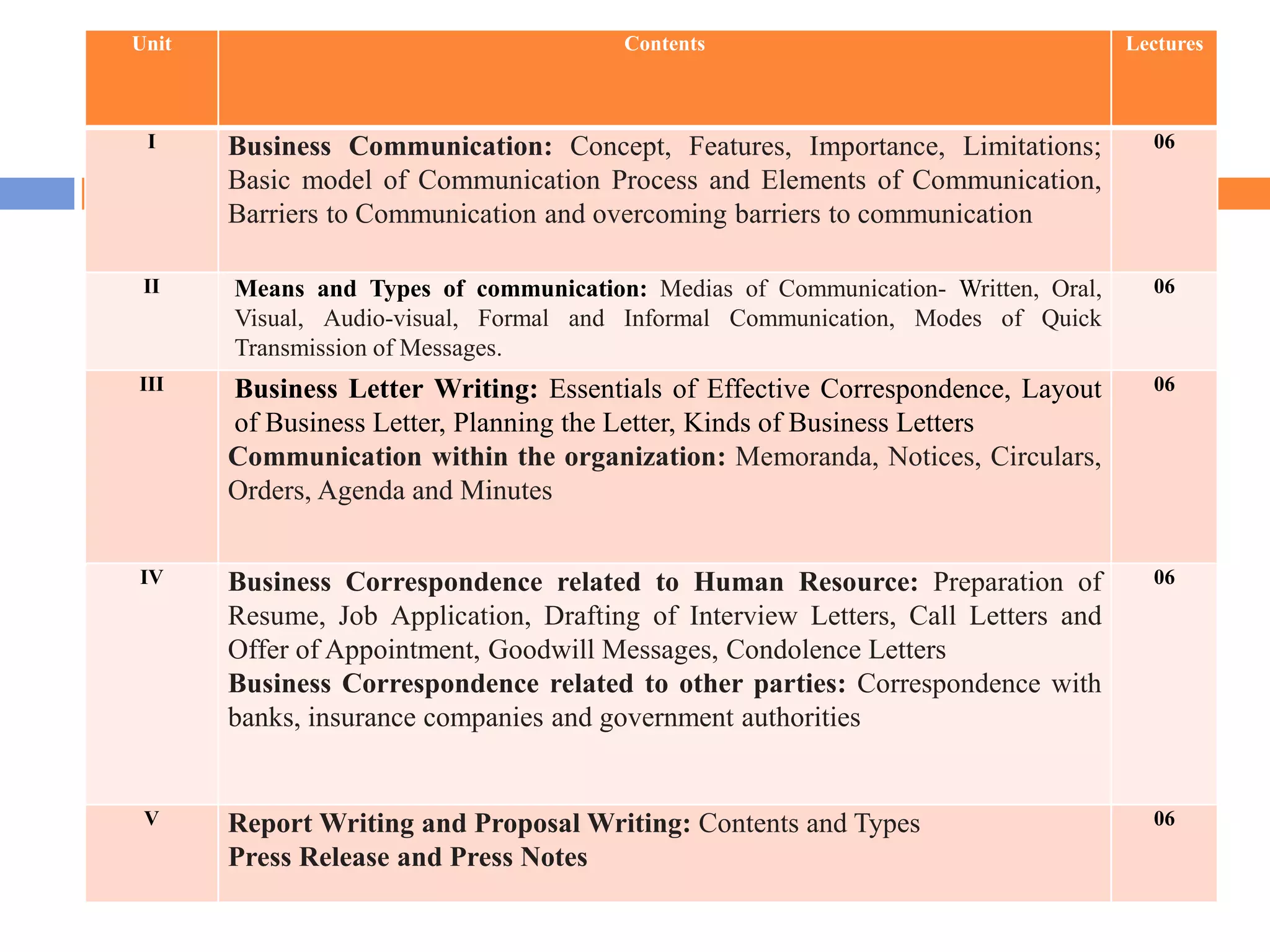
Unit Contents Lectures
I Business Communication: Concept, Features, Importance, Limitations;
Basic model of Communication Process and Elements of Communication,
Barriers to Communication and overcoming barriers to communication
06
II Means and Types of communication: Medias of Communication- Written, Oral,
Visual, Audio-visual, Formal and Informal Communication, Modes of Quick
Transmission of Messages.
06
III Business Letter Writing: Essentials of Effective Correspondence, Layout
of Business Letter, Planning the Letter, Kinds of Business Letters
Communication within the organization: Memoranda, Notices, Circulars,
Orders, Agenda and Minutes
06
IV Business Correspondence related to Human Resource: Preparation of
Resume, Job Application, Drafting of Interview Letters, Call Letters and
Offer of Appointment, Goodwill Messages, Condolence Letters
Business Correspondence related to other parties: Correspondence with
banks, insurance companies and government authorities
06
V Report Writing and Proposal Writing: Contents and Types
Press Release and Press Notes
06
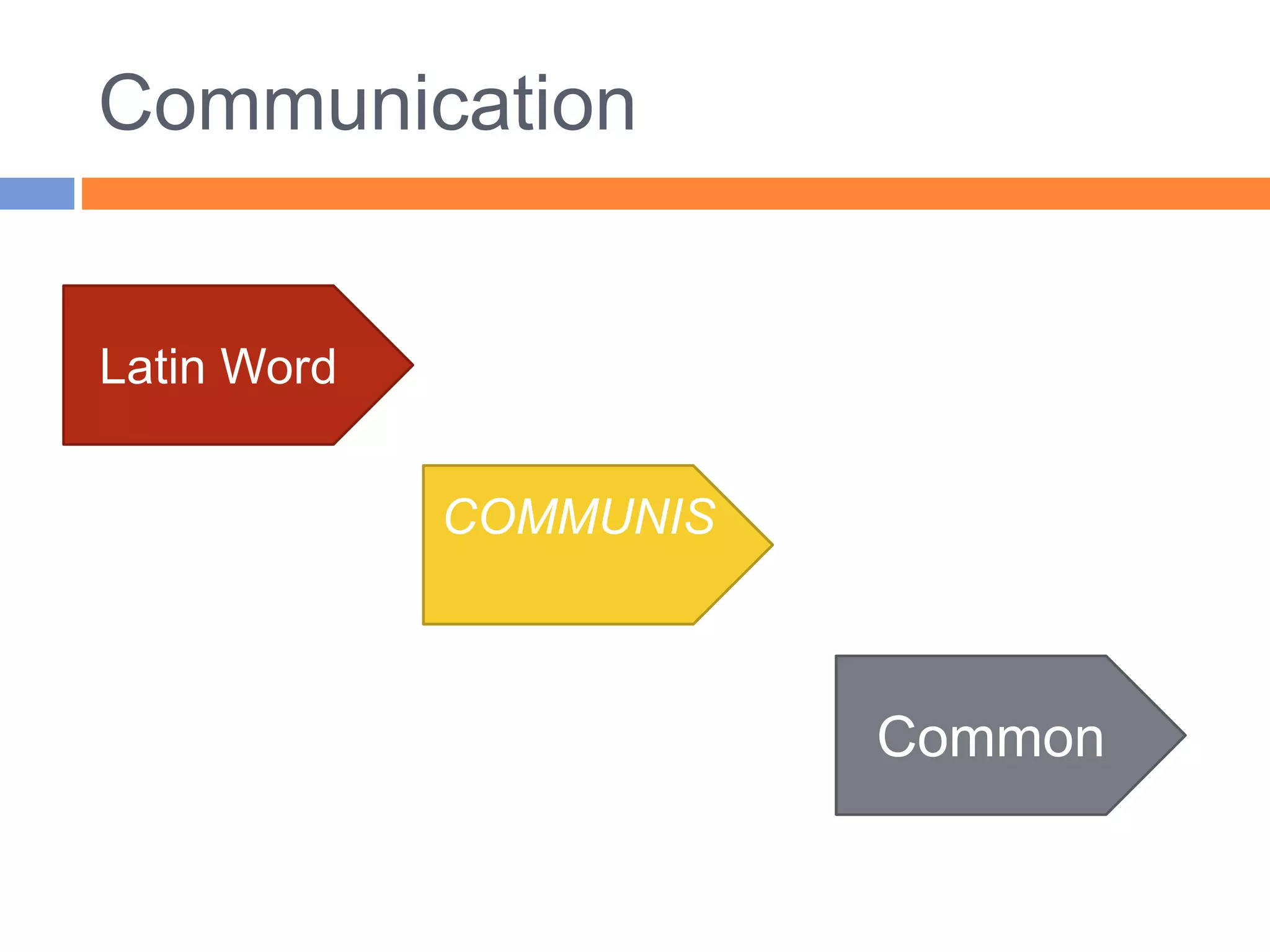
Communication
Latin Word
COMMUNIS
Common
Communication is an
interchange of thoughts,
opinions or information, by
speech, writing or signs.
Business Communication
 Business Communication is information
sharing between people within and
outside an organisation that is performed
for the commercial benefit of the
organisation.
 It can also be defined as relaying of
information within a business by its
people.
Classification- Basis- Number of
receivers to whom the message is
addressed
COMMUNICATION
Interpersonal Communication
Group Communication
Mass Communication
Classification- Basis- Medium
employed
How we communicate
Verbal
• Words-
What we
say
Para Verbal
• Tone – How
we say it
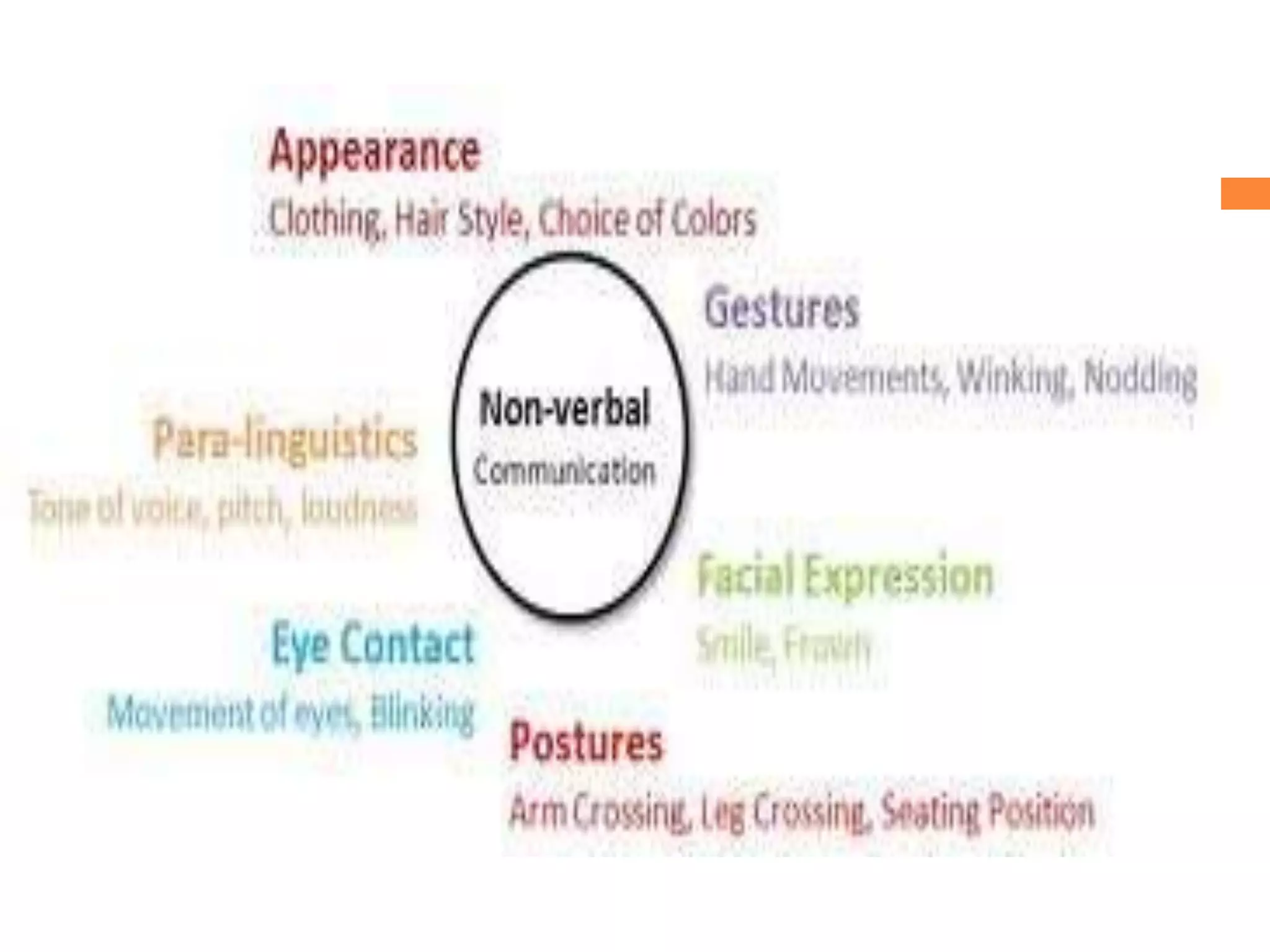
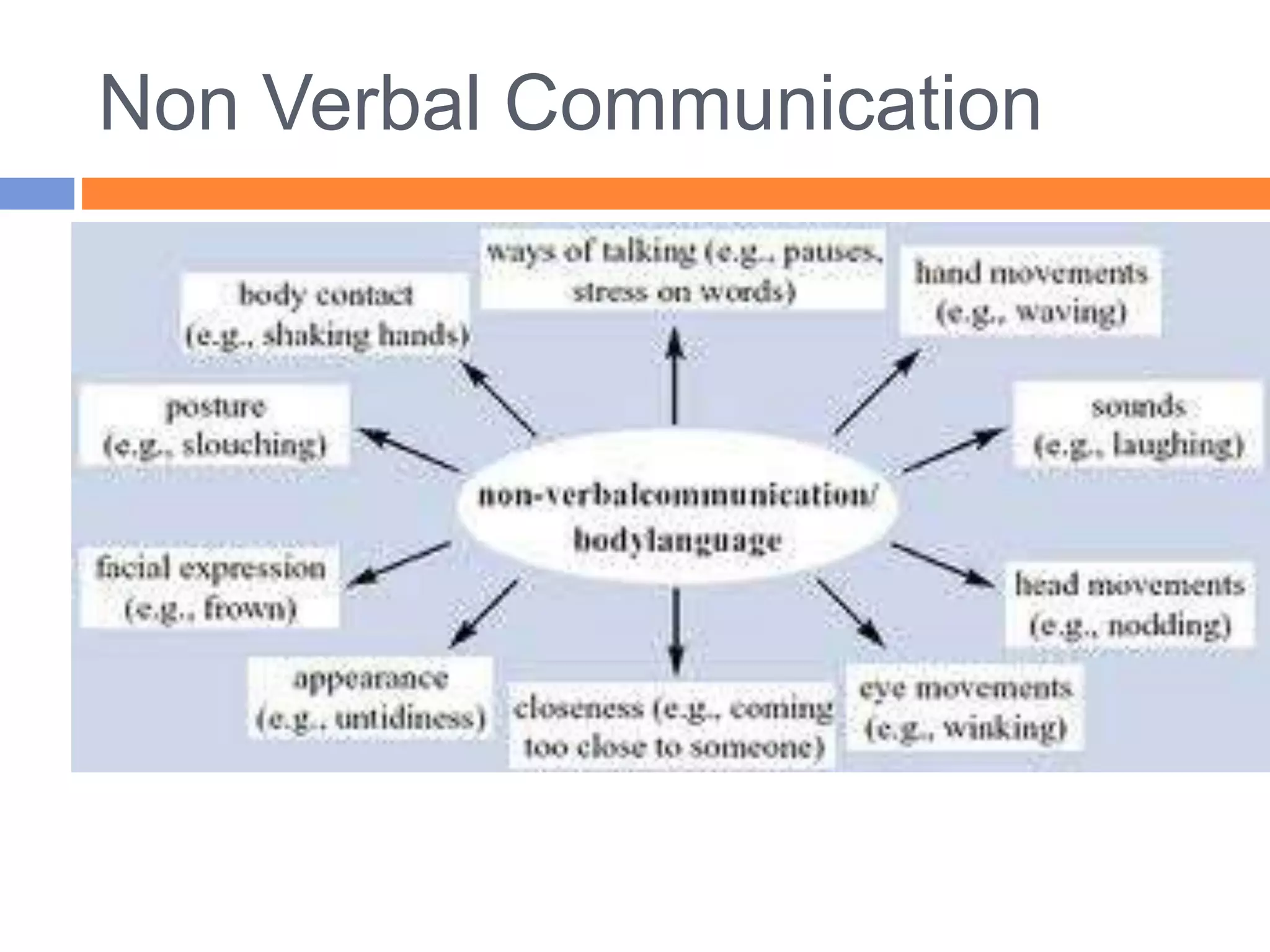
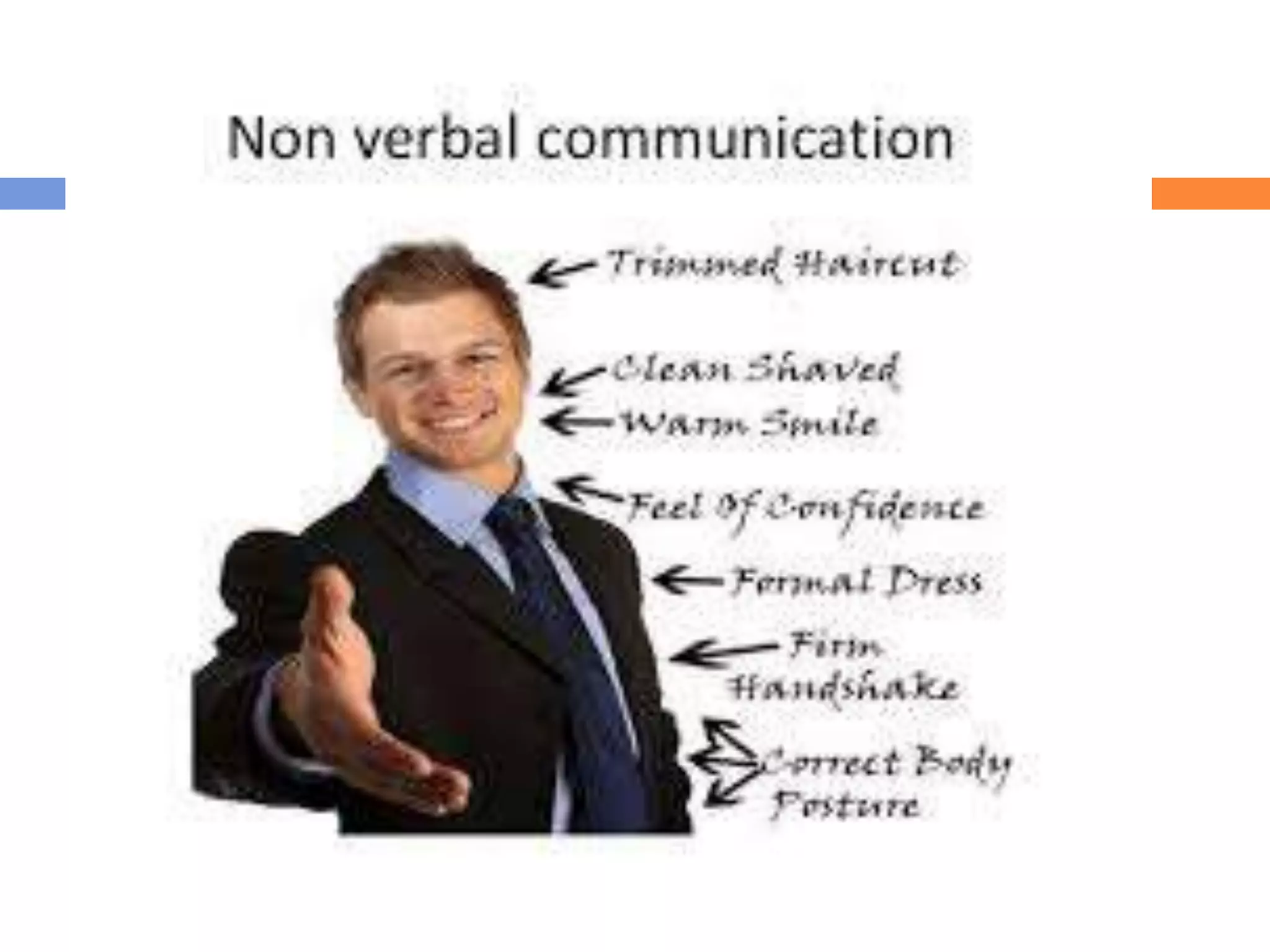
Non Verbal
• Our
Expressions
and actions
Non Verbal Communication
Meta Communication
Communication which is implicit and not
expressed in words.
Features of Business
Communication
 Practical
 Factual
 Clear and brief
 Target Oriented
 Persuasive
Objectives of Business
CommunicationGIVING
INFORMATION
PERSUASION
CONVEYING
SUGGESTION
ADVICE
MOTIVATION
TRAINING
INSTRUCTION,
GUIDANCE AND
COUNSELLING
WARNING AND
APPRECIATION
RESOURCE
UTILISATION
MANAGEMENT
EFFICIENCY
A. Internal Objectives
B. External Objectives
Internal Objectives
•Information to
•Management
•Employees
•Means to achieve
ends
•Co-ordination •Helps to accomplish
results
•Improvement in
morale
•Provides decision
making support
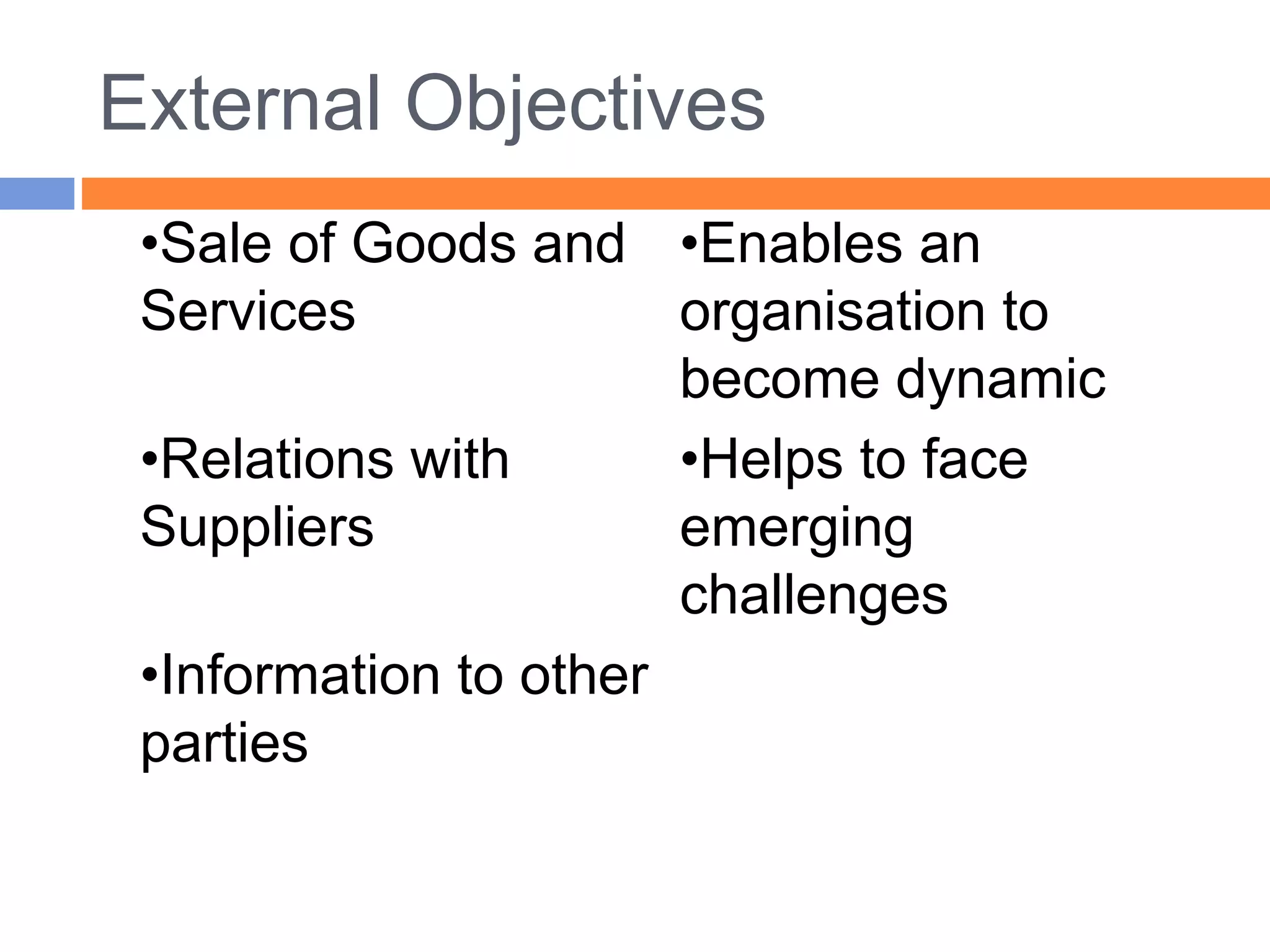
External Objectives
•Sale of Goods and
Services
•Enables an
organisation to
become dynamic
•Relations with
Suppliers
•Helps to face
emerging
challenges
•Information to other
parties
Importance of Communication
Increase in size of
business
Smooth running of
business
Growing specialisation Right and quick decision
making
Cut-throat competition Facilitates proper planning
and co-ordination
Trade union movement Maximum productivity with
minimum cost
Human relations Minimize organisation
conflicts
Public relations Promote employee loyalty
Personal asset Helps in moulding attitudes
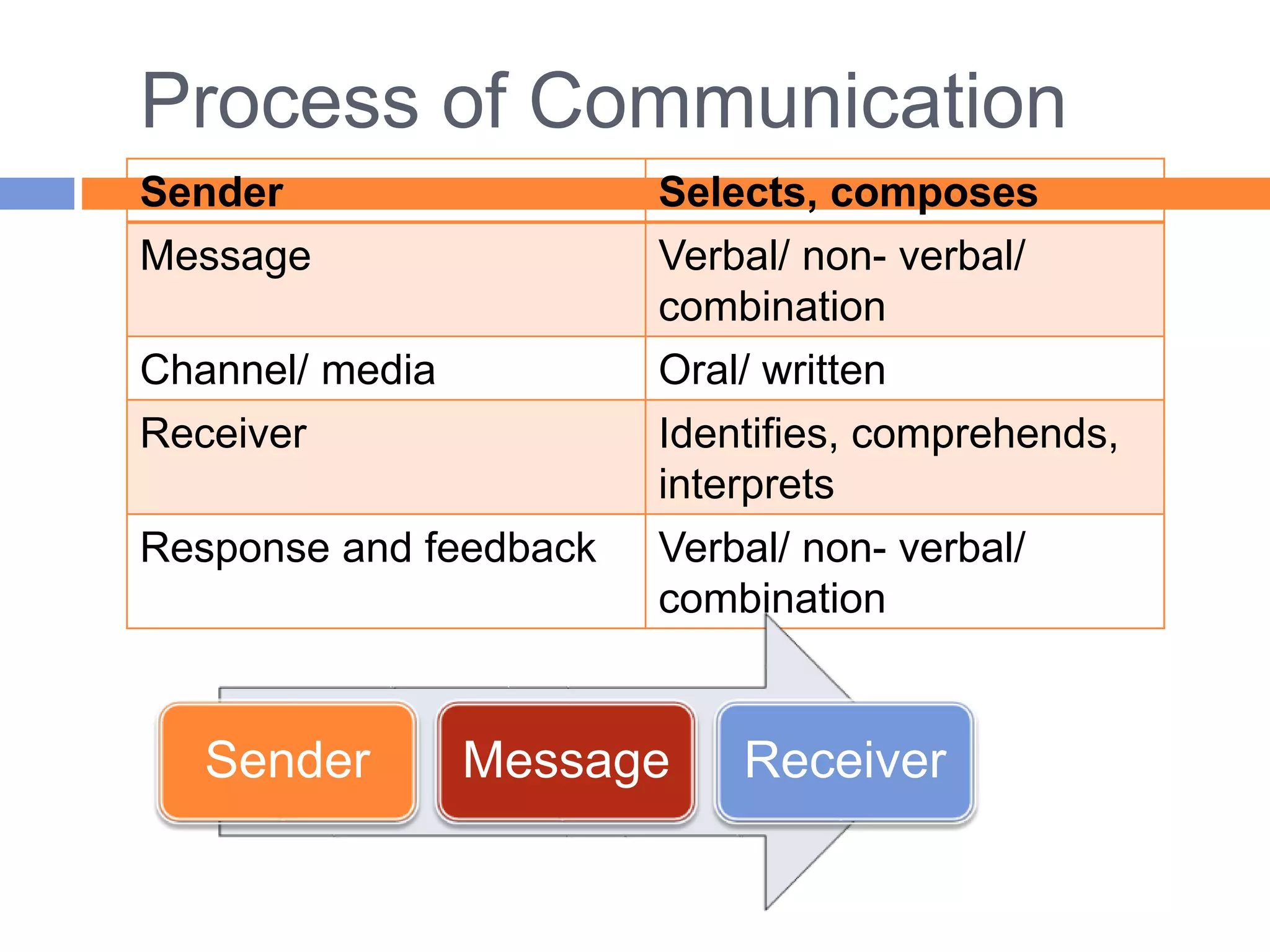
Process of Communication
Sender Selects, composes
Message Verbal/ non- verbal/
combination
Channel/ media Oral/ written
Receiver Identifies, comprehends,
interprets
Response and feedback Verbal/ non- verbal/
combination
Sender Message Receiver
Feedback
Communication Process
Sender
Messag
e
Encodin
g
Receive
r
Decodin
g
Messag
e
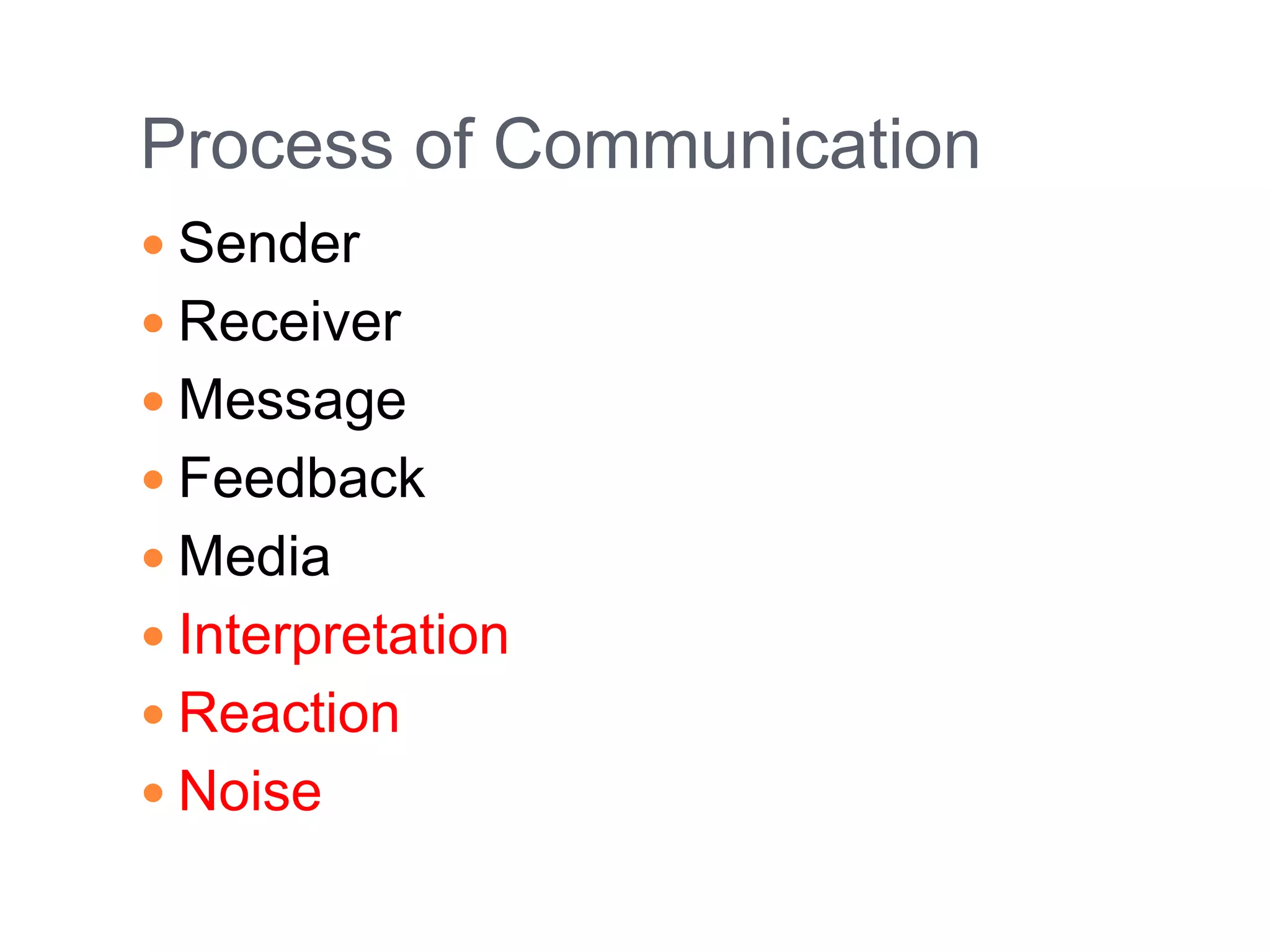
Process of Communication
 Sender
 Receiver
 Message
 Feedback
 Media
 Interpretation
 Reaction
 Noise
Elements of Communication
 Message
 Sender
 Encoding
 Channel
 Receiver
 Decoding
 Action
 Feedback
Elements of Communication
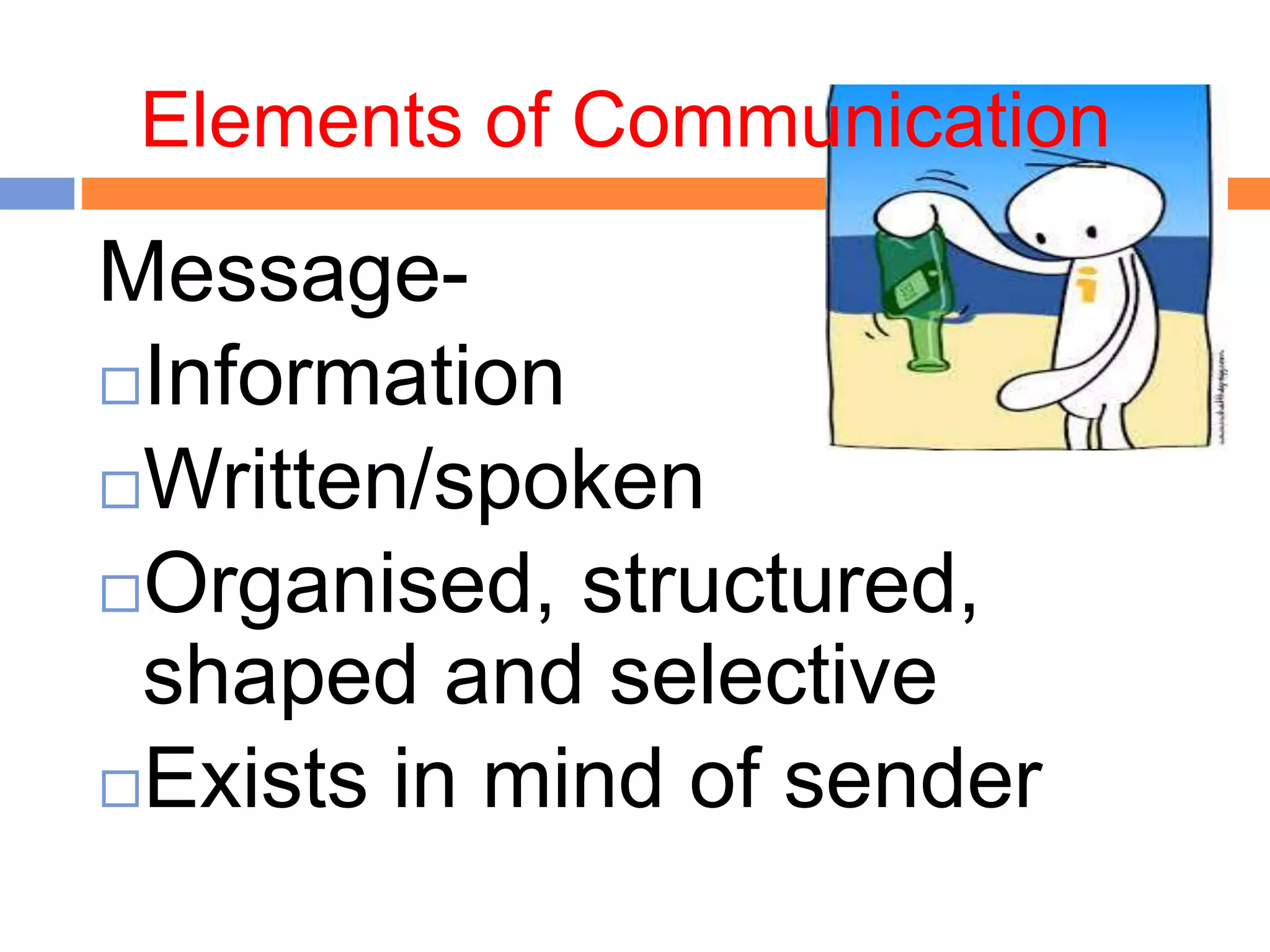
Message-
Information
Written/spoken
Organised, structured,
shaped and selective
Exists in mind of sender
Elements of Communication
Sender-
 Person who transmits/ spreads/
communicates a message
 Initiates message
 Purpose- informing, persuading,
influencing, change in receiver’s
attitude/ opinion
 Decides the channel, time, type of
communication
Elements of Communication
Encoding-
 Changing the message (ideas, facts,
feelings, opinions) into symbols/ patterns
of words/ gestures, etc.
 Selected by sender keeping in mind the
receiver’s ability to understand and
interpret them correctly.
Channels
Core
Messa
ging
Telem
arketi
ng Website
Social
media
Direct
Mail
E Mail
Face to
Face
Meeting
s
Donor
Event
s
Radio
/TV
Mobile
Phone
and
Apps
Elements of Communication
Channel-
 Vehicle or medium which facilitates the
sender to convey the message to
receiver
 Written medium- letter/ memo/ report/
manual/ notice/ circular/ questionnaire/
minutes, etc.
 Oral- dialogue/ interview/ telephone
conversation/ conference/ recording,
etc.
Elements of Communication
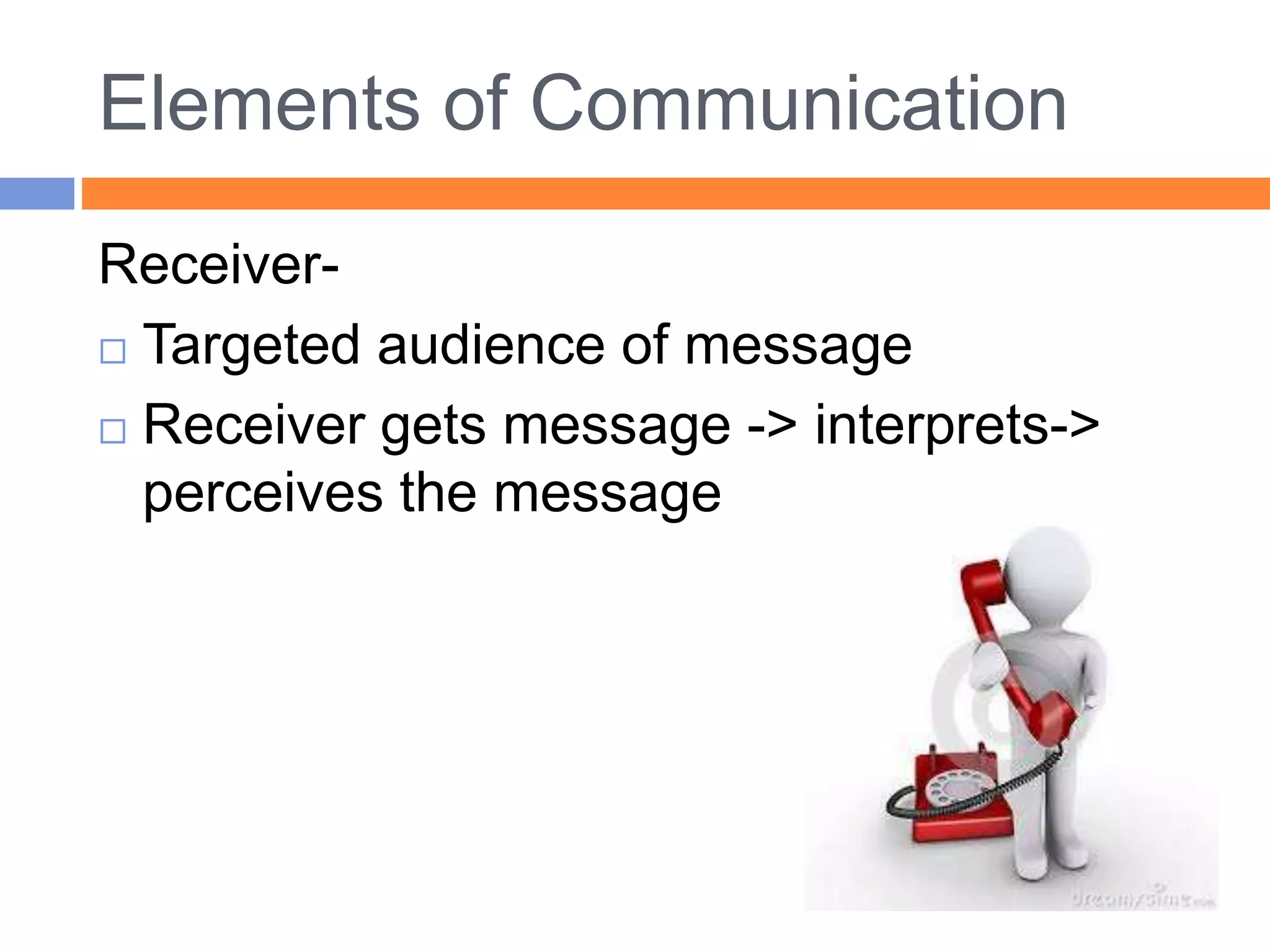
Receiver-
 Targeted audience of message
 Receiver gets message -> interprets->
perceives the message
Elements of Communication
Decoding-
 Act of translating symbols of
communication into meanings.
Elements of Communication
Action-
 When receiver understood the
message he responds through a
particular action
Elements of Communication
Feedback-
 Ensures that receiver has received
the message and understood it as
intended by the sender.
Choice of channel
Organisation size and policy
Cost factor
Nature of message
Distance involved
Resources
Channels of Communication
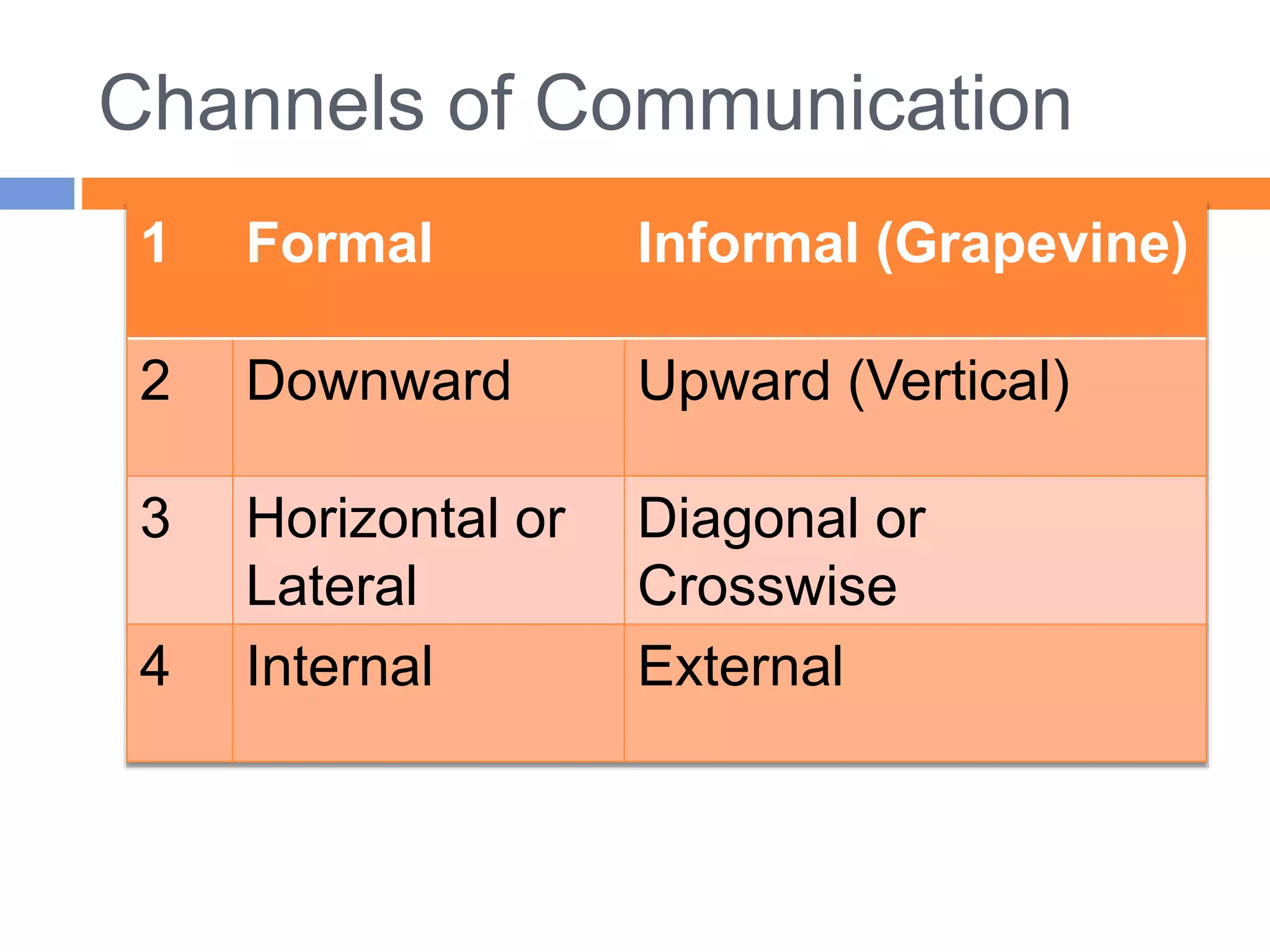
1 Formal Informal (Grapevine)
2 Downward Upward (Vertical)
3 Horizontal or
Lateral
Diagonal or
Crosswise
4 Internal External
Formal Channel of
Communication
Formal Channel of
Communication
 Official channel
 Established by management-
deliberately and consciously
 Line of communication for
transmission of messages
and information officially
within and outside the
organisation
Information
about
performance
Directive
information
Formal Channel of
Communication
Advantages Disadvantages
Follows unity of command Slow and time consuming
Subordinates are bound to
act within the purview of
responsibilities
May impede smooth and
accurate circulation of
information
Flow of orders,
instructions, etc. very
specific, clear and definite.
Lacks personal contact
and relationships
Effective control and
discipline in the
organisation
Possibility of distortion of
facts when the message
passes through various
levels
Helps in maintaining
Informal Channel of
Communication
Informal Channel of
Communication
 Also called grapevine.
 Takes place without giving regard to
hierarchical / task requirements.
 Personal rather than positional.
 Result of social interaction of people.
 Carries unofficial information about
management’s policies, plans,
performance, etc.
 Rumour is an undesirable feature of
grapevine.
Informal Channel of
Communication
Advantages Disadvantages
Can work as a powerful and
purposeful effective tool of
communication.
Tends to be fast
Valuable aid in communicating
organisational rules, values and
morals.
Carry large amount of
information but fairly inaccurate
information, because of
misinterpretation.
Helps in dissemination of
information about organisational
traditions and history.
Spreads rumours and carry
gossips.
Speedy transmission, feedback
value, support to other channels,
psychological satisfaction
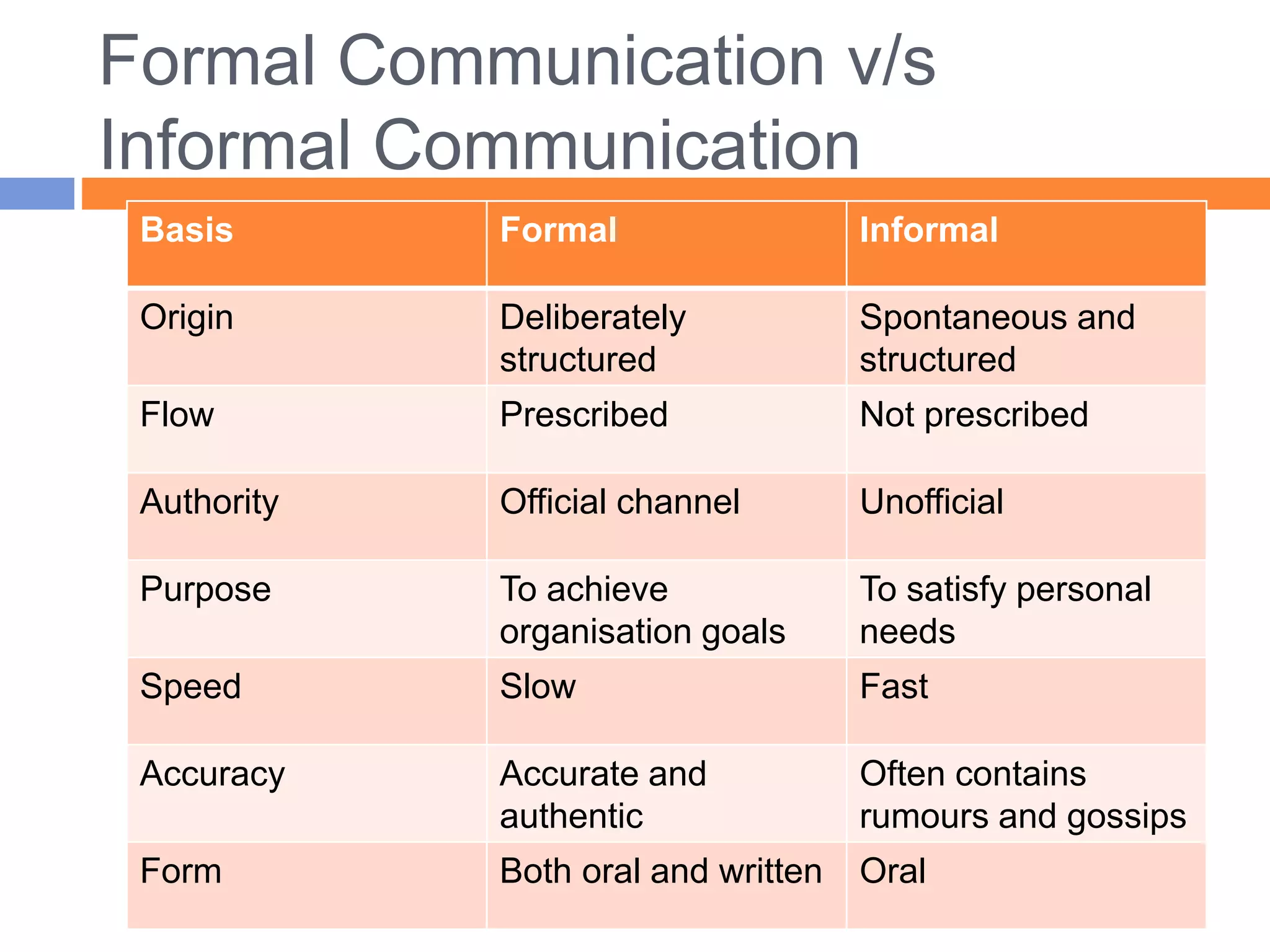
Formal Communication v/s
Informal Communication
Basis Formal Informal
Origin Deliberately
structured
Spontaneous and
structured
Flow Prescribed Not prescribed
Authority Official channel Unofficial
Purpose To achieve
organisation goals
To satisfy personal
needs
Speed Slow Fast
Accuracy Accurate and
authentic
Often contains
rumours and gossips
Form Both oral and written Oral
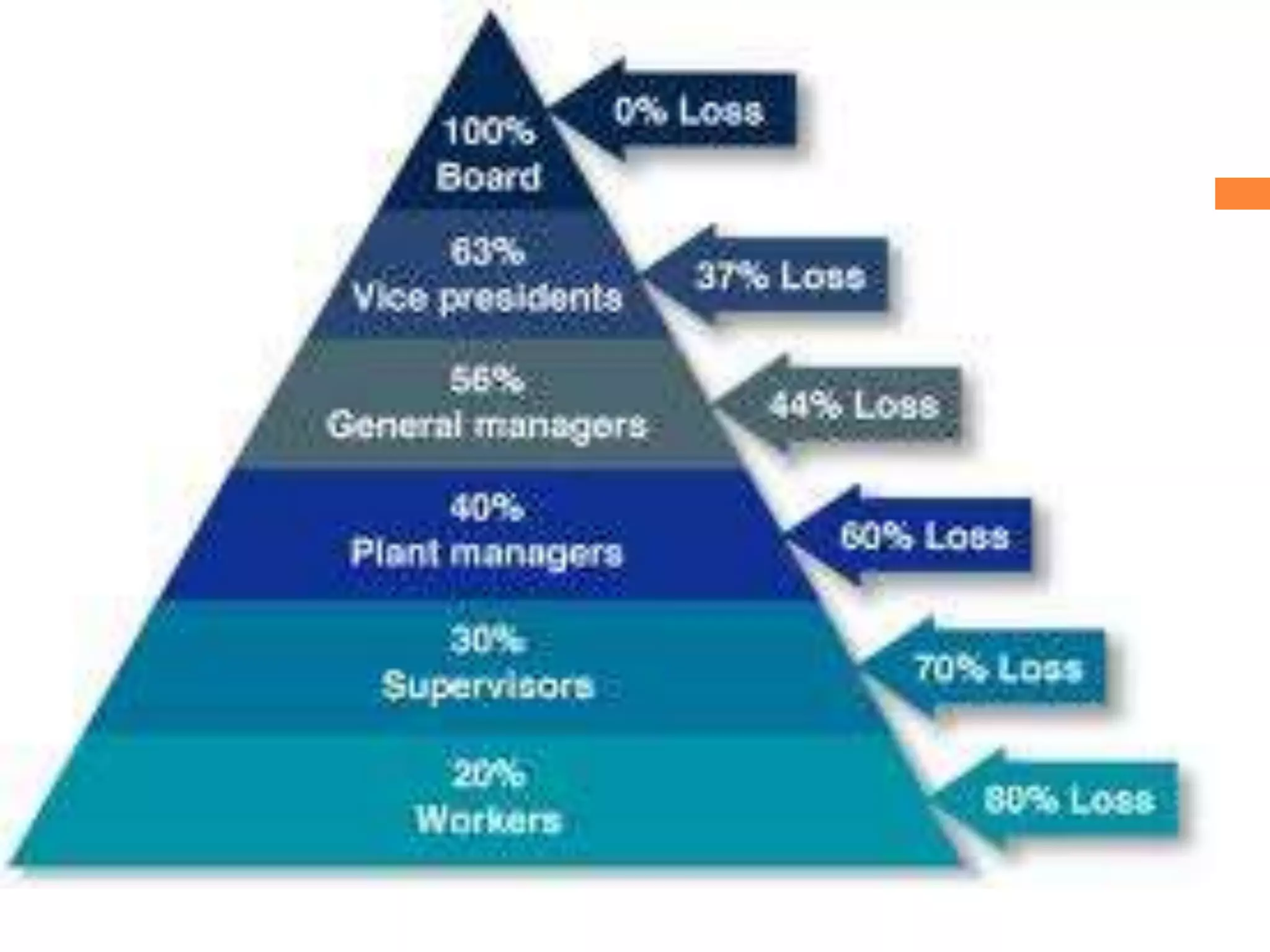
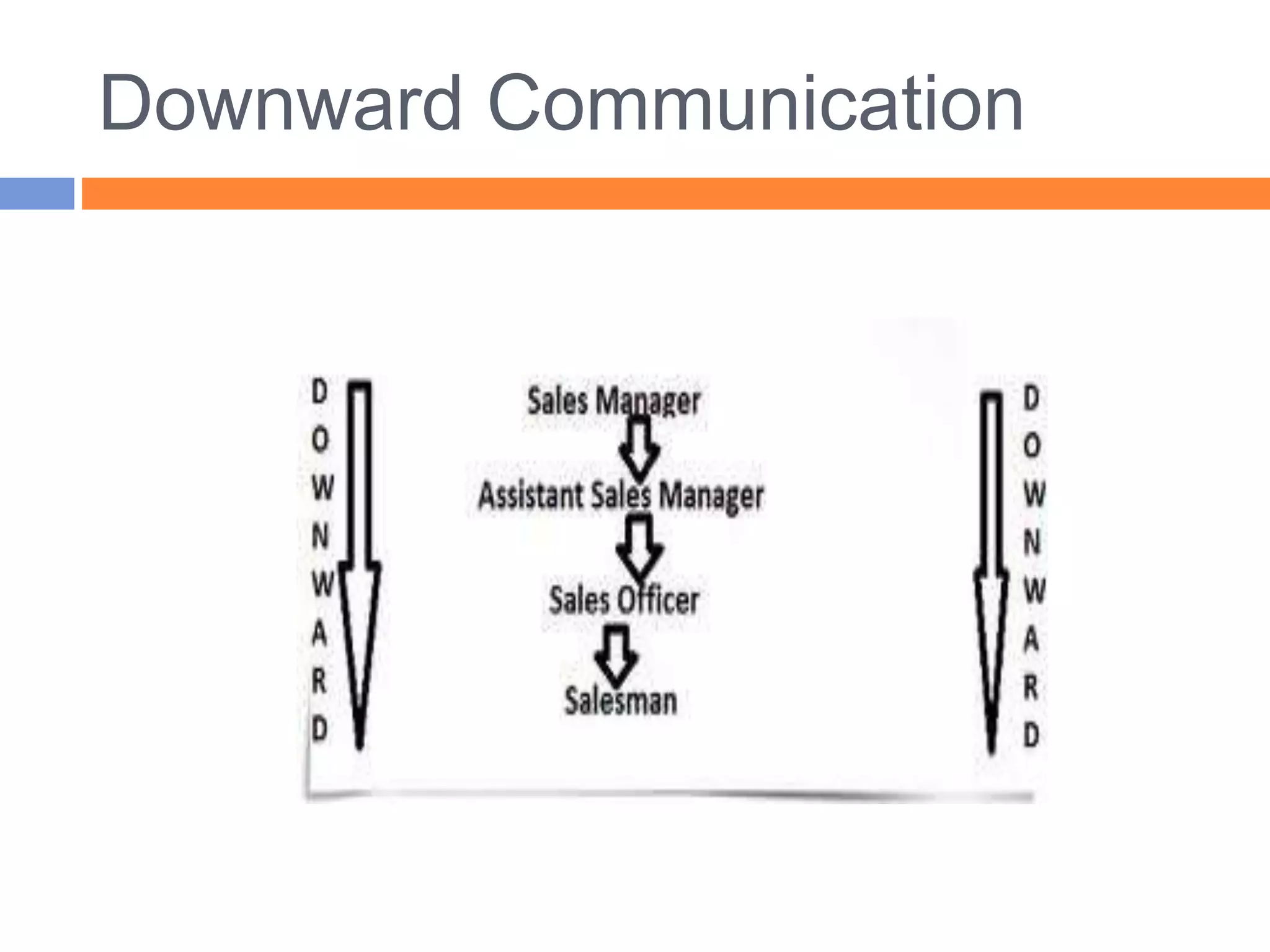
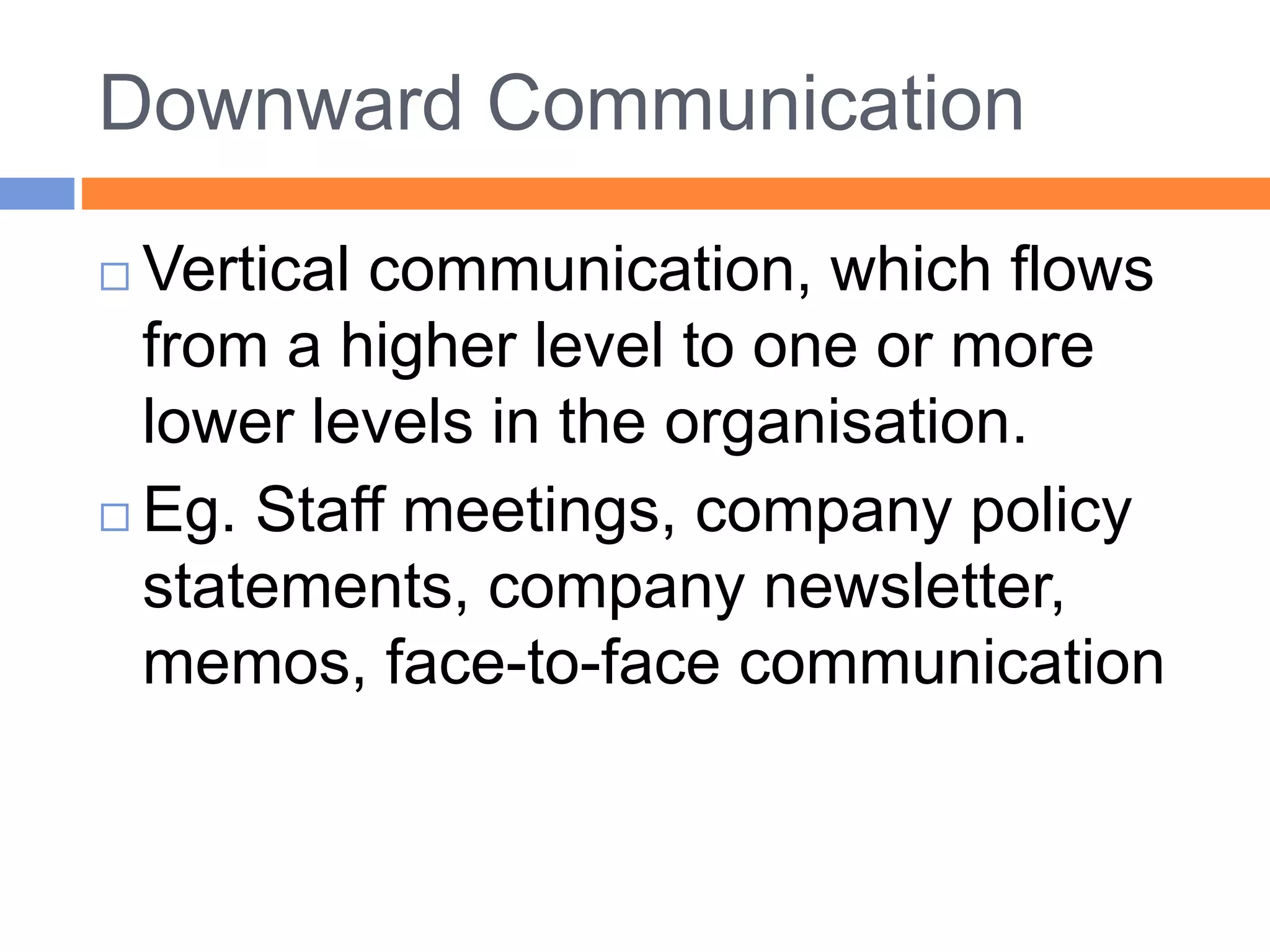
Downward Communication
 Vertical communication, which flows
from a higher level to one or more
lower levels in the organisation.
 Eg. Staff meetings, company policy
statements, company newsletter,
memos, face-to-face communication
Downward Communication
Advantages Disadvantages
Helps to tie different levels of
organisation.
Prone to considerable distortion.
Helps encouraging the
effectiveness of upward
communication through
feedback.
Some managers may purposely/
non-purposely filter
communication by withholding,
screening or manipulating
information
Managers tend to over-use one-
way communication methods,
such as memos, manuals,
newsletters, etc. thus litter
feedback from receiver.
Distortion/ dilution, delay,
filtering, too much or too less
Upward (Vertical)
Communication
Upward (Vertical)
Communication
 Vertical flow of communication from
lower level to higher level in the
organisation.
 Includes one-to-one meetings with
immediate superior, memos and
reports, grievance procedures, etc.
 Good staff relation facilitate free
upward communication.
Upward (Vertical)
Communication
Advantages Disadvantages
Create greater harmony and
mutual understanding between
management and employees
Often subordinates are reluctant
to speak freely to their superiors.
Managers get-
•Up-dation of progress of work
done
•Come to know about problems
faced by subordinates.
•Constructive suggestions and
innovative ideas from employees
.
Psychological, hierarchical
•Feedback, release of tension,
suggestions, mutual co-
operation, change
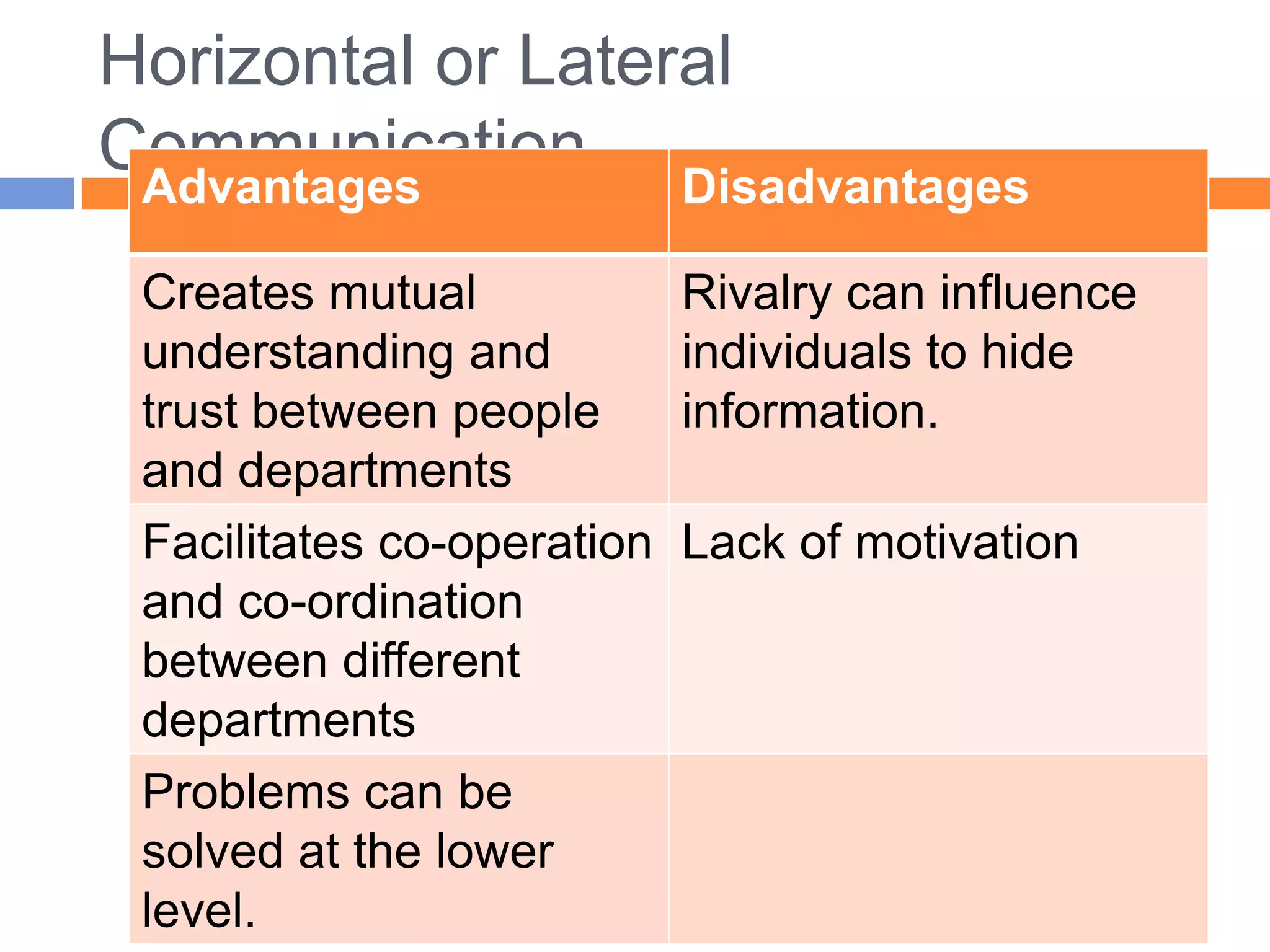
Horizontal or Lateral
Communication
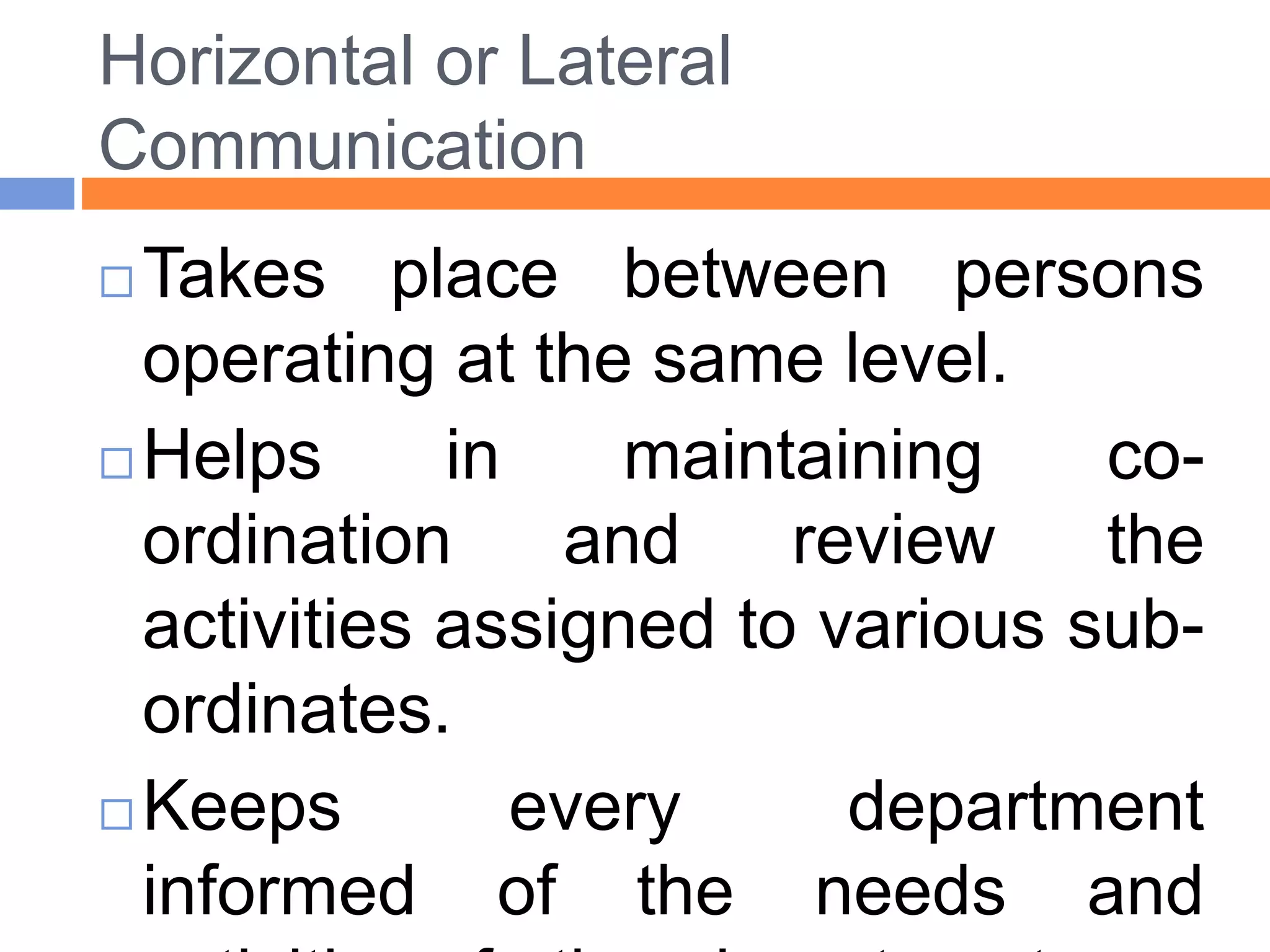
Horizontal or Lateral
Communication
 Takes place between persons
operating at the same level.
 Helps in maintaining co-
ordination and review the
activities assigned to various sub-
ordinates.
 Keeps every department
informed of the needs and
Horizontal or Lateral
CommunicationAdvantages Disadvantages
Creates mutual
understanding and
trust between people
and departments
Rivalry can influence
individuals to hide
information.
Facilitates co-operation
and co-ordination
between different
departments
Lack of motivation
Problems can be
solved at the lower
level.
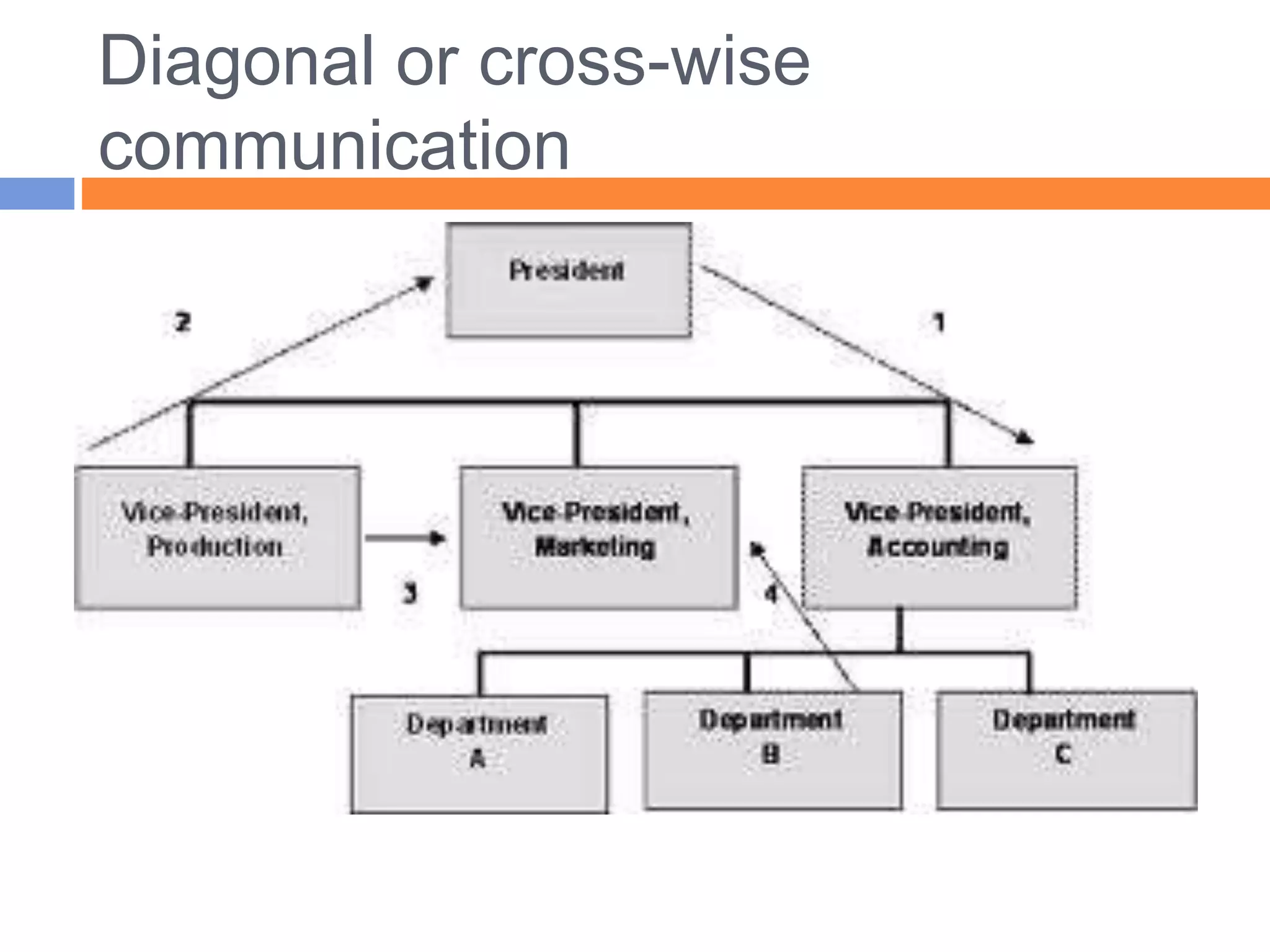
Diagonal or cross-wise
communication
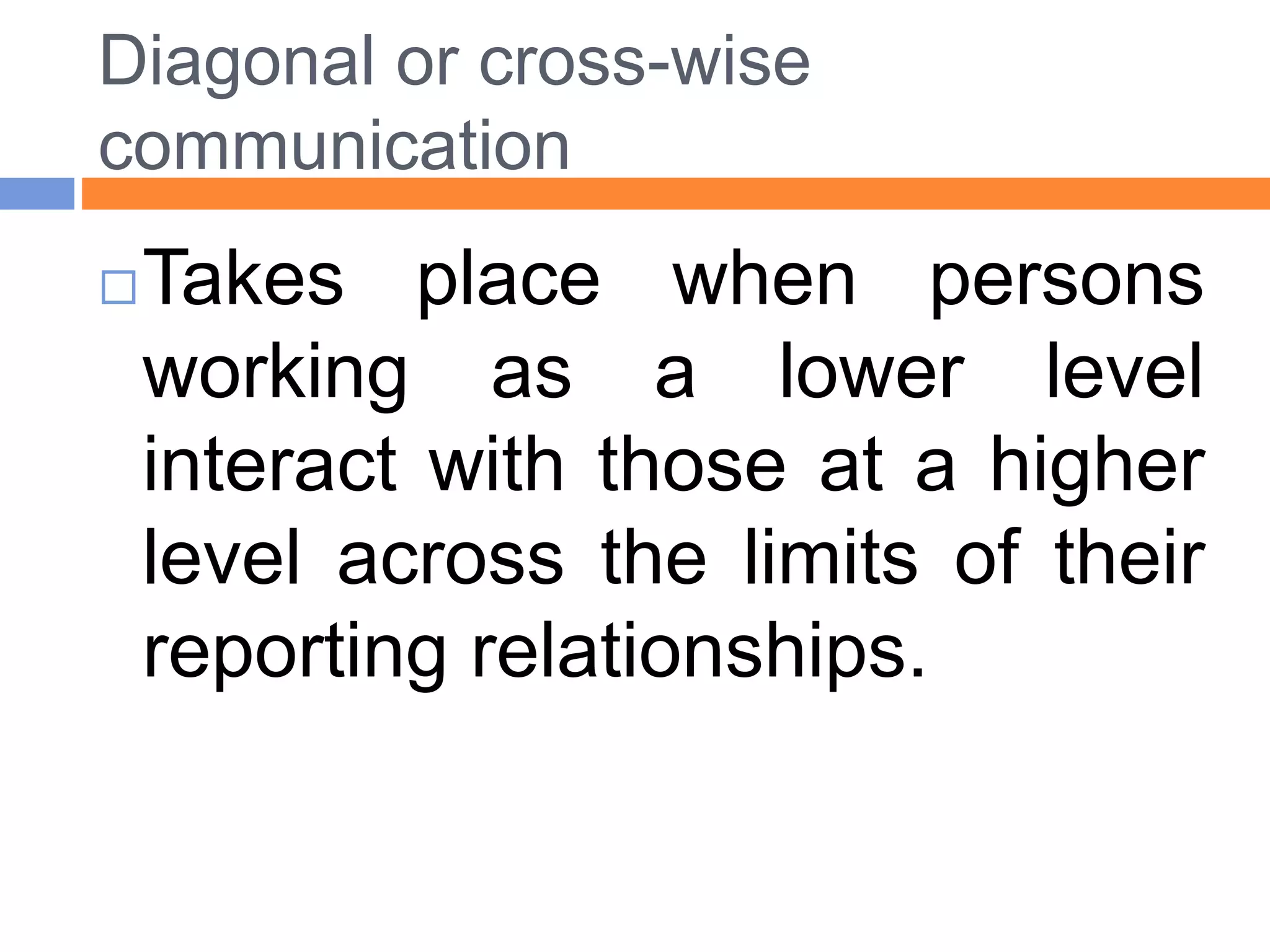
Diagonal or cross-wise
communication
Takes place when persons
working as a lower level
interact with those at a higher
level across the limits of their
reporting relationships.
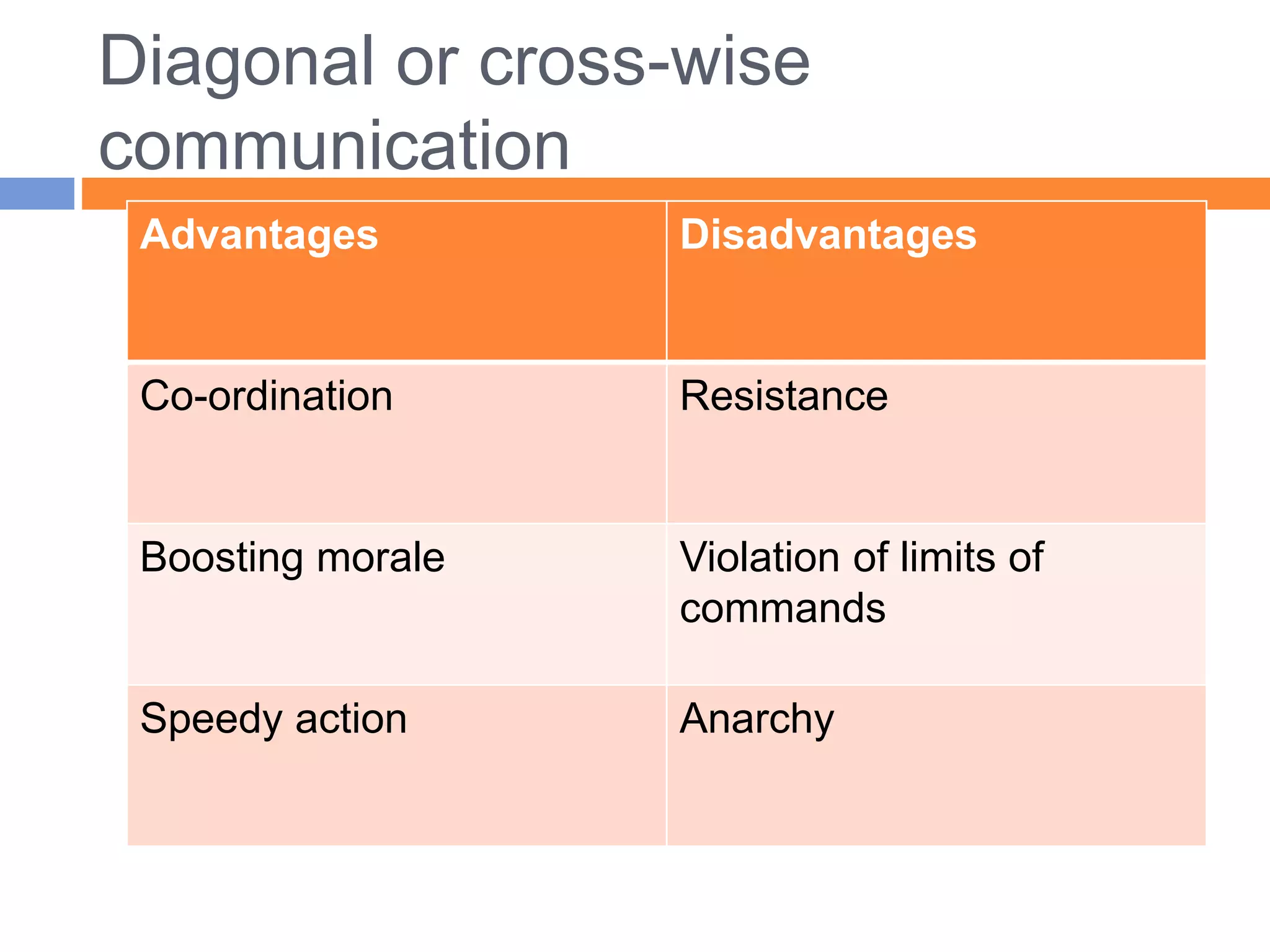
Diagonal or cross-wise
communication
Advantages Disadvantages
Co-ordination Resistance
Boosting morale Violation of limits of
commands
Speedy action Anarchy
Internal communication
 People within organisation communicate
with each other
Individual to Individual
Individual to group
Group to individual
Department to department
 Mostly oral and informal
 Informal communication/ grapevine
 Memo, report, office order, circular,
manuals, minutes of meeting, notice,
agenda, etc.
External communication
 When people in organisation
communicate with anyone
outside the organsiation
 Client, customer. supplier,
government, etc.
 Price list, tender documents, letter,
circular, brochure, advertisement,
press release, etc.
IMPORTANCE OF BUSINESS
COMMUNICATION
 Movement of
information
 Efficient and smooth
running of organsiation
 Promotion of
management efficiency
 Proper planning
 Basis of decision
making
 Basis of co-operation
 Means of co-ordination
 Establishment of public
relation
 Establishment of
effective leadership
 Assisting motivation
 Loyalty
 Goal accomplishment
 Industrial peace
External Factors affecting Business
Communication
Legal and Ethical Constraints
• International
Laws
• Domestic Laws
• Code of Ethics
• Stakeholder’s
interests
• Ethical
Frameworks
• Personal Values
Diversity Challenges
• Cultural
differences
• Language
barriers
• Gender issues
• Education
levels
• Age factors
• Nonverbal
differences
Team Environment
• Trust
• Team roles
• Shared goals
and
expectations
• Synergy
• Group reward
• Distributed
leadership
Changing Technology
• Accuracy and
security issues
• Telecommunication
s
• Software
applications
• Telecommuting
• Databases

Business Communication

  • 1.
  • 2.
    Unit Contents Lectures IBusiness Communication: Concept, Features, Importance, Limitations; Basic model of Communication Process and Elements of Communication, Barriers to Communication and overcoming barriers to communication 06 II Means and Types of communication: Medias of Communication- Written, Oral, Visual, Audio-visual, Formal and Informal Communication, Modes of Quick Transmission of Messages. 06 III Business Letter Writing: Essentials of Effective Correspondence, Layout of Business Letter, Planning the Letter, Kinds of Business Letters Communication within the organization: Memoranda, Notices, Circulars, Orders, Agenda and Minutes 06 IV Business Correspondence related to Human Resource: Preparation of Resume, Job Application, Drafting of Interview Letters, Call Letters and Offer of Appointment, Goodwill Messages, Condolence Letters Business Correspondence related to other parties: Correspondence with banks, insurance companies and government authorities 06 V Report Writing and Proposal Writing: Contents and Types Press Release and Press Notes 06
  • 3.
  • 4.
    Communication is an interchangeof thoughts, opinions or information, by speech, writing or signs.
  • 5.
    Business Communication  BusinessCommunication is information sharing between people within and outside an organisation that is performed for the commercial benefit of the organisation.  It can also be defined as relaying of information within a business by its people.
  • 6.
    Classification- Basis- Numberof receivers to whom the message is addressed
  • 7.
  • 8.
  • 9.
  • 10.
  • 11.
  • 12.
    How we communicate Verbal •Words- What we say Para Verbal • Tone – How we say it Non Verbal • Our Expressions and actions
  • 15.
  • 17.
    Meta Communication Communication whichis implicit and not expressed in words.
  • 18.
    Features of Business Communication Practical  Factual  Clear and brief  Target Oriented  Persuasive
  • 19.
  • 20.
    A. Internal Objectives B.External Objectives
  • 21.
    Internal Objectives •Information to •Management •Employees •Meansto achieve ends •Co-ordination •Helps to accomplish results •Improvement in morale •Provides decision making support
  • 22.
    External Objectives •Sale ofGoods and Services •Enables an organisation to become dynamic •Relations with Suppliers •Helps to face emerging challenges •Information to other parties
  • 23.
    Importance of Communication Increasein size of business Smooth running of business Growing specialisation Right and quick decision making Cut-throat competition Facilitates proper planning and co-ordination Trade union movement Maximum productivity with minimum cost Human relations Minimize organisation conflicts Public relations Promote employee loyalty Personal asset Helps in moulding attitudes
  • 24.
    Process of Communication SenderSelects, composes Message Verbal/ non- verbal/ combination Channel/ media Oral/ written Receiver Identifies, comprehends, interprets Response and feedback Verbal/ non- verbal/ combination Sender Message Receiver
  • 25.
  • 27.
    Process of Communication Sender  Receiver  Message  Feedback  Media  Interpretation  Reaction  Noise
  • 28.
    Elements of Communication Message  Sender  Encoding  Channel  Receiver  Decoding  Action  Feedback
  • 29.
    Elements of Communication Message- Information Written/spoken Organised,structured, shaped and selective Exists in mind of sender
  • 30.
    Elements of Communication Sender- Person who transmits/ spreads/ communicates a message  Initiates message  Purpose- informing, persuading, influencing, change in receiver’s attitude/ opinion  Decides the channel, time, type of communication
  • 31.
    Elements of Communication Encoding- Changing the message (ideas, facts, feelings, opinions) into symbols/ patterns of words/ gestures, etc.  Selected by sender keeping in mind the receiver’s ability to understand and interpret them correctly.
  • 32.
    Channels Core Messa ging Telem arketi ng Website Social media Direct Mail E Mail Faceto Face Meeting s Donor Event s Radio /TV Mobile Phone and Apps
  • 33.
    Elements of Communication Channel- Vehicle or medium which facilitates the sender to convey the message to receiver  Written medium- letter/ memo/ report/ manual/ notice/ circular/ questionnaire/ minutes, etc.  Oral- dialogue/ interview/ telephone conversation/ conference/ recording, etc.
  • 34.
    Elements of Communication Receiver- Targeted audience of message  Receiver gets message -> interprets-> perceives the message
  • 35.
    Elements of Communication Decoding- Act of translating symbols of communication into meanings.
  • 36.
    Elements of Communication Action- When receiver understood the message he responds through a particular action
  • 37.
    Elements of Communication Feedback- Ensures that receiver has received the message and understood it as intended by the sender.
  • 38.
    Choice of channel Organisationsize and policy Cost factor Nature of message Distance involved Resources
  • 39.
    Channels of Communication 1Formal Informal (Grapevine) 2 Downward Upward (Vertical) 3 Horizontal or Lateral Diagonal or Crosswise 4 Internal External
  • 40.
  • 41.
    Formal Channel of Communication Official channel  Established by management- deliberately and consciously  Line of communication for transmission of messages and information officially within and outside the organisation Information about performance Directive information
  • 42.
    Formal Channel of Communication AdvantagesDisadvantages Follows unity of command Slow and time consuming Subordinates are bound to act within the purview of responsibilities May impede smooth and accurate circulation of information Flow of orders, instructions, etc. very specific, clear and definite. Lacks personal contact and relationships Effective control and discipline in the organisation Possibility of distortion of facts when the message passes through various levels Helps in maintaining
  • 44.
  • 45.
    Informal Channel of Communication Also called grapevine.  Takes place without giving regard to hierarchical / task requirements.  Personal rather than positional.  Result of social interaction of people.  Carries unofficial information about management’s policies, plans, performance, etc.  Rumour is an undesirable feature of grapevine.
  • 46.
    Informal Channel of Communication AdvantagesDisadvantages Can work as a powerful and purposeful effective tool of communication. Tends to be fast Valuable aid in communicating organisational rules, values and morals. Carry large amount of information but fairly inaccurate information, because of misinterpretation. Helps in dissemination of information about organisational traditions and history. Spreads rumours and carry gossips. Speedy transmission, feedback value, support to other channels, psychological satisfaction
  • 47.
    Formal Communication v/s InformalCommunication Basis Formal Informal Origin Deliberately structured Spontaneous and structured Flow Prescribed Not prescribed Authority Official channel Unofficial Purpose To achieve organisation goals To satisfy personal needs Speed Slow Fast Accuracy Accurate and authentic Often contains rumours and gossips Form Both oral and written Oral
  • 48.
  • 49.
    Downward Communication  Verticalcommunication, which flows from a higher level to one or more lower levels in the organisation.  Eg. Staff meetings, company policy statements, company newsletter, memos, face-to-face communication
  • 50.
    Downward Communication Advantages Disadvantages Helpsto tie different levels of organisation. Prone to considerable distortion. Helps encouraging the effectiveness of upward communication through feedback. Some managers may purposely/ non-purposely filter communication by withholding, screening or manipulating information Managers tend to over-use one- way communication methods, such as memos, manuals, newsletters, etc. thus litter feedback from receiver. Distortion/ dilution, delay, filtering, too much or too less
  • 51.
  • 52.
    Upward (Vertical) Communication  Verticalflow of communication from lower level to higher level in the organisation.  Includes one-to-one meetings with immediate superior, memos and reports, grievance procedures, etc.  Good staff relation facilitate free upward communication.
  • 53.
    Upward (Vertical) Communication Advantages Disadvantages Creategreater harmony and mutual understanding between management and employees Often subordinates are reluctant to speak freely to their superiors. Managers get- •Up-dation of progress of work done •Come to know about problems faced by subordinates. •Constructive suggestions and innovative ideas from employees . Psychological, hierarchical •Feedback, release of tension, suggestions, mutual co- operation, change
  • 54.
  • 55.
    Horizontal or Lateral Communication Takes place between persons operating at the same level.  Helps in maintaining co- ordination and review the activities assigned to various sub- ordinates.  Keeps every department informed of the needs and
  • 56.
    Horizontal or Lateral CommunicationAdvantagesDisadvantages Creates mutual understanding and trust between people and departments Rivalry can influence individuals to hide information. Facilitates co-operation and co-ordination between different departments Lack of motivation Problems can be solved at the lower level.
  • 57.
  • 58.
    Diagonal or cross-wise communication Takesplace when persons working as a lower level interact with those at a higher level across the limits of their reporting relationships.
  • 59.
    Diagonal or cross-wise communication AdvantagesDisadvantages Co-ordination Resistance Boosting morale Violation of limits of commands Speedy action Anarchy
  • 60.
    Internal communication  Peoplewithin organisation communicate with each other Individual to Individual Individual to group Group to individual Department to department  Mostly oral and informal  Informal communication/ grapevine  Memo, report, office order, circular, manuals, minutes of meeting, notice, agenda, etc.
  • 61.
    External communication  Whenpeople in organisation communicate with anyone outside the organsiation  Client, customer. supplier, government, etc.  Price list, tender documents, letter, circular, brochure, advertisement, press release, etc.
  • 62.
    IMPORTANCE OF BUSINESS COMMUNICATION Movement of information  Efficient and smooth running of organsiation  Promotion of management efficiency  Proper planning  Basis of decision making  Basis of co-operation  Means of co-ordination  Establishment of public relation  Establishment of effective leadership  Assisting motivation  Loyalty  Goal accomplishment  Industrial peace
  • 63.
    External Factors affectingBusiness Communication Legal and Ethical Constraints • International Laws • Domestic Laws • Code of Ethics • Stakeholder’s interests • Ethical Frameworks • Personal Values Diversity Challenges • Cultural differences • Language barriers • Gender issues • Education levels • Age factors • Nonverbal differences Team Environment • Trust • Team roles • Shared goals and expectations • Synergy • Group reward • Distributed leadership Changing Technology • Accuracy and security issues • Telecommunication s • Software applications • Telecommuting • Databases

Editor's Notes

  • #8 Soliloquies- An act of speaking one's thoughts aloud when by oneself or regardless of any hearers, esp. by a character in a play.
  • #9 Conversation, Dialogue, Interview, Book, Letter, etc.
  • #10 Organisation, club, classroom
  • #22 RBD paney pareek Madan pg 1.4
  • #23 RBD paney pareek Madan pg 1.4
  • #38 Pd chaturvedi pg 26
  • #42 M j mathew pg 23
  • #48 R c bhatia pg 49