EEG- Artefacts
 and Benign
  Variants
           Dr.Roopchand.PS
       Senior Resident Academic
 Dept. of Neurology, TDMC, Alappuzha
Artefacts:
• Recorded signals of non cerebral origin.
• Poses great problem in EEG reading.
• Recognition and elimination are therefore
  important.
• Mechanical
   o Electromagnetic, electrostatic, radio frequency, mains born, external
     electrical interference.
   o Instrument artefact.
   o IV drip artefact
   o Respirator artefact.

• Biological
   o Eye movement, cardiac/pulse, respiratory, electromyographic,
     movement, cutaneous, glossokinetic, Msic
Electro magnetic
             interference:

•   Due to AC current.
•   Induces fluctuating magnetic fields to EEG leads.
•   Opposite fields may cancel out.
•   Proper earth connection of apparatus.
•   Patient bed may be connected to earth socket.
Electrostatic Interference:

• Due to capacitance property of objects.
• Patient or electrode may pick up capacitance
  potentials from sources in their vicinity.
• Reduced by moving the patient from the source.
• Proper earth connection.
Radio frequency
           Interference:


• Signal between 120-400Hz
• Especially diathermy equipment's.
• Radio frequency filters may be used.
• Mains born interference: due to fluctuating power
  supply.
   o Stabilized power supply can avoid this artefact.

• External electrical interference: fluorescent light ,
  ac, refrigerator…
Instrument Artefact:
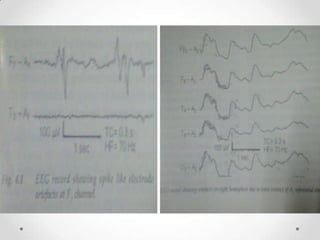
• Electrode artefact: due to change in resistance,
  capacitance and inductive reactance of two
  electrodes compared to others.
   o Individual electrode impedance should be less than 5kΊ.

• Bizarre potentials are seen
   o Confined to two adjacent channels in bipolar chain .
   o Confined to one channel or one hemisphere in reference recording.

• Waves are markedly different from background
  activity.
• Appear as spike like potentials.
• Ground electrode artefact: due to defective
  grounding.
   o Produce 60Hz AC artefact.
• Machine fault: loss of main, blown fuse, selective
  malfunctioning of one system.
• Intravenous drip artefact: may produce
  stereotyped spike like potentials at fixed intervals.
   o Infusion pumps produce stereotyped brief spike
     like transients.
• Respirator artefact: single high voltage or multiple
  high/low voltage transients of 2 to 40 Hz.
Biological Artefact:
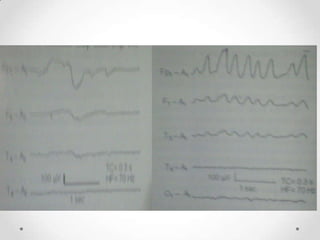
Eye movement Artefacts:
•   From eye ball or muscles around orbit.
•   Eye ball act as a dipole.
•   Eye movements produce AC fields.
•   Detectable in electrodes near globe
    o Fp1, Fp2, F7, F8

• Negative deflection when Fp1 and Fp2 are positive.
• Eye ball movement monitoring.
• Blinking produces upward movement of eye ball.
    o Fp1 and Fp2 are positive.

• Repetitive blinking can mimic FRIDA(Frontal
  Intermittent Rhythmic Delta Activity) or triphasic
  wave.
• More frequent blinking can simulate theta activity.
• Horizontal or vertical nystagmus can produce
  aretfacts simulating theta activity.
• Asymmetric eyeball artifacts can be seen in
  unilateral ophthalmoplegia and enucleation.
• Can be abolished by keeping the eye closed or
  simultaneously recording eye ball movements.
• IPS may produce photomyoclonic repose from
  orbicularis occuli and frontalis.
Cardiac and respiratory
         artefacts:
• Normally electrical field of heart extends up to base
  of the skull.
• In short necked persons can extend up to vertex.
• Normally can extend up to ear.
• Cardiac artefacts are mainly due to QRS
  complexes.
• Positive in A1 and negative in A2.
• Recognized by characteristic from and regularity.
• Interfere in diagnosing electro cerebral silence.
• Respiration may cause change is electrical axis of
  the heart.
   o Produce fluctuation in amplitude of waves.
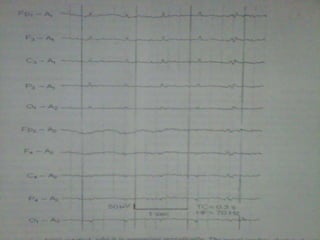
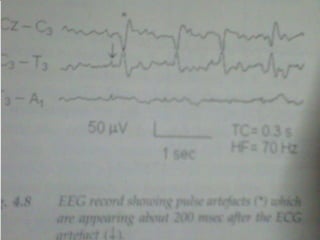
Pulse artefact:
•   Electrode near or overlying a small scalp artery.
•   Systolic pulse alter the impedance.
•   Waves are periodic
•   Smooth and sharply contoured
•   Time locked to ECG by 200msec delay in peak.
Electromyographic
             artefact:
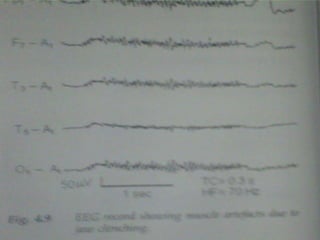
• Brief single or multiple myogenic potentials.
• Located in the temporal, frontal and occipital
  areas.
• Frontal epileptiform discharges can mimic them.
• Avoiding jaw clenching and frowning will abolish
  the waves.
• Essential tremor and Parkinson's tremor produce 4-
  6Hz sinusoidal artefacts.
• Hemi facial spasm can also produce EMG artefacts.
Movement Aretacts:
• Due to combination of instrument and biologic
  factors.
• Related to observed activity of the subject.
• Difficult to differentiate from discharges during
  GTCS.
• Significant reduction possible by proper electrode
  placement and use of self retaining electrodes.
Cutaneous Artefacts:
• Perspiration artefact: perspiration causes slow shift
  of electrical baseline due to change in impedance.
• Sweat gland produces slow changing electrical
  potentials recorded by electrodes.
• Produce slow wave forms of more than 2 sec.
• Perspiration artefact + background slowing :
  hypoglycemia.
• Reduced by lowering the room temparature and
  wiping the brow with alcohol.
• Galvanic skin response: represent sympathetic skin
  response produced by sweat gland and changes in
  skin conductance in response to sensory or psychic
  stimuli.
• Slow waves of 0.5 to 1 sec, lasting for 1.5 to 2 sec
  with two to three prominent phases.
• Can be confirmed by simultaneous recording of
  sympathetic response of palm.
Glossokinetic Artefact:
• Tongue has a DC potential.
   o Tip negative compared to base

• Tongue movements produce artifacts
   o Bursts of diffuse delta like activity, accompanied by muscle artefact.

• Artefacts confirmed by asking the patient to
  pronounce lah lah lah.
• Sucking by infants can also produce such artefacts.
• Hiccpus, dental fillings.
Benign EEG variants:
Rhythmic activities:
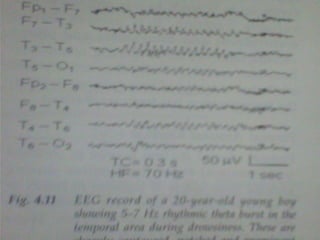
• Rhythmic temporal Theta bursts of Drowsiness or
  psychomotor variant pattern.
• Trains of rhythmic theta waves of 5-7Hz.
• Flat top, sharp contour or notched appearance.
• Temporal location, maximal in the mid temporal
  electrodes.
• Simulates psychomotor seizure discharge.
• Seen in0.5-2% adolescent and adults in wakeful or
  drowsy state.,
Sub clinical rhythmic
 theta discharge in adults:
• Rhythmic sharp theta waves of 5-7hz.
• Widespread with highest amplitude at parietal and
  post. Temporal regions.
• Lasts for 20 sec to few minutes.
• 50% adults spontaneously, > 50yrs and prominent
  during HV.
• In 50% : single monophasic sharp or slow wave
  followed one to several seconds later by another
  sharp wave and progress to discharge at a shorter
  interval reaching up to 7Hz.
• Seen in relaxed and drowsy states.
• Midline theta rhythm: 5-7Hz smooth sinusoidal ,
  arciform waves.
• Central and vertex leads.
• Present during wakefulness and sleep.
• Benign.
• Frontal Arousal rhythm: seen in children with
  minimum brain dysfunction.
• Seen during arousal from sleep.
• Trains of 7-10HZ waves
• Frontal location.
• Lasting up to 20 sec.
• Disappears when child is fully awake.
Benign Epileptiform
            Variants:
• 14-16Hz positive bursts: seen in drowsiness and light
  sleep.
• Rhythmic trains of arc shaped waveforms with
  alternating positive spiky components and a
  negative smooth rounded wave form.
• Sharp phase 0,5 to 1 sec
• Usually14Hz.
• Maximum amplitude in the posterior temporal
  region.
• Appears by 3-4yrs, peaks in adolescence, decrease
  in old age.
• Seen in
   o Head ache , vertigo, emotional instability, thalamic and hypothalamic
     epilepsy etc..
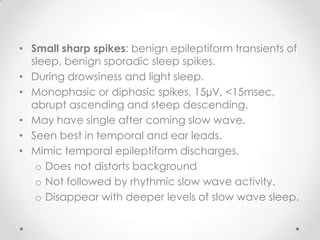
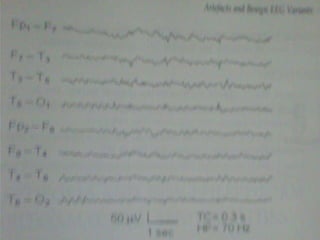
• Small sharp spikes: benign epileptiform transients of
  sleep, benign sporadic sleep spikes.
• During drowsiness and light sleep.
• Monophasic or diphasic spikes, 15µV, <15msec,
  abrupt ascending and steep descending.
• May have single after coming slow wave.
• Seen best in temporal and ear leads.
• Mimic temporal epileptiform discharges.
   o Does not distorts background
   o Not followed by rhythmic slow wave activity.
   o Disappear with deeper levels of slow wave sleep.
• 6Hz spike and wave: 5-7Hz bursts lasting for 1-2secs.
• Called phantom spikes: brief, small amplitude.
• Appear mainly in relaxed wakeful state, drowsiness
   o Disappears in deep sleep.

• Diffuse bilateral, prominent in anterior and posterior
  locations.
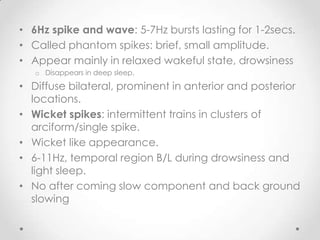
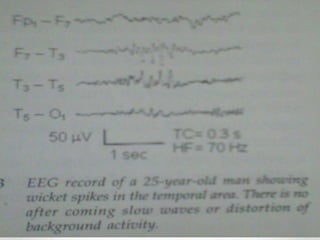
• Wicket spikes: intermittent trains in clusters of
  arciform/single spike.
• Wicket like appearance.
• 6-11Hz, temporal region B/L during drowsiness and
  light sleep.
• No after coming slow component and back ground
  slowing
Eeg artifacts and benign variants

Eeg artifacts and benign variants

  • 1.
    EEG- Artefacts andBenign Variants Dr.Roopchand.PS Senior Resident Academic Dept. of Neurology, TDMC, Alappuzha
  • 2.
    Artefacts: • Recorded signalsof non cerebral origin. • Poses great problem in EEG reading. • Recognition and elimination are therefore important. • Mechanical o Electromagnetic, electrostatic, radio frequency, mains born, external electrical interference. o Instrument artefact. o IV drip artefact o Respirator artefact. • Biological o Eye movement, cardiac/pulse, respiratory, electromyographic, movement, cutaneous, glossokinetic, Msic
  • 3.
    Electro magnetic interference: • Due to AC current. • Induces fluctuating magnetic fields to EEG leads. • Opposite fields may cancel out. • Proper earth connection of apparatus. • Patient bed may be connected to earth socket.
  • 4.
    Electrostatic Interference: • Dueto capacitance property of objects. • Patient or electrode may pick up capacitance potentials from sources in their vicinity. • Reduced by moving the patient from the source. • Proper earth connection.
  • 5.
    Radio frequency Interference: • Signal between 120-400Hz • Especially diathermy equipment's. • Radio frequency filters may be used.
  • 6.
    • Mains borninterference: due to fluctuating power supply. o Stabilized power supply can avoid this artefact. • External electrical interference: fluorescent light , ac, refrigerator…
  • 7.
    Instrument Artefact: • Electrodeartefact: due to change in resistance, capacitance and inductive reactance of two electrodes compared to others. o Individual electrode impedance should be less than 5kΩ. • Bizarre potentials are seen o Confined to two adjacent channels in bipolar chain . o Confined to one channel or one hemisphere in reference recording. • Waves are markedly different from background activity. • Appear as spike like potentials.
  • 8.
    • Ground electrodeartefact: due to defective grounding. o Produce 60Hz AC artefact. • Machine fault: loss of main, blown fuse, selective malfunctioning of one system. • Intravenous drip artefact: may produce stereotyped spike like potentials at fixed intervals. o Infusion pumps produce stereotyped brief spike like transients. • Respirator artefact: single high voltage or multiple high/low voltage transients of 2 to 40 Hz.
  • 10.
  • 11.
    Eye movement Artefacts: • From eye ball or muscles around orbit. • Eye ball act as a dipole. • Eye movements produce AC fields. • Detectable in electrodes near globe o Fp1, Fp2, F7, F8 • Negative deflection when Fp1 and Fp2 are positive. • Eye ball movement monitoring. • Blinking produces upward movement of eye ball. o Fp1 and Fp2 are positive. • Repetitive blinking can mimic FRIDA(Frontal Intermittent Rhythmic Delta Activity) or triphasic wave.
  • 12.
    • More frequentblinking can simulate theta activity. • Horizontal or vertical nystagmus can produce aretfacts simulating theta activity. • Asymmetric eyeball artifacts can be seen in unilateral ophthalmoplegia and enucleation. • Can be abolished by keeping the eye closed or simultaneously recording eye ball movements. • IPS may produce photomyoclonic repose from orbicularis occuli and frontalis.
  • 14.
    Cardiac and respiratory artefacts: • Normally electrical field of heart extends up to base of the skull. • In short necked persons can extend up to vertex. • Normally can extend up to ear. • Cardiac artefacts are mainly due to QRS complexes. • Positive in A1 and negative in A2. • Recognized by characteristic from and regularity. • Interfere in diagnosing electro cerebral silence. • Respiration may cause change is electrical axis of the heart. o Produce fluctuation in amplitude of waves.
  • 16.
    Pulse artefact: • Electrode near or overlying a small scalp artery. • Systolic pulse alter the impedance. • Waves are periodic • Smooth and sharply contoured • Time locked to ECG by 200msec delay in peak.
  • 18.
    Electromyographic artefact: • Brief single or multiple myogenic potentials. • Located in the temporal, frontal and occipital areas. • Frontal epileptiform discharges can mimic them. • Avoiding jaw clenching and frowning will abolish the waves. • Essential tremor and Parkinson's tremor produce 4- 6Hz sinusoidal artefacts. • Hemi facial spasm can also produce EMG artefacts.
  • 20.
    Movement Aretacts: • Dueto combination of instrument and biologic factors. • Related to observed activity of the subject. • Difficult to differentiate from discharges during GTCS. • Significant reduction possible by proper electrode placement and use of self retaining electrodes.
  • 21.
    Cutaneous Artefacts: • Perspirationartefact: perspiration causes slow shift of electrical baseline due to change in impedance. • Sweat gland produces slow changing electrical potentials recorded by electrodes. • Produce slow wave forms of more than 2 sec. • Perspiration artefact + background slowing : hypoglycemia. • Reduced by lowering the room temparature and wiping the brow with alcohol.
  • 22.
    • Galvanic skinresponse: represent sympathetic skin response produced by sweat gland and changes in skin conductance in response to sensory or psychic stimuli. • Slow waves of 0.5 to 1 sec, lasting for 1.5 to 2 sec with two to three prominent phases. • Can be confirmed by simultaneous recording of sympathetic response of palm.
  • 23.
    Glossokinetic Artefact: • Tonguehas a DC potential. o Tip negative compared to base • Tongue movements produce artifacts o Bursts of diffuse delta like activity, accompanied by muscle artefact. • Artefacts confirmed by asking the patient to pronounce lah lah lah. • Sucking by infants can also produce such artefacts. • Hiccpus, dental fillings.
  • 24.
  • 25.
    Rhythmic activities: • Rhythmictemporal Theta bursts of Drowsiness or psychomotor variant pattern. • Trains of rhythmic theta waves of 5-7Hz. • Flat top, sharp contour or notched appearance. • Temporal location, maximal in the mid temporal electrodes. • Simulates psychomotor seizure discharge. • Seen in0.5-2% adolescent and adults in wakeful or drowsy state.,
  • 27.
    Sub clinical rhythmic theta discharge in adults: • Rhythmic sharp theta waves of 5-7hz. • Widespread with highest amplitude at parietal and post. Temporal regions. • Lasts for 20 sec to few minutes. • 50% adults spontaneously, > 50yrs and prominent during HV. • In 50% : single monophasic sharp or slow wave followed one to several seconds later by another sharp wave and progress to discharge at a shorter interval reaching up to 7Hz. • Seen in relaxed and drowsy states.
  • 28.
    • Midline thetarhythm: 5-7Hz smooth sinusoidal , arciform waves. • Central and vertex leads. • Present during wakefulness and sleep. • Benign. • Frontal Arousal rhythm: seen in children with minimum brain dysfunction. • Seen during arousal from sleep. • Trains of 7-10HZ waves • Frontal location. • Lasting up to 20 sec. • Disappears when child is fully awake.
  • 29.
    Benign Epileptiform Variants: • 14-16Hz positive bursts: seen in drowsiness and light sleep. • Rhythmic trains of arc shaped waveforms with alternating positive spiky components and a negative smooth rounded wave form. • Sharp phase 0,5 to 1 sec • Usually14Hz. • Maximum amplitude in the posterior temporal region. • Appears by 3-4yrs, peaks in adolescence, decrease in old age. • Seen in o Head ache , vertigo, emotional instability, thalamic and hypothalamic epilepsy etc..
  • 30.
    • Small sharpspikes: benign epileptiform transients of sleep, benign sporadic sleep spikes. • During drowsiness and light sleep. • Monophasic or diphasic spikes, 15µV, <15msec, abrupt ascending and steep descending. • May have single after coming slow wave. • Seen best in temporal and ear leads. • Mimic temporal epileptiform discharges. o Does not distorts background o Not followed by rhythmic slow wave activity. o Disappear with deeper levels of slow wave sleep.
  • 32.
    • 6Hz spikeand wave: 5-7Hz bursts lasting for 1-2secs. • Called phantom spikes: brief, small amplitude. • Appear mainly in relaxed wakeful state, drowsiness o Disappears in deep sleep. • Diffuse bilateral, prominent in anterior and posterior locations. • Wicket spikes: intermittent trains in clusters of arciform/single spike. • Wicket like appearance. • 6-11Hz, temporal region B/L during drowsiness and light sleep. • No after coming slow component and back ground slowing