Introduction
 Electroencephalography is a technique tha
records the electrical activity of the brain
 During an EEG test, small electrodes like c
disc type are placed on the scalp
 They pick upthe brain's electrical signals a
send them to a machine called
electroencephalogram
 It records the signals as wavy lines on to a
computer screen or paper in order of micro
2
W hy EEG is used
 An EEG is mainly used when there is a nee
diagnose and manageepilepsy
 It canalso be used to investigate other
conditions such as encephalitis, dementia
injuries, brain tumors, hemorrhage
 An EEG canidentify areas of thebrain thata
not workingproperly
 EEGs are also usedto determinethe level o
brain function inpeople who are in a coma
4
Parts ofBrain
 Cerebrum
 Frontal Lobe
 Parietal Lobe
 Temporal Lobe
 Occipital Lobe
 Cerebellum
 Brain stem
Parts of brain
5
Source ofEEG activity
 Neurons are electrically
charged by membrane
transport proteins that
pump ions across their
membranes
 When the wave of ions
reaches the electrodes o
the scalp, they can push
pull electrons on the me
of the electrodes
 Push or pull difference
measured as voltage acr
time is referred as EEGElectrode on scalp
6
Types ofelectrode placem ent
EEG electrodes placed
separately on scalp
EEG electrodes mounted as
special band on head
7
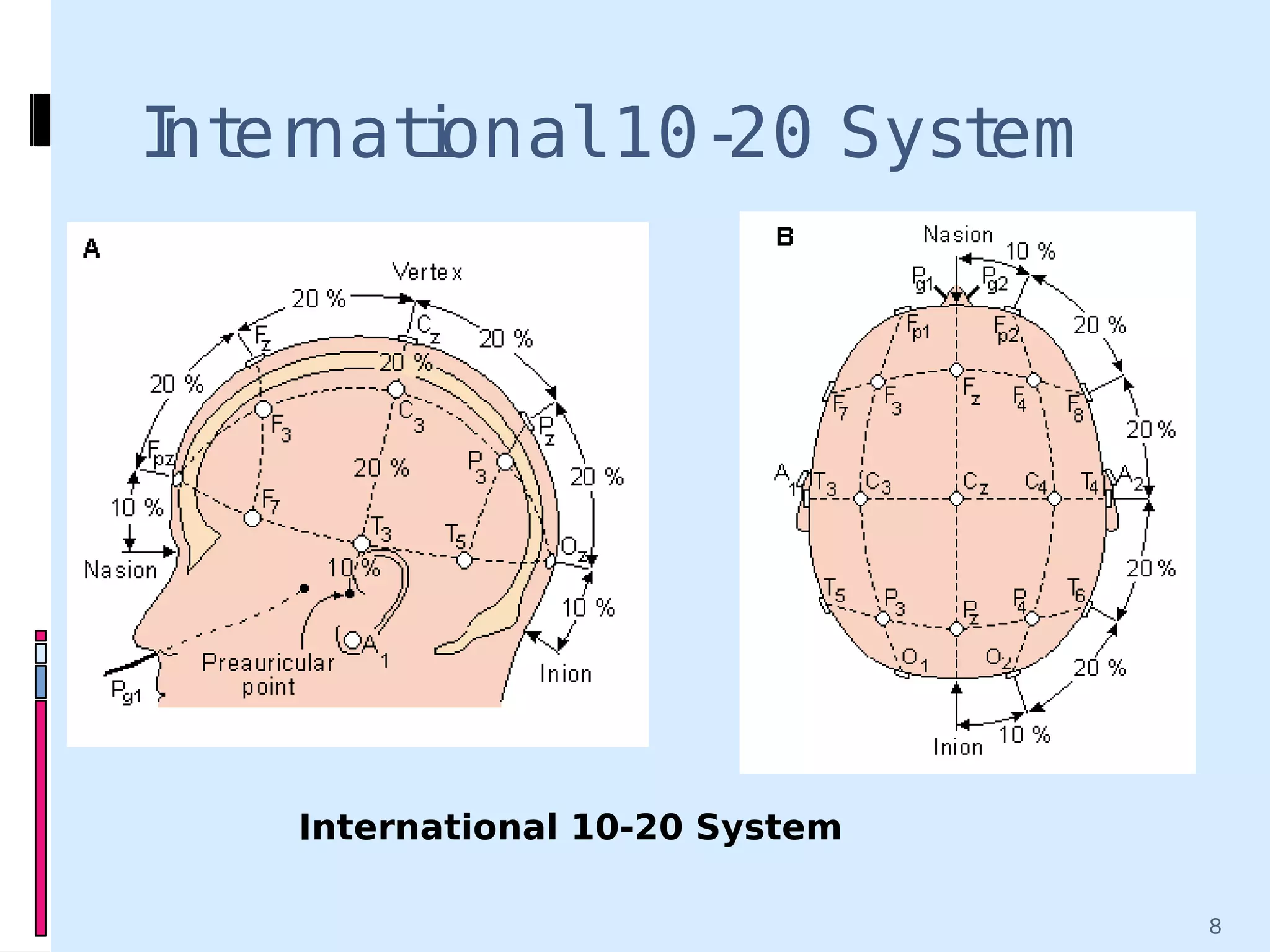
International10-20 System
International 10-20 System
8
Closely spaced electrodes
9
Types ofEEG
•Around 20 electrodes are stuck to the scalp using a specia
paste and EEG signals are recorded
RoutineEEG
•The EEG tracing will be recorded alongwith the heart rate,
airflow, respiration, oxygen saturation and limb movemen
Sleep EEG
•It involves recording the brain activity throughout the day
night
•Asmall portable EEG recorderis clipped on to the clothing
Ambulatory EEG
10
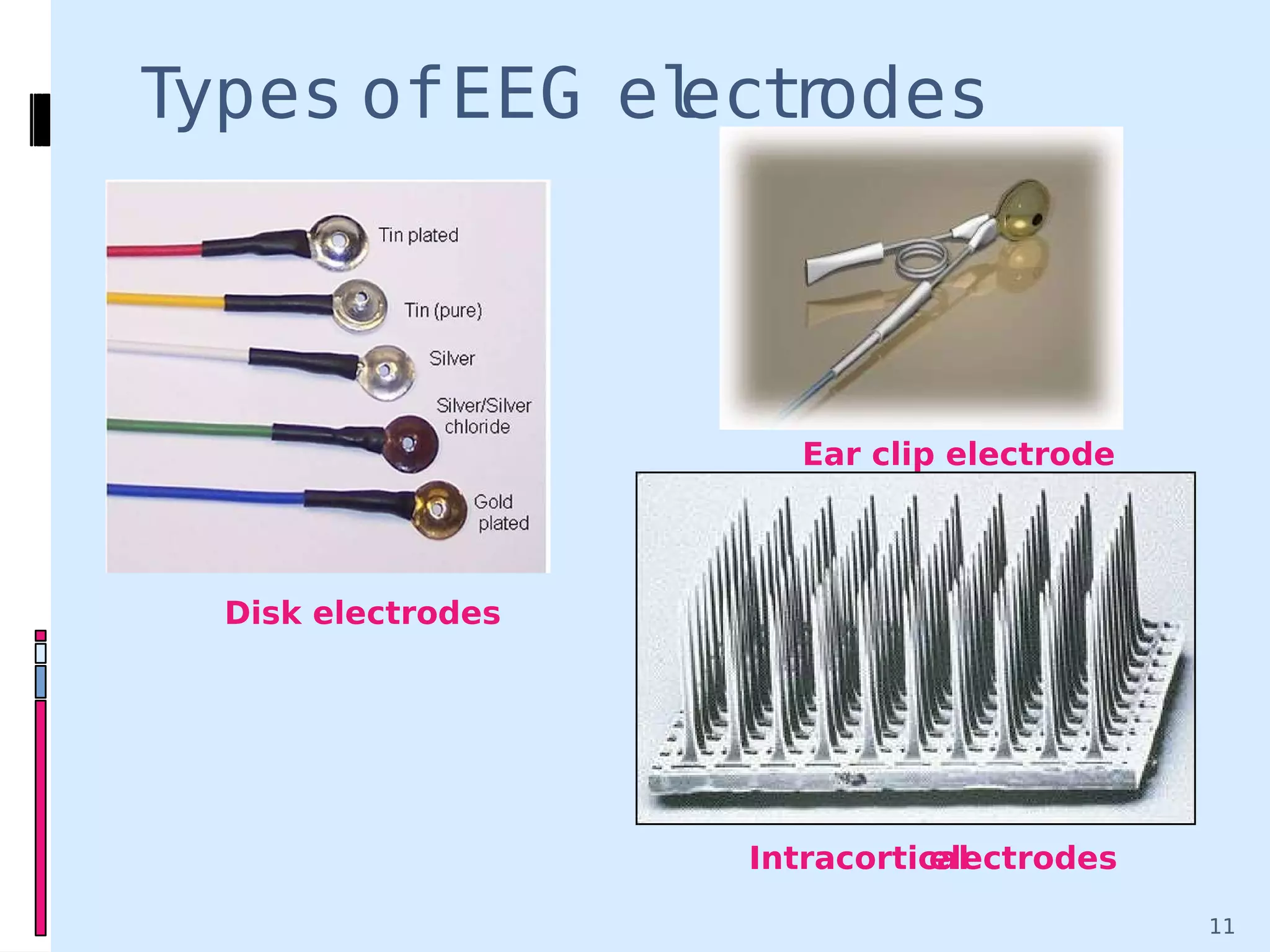
Types ofEEG electrodes
11
Ear clip electrode
Disk electrodes
Intracorticalelectrodes
Electrode
Montage
Selector
Hi-pass Low-passNotch Sensitivity
Amplifiers
Filters
Electrode
test/calibrate
Jackbox
Analog to digital
converter
Oscilloscope Computer
Chart
drive
Ink-writing
oscillograph
Writer unit
EEG
Subject
Electrodes
Schem atic diagram ofan EEG m achine
12
M ontages
Sequential montage
•Each channel represents the difference between two
adjacent electrodes
Referential montage
•Each channel represents the difference between a
certain electrode and a designated reference electrod
Average reference montage
•The outputs of all of the amplifiers are summed and ave
Laplacianmontage
•Each channel represents the difference between an elec
and a weighted average of the surrounding electrodes
13
W ave patterns
 Delta waves
 Frequency range 0.5-4 Hz
 Slow-sleep wave for adults
 Theta waves
 Frequency range 4-7 Hz
 Drowsiness in older children and adults
14
 Alpha waves
 Frequency range from 7-14Hz
 Closing of the eyes, relaxation and attenuation
eye opening or mental exertion
 Mu rhythm
 Frequency range from 8-13Hz
 Shows rest-state motor neurons
15
 Beta waves
 Frequency range 15 –30 Hz
 Active, busy, or anxious thinking, active conce
 Gamma waves
 Frequency range approximately 30–100Hz
 Perception that combines two different senses,
sound and sight
 Short-term memory matching of recognized ob
sounds, or tactile sensations
16
EEG displaying epilepsy
EEG waveforms detecting epileptic spikes
17
EEG Results
NormalEEG AbnormalEEG
 A brainwave pattern called
alpha rhythmshould be
seen when sitting quietly
with eyes closed
 EEGresultsare
oftennormal because
recording a person's brain
activityduring the times it
is abnormal is difficult
 People with epilepsy may
have abnormal brain
activity detected
 People who do not have
epilepsy may also have an
abnormal EEG result
indicating any other
disorder
18
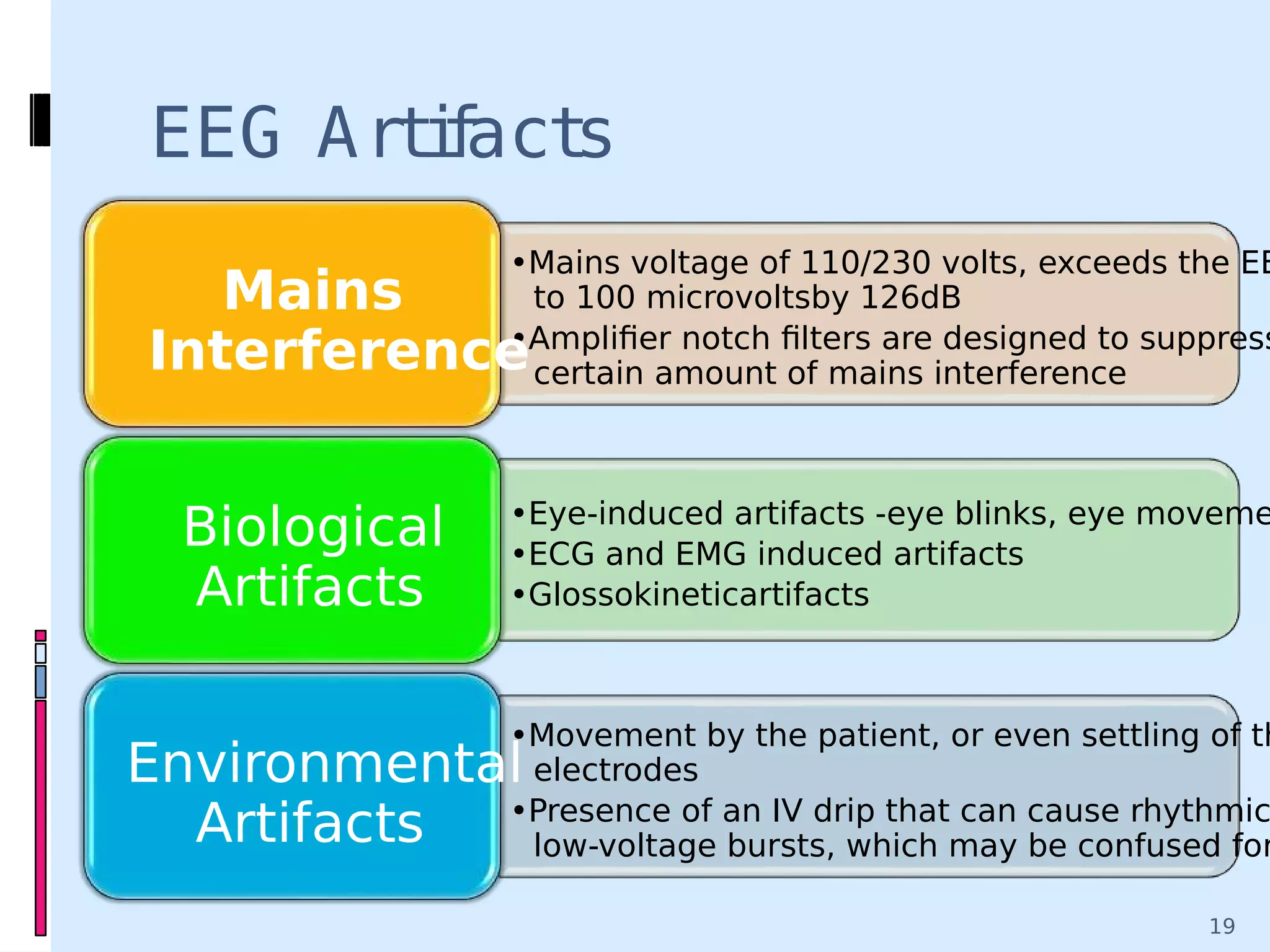
EEG Artifacts
•Mains voltage of 110/230 volts, exceeds the EE
to 100 microvoltsby 126dB
•Amplifier notch filters are designed to suppress
certain amount of mains interference
Mains
Interference
•Eye-induced artifacts -eye blinks, eye moveme
•ECG and EMG induced artifacts
•Glossokineticartifacts
Biological
Artifacts
•Movement by the patient, or even settling of th
electrodes
•Presence of an IV drip that can cause rhythmic
low-voltage bursts, which may be confused for
Environmental
Artifacts
19
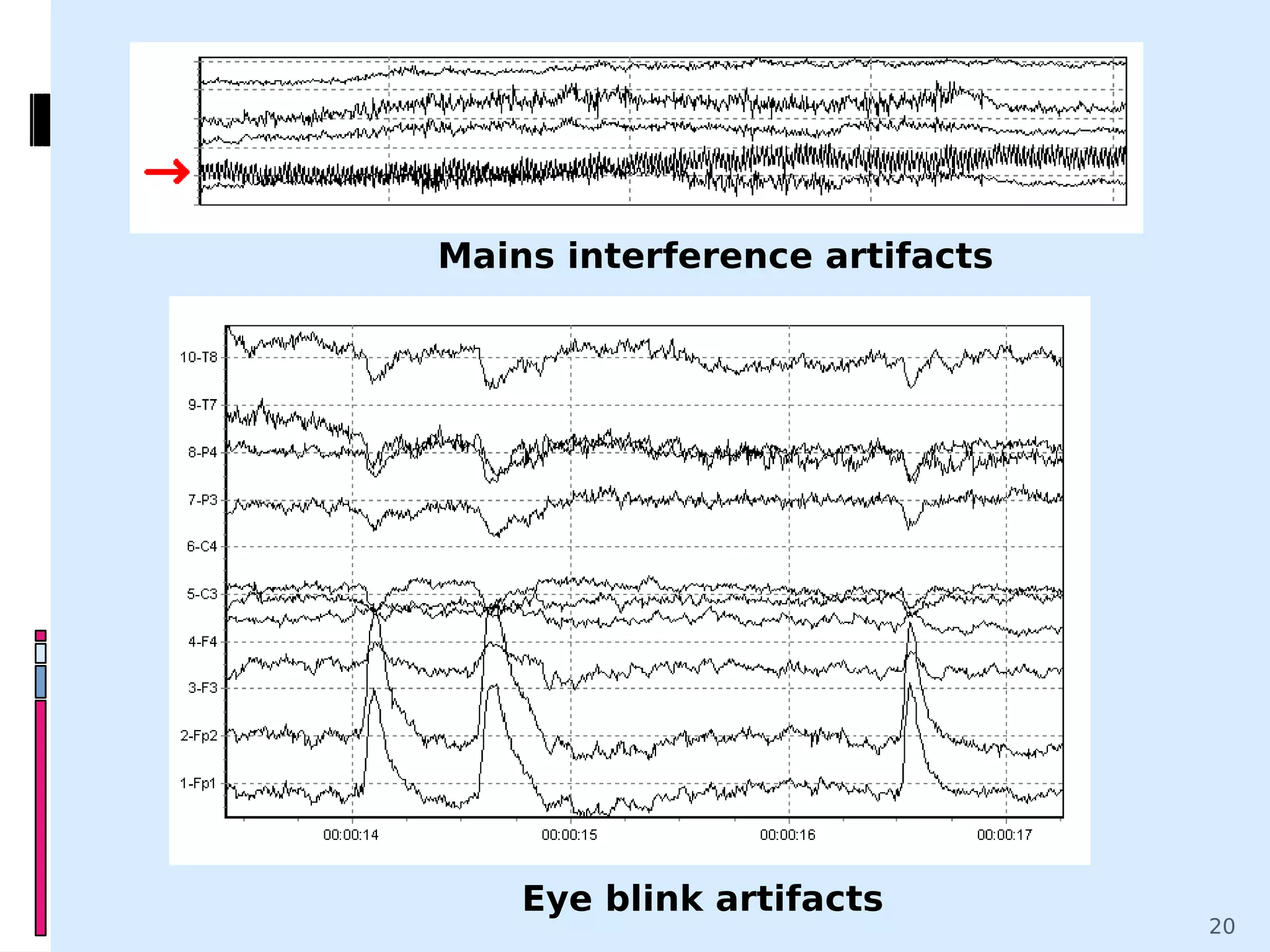
Mains interference artifacts
Eye blink artifacts
20
Artifactcorrection
 Independent component analysis techniq
have been used to correct or remove EEG
contaminants
 This would result in clean EEG by nullifyin
(zeroing) the weight of unwanted compo
 Surface Laplacianhas been shown to be
effective in eliminating muscle artefact
21
Risks and Precautions
 Slight redness may occur in the locations
the electrodes were placed
 In rare cases, the cleaning liquid or paste
cause temporary skin irritation
 The person is instructed not to take food t
contains caffeine
 Not to have oiled hair on the day of test
22
Advantages
 Hardware costs are significantly lower than th
most other techniques
 EEG has very high temporal resolution, on the
of milliseconds rather than seconds
 Extremely non-invasive
 EEG is silent, which allows for better study of
responses to auditory stimuli
 EEG does not involve exposure to high-intensi
(>1 Tesla) magnetic fields
23
D isadvantages
 Low spatial resolution on the scalp
 EEG determines neural activity that occurs
below the upper layers of the brain poorly
 Often takes a long time to connect a subje
EEG
 Signal-to-noise ratio is poor
24
Uses ofEEG
 Clinical Use
 Distinguish epileptic seizures from non-epileptic
seizures, syncope (fainting) and sub-cortical
movement disorders
 To serve as an adjunct test of brain death
 To determine whether to use anti-epileptic
medications
 Research Use
 Cognitive science, cognitive psychology, neuro
linguistics and psycho physiological research
25
Som e m ore uses
 Investigate epilepsy and locate seizure ori
 Monitor cognitive engagement (alpha rhyt
 Monitor human and animal brain developm
 Test epilepsy drug effects
 Test afferent pathways (by evoked potentia
 Investigate sleep disorder and physiology
 Control anesthesia depth
26

Eeg

  • 1.
    Introduction  Electroencephalography isa technique tha records the electrical activity of the brain  During an EEG test, small electrodes like c disc type are placed on the scalp  They pick upthe brain's electrical signals a send them to a machine called electroencephalogram  It records the signals as wavy lines on to a computer screen or paper in order of micro 2
  • 2.
    W hy EEGis used  An EEG is mainly used when there is a nee diagnose and manageepilepsy  It canalso be used to investigate other conditions such as encephalitis, dementia injuries, brain tumors, hemorrhage  An EEG canidentify areas of thebrain thata not workingproperly  EEGs are also usedto determinethe level o brain function inpeople who are in a coma 4
  • 3.
    Parts ofBrain  Cerebrum Frontal Lobe  Parietal Lobe  Temporal Lobe  Occipital Lobe  Cerebellum  Brain stem Parts of brain 5
  • 4.
    Source ofEEG activity Neurons are electrically charged by membrane transport proteins that pump ions across their membranes  When the wave of ions reaches the electrodes o the scalp, they can push pull electrons on the me of the electrodes  Push or pull difference measured as voltage acr time is referred as EEGElectrode on scalp 6
  • 5.
    Types ofelectrode placement EEG electrodes placed separately on scalp EEG electrodes mounted as special band on head 7
  • 6.
  • 7.
  • 8.
    Types ofEEG •Around 20electrodes are stuck to the scalp using a specia paste and EEG signals are recorded RoutineEEG •The EEG tracing will be recorded alongwith the heart rate, airflow, respiration, oxygen saturation and limb movemen Sleep EEG •It involves recording the brain activity throughout the day night •Asmall portable EEG recorderis clipped on to the clothing Ambulatory EEG 10
  • 9.
    Types ofEEG electrodes 11 Earclip electrode Disk electrodes Intracorticalelectrodes
  • 10.
    Electrode Montage Selector Hi-pass Low-passNotch Sensitivity Amplifiers Filters Electrode test/calibrate Jackbox Analogto digital converter Oscilloscope Computer Chart drive Ink-writing oscillograph Writer unit EEG Subject Electrodes Schem atic diagram ofan EEG m achine 12
  • 11.
    M ontages Sequential montage •Eachchannel represents the difference between two adjacent electrodes Referential montage •Each channel represents the difference between a certain electrode and a designated reference electrod Average reference montage •The outputs of all of the amplifiers are summed and ave Laplacianmontage •Each channel represents the difference between an elec and a weighted average of the surrounding electrodes 13
  • 12.
    W ave patterns Delta waves  Frequency range 0.5-4 Hz  Slow-sleep wave for adults  Theta waves  Frequency range 4-7 Hz  Drowsiness in older children and adults 14
  • 13.
     Alpha waves Frequency range from 7-14Hz  Closing of the eyes, relaxation and attenuation eye opening or mental exertion  Mu rhythm  Frequency range from 8-13Hz  Shows rest-state motor neurons 15
  • 14.
     Beta waves Frequency range 15 –30 Hz  Active, busy, or anxious thinking, active conce  Gamma waves  Frequency range approximately 30–100Hz  Perception that combines two different senses, sound and sight  Short-term memory matching of recognized ob sounds, or tactile sensations 16
  • 15.
    EEG displaying epilepsy EEGwaveforms detecting epileptic spikes 17
  • 16.
    EEG Results NormalEEG AbnormalEEG A brainwave pattern called alpha rhythmshould be seen when sitting quietly with eyes closed  EEGresultsare oftennormal because recording a person's brain activityduring the times it is abnormal is difficult  People with epilepsy may have abnormal brain activity detected  People who do not have epilepsy may also have an abnormal EEG result indicating any other disorder 18
  • 17.
    EEG Artifacts •Mains voltageof 110/230 volts, exceeds the EE to 100 microvoltsby 126dB •Amplifier notch filters are designed to suppress certain amount of mains interference Mains Interference •Eye-induced artifacts -eye blinks, eye moveme •ECG and EMG induced artifacts •Glossokineticartifacts Biological Artifacts •Movement by the patient, or even settling of th electrodes •Presence of an IV drip that can cause rhythmic low-voltage bursts, which may be confused for Environmental Artifacts 19
  • 18.
  • 19.
    Artifactcorrection  Independent componentanalysis techniq have been used to correct or remove EEG contaminants  This would result in clean EEG by nullifyin (zeroing) the weight of unwanted compo  Surface Laplacianhas been shown to be effective in eliminating muscle artefact 21
  • 20.
    Risks and Precautions Slight redness may occur in the locations the electrodes were placed  In rare cases, the cleaning liquid or paste cause temporary skin irritation  The person is instructed not to take food t contains caffeine  Not to have oiled hair on the day of test 22
  • 21.
    Advantages  Hardware costsare significantly lower than th most other techniques  EEG has very high temporal resolution, on the of milliseconds rather than seconds  Extremely non-invasive  EEG is silent, which allows for better study of responses to auditory stimuli  EEG does not involve exposure to high-intensi (>1 Tesla) magnetic fields 23
  • 22.
    D isadvantages  Lowspatial resolution on the scalp  EEG determines neural activity that occurs below the upper layers of the brain poorly  Often takes a long time to connect a subje EEG  Signal-to-noise ratio is poor 24
  • 23.
    Uses ofEEG  ClinicalUse  Distinguish epileptic seizures from non-epileptic seizures, syncope (fainting) and sub-cortical movement disorders  To serve as an adjunct test of brain death  To determine whether to use anti-epileptic medications  Research Use  Cognitive science, cognitive psychology, neuro linguistics and psycho physiological research 25
  • 24.
    Som e more uses  Investigate epilepsy and locate seizure ori  Monitor cognitive engagement (alpha rhyt  Monitor human and animal brain developm  Test epilepsy drug effects  Test afferent pathways (by evoked potentia  Investigate sleep disorder and physiology  Control anesthesia depth 26