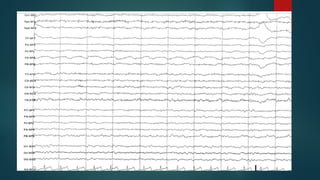
Interpretation of EEG
Dr G. Sree Ranga Lakshmi
Professor & HOD of Neurology
Osmania Medical College
๏ต Clinicians face patients who
develop spells of altered responsiveness/remain
drowsy/have recurring episodes of neurological
dysfunction.
๏ต Can be sorted out by thorough history taking and
clinical examination followed by some investigations.
๏ต EEG can provide some clues in such situations.
๏ต Hans Berger ---- recorded first human EEG, 1924
๏ต American EEG Society---- 1947
๏ต First EEG machine in India----Dr. Anil D . Desai in Mumbai and
housed at King Edward hospital
๏ต In the 1980s EEG became digitalized and recorded, allowing
ambulatory procedures.
๏ต By the 1990s the first-generation commercial digital EEG
systems were introduced
๏ต A clear understanding of a normal EEG is mandatory
prior to studying abnormalities.
๏ต Recognizing variations of a normal tracing ---
challenging.
๏ต Interpreting rhythmic or sharply contoured normal
discharges as abnormal and epileptiform can lead to
the erroneous diagnosis of epilepsy and years of
unnecessary treatment.
๏ต โ€œOver readingโ€ EEG is more common than โ€œunder
readingโ€, and can lead to more patient distress
Normal Awake EEG
๏ต There are many features of a normal awake EEG that
should be sought in every recording.
๏ต Not all features will be seen in each EEG.
Alpha rhythm with a 10 Hz background.
Blocking with eye opening . Immediately after eye closure, the alpha rhythm is 11
Hz (alpha squeak).
๏ต The morphology of the alpha rhythm is usually sinusoidal
and regular.
๏ต It may appear peaked at the top or bottom of the
waveform if there are superimposed beta frequencies;
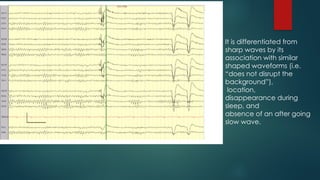
๏ต this is referred to as apiculate alpha activity
The Apiculate Alpha
It is differentiated from
sharp waves by its
association with similar
shaped waveforms (i.e.
โ€œdoes not disrupt the
backgroundโ€),
location,
disappearance during
sleep, and
absence of an after going
slow wave.
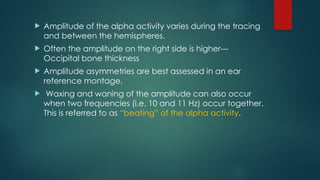
๏ต Amplitude of the alpha activity varies during the tracing
and between the hemispheres.
๏ต Often the amplitude on the right side is higher---
Occipital bone thickness
๏ต Amplitude asymmetries are best assessed in an ear
reference montage.
๏ต Waxing and waning of the amplitude can also occur
when two frequencies (i.e. 10 and 11 Hz) occur together.
This is referred to as โ€œbeatingโ€ of the alpha activity.
๏ต Paradoxical alpha rhythm:
๏ต In some patients alpha activity decrease with eye
closure but appears with eye opening.
๏ต No pathological significance.
Beta activity
๏ต Greater than 13 Hz. ( between 14 -25 Hz).
๏ต It commonly occurs in the frontal and central regions in
awake individuals.
๏ต Benzodiazepines, barbiturates, and other sedatives cause
an increase in the amplitude of beta activity,
๏ต Persists in light sleep and REM sleep,
๏ต With age beta activity tends to increase. its amplitude
also increases
๏ต As individuals become very old, the beta activity may
decrease. This change is also associated with cerebral
atrophy;
Theta activity 4 โ€“ 7 Hz.
๏ต Can be seen in wakefulness in the frontocentral area in
young individuals.
๏ต This activity is present in states of heightened attention or
vigilance
๏ต In sleep----- this activity disappears.
High amplitude theta activity can also occur with
hyperventilation
๏ต Like the alpha rhythm, temporal theta activity is reactive
to eye opening and stimulation.
๏ต Intermittent temporal theta activity mixed with alpha is
normal after 60 yrs
๏ต it is abnormal when it is persistent and of high amplitude
Delta activity-- less than 4 Hz.
๏ต Seen in a normal sleep EEG stage III
๏ต They are less common than theta frequencies in the normal awake
adult EEG.
๏ต They occur only in the elderly in the same distribution as temporal
theta activity.
๏ต When present these delta waves should be of the same amplitude
as the alpha rhythm, occur as single wave, and occupy less than 1%
of the record
If delta waves are more frequent or of higher amplitude, they represent
an abnormality.
Low voltage EEG
๏ต In some individuals a clear alpha rhythm cannot be
identified.
๏ต Instead their background activity is a low amplitude
activity with beta, alpha, and theta frequencies.
๏ต The amplitude of this activity is usually less than 20 ยตV
๏ต A low voltage EEG is seen more often in older individuals
than children and is not considered an abnormality
unless a previous EEG in the same patient showed clear
alpha rhythm.
๏ต When all activity is less than 10 ยตV it may be abnormal
Artifacts in EEG
๏ต EEG records activities arising from brain and
other sites also
๏ต The extra cerebral activity is called artifact.
Artifacts in EEG
๏ต May obscure / be confused with EEG activity.
๏ต Physiological : EKG ,EMG, Tongue movement ,
๏ต Eye movement
Other movements
Sweat artifact
Non Physiological : instrumental /electrode/environment
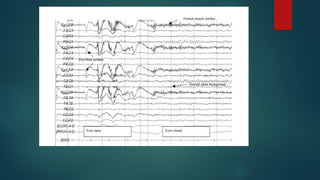
Eye movement artifact
the cornea is positively charged compared to the retina
(Negative)
whenever the cornea moves closer to one electrode, a
positive deflection occurs in that electrode.
When the eyes move upward, (eye closure) a downward
deflection is noted in the frontal leads; (FP1 & FP2)
when the eyes move laterally, out of phase deflections are
noted in F7/F8 electrodes.
Eye movement artifact ----- helpful in identifying REM sleep
and wakefulness.
๏ต Asymmetry of eye movement artifact : Placement of
frontal leads which is not symmetric is a common cause
of such asymmetry.
๏ต Enucleation of one eye will result in absence of artifact
on that side
๏ต A skull defect over one frontal region will cause the eye
movement artifact on that side to have higher
amplitude.
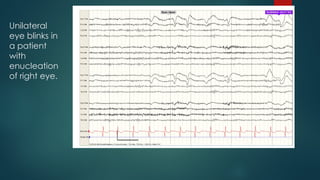
Unilateral
eye blinks in
a patient
with
enucleation
of right eye.
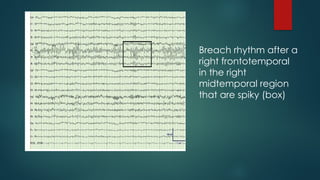
Breach rhythm after a
right frontotemporal
in the right
midtemporal region
that are spiky (box)
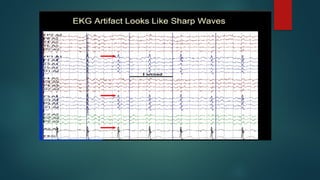
EKG artifact
๏ต EKG artifact โ€“ infants /short neck
๏ต Referential montage.
๏ต Poorly formed QRS complex
๏ต Maximum amplitude T3/T4
๏ต Neck extension can eliminate
Pulse artifact
๏ต Electrode placed on an artery
slow wave,
usually confined o single electrode
follows QRS after 100ms
Muscle artifact
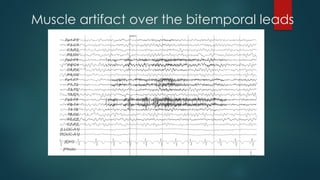
๏ต High amplitude and frequency. Frontal/temporal leads
๏ต Obscure EEG patterns
๏ต High frequency filters eliminate them
Muscle artifact over the bitemporal leads
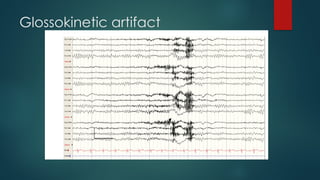
Glossokinetic artifact
๏ต occurs when there is tongue movement.
๏ต The tip of the tongue is negatively charged compared
to its base.
๏ต Thus when the tongue moves, the artifact is best seen
along the temporal chain
๏ต It consists of a burst of delta activity accompanied by
EMG artifact
Glossokinetic artifact
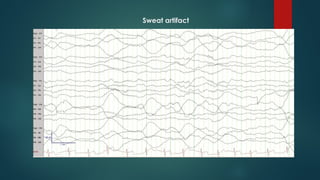
Sweat artifact
๏ต Perspiration produces artifact that consists of very slow
potentials, often lasting several seconds.
๏ต Sweating produces a very slow discharge (less than 1 Hz)
that can often be reduced with low frequency filters.
๏ต Cooling the room may help in reducing sweat artifact.
Sweat artifact
Repetitive body movements
produce changing electrical fields
produce rhythmic depolarization mimicking
electrographic seizures
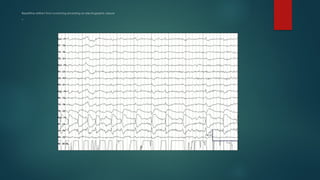
Repetitive artifact from scratching simulating an electrographic seizure
.
Environmental artifact
๏ต Nonbiologic artifact that can be very challenging to
isolate.
๏ต They are often seen in hostile recording environments
such as intensive care units or the operating room.
๏ต Common examples include
60-Hz line artifact,
drip artifact from intravenous bags,
respirator artifact
Electrode artifact
๏ต also known as electrode pop,
๏ต Nonbiologic artifact
๏ต Typically confined to the single electrode that is at fault.
๏ต At times it can produce a high amplitude negative
phase reversal between two channels in a bipolar
montage, resembling a spike
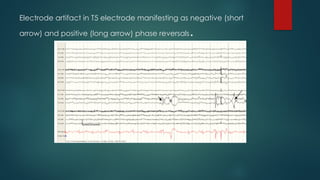
Electrode artifact in T5 electrode manifesting as negative (short
arrow) and positive (long arrow) phase reversals.
Electrode pop
๏ต It should be differentiated from a spike by
its very restricted field (confined to a singe electrode),
its association with other bizarre-looking discharges in the same
channels,
and disappearance with reapplication of the electrode.
These artifacts most commonly result from
poorly applied electrodes
can also occur due to a broken electrode wire,
drying of electrode gel, or
change in the scalp-lead interface.
When an electrode artifact is seen, the technologist should reapply the
electrode and if it does not disappear, replace it
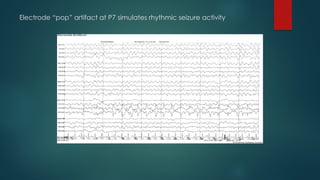
Electrode โ€œpopโ€ artifact at P7 simulates rhythmic seizure activity
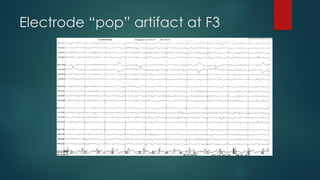
Electrode โ€œpopโ€ artifact at F3
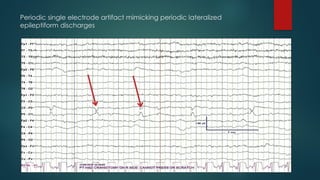
Periodic single electrode artifact mimicking periodic lateralized
epileptiform discharges
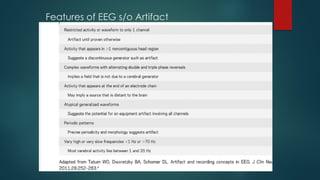
Features of EEG s/o Artifact
๏ต A normal adult EEG is often considered the easiest type
of EEG to interpret.
๏ต The simplicity can be deceptive, however.
๏ต The wide range of normal, rhythmic and sharply
contoured normal variants, and artifacts that resemble
cerebral activity make interpretation of these studies
much more challenging
๏ต When normal patterns are interpreted as epileptiform, patients are
inappropriately subjected to years of antiepileptic drug therapy.
๏ต It should be remembered that it is not the absence of normal
features but the presence of abnormal ones that makes an EEG
abnormal.
๏ต A normal EEG report does not prevent treatment, however an
abnormal EEG report often mandates it!
The role of EEG in epilepsy
Differential diagnosis of paroxysmal neurological events(spells)
Distinction between a focal and generalized seizure disorder
(classification)
Diagnosis of epileptic syndromes and predicting the prognosis
Recognition of photosensitivity (triggering factors)
Identification of the refractory epilepsies
Detection of non convulsive status
Additional indications
๏ต Rapidly progressive dementia ----CJD
๏ต Other degenerative dementias
๏ต Declaration of brain death----- ancillary
๏ต SSPE
๏ต Autoimmune encephalitis--- Delta brushes in NMDA
receptor encephalitis
When interpreting EEG
๏ต Conservative approach is generally recommended.
๏ต When interpreting an EEG, if a waveform in question is
equivocally epileptiform, a nonepileptiform
interpretation is preferred
Careful analysis of a waveform's
๏ต location,
๏ต frequency, and
๏ต morphology in relationship to the background electrocerebral
activity and
๏ต to accurately discern normal variations /benign variants / abnormal
waveforms
Abnormal EEG
Abnormal Adult EEG
๏ต Focal or Generalized
๏ต Subdivided into Nonepileptiform,
Interictal epileptiform, and
Ictal patterns.
Nonepileptiform EEG abnormalities
๏ต Include
focal slow activity,
regional or generalized bisynchronous slow activity,
generalized asynchronous slow activity, and
focal or generalized suppression of the background
activity.
Interictal epileptiform discharges
๏ต are characterized by the presence of
spikes and sharp waves,
with or without after-going slow waves.
๏ต Associated with epilepsy usually
๏ต These discharges may also be seen up to 6.6% of
healthy adult volunteers without epilepsy
International Federation of Societies of
Electroencephalography and Clinical
Neurophysiology
๏ต Epileptiform Discharges
๏ต These are transient potentials that are
clearly distinguishable from background activity,
have a pointed peak, and
are described as a spike or a sharp wave.
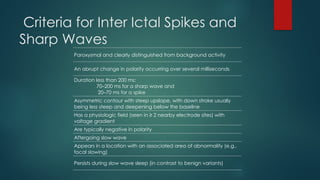
Criteria for Inter Ictal Spikes and
Sharp Waves
Paroxysmal and clearly distinguished from background activity
An abrupt change in polarity occurring over several milliseconds
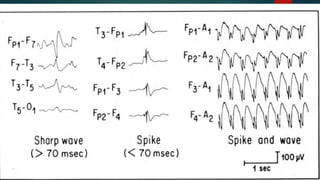
Duration less than 200 ms:
70โ€“200 ms for a sharp wave and
20โ€“70 ms for a spike
Asymmetric contour with steep upslope, with down stroke usually
being less steep and deepening below the baseline
Has a physiologic field (seen in โ‰ฅ 2 nearby electrode sites) with
voltage gradient
Are typically negative in polarity
Aftergoing slow wave
Appears in a location with an associated area of abnormality (e.g.,
focal slowing)
Persists during slow wave sleep (in contrast to benign variants)
๏ต Dr. Shah,
๏ต โ€œIf it looks like you would sit on it and it would hurt,
itโ€™s probably a spikeโ€.
๏ต In the 1930s, Gibbs, Lennox, and Jasper defined
the interictal patterns reporting
generalized spike-and-wave activity and
focal epileptiform discharges (EDs) as markers of
epilepsy
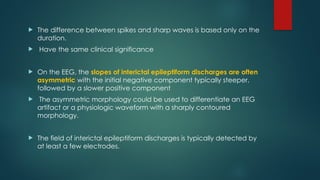
๏ต The difference between spikes and sharp waves is based only on the
duration.
๏ต Have the same clinical significance
๏ต On the EEG, the slopes of interictal epileptiform discharges are often
asymmetric with the initial negative component typically steeper,
followed by a slower positive component
๏ต The asymmetric morphology could be used to differentiate an EEG
artifact or a physiologic waveform with a sharply contoured
morphology.
๏ต The field of interictal epileptiform discharges is typically detected by
at least a few electrodes.
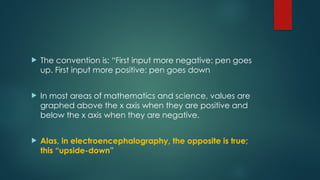
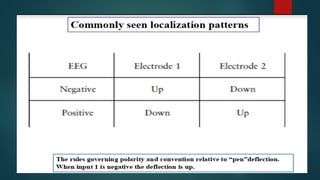
๏ต The convention is: โ€œFirst input more negative: pen goes
up. First input more positive: pen goes down
๏ต In most areas of mathematics and science, values are
graphed above the x axis when they are positive and
below the x axis when they are negative.
๏ต Alas, in electroencephalography, the opposite is true;
this โ€œupside-downโ€
Focal Interictal Epileptiform Discharges
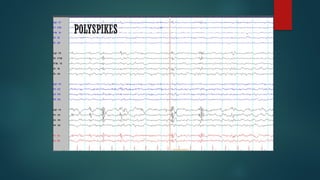
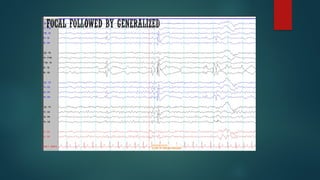
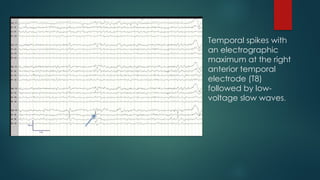
๏ต Focal epileptiform discharges occur in a focal
distribution, commonly in one lobe or region.
๏ต Temporal lobe epilepsy is the most common focal
epilepsy in adolescents and adults, and therefore,
temporal spikes or sharp waves are the most commonly
observed interictal epileptiform discharges
Temporal spikes with
an electrographic
maximum at the right
anterior temporal
electrode (T8)
followed by low-
voltage slow waves.
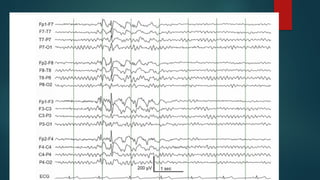
Generalized Interictal Epileptiform Discharges
๏ต Present in a bilateral symmetric fashion.
๏ต Generalized spike and slow waves consist of bilaterally
synchronous spikes followed by a slow wave of high
amplitude
๏ต Typically, the diffuse spike and slow wave often has
frontal predominance and may occur in rhythmic runs at
various frequencies
๏ต This electrographic pattern is consistent with the
diagnosis of generalized epilepsy.
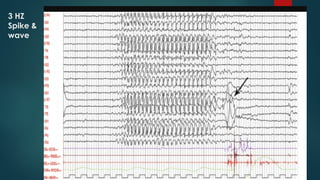
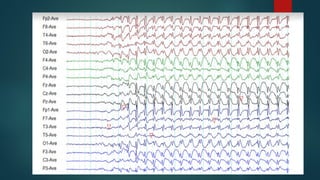
3 HZ
Spike &
wave
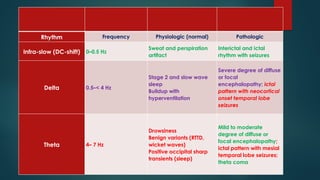
Rhythm Frequency Physiologic (normal) Pathologic
Infra-slow (DC-shift) 0โ€“0.5 Hz
Sweat and perspiration
artifact
Interictal and ictal
rhythm with seizures
Delta 0.5โ€“< 4 Hz
Stage 2 and slow wave
sleep
Buildup with
hyperventilation
Severe degree of diffuse
or focal
encephalopathy; ictal
pattern with neocortical
onset temporal lobe
seizures
Theta 4โ€“ 7 Hz
Drowsiness
Benign variants (RTTD,
wicket waves)
Positive occipital sharp
transients (sleep)
Mild to moderate
degree of diffuse or
focal encephalopathy;
ictal pattern with mesial
temporal lobe seizures;
theta coma
Rhythm Frequency Physiologic
(normal)
Pathologic
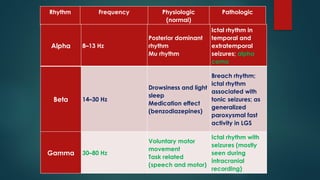
Alpha 8โ€“13 Hz
Posterior dominant
rhythm
Mu rhythm
Ictal rhythm in
temporal and
extratemporal
seizures; alpha
coma
Beta 14โ€“30 Hz
Drowsiness and light
sleep
Medication effect
(benzodiazepines)
Breach rhythm;
ictal rhythm
associated with
tonic seizures; as
generalized
paroxysmal fast
activity in LGS
Gamma 30โ€“80 Hz
Voluntary motor
movement
Task related
(speech and motor)
Ictal rhythm with
seizures (mostly
seen during
intracranial
recording)
Rhythm Frequency Physiologic
(normal)
Pathologic
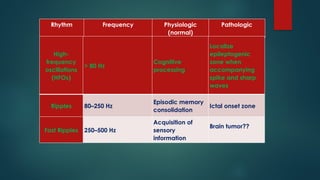
High-
frequency
oscillations
(HFOs)
> 80 Hz
Cognitive
processing
Localize
epileptogenic
zone when
accompanying
spike and sharp
waves
Ripples 80โ€“250 Hz
Episodic memory
consolidation
Ictal onset zone
Fast Ripples 250โ€“500 Hz
Acquisition of
sensory
information
Brain tumor??
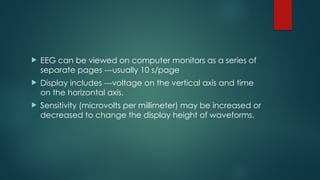
๏ต EEG can be viewed on computer monitors as a series of
separate pages ---usually 10 s/page
๏ต Display includes ---voltage on the vertical axis and time
on the horizontal axis.
๏ต Sensitivity (microvolts per millimeter) may be increased or
decreased to change the display height of waveforms.
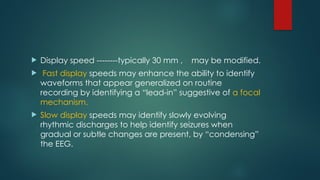
๏ต Display speed --------typically 30 mm , may be modified.
๏ต Fast display speeds may enhance the ability to identify
waveforms that appear generalized on routine
recording by identifying a โ€œlead-inโ€ suggestive of a focal
mechanism.
๏ต Slow display speeds may identify slowly evolving
rhythmic discharges to help identify seizures when
gradual or subtle changes are present, by โ€œcondensingโ€
the EEG.
๏ต The different states during which the EEG was then
recorded
-------- Awake, Drowsy, Sleep, Eyes closed, etc. should be
noted.
Comment on the background activity or the dominant
(usually posterior) in Hertz (Hz) or cycles / second.
All frequencies in turn will be described regarding
their frequency, location, persistence (continuous /
intermittent), amplitude in microvolts,
symmetry (comparing side-to-side and anterior vs
posterior)
๏ต State which forms of stimulation or arousal were performed to
evaluate EEG reactivity, particularly in cases of encephalopathy or
coma.
๏ต Forms of stimuli include --- touch, sound, eye opening, nasal tickle,
mouth or tracheal suctioning, or sternal pressure.
๏ต comment on the EKG, notably if there is a significant abnormality,
avoiding interpretative statements such as ischemia.
๏ต When epileptiform discharges occur in the EEG, note whether they
are congruent with the EKG complexes.
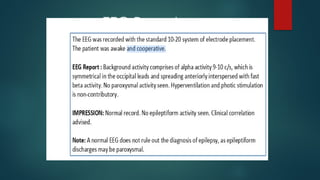
EEG Report
PITFALLS OF PATTERN RECOGNITION
๏ต The EEG is a unique measure of electrical brain function
and is widely used in patients with seizures.
๏ต The interpretation of EEG is associated with a poor inter
oberserver reliability (Williams et al. 1985) which makes it
even more important to follow a systematic approach to
the classification of EEG abnormalities
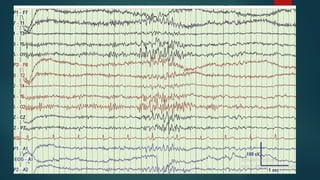
๏ต Normal burst of theta in the EEG of an adult during
drowsiness
๏ต Note the prominent intermixed beta activity
๏ต and electrode artifact at F7 and F3 that combine to
make the appearance โ€œspikier.โ€
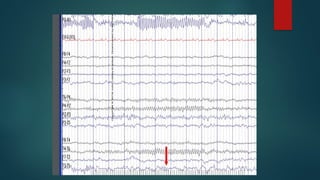
Normal โ€œsuspiciousโ€ EEG
๏ต Many normal variants and variations of normal EEG have
a predilection for the temporal lobe and mimic
epileptiform discharges.
๏ต The high prevalence of temporal lobe epilepsy and the
propensity for normal variants to occupy the temporal
lobe may result in an undesired bias, leading to
misidentification of normal waveforms
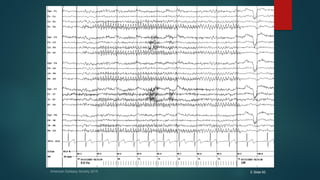
American Epilepsy Society 2015 E Slide 93
Test EEGs
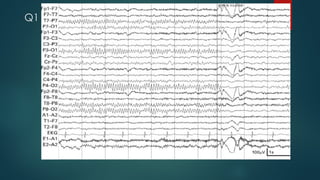
Q1
A 1
๏ต Normal EEG
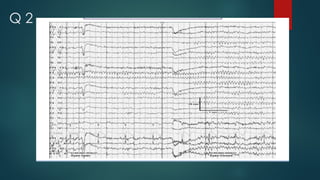
Q 2
A 2
๏ต Eye opening and closing , aipha reactivity
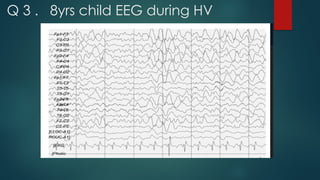
Q 3 . 8yrs child EEG during HV
A 3
๏ต Normal HV response , generalized slowing
๏ต A normal HV response is characterized by diffuse high-
amplitude theta or delta background slowing (buildup)
๏ต exaggerated during fasting (relative hypoglycemia).
๏ต The EEG usually returns to baseline within 2 min after HV
ends.
๏ต Focal changes on the EEG during HV that do not resolve
afterward are considered pathological
American Epilepsy Society 2015 E Slide 101
Q 5
Q 5
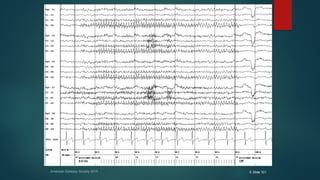
๏ต photic driving response,
๏ต A series of stimulus trains of increasing frequency is
presented for 4โ€“10 s, with a pause of 4 s between each
train, up to a frequency of 30 Hz.
๏ต Normal findings with IPS are either no change in the
background or a symmetrical photic โ€œdrivingโ€
response
๏ต The photic driving response represents repetitive visual
evoked potentials produced in response to the photic
flash.
๏ต The response occurs in a time-locked fashion 100 ms
after the stimulus.
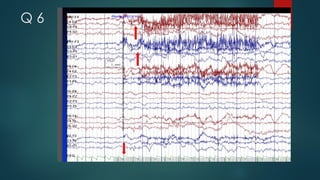
Q 6
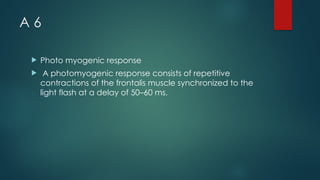
A 6
๏ต Photo myogenic response
๏ต A photomyogenic response consists of repetitive
contractions of the frontalis muscle synchronized to the
light flash at a delay of 50โ€“60 ms.
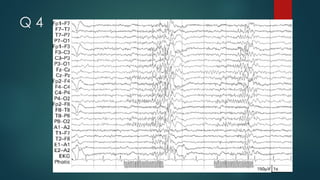
Q 4
).
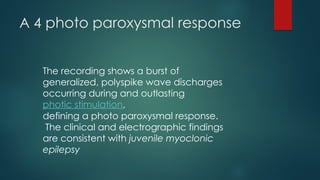
A 4 photo paroxysmal response
The recording shows a burst of
generalized, polyspike wave discharges
occurring during and outlasting
photic stimulation,
defining a photo paroxysmal response.
The clinical and electrographic findings
are consistent with juvenile myoclonic
epilepsy
American Epilepsy Society 2015 E Slide 107
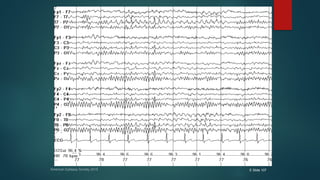
๏ต Rhythmic temporal theta of drowsiness
American Epilepsy Society 2015 E Slide 109
๏ต 6 hertz (โ€œphantomโ€) spike and wave discharges-- normal
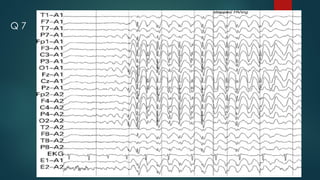
Question 7
A 5-year-old girl
has recent onset of numerous brief spells of
inattention or staring noted at school and at home.
Occasionally, she has limited eye fluttering with spells,
but no other automatisms are noted.
Her developmental history is normal
Q 7
A 6
๏ต Absence seizures 3 HZ SW
Q- 8
๏ต 12-year-old girl
๏ต has a generalized tonic-clonic seizure while watching
cartoons on TV the morning after a late bedtime and
sleep over at a friend's house.
๏ต She notes habitual and frequent jerks of the upper
extremities, clustered in the morning during breakfast.
๏ต Her mother also has morning myoclonus.
Q- 7
A 8
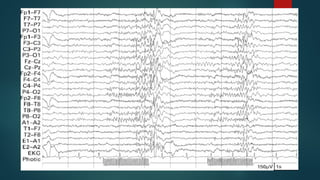
๏ต Juvenile myoclonic epilepsy
Juvenile myoclonic epilepsy
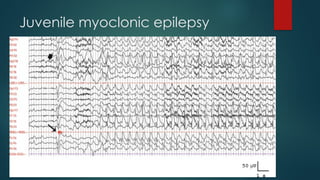
๏ต Background EEG activity is normal.
๏ต There are inter ictal bursts of fronto central dominant
GSW and GPWS.
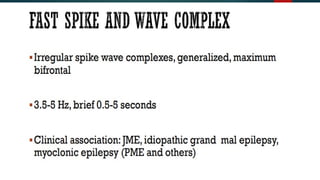
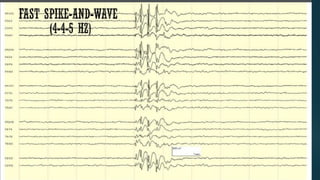
๏ต The frequency of these bursts tends to be more irregular
than the typical 3-Hz spike-and-wave bursts and varies
between 3 and 5 Hz
๏ต Photosensitivity is found in about 30% of males and 40%
of females
Juvenile myoclonic epilepsy
Q 9
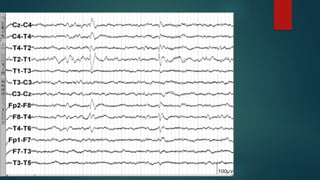
๏ต 23 yrs old male presented with episodes of
confusion , unresponsiveness and involuntary
movements involving left UL
A 9
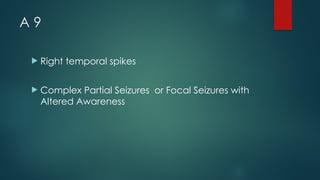
๏ต Right temporal spikes
๏ต Complex Partial Seizures or Focal Seizures with
Altered Awareness
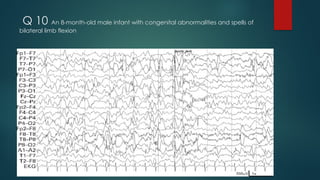
Q 10 An 8-month-old male infant with congenital abnormalities and spells of
bilateral limb flexion
.
A 10
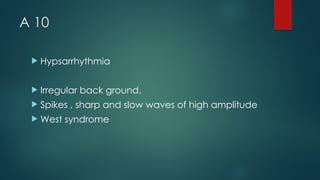
๏ต Hypsarrhythmia
๏ต Irregular back ground.
๏ต Spikes , sharp and slow waves of high amplitude
๏ต West syndrome
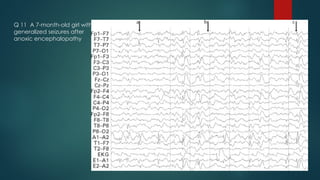
Q 11 A 7-month-old girl with
generalized seizures after
anoxic encephalopathy
(.
A 11 a ) Left temporal,
(b) right parietal,
(c) bifrontal regions
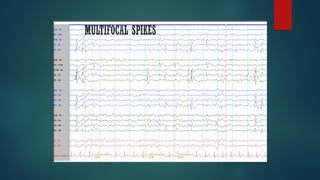
IEDs that occur in several different locations with no clear
relationship to each other are termed multifocal,
independent spikes
๏ต Multifocal independent spikes usually occur in subjects
with static or progressive encephalopathies.
๏ต Most patients have frequent seizures that are medically
intractable, and most are mentally retarded
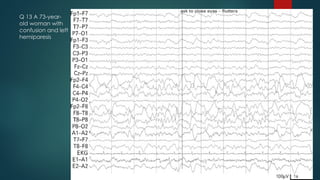
Q 13 A 73-year-
old woman with
confusion and left
hemiparesis
A 13
๏ต Continuous, unreactive, arrhythmic delta activity is
present across right frontal-temporal-central regions.
๏ต Focal arrhythmic delta activity indicates a structural
lesion of the area, corresponding to the region
of hemorrhagic stroke
Q
15
A 15
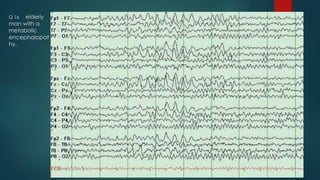
๏ต Focal slowing over the right temporal region as
the result of a right temporal brain tumor in a 35-
year-old man.
Q 16 elderly
man with a
metabolic
encephalopat
hy.
A 16
๏ต FIRDA pattern with a slightly slower theta EEG background
Q 17
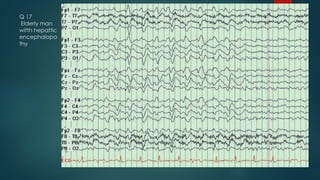
Elderly man
witth hepattic
encephalopa
thy
A 17
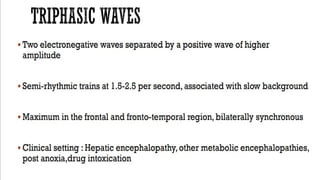
๏ต Generalized triphasic wave pattern and slowing
๏ต Will have a lag anterior to posterior in wave 2
peak
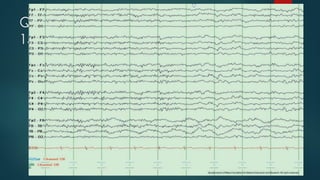
Q
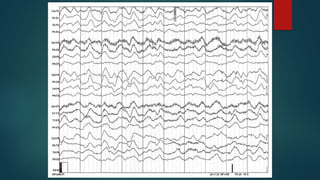
๏ต CHILD WITH ALTERED SENSORIUM
๏ต Generalized delta activity in encephalopathic child
Ictal rhythms
Seizure Activity
๏ต Not just epileptiform, actual seizures occurring during
record
๏ต Seizure should be like a wave, should have a
build up and let down
Pre-Lorazepam Post-Lorazepam
American Epilepsy Society 2015 E Slide 140
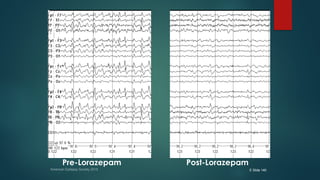
๏ต Generalized non-convulsive status epilepticus in confused patient
showing continuous generalized anterior predominant sharp activity
(labeled โ€œPre-Lorazepam).
๏ต Resolution of generalized sharp activity shown post- lorazepam
infusion
Part 1
Part 2
American Epilepsy Society 2015 E Slide 144
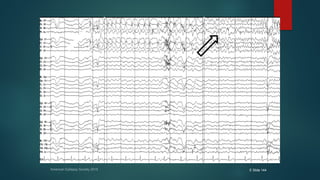
๏ต Left temporal onset seizure discharge with onset showing rhythmic
delta localized to the left anterior temporal region, with phase-
reversal noted over the F7-T7 and F9-T9 derivations
๏ต Discharge evolves into rhythmic left temporal theta towards end of
the epoch shown.
EEG is Great !
THANK YOU
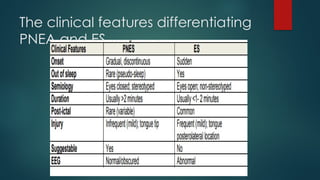
The clinical features differentiating
PNEA and ES
Epileptic Syndromes with Interictal Epileptifform Discharges
Activated by Sleep
1. Continuous spike wave during slow wave sleep (CSWS)
2. Benign Rolandic epilepsy
3. JME
4. Epilepsy with GTCS on awakening
5. ADNFLE
Electroenchephalography aka EEG brief ppt

Electroenchephalography aka EEG brief ppt

  • 1.
    Interpretation of EEG DrG. Sree Ranga Lakshmi Professor & HOD of Neurology Osmania Medical College
  • 2.
    ๏ต Clinicians facepatients who develop spells of altered responsiveness/remain drowsy/have recurring episodes of neurological dysfunction. ๏ต Can be sorted out by thorough history taking and clinical examination followed by some investigations. ๏ต EEG can provide some clues in such situations.
  • 3.
    ๏ต Hans Berger---- recorded first human EEG, 1924 ๏ต American EEG Society---- 1947 ๏ต First EEG machine in India----Dr. Anil D . Desai in Mumbai and housed at King Edward hospital ๏ต In the 1980s EEG became digitalized and recorded, allowing ambulatory procedures. ๏ต By the 1990s the first-generation commercial digital EEG systems were introduced
  • 4.
    ๏ต A clearunderstanding of a normal EEG is mandatory prior to studying abnormalities. ๏ต Recognizing variations of a normal tracing --- challenging. ๏ต Interpreting rhythmic or sharply contoured normal discharges as abnormal and epileptiform can lead to the erroneous diagnosis of epilepsy and years of unnecessary treatment. ๏ต โ€œOver readingโ€ EEG is more common than โ€œunder readingโ€, and can lead to more patient distress
  • 5.
    Normal Awake EEG ๏ตThere are many features of a normal awake EEG that should be sought in every recording. ๏ต Not all features will be seen in each EEG.
  • 6.
    Alpha rhythm witha 10 Hz background. Blocking with eye opening . Immediately after eye closure, the alpha rhythm is 11 Hz (alpha squeak).
  • 7.
    ๏ต The morphologyof the alpha rhythm is usually sinusoidal and regular. ๏ต It may appear peaked at the top or bottom of the waveform if there are superimposed beta frequencies; ๏ต this is referred to as apiculate alpha activity
  • 8.
    The Apiculate Alpha Itis differentiated from sharp waves by its association with similar shaped waveforms (i.e. โ€œdoes not disrupt the backgroundโ€), location, disappearance during sleep, and absence of an after going slow wave.
  • 9.
    ๏ต Amplitude ofthe alpha activity varies during the tracing and between the hemispheres. ๏ต Often the amplitude on the right side is higher--- Occipital bone thickness ๏ต Amplitude asymmetries are best assessed in an ear reference montage. ๏ต Waxing and waning of the amplitude can also occur when two frequencies (i.e. 10 and 11 Hz) occur together. This is referred to as โ€œbeatingโ€ of the alpha activity.
  • 10.
    ๏ต Paradoxical alpharhythm: ๏ต In some patients alpha activity decrease with eye closure but appears with eye opening. ๏ต No pathological significance.
  • 11.
    Beta activity ๏ต Greaterthan 13 Hz. ( between 14 -25 Hz). ๏ต It commonly occurs in the frontal and central regions in awake individuals. ๏ต Benzodiazepines, barbiturates, and other sedatives cause an increase in the amplitude of beta activity, ๏ต Persists in light sleep and REM sleep, ๏ต With age beta activity tends to increase. its amplitude also increases ๏ต As individuals become very old, the beta activity may decrease. This change is also associated with cerebral atrophy;
  • 12.
    Theta activity 4โ€“ 7 Hz. ๏ต Can be seen in wakefulness in the frontocentral area in young individuals. ๏ต This activity is present in states of heightened attention or vigilance ๏ต In sleep----- this activity disappears. High amplitude theta activity can also occur with hyperventilation ๏ต Like the alpha rhythm, temporal theta activity is reactive to eye opening and stimulation. ๏ต Intermittent temporal theta activity mixed with alpha is normal after 60 yrs ๏ต it is abnormal when it is persistent and of high amplitude
  • 13.
    Delta activity-- lessthan 4 Hz. ๏ต Seen in a normal sleep EEG stage III ๏ต They are less common than theta frequencies in the normal awake adult EEG. ๏ต They occur only in the elderly in the same distribution as temporal theta activity. ๏ต When present these delta waves should be of the same amplitude as the alpha rhythm, occur as single wave, and occupy less than 1% of the record If delta waves are more frequent or of higher amplitude, they represent an abnormality.
  • 14.
    Low voltage EEG ๏ตIn some individuals a clear alpha rhythm cannot be identified. ๏ต Instead their background activity is a low amplitude activity with beta, alpha, and theta frequencies. ๏ต The amplitude of this activity is usually less than 20 ยตV ๏ต A low voltage EEG is seen more often in older individuals than children and is not considered an abnormality unless a previous EEG in the same patient showed clear alpha rhythm. ๏ต When all activity is less than 10 ยตV it may be abnormal
  • 15.
  • 16.
    ๏ต EEG recordsactivities arising from brain and other sites also ๏ต The extra cerebral activity is called artifact.
  • 17.
    Artifacts in EEG ๏ตMay obscure / be confused with EEG activity. ๏ต Physiological : EKG ,EMG, Tongue movement , ๏ต Eye movement Other movements Sweat artifact Non Physiological : instrumental /electrode/environment
  • 18.
    Eye movement artifact thecornea is positively charged compared to the retina (Negative) whenever the cornea moves closer to one electrode, a positive deflection occurs in that electrode. When the eyes move upward, (eye closure) a downward deflection is noted in the frontal leads; (FP1 & FP2) when the eyes move laterally, out of phase deflections are noted in F7/F8 electrodes. Eye movement artifact ----- helpful in identifying REM sleep and wakefulness.
  • 20.
    ๏ต Asymmetry ofeye movement artifact : Placement of frontal leads which is not symmetric is a common cause of such asymmetry. ๏ต Enucleation of one eye will result in absence of artifact on that side ๏ต A skull defect over one frontal region will cause the eye movement artifact on that side to have higher amplitude.
  • 21.
    Unilateral eye blinks in apatient with enucleation of right eye.
  • 22.
    Breach rhythm aftera right frontotemporal in the right midtemporal region that are spiky (box)
  • 23.
    EKG artifact ๏ต EKGartifact โ€“ infants /short neck ๏ต Referential montage. ๏ต Poorly formed QRS complex ๏ต Maximum amplitude T3/T4 ๏ต Neck extension can eliminate
  • 25.
    Pulse artifact ๏ต Electrodeplaced on an artery slow wave, usually confined o single electrode follows QRS after 100ms
  • 27.
    Muscle artifact ๏ต Highamplitude and frequency. Frontal/temporal leads ๏ต Obscure EEG patterns ๏ต High frequency filters eliminate them
  • 28.
    Muscle artifact overthe bitemporal leads
  • 29.
    Glossokinetic artifact ๏ต occurswhen there is tongue movement. ๏ต The tip of the tongue is negatively charged compared to its base. ๏ต Thus when the tongue moves, the artifact is best seen along the temporal chain ๏ต It consists of a burst of delta activity accompanied by EMG artifact
  • 30.
  • 31.
    Sweat artifact ๏ต Perspirationproduces artifact that consists of very slow potentials, often lasting several seconds. ๏ต Sweating produces a very slow discharge (less than 1 Hz) that can often be reduced with low frequency filters. ๏ต Cooling the room may help in reducing sweat artifact.
  • 32.
  • 34.
    Repetitive body movements producechanging electrical fields produce rhythmic depolarization mimicking electrographic seizures
  • 35.
    Repetitive artifact fromscratching simulating an electrographic seizure .
  • 36.
    Environmental artifact ๏ต Nonbiologicartifact that can be very challenging to isolate. ๏ต They are often seen in hostile recording environments such as intensive care units or the operating room. ๏ต Common examples include 60-Hz line artifact, drip artifact from intravenous bags, respirator artifact
  • 37.
    Electrode artifact ๏ต alsoknown as electrode pop, ๏ต Nonbiologic artifact ๏ต Typically confined to the single electrode that is at fault. ๏ต At times it can produce a high amplitude negative phase reversal between two channels in a bipolar montage, resembling a spike
  • 38.
    Electrode artifact inT5 electrode manifesting as negative (short arrow) and positive (long arrow) phase reversals.
  • 39.
    Electrode pop ๏ต Itshould be differentiated from a spike by its very restricted field (confined to a singe electrode), its association with other bizarre-looking discharges in the same channels, and disappearance with reapplication of the electrode. These artifacts most commonly result from poorly applied electrodes can also occur due to a broken electrode wire, drying of electrode gel, or change in the scalp-lead interface. When an electrode artifact is seen, the technologist should reapply the electrode and if it does not disappear, replace it
  • 40.
    Electrode โ€œpopโ€ artifactat P7 simulates rhythmic seizure activity
  • 41.
  • 42.
    Periodic single electrodeartifact mimicking periodic lateralized epileptiform discharges
  • 44.
    Features of EEGs/o Artifact
  • 45.
    ๏ต A normaladult EEG is often considered the easiest type of EEG to interpret. ๏ต The simplicity can be deceptive, however. ๏ต The wide range of normal, rhythmic and sharply contoured normal variants, and artifacts that resemble cerebral activity make interpretation of these studies much more challenging
  • 46.
    ๏ต When normalpatterns are interpreted as epileptiform, patients are inappropriately subjected to years of antiepileptic drug therapy. ๏ต It should be remembered that it is not the absence of normal features but the presence of abnormal ones that makes an EEG abnormal. ๏ต A normal EEG report does not prevent treatment, however an abnormal EEG report often mandates it!
  • 47.
    The role ofEEG in epilepsy Differential diagnosis of paroxysmal neurological events(spells) Distinction between a focal and generalized seizure disorder (classification) Diagnosis of epileptic syndromes and predicting the prognosis Recognition of photosensitivity (triggering factors) Identification of the refractory epilepsies Detection of non convulsive status
  • 48.
    Additional indications ๏ต Rapidlyprogressive dementia ----CJD ๏ต Other degenerative dementias ๏ต Declaration of brain death----- ancillary ๏ต SSPE ๏ต Autoimmune encephalitis--- Delta brushes in NMDA receptor encephalitis
  • 49.
    When interpreting EEG ๏ตConservative approach is generally recommended. ๏ต When interpreting an EEG, if a waveform in question is equivocally epileptiform, a nonepileptiform interpretation is preferred
  • 50.
    Careful analysis ofa waveform's ๏ต location, ๏ต frequency, and ๏ต morphology in relationship to the background electrocerebral activity and ๏ต to accurately discern normal variations /benign variants / abnormal waveforms
  • 51.
  • 52.
    Abnormal Adult EEG ๏ตFocal or Generalized ๏ต Subdivided into Nonepileptiform, Interictal epileptiform, and Ictal patterns.
  • 53.
    Nonepileptiform EEG abnormalities ๏ตInclude focal slow activity, regional or generalized bisynchronous slow activity, generalized asynchronous slow activity, and focal or generalized suppression of the background activity.
  • 54.
    Interictal epileptiform discharges ๏ตare characterized by the presence of spikes and sharp waves, with or without after-going slow waves. ๏ต Associated with epilepsy usually ๏ต These discharges may also be seen up to 6.6% of healthy adult volunteers without epilepsy
  • 55.
    International Federation ofSocieties of Electroencephalography and Clinical Neurophysiology ๏ต Epileptiform Discharges ๏ต These are transient potentials that are clearly distinguishable from background activity, have a pointed peak, and are described as a spike or a sharp wave.
  • 56.
    Criteria for InterIctal Spikes and Sharp Waves Paroxysmal and clearly distinguished from background activity An abrupt change in polarity occurring over several milliseconds Duration less than 200 ms: 70โ€“200 ms for a sharp wave and 20โ€“70 ms for a spike Asymmetric contour with steep upslope, with down stroke usually being less steep and deepening below the baseline Has a physiologic field (seen in โ‰ฅ 2 nearby electrode sites) with voltage gradient Are typically negative in polarity Aftergoing slow wave Appears in a location with an associated area of abnormality (e.g., focal slowing) Persists during slow wave sleep (in contrast to benign variants)
  • 57.
    ๏ต Dr. Shah, ๏ตโ€œIf it looks like you would sit on it and it would hurt, itโ€™s probably a spikeโ€.
  • 58.
    ๏ต In the1930s, Gibbs, Lennox, and Jasper defined the interictal patterns reporting generalized spike-and-wave activity and focal epileptiform discharges (EDs) as markers of epilepsy
  • 59.
    ๏ต The differencebetween spikes and sharp waves is based only on the duration. ๏ต Have the same clinical significance ๏ต On the EEG, the slopes of interictal epileptiform discharges are often asymmetric with the initial negative component typically steeper, followed by a slower positive component ๏ต The asymmetric morphology could be used to differentiate an EEG artifact or a physiologic waveform with a sharply contoured morphology. ๏ต The field of interictal epileptiform discharges is typically detected by at least a few electrodes.
  • 60.
    ๏ต The conventionis: โ€œFirst input more negative: pen goes up. First input more positive: pen goes down ๏ต In most areas of mathematics and science, values are graphed above the x axis when they are positive and below the x axis when they are negative. ๏ต Alas, in electroencephalography, the opposite is true; this โ€œupside-downโ€
  • 66.
    Focal Interictal EpileptiformDischarges ๏ต Focal epileptiform discharges occur in a focal distribution, commonly in one lobe or region. ๏ต Temporal lobe epilepsy is the most common focal epilepsy in adolescents and adults, and therefore, temporal spikes or sharp waves are the most commonly observed interictal epileptiform discharges
  • 67.
    Temporal spikes with anelectrographic maximum at the right anterior temporal electrode (T8) followed by low- voltage slow waves.
  • 68.
    Generalized Interictal EpileptiformDischarges ๏ต Present in a bilateral symmetric fashion. ๏ต Generalized spike and slow waves consist of bilaterally synchronous spikes followed by a slow wave of high amplitude ๏ต Typically, the diffuse spike and slow wave often has frontal predominance and may occur in rhythmic runs at various frequencies ๏ต This electrographic pattern is consistent with the diagnosis of generalized epilepsy.
  • 70.
  • 79.
    Rhythm Frequency Physiologic(normal) Pathologic Infra-slow (DC-shift) 0โ€“0.5 Hz Sweat and perspiration artifact Interictal and ictal rhythm with seizures Delta 0.5โ€“< 4 Hz Stage 2 and slow wave sleep Buildup with hyperventilation Severe degree of diffuse or focal encephalopathy; ictal pattern with neocortical onset temporal lobe seizures Theta 4โ€“ 7 Hz Drowsiness Benign variants (RTTD, wicket waves) Positive occipital sharp transients (sleep) Mild to moderate degree of diffuse or focal encephalopathy; ictal pattern with mesial temporal lobe seizures; theta coma
  • 80.
    Rhythm Frequency Physiologic (normal) Pathologic Alpha8โ€“13 Hz Posterior dominant rhythm Mu rhythm Ictal rhythm in temporal and extratemporal seizures; alpha coma Beta 14โ€“30 Hz Drowsiness and light sleep Medication effect (benzodiazepines) Breach rhythm; ictal rhythm associated with tonic seizures; as generalized paroxysmal fast activity in LGS Gamma 30โ€“80 Hz Voluntary motor movement Task related (speech and motor) Ictal rhythm with seizures (mostly seen during intracranial recording)
  • 81.
    Rhythm Frequency Physiologic (normal) Pathologic High- frequency oscillations (HFOs) >80 Hz Cognitive processing Localize epileptogenic zone when accompanying spike and sharp waves Ripples 80โ€“250 Hz Episodic memory consolidation Ictal onset zone Fast Ripples 250โ€“500 Hz Acquisition of sensory information Brain tumor??
  • 83.
    ๏ต EEG canbe viewed on computer monitors as a series of separate pages ---usually 10 s/page ๏ต Display includes ---voltage on the vertical axis and time on the horizontal axis. ๏ต Sensitivity (microvolts per millimeter) may be increased or decreased to change the display height of waveforms.
  • 84.
    ๏ต Display speed--------typically 30 mm , may be modified. ๏ต Fast display speeds may enhance the ability to identify waveforms that appear generalized on routine recording by identifying a โ€œlead-inโ€ suggestive of a focal mechanism. ๏ต Slow display speeds may identify slowly evolving rhythmic discharges to help identify seizures when gradual or subtle changes are present, by โ€œcondensingโ€ the EEG.
  • 85.
    ๏ต The differentstates during which the EEG was then recorded -------- Awake, Drowsy, Sleep, Eyes closed, etc. should be noted. Comment on the background activity or the dominant (usually posterior) in Hertz (Hz) or cycles / second. All frequencies in turn will be described regarding their frequency, location, persistence (continuous / intermittent), amplitude in microvolts, symmetry (comparing side-to-side and anterior vs posterior)
  • 86.
    ๏ต State whichforms of stimulation or arousal were performed to evaluate EEG reactivity, particularly in cases of encephalopathy or coma. ๏ต Forms of stimuli include --- touch, sound, eye opening, nasal tickle, mouth or tracheal suctioning, or sternal pressure. ๏ต comment on the EKG, notably if there is a significant abnormality, avoiding interpretative statements such as ischemia. ๏ต When epileptiform discharges occur in the EEG, note whether they are congruent with the EKG complexes.
  • 87.
  • 88.
    PITFALLS OF PATTERNRECOGNITION ๏ต The EEG is a unique measure of electrical brain function and is widely used in patients with seizures. ๏ต The interpretation of EEG is associated with a poor inter oberserver reliability (Williams et al. 1985) which makes it even more important to follow a systematic approach to the classification of EEG abnormalities
  • 90.
    ๏ต Normal burstof theta in the EEG of an adult during drowsiness ๏ต Note the prominent intermixed beta activity ๏ต and electrode artifact at F7 and F3 that combine to make the appearance โ€œspikier.โ€
  • 91.
    Normal โ€œsuspiciousโ€ EEG ๏ตMany normal variants and variations of normal EEG have a predilection for the temporal lobe and mimic epileptiform discharges. ๏ต The high prevalence of temporal lobe epilepsy and the propensity for normal variants to occupy the temporal lobe may result in an undesired bias, leading to misidentification of normal waveforms
  • 93.
  • 94.
  • 95.
  • 96.
  • 97.
  • 98.
    A 2 ๏ต Eyeopening and closing , aipha reactivity
  • 99.
    Q 3 .8yrs child EEG during HV
  • 100.
    A 3 ๏ต NormalHV response , generalized slowing ๏ต A normal HV response is characterized by diffuse high- amplitude theta or delta background slowing (buildup) ๏ต exaggerated during fasting (relative hypoglycemia). ๏ต The EEG usually returns to baseline within 2 min after HV ends. ๏ต Focal changes on the EEG during HV that do not resolve afterward are considered pathological
  • 101.
    American Epilepsy Society2015 E Slide 101 Q 5 Q 5
  • 102.
    ๏ต photic drivingresponse, ๏ต A series of stimulus trains of increasing frequency is presented for 4โ€“10 s, with a pause of 4 s between each train, up to a frequency of 30 Hz. ๏ต Normal findings with IPS are either no change in the background or a symmetrical photic โ€œdrivingโ€ response ๏ต The photic driving response represents repetitive visual evoked potentials produced in response to the photic flash. ๏ต The response occurs in a time-locked fashion 100 ms after the stimulus.
  • 103.
  • 104.
    A 6 ๏ต Photomyogenic response ๏ต A photomyogenic response consists of repetitive contractions of the frontalis muscle synchronized to the light flash at a delay of 50โ€“60 ms.
  • 105.
  • 106.
    A 4 photoparoxysmal response The recording shows a burst of generalized, polyspike wave discharges occurring during and outlasting photic stimulation, defining a photo paroxysmal response. The clinical and electrographic findings are consistent with juvenile myoclonic epilepsy
  • 107.
    American Epilepsy Society2015 E Slide 107
  • 108.
    ๏ต Rhythmic temporaltheta of drowsiness
  • 109.
    American Epilepsy Society2015 E Slide 109
  • 110.
    ๏ต 6 hertz(โ€œphantomโ€) spike and wave discharges-- normal
  • 111.
    Question 7 A 5-year-oldgirl has recent onset of numerous brief spells of inattention or staring noted at school and at home. Occasionally, she has limited eye fluttering with spells, but no other automatisms are noted. Her developmental history is normal
  • 112.
  • 113.
    A 6 ๏ต Absenceseizures 3 HZ SW
  • 115.
    Q- 8 ๏ต 12-year-oldgirl ๏ต has a generalized tonic-clonic seizure while watching cartoons on TV the morning after a late bedtime and sleep over at a friend's house. ๏ต She notes habitual and frequent jerks of the upper extremities, clustered in the morning during breakfast. ๏ต Her mother also has morning myoclonus.
  • 116.
  • 117.
    A 8 ๏ต Juvenilemyoclonic epilepsy
  • 118.
    Juvenile myoclonic epilepsy ๏ตBackground EEG activity is normal. ๏ต There are inter ictal bursts of fronto central dominant GSW and GPWS. ๏ต The frequency of these bursts tends to be more irregular than the typical 3-Hz spike-and-wave bursts and varies between 3 and 5 Hz ๏ต Photosensitivity is found in about 30% of males and 40% of females
  • 119.
  • 120.
    Q 9 ๏ต 23yrs old male presented with episodes of confusion , unresponsiveness and involuntary movements involving left UL
  • 122.
    A 9 ๏ต Righttemporal spikes ๏ต Complex Partial Seizures or Focal Seizures with Altered Awareness
  • 123.
    Q 10 An8-month-old male infant with congenital abnormalities and spells of bilateral limb flexion .
  • 124.
    A 10 ๏ต Hypsarrhythmia ๏ตIrregular back ground. ๏ต Spikes , sharp and slow waves of high amplitude ๏ต West syndrome
  • 125.
    Q 11 A7-month-old girl with generalized seizures after anoxic encephalopathy (.
  • 126.
    A 11 a) Left temporal, (b) right parietal, (c) bifrontal regions IEDs that occur in several different locations with no clear relationship to each other are termed multifocal, independent spikes ๏ต Multifocal independent spikes usually occur in subjects with static or progressive encephalopathies. ๏ต Most patients have frequent seizures that are medically intractable, and most are mentally retarded
  • 127.
    Q 13 A73-year- old woman with confusion and left hemiparesis
  • 128.
    A 13 ๏ต Continuous,unreactive, arrhythmic delta activity is present across right frontal-temporal-central regions. ๏ต Focal arrhythmic delta activity indicates a structural lesion of the area, corresponding to the region of hemorrhagic stroke
  • 129.
  • 130.
    A 15 ๏ต Focalslowing over the right temporal region as the result of a right temporal brain tumor in a 35- year-old man.
  • 131.
    Q 16 elderly manwith a metabolic encephalopat hy.
  • 132.
    A 16 ๏ต FIRDApattern with a slightly slower theta EEG background
  • 133.
    Q 17 Elderly man witthhepattic encephalopa thy
  • 134.
    A 17 ๏ต Generalizedtriphasic wave pattern and slowing ๏ต Will have a lag anterior to posterior in wave 2 peak
  • 135.
    Q ๏ต CHILD WITHALTERED SENSORIUM
  • 137.
    ๏ต Generalized deltaactivity in encephalopathic child
  • 138.
  • 139.
    Seizure Activity ๏ต Notjust epileptiform, actual seizures occurring during record ๏ต Seizure should be like a wave, should have a build up and let down
  • 140.
  • 141.
    ๏ต Generalized non-convulsivestatus epilepticus in confused patient showing continuous generalized anterior predominant sharp activity (labeled โ€œPre-Lorazepam). ๏ต Resolution of generalized sharp activity shown post- lorazepam infusion
  • 142.
  • 143.
  • 144.
    American Epilepsy Society2015 E Slide 144
  • 145.
    ๏ต Left temporalonset seizure discharge with onset showing rhythmic delta localized to the left anterior temporal region, with phase- reversal noted over the F7-T7 and F9-T9 derivations ๏ต Discharge evolves into rhythmic left temporal theta towards end of the epoch shown.
  • 146.
  • 147.
  • 149.
    The clinical featuresdifferentiating PNEA and ES
  • 151.
    Epileptic Syndromes withInterictal Epileptifform Discharges Activated by Sleep 1. Continuous spike wave during slow wave sleep (CSWS) 2. Benign Rolandic epilepsy 3. JME 4. Epilepsy with GTCS on awakening 5. ADNFLE

Editor's Notes

  • #93ย Photic driving response, longitudinal bipolar montage. Photic stimulus marked by grey ticks at bottom of figure. Copyright 2013. Mayo Foundation for Medical Education and Research. All rights reserved. Courtesy of Dr. Jeffrey W. Britton, MD.
  • #101ย Photic driving response, longitudinal bipolar montage. Photic stimulus marked by grey ticks at bottom of figure. Copyright 2013. Mayo Foundation for Medical Education and Research. All rights reserved. Courtesy of Dr. Jeffrey W. Britton, MD.
  • #107ย Rhythmic temporal theta of drowsiness, bitemporal left greater than right, longitudinal bipolar montage. Noted are notched rhythmic waveforms localized to the temporal regions, some of which are sharply contoured. This artifact was formerly referred to as the โ€œpsychomotor variantโ€. Copyright 2013. Mayo Foundation for Medical Education and Research. All rights reserved. Courtesy of Dr. Jeffrey W. Britton, MD.
  • #109ย 6 hertz (โ€œphantomโ€) spike and wave, longitudinal bipolar montage. This is the posterior variant sometimes referred to as the FOLD (โ€œfemale occipical low-amplitude drowsinessโ€) subtype. An anterior variant known as WHAM (โ€œWake high amplitude maleโ€) subtype has also been described (not shown). Copyright 2013. Mayo Foundation for Medical Education and Research. All rights reserved. Courtesy of Dr. Jeffrey W. Britton, MD.
  • #136ย Generalized delta activity in encephalopathic child, longitudinal bipolar montage. Copyright 2013. Mayo Foundation for Medical Education and Research. All rights reserved. Courtesy of Dr. Jeffrey W. Britton, MD.
  • #140ย Generalized non-convulsive status epilepticus in confused patient showing continuous generalized anterior predominant sharp activity (labeled โ€œPre-Lorazepam). Resolution of generalized sharp activity shown post- lorazepam infusion. Longitudinal bipolar montage. Copyright 2013. Mayo Foundation for Medical Education and Research. All rights reserved. Courtesy of Dr. Jeffrey W. Britton, MD.
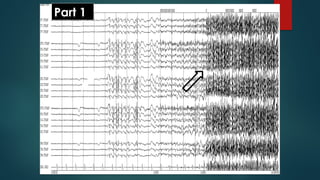
  • #142ย Generalized tonic-clonic seizure (Part 1). Onset of generalized tonic-clonic seizure, longitudinal average ear referential montage. Generalized spike and wave and polyspikes noted at seizure onset (filled arrow), evolving to continuous activation during tonic phase (open arrow). Copyright 2013. Mayo Foundation for Medical Education and Research. All rights reserved. Courtesy of Dr. Jeffrey W. Britton, MD.
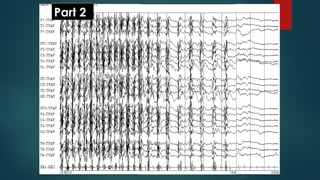
  • #143ย Generalized tonic-clonic seizure (Part 2). Seizure progresses to clonic phase, showing intermittent bursts of diffuse high frequency activity with progressively longer intervals of suppression between bursts. Post-ictal phase marked by diffuse suppression as noted in the latter portion of the epoch shown. Copyright 2013. Mayo Foundation for Medical Education and Research. All rights reserved. Courtesy of Dr. Jeffrey W. Britton, MD.
  • #144ย Left temporal onset seizure discharge with onset showing rhythmic delta localized to the left anterior temporal region, with phase-reversal noted over the F7-T7 and F9-T9 derivations (filled arrow). Discharge evolves into rhythmic left temporal theta (open arrow) towards end of the epoch shown. Longitudinal bipolar montage with left hemispheric derivations upper half, right hemispheric lower half. Copyright 2013. Mayo Foundation for Medical Education and Research. All rights reserved. Courtesy of Dr. Jeffrey W. Britton, MD.