School of Engineering – UCSI UNIVERSITY                                 EE107 (Jan-April 2013)

                        Mock Test1 (XY Feb 2013): Questions & Solutions

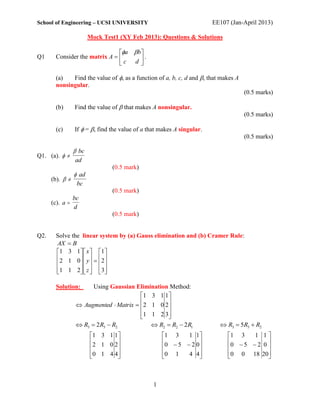
                               a b
Q1     Consider the matrix A       .
                               c d 

       (a)   Find the value of , as a function of a, b, c, d and , that makes A
       nonsingular.
                                                                                    (0.5 marks)

       (b)       Find the value of  that makes A nonsingular.
                                                                                    (0.5 marks)

       (c)       If  = , find the value of a that makes A singular.
                                                                                    (0.5 marks)

                  bc
Q1. (a).  
                 ad
                                (0.5 mark)
                  ad
      (b).  
                  bc
                                (0.5 mark)
               bc
      (c). a 
               d
                                (0.5 mark)


Q2.    Solve the linear system by (a) Gauss elimination and (b) Cramer Rule:
       AX  B
       1 3 1   x   1 
        2 1 0   y    2
                  
       1 1 2   z   3 
                  

       Solution:       Using Gaussian Elimination Method:
                                        1 3 1 1 
                                                
                  Augmented  Matrix  2 1 0 2
                                        1 1 2 3 
                                                
                  R3  2R3  R2            R2  R2  2R1                 R3  5R3  R2
                        1 3 1 1                    1 3    1 1            1 3    1 1
                                                                                     
                         2 1 0 2                   0  5  2 0           0  5  2 0 
                        0 1 4 4
                                                   0 1
                                                            4 4           0 0 18 20
                                                                                         


                                                 1
School of Engineering – UCSI UNIVERSITY                               EE107 (Jan-April 2013)

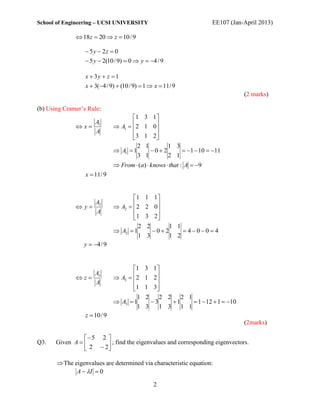
               18z  20  z  10 / 9

                   5 y  2z  0
                   5 y  2(10 / 9)  0  y  4 / 9

                  x  3y  z  1
                  x  3(4 / 9)  (10 / 9)  1  x  11/ 9
                                                                                 (2 marks)

(b) Using Cramer’s Rule:
                                      1    3 1
                                A1  2    1 0
                  A
              x 1                           
                  A
                                      3
                                           1 2
                                               
                                        2   1      1 3
                                A1  1       02      1  10  11
                                        3   1      2 1
                                From  (a)  knows  that : A  9
                  x  11/ 9


                                      1    1 1
                                A2  2    2 0
                  A
               y 2                           
                   A
                                      1
                                           3 2
                                        2    2      1 1
                                A2  1        02      400 4
                                        1    3      1 2
                 y  4 / 9


                                      1    3 1
                                A3  2    1 2
                  A
              z 3                            
                  A
                                      1
                                           1 3
                                        1   2    2 2 2 1
                                A3  1       3    1    1  12  1  10
                                        1   3    1 3 1 1
                  z  10 / 9
                                                                                 (2marks)

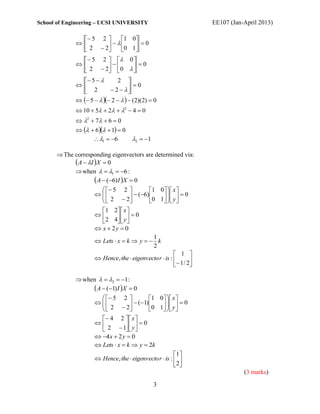
                  5 2 
Q3.    Given A         ; find the eigenvalues and corresponding eigenvectors.
                  2  2

        The eigenvalues are determined via characteristic equation:
              A  I  0

                                                2
School of Engineering – UCSI UNIVERSITY                               EE107 (Jan-April 2013)

                 5 2      1 0
                        0 1   0
                 2  2         
                  5 2   0 
                           0
                 2  2  0  
                 5          2 
                                     0
                 2          2   
                5    2     (2)(2)  0
               10  5  2  2  4  0
               2  7  6  0
                 6   1  0
                     1  6          2  1

       The corresponding eigenvectors are determined via:
             A  I X  0
             when   1  6 :
                      A  (6) I X  0
                           5 2             1 0   x 
                       2 2         (6) 0 1   y   0
                                                     
                                                 
                         1 2   x 
                                 0
                          2 4  y 
                      x  2y  0
                                                 1
                      Lets  x  k  y   k
                                                 2
                                                          1 
                      Hence,the  eigenvecto r  is :          
                                                           1 / 2

               when   2  1 :
                    A  (1) I X  0
                          5 2          1 0   x 
                                                  
                         2  2  (1) 0 1   y   0
                                                
                         4 2   x 
                                   0
                         2  1  y 
                       4 x  2 y  0
                       Lets  x  k  y  2k
                                                         1
                       Hence,the  eigenvecto r  is :  
                                                          2
                                                                                 (3 marks)

                                                 3

Ee107 sp 06_mock_test1_q_s_ok_3p_

  • 1.
    School of Engineering– UCSI UNIVERSITY EE107 (Jan-April 2013) Mock Test1 (XY Feb 2013): Questions & Solutions a b Q1 Consider the matrix A   . c d  (a) Find the value of , as a function of a, b, c, d and , that makes A nonsingular. (0.5 marks) (b) Find the value of  that makes A nonsingular. (0.5 marks) (c) If  = , find the value of a that makes A singular. (0.5 marks)  bc Q1. (a).   ad (0.5 mark)  ad (b).   bc (0.5 mark) bc (c). a  d (0.5 mark) Q2. Solve the linear system by (a) Gauss elimination and (b) Cramer Rule: AX  B 1 3 1   x   1   2 1 0   y    2      1 1 2   z   3       Solution: Using Gaussian Elimination Method: 1 3 1 1     Augmented  Matrix  2 1 0 2 1 1 2 3     R3  2R3  R2  R2  R2  2R1  R3  5R3  R2 1 3 1 1  1 3 1 1 1 3 1 1        2 1 0 2 0  5  2 0  0  5  2 0  0 1 4 4   0 1  4 4  0 0 18 20   1
  • 2.
    School of Engineering– UCSI UNIVERSITY EE107 (Jan-April 2013)  18z  20  z  10 / 9  5 y  2z  0  5 y  2(10 / 9)  0  y  4 / 9 x  3y  z  1 x  3(4 / 9)  (10 / 9)  1  x  11/ 9 (2 marks) (b) Using Cramer’s Rule: 1 3 1  A1  2 1 0 A x 1   A 3  1 2  2 1 1 3  A1  1 02  1  10  11 3 1 2 1  From  (a)  knows  that : A  9 x  11/ 9 1 1 1  A2  2 2 0 A  y 2   A 1  3 2 2 2 1 1  A2  1 02  400 4 1 3 1 2 y  4 / 9 1 3 1  A3  2 1 2 A z 3   A 1  1 3 1 2 2 2 2 1  A3  1 3 1  1  12  1  10 1 3 1 3 1 1 z  10 / 9 (2marks)  5 2  Q3. Given A    ; find the eigenvalues and corresponding eigenvectors.  2  2  The eigenvalues are determined via characteristic equation: A  I  0 2
  • 3.
    School of Engineering– UCSI UNIVERSITY EE107 (Jan-April 2013)  5 2  1 0      0 1   0  2  2     5 2   0      0  2  2  0    5   2    0  2  2      5    2     (2)(2)  0  10  5  2  2  4  0  2  7  6  0    6   1  0  1  6 2  1  The corresponding eigenvectors are determined via:  A  I X  0  when   1  6 :  A  (6) I X  0   5 2  1 0   x    2 2   (6) 0 1   y   0        1 2   x      0  2 4  y   x  2y  0 1  Lets  x  k  y   k 2  1   Hence,the  eigenvecto r  is :     1 / 2  when   2  1 :  A  (1) I X  0   5 2  1 0   x      2  2  (1) 0 1   y   0        4 2   x      0  2  1  y   4 x  2 y  0  Lets  x  k  y  2k 1  Hence,the  eigenvecto r  is :    2 (3 marks) 3