Roll No.
QUESTION PAPER CODE: X10658
B.E. / B.Tech. DEGREE EXAMINATIONS, NOVEMBER/DECEMBER 2020
Third Semester
Electronics and Communication Engineering
MA8352 –LINEAR ALGEBRA AND PARTIAL DIFFERENTIAL EQUATIONS
(Common to Biomedical Engineering, Computer and Communication Engineering,
Electronics and Telecommunication Engineering and Medical Electronics)
(Regulations 2017)
Answer ALL Questions
Time: 3 Hours Maximum Marks:100
PART A (10 × 2 = 20 Marks)
1. Determine whether the subset S = {(x, y, 0)|x and y are real numbers} of the vector space
V = R3
is a subspace or not.
2. For which values of k will the vector v = (1, −2, k) in R3
be a linear combination of the
vectors u = (3, 0, −2) and w = (2, −1, −5).
3. Find the matrix representation of a linear transformation T : P3(R) → P2(R) defined by
T(f(x)) = f′
(x) with respect to the standard ordered bases for P3(R) and P2(R).
4. Is there a linear transformation T : R3
→ R2
such that T(1, 0, 3) = (1, 1) and
T(−2, 0, −6) = (2, 1)? Justify.
5. Prove that ||α + β|| ≤ ||α|| + ||β|| for any two vectors α, β belong to the standard inner
product space.
6. Find the orthogonal complement of S = (0, 0, 1) in an inner product space R3
.
7. Obtain the partial differential equation by eliminating the arbitrary function from
z = f(x2
+ y2
).
8. Find the complete solution of p2
+ q2
= 4.
9. State Dirichlet’s conditions for a function f(x) to be expressed as a Fourier series.
10. Solve x2 ∂z
∂x
+ y3 ∂z
∂y
= 0 by method of separation of variables.
PART-B (5×16=80 Marks)
11. (a) (i) Let V = R3
and S1 = {(1, 0, 0), (2, 2, 0), (5, 7, 2)}. Show that S1 is a minimal
generating set. (8)
(ii) Verify whether the set S =
{(
1 −3 2
−4 0 5
)
,
(
−3 7 4
6 −2 −7
)
,
(
−2 3 11
−1 −3 2
)}
in M2×3(R) is linearly dependent or not. (6) (8)
1
(OR)
(b) (i) Let V = R3
and S1 = {(1, 0, 0), (2, 2, 0), (5, 7, 2)}. Show that S1 is a minimal
generating set. (8)
(ii) Let V = R3
, W1 = {(x, x, x)/x ∈ R} and W2 = {(0, y, z)/y, z ∈ R} are two
subspaces of V , then prove that V = W1 ⊕ W2. (8)
12. (a) Let T : R2
→ R3
and U : R2
→ R3
be the linear transformations defined by
T(a1, a2) = (a1 + 3a2, 0, 2a1 − 4a2) and U(a1, a2) = (a1 − a2, 2a1, 3a1 + 2a2) respec-
tively. Then prove that [T + U]γ
B = [T]γ
B + [U]γ
B. (16)
(OR)
(b) Let T be a linear operator on P2(R) defined by T[f(x)] = f(1)+f′
(0)x[f′
(0)+f′′
(0)]x2
.
Test for diagonalizability. (16)
13. (a) Let V = P(R) with the inner product < f(x), g(x) >=
∫ 1
−1
f(t)g(t)dt. Consider the
sub space P2(R) with standard ordered basis B. Use the Gram-Schmidt process to
replace B by an orthogonal basis {v1, v2, v3} for P2(R) and use that orthogonal basis
to obtain an orthonormal basis for P2(R). (16)
(OR)
(b) (i) Let V = C3
where C is the set of complex numbers. Define < x, y >= a1b1 +
a2b2 + a3b3 where x = (a1, a2, a3) and y = (b1, b2, b3). Verify whether V is an inner
product space or not. (8)
(ii) Let V be a finite dimensional inner product space, and let T be a linear operator
on V . Then show that there exists a unique linear function T∗
: V → V such that
< T(x), y >=< x, T∗
(y) > for all x, y ∈ V . (8)
14. (a) (i) Solve:(D2
+ DD′
− 6D′2
)z = y cos x. (8)
(ii) Find the singular integral of z = px + qy +
√
1 + p2 + q2. (8)
(OR)
(b) (i) Find the integral surface of the equation 2y(z − 3)p + (2x − z)q = y(2x − 3) that
passes through the circle x2
+ y2
= 2x and z = 0. (8)
(ii) Find the complete solution of x2
p2
+ y2
q2
= z2
. (8)
15. (a) A rectangular plate 0 ≤ x ≤ 20, 0 ≤ y ≤ 10 has the edges x = 0, x = 20, y = 0
maintained at zero temperature and the edge y = 10 has the temperature u = 20x−x2
.
Find the steady state temperature at any point (x, y) on the plate. (16)
(OR)
(b) (i) Obtain the Fourier series for the function f(x) = |x|, − π < x < π. (8)
(ii) Express f(x) = x(π−x), 0 < x < π, as a Fourier series of periodicity 2π containing
cosine terms only. (8)
∗ ∗ ∗ ∗ ∗ ∗ ∗
2

X10658(ma8352)

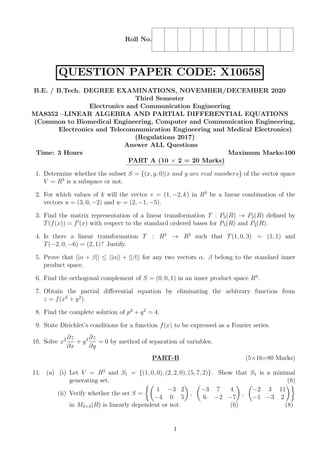
  • 1.
    Roll No. QUESTION PAPERCODE: X10658 B.E. / B.Tech. DEGREE EXAMINATIONS, NOVEMBER/DECEMBER 2020 Third Semester Electronics and Communication Engineering MA8352 –LINEAR ALGEBRA AND PARTIAL DIFFERENTIAL EQUATIONS (Common to Biomedical Engineering, Computer and Communication Engineering, Electronics and Telecommunication Engineering and Medical Electronics) (Regulations 2017) Answer ALL Questions Time: 3 Hours Maximum Marks:100 PART A (10 × 2 = 20 Marks) 1. Determine whether the subset S = {(x, y, 0)|x and y are real numbers} of the vector space V = R3 is a subspace or not. 2. For which values of k will the vector v = (1, −2, k) in R3 be a linear combination of the vectors u = (3, 0, −2) and w = (2, −1, −5). 3. Find the matrix representation of a linear transformation T : P3(R) → P2(R) defined by T(f(x)) = f′ (x) with respect to the standard ordered bases for P3(R) and P2(R). 4. Is there a linear transformation T : R3 → R2 such that T(1, 0, 3) = (1, 1) and T(−2, 0, −6) = (2, 1)? Justify. 5. Prove that ||α + β|| ≤ ||α|| + ||β|| for any two vectors α, β belong to the standard inner product space. 6. Find the orthogonal complement of S = (0, 0, 1) in an inner product space R3 . 7. Obtain the partial differential equation by eliminating the arbitrary function from z = f(x2 + y2 ). 8. Find the complete solution of p2 + q2 = 4. 9. State Dirichlet’s conditions for a function f(x) to be expressed as a Fourier series. 10. Solve x2 ∂z ∂x + y3 ∂z ∂y = 0 by method of separation of variables. PART-B (5×16=80 Marks) 11. (a) (i) Let V = R3 and S1 = {(1, 0, 0), (2, 2, 0), (5, 7, 2)}. Show that S1 is a minimal generating set. (8) (ii) Verify whether the set S = {( 1 −3 2 −4 0 5 ) , ( −3 7 4 6 −2 −7 ) , ( −2 3 11 −1 −3 2 )} in M2×3(R) is linearly dependent or not. (6) (8) 1
  • 2.
    (OR) (b) (i) LetV = R3 and S1 = {(1, 0, 0), (2, 2, 0), (5, 7, 2)}. Show that S1 is a minimal generating set. (8) (ii) Let V = R3 , W1 = {(x, x, x)/x ∈ R} and W2 = {(0, y, z)/y, z ∈ R} are two subspaces of V , then prove that V = W1 ⊕ W2. (8) 12. (a) Let T : R2 → R3 and U : R2 → R3 be the linear transformations defined by T(a1, a2) = (a1 + 3a2, 0, 2a1 − 4a2) and U(a1, a2) = (a1 − a2, 2a1, 3a1 + 2a2) respec- tively. Then prove that [T + U]γ B = [T]γ B + [U]γ B. (16) (OR) (b) Let T be a linear operator on P2(R) defined by T[f(x)] = f(1)+f′ (0)x[f′ (0)+f′′ (0)]x2 . Test for diagonalizability. (16) 13. (a) Let V = P(R) with the inner product < f(x), g(x) >= ∫ 1 −1 f(t)g(t)dt. Consider the sub space P2(R) with standard ordered basis B. Use the Gram-Schmidt process to replace B by an orthogonal basis {v1, v2, v3} for P2(R) and use that orthogonal basis to obtain an orthonormal basis for P2(R). (16) (OR) (b) (i) Let V = C3 where C is the set of complex numbers. Define < x, y >= a1b1 + a2b2 + a3b3 where x = (a1, a2, a3) and y = (b1, b2, b3). Verify whether V is an inner product space or not. (8) (ii) Let V be a finite dimensional inner product space, and let T be a linear operator on V . Then show that there exists a unique linear function T∗ : V → V such that < T(x), y >=< x, T∗ (y) > for all x, y ∈ V . (8) 14. (a) (i) Solve:(D2 + DD′ − 6D′2 )z = y cos x. (8) (ii) Find the singular integral of z = px + qy + √ 1 + p2 + q2. (8) (OR) (b) (i) Find the integral surface of the equation 2y(z − 3)p + (2x − z)q = y(2x − 3) that passes through the circle x2 + y2 = 2x and z = 0. (8) (ii) Find the complete solution of x2 p2 + y2 q2 = z2 . (8) 15. (a) A rectangular plate 0 ≤ x ≤ 20, 0 ≤ y ≤ 10 has the edges x = 0, x = 20, y = 0 maintained at zero temperature and the edge y = 10 has the temperature u = 20x−x2 . Find the steady state temperature at any point (x, y) on the plate. (16) (OR) (b) (i) Obtain the Fourier series for the function f(x) = |x|, − π < x < π. (8) (ii) Express f(x) = x(π−x), 0 < x < π, as a Fourier series of periodicity 2π containing cosine terms only. (8) ∗ ∗ ∗ ∗ ∗ ∗ ∗ 2