1


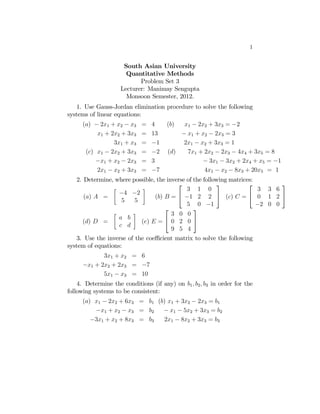
                     South Asian University
                      Quantitative Methods
                           Problem Set 3
                    Lecturer: Manimay Sengupta
                      Monsoon Semester, 2012.
   1. Use Gauss-Jordan elimination procedure to solve the following
systems of linear equations:
      () − 21 + 2 − 3    =   4     ()  1 − 22 + 33 = −2
           1 + 22 + 33    =   13        − 1 + 2 − 23 = 3
                 31 + 3    =   −1        21 − 2 + 33 = 1
       () 1 − 22 + 33    =   −2    ()   71 + 22 − 23 − 44 + 35 = 8
           −1 + 2 − 23    =   3                 − 31 − 32 + 24 + 5 = −1
           21 − 2 + 33    =   −7                41 − 2 − 83 + 205 = 1
   2. Determine, where possible, the inverse of the following matrices:
                                         ⎡               ⎤           ⎡         ⎤
                 ∙          ¸                3 1 0                       3 3 6
                   −4 −2
      ()  =                   ()  = ⎣ −1 2 2 ⎦ ()  = ⎣ 0 1 2 ⎦
                    5    5
                                             5 0 −1                     −2 0 0
                                    ⎡           ⎤
                 ∙      ¸              3 0 0
                    
      ()  =              ()  = ⎣ 0 2 0 ⎦
                    
                                       9 5 4
   3. Use the inverse of the coefficient matrix to solve the following
system of equations:
             31 + 2 = 6
      −1 + 22 + 23 = −7
             51 − 3 = 10
    4. Determine the conditions (if any) on 1  2  3 in order for the
following systems to be consistent:
      () 1 − 22 + 63 = 1 () 1 + 32 − 23 = 1
          −1 + 2 − 3 = 2    − 1 − 52 + 33 = 2
         −31 + 2 + 83 = 3   21 − 82 + 33 = 3
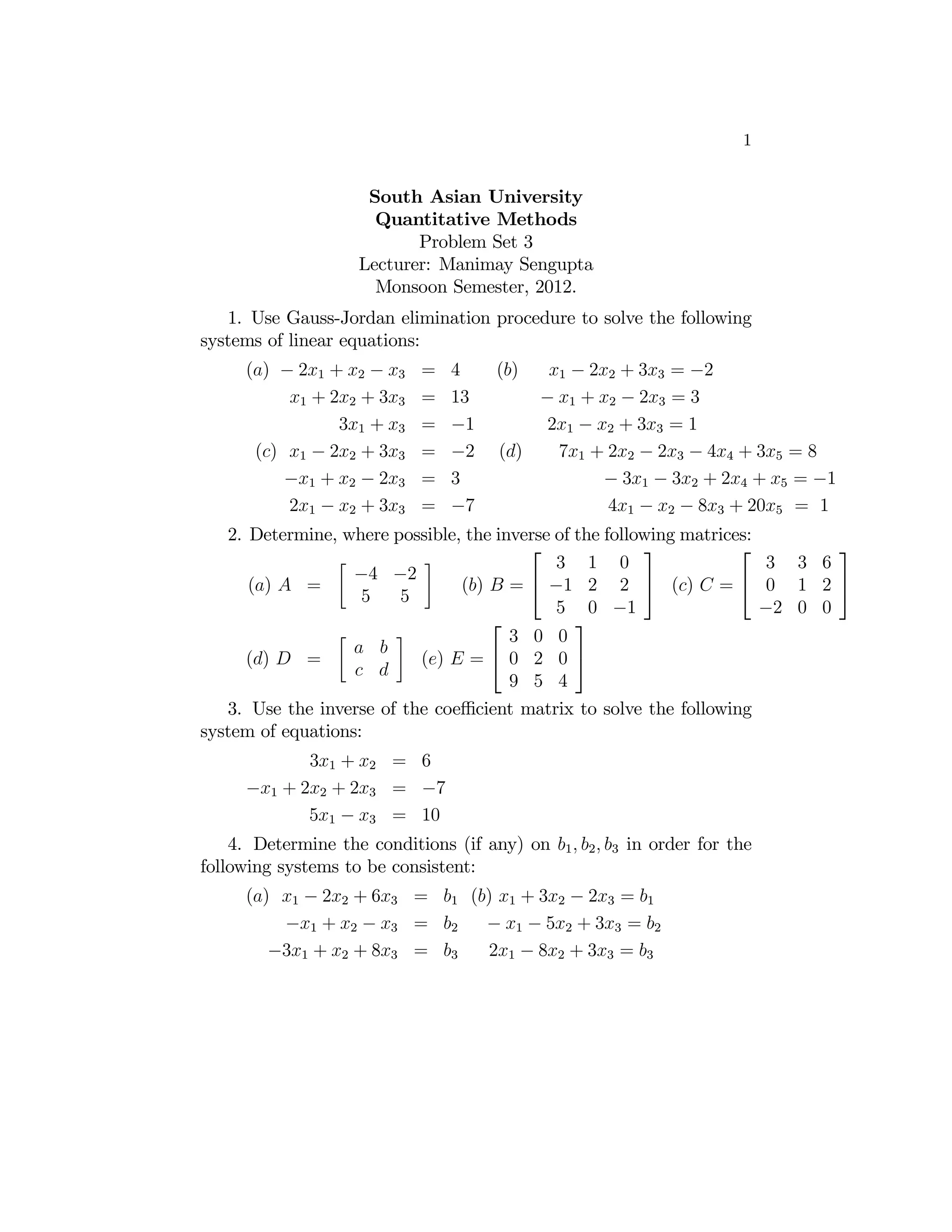
2


    5. Determine if the following functions are linear transformations
or not:
            ()        :     2 → 4                 ()  : 3 → 2
      (1  2 )   =     (1  2  3  4 )    (1  2  3 ) = (1  2 )
          1       =     31 − 42                  1 = 42 + 2 2   3
                                                                             2
                  2    =     1 + 22                             2 = 1 − 2 3 
                  3    =     61 − 2
                  4    =     102 
   6. Examine whether the following sets are vector spaces or not:
   () The set  = 2 with the usual definition of vector addition,
and scalar multiplication defined as:
                              (1  2 ) = (1  2 )
   () The set The set  = 3 with the usual definition of vector
addition, and scalar multiplication defined as:
                            (1  2  3 ) = (0 0 3 )
    () The set  = 2 with the usual definition of scalar multiplica-
tion, and vector addition defined as:
                 (1  2 ) + (1  2 ) = (1 + 21  2 + 2 )
  (d) The set  = { ∈  |   0} with addition and scalar
multiplication defined as follows:
                               +  = ;  =  
    (e) The set  of the points on a line through the origin in 2 with
the usual addition and scalar multiplication.
    (f ) The set  of the points on a line that does not go through the
origin in 2 with the usual addition and scalar multiplication.
    (g) The set  of the points on a plane that goes through the origin
in 3  with the standard addition and scalar multiplication.
    (Note: The equation of a plane through the origin is + + =
0 where    are given constants.)
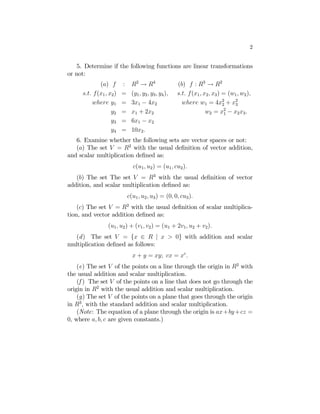
3


    7. Determine if the given sets are subspaces of the respective vector
spaces:
    ()  = {( ) ∈ 2 |  ≥ 0}; 2 
    ()  = {(  ) ∈ 3 |  = 0}; 3 
    ()  = {(  ) ∈ 3 |  = 1}; 3 
    In what follows,  denotes the set of all  ×  matrices.
    ()  = All diagonal matrices of order ;  
    ()  = All 3 × 2 matrices such that 11 = 0; 32 
    ()  = [] , the set of all continuous functions  : [ ] →
; <[]  the set of all real-values functions defined on [ ],
    ()  =   the set of all polynomials of degree  or less; < the
set of all real-valued functions  :  → 
                 0
    ()  =   the set of all polynomials of degree exactly ; <
    8. Determine the null space of each of¸the following matrices:
               ∙           ¸        ∙                 ∙       ¸
                   2 0                 1 −7             0 0
    ()  =                  ;=                 ;=            
                 −4 10                −3 21             0 0
    9. Describe the span of each of the following sets of “vectors”:
                     ∙       ¸        ∙      ¸
                       1 0              0 0
       () 1 =                 2 =          ;
                       0 0              0 1
      () 1 = 1 2 =  3 = 3 
    10. Specify a set of vectors that will exactly span each of the
following vector spaces and verify your answers::
                        ()  ; () 22 ; ()  
   11. Verify if the following sets of vectors will span 3 :
      () 1 = (1 2 0) 2 = (3 1 0) 3 = (4 0 1);
      () 1 = (4 −3 9) 2 = (2 −1 8) 3 = (6 −5 10)
   12. Determine if the following sets of vectors are linearly indepen-
dent or linearly dependent:
      () 1 = (−2 1) 2 = (−1 −3) 3 = (4 −2);
      () 1 = (1 1 −1 2) 2 = (2 −2 0 2) 3 = (2 −8 3 −1);
      () 1 = (1 −2 3 −4) 2 = (−1 3 4 2) 3 = (1 1 −2 −2)
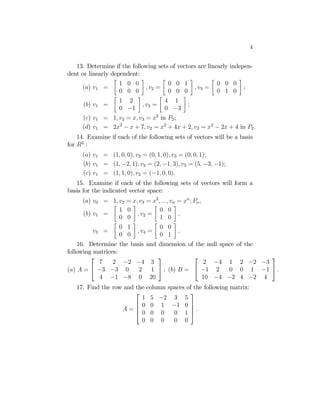
4


   13. Determine if the following sets of vectors are linearly indepen-
dent or linearly dependent:
                  ∙         ¸         ∙         ¸        ∙        ¸
                    1 0 0               0 0 1              0 0 0
     () 1 =                  2 =               3 =            ;
                    0 0 0               0 0 0              0 1 0
                  ∙       ¸         ∙       ¸
                    1 2                4 1
      () 1 =               2 =            ;
                    0 −1               0 −3
     () 1 = 1 2 =  3 = 2 in 2 ;
     () 1 = 22 −  + 7 2 = 2 + 4 + 2 3 = 2 − 2 + 4 in 2 
    14. Examine if each of the following sets of vectors will be a basis
for 3 :
     () 1 = (1 0 0) 2 = (0 1 0) 3 = (0 0 1);
     () 1 = (1 −2 1) 2 = (2 −1 3) 3 = (5 −3 −1);
     () 1 = (1 1 0) 2 = (−1 0 0)
   15. Examine if each of the following sets of vectors will form a
basis for the indicated vector space:
     () 0 = 1 2   =  3 = 2    =  ;  
              ∙         ¸        ∙          ¸
                 1    0             0 0
     () 1 =              2 =              
                 0    0             1 0
              ∙         ¸        ∙          ¸
                 0    1             0 0
         3 =              4 =              
                 0    0             0 1
    16. Determine the basis and dimension of the null space of the
following matrices:
         ⎡                      ⎤           ⎡                      ⎤
           7     2 −2 −4 3                      2 −4 1 2 −2 −3
()  = ⎣ −3 −3 0        2 1 ⎦ ; ()  = ⎣ −1 2          0 0 1 −1 ⎦ 
           4 −1 −8 0 20                        10 −4 −2 4 −2 4
   17. Find the row and the column spaces of the following matrix:
                        ⎡                   ⎤
                          1 5 −2 3 5
                        ⎢ 0 0 1 −1 0 ⎥
                   =⎢  ⎣ 0 0 0
                                            ⎥
                                     0 1 ⎦
                          0 0 0      0 0
5


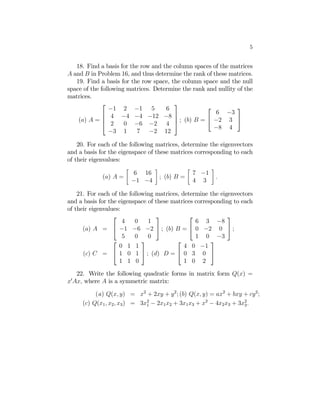
   18. Find a basis for the row and the column spaces of the matrices
 and  in Problem 16, and thus determine the rank of these matrices.
   19. Find a basis for the row space, the column space and the null
space of the following matrices. Determine the rank and nullity of the
matrices.
             ⎡                          ⎤
                 −1 2 −1 5           6              ⎡           ⎤
             ⎢ 4 −4 −4 −12 −8 ⎥                        6 −3
    ()  = ⎢⎣ 2
                                        ⎥ ; ()  = ⎣ −2 3 ⎦
                      0 −6 −2 4 ⎦
                                                      −8 4
                 −3 1     7 −2 12

    20. For each of the following matrices, determine the eigenvectors
and a basis for the eigenspace of these matrices corresponding to each
of their eigenvalues:
                       ∙          ¸           ∙        ¸
                          6 16                  7 −1
              ()  =               ; ()  =            
                         −1 −4                  4 3

    21. For each of the following matrices, determine the eigenvectors
and a basis for the eigenspace of these matrices corresponding to each
of their eigenvalues:
                  ⎡                ⎤          ⎡              ⎤
                      4   0    1                 6 3 −8
      ()  = ⎣ −1 −6 −2 ⎦ ; ()  = ⎣ 0 −2 0 ⎦ ;
                      5   0    0                 1 0 −3
                  ⎡          ⎤            ⎡            ⎤
                    0 1 1                    4 0 −1
      ()  = ⎣ 1 0 1 ⎦ ; ()  = ⎣ 0 3 0 ⎦
                    1 1 0                    1 0 2

   22. Write the following quadratic forms in matrix form () =
 0
  where  is a symmetric matrix:

          (a) ( ) = 2 + 2 +  2 ; () ( ) = 2 +  +  2 ;
     () (1  2  3 ) = 32 − 21 2 + 31 3 + 2 − 42 3 + 32 
                              1                                     3
6


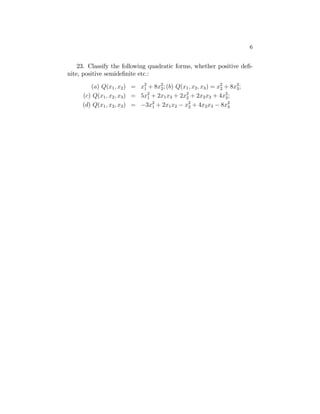
    23. Classify the following quadratic forms, whether positive defi-
nite, positive semidefinite etc.:

        () (1  2 ) = 2 + 82 ; () (1  2  3 ) = 2 + 82 ;
                             1     2                         2     3
     () (1  2  3 ) = 52 + 21 3 + 22 + 22 3 + 42 ;
                               1             2                 3
     () (1  2  3 ) = −31 + 21 2 − 2 + 42 3 − 82
                                 2            2
                                                                3

Sau quantitative methods problem set 3

  • 1.
    1 South Asian University Quantitative Methods Problem Set 3 Lecturer: Manimay Sengupta Monsoon Semester, 2012. 1. Use Gauss-Jordan elimination procedure to solve the following systems of linear equations: () − 21 + 2 − 3 = 4 () 1 − 22 + 33 = −2 1 + 22 + 33 = 13 − 1 + 2 − 23 = 3 31 + 3 = −1 21 − 2 + 33 = 1 () 1 − 22 + 33 = −2 () 71 + 22 − 23 − 44 + 35 = 8 −1 + 2 − 23 = 3 − 31 − 32 + 24 + 5 = −1 21 − 2 + 33 = −7 41 − 2 − 83 + 205 = 1 2. Determine, where possible, the inverse of the following matrices: ⎡ ⎤ ⎡ ⎤ ∙ ¸ 3 1 0 3 3 6 −4 −2 ()  = ()  = ⎣ −1 2 2 ⎦ ()  = ⎣ 0 1 2 ⎦ 5 5 5 0 −1 −2 0 0 ⎡ ⎤ ∙ ¸ 3 0 0   ()  = ()  = ⎣ 0 2 0 ⎦   9 5 4 3. Use the inverse of the coefficient matrix to solve the following system of equations: 31 + 2 = 6 −1 + 22 + 23 = −7 51 − 3 = 10 4. Determine the conditions (if any) on 1  2  3 in order for the following systems to be consistent: () 1 − 22 + 63 = 1 () 1 + 32 − 23 = 1 −1 + 2 − 3 = 2 − 1 − 52 + 33 = 2 −31 + 2 + 83 = 3 21 − 82 + 33 = 3
  • 2.
    2 5. Determine if the following functions are linear transformations or not: ()  : 2 → 4 ()  : 3 → 2  (1  2 ) = (1  2  3  4 )  (1  2  3 ) = (1  2 )  1 = 31 − 42  1 = 42 + 2 2 3 2 2 = 1 + 22 2 = 1 − 2 3  3 = 61 − 2 4 = 102  6. Examine whether the following sets are vector spaces or not: () The set  = 2 with the usual definition of vector addition, and scalar multiplication defined as: (1  2 ) = (1  2 ) () The set The set  = 3 with the usual definition of vector addition, and scalar multiplication defined as: (1  2  3 ) = (0 0 3 ) () The set  = 2 with the usual definition of scalar multiplica- tion, and vector addition defined as: (1  2 ) + (1  2 ) = (1 + 21  2 + 2 ) (d) The set  = { ∈  |   0} with addition and scalar multiplication defined as follows:  +  = ;  =   (e) The set  of the points on a line through the origin in 2 with the usual addition and scalar multiplication. (f ) The set  of the points on a line that does not go through the origin in 2 with the usual addition and scalar multiplication. (g) The set  of the points on a plane that goes through the origin in 3  with the standard addition and scalar multiplication. (Note: The equation of a plane through the origin is + + = 0 where    are given constants.)
  • 3.
    3 7. Determine if the given sets are subspaces of the respective vector spaces: ()  = {( ) ∈ 2 |  ≥ 0}; 2  ()  = {(  ) ∈ 3 |  = 0}; 3  ()  = {(  ) ∈ 3 |  = 1}; 3  In what follows,  denotes the set of all  ×  matrices. ()  = All diagonal matrices of order ;   ()  = All 3 × 2 matrices such that 11 = 0; 32  ()  = [] , the set of all continuous functions  : [ ] → ; <[]  the set of all real-values functions defined on [ ], ()  =   the set of all polynomials of degree  or less; < the set of all real-valued functions  :  →  0 ()  =   the set of all polynomials of degree exactly ; < 8. Determine the null space of each of¸the following matrices: ∙ ¸ ∙ ∙ ¸ 2 0 1 −7 0 0 ()  = ;= ;=  −4 10 −3 21 0 0 9. Describe the span of each of the following sets of “vectors”: ∙ ¸ ∙ ¸ 1 0 0 0 () 1 =  2 = ; 0 0 0 1 () 1 = 1 2 =  3 = 3  10. Specify a set of vectors that will exactly span each of the following vector spaces and verify your answers:: ()  ; () 22 ; ()   11. Verify if the following sets of vectors will span 3 : () 1 = (1 2 0) 2 = (3 1 0) 3 = (4 0 1); () 1 = (4 −3 9) 2 = (2 −1 8) 3 = (6 −5 10) 12. Determine if the following sets of vectors are linearly indepen- dent or linearly dependent: () 1 = (−2 1) 2 = (−1 −3) 3 = (4 −2); () 1 = (1 1 −1 2) 2 = (2 −2 0 2) 3 = (2 −8 3 −1); () 1 = (1 −2 3 −4) 2 = (−1 3 4 2) 3 = (1 1 −2 −2)
  • 4.
    4 13. Determine if the following sets of vectors are linearly indepen- dent or linearly dependent: ∙ ¸ ∙ ¸ ∙ ¸ 1 0 0 0 0 1 0 0 0 () 1 =  2 =  3 = ; 0 0 0 0 0 0 0 1 0 ∙ ¸ ∙ ¸ 1 2 4 1 () 1 =  2 = ; 0 −1 0 −3 () 1 = 1 2 =  3 = 2 in 2 ; () 1 = 22 −  + 7 2 = 2 + 4 + 2 3 = 2 − 2 + 4 in 2  14. Examine if each of the following sets of vectors will be a basis for 3 : () 1 = (1 0 0) 2 = (0 1 0) 3 = (0 0 1); () 1 = (1 −2 1) 2 = (2 −1 3) 3 = (5 −3 −1); () 1 = (1 1 0) 2 = (−1 0 0) 15. Examine if each of the following sets of vectors will form a basis for the indicated vector space: () 0 = 1 2 =  3 = 2    =  ;   ∙ ¸ ∙ ¸ 1 0 0 0 () 1 =  2 =  0 0 1 0 ∙ ¸ ∙ ¸ 0 1 0 0 3 =  4 =  0 0 0 1 16. Determine the basis and dimension of the null space of the following matrices: ⎡ ⎤ ⎡ ⎤ 7 2 −2 −4 3 2 −4 1 2 −2 −3 ()  = ⎣ −3 −3 0 2 1 ⎦ ; ()  = ⎣ −1 2 0 0 1 −1 ⎦  4 −1 −8 0 20 10 −4 −2 4 −2 4 17. Find the row and the column spaces of the following matrix: ⎡ ⎤ 1 5 −2 3 5 ⎢ 0 0 1 −1 0 ⎥ =⎢ ⎣ 0 0 0 ⎥ 0 1 ⎦ 0 0 0 0 0
  • 5.
    5 18. Find a basis for the row and the column spaces of the matrices  and  in Problem 16, and thus determine the rank of these matrices. 19. Find a basis for the row space, the column space and the null space of the following matrices. Determine the rank and nullity of the matrices. ⎡ ⎤ −1 2 −1 5 6 ⎡ ⎤ ⎢ 4 −4 −4 −12 −8 ⎥ 6 −3 ()  = ⎢⎣ 2 ⎥ ; ()  = ⎣ −2 3 ⎦ 0 −6 −2 4 ⎦ −8 4 −3 1 7 −2 12 20. For each of the following matrices, determine the eigenvectors and a basis for the eigenspace of these matrices corresponding to each of their eigenvalues: ∙ ¸ ∙ ¸ 6 16 7 −1 ()  = ; ()  =  −1 −4 4 3 21. For each of the following matrices, determine the eigenvectors and a basis for the eigenspace of these matrices corresponding to each of their eigenvalues: ⎡ ⎤ ⎡ ⎤ 4 0 1 6 3 −8 ()  = ⎣ −1 −6 −2 ⎦ ; ()  = ⎣ 0 −2 0 ⎦ ; 5 0 0 1 0 −3 ⎡ ⎤ ⎡ ⎤ 0 1 1 4 0 −1 ()  = ⎣ 1 0 1 ⎦ ; ()  = ⎣ 0 3 0 ⎦ 1 1 0 1 0 2 22. Write the following quadratic forms in matrix form () = 0   where  is a symmetric matrix: (a) ( ) = 2 + 2 +  2 ; () ( ) = 2 +  +  2 ; () (1  2  3 ) = 32 − 21 2 + 31 3 + 2 − 42 3 + 32  1 3
  • 6.
    6 23. Classify the following quadratic forms, whether positive defi- nite, positive semidefinite etc.: () (1  2 ) = 2 + 82 ; () (1  2  3 ) = 2 + 82 ; 1 2 2 3 () (1  2  3 ) = 52 + 21 3 + 22 + 22 3 + 42 ; 1 2 3 () (1  2  3 ) = −31 + 21 2 − 2 + 42 3 − 82 2 2 3