Studymate Solutions to CBSE Board Examination 2011-2012

       Series : SMA/1                                                         Code No. 65/1/1
                                                          Candidates must write the Code on
Roll No.                                                  the title page of the answer-book.


  Please check that this question paper contains 8 printed pages.

  Code number given on the right hand side of the question paper should be written on the title
   page of the answer-book by the candidate.

  Please check that this question paper contains 29 questions.

  Please write down the Serial Number of the questions before attempting it.

  15 minutes time has been allotted to read this question paper. The question paper will be distributed
   at 10.15 a.m. From 10.15 a.m. to 10.30 a.m., the student will read the question paper only and
   will not write any answer on the answer script during this period.


                                    MATHEMATICS

[Time allowed : 3 hours]                                                      [Maximum marks : 100]


General Instructuions:
(i)     All questions are compulsory.
(ii)    Questions numbered 1 to 10 are very short-answer questions and carry 1 mark each.
(iii) Questions numbered 11 to 22 are short-answer questions and carry 4 marks each.
(iv) Questions numbered 23 to 29 are also short-answer questions and carry 6 marks each.
(v)     Use of calculators is not allowed.


                                                  -(1)-
STUDYmate

                                                                         SECTION-A
                                                  Question numbers 1 to 10 carry 1 mark each.
1.     If a line has direction ratios 2, –1, –2, then what are its direction cosines?
Ans. d.r.’s = <2, –1, –2>
                                                  2 1 2
                d.c.’s =                          , ,
                                                  3 3 3

                                                        
2.   Find ‘’ when the projection of a      4 k on b  2  6   3k is 4 units.
                                          i j                i     j    
                             
                          a.b
Ans. Projection of a on b = 
                             b
            2  6  12
       4=
             4  36  9
           2  18
       4=
              7
       28 – 18 = 2
       5=

                                                                          
3.     Find the sum of the vectors a    2   k , b  2  4   5k and c    6   7 k .
                                       i     j            i     j             i     j     

Ans. a  b  c  0  4   k
               i     j 

                              3
                                  1
4.     Evaluate:               x dx
                              2
       3
           1                                                                3
        x dx  log | x |
                                                  3
Ans.                                              2   = log 3 – log 2 = log  
       2                                                                    2


5.     Evaluate  (1  x) xdx

             x  ( x)                dx
                              3
Ans.                              2


                      3                   5
                  x       2           x       2

       =          3
                                     5
                                                  C
                      2                   2


                 2 32 2 52
       =           x  x C
                 3    5


              5 3 8
6.     If  = 2 0 1 , write the minor of the element a23.
              1 2 3
                                                  5 3
Ans. Minor of a23 =                                     = 10 – 3 = 7.
                                                  1 2


                                                                                  -(2)-
STUDYmate

          2 3  1 3   4 6 
7.    If                   , write the value of x.
          5 7  2 4   9 x 
      2 3  1 3   4           6
Ans.                           
      5 7  2 4   9           x
      2  6 6  12   4          6
     5  14 15  28    9       x
                                    
       4 6   4 6 
       9 13   9 x 
                     
          x = 13


                       cos  sin              sin   cos  
8.    Simplify: cos                   sin   cos  sin  
                        sin  cos                          
        cos2         cos  sin   sin 2    cos  sin 
Ans. =   cos  sin                                    
                        cos2   sin  cos     sin 2  
        1 0 
      =     
        0 1 


                                         1            1
9.    Write the principal value of cos1    2sin 1   
                                         2            2
        –1 
             1     –1 
                         1
Ans. cos   – 2 sin   
            2         2
          –1 
                               
      cos  cos  + 2 sin        sin 
                          –1

                3                 6
              
          2
       3       6
         2
          
       3 3 3


10.   Let * be a ‘binary’ operation on N given by a * b = LCM (a, b) for all a, b  N. Find 5 * 7.
Ans. a * b = LCM of (a, b), a, b  N
      5 * 7 = LCM of (5, 7) = 35


                                                SECTION-B
                      Question numbers 11 to 22 carry 4 marks each.
               y            x       dy
11.   If (cos x) = (cos y) , find      .
                                    dx
                                                        OR
                                        dy sin 2 (a  y )
      If sin y = x sin (a + y), prove that 
                                        dx      sin a
                  y         x
Ans. Given (cos x) = (cos y) , taking logarithms on the two sides, we have
                        y                  x
             log (cos x) = log (cos y)

                                                        -(3)-
STUDYmate

      or     y log (cos x) = x log (cos y)
      Differentiating both sides w.r.t. x, we get
                  1                             dy      1                 dy
              y          ( sin x)  log(cos x) dx  x  cos y  ( sin y ) dx  log(cos y ).1
                  cos x                                       
                             dy             dy
            log (cos x)          + x tan y     = log (cos y) + y tan x
                             dx             dx
                                        dy
              log(cos x)  x tan y  = log (cos y) + y tan x
                                        dx
              dy log(cos y )  y tan x
                  
              dx log(cos x)  x tan y
                                                           OR
Ans. sin y = x sin (a + y)
                sin y
                         =x
             sin( a  y )
             sin( a  y )cos y  sin y cos( a  y ) dx
                                                  
                          sin 2 ( a  y )            dy
             sin( a  y  y )                dx
                                        
                sin 2 (a  y )               dy
                sin a      dx
                        
             sin (a  y ) dy
                 2


             sin 2 (a  y ) dy
                          
                 sin a       dx


12.   How many times must a man toss a fair coin, so that the probability of having at least one head is more
      than 80%?
Ans. Let the man throws the coin ‘n’ times.
                                                                    1
      Probability of getting a head in a single throw, p 
                                                                    2
                                                              1
      Probability of not getting a head in a single throw, q 
                                                              2
      Given: Probability that the man gets atleast one head is more than 80%.
      i.e.   P(atleast 1 Head) > 80%
                                              80
      i.e.   1 – P (no head) 
                                             100
                                 n 0        0
                      1               1    8
      i.e.   1  n C0                   
                      2                2  10
                             n
                1   4
      i.e.   1   
                2   5
                         n
              1     1
      i.e.      
              2     5
                     n
             1   1
      i.e.     
             2   5
              n
      i.e.   2 >5

                                                            -(4)-
STUDYmate

      i.e.        n = 3 or more.
                 The man must throw the coin atleast 3 times.


13.  Find the Vector and Cartesian equations of the line passing through the point (1, 2, –4) and perpendicular
                      x  8 y  19 z  10          x  15 y  29 z  5
     to the two lines                      and                         .
                        3     16       7             3        8      5
Ans. Any line through (1, 2, –4) can be written as
       x 1 y  2 z  4
                                                           ...(i)
         a        b       c
      (i) is at right angles to given lines with d.n. < 3, –16, 7 > and < 3, 8, –5 >
      if          3a – 16b + 7c = 0                              ...(ii)
      and         3a + 8b – 5c = 0                               ...(iii)
      By cross-multiplication, we have
                a          b        c
                              
            80  56 21  15 24  48
             a    b      c
      or             
            24 36 72
            a b c
      or                                                       ...(iv)
            2 3 6
      From (i) and (iv), we find that required line is
       x 1 y  2 z  4
                     
         2       3       6
      In vector form, this line can be written as
       
           i    j          i    j    
                                            
       r    2   4k   2  3   6k ( d.n. of the line are < 2, 3, 6 > and line passes through < 1, 2, –4 >)
                       


                                                                     
14.  If a, b, c are three vectors such that a  5, b  12, c  13 , and a  b  c  0 , find the value of
        
      a.b  b.c  c.a .
          
Ans. a  b  c  0
                     
            (a  b  c) · (a  b  c)  0·0
                2
     i.e.     abc 0
                                      
     i.e. | a |2  | b |2  | c |2 2(a · b  b·c  c·a )  0
                                       
     i.e. 5 + 12 + 13 + 2( a · b  b·c  c·a )  0
              2       2      2

                           
     i.e. 338  2(a · b  b·c  c·a)  0
                
     i.e.    a · b  b·c  c·a  169


15.   Solve the following differential equation:
           dy
       2 x2    2 xy  y 2  0
           dx
           dy
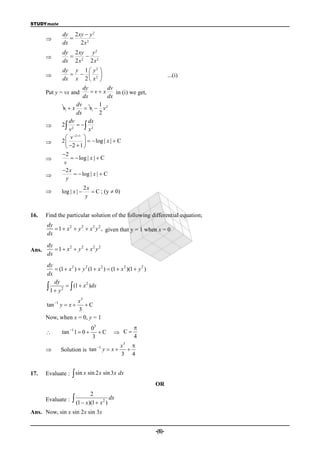
Ans. 2 x 2     2 xy  y 2
           dx
                                                         -(5)-
STUDYmate

               dy 2 xy  y 2
                 
               dx    2x2
               dy 2 xy y 2
                     
               dx 2 x 2 2 x 2
              dy y 1  y 2 
                  
              dx x 2  x 2 
                                                                          ...(i)
                              
                          dy          dv
       Put y = vx and         vx         in (i) we get,
                          dx          dx
                      dv          1
              v  x  v  v2
                      dx          2
                  dv        dx
             2 2   2
                  v          x
                v  2 1
                          
             2             log | x |  C
                2  1 
              2
                    log | x |  C
               v
              2 x
                     log | x |  C
                y
                             2x
              log | x |        C ; (y  0)
                              y


16.    Find the particular solution of the following differential equation;
       dy
           1  x 2  y 2  x 2 y 2 , given that y = 1 when x = 0
       dx
       dy
Ans.       1  x2  y 2  x2 y 2
       dx
       dy
            (1  x 2 )  y 2 (1  x  )  (1  x 2 )(1  y 2 )
       dx
           dy
        1  y 2   (1  x )dx
                            2


                   x3
       tan 1 y  x  C
                   3
       Now, when x = 0, y = 1
                                03                      
              tan 1 1  0       C        C
                                3                       4
                             1                 x3 
             Solution is tan y  x              
                                                3 4


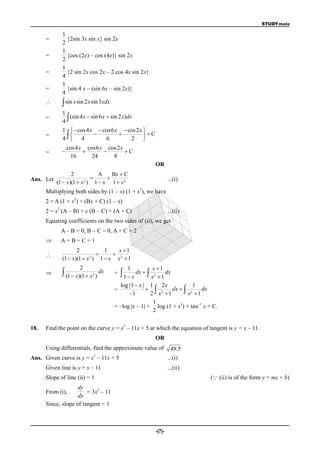
17.    Evaluate :  sin x sin 2 x sin 3x dx
                                                                  OR
                                2
       Evaluate :     (1  x)(1  x2 ) dx
Ans. Now, sin x sin 2x sin 3x


                                                                  -(6)-
STUDYmate

               1
      =          {2sin 3x sin x} sin 2x
               2
               1
      =          {cos (2x) – cos (4x)} sin 2x
               2
               1
      =          {2 sin 2x cos 2x – 2 cos 4x sin 2x}
               4
               1
      =          {sin 4 x – (sin 6x – sin 2x)}
               4
               sin x sin 2 x sin 3xdx
               1
               4
      =           (sin 4 x  sin 6 x  sin 2 x)dx

               1   cos 4 x  cos6 x  cos 2 x 
               4  4
      =                                      C
                                6        2 
                   cos 4 x cos6 x cos 2 x
      =                                C
                     16      24     8
                                                                     OR
                  2          A    Bx  C
Ans. Let                                                                   ...(i)
           (1  x)(1  x ) 1  x 1  x 2
                        2

                                                           2
      Multiplying both sides by (1 – x) (1 + x ), we have
                     2
      2 = A (1 + x ) + (Bx + C) (1 – x)
           2
      2 = x (A – B) + x (B – C) + (A + C)                                    ...(ii)
      Equating coefficients on the two sides of (ii), we get
               A – B = 0, B – C = 0, A + C = 2
              A=B=C=1
                      2            1    x 1
                                    
               (1  x)(1  x 2 ) 1  x x 2  1
                         2                             1       x 1
               (1  x)(1  x   2
                                     )
                                         dx   =    1  x dx   x
                                                                2
                                                                  1
                                                                     dx

                                                 log |1  x | 1 2 x              1
                                              =                2      dx   2      dx
                                                     1       2 x 1          x 1
                                                               1           2       –1
                                              = –log |x – 1| + log (1 + x ) + tan x + C.
                                                               2

                                                   3
18.   Find the point on the curve y = x – 11x + 5 at which the equation of tangent is y = x – 11.
                                                                     OR
      Using differentials, find the approximate value of                       49.5
                                 3
Ans. Given curve is y = x – 11x + 5                                          ...(i)
      Given line is y = x – 11                                               ...(ii)
      Slope of line (ii) = 1                                                           ( (ii) is of the form y = mx + b)
                    dy      2
      From (i),         = 3x – 11
                                1
                    dx
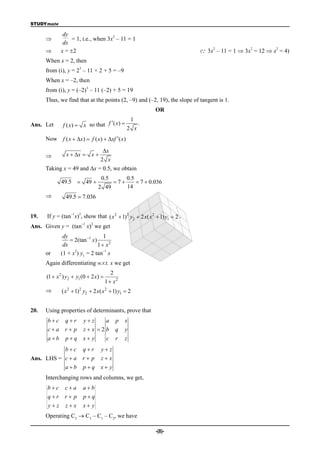
      Since, slope of tangent = 1


                                                                     -(7)-
STUDYmate

              dy                    2
                 = 1, i.e., when 3x – 11 = 1
              dx
                                                                            
                                                                                2            2        2
            x = 2                                                        ( 3x – 11 = 1  3x = 12  x = 4)
      When x = 2, then
                       3
      from (i), y = 2 – 11 × 2 + 5 = –9
      When x = –2, then
                                3
      from (i), y = (–2) – 11 (–2) + 5 = 19
      Thus, we find that at the points (2, –9) and (–2, 19), the slope of tangent is 1.
                                                               OR
                                                       1
Ans. Let      f ( x)  x so that f ( x )                 .
                                                   2 x
      Now f ( x  x)  f ( x)  xf ( x)

                                         x
               x  x  x 
                                        2 x
      Taking x = 49 and x = 0.5, we obtain
                                         0.5     0.5
             49.5  49                      7      7  0.036
                                        2 49     14
               49.5  7.036

                  –1   2
19.   If y = (tan x) , show that ( x 2  1)2 y2  2 x( x 2  1) y1  2 .
                           –1       2
Ans. Given y = (tan x) we get
              dy                  1
                  2(tan 1 x)
              dx               1  x2
                   2              –1
      or     (1 + x ) y1 = 2 tan x
      Again differentiating w.r.t. x we get
                                             2
      (1  x 2 ) y2  y1 (0  2 x) 
                                          1  x2
             ( x 2  1)2 y2  2 x( x 2  1) y1  2


20.   Using properties of determinants, prove that
      bc      qr          yz   a            p   x
      ca      r p         zx 2b            q   y
      ab      pq         x y            c   r   z
           bc             qr           yz
Ans. LHS = c  a           r p          zx
           ab             pq          x y
      Interchanging rows and columns, we get,
      bc      ca         ab
      qr      r p        pq
       yz     zx         x y
      Operating C3  C3 – C1 – C2, we have

                                                               -(8)-
STUDYmate

       bc    ca           ab bc          c  a 2c
       qr    r p          pq  qr        r  p 2r                                                        1
                                                                    (Take out –2 from C3 i.e., operate C3      C)
       yz    zx           x y       yz   zx   2 z                                                       2 3

                bc          ca c
      =      2 q  r        r p r                                 Now, Operate C1  C1 – C3 and C2  C2 – C3
                   yz           zx   z
                b          a c
      =      2 q          p r , operate C1  C2
                   y       x z
              a b            c
      =      2p q            r
               x       y     z
              a        p     x
      =      2b        q     y (by interchanging rows and columns again)
               c       r     z


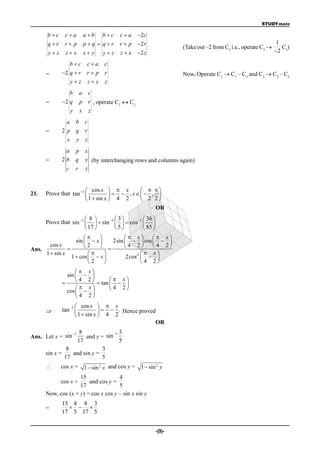
                         cos x   x            
21.   Prove that tan 1               , x   , 
                         1  sin x  4 2       2 2
                                                    OR
                        8          3          36 
      Prove that sin 1    sin 1    cos1  
                         17        5          85 
                                      x        x
                     sin   x    2sin    cos   
       cos x              2           4 2       4 2
Ans.           
     1  sin x                                x
                   1  cos   x        2cos 2   
                           2                   4 2
                    x
               sin   
                   4 2   tan    x 
                                        
                    x         4 2
               cos   
                    4 2
                     cos x   x
            tan 1               . Hence proved
                     1  sin x  4 2
                                                    OR
                 1 8             1 3
Ans. Let x = sin      and y = sin
                   17                5
               8             3
      sin x =    and sin y =
              17             5
            cos x =        1  sin 2 x and cos y = 1  sin 2 y
                    15               4
             cos x =    and cos y =
                    17               5
      Now, cos (x + y) = cos x cos y – sin x sin y
             15 4 8 3
      =          
             17 5 17 5


                                                            -(9)-
STUDYmate

             36
      =
             85
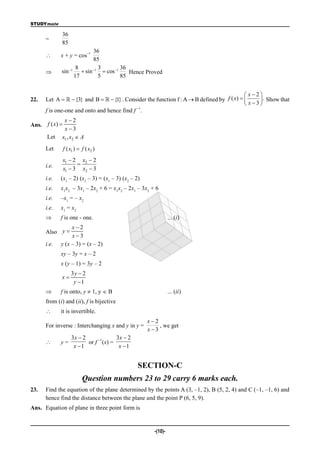
                          36  –1
            x + y = cos
                          85
                    8       3         36
            sin 1  sin 1  cos 1    Hence Proved
                   17       5         85


                                                                                             x2
22.   Let A    {3} and B    {1} . Consider the function f : A  B defined by f ( x)       . Show that
                                                                                             x3
                                            –1
      f is one-one and onto and hence find f .
              x2
Ans. f ( x) 
              x 3
      Let    x1 , x2  A
      Let       f ( x1 )  f ( x2 )
                x1  2 x2  2
      i.e.            
                x1  3 x2  3
      i.e.   (x1 – 2) (x2 – 3) = (x1 – 3) (x2 – 2)
      i.e.   x1x2 – 3x1 – 2x2 + 6 = x1x2 – 2x1 – 3x2 + 6
      i.e.   –x1 = – x2
      i.e.   x1 = x2
            f is one - one.                                    ... (i)
                  x2
      Also y 
                  x3
      i.e.   y (x – 3) = (x – 2)
             xy – 3y = x – 2
             x (y – 1) = 3y – 2
                    3y  2
             x
                     y 1
            f is onto, y  1, y  B                            ... (ii)
      from (i) and (ii), f is bijective
            it is invertible.
                                                     x2
      For inverse : Interchanging x and y in y =         , we get
                                                     x3
                    3x  2     –1     3x  2
            y=            or f (x) =
                     x 1              x 1


                                                 SECTION-C
                           Question numbers 23 to 29 carry 6 marks each.
23.   Find the equation of the plane determined by the points A (3, –1, 2), B (5, 2, 4) and C (–1, –1, 6) and
      hence find the distance between the plane and the point P (6, 5, 9).
Ans. Equation of plane in three point form is


                                                       -(10)-
STUDYmate

               x3      y 1    z2
               53      2 1    42 0
              1  3 1  1 6  2
              x  3 y 1 z  2
      i.e.,     2     3    2 0
               4       0       4
      i.e.    (x – 3) (12) – (y + 1) (8 + 8) + (z – 2) (12) = 0
      i.e.,   3(x – 3) – 4 (y + 1) + 3 (z – 2) = 0
      i.e.,   3x – 4y + 3z – 19 = 0 is the equation of the required plane.
                    18  20  27  19
      and     d=
                        9  16  9
                     6    34
              d=        
                     34   34
                    3 34
              d=         .
                     17


24.   Of the students in a college, it is known that 60% reside in hostel and 40% are day scholars (no residing
      in hostel). Previous year results report that 30% of all students who reside in hostel attain ‘A’ grade and
      20% of day scholars attain ‘A’ grade in their annual examination. At the end of the year, one student is
      chosen at random from the college and he has an ‘A’ grade, what is the probability that the student is a
      hostlier?
Ans. Let      E1 : ‘A student is residing in hostel’
      and     E2 : ‘A student is a day scholar’
      then E1 and E2 are mutually exclusive and exhaustive. Moreover,
                      60 3                                                 40 2
              P(E1) =                 and                      P(E2) =      
                     100 5                                                100 5
      Let E : Student attains ‘A’ grade;
                      30     3                                               20   2
      then P(E/E1) =                 and                       P(E/E2) =       
                     100 10                                                 100 10
      Required probability = P (E1/E)
                      P(E/E1 )P(E1 )
      =                                                                                   [By Baye’s Theorem]
              P(E/E1 )P(E1 )+P(E/E 2 )P(E 2 )
                  3 3
                   
                 10 5     9   9
      =                    
               3 3 2 2 9  4 13
                  
              10 5 10 5


25.   A manufacturer produces nuts and bolts. It takes 1 hour of work on machine A and 3 hours on machine
      B to produce a package of nuts. It takes 3 hours on machine A and 1 hour on machine B to produce a
      package of bolts. He earns a profit of ` 17.50 per package on nuts and ` 7 per package of bolts. How
      many packages of each should be produced each day so as to maximize his profits if he operates his
      machines for at the most 12 hours a day? Form the above as a linear programming problem and solve it
      graphically.


                                                       -(11)-
STUDYmate

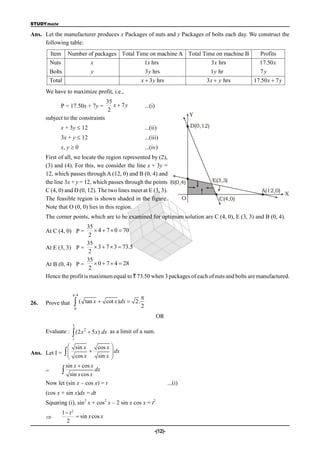
Ans. Let the manufacturer produces x Packages of nuts and y Packages of bolts each day. We construct the
     following table:
       Item     Number of packages Total Time on machine A Total Time on machine B                   Profits
       Nuts             x                   1x hrs                  3 x hrs                          17.50 x
       Bolts                  y                      3 y hrs                         1 y hr          7y
       Total                                       x  3 y hrs                     3 x  y hrs     17.50 x  7 y
      We have to maximize profit, i.e.,
                                    35
            P = 17.50x + 7y =          x  7y          ...(i)
                                     2
                                                                              Y
      subject to the constraints
            x + 3y  12                                ...(ii)                D(0,12)

            3x + y  12                                ...(iii)
            x, y  0                                   ...(iv)
      First of all, we locate the region represented by (2),
      (3) and (4). For this, we consider the line x + 3y =
      12, which passes through A (12, 0) and B (0, 4) and
      the line 3x + y = 12, which passes through the points B(0,4)                      E(3,3)
      C (4, 0) and D (0, 12). The two lines meet at E (3, 3).                                         A(12,0)
                                                                                                                   X
      The feasible region is shown shaded in the figure.        O                         C(4,0)
      Note that O (0, 0) lies in this region.
      The corner points, which are to be examined for optimum solution are C (4, 0), E (3, 3) and B (0, 4).
                         35
      At C (4, 0) P =        4  7  0  70
                          2
                         35
      At E (3, 3) P =        3  7  3  73.5
                          2
                         35
      At B (0, 4) P =        0  7  4  28
                          2
      Hence the profit is maximum equal to ` 73.50 when 3 packages of each of nuts and bolts are manufactured.


                    /4
                                                   
26.   Prove that    (    tan x  cot x )dx  2.
                                                   2
                    0

                                                                OR
                   3
      Evaluate :  (2 x 2  5 x) dx as a limit of a sum.
                   1

                sin x     cos x        
Ans. Let I =  
                cos x  sin x           dx
                                        
                                       
             sin x  cos x
     =       sin x cos x dx
     Now let (sin x – cos x) = t                                     ...(i)
      (cos x + sin x)dx = dt
                          2         2                       2
      Squaring (i), sin x + cos x – 2 sin x cos x = t
              1 t2
                    sin x cos x
               2
                                                            -(12)-
STUDYmate

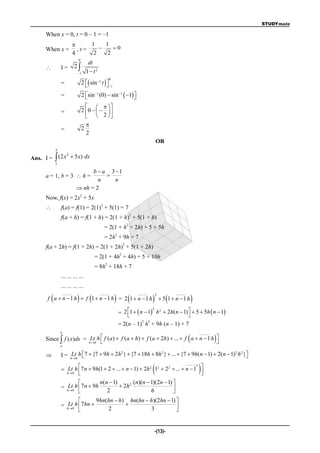
      When x = 0, t = 0 – 1 = –1
                              1    1
      When x =             ,t=        0
                         4      2    2
                             0
                                      dt
                 I=      2
                             1      1 t2
                                 2  sin 1 t  
                                                          0
                  =                                     1

                  =              2 sin (0)  sin 1  1 
                                   
                                             1
                                                           
                                      
                  =              2 0     
                                     2 
                                     
                  =              2
                                     2
                                                                                        OR
              3

Ans. I =  (2 x  5 x) dx
               2

              1

                                  b  a 3 1
      a = 1, b = 3  h =               
                                    n     n
                             nh = 2
                                2
      Now, f(x) = 2x + 5x
                                                  2
                 f(a) = f(1) = 2(1) + 5(1) = 7
                                                                               2
                  f(a + h) = f(1 + h) = 2(1 + h) + 5(1 + h)
                                                                           2
                                                      = 2(1 + h + 2h) + 5 + 5h
                                                               2
                                                      = 2h + 9h + 7
                                                                       2
      f(a + 2h) = f(1 + 2h) = 2(1 + 2h) + 5(1 + 2h)
                                                                   2
                                             = 2(1 + 4h + 4h) + 5 + 10h
                                                      2
                                             = 8h + 18h + 7
                  ... ... ... ...
                  ... ... ... ...

                                                                                                     
                                                                                        2
       f a  n 1 h  f 1  n 1 h = 2 1  n 1 h                                            5 1 n 1 h

                                                                   = 2 1   n  1 h 2  2h( n  1)   5  5h  n  1
                                                                                    2

                                                                                                     
                                                                               2 2
                                                                   = 2(n – 1) h + 9h (n – 1) + 7
                  b
      Since  f ( x)dx = hLt0 h  f (a )  f (a  h)  f (a  2h)  ...  f a  n  1 h 
                                                                                                                
                  a

                  I = hLt0 h  7  {7  9h  2h }  {7  18h  8h }  ...  {7  9h( n  1)  2(n  1) h }
                                               2                 2                                    2 2
                                                                                                       

                     
                           
                                                                                    2
                  = hLt0 h 7 n  9h(1  2  ...  n  1)  2h 2 12  22  ...  n  1 
                                                                                        
                                                                                                               
                                   n(n  1)        (n)(n  1)(2n  1) 
                  = hLt0 h 7n  9h           2h 2                    
                     
                                      2                    6          
                                  9hn(hn  h) hn(hn  h)(2hn  1) 
                  = hLt0 h 7 hn                                 
                     
                                      2               3           


                                                                                        -(13)-
STUDYmate

                      9  2(2  0) 2(2  0)(4  0) 
            = 7  2                              
                           2              3        
                       16 
            = 14  18  
                        3
               42  54  16 
            =               
                    3       
              112
            =
                3


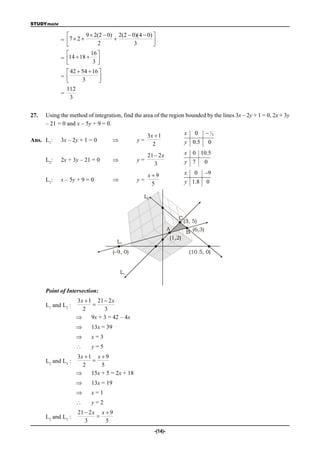
27.   Using the method of integration, find the area of the region bounded by the lines 3x – 2y + 1 = 0, 2x + 3y
      – 21 = 0 and x – 5y + 9 = 0.

                                                  3x  1               x 0  13
Ans. L1:    3x – 2y + 1 = 0                   y=                      y 0.5 0
                                                    2
                                                  21  2 x             x 0 10.5
      L2:   2x + 3y – 21 = 0                  y=                      y 7 0
                                                     3
                                                    x9                x 0 9
      L3:   x – 5y + 9 = 0                    y=                      y 1.8 0
                                                     5

                                                 L2


                                                                   C
                                                                       (3, 5)
                                                               A
                                                                        B (6,3)
                                                               (1,2)
                                      L3
                                     (–9, 0)                             (10.5, 0)


                                         L1


      Point of Intersection:
                    3x  1 21  2 x
      L1 and L2 :         
                      2        3
                         9x + 3 = 42 – 4x
                         13x = 39
                         x=3
                         y=5
                    3x  1 x  9
      L2 and L3 :         
                      2       5
                         15x + 5 = 2x + 18
                         13x = 19
                         x=1
                         y=2
                    21  2 x x  9
      L2 and L3 :           
                       3       5
                                                      -(14)-
STUDYmate

                             105 – 10x = 3x + 27
                             78 = 13x
                             x=6
                             y=3
           A = (1, 2) ; B = (6, 3) ; C = (3, 5)
                                          3             6                 6

      Thus, required area: A =               ydx   ydx   ydx
                                          1 ( Line1)    3 ( Line 2)       1 ( Line 3)
               3                      6                               6
             1                1                  1
      =
             21 (3x  1)dx  3  (21  2 x)dx  5  ( x  9)dx
                                3                  1
                             3                                                          6
             1  3x 2   1            2 6    1  x2      
      =
             2 2  x   3  21x  x  3  5  2  9 x 
                                      
                       1                               1
             1  27      3  1                            1           1     
      =
             2 2  3  2  1  3 126  36  63  9  5 18  54  2  9 
                                                                           
                               1  125 
                                      25
             1        1
      =      2
               14    36  
                      3
                                         
                               5 2 
                                        
                      25         25 38  25 13
      =      7  12       19              sq. units.
                       2         2       2   2


28.   Show that the height of a closed right circular cylinder of given surface and maximum volume, is equal
      to the diameter of its base.
Ans. Let r be the radius of the circular base, h the height and S, the total surface area of a right circular
                           2
     cylinder, then S = 2r + 2rh is given to be a constant.
      Let V be the volume of the cylinder with the above dimensions, then

                         2  S  2r                    r                                                                       S  2r 2
                                     2

            V = r h = r                               2 (S  2r )
                  2                                                  2                                          2
                                                                                                     [ S = 2r + 2rh,  h =              ]
                            2r                                                                                                  2r
                  Sr                   S                                                                        S  2r 2              S
           V=        r 3 ,0  r                                                         ...(i)     [ h =             > 0,  r <      ]
                   2                  2                                                                          2r                  2
      Differentiating (i), twice w.r.t. r, we get
             dV S
                    3r 2
             dr 2
             d 2V
      and           6r
             dr 2
            dV                                             S 
      Now      exists at all points in                  0,    
            dr                                         
                                                           2  and
                                                               
             dV      S                   S
                 0   3r 2  0  r2 =
             dr      2                   6
                   S                                                                                                                   S
           r=                                                                                                           [ 0 < r <       ]
                   6                                                                                                                  2
             d 2V                             S
      Also,  2                     6          0
             dr  r    S/(6  )               6

                                                                               S
           V has a local maximum value at r =
                                                                               6

                                                                                 -(15)-
STUDYmate

                                   S                                         S       S 
      Since V is continuous in  0,     and has only one extremum at              0,
                                                                                           , therefore, V is
                               
                                   2 
                                                                              6      2 
                                                                                           
                                     S
      absolutely maximum for r =        .
                                     6
                                                   S 
                                           S  2  
                   S             S  2r2
                                                   6   2S 6
      When r =        , then h =         
                   6              2r             S       6 S
                                             2
                                                  6
                       S
      =     i.e., h = 2   = 2 radius = diameter.
                                               .
                       6
      So, volume is maximum when the height is equal to the diameter.


29.   Using matrices, solve the following system of linear equations:
            x – y + 2z = 7
            3x + 4y – 5z = – 5
            2x – y + 3z = 12
                                                    OR
      Using elementary operations, find the inverse of the following matrix.
            1 1 2 
                    
            1 2 3
            3 1 1
                    
Ans. The given system can be written as AX = B,
                 1 1 2 
                        
      where A   3 4 5
                 2 1 3 
                        
                 x
            X   y
                 
                z
                 
                7
      and   B   5
                 
                12 
                 
                   1 1 2
      Here | A |  3 4 5
                   2 1 3
            = 1 (12 – 5) – (– 1) (9 + 10) + 2(–3 – 8)
            = 7 + 19 – 22 = 4  0
              –1
           A exists
      Therefore, the given system is consistent and has a unique solution given by

                 1  1             
            X = A B=      (adj. A)  B
                    | A |          


                                                    -(16)-
STUDYmate

                                     t
                   7 19 11  7 
                1             
              = 4  1 1 1   5
                   3 11
                          7  12 
                               
                  7   1 3  7 
               1
                19 1 11   5
                             
               4
                  11 1 7  12 
                            
                  49  5  36 
               1
                133  5  132 
                                 
               4
                  77  5  84 
                                
            x       8   2
            y   1  4   1 
            4   
           z
                   12   3 
                        
         x = 2 , y = 1, z = 3
                                         OR
Ans. A = IA
      1 1 2  1 0 0 
      1 2 3  0 1 0 A
                    
      3 1 1  0 0 1 
                    
     R1   R2
      1 2 3 0 1 0
      1 1 2   1 0 0  A
                         
      3 1 1  0 0 1 
                         
     R2  R2 + R1 ; R3  R3 – 3R1
     1 2 3          0 1 0
     0 3 5         1 1 0  A
                            
     0 5 8
                     0 3 1 
                              
     R3  R3 + 2R2
     1 2 3     0 1 0
     0 3 5     1 1 0  A
                       
     0 1 2
                2 1 1 
                         
     R2  R3
     1 2 3   0 1 0 
     0 1 2    2 1 1  A
                      
     0 3 5   1 1 0 
                      
     R1  R1 – 2R2
     R3  R3 – 3R2
     1 0 1  4 3 2 
      0 1 2    2 1 1  A
                       
      0 1 1  5 4 3
                       
     R3  – R3


                                         -(17)-
STUDYmate

    1 0 1  4 3 2 
    0 1 2    2 1 1  A
                     
    0 0 1   5 4 3 
                     
    R1  R1 + R3
    R2  R2 – 2R3
     1 0 0   1 1 1 
     0 1 0    8 7 5 A
                      
     0 0 1   5 4 3 
                      
                    1 1 1 
     A
            1
                   8 7 5
                           
                    5 4 3 
                           

                                ×·×·×·×·×


                                   -(18)-
STUDYmate


        Studymate Solutions to CBSE Board Examination 2011-2012

      Series : SMA/1                                                            Code No. 65/1/2
                              UNCOMMON QUESTIONS ONLY
                                                    SECTION-A
                              Question numbers 1 to 10 carry 1 mark each.
9.   Find the sum of the following vectors:
                              
     a  i  2 ˆ, b  2i  3 ˆ, c  2i  3k
         ˆ     j       ˆ     j       ˆ      ˆ
                                                 ˆ
Ans.    a  b  c  (i  2 ˆ)  (2i  3 ˆ)  (2i  3k )
                       ˆ     j      ˆ     j    ˆ
                           ˆ     j    ˆ
                         5i  5 ˆ  3k


            5 3 8
10. If   2 0 1 , write the cofactor of the element a32.
            1 2 3
                     5 8
Ans. M 32  (1)3 2      (5  16)  11
                     2 1


                                                     SECTION-B
                          Question numbers 11 to 22 carry 4 marks each.
19.    Using properties of determinants, prove the following
        1      1    1
        a      b    c  (a  b)(b  c)(c  a )(a  b  c)
        a 3 b3     c3
         1         1     1
Ans.   a         b     c
             a 3 b3      c3
       Applying         C1  C1 – C3                                  (Given)
                        C2  C2 – C3

            0              0        1
         ac            bc       c
             a 3  c3    b3  c 3   c3
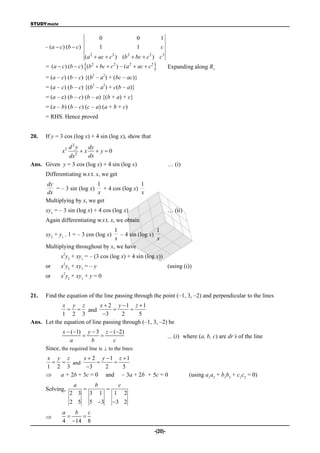
                      0                        0                1
       =             ac                      bc               c
            (a  c)( a 2  ac  c 2 ) (b  c) (b 2  bc  c 2 ) c3


                                                             -(19)-
STUDYmate


                                        0                  0       1
      =   (a  c) (b  c)               1                  1       c
                            (a 2  ac  c 2 ) (b 2  bc  c 2 ) c3
                            2        2       2
      = ( a  c ) (b  c ) (b  bc  c )  ( a  ac  c
                                                        2
                                                                       Expanding along R1
                                2           2
      = (a – c) (b – c) {(b – a ) + (bc – ac)}
                                2           2
      = (a – c) (b – c) {(b – a ) + c(b – a)}
      = (a – c) (b – c) (b – a) {(b + a) + c}
      = (a – b) (b – c) (c – a) (a + b + c)
      = RHS. Hence proved


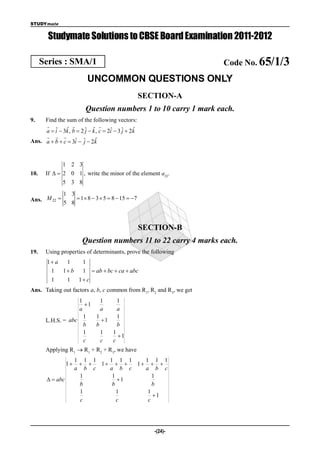
20.   If y = 3 cos (log x) + 4 sin (log x), show that
             d2y      dy
                x2
                 2
                   x  y0
              dx      dx
Ans. Given y = 3 cos (log x) + 4 sin (log x)                            … (i)
      Differentiating w.r.t. x, we get
      dy                   1                  1
         = – 3 sin (log x)    + 4 cos (log x)
      dx                   x                  x
      Multiplying by x, we get
      xy1 = – 3 sin (log x) + 4 cos (log x)                             … (ii)
      Again differentiating w.r.t. x, we obtain
                                  1                 1
      xy2 + y1 . 1 = – 3 cos (log x)– 4 sin (log x)
                                  x                 x
      Multiplying throughout by x, we have
                2
               x y2 + xy1 = – (3 cos (log x) + 4 sin (log x))
                2
      or       x y2 + xy1 = – y                                         (using (i))
                2
      or       x y2 + xy1 + y = 0


21.   Find the equation of the line passing through the point (–1, 3, –2) and perpendicular to the lines
            x y z           x  2 y 1 z  1
                and                   
            1 2 3             3      2     5
Ans. Let the equation of line passing through (–1, 3, –2) be
                x  (1) y  3 z  (2)
                                                                      ... (i) where (a, b, c) are dr’s of the line
                   a       b       c
      Since, the required line is  to the lines:
      x y z        x  2 y 1 z  1
          and             
      1 2 3         3     2    5
         a + 2b + 3c = 0 and – 3a + 2b + 5c = 0                                 (using a1a2 + b1b2 + c1c2 = 0)
                      a             b                c
      Solving,                                 
                     2 3        3 1                 1 2
                     2 5        5 3                3 2
                a   b   c
                    
                4 14 8
                                                               -(20)-
STUDYmate

              a b c
      or             
              2 7 4
            a = 2, b = –7, c = 4
      Putting the values of a, b and c in equation (i) we get
                 x 1           y 3 z  2
                                   
                  2            7   4
                 x 1           y 3 z  2
      or                                                                   [Note: Using  is not compulsory]
                   2             7    4


22.   Find the particular solution of the following differential equation
           dy
      ( x  1)  2e  y  1; y  0 when x = 0
           dx
Ans. Given differential equation is
                            dy
                 ( x  1)       2e  y  1                       ...(i)
                            dx
                      dy   dx
                    y
                                
             2e  1 x  1
              e y dy     dx
                           ,
             2e    y
                        x 1
      Integrating, we obtain
                     e y dy      dx
                    2e   y
                             
                                x 1
                                     C

                 e y dy        dx
                –               C
                 2e   y
                               x 1
                         y
            – log |2 – e | = log | x + 1| + C
                                        y
             log (x + 1) (2 – e ) = –C
                                    y       –c
            |(x + 1) (2 – e ) | = e
                                    y         –c
            (x + 1) (2 – e ) = ± e = A (say)
                                    y
            (x + 1) (2 – e ) = A                                 ... (ii)
      Also, when x = 0, y = 0,
                            0
      (0 + 1) (2 – e ) = A
            1(2 – 1) = A
            A=1
      Substituting this value of A in (ii), we obtain, the required particular solution as
                            y
      (x + 1) (2 – e ) = 1.


                                                   SECTION-C
                                Question numbers 23 to 29 carry 6 marks each.
28.   A girl throws a die. If she gets a 5 or 6, she tosses a coin three times and notes the number of heads. If she
      gets 1, 2, 3 or 4, she tosses a coin two times and notes the number of heads obtained. If she obtained
      exactly two heads, what is the probability that she threw 1, 2, 3 or 4 with the die?
Ans. Let     E1 : ‘1, 2, 3, or 4 is shown on die’, and

                                                         -(21)-
STUDYmate

             E2 : ‘5 or 6 is shown on die’,
      then E1 and E2 are mutually exclusive and exhaustive. Moreover,
                      4 2
             P(E1 )    
                      6 3
                      2 1
      and P(E 2 )  
                      6 3
      Let E : ‘exactly one head shows up’,
               E                                                                          2 1
      then   P    P (exactly one head shows up when coin is tossed twice) = P({HT, TH}) = 
                E1                                                                        4 2
                E 
      and    P       P (exactly one head shows up when coin is tossed thrice)
                E2 
             = P ({HTT, THT, TTH})
                 3
             =
                 8
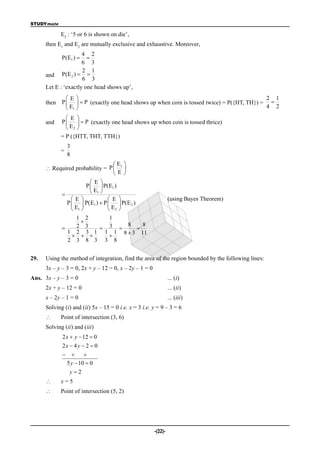
                                  E1 
       Required probability = P  
                                 E
                          E
                        P   P(E1 )
                          E1 
                 E              E                            (using Bayes Theorem)
               P   P(E1 )  P   P(E 2 )
                  E1            E2 
                 1 2    1
                  
                 2 3         8    8
                      3      
               1 2 3 1 1 1 8  3 11
                     
               2 3 8 3 3 8


29.   Using the method of integration, find the area of the region bounded by the following lines:
      3x – y – 3 = 0, 2x + y – 12 = 0, x – 2y – 1 = 0
Ans. 3x – y – 3 = 0                                              ... (i)
      2x + y – 12 = 0                                            ... (ii)
      x – 2y – 1 = 0                                             ... (iii)
      Solving (i) and (ii) 5x – 15 = 0 i.e. x = 3 i.e. y = 9 – 3 = 6
            Point of intersection (3, 6)
      Solving (ii) and (iii)
             2 x  y  12  0
             2x  4 y  2  0
                    
              5 y  10  0
               y2
            x=5
            Point of intersection (5, 2)


                                                        -(22)-
STUDYmate

Solving (iii) and (i)
       3x  y  3  0                                                       y
       3x  6 y  3  0
         
                               y  0 and x  1                                          B(3, 6)
         5y  0
     Point of intersection is (1, 0)
                                                                                             (ii )
Required area                                                                    (i)

      = Area of region ABCA                                                                           C(5, 2)
      = area of region ABCDA – Area of ACDA                                                (iii)

         3             5             5                                                                          x
                                                                        0       A(1, 0) E(3,0)       D(5,0)
         y(i ) dx   y(ii ) dx   y(iii ) dx
         1             3             1
         3                     5                       5
                                                         ( x  1)
         (3x  3) dx   (2 x  12)dx                        dx
         1                     3                       1
                                                             2
                           3                                       5
         3x 2                                        x2 x 
                                             
                                                   5
              3 x    x 2  12 x                  
         2               1
                                                   3
                                                       4 2 1
          27      3                                          25 5   1 1  
             9     3     ( 25  60)  ( 9  36)          
          2       2                                          4 2   4 2  
         24                 24 4 
         6  [35  27]    
        2                   4 2
      = 10 sq. units

                                                       ×·×·×·×·×


                                                               -(23)-
STUDYmate


        Studymate Solutions to CBSE Board Examination 2011-2012

      Series : SMA/1                                                Code No. 65/1/3
                          UNCOMMON QUESTIONS ONLY
                                                    SECTION-A
                         Question numbers 1 to 10 carry 1 mark each.
9.   Find the sum of the following vectors:
                              
               ˆ        j ˆ                     ˆ
     a  i  3k , b  2 ˆ  k , c  2i  3 ˆ  2k
         ˆ                           ˆ     j
       
Ans. a  b  c  3i  ˆ  2k
                    ˆ j       ˆ


              1 2 3
10.    If   2 0 1 , write the minor of the element a22.
              5 3 8
               1 3
Ans. M 22          1  8  3  5  8  15  7
               5 8


                                                    SECTION-B
                        Question numbers 11 to 22 carry 4 marks each.
19.    Using properties of determinants, prove the following
       1 a 1           1
        1 1 b          1  ab  bc  ca  abc
         1       1     1 c
Ans. Taking out factors a, b, c common from R1, R2 and R3, we get
                    1      1    1
                      1
                    a      a    a
                      1  1      1
       L.H.S. = abc        1
                      b  b      b
                      1    1  1
                                1
                      c    c  c
       Applying R1  R1 + R2 + R3, we have
                      1 1 1   1 1 1   1 1 1
                 1       1    1  
                      a b c   a b c   a b c
                       1       1         1
         abc                   1
                       b       b         b
                       1         1     1
                                         1
                       c         c     c


                                                       -(24)-
STUDYmate


                         1    1       1
             1 1 1 1 1              1
       abc  1            1
             a b c b b              b
                         1    1     1
                                      1
                         c    c     c
      Now applying C2  C2 – C1, C3  C3 – C1, we get

                                      1    0 0
               1 1 1                1
        abc 1                       1 0
               a b c                b
                                      1
                                           0 1
                                      c
             1 1 1
       abc 1    [1(1  0)]
             a b c

             1 1 1
       abc 1      abc  bc  ca  ab  R.H.S.
             a b c


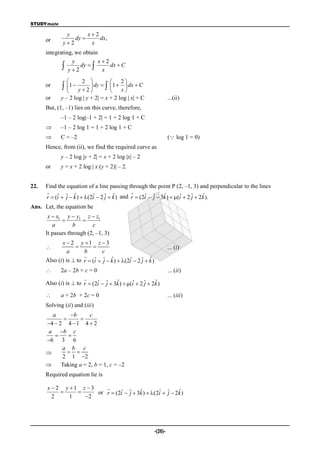
                                    2          d2y     dy
      If y = sin x, show that (1  x )               x  0.
                 –1
20.                                               2
                                               dx      dx
                             –1
Ans. We have y = sin x. Then
               dy      1
                  
               dx   (1  x 2 )

      or                  dy
                1  x2       1
                          dx
               d        2  dy 
      So           1  x ).   0
               dx          dx 

                1  x 2 ).
                             d 2 y dy d
                                    .
                             dx2 dx dx
                                               1 x )   0
                                                     2


                  d 2 y dy          2 x
        1  x 2 ).          .              0
                  dx 2 dx 2         1  x2
                          d2y       dy       x
      or        1  x 2 ). 2 –         .          0
                          dx        dx     1  x2
                           d2y     dy
      Hence (1  x 2 )        2
                                 x 0
                           dx      dx

21.   Find the particular solution of the following differential equation
              dy
              xy   ( x  2)( y  2); y  1 when x = 1
              dx
Ans. Given differential equation is
                     dy
              xy         ( x  2) ( y  2)                             ...(i)
                     dx


                                                               -(25)-
STUDYmate

               y       x2
      or          dy      dx,
              y2       x
      integrating, we obtain
                 y          x2
              y  2 dy   x dx  C
                      2                2
      or      1  y  2  dy   1  x  dx  C
                                       
      or     y – 2 log | y + 2| = x + 2 log | x| + C                  ...(ii)
      But, (1, –1) lies on this curve, therefore,
             –1 – 2 log|–1 + 2| = 1 + 2 log 1 + C
            –1 – 2 log 1 = 1 + 2 log 1 + C
            C = –2                                                   ( log 1 = 0)
      Hence, from (ii), we find the required curve as
             y – 2 log |y + 2| = x + 2 log |x| – 2
      or     y = x + 2 log | x (y + 2)| – 2.


22.   Find the equation of a line passing through the point P (2, –1, 3) and perpendicular to the lines
                                             
           ˆ j ˆ                  j ˆ                        ˆ                  ˆ
      r  (i  ˆ  k )  (2i  2 ˆ  k ) and r  (2i  ˆ  3k )  (i  2 ˆ  2k ).
                            ˆ                       ˆ j              ˆ     j
Ans. Let, the equation be
       x  x1 y  y1 z  z1
                     
         a        b       c
      It passes through (2, –1, 3)
             x  2 y 1 z  3
                                                                   ... (i)
                a      b        c
                       
                            ˆ j ˆ                  j ˆ
      Also (i) is  to r  (i  ˆ  k )  (2i  2 ˆ  k )
                                             ˆ
           2a – 2b + c = 0                                           ... (ii)
                       
                             ˆ j      ˆ       ˆ     j    ˆ
      Also (i) is  to r  (2i  ˆ  3k )  µ(i  2 ˆ  2k )

            a + 2b + 2c = 0                                          ... (iii)
      Solving (ii) and (iii)
        a       b      c
                   
      4  2 4  1 4  2
       a b c
              
      6 3 6
            a b c
               
            2 1 2
           Taking a = 2, b = 1, c = –2
      Required equation lie is

      x  2 y 1 z  3    
                              ˆ j      ˆ        ˆ j      ˆ
                       or r  (2i  ˆ  3k )  (2i  ˆ  2k )
        2     1   2


                                                             -(26)-
STUDYmate

                                                  SECTION-C
                        Question numbers 23 to 29 carry 6 marks each.
28.   Bag I contains 3 red and 4 black balls and Bag II contains 4 red and 5 black balls. Two balls are transferred
      at random from Bag I to Bag II and then a ball is drawn from Bag II. The ball so drawn is found to be red
      in colour. Find the probability that the transferred balls were both black.
Ans. Bag I contains 3 red, 4 black balls
      Bag II contains 4 red, 5 black balls
      2 balls transferred from Bag I to Bag II
      Case 1 :     Event A = Both black balls transferred
      Case 2 :     Event B = One black balls and One red ball transferred
      Case 3 :     Event C = Both red balls transferred.
                        4               3
                          C2 2            C  4C1 4           3
                                                                C   1
            P ( A)    7
                             , P ( B)  1 7
                                                  , P (C )  7 2 
                          C2 7               C2   7             C2 7
      Let event E = 1 ball drawn from bag II is red.
                         4
            P( E / A)                                           (Since bag II contains 4R, 7B balls now)
                        11
                         5
            P( E / B)                                            (Bag II contains 5R, 6B balls now)
                        11
                         6
      and P( E / C )                                             (Bag II contains 6R, 5B balls now)
                        11
      Required Probability = P (A/E)
                                                    P( A) P( E / A)
                              
                                  P( A) P( E / A)  P( B) P( E / B)  P(C ) P( E / C )
                                         2 4
                                          
                                        7 11
                                2 4 4 5 1 6
                                      
                                7 11 7 77 7 11
                                    8       8   4
                                            
                                8  20  6 34 17


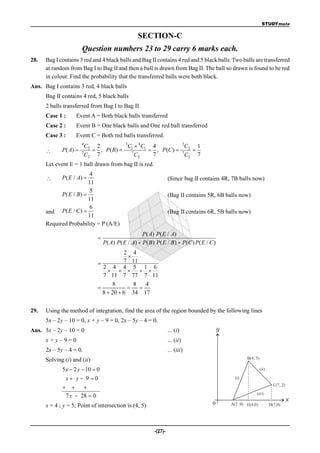
29.   Using the method of integration, find the area of the region bounded by the following lines
      5x – 2y – 10 = 0, x + y – 9 = 0, 2x – 5y – 4 = 0.
Ans. 5x – 2y – 10 = 0                                             ... (i)                y
      x+y–9=0                                                     ... (ii)
      2x – 5y – 4 = 0.                                            ... (iii)
      Solving (i) and (ii)                                                                           B(4, 5)

             5 x  2 y  10  0                                                                                (ii )

               x y 9 0                                                                      (i)
                                                                                                                         C(7, 2)
                   
                                                                                                          (iii)
              7 x  28  0
                                                                                                                                   x
      x = 4 ; y = 5; Point of intersection is (4, 5)                                0        A(2, 0) E(4,0)            D(7,0)


                                                         -(27)-
STUDYmate

    Solving (i) and (iii)
            10 x  4 y  20  0
            10 x  25 y  20  0
                         
                    21 y  0
    i.e.,   y = 0; x = 2, therefore, Point of intersection is (2, 0)
    Solving (ii) and (iii)
            2 x  2 y  18  0
            2x  5 y  4  0
              
             7 y  14  0
    i.e.,   y = 2; x = 7, therefore, Point of intersection is (7, 2)
    Required Area = Area of Region ABCA
            = Area of Region ABCDA – Area of Region ACDA
                4           7             7
              y(i ) dx   y(ii ) dx   y(iii ) dx
                2           4             2
                4                    7                  7
                5 x  10                         2x  4 
                        dx   (9  x) dx            dx
              2
                     2          4              2
                                                      5 
                                4                 7            7
              5x2              x2     x2 4x 
                  5x    9x      
              4        2       2 
                                       4  5  5 
                                                   2

               80     20              49       16    49 28   4 8  
               20     10     63     36            
               4      4                2        2    5  5   5 5 
                                   21 4 
             [5]  [38.5  28]    
                                   5 5
            = 43.5 – 28 – 5
            = 10.5
                21
                  sq. units
                2

                                                        ×·×·×·×·×


                                                            -(28)-

Maths CBSE 2011-12

  • 1.
    Studymate Solutions toCBSE Board Examination 2011-2012 Series : SMA/1 Code No. 65/1/1 Candidates must write the Code on Roll No. the title page of the answer-book.  Please check that this question paper contains 8 printed pages.  Code number given on the right hand side of the question paper should be written on the title page of the answer-book by the candidate.  Please check that this question paper contains 29 questions.  Please write down the Serial Number of the questions before attempting it.  15 minutes time has been allotted to read this question paper. The question paper will be distributed at 10.15 a.m. From 10.15 a.m. to 10.30 a.m., the student will read the question paper only and will not write any answer on the answer script during this period. MATHEMATICS [Time allowed : 3 hours] [Maximum marks : 100] General Instructuions: (i) All questions are compulsory. (ii) Questions numbered 1 to 10 are very short-answer questions and carry 1 mark each. (iii) Questions numbered 11 to 22 are short-answer questions and carry 4 marks each. (iv) Questions numbered 23 to 29 are also short-answer questions and carry 6 marks each. (v) Use of calculators is not allowed. -(1)-
  • 2.
    STUDYmate SECTION-A Question numbers 1 to 10 carry 1 mark each. 1. If a line has direction ratios 2, –1, –2, then what are its direction cosines? Ans. d.r.’s = <2, –1, –2> 2 1 2  d.c.’s = , , 3 3 3   2. Find ‘’ when the projection of a      4 k on b  2  6   3k is 4 units. i j  i j     a.b Ans. Projection of a on b =  b 2  6  12 4= 4  36  9 2  18 4= 7 28 – 18 = 2 5=    3. Find the sum of the vectors a    2   k , b  2  4   5k and c    6   7 k . i j  i j  i j  Ans. a  b  c  0  4   k    i j  3 1 4. Evaluate:  x dx 2 3 1 3  x dx  log | x | 3 Ans. 2 = log 3 – log 2 = log   2 2 5. Evaluate  (1  x) xdx  x  ( x)  dx 3 Ans. 2 3 5 x 2 x 2 = 3  5 C 2 2 2 32 2 52 = x  x C 3 5 5 3 8 6. If  = 2 0 1 , write the minor of the element a23. 1 2 3 5 3 Ans. Minor of a23 = = 10 – 3 = 7. 1 2 -(2)-
  • 3.
    STUDYmate  2 3  1 3   4 6  7. If     , write the value of x.  5 7  2 4   9 x   2 3  1 3   4 6 Ans.      5 7  2 4   9 x  2  6 6  12   4 6 5  14 15  28    9 x      4 6   4 6   9 13   9 x       x = 13  cos  sin    sin   cos   8. Simplify: cos     sin   cos  sin     sin  cos      cos2  cos  sin   sin 2   cos  sin  Ans. =   cos  sin     cos2   sin  cos  sin 2   1 0  =   0 1  1  1 9. Write the principal value of cos1    2sin 1    2  2 –1  1 –1  1 Ans. cos   – 2 sin     2  2 –1     cos  cos  + 2 sin  sin  –1  3  6    2 3 6   2   3 3 3 10. Let * be a ‘binary’ operation on N given by a * b = LCM (a, b) for all a, b  N. Find 5 * 7. Ans. a * b = LCM of (a, b), a, b  N 5 * 7 = LCM of (5, 7) = 35 SECTION-B Question numbers 11 to 22 carry 4 marks each. y x dy 11. If (cos x) = (cos y) , find . dx OR dy sin 2 (a  y ) If sin y = x sin (a + y), prove that  dx sin a y x Ans. Given (cos x) = (cos y) , taking logarithms on the two sides, we have y x log (cos x) = log (cos y) -(3)-
  • 4.
    STUDYmate or y log (cos x) = x log (cos y) Differentiating both sides w.r.t. x, we get  1  dy  1  dy y  ( sin x)  log(cos x) dx  x  cos y  ( sin y ) dx  log(cos y ).1  cos x    dy dy  log (cos x) + x tan y = log (cos y) + y tan x dx dx dy   log(cos x)  x tan y  = log (cos y) + y tan x dx dy log(cos y )  y tan x   dx log(cos x)  x tan y OR Ans. sin y = x sin (a + y) sin y  =x sin( a  y ) sin( a  y )cos y  sin y cos( a  y ) dx   sin 2 ( a  y ) dy sin( a  y  y ) dx   sin 2 (a  y ) dy sin a dx   sin (a  y ) dy 2 sin 2 (a  y ) dy   sin a dx 12. How many times must a man toss a fair coin, so that the probability of having at least one head is more than 80%? Ans. Let the man throws the coin ‘n’ times. 1 Probability of getting a head in a single throw, p  2 1 Probability of not getting a head in a single throw, q  2 Given: Probability that the man gets atleast one head is more than 80%. i.e. P(atleast 1 Head) > 80% 80 i.e. 1 – P (no head)  100 n 0 0 1 1 8 i.e. 1  n C0      2  2  10 n 1 4 i.e. 1    2 5 n 1 1 i.e.     2 5 n 1 1 i.e.    2 5 n i.e. 2 >5 -(4)-
  • 5.
    STUDYmate i.e. n = 3 or more.  The man must throw the coin atleast 3 times. 13. Find the Vector and Cartesian equations of the line passing through the point (1, 2, –4) and perpendicular x  8 y  19 z  10 x  15 y  29 z  5 to the two lines   and   . 3 16 7 3 8 5 Ans. Any line through (1, 2, –4) can be written as x 1 y  2 z  4   ...(i) a b c (i) is at right angles to given lines with d.n. < 3, –16, 7 > and < 3, 8, –5 > if 3a – 16b + 7c = 0 ...(ii) and 3a + 8b – 5c = 0 ...(iii) By cross-multiplication, we have a b c   80  56 21  15 24  48 a b c or   24 36 72 a b c or   ...(iv) 2 3 6 From (i) and (iv), we find that required line is x 1 y  2 z  4   2 3 6 In vector form, this line can be written as  i  j  i j   r    2   4k   2  3   6k ( d.n. of the line are < 2, 3, 6 > and line passes through < 1, 2, –4 >)           14. If a, b, c are three vectors such that a  5, b  12, c  13 , and a  b  c  0 , find the value of    a.b  b.c  c.a .     Ans. a  b  c  0          (a  b  c) · (a  b  c)  0·0   2 i.e. abc 0        i.e. | a |2  | b |2  | c |2 2(a · b  b·c  c·a )  0     i.e. 5 + 12 + 13 + 2( a · b  b·c  c·a )  0 2 2 2     i.e. 338  2(a · b  b·c  c·a)  0     i.e. a · b  b·c  c·a  169 15. Solve the following differential equation: dy 2 x2  2 xy  y 2  0 dx dy Ans. 2 x 2  2 xy  y 2 dx -(5)-
  • 6.
    STUDYmate dy 2 xy  y 2   dx 2x2 dy 2 xy y 2    dx 2 x 2 2 x 2 dy y 1  y 2     dx x 2  x 2  ...(i)   dy dv Put y = vx and vx in (i) we get, dx dx dv 1 v  x  v  v2 dx 2 dv dx  2 2   2 v x  v 2 1   2    log | x |  C  2  1  2    log | x |  C v 2 x    log | x |  C y 2x  log | x |   C ; (y  0) y 16. Find the particular solution of the following differential equation; dy  1  x 2  y 2  x 2 y 2 , given that y = 1 when x = 0 dx dy Ans.  1  x2  y 2  x2 y 2 dx dy  (1  x 2 )  y 2 (1  x  )  (1  x 2 )(1  y 2 ) dx dy  1  y 2   (1  x )dx 2 x3 tan 1 y  x  C 3 Now, when x = 0, y = 1 03   tan 1 1  0  C  C 3 4 1 x3   Solution is tan y  x   3 4 17. Evaluate :  sin x sin 2 x sin 3x dx OR 2 Evaluate :  (1  x)(1  x2 ) dx Ans. Now, sin x sin 2x sin 3x -(6)-
  • 7.
    STUDYmate 1 = {2sin 3x sin x} sin 2x 2 1 = {cos (2x) – cos (4x)} sin 2x 2 1 = {2 sin 2x cos 2x – 2 cos 4x sin 2x} 4 1 = {sin 4 x – (sin 6x – sin 2x)} 4   sin x sin 2 x sin 3xdx 1 4 = (sin 4 x  sin 6 x  sin 2 x)dx 1   cos 4 x  cos6 x  cos 2 x  4  4 =    C 6 2  cos 4 x cos6 x cos 2 x =    C 16 24 8 OR 2 A Bx  C Ans. Let   ...(i) (1  x)(1  x ) 1  x 1  x 2 2 2 Multiplying both sides by (1 – x) (1 + x ), we have 2 2 = A (1 + x ) + (Bx + C) (1 – x) 2 2 = x (A – B) + x (B – C) + (A + C) ...(ii) Equating coefficients on the two sides of (ii), we get A – B = 0, B – C = 0, A + C = 2  A=B=C=1 2 1 x 1    (1  x)(1  x 2 ) 1  x x 2  1 2 1 x 1   (1  x)(1  x 2 ) dx =  1  x dx   x 2 1 dx log |1  x | 1 2 x 1 =   2 dx   2 dx 1 2 x 1 x 1 1 2 –1 = –log |x – 1| + log (1 + x ) + tan x + C. 2 3 18. Find the point on the curve y = x – 11x + 5 at which the equation of tangent is y = x – 11. OR Using differentials, find the approximate value of 49.5 3 Ans. Given curve is y = x – 11x + 5 ...(i) Given line is y = x – 11 ...(ii) Slope of line (ii) = 1 ( (ii) is of the form y = mx + b) dy 2 From (i), = 3x – 11 1 dx Since, slope of tangent = 1 -(7)-
  • 8.
    STUDYmate dy 2  = 1, i.e., when 3x – 11 = 1 dx  2 2 2  x = 2 ( 3x – 11 = 1  3x = 12  x = 4) When x = 2, then 3 from (i), y = 2 – 11 × 2 + 5 = –9 When x = –2, then 3 from (i), y = (–2) – 11 (–2) + 5 = 19 Thus, we find that at the points (2, –9) and (–2, 19), the slope of tangent is 1. OR 1 Ans. Let f ( x)  x so that f ( x )  . 2 x Now f ( x  x)  f ( x)  xf ( x) x  x  x  x  2 x Taking x = 49 and x = 0.5, we obtain 0.5 0.5 49.5  49  7  7  0.036 2 49 14  49.5  7.036 –1 2 19. If y = (tan x) , show that ( x 2  1)2 y2  2 x( x 2  1) y1  2 . –1 2 Ans. Given y = (tan x) we get dy 1  2(tan 1 x) dx 1  x2 2 –1 or (1 + x ) y1 = 2 tan x Again differentiating w.r.t. x we get 2 (1  x 2 ) y2  y1 (0  2 x)  1  x2  ( x 2  1)2 y2  2 x( x 2  1) y1  2 20. Using properties of determinants, prove that bc qr yz a p x ca r p zx 2b q y ab pq x y c r z bc qr yz Ans. LHS = c  a r p zx ab pq x y Interchanging rows and columns, we get, bc ca ab qr r p pq yz zx x y Operating C3  C3 – C1 – C2, we have -(8)-
  • 9.
    STUDYmate bc ca ab bc c  a 2c qr r p pq  qr r  p 2r 1 (Take out –2 from C3 i.e., operate C3  C) yz zx x y yz zx 2 z 2 3 bc ca c = 2 q  r r p r Now, Operate C1  C1 – C3 and C2  C2 – C3 yz zx z b a c = 2 q p r , operate C1  C2 y x z a b c = 2p q r x y z a p x = 2b q y (by interchanging rows and columns again) c r z  cos x   x    21. Prove that tan 1     , x   ,   1  sin x  4 2  2 2 OR 8 3  36  Prove that sin 1    sin 1    cos1    17  5  85     x  x sin   x  2sin    cos    cos x  2    4 2  4 2 Ans.  1  sin x    x 1  cos   x  2cos 2    2   4 2  x sin      4 2   tan    x     x 4 2 cos     4 2  cos x   x  tan 1     . Hence proved  1  sin x  4 2 OR 1 8 1 3 Ans. Let x = sin and y = sin 17 5 8 3 sin x = and sin y = 17 5  cos x = 1  sin 2 x and cos y = 1  sin 2 y 15 4 cos x = and cos y = 17 5 Now, cos (x + y) = cos x cos y – sin x sin y 15 4 8 3 =    17 5 17 5 -(9)-
  • 10.
    STUDYmate 36 = 85 36 –1  x + y = cos 85 8 3 36  sin 1  sin 1  cos 1 Hence Proved 17 5 85  x2 22. Let A    {3} and B    {1} . Consider the function f : A  B defined by f ( x)    . Show that  x3 –1 f is one-one and onto and hence find f . x2 Ans. f ( x)  x 3 Let x1 , x2  A Let f ( x1 )  f ( x2 ) x1  2 x2  2 i.e.  x1  3 x2  3 i.e. (x1 – 2) (x2 – 3) = (x1 – 3) (x2 – 2) i.e. x1x2 – 3x1 – 2x2 + 6 = x1x2 – 2x1 – 3x2 + 6 i.e. –x1 = – x2 i.e. x1 = x2  f is one - one. ... (i) x2 Also y  x3 i.e. y (x – 3) = (x – 2) xy – 3y = x – 2 x (y – 1) = 3y – 2 3y  2 x y 1  f is onto, y  1, y  B ... (ii) from (i) and (ii), f is bijective  it is invertible. x2 For inverse : Interchanging x and y in y = , we get x3 3x  2 –1 3x  2  y= or f (x) = x 1 x 1 SECTION-C Question numbers 23 to 29 carry 6 marks each. 23. Find the equation of the plane determined by the points A (3, –1, 2), B (5, 2, 4) and C (–1, –1, 6) and hence find the distance between the plane and the point P (6, 5, 9). Ans. Equation of plane in three point form is -(10)-
  • 11.
    STUDYmate x3 y 1 z2 53 2 1 42 0 1  3 1  1 6  2 x  3 y 1 z  2 i.e., 2 3 2 0 4 0 4 i.e. (x – 3) (12) – (y + 1) (8 + 8) + (z – 2) (12) = 0 i.e., 3(x – 3) – 4 (y + 1) + 3 (z – 2) = 0 i.e., 3x – 4y + 3z – 19 = 0 is the equation of the required plane. 18  20  27  19 and d= 9  16  9 6 34 d=  34 34 3 34 d= . 17 24. Of the students in a college, it is known that 60% reside in hostel and 40% are day scholars (no residing in hostel). Previous year results report that 30% of all students who reside in hostel attain ‘A’ grade and 20% of day scholars attain ‘A’ grade in their annual examination. At the end of the year, one student is chosen at random from the college and he has an ‘A’ grade, what is the probability that the student is a hostlier? Ans. Let E1 : ‘A student is residing in hostel’ and E2 : ‘A student is a day scholar’ then E1 and E2 are mutually exclusive and exhaustive. Moreover, 60 3 40 2 P(E1) =  and P(E2) =  100 5 100 5 Let E : Student attains ‘A’ grade; 30 3 20 2 then P(E/E1) =  and P(E/E2) =  100 10 100 10 Required probability = P (E1/E) P(E/E1 )P(E1 ) = [By Baye’s Theorem] P(E/E1 )P(E1 )+P(E/E 2 )P(E 2 ) 3 3  10 5 9 9 =   3 3 2 2 9  4 13    10 5 10 5 25. A manufacturer produces nuts and bolts. It takes 1 hour of work on machine A and 3 hours on machine B to produce a package of nuts. It takes 3 hours on machine A and 1 hour on machine B to produce a package of bolts. He earns a profit of ` 17.50 per package on nuts and ` 7 per package of bolts. How many packages of each should be produced each day so as to maximize his profits if he operates his machines for at the most 12 hours a day? Form the above as a linear programming problem and solve it graphically. -(11)-
  • 12.
    STUDYmate Ans. Let themanufacturer produces x Packages of nuts and y Packages of bolts each day. We construct the following table: Item Number of packages Total Time on machine A Total Time on machine B Profits Nuts x 1x hrs 3 x hrs 17.50 x Bolts y 3 y hrs 1 y hr 7y Total x  3 y hrs 3 x  y hrs 17.50 x  7 y We have to maximize profit, i.e., 35 P = 17.50x + 7y = x  7y ...(i) 2 Y subject to the constraints x + 3y  12 ...(ii) D(0,12) 3x + y  12 ...(iii) x, y  0 ...(iv) First of all, we locate the region represented by (2), (3) and (4). For this, we consider the line x + 3y = 12, which passes through A (12, 0) and B (0, 4) and the line 3x + y = 12, which passes through the points B(0,4) E(3,3) C (4, 0) and D (0, 12). The two lines meet at E (3, 3). A(12,0) X The feasible region is shown shaded in the figure. O C(4,0) Note that O (0, 0) lies in this region. The corner points, which are to be examined for optimum solution are C (4, 0), E (3, 3) and B (0, 4). 35 At C (4, 0) P =  4  7  0  70 2 35 At E (3, 3) P =  3  7  3  73.5 2 35 At B (0, 4) P =  0  7  4  28 2 Hence the profit is maximum equal to ` 73.50 when 3 packages of each of nuts and bolts are manufactured.  /4  26. Prove that ( tan x  cot x )dx  2. 2 0 OR 3 Evaluate :  (2 x 2  5 x) dx as a limit of a sum. 1  sin x cos x  Ans. Let I =    cos x  sin x  dx    sin x  cos x =  sin x cos x dx Now let (sin x – cos x) = t ...(i) (cos x + sin x)dx = dt 2 2 2 Squaring (i), sin x + cos x – 2 sin x cos x = t 1 t2   sin x cos x 2 -(12)-
  • 13.
    STUDYmate When x = 0, t = 0 – 1 = –1  1 1 When x = ,t=  0 4 2 2 0 dt  I= 2 1 1 t2 2  sin 1 t   0 =   1 = 2 sin (0)  sin 1  1   1      = 2 0        2   = 2 2 OR 3 Ans. I =  (2 x  5 x) dx 2 1 b  a 3 1 a = 1, b = 3  h =  n n  nh = 2 2 Now, f(x) = 2x + 5x 2  f(a) = f(1) = 2(1) + 5(1) = 7 2 f(a + h) = f(1 + h) = 2(1 + h) + 5(1 + h) 2 = 2(1 + h + 2h) + 5 + 5h 2 = 2h + 9h + 7 2 f(a + 2h) = f(1 + 2h) = 2(1 + 2h) + 5(1 + 2h) 2 = 2(1 + 4h + 4h) + 5 + 10h 2 = 8h + 18h + 7 ... ... ... ... ... ... ... ...         2 f a  n 1 h  f 1  n 1 h = 2 1  n 1 h  5 1 n 1 h = 2 1   n  1 h 2  2h( n  1)   5  5h  n  1 2   2 2 = 2(n – 1) h + 9h (n – 1) + 7 b Since  f ( x)dx = hLt0 h  f (a )  f (a  h)  f (a  2h)  ...  f a  n  1 h       a I = hLt0 h  7  {7  9h  2h }  {7  18h  8h }  ...  {7  9h( n  1)  2(n  1) h } 2 2 2 2         2 = hLt0 h 7 n  9h(1  2  ...  n  1)  2h 2 12  22  ...  n  1      n(n  1) (n)(n  1)(2n  1)  = hLt0 h 7n  9h  2h 2    2 6   9hn(hn  h) hn(hn  h)(2hn  1)  = hLt0 h 7 hn      2 3  -(13)-
  • 14.
    STUDYmate  9  2(2  0) 2(2  0)(4  0)  = 7  2     2 3   16  = 14  18    3  42  54  16  =    3  112 = 3 27. Using the method of integration, find the area of the region bounded by the lines 3x – 2y + 1 = 0, 2x + 3y – 21 = 0 and x – 5y + 9 = 0. 3x  1 x 0  13 Ans. L1: 3x – 2y + 1 = 0  y= y 0.5 0 2 21  2 x x 0 10.5 L2: 2x + 3y – 21 = 0  y= y 7 0 3 x9 x 0 9 L3: x – 5y + 9 = 0  y= y 1.8 0 5 L2 C (3, 5) A B (6,3) (1,2) L3 (–9, 0) (10.5, 0) L1 Point of Intersection: 3x  1 21  2 x L1 and L2 :  2 3  9x + 3 = 42 – 4x  13x = 39  x=3  y=5 3x  1 x  9 L2 and L3 :  2 5  15x + 5 = 2x + 18  13x = 19  x=1  y=2 21  2 x x  9 L2 and L3 :  3 5 -(14)-
  • 15.
    STUDYmate  105 – 10x = 3x + 27  78 = 13x  x=6  y=3  A = (1, 2) ; B = (6, 3) ; C = (3, 5) 3 6 6 Thus, required area: A =  ydx   ydx   ydx 1 ( Line1) 3 ( Line 2) 1 ( Line 3) 3 6 6 1 1 1 = 21 (3x  1)dx  3  (21  2 x)dx  5  ( x  9)dx 3 1 3 6 1  3x 2  1 2 6 1  x2  = 2 2  x   3  21x  x  3  5  2  9 x    1  1 1  27 3  1 1 1  = 2 2  3  2  1  3 126  36  63  9  5 18  54  2  9     1  125  25 1 1 = 2 14    36   3  5 2    25 25 38  25 13 = 7  12   19    sq. units. 2 2 2 2 28. Show that the height of a closed right circular cylinder of given surface and maximum volume, is equal to the diameter of its base. Ans. Let r be the radius of the circular base, h the height and S, the total surface area of a right circular 2 cylinder, then S = 2r + 2rh is given to be a constant. Let V be the volume of the cylinder with the above dimensions, then 2  S  2r  r S  2r 2 2 V = r h = r    2 (S  2r ) 2 2 2 [ S = 2r + 2rh,  h = ]  2r  2r Sr S S  2r 2 S  V=  r 3 ,0  r  ...(i) [ h = > 0,  r < ] 2 2 2r 2 Differentiating (i), twice w.r.t. r, we get dV S   3r 2 dr 2 d 2V and  6r dr 2 dV  S  Now exists at all points in  0,  dr   2  and  dV S S  0   3r 2  0  r2 = dr 2 6 S S  r= [ 0 < r < ] 6 2  d 2V  S Also,  2   6 0  dr  r  S/(6  ) 6 S  V has a local maximum value at r = 6 -(15)-
  • 16.
    STUDYmate  S  S  S  Since V is continuous in  0,  and has only one extremum at   0,   , therefore, V is   2   6  2   S absolutely maximum for r = . 6  S  S  2   S S  2r2  6   2S 6 When r = , then h =  6 2r S 6 S 2 6 S = i.e., h = 2 = 2 radius = diameter. . 6 So, volume is maximum when the height is equal to the diameter. 29. Using matrices, solve the following system of linear equations: x – y + 2z = 7 3x + 4y – 5z = – 5 2x – y + 3z = 12 OR Using elementary operations, find the inverse of the following matrix.  1 1 2     1 2 3  3 1 1   Ans. The given system can be written as AX = B,  1 1 2    where A   3 4 5  2 1 3     x X   y   z   7 and B   5   12    1 1 2 Here | A |  3 4 5 2 1 3 = 1 (12 – 5) – (– 1) (9 + 10) + 2(–3 – 8) = 7 + 19 – 22 = 4  0 –1  A exists Therefore, the given system is consistent and has a unique solution given by 1  1  X = A B= (adj. A)  B | A |  -(16)-
  • 17.
    STUDYmate t  7 19 11  7  1    = 4  1 1 1   5  3 11  7  12      7 1 3  7  1   19 1 11   5   4  11 1 7  12      49  5  36  1   133  5  132   4  77  5  84     x  8   2  y   1  4   1     4    z   12   3       x = 2 , y = 1, z = 3 OR Ans. A = IA  1 1 2  1 0 0   1 2 3  0 1 0 A      3 1 1  0 0 1      R1   R2  1 2 3 0 1 0  1 1 2   1 0 0  A      3 1 1  0 0 1      R2  R2 + R1 ; R3  R3 – 3R1 1 2 3  0 1 0 0 3 5   1 1 0  A     0 5 8    0 3 1    R3  R3 + 2R2 1 2 3  0 1 0 0 3 5  1 1 0  A     0 1 2    2 1 1    R2  R3 1 2 3   0 1 0  0 1 2    2 1 1  A     0 3 5   1 1 0      R1  R1 – 2R2 R3  R3 – 3R2 1 0 1  4 3 2   0 1 2    2 1 1  A      0 1 1  5 4 3     R3  – R3 -(17)-
  • 18.
    STUDYmate 1 0 1  4 3 2  0 1 2    2 1 1  A     0 0 1   5 4 3      R1  R1 + R3 R2  R2 – 2R3 1 0 0   1 1 1  0 1 0    8 7 5 A     0 0 1   5 4 3       1 1 1   A 1   8 7 5    5 4 3    ×·×·×·×·× -(18)-
  • 19.
    STUDYmate Studymate Solutions to CBSE Board Examination 2011-2012 Series : SMA/1 Code No. 65/1/2 UNCOMMON QUESTIONS ONLY SECTION-A Question numbers 1 to 10 carry 1 mark each. 9. Find the sum of the following vectors:    a  i  2 ˆ, b  2i  3 ˆ, c  2i  3k ˆ j ˆ j ˆ ˆ    ˆ Ans. a  b  c  (i  2 ˆ)  (2i  3 ˆ)  (2i  3k ) ˆ j ˆ j ˆ ˆ j ˆ  5i  5 ˆ  3k 5 3 8 10. If   2 0 1 , write the cofactor of the element a32. 1 2 3 5 8 Ans. M 32  (1)3 2  (5  16)  11 2 1 SECTION-B Question numbers 11 to 22 carry 4 marks each. 19. Using properties of determinants, prove the following 1 1 1 a b c  (a  b)(b  c)(c  a )(a  b  c) a 3 b3 c3 1 1 1 Ans.   a b c a 3 b3 c3 Applying C1  C1 – C3 (Given) C2  C2 – C3 0 0 1   ac bc c a 3  c3 b3  c 3 c3 0 0 1 = ac bc c (a  c)( a 2  ac  c 2 ) (b  c) (b 2  bc  c 2 ) c3 -(19)-
  • 20.
    STUDYmate 0 0 1 = (a  c) (b  c) 1 1 c (a 2  ac  c 2 ) (b 2  bc  c 2 ) c3 2 2 2 = ( a  c ) (b  c ) (b  bc  c )  ( a  ac  c 2  Expanding along R1 2 2 = (a – c) (b – c) {(b – a ) + (bc – ac)} 2 2 = (a – c) (b – c) {(b – a ) + c(b – a)} = (a – c) (b – c) (b – a) {(b + a) + c} = (a – b) (b – c) (c – a) (a + b + c) = RHS. Hence proved 20. If y = 3 cos (log x) + 4 sin (log x), show that d2y dy x2 2 x  y0 dx dx Ans. Given y = 3 cos (log x) + 4 sin (log x) … (i) Differentiating w.r.t. x, we get dy 1 1 = – 3 sin (log x) + 4 cos (log x) dx x x Multiplying by x, we get xy1 = – 3 sin (log x) + 4 cos (log x) … (ii) Again differentiating w.r.t. x, we obtain 1 1 xy2 + y1 . 1 = – 3 cos (log x)– 4 sin (log x) x x Multiplying throughout by x, we have 2 x y2 + xy1 = – (3 cos (log x) + 4 sin (log x)) 2 or x y2 + xy1 = – y (using (i)) 2 or x y2 + xy1 + y = 0 21. Find the equation of the line passing through the point (–1, 3, –2) and perpendicular to the lines x y z x  2 y 1 z  1   and   1 2 3 3 2 5 Ans. Let the equation of line passing through (–1, 3, –2) be x  (1) y  3 z  (2)   ... (i) where (a, b, c) are dr’s of the line a b c Since, the required line is  to the lines: x y z x  2 y 1 z  1   and   1 2 3 3 2 5  a + 2b + 3c = 0 and – 3a + 2b + 5c = 0 (using a1a2 + b1b2 + c1c2 = 0) a b c Solving,   2 3 3 1 1 2 2 5 5 3 3 2 a b c    4 14 8 -(20)-
  • 21.
    STUDYmate a b c or    2 7 4  a = 2, b = –7, c = 4 Putting the values of a, b and c in equation (i) we get x 1 y 3 z  2   2 7 4 x 1 y 3 z  2 or   [Note: Using  is not compulsory] 2 7 4 22. Find the particular solution of the following differential equation dy ( x  1)  2e  y  1; y  0 when x = 0 dx Ans. Given differential equation is dy ( x  1)  2e  y  1 ...(i) dx dy dx  y  2e  1 x  1 e y dy dx   , 2e y x 1 Integrating, we obtain e y dy dx  2e y  x 1 C e y dy dx  –  C 2e y x 1 y  – log |2 – e | = log | x + 1| + C y log (x + 1) (2 – e ) = –C y –c  |(x + 1) (2 – e ) | = e y –c  (x + 1) (2 – e ) = ± e = A (say) y  (x + 1) (2 – e ) = A ... (ii) Also, when x = 0, y = 0, 0 (0 + 1) (2 – e ) = A  1(2 – 1) = A  A=1 Substituting this value of A in (ii), we obtain, the required particular solution as y (x + 1) (2 – e ) = 1. SECTION-C Question numbers 23 to 29 carry 6 marks each. 28. A girl throws a die. If she gets a 5 or 6, she tosses a coin three times and notes the number of heads. If she gets 1, 2, 3 or 4, she tosses a coin two times and notes the number of heads obtained. If she obtained exactly two heads, what is the probability that she threw 1, 2, 3 or 4 with the die? Ans. Let E1 : ‘1, 2, 3, or 4 is shown on die’, and -(21)-
  • 22.
    STUDYmate E2 : ‘5 or 6 is shown on die’, then E1 and E2 are mutually exclusive and exhaustive. Moreover, 4 2 P(E1 )   6 3 2 1 and P(E 2 )   6 3 Let E : ‘exactly one head shows up’, E 2 1 then P    P (exactly one head shows up when coin is tossed twice) = P({HT, TH}) =   E1  4 2  E  and P   P (exactly one head shows up when coin is tossed thrice)  E2  = P ({HTT, THT, TTH}) 3 = 8  E1   Required probability = P   E E P   P(E1 )   E1  E  E  (using Bayes Theorem) P   P(E1 )  P   P(E 2 )  E1   E2  1 2 1  2 3 8 8   3   1 2 3 1 1 1 8  3 11     2 3 8 3 3 8 29. Using the method of integration, find the area of the region bounded by the following lines: 3x – y – 3 = 0, 2x + y – 12 = 0, x – 2y – 1 = 0 Ans. 3x – y – 3 = 0 ... (i) 2x + y – 12 = 0 ... (ii) x – 2y – 1 = 0 ... (iii) Solving (i) and (ii) 5x – 15 = 0 i.e. x = 3 i.e. y = 9 – 3 = 6  Point of intersection (3, 6) Solving (ii) and (iii) 2 x  y  12  0 2x  4 y  2  0    5 y  10  0 y2  x=5  Point of intersection (5, 2) -(22)-
  • 23.
    STUDYmate Solving (iii) and(i) 3x  y  3  0 y 3x  6 y  3  0    y  0 and x  1 B(3, 6) 5y  0  Point of intersection is (1, 0) (ii ) Required area (i) = Area of region ABCA C(5, 2) = area of region ABCDA – Area of ACDA (iii) 3 5 5 x 0 A(1, 0) E(3,0) D(5,0)   y(i ) dx   y(ii ) dx   y(iii ) dx 1 3 1 3 5 5 ( x  1)   (3x  3) dx   (2 x  12)dx   dx 1 3 1 2 3 5  3x 2   x2 x    5   3 x    x 2  12 x     2  1 3  4 2 1  27  3   25 5   1 1      9     3     ( 25  60)  ( 9  36)            2  2   4 2   4 2    24   24 4     6  [35  27]     2   4 2 = 10 sq. units ×·×·×·×·× -(23)-
  • 24.
    STUDYmate Studymate Solutions to CBSE Board Examination 2011-2012 Series : SMA/1 Code No. 65/1/3 UNCOMMON QUESTIONS ONLY SECTION-A Question numbers 1 to 10 carry 1 mark each. 9. Find the sum of the following vectors:    ˆ j ˆ ˆ a  i  3k , b  2 ˆ  k , c  2i  3 ˆ  2k ˆ ˆ j    Ans. a  b  c  3i  ˆ  2k ˆ j ˆ 1 2 3 10. If   2 0 1 , write the minor of the element a22. 5 3 8 1 3 Ans. M 22   1  8  3  5  8  15  7 5 8 SECTION-B Question numbers 11 to 22 carry 4 marks each. 19. Using properties of determinants, prove the following 1 a 1 1 1 1 b 1  ab  bc  ca  abc 1 1 1 c Ans. Taking out factors a, b, c common from R1, R2 and R3, we get 1 1 1 1 a a a 1 1 1 L.H.S. = abc 1 b b b 1 1 1 1 c c c Applying R1  R1 + R2 + R3, we have 1 1 1 1 1 1 1 1 1 1   1   1   a b c a b c a b c 1 1 1   abc 1 b b b 1 1 1 1 c c c -(24)-
  • 25.
    STUDYmate 1 1 1  1 1 1 1 1 1  abc  1     1  a b c b b b 1 1 1 1 c c c Now applying C2  C2 – C1, C3  C3 – C1, we get 1 0 0  1 1 1 1   abc 1     1 0  a b c b 1 0 1 c  1 1 1  abc 1    [1(1  0)]  a b c  1 1 1  abc 1      abc  bc  ca  ab  R.H.S.  a b c 2 d2y dy If y = sin x, show that (1  x )  x  0. –1 20. 2 dx dx –1 Ans. We have y = sin x. Then dy 1  dx (1  x 2 ) or dy 1  x2 1 dx d  2 dy  So  1  x ).   0 dx  dx  1  x 2 ). d 2 y dy d  . dx2 dx dx  1 x )   0 2 d 2 y dy 2 x 1  x 2 ).  . 0 dx 2 dx 2 1  x2 d2y dy x or 1  x 2 ). 2 – . 0 dx dx 1  x2 d2y dy Hence (1  x 2 ) 2  x 0 dx dx 21. Find the particular solution of the following differential equation dy xy  ( x  2)( y  2); y  1 when x = 1 dx Ans. Given differential equation is dy xy  ( x  2) ( y  2) ...(i) dx -(25)-
  • 26.
    STUDYmate y x2 or dy  dx, y2 x integrating, we obtain y x2  y  2 dy   x dx  C  2   2 or  1  y  2  dy   1  x  dx  C     or y – 2 log | y + 2| = x + 2 log | x| + C ...(ii) But, (1, –1) lies on this curve, therefore, –1 – 2 log|–1 + 2| = 1 + 2 log 1 + C  –1 – 2 log 1 = 1 + 2 log 1 + C  C = –2 ( log 1 = 0) Hence, from (ii), we find the required curve as y – 2 log |y + 2| = x + 2 log |x| – 2 or y = x + 2 log | x (y + 2)| – 2. 22. Find the equation of a line passing through the point P (2, –1, 3) and perpendicular to the lines   ˆ j ˆ j ˆ ˆ ˆ r  (i  ˆ  k )  (2i  2 ˆ  k ) and r  (2i  ˆ  3k )  (i  2 ˆ  2k ). ˆ ˆ j ˆ j Ans. Let, the equation be x  x1 y  y1 z  z1   a b c It passes through (2, –1, 3) x  2 y 1 z  3    ... (i) a b c  ˆ j ˆ j ˆ Also (i) is  to r  (i  ˆ  k )  (2i  2 ˆ  k ) ˆ  2a – 2b + c = 0 ... (ii)  ˆ j ˆ ˆ j ˆ Also (i) is  to r  (2i  ˆ  3k )  µ(i  2 ˆ  2k )  a + 2b + 2c = 0 ... (iii) Solving (ii) and (iii) a b c   4  2 4  1 4  2 a b c   6 3 6 a b c    2 1 2  Taking a = 2, b = 1, c = –2 Required equation lie is x  2 y 1 z  3    ˆ j ˆ ˆ j ˆ or r  (2i  ˆ  3k )  (2i  ˆ  2k ) 2 1 2 -(26)-
  • 27.
    STUDYmate SECTION-C Question numbers 23 to 29 carry 6 marks each. 28. Bag I contains 3 red and 4 black balls and Bag II contains 4 red and 5 black balls. Two balls are transferred at random from Bag I to Bag II and then a ball is drawn from Bag II. The ball so drawn is found to be red in colour. Find the probability that the transferred balls were both black. Ans. Bag I contains 3 red, 4 black balls Bag II contains 4 red, 5 black balls 2 balls transferred from Bag I to Bag II Case 1 : Event A = Both black balls transferred Case 2 : Event B = One black balls and One red ball transferred Case 3 : Event C = Both red balls transferred. 4 3 C2 2 C  4C1 4 3 C 1  P ( A)  7  , P ( B)  1 7  , P (C )  7 2  C2 7 C2 7 C2 7 Let event E = 1 ball drawn from bag II is red. 4  P( E / A)  (Since bag II contains 4R, 7B balls now) 11 5 P( E / B)  (Bag II contains 5R, 6B balls now) 11 6 and P( E / C )  (Bag II contains 6R, 5B balls now) 11 Required Probability = P (A/E) P( A) P( E / A)  P( A) P( E / A)  P( B) P( E / B)  P(C ) P( E / C ) 2 4   7 11 2 4 4 5 1 6      7 11 7 77 7 11 8 8 4    8  20  6 34 17 29. Using the method of integration, find the area of the region bounded by the following lines 5x – 2y – 10 = 0, x + y – 9 = 0, 2x – 5y – 4 = 0. Ans. 5x – 2y – 10 = 0 ... (i) y x+y–9=0 ... (ii) 2x – 5y – 4 = 0. ... (iii) Solving (i) and (ii) B(4, 5) 5 x  2 y  10  0 (ii ) x y 9 0 (i) C(7, 2)    (iii) 7 x  28  0 x x = 4 ; y = 5; Point of intersection is (4, 5) 0 A(2, 0) E(4,0) D(7,0) -(27)-
  • 28.
    STUDYmate Solving (i) and (iii) 10 x  4 y  20  0 10 x  25 y  20  0    21 y  0 i.e., y = 0; x = 2, therefore, Point of intersection is (2, 0) Solving (ii) and (iii) 2 x  2 y  18  0 2x  5 y  4  0    7 y  14  0 i.e., y = 2; x = 7, therefore, Point of intersection is (7, 2) Required Area = Area of Region ABCA = Area of Region ABCDA – Area of Region ACDA 4 7 7   y(i ) dx   y(ii ) dx   y(iii ) dx 2 4 2 4 7 7  5 x  10   2x  4     dx   (9  x) dx     dx 2 2  4 2 5  4 7 7  5x2   x2   x2 4x    5x    9x        4 2  2  4  5 5  2  80   20    49   16    49 28   4 8      20     10     63     36              4   4    2   2    5 5   5 5   21 4   [5]  [38.5  28]      5 5 = 43.5 – 28 – 5 = 10.5 21  sq. units 2 ×·×·×·×·× -(28)-