School of Engineering, FETBE

                    EM203/208 (January 2013 Semester) - Assignment 3

1. A saturated liquid–vapor mixture of water at 150 kPa is contained in a well-insulated rigid
tank. Initially, the quality of the mixture is 30%. An electric resistance heater placed in the
tank is now turned on and kept on until only saturated vapor exists in the tank. If the initial
mass of the vapor in the tank is 0.6 kg, determine (a) the final mass of the saturated vapor in
the tank, and (b) entropy change of the steam during this process.

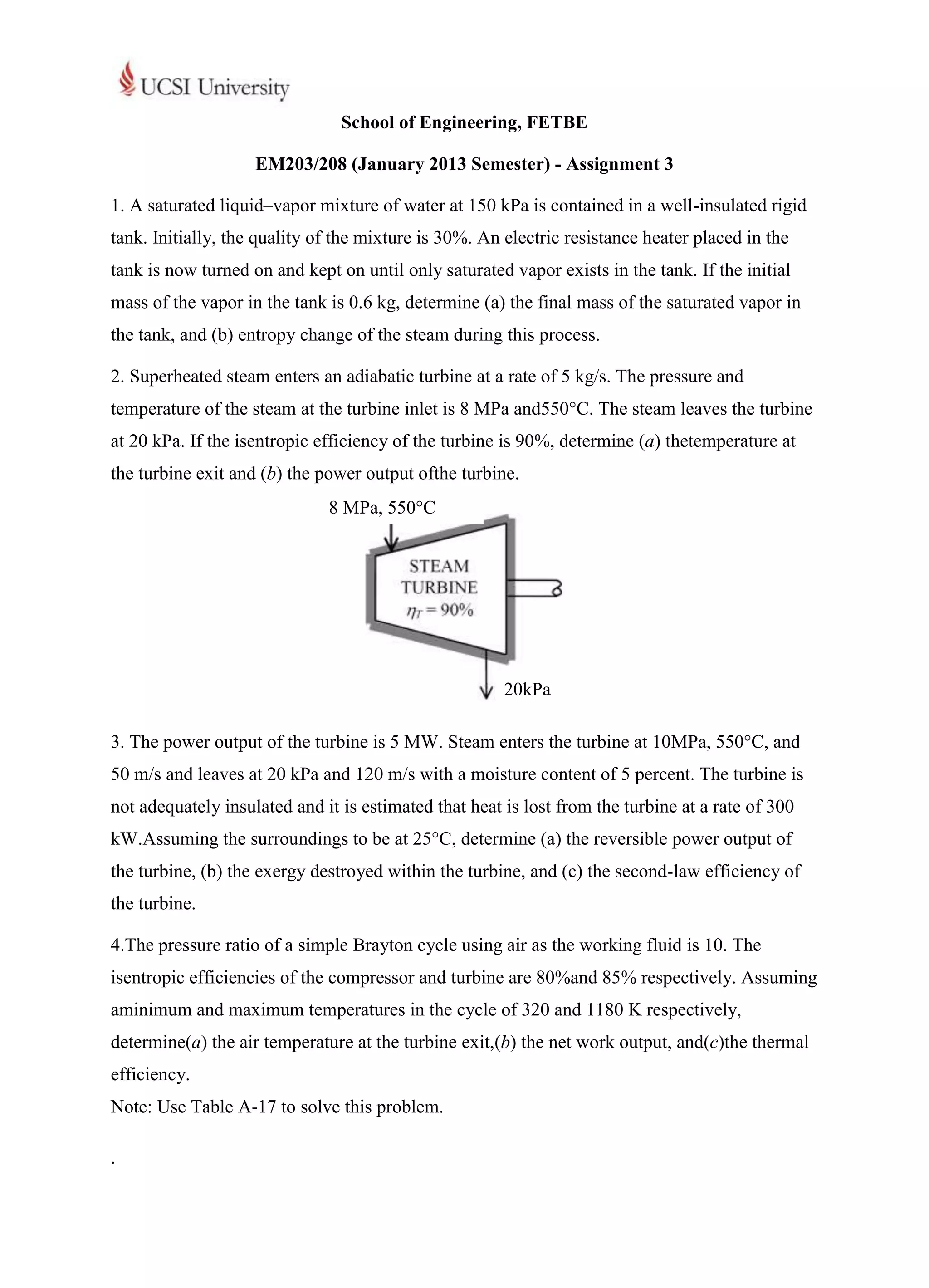
2. Superheated steam enters an adiabatic turbine at a rate of 5 kg/s. The pressure and
temperature of the steam at the turbine inlet is 8 MPa and550°C. The steam leaves the turbine
at 20 kPa. If the isentropic efficiency of the turbine is 90%, determine (a) thetemperature at
the turbine exit and (b) the power output ofthe turbine.
                              8 MPa, 550°C


                                                       20kPa

3. The power output of the turbine is 5 MW. Steam enters the turbine at 10MPa, 550°C, and
50 m/s and leaves at 20 kPa and 120 m/s with a moisture content of 5 percent. The turbine is
not adequately insulated and it is estimated that heat is lost from the turbine at a rate of 300
kW.Assuming the surroundings to be at 25°C, determine (a) the reversible power output of
the turbine, (b) the exergy destroyed within the turbine, and (c) the second-law efficiency of
the turbine.

4.The pressure ratio of a simple Brayton cycle using air as the working fluid is 10. The
isentropic efficiencies of the compressor and turbine are 80%and 85% respectively. Assuming
aminimum and maximum temperatures in the cycle of 320 and 1180 K respectively,
determine(a) the air temperature at the turbine exit,(b) the net work output, and(c)the thermal
efficiency.
Note: Use Table A-17 to solve this problem.

.
.Solution

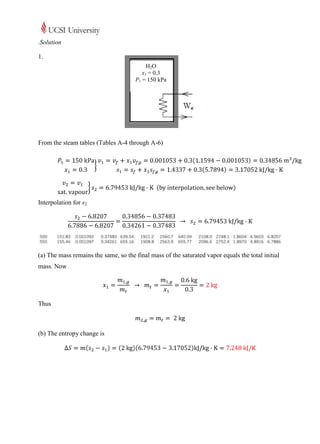
1.
                                           H2O
                                         x1 = 0.3
                                      P1 = 150 kPa


From the steam tables (Tables A-4 through A-6)


Interpolation for s2


(a) The mass remains the same, so the final mass of the saturated vapor equals the total initial
mass. Now


Thus


(b) The entropy change is
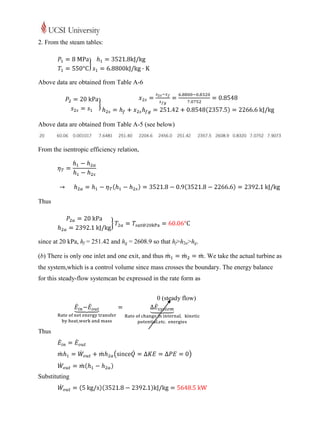
2. From the steam tables:


Above data are obtained from Table A-6


Above data are obtained from Table A-5 (see below)


From the isentropic efficiency relation,


Thus


since at 20 kPa, hf = 251.42 and hg = 2608.9 so that hf>h2a>hg.

(b) There is only one inlet and one exit, and thus                . We take the actual turbine as
the system,which is a control volume since mass crosses the boundary. The energy balance
for this steady-flow systemcan be expressed in the rate form as


                                               0 (steady flow)


Thus


Substituting
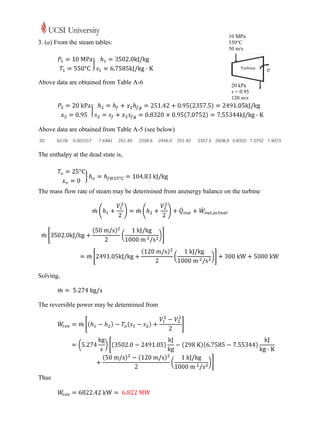
10 MPa
3. (a) From the steam tables:                                         550°C
                                                                      50 m/s


Above data are obtained from Table A-6                                 20 kPa
                                                                       x = 0.95
                                                                       120 m/s


Above data are obtained from Table A-5 (see below)


The enthalpy at the dead state is,


The mass flow rate of steam may be determined from anenergy balance on the turbine


Solving,


The reversible power may be determined from


Thus
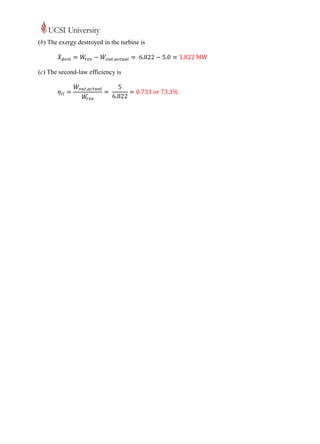
(b) The exergy destroyed in the turbine is


(c) The second-law efficiency is
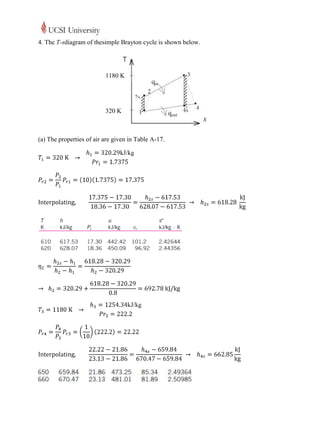
4. The T-sdiagram of thesimple Brayton cycle is shown below.


                          1180 K


                          320 K


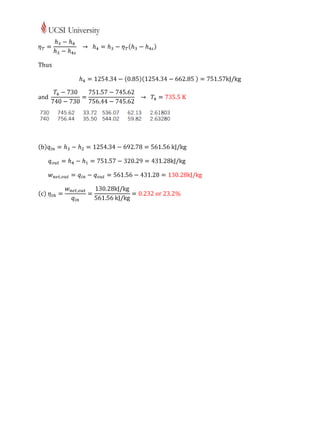
(a) The properties of air are given in Table A-17.
Em208 203 assignment_3_with_solution

Em208 203 assignment_3_with_solution

  • 1.
    School of Engineering,FETBE EM203/208 (January 2013 Semester) - Assignment 3 1. A saturated liquid–vapor mixture of water at 150 kPa is contained in a well-insulated rigid tank. Initially, the quality of the mixture is 30%. An electric resistance heater placed in the tank is now turned on and kept on until only saturated vapor exists in the tank. If the initial mass of the vapor in the tank is 0.6 kg, determine (a) the final mass of the saturated vapor in the tank, and (b) entropy change of the steam during this process. 2. Superheated steam enters an adiabatic turbine at a rate of 5 kg/s. The pressure and temperature of the steam at the turbine inlet is 8 MPa and550°C. The steam leaves the turbine at 20 kPa. If the isentropic efficiency of the turbine is 90%, determine (a) thetemperature at the turbine exit and (b) the power output ofthe turbine. 8 MPa, 550°C 20kPa 3. The power output of the turbine is 5 MW. Steam enters the turbine at 10MPa, 550°C, and 50 m/s and leaves at 20 kPa and 120 m/s with a moisture content of 5 percent. The turbine is not adequately insulated and it is estimated that heat is lost from the turbine at a rate of 300 kW.Assuming the surroundings to be at 25°C, determine (a) the reversible power output of the turbine, (b) the exergy destroyed within the turbine, and (c) the second-law efficiency of the turbine. 4.The pressure ratio of a simple Brayton cycle using air as the working fluid is 10. The isentropic efficiencies of the compressor and turbine are 80%and 85% respectively. Assuming aminimum and maximum temperatures in the cycle of 320 and 1180 K respectively, determine(a) the air temperature at the turbine exit,(b) the net work output, and(c)the thermal efficiency. Note: Use Table A-17 to solve this problem. .
  • 2.
    .Solution 1. H2O x1 = 0.3 P1 = 150 kPa From the steam tables (Tables A-4 through A-6) Interpolation for s2 (a) The mass remains the same, so the final mass of the saturated vapor equals the total initial mass. Now Thus (b) The entropy change is
  • 3.
    2. From thesteam tables: Above data are obtained from Table A-6 Above data are obtained from Table A-5 (see below) From the isentropic efficiency relation, Thus since at 20 kPa, hf = 251.42 and hg = 2608.9 so that hf>h2a>hg. (b) There is only one inlet and one exit, and thus . We take the actual turbine as the system,which is a control volume since mass crosses the boundary. The energy balance for this steady-flow systemcan be expressed in the rate form as 0 (steady flow) Thus Substituting
  • 4.
    10 MPa 3. (a)From the steam tables: 550°C 50 m/s Above data are obtained from Table A-6 20 kPa x = 0.95 120 m/s Above data are obtained from Table A-5 (see below) The enthalpy at the dead state is, The mass flow rate of steam may be determined from anenergy balance on the turbine Solving, The reversible power may be determined from Thus
  • 5.
    (b) The exergydestroyed in the turbine is (c) The second-law efficiency is
  • 6.
    4. The T-sdiagramof thesimple Brayton cycle is shown below. 1180 K 320 K (a) The properties of air are given in Table A-17.