School of Engineering

                     EM203/208(January 2013 Semester) - Assignment 1

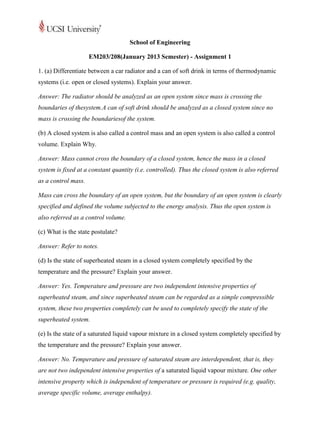
1. (a) Differentiate between a car radiator and a can of soft drink in terms of thermodynamic
systems (i.e. open or closed systems). Explain your answer.

Answer: The radiator should be analyzed as an open system since mass is crossing the
boundaries of thesystem.A can of soft drink should be analyzed as a closed system since no
mass is crossing the boundariesof the system.

(b) A closed system is also called a control mass and an open system is also called a control
volume. Explain Why.

Answer: Mass cannot cross the boundary of a closed system, hence the mass in a closed
system is fixed at a constant quantity (i.e. controlled). Thus the closed system is also referred
as a control mass.

Mass can cross the boundary of an open system, but the boundary of an open system is clearly
specified and defined the volume subjected to the energy analysis. Thus the open system is
also referred as a control volume.

(c) What is the state postulate?

Answer: Refer to notes.

(d) Is the state of superheated steam in a closed system completely specified by the
temperature and the pressure? Explain your answer.

Answer: Yes. Temperature and pressure are two independent intensive properties of
superheated steam, and since superheated steam can be regarded as a simple compressible
system, these two properties completely can be used to completely specify the state of the
superheated system.

(e) Is the state of a saturated liquid vapour mixture in a closed system completely specified by
the temperature and the pressure? Explain your answer.

Answer: No. Temperature and pressure of saturated steam are interdependent, that is, they
are not two independent intensive properties of a saturated liquid vapour mixture. One other
intensive property which is independent of temperature or pressure is required (e.g. quality,
average specific volume, average enthalpy).
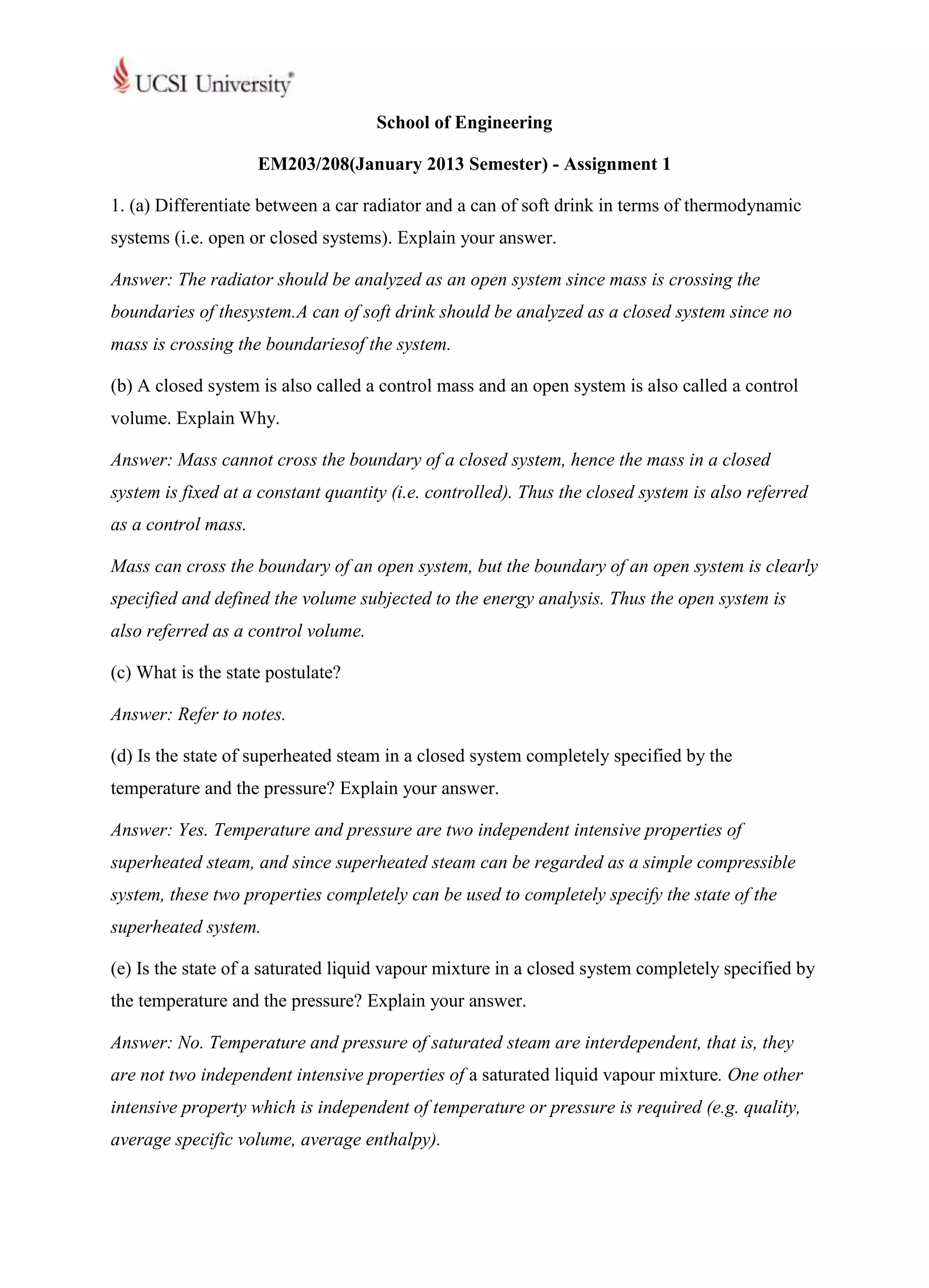
2. A 1.8-m3 rigid tank contains steam at 220°C. One third (1/3) of the volume is in the liquid
phase and the rest is in the vapor form. Determine (a) the pressure of the steam, (b) the quality
of the saturated mixture, and (c) the density of the mixture.

Solution:

(a) Two phases coexist in equilibrium, thus we have a saturated liquid-vapor mixture. The
pressure of the steam is the saturation pressure at the given temperature. Thus,

       P = Tsat@220°C= 2320 kPa

(b) The total mass and the quality are determined as


(c) The density is determined from


3. A closed, rigid container of volume 0.5 m3 is placed on a hot plate. Initially, the container
holds a two-phase mixture of saturatedliquid water and saturated water vapor at p1= 1 bar
with a quality of 0.5. After heating, the pressure in the containeris p2= 1.5 bar. Indicate the
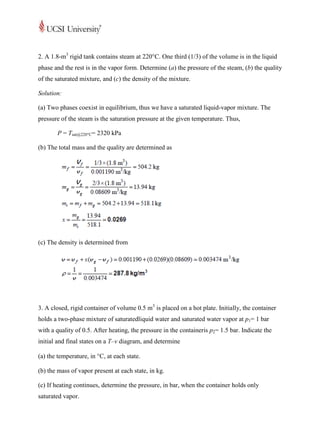
initial and final states on a T–v diagram, and determine

(a) the temperature, in C, at each state.

(b) the mass of vapor present at each state, in kg.

(c) If heating continues, determine the pressure, in bar, when the container holds only
saturated vapor.
Solution:

Two independent properties are required to fix states 1 and 2.

At the initial state, the pressure and quality are known. As these are independent, the state is
fixed. State 1 is shown on the T–v diagram below (in the two-phase region).


The specific volume at state 1 is found using the given quality. That is

        v1   vf   x vg   vf

From Table A-5, at p1= 1 bar (100 kPa), vf = 0.001043 m3/kg and vg = 1.6941 m3/kg. Thus

        v1   0.001043     0.5 1.6941    0.001043   0.8475 m3/kg.

At state 2, the pressure is known. One other property required to fix the state. This property is
the specific volume v2 which can be determined since the specific volume is constant in a
closed system with a rigid (fixed) boundary. Hence v2=v1= 0.8475 m3/kg.

Since p2= 1.5 bar (150 kPa), Table A-5 gives vf,2=0.001053and vg,2 =1.1594 m3/kg. Since

        vf,2< v2<vg,2

state 2 must be in the two-phase region as well, as shown on the T–v diagram above.

(a) Since states 1 and 2 are in the liquid–vapour mixture region, the temperatures correspond
to the saturation temperaturesfor the given pressures (100 kPa and 150 kPa). Table A-5 gives

        T1= 99.63°C and T2= 111.4°C

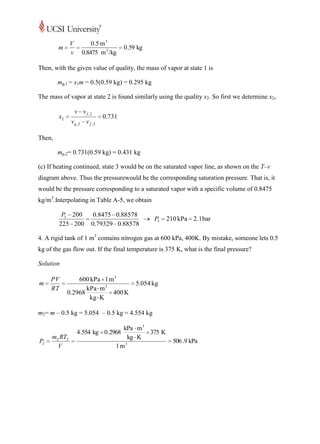
(b) To find the mass of water vapor present, we use the volume and the specific volume to
first find the total mass, m. That is
V          0 .5 m 3
        m                             0.59 kg
              v      0.8475 m 3 /kg

Then, with the given value of quality, the mass of vapor at state 1 is

        mg,1 = x1m = 0.5(0.59 kg) = 0.295 kg

The mass of vapor at state 2 is found similarly using the quality x2. So first we determine x2,

                  v v f ,2
        x2                   0.731
              vg ,2 v f ,2

Then,

        mg,2= 0.731(0.59 kg) = 0.431 kg

(c) If heating continued, state 3 would be on the saturated vapor line, as shown on the T–v
diagram above. Thus the pressurewould be the corresponding saturation pressure. That is, it
would be the pressure corresponding to a saturated vapor with a specific volume of 0.8475
kg/m3.Interpolating in Table A-5, we obtain

         P3 200           0.8475 0.88578
                                                P3   210 kPa 2.1 bar
        225 200          0.79329 0.88578

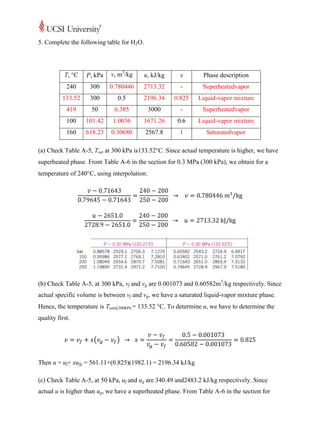
4. A rigid tank of 1 m3 contains nitrogen gas at 600 kPa, 400K. By mistake, someone lets 0.5
kg of the gas flow out. If the final temperature is 375 K, what is the final pressure?

Solution

     PV          600 kPa 1 m 3
m                                         5.054 kg
     RT             kPa m 3
             0.2968         400 K
                     kg K

m2= m – 0.5 kg = 5.054 – 0.5 kg = 4.554 kg

                                     kPa m 3
                   4.554 kg 0.2968           375 K
     m2 RT2                           kg K
P2                                                     506 .9 kPa
       V                          1 m3
5. Complete the following table for H2O.


           T, C    P, kPa   v, m3/kg       u, kJ/kg    x        Phase description
            240     300     0.780446    2713.32         -      Superheatedvapor
          133.52    300       0.5       2196.34       0.825   Liquid-vapor mixture
            419     50       6.385           3000       -      Superheatedvapor
            100    101.42    1.0036     1671.26        0.6    Liquid-vapor mixture
            160    618.23   0.30680        2567.8      1         Saturatedvapor

(a) Check Table A-5, Tsat at 300 kPa is133.52 C. Since actual temperature is higher, we have
superheated phase. From Table A-6 in the section for 0.3 MPa (300 kPa), we obtain for a
temperature of 240 C, using interpolation:


(b) Check Table A-5, at 300 kPa, vf and vg are 0.001073 and 0.60582m3/kg respectively. Since
actual specific volume is between vf and vg, we have a saturated liquid-vapor mixture phase.
Hence, the temperature is Tsat@300kPa = 133.52 C. To determine u, we have to determine the
quality first.


Then u = uf+ xufg = 561.11+(0.825)(1982.1) = 2196.34 kJ/kg

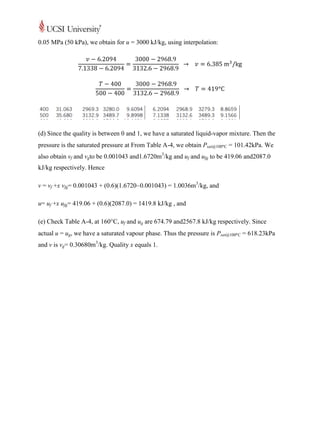
(c) Check Table A-5, at 50 kPa, uf and ug are 340.49 and2483.2 kJ/kg respectively. Since
actual u is higher than ug, we have a superheated phase. From Table A-6 in the section for
0.05 MPa (50 kPa), we obtain for u = 3000 kJ/kg, using interpolation:


(d) Since the quality is between 0 and 1, we have a saturated liquid-vapor mixture. Then the
pressure is the saturated pressure at From Table A-4, we obtain Psat@100 C = 101.42kPa. We
also obtain vf and vgto be 0.001043 and1.6720m3/kg and uf and ufg to be 419.06 and2087.0
kJ/kg respectively. Hence

v = vf +x vfg= 0.001043 + (0.6)(1.6720 0.001043) = 1.0036m3/kg, and

u= uf +x ufg= 419.06 + (0.6)(2087.0) = 1419.8 kJ/kg , and

(e) Check Table A-4, at 160 C, uf and ug are 674.79 and2567.8 kJ/kg respectively. Since
actual u = ug, we have a saturated vapour phase. Thus the pressure is Psat@100 C = 618.23kPa
and v is vg= 0.30680m3/kg. Quality x equals 1.

Em208 203 assignment_1_with_solution

  • 1.
    School of Engineering EM203/208(January 2013 Semester) - Assignment 1 1. (a) Differentiate between a car radiator and a can of soft drink in terms of thermodynamic systems (i.e. open or closed systems). Explain your answer. Answer: The radiator should be analyzed as an open system since mass is crossing the boundaries of thesystem.A can of soft drink should be analyzed as a closed system since no mass is crossing the boundariesof the system. (b) A closed system is also called a control mass and an open system is also called a control volume. Explain Why. Answer: Mass cannot cross the boundary of a closed system, hence the mass in a closed system is fixed at a constant quantity (i.e. controlled). Thus the closed system is also referred as a control mass. Mass can cross the boundary of an open system, but the boundary of an open system is clearly specified and defined the volume subjected to the energy analysis. Thus the open system is also referred as a control volume. (c) What is the state postulate? Answer: Refer to notes. (d) Is the state of superheated steam in a closed system completely specified by the temperature and the pressure? Explain your answer. Answer: Yes. Temperature and pressure are two independent intensive properties of superheated steam, and since superheated steam can be regarded as a simple compressible system, these two properties completely can be used to completely specify the state of the superheated system. (e) Is the state of a saturated liquid vapour mixture in a closed system completely specified by the temperature and the pressure? Explain your answer. Answer: No. Temperature and pressure of saturated steam are interdependent, that is, they are not two independent intensive properties of a saturated liquid vapour mixture. One other intensive property which is independent of temperature or pressure is required (e.g. quality, average specific volume, average enthalpy).
  • 2.
    2. A 1.8-m3rigid tank contains steam at 220°C. One third (1/3) of the volume is in the liquid phase and the rest is in the vapor form. Determine (a) the pressure of the steam, (b) the quality of the saturated mixture, and (c) the density of the mixture. Solution: (a) Two phases coexist in equilibrium, thus we have a saturated liquid-vapor mixture. The pressure of the steam is the saturation pressure at the given temperature. Thus, P = Tsat@220°C= 2320 kPa (b) The total mass and the quality are determined as (c) The density is determined from 3. A closed, rigid container of volume 0.5 m3 is placed on a hot plate. Initially, the container holds a two-phase mixture of saturatedliquid water and saturated water vapor at p1= 1 bar with a quality of 0.5. After heating, the pressure in the containeris p2= 1.5 bar. Indicate the initial and final states on a T–v diagram, and determine (a) the temperature, in C, at each state. (b) the mass of vapor present at each state, in kg. (c) If heating continues, determine the pressure, in bar, when the container holds only saturated vapor.
  • 3.
    Solution: Two independent propertiesare required to fix states 1 and 2. At the initial state, the pressure and quality are known. As these are independent, the state is fixed. State 1 is shown on the T–v diagram below (in the two-phase region). The specific volume at state 1 is found using the given quality. That is v1 vf x vg vf From Table A-5, at p1= 1 bar (100 kPa), vf = 0.001043 m3/kg and vg = 1.6941 m3/kg. Thus v1 0.001043 0.5 1.6941 0.001043 0.8475 m3/kg. At state 2, the pressure is known. One other property required to fix the state. This property is the specific volume v2 which can be determined since the specific volume is constant in a closed system with a rigid (fixed) boundary. Hence v2=v1= 0.8475 m3/kg. Since p2= 1.5 bar (150 kPa), Table A-5 gives vf,2=0.001053and vg,2 =1.1594 m3/kg. Since vf,2< v2<vg,2 state 2 must be in the two-phase region as well, as shown on the T–v diagram above. (a) Since states 1 and 2 are in the liquid–vapour mixture region, the temperatures correspond to the saturation temperaturesfor the given pressures (100 kPa and 150 kPa). Table A-5 gives T1= 99.63°C and T2= 111.4°C (b) To find the mass of water vapor present, we use the volume and the specific volume to first find the total mass, m. That is
  • 4.
    V 0 .5 m 3 m 0.59 kg v 0.8475 m 3 /kg Then, with the given value of quality, the mass of vapor at state 1 is mg,1 = x1m = 0.5(0.59 kg) = 0.295 kg The mass of vapor at state 2 is found similarly using the quality x2. So first we determine x2, v v f ,2 x2 0.731 vg ,2 v f ,2 Then, mg,2= 0.731(0.59 kg) = 0.431 kg (c) If heating continued, state 3 would be on the saturated vapor line, as shown on the T–v diagram above. Thus the pressurewould be the corresponding saturation pressure. That is, it would be the pressure corresponding to a saturated vapor with a specific volume of 0.8475 kg/m3.Interpolating in Table A-5, we obtain P3 200 0.8475 0.88578 P3 210 kPa 2.1 bar 225 200 0.79329 0.88578 4. A rigid tank of 1 m3 contains nitrogen gas at 600 kPa, 400K. By mistake, someone lets 0.5 kg of the gas flow out. If the final temperature is 375 K, what is the final pressure? Solution PV 600 kPa 1 m 3 m 5.054 kg RT kPa m 3 0.2968 400 K kg K m2= m – 0.5 kg = 5.054 – 0.5 kg = 4.554 kg kPa m 3 4.554 kg 0.2968 375 K m2 RT2 kg K P2 506 .9 kPa V 1 m3
  • 5.
    5. Complete thefollowing table for H2O. T, C P, kPa v, m3/kg u, kJ/kg x Phase description 240 300 0.780446 2713.32 - Superheatedvapor 133.52 300 0.5 2196.34 0.825 Liquid-vapor mixture 419 50 6.385 3000 - Superheatedvapor 100 101.42 1.0036 1671.26 0.6 Liquid-vapor mixture 160 618.23 0.30680 2567.8 1 Saturatedvapor (a) Check Table A-5, Tsat at 300 kPa is133.52 C. Since actual temperature is higher, we have superheated phase. From Table A-6 in the section for 0.3 MPa (300 kPa), we obtain for a temperature of 240 C, using interpolation: (b) Check Table A-5, at 300 kPa, vf and vg are 0.001073 and 0.60582m3/kg respectively. Since actual specific volume is between vf and vg, we have a saturated liquid-vapor mixture phase. Hence, the temperature is Tsat@300kPa = 133.52 C. To determine u, we have to determine the quality first. Then u = uf+ xufg = 561.11+(0.825)(1982.1) = 2196.34 kJ/kg (c) Check Table A-5, at 50 kPa, uf and ug are 340.49 and2483.2 kJ/kg respectively. Since actual u is higher than ug, we have a superheated phase. From Table A-6 in the section for
  • 6.
    0.05 MPa (50kPa), we obtain for u = 3000 kJ/kg, using interpolation: (d) Since the quality is between 0 and 1, we have a saturated liquid-vapor mixture. Then the pressure is the saturated pressure at From Table A-4, we obtain Psat@100 C = 101.42kPa. We also obtain vf and vgto be 0.001043 and1.6720m3/kg and uf and ufg to be 419.06 and2087.0 kJ/kg respectively. Hence v = vf +x vfg= 0.001043 + (0.6)(1.6720 0.001043) = 1.0036m3/kg, and u= uf +x ufg= 419.06 + (0.6)(2087.0) = 1419.8 kJ/kg , and (e) Check Table A-4, at 160 C, uf and ug are 674.79 and2567.8 kJ/kg respectively. Since actual u = ug, we have a saturated vapour phase. Thus the pressure is Psat@100 C = 618.23kPa and v is vg= 0.30680m3/kg. Quality x equals 1.