Circuit Theory
(EE102)
Lecture 1(a)
Basic Concepts & Basic Laws
Text Book:
Fundamentals of Electric Circuits (4th Ed/3rd Ed) By Alexander & Sadiku. McGraw-Hill [CH1]
Faculty of Engineering
Page 1
Basic Concepts
1.1 Systems of Units.
1.2 Electric Charge.
1.3 Current.
1.4 Voltage.
1.5 Power and Energy.
1.6 Circuit Elements.
Faculty of Engineering
Page 2
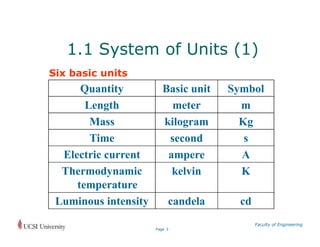
1.1 System of Units (1)
Quantity Basic unit Symbol
Length meter m
Mass kilogram Kg
Time second s
Electric current ampere A
Thermodynamic
temperature
kelvin K
Luminous intensity candela cd
Six basic units
Faculty of Engineering
Page 3
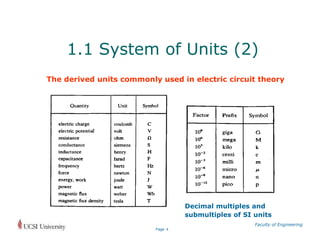
1.1 System of Units (2)
The derived units commonly used in electric circuit theory
Decimal multiples and
submultiples of SI units
Faculty of Engineering
Page 4
1.2 Electric Charges
• Charge is an electrical property of the atomic
particles of which matter consists, measured in
coulombs (C).
• The charge e on one electron is negative and
equal in magnitude to 1.602 × 10⁻¹⁹ C which is
called as electronic charge. The charges that
occur in nature are integral multiples of the
electronic charge.
Faculty of Engineering
Page 5
1.3 Current (1)
• Electric current i = dq/dt. The unit of
ampere can be derived as 1 A = 1C/s.
• A direct current (dc) is a current that
remains constant with time.
• An alternating current (ac) is a current
that varies sinusoidally with time.
(reverse direction)
Faculty of Engineering
Page 6
1.3 Current (2)
• The direction of current flow
Positive ions Negative ions
Faculty of Engineering
Page 7
1.3 Current (3)
Example 1
A conductor has a constant current of
5 A. How many electrons pass a fixed
point on the conductor in one minute?
Faculty of Engineering
Page 8
1.3 Current (4)
Solution
1 A = 1C/s, 1e=1.602 × 10⁻¹⁹ C /electron
Total no. of charges pass in 1 min is given by
5 A = (5 C/s)(60 s/min) = 300 C/min.
Total no. of electronics pass in 1 min is given
minelectrons/1087.1
C/electron10602.1
C/min300 21
19
x
x
=−
Faculty of Engineering
Page 9
1.4 Voltage (1)
• Voltage (or potential difference) is the energy
required to move a unit charge through an
element, measured in volts (V).
• Mathematically, (volt)
– w is energy in joules (J) and q is charge in coulomb (C).
• Electric voltage, vab, is always across the circuit
element or between two points in a circuit.
– vab > 0 means the potential of a is higher than potential
of b.
– vab < 0 means the potential of a is lower than potential
of b.
dqdwvab /=
Faculty of Engineering
Page 10
1.5 Power and Energy (1)
• Power is the time rate of expending or absorbing
energy, measured in watts (W).
• Mathematical expression: vi
dt
dq
dq
dw
dt
dw
p =⋅==
i
+
–
v
i
+
–
v
Passive sign convention
P = +vi p = –vi
absorbing power supplying power
Faculty of Engineering
Page 11
1.5 Power and Energy (2)
• The law of conservation of energy
∑ = 0p
• Energy is the capacity to do work, measured
in joules (J).
• Mathematical expression ∫ ∫==
t
t
t
t
vidtpdtw
0 0
Faculty of Engineering
Page 12
1.6 Circuit Elements (1)
Active Elements Passive Elements
Independent
sources
Dependant
sources
• A dependent source is an active
element in which the source quantity
is controlled by another voltage or
current.
• They have four different types: VCVS,
CCVS, VCCS, CCCS. Keep in minds the
signs of dependent sources.
Faculty of Engineering
Page 13
1.6 Circuit Elements (2)
Example 2
Obtain the voltage v in the branch shown in Figure 2.1.1P for i2 = 1A.
Figure 2.1.1P
Faculty of Engineering
Page 14
1.6 Circuit Elements (3)
Solution
Voltage v is the sum of the current-independent
10-V source and the current-dependent voltage
source vx.
Note that the factor 15 multiplying the control
current carries the units .
Therefore, v = 10 + vx = 10 + 15(1) = 25 V
Faculty of Engineering
Page 15
Text Book:
Fundamentals of Electric Circuits (4th Ed/3rd Ed) By Alexander & Sadiku. McGraw-Hill [CH2]
Faculty of Engineering
Page 16
Basic Laws
Basic Laws
2.1 Ohm’s Law.
2.2 Nodes, Branches, and Loops.
2.3 Kirchhoff’s Laws.
2.4 Series Resistors and Voltage Division.
2.5 Parallel Resistors and Current Division.
2.6 Wye-Delta Transformations.
Faculty of Engineering
Page 17
2.1 Ohms Law (1)
• Ohm’s law states that the voltage across
a resistor is directly proportional to the
current I flowing through the resistor.
• Mathematical expression for Ohm’s Law
is as follows:
• Two extreme possible values of R:
0 (zero) and ∞∞∞∞ (infinite) are related
with two basic circuit concepts: short
circuit and open circuit.
iRv =
Faculty of Engineering
Page 18
2.1 Ohms Law (2)
• Conductance is the ability of an element to
conduct electric current; it is the reciprocal
of resistance R and is measured in mhos or
siemens.
• The power dissipated by a resistor:
v
i
R
G ==
1
R
v
Rivip
2
2
===
Faculty of Engineering
Page 19
2.2 Nodes, Branches and
Loops (1)
• A branch represents a single element such as a
voltage source or a resistor.
• A node is the point of connection between two
or more branches.
• A loop is any closed path in a circuit.
• A network with b branches, n nodes, and l
independent loops will satisfy the fundamental
theorem of network topology:
1−+= nlb
Faculty of Engineering
Page 20
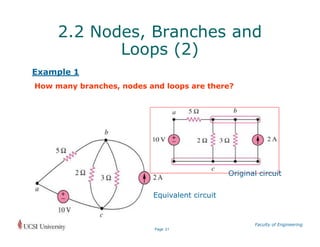
2.2 Nodes, Branches and
Loops (2)
Example 1
How many branches, nodes and loops are there?
Original circuit
Equivalent circuit
Faculty of Engineering
Page 21
2.2 Nodes, Branches and
Loops (3)
Example 2
How many branches, nodes and loops are there?
Should we consider it as one
branch or two branches?
Faculty of Engineering
Page 22
2.3 Kirchhoff’s Laws (1)
• Kirchhoff’s current law (KCL) states that the
algebraic sum of currents entering a node
(or a closed boundary) is zero.
0
1
=∑=
N
n
niMathematically,
Faculty of Engineering
Page 23
2.3 Kirchhoff’s Laws (2)
Example 3
• Determine the current I for the circuit shown in
the figure below.
I + 4-(-3)-2 = 0
⇒I = -5A
This indicates that
the actual current
for I is flowing
in the opposite
direction.We can consider the whole
enclosed area as one “node”.
Faculty of Engineering
Page 24
2.3 Kirchhoff’s Laws (3)
• Kirchhoff’s voltage law (KVL) states that the
algebraic sum of all voltages around a closed
path (or loop) is zero.
Mathematically, 0
1
=∑=
M
m
nv
Faculty of Engineering
Page 25
2.3 Kirchhoff’s Laws (4)
Example 4
• Applying the KVL equation for the circuit of the
figure below.
va-v1-vb-v2-v3 = 0
V1 = IR1 v2 = IR2 v3 = IR3
⇒ va-vb = I(R1 + R2 + R3)
321 RRR
vv
I ba
++
−
=
Faculty of Engineering
Page 26
2.4 Series Resistors and Voltage
Division (1)
• Series: Two or more elements are in series if they
are cascaded or connected sequentially
and consequently carry the same current.
• The equivalent resistance of any number of
resistors connected in a series is the sum of the
individual resistances.
• The voltage divider can be expressed as
∑=
=+⋅⋅⋅++=
N
n
nNeq RRRRR
1
21
v
RRR
R
v
N
n
n
+⋅⋅⋅++
=
21
Faculty of Engineering
Page 27
Example 5
10V and 5ΩΩΩΩ
are in series
2.4 Series Resistors and Voltage
Division (2)
Faculty of Engineering
Page 28
2.5 Parallel Resistors and Current
Division (1)
• Parallel: Two or more elements are in parallel if
they are connected to the same two nodes and
consequently have the same voltage across them.
• The equivalent resistance of a circuit with
N resistors in parallel is:
• The total current i is shared by the resistors in
inverse proportion to their resistances. The
current divider can be expressed as:
Neq RRRR
1111
21
+⋅⋅⋅++=
n
eq
n
n
R
iR
R
v
i ==
Faculty of Engineering
Page 29
Example 6
2ΩΩΩΩ, 3ΩΩΩΩ and 2A
are in parallel
2.5 Parallel Resistors and Current
Division (2)
Faculty of Engineering
Page 30
2.6 Wye-Delta Transformations
)(
1
cba
cb
RRR
RR
R
++
=
)(
2
cba
ac
RRR
RR
R
++
=
)(
3
cba
ba
RRR
RR
R
++
=
1
133221
R
RRRRRR
Ra
++
=
2
133221
R
RRRRRR
Rb
++
=
3
133221
R
RRRRRR
Rc
++
=
Delta -> Wye Wye -> Delta
Faculty of Engineering
Page 31
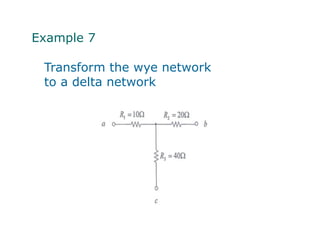
Example 7
Transform the wye network
to a delta network
Solution

Lecture 1a [compatibility mode]

  • 1.
    Circuit Theory (EE102) Lecture 1(a) BasicConcepts & Basic Laws Text Book: Fundamentals of Electric Circuits (4th Ed/3rd Ed) By Alexander & Sadiku. McGraw-Hill [CH1] Faculty of Engineering Page 1
  • 2.
    Basic Concepts 1.1 Systemsof Units. 1.2 Electric Charge. 1.3 Current. 1.4 Voltage. 1.5 Power and Energy. 1.6 Circuit Elements. Faculty of Engineering Page 2
  • 3.
    1.1 System ofUnits (1) Quantity Basic unit Symbol Length meter m Mass kilogram Kg Time second s Electric current ampere A Thermodynamic temperature kelvin K Luminous intensity candela cd Six basic units Faculty of Engineering Page 3
  • 4.
    1.1 System ofUnits (2) The derived units commonly used in electric circuit theory Decimal multiples and submultiples of SI units Faculty of Engineering Page 4
  • 5.
    1.2 Electric Charges •Charge is an electrical property of the atomic particles of which matter consists, measured in coulombs (C). • The charge e on one electron is negative and equal in magnitude to 1.602 × 10⁻¹⁹ C which is called as electronic charge. The charges that occur in nature are integral multiples of the electronic charge. Faculty of Engineering Page 5
  • 6.
    1.3 Current (1) •Electric current i = dq/dt. The unit of ampere can be derived as 1 A = 1C/s. • A direct current (dc) is a current that remains constant with time. • An alternating current (ac) is a current that varies sinusoidally with time. (reverse direction) Faculty of Engineering Page 6
  • 7.
    1.3 Current (2) •The direction of current flow Positive ions Negative ions Faculty of Engineering Page 7
  • 8.
    1.3 Current (3) Example1 A conductor has a constant current of 5 A. How many electrons pass a fixed point on the conductor in one minute? Faculty of Engineering Page 8
  • 9.
    1.3 Current (4) Solution 1A = 1C/s, 1e=1.602 × 10⁻¹⁹ C /electron Total no. of charges pass in 1 min is given by 5 A = (5 C/s)(60 s/min) = 300 C/min. Total no. of electronics pass in 1 min is given minelectrons/1087.1 C/electron10602.1 C/min300 21 19 x x =− Faculty of Engineering Page 9
  • 10.
    1.4 Voltage (1) •Voltage (or potential difference) is the energy required to move a unit charge through an element, measured in volts (V). • Mathematically, (volt) – w is energy in joules (J) and q is charge in coulomb (C). • Electric voltage, vab, is always across the circuit element or between two points in a circuit. – vab > 0 means the potential of a is higher than potential of b. – vab < 0 means the potential of a is lower than potential of b. dqdwvab /= Faculty of Engineering Page 10
  • 11.
    1.5 Power andEnergy (1) • Power is the time rate of expending or absorbing energy, measured in watts (W). • Mathematical expression: vi dt dq dq dw dt dw p =⋅== i + – v i + – v Passive sign convention P = +vi p = –vi absorbing power supplying power Faculty of Engineering Page 11
  • 12.
    1.5 Power andEnergy (2) • The law of conservation of energy ∑ = 0p • Energy is the capacity to do work, measured in joules (J). • Mathematical expression ∫ ∫== t t t t vidtpdtw 0 0 Faculty of Engineering Page 12
  • 13.
    1.6 Circuit Elements(1) Active Elements Passive Elements Independent sources Dependant sources • A dependent source is an active element in which the source quantity is controlled by another voltage or current. • They have four different types: VCVS, CCVS, VCCS, CCCS. Keep in minds the signs of dependent sources. Faculty of Engineering Page 13
  • 14.
    1.6 Circuit Elements(2) Example 2 Obtain the voltage v in the branch shown in Figure 2.1.1P for i2 = 1A. Figure 2.1.1P Faculty of Engineering Page 14
  • 15.
    1.6 Circuit Elements(3) Solution Voltage v is the sum of the current-independent 10-V source and the current-dependent voltage source vx. Note that the factor 15 multiplying the control current carries the units . Therefore, v = 10 + vx = 10 + 15(1) = 25 V Faculty of Engineering Page 15
  • 16.
    Text Book: Fundamentals ofElectric Circuits (4th Ed/3rd Ed) By Alexander & Sadiku. McGraw-Hill [CH2] Faculty of Engineering Page 16 Basic Laws
  • 17.
    Basic Laws 2.1 Ohm’sLaw. 2.2 Nodes, Branches, and Loops. 2.3 Kirchhoff’s Laws. 2.4 Series Resistors and Voltage Division. 2.5 Parallel Resistors and Current Division. 2.6 Wye-Delta Transformations. Faculty of Engineering Page 17
  • 18.
    2.1 Ohms Law(1) • Ohm’s law states that the voltage across a resistor is directly proportional to the current I flowing through the resistor. • Mathematical expression for Ohm’s Law is as follows: • Two extreme possible values of R: 0 (zero) and ∞∞∞∞ (infinite) are related with two basic circuit concepts: short circuit and open circuit. iRv = Faculty of Engineering Page 18
  • 19.
    2.1 Ohms Law(2) • Conductance is the ability of an element to conduct electric current; it is the reciprocal of resistance R and is measured in mhos or siemens. • The power dissipated by a resistor: v i R G == 1 R v Rivip 2 2 === Faculty of Engineering Page 19
  • 20.
    2.2 Nodes, Branchesand Loops (1) • A branch represents a single element such as a voltage source or a resistor. • A node is the point of connection between two or more branches. • A loop is any closed path in a circuit. • A network with b branches, n nodes, and l independent loops will satisfy the fundamental theorem of network topology: 1−+= nlb Faculty of Engineering Page 20
  • 21.
    2.2 Nodes, Branchesand Loops (2) Example 1 How many branches, nodes and loops are there? Original circuit Equivalent circuit Faculty of Engineering Page 21
  • 22.
    2.2 Nodes, Branchesand Loops (3) Example 2 How many branches, nodes and loops are there? Should we consider it as one branch or two branches? Faculty of Engineering Page 22
  • 23.
    2.3 Kirchhoff’s Laws(1) • Kirchhoff’s current law (KCL) states that the algebraic sum of currents entering a node (or a closed boundary) is zero. 0 1 =∑= N n niMathematically, Faculty of Engineering Page 23
  • 24.
    2.3 Kirchhoff’s Laws(2) Example 3 • Determine the current I for the circuit shown in the figure below. I + 4-(-3)-2 = 0 ⇒I = -5A This indicates that the actual current for I is flowing in the opposite direction.We can consider the whole enclosed area as one “node”. Faculty of Engineering Page 24
  • 25.
    2.3 Kirchhoff’s Laws(3) • Kirchhoff’s voltage law (KVL) states that the algebraic sum of all voltages around a closed path (or loop) is zero. Mathematically, 0 1 =∑= M m nv Faculty of Engineering Page 25
  • 26.
    2.3 Kirchhoff’s Laws(4) Example 4 • Applying the KVL equation for the circuit of the figure below. va-v1-vb-v2-v3 = 0 V1 = IR1 v2 = IR2 v3 = IR3 ⇒ va-vb = I(R1 + R2 + R3) 321 RRR vv I ba ++ − = Faculty of Engineering Page 26
  • 27.
    2.4 Series Resistorsand Voltage Division (1) • Series: Two or more elements are in series if they are cascaded or connected sequentially and consequently carry the same current. • The equivalent resistance of any number of resistors connected in a series is the sum of the individual resistances. • The voltage divider can be expressed as ∑= =+⋅⋅⋅++= N n nNeq RRRRR 1 21 v RRR R v N n n +⋅⋅⋅++ = 21 Faculty of Engineering Page 27
  • 28.
    Example 5 10V and5ΩΩΩΩ are in series 2.4 Series Resistors and Voltage Division (2) Faculty of Engineering Page 28
  • 29.
    2.5 Parallel Resistorsand Current Division (1) • Parallel: Two or more elements are in parallel if they are connected to the same two nodes and consequently have the same voltage across them. • The equivalent resistance of a circuit with N resistors in parallel is: • The total current i is shared by the resistors in inverse proportion to their resistances. The current divider can be expressed as: Neq RRRR 1111 21 +⋅⋅⋅++= n eq n n R iR R v i == Faculty of Engineering Page 29
  • 30.
    Example 6 2ΩΩΩΩ, 3ΩΩΩΩand 2A are in parallel 2.5 Parallel Resistors and Current Division (2) Faculty of Engineering Page 30
  • 31.
  • 32.
    Example 7 Transform thewye network to a delta network
  • 33.