Education, development
and curriculum
Shams ud din pandrani
shams kalati@yahoo.com

MA-Education
Topics Covered
• Objective of curriculum
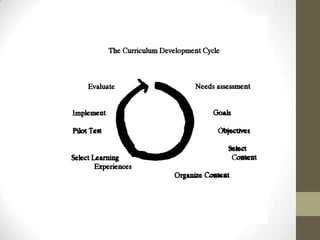
• Curriculum Development Cycle
• Overview of national curriculum
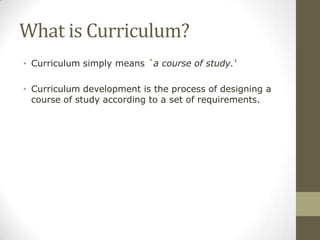
What is Curriculum?
• Curriculum simply means `a course of study.'
• Curriculum development is the process of designing a
course of study according to a set of requirements.
Let’s examine what happens in each step of the
curriculum development/revision cycle. This
cycle is a dynamic system that helps each school
re-vitalize and replenish what is taught to its
students.
Needs Assessment
• For one child in special education, this would
include his test scores
• For a campus, this might include achievement
test data, attendance, graduation, collegegoing rate, and others
Types of assessments
Normative such as
• Achievement tests
• IQ tests, group and
individual
• Learning styles
inventories
• Adaptive behavior

Criterion-referenced
such as
• Individual testing
• Individual or
analytical reading
inventories
Don’t forget the qualitative information.
For either one child or for a school, interest
inventories can tell a lot, as can opinion
polls.
Writing Goals (second step)
• Goals do not have to be
behavioral, but should
be translatable into
behavioral language
• Need enough goals to
point the way
Writing objectives (3rd)
• Objectives are more
detailed
• Audience, behavior, con
ditions, degree
• In
cognitive, affective, and
psychomotor domains
• Assessments should be
written from objectives
Selecting content (4th)
• For MRs, keep in mind the mental age of the person or
persons being written for. Chronological ages are deceiving.
• For special ed., keep it very utilitarian. The content must be
useful . . . These will remember, at the most, one-half of what
normal persons would.
• Build on students’ past experiences.
Organization of content (5)
• Logical sequencing of content always helps.
• Build in some repetition
• Provide for loop-backs for students to re-visit things that they
may have forgotten
• Spiral curriculum is one very effective plan
Selection of learning
experiences
• Learning experiences
do not stand alone-they must relate to
objectives
• Fun!
• Interesting!
• Multi-sensory
• Use technology as often
as possible
Adaptation to teaching
situation
For campuses, this seventh section is where teachers
make adjustments to make the new curriculum their
own and in their own ways in their classrooms.

For special education, this is where the related
services sometimes come in; special
transportation, special technology, nurse
care, counseling on demand, wheelchairs, medical
assistance.
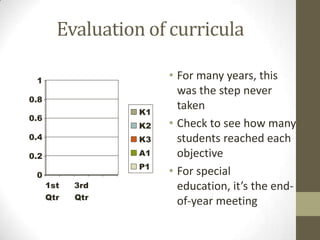
Evaluation of curricula
1
0.8
K1

0.6

K2

0.4

K3

0.2

A1

0

P1
1st
Qtr

3rd
Qtr

• For many years, this
was the step never
taken
• Check to see how many
students reached each
objective
• For special
education, it’s the endof-year meeting
The evaluation at the end of one curriculum
cycle feeds right into the needs assessment of
the next. In this way, the curriculum of the
school--or for one child--is perpetually
replenished and revitalized.
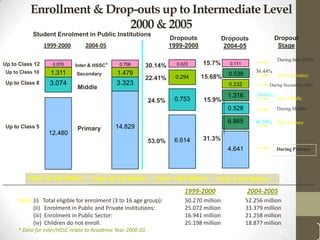
Enrollment & Drop-outs up to Intermediate Level
2000 & 2005
Student Enrolment in Public Institutions
1999-2000
Up to Class 12

0.076

Up to Class 10

1.311

Up to Class 8

3.074

Dropouts
1999-2000

2004-05
Inter & HSSC*
Secondary

Middle

0.708

1.479

3.323

30.14%
22.41%

0.023

0.294

Dropout
Stage

Dropouts
2004-05
15.7%
15.68%

During Inter/HSSC

0.111

0.539

36.44%

0.232

24.5%

0.753

15.9%

1.316

During Secondary (SSC)

39.60%

0.528
Up to Class 5

12.480

Primary

6.865

14.829
53.0%

6.614

Total: 20.339 Million

After Middle
During Middle

46.30% After Primary

31.3%
4.641

Total: 16.941 Million

After Secondary

Total: 7.684 Million

During Primary

Total: 5.512 Million

1999-2000
Note: (i) Total eligible for enrolment (3 to 16 age group):
(ii) Enrolment in Public and Private Institutions:
(iii) Enrolment in Public Sector:
(iv) Children do not enroll.
* Data for Inter/HSSC relate to Academic Year 2000-01.

2004-2005

50.270 million
25.072 million
16.941 million
25.198 million

52.256 million
33.379 million
21.258 million
18.877 million

17
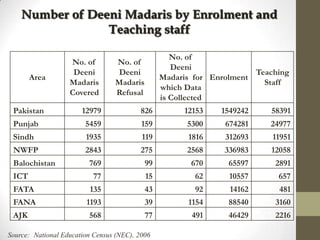
Number of Deeni Madaris by Enrolment and
Teaching staff
No. of
Deeni
Teaching
Madaris for Enrolment
Staff
which Data
is Collected

Area

No. of
Deeni
Madaris
Covered

Pakistan

12979

826

12153

1549242

58391

Punjab

5459

159

5300

674281

24977

Sindh

1935

119

1816

312693

11951

NWFP

2843

275

2568

336983

12058

769

99

670

65597

2891

77

15

62

10557

657

FATA

135

43

92

14162

481

FANA

1193

39

1154

88540

3160

568

77

491

46429

2216

Balochistan
ICT

AJK

No. of
Deeni
Madaris
Refusal

Source: National Education Census (NEC), 2006
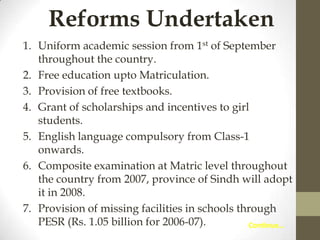
Reforms Undertaken
1. Uniform academic session from 1st of September
throughout the country.
2. Free education upto Matriculation.
3. Provision of free textbooks.
4. Grant of scholarships and incentives to girl
students.
5. English language compulsory from Class-1
onwards.
6. Composite examination at Matric level throughout
the country from 2007, province of Sindh will adopt
it in 2008.
7. Provision of missing facilities in schools through
PESR (Rs. 1.05 billion for 2006-07).
Continue…
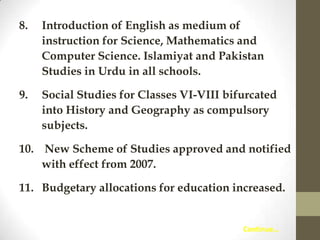
8.

Introduction of English as medium of
instruction for Science, Mathematics and
Computer Science. Islamiyat and Pakistan
Studies in Urdu in all schools.

9.

Social Studies for Classes VI-VIII bifurcated
into History and Geography as compulsory
subjects.

10. New Scheme of Studies approved and notified
with effect from 2007.
11. Budgetary allocations for education increased.

Continue…
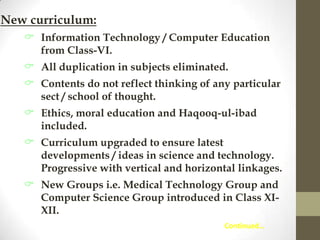
New curriculum:
 Information Technology / Computer Education
from Class-VI.
 All duplication in subjects eliminated.
 Contents do not reflect thinking of any particular
sect / school of thought.
 Ethics, moral education and Haqooq-ul-ibad
included.
 Curriculum upgraded to ensure latest
developments / ideas in science and technology.
Progressive with vertical and horizontal linkages.

 New Groups i.e. Medical Technology Group and
Computer Science Group introduced in Class XIXII.
Continued…
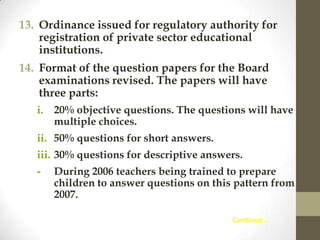
13. Ordinance issued for regulatory authority for
registration of private sector educational
institutions.
14. Format of the question papers for the Board
examinations revised. The papers will have
three parts:
i.

20% objective questions. The questions will have
multiple choices.

ii. 50% questions for short answers.
iii. 30% questions for descriptive answers.
-

During 2006 teachers being trained to prepare
children to answer questions on this pattern from
2007.
Continue…
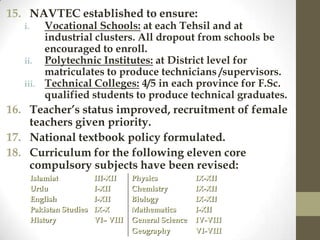
15. NAVTEC established to ensure:

Vocational Schools: at each Tehsil and at
industrial clusters. All dropout from schools be
encouraged to enroll.
ii. Polytechnic Institutes: at District level for
matriculates to produce technicians /supervisors.
iii. Technical Colleges: 4/5 in each province for F.Sc.
qualified students to produce technical graduates.
i.

16. Teacher’s status improved, recruitment of female
teachers given priority.
17. National textbook policy formulated.
18. Curriculum for the following eleven core
compulsory subjects have been revised:
Islamiat
Urdu
English
Pakistan Studies
History

III-XII
I-XII
I-XII
IX-X
VI– VIII

Physics
Chemistry
Biology
Mathematics
General Science
Geography

IX-XII
IX-XII
IX-XII
I-XII
IV-VIII
VI-VIII
Thank You
shamskalati@yahoo.com

Education, development and curriculum

  • 1.
    Education, development and curriculum Shamsud din pandrani shams kalati@yahoo.com MA-Education
  • 2.
    Topics Covered • Objectiveof curriculum • Curriculum Development Cycle • Overview of national curriculum
  • 3.
    What is Curriculum? •Curriculum simply means `a course of study.' • Curriculum development is the process of designing a course of study according to a set of requirements.
  • 5.
    Let’s examine whathappens in each step of the curriculum development/revision cycle. This cycle is a dynamic system that helps each school re-vitalize and replenish what is taught to its students.
  • 6.
    Needs Assessment • Forone child in special education, this would include his test scores • For a campus, this might include achievement test data, attendance, graduation, collegegoing rate, and others
  • 7.
    Types of assessments Normativesuch as • Achievement tests • IQ tests, group and individual • Learning styles inventories • Adaptive behavior Criterion-referenced such as • Individual testing • Individual or analytical reading inventories
  • 8.
    Don’t forget thequalitative information. For either one child or for a school, interest inventories can tell a lot, as can opinion polls.
  • 9.
    Writing Goals (secondstep) • Goals do not have to be behavioral, but should be translatable into behavioral language • Need enough goals to point the way
  • 10.
    Writing objectives (3rd) •Objectives are more detailed • Audience, behavior, con ditions, degree • In cognitive, affective, and psychomotor domains • Assessments should be written from objectives
  • 11.
    Selecting content (4th) •For MRs, keep in mind the mental age of the person or persons being written for. Chronological ages are deceiving. • For special ed., keep it very utilitarian. The content must be useful . . . These will remember, at the most, one-half of what normal persons would. • Build on students’ past experiences.
  • 12.
    Organization of content(5) • Logical sequencing of content always helps. • Build in some repetition • Provide for loop-backs for students to re-visit things that they may have forgotten • Spiral curriculum is one very effective plan
  • 13.
    Selection of learning experiences •Learning experiences do not stand alone-they must relate to objectives • Fun! • Interesting! • Multi-sensory • Use technology as often as possible
  • 14.
    Adaptation to teaching situation Forcampuses, this seventh section is where teachers make adjustments to make the new curriculum their own and in their own ways in their classrooms. For special education, this is where the related services sometimes come in; special transportation, special technology, nurse care, counseling on demand, wheelchairs, medical assistance.
  • 15.
    Evaluation of curricula 1 0.8 K1 0.6 K2 0.4 K3 0.2 A1 0 P1 1st Qtr 3rd Qtr •For many years, this was the step never taken • Check to see how many students reached each objective • For special education, it’s the endof-year meeting
  • 16.
    The evaluation atthe end of one curriculum cycle feeds right into the needs assessment of the next. In this way, the curriculum of the school--or for one child--is perpetually replenished and revitalized.
  • 17.
    Enrollment & Drop-outsup to Intermediate Level 2000 & 2005 Student Enrolment in Public Institutions 1999-2000 Up to Class 12 0.076 Up to Class 10 1.311 Up to Class 8 3.074 Dropouts 1999-2000 2004-05 Inter & HSSC* Secondary Middle 0.708 1.479 3.323 30.14% 22.41% 0.023 0.294 Dropout Stage Dropouts 2004-05 15.7% 15.68% During Inter/HSSC 0.111 0.539 36.44% 0.232 24.5% 0.753 15.9% 1.316 During Secondary (SSC) 39.60% 0.528 Up to Class 5 12.480 Primary 6.865 14.829 53.0% 6.614 Total: 20.339 Million After Middle During Middle 46.30% After Primary 31.3% 4.641 Total: 16.941 Million After Secondary Total: 7.684 Million During Primary Total: 5.512 Million 1999-2000 Note: (i) Total eligible for enrolment (3 to 16 age group): (ii) Enrolment in Public and Private Institutions: (iii) Enrolment in Public Sector: (iv) Children do not enroll. * Data for Inter/HSSC relate to Academic Year 2000-01. 2004-2005 50.270 million 25.072 million 16.941 million 25.198 million 52.256 million 33.379 million 21.258 million 18.877 million 17
  • 18.
    Number of DeeniMadaris by Enrolment and Teaching staff No. of Deeni Teaching Madaris for Enrolment Staff which Data is Collected Area No. of Deeni Madaris Covered Pakistan 12979 826 12153 1549242 58391 Punjab 5459 159 5300 674281 24977 Sindh 1935 119 1816 312693 11951 NWFP 2843 275 2568 336983 12058 769 99 670 65597 2891 77 15 62 10557 657 FATA 135 43 92 14162 481 FANA 1193 39 1154 88540 3160 568 77 491 46429 2216 Balochistan ICT AJK No. of Deeni Madaris Refusal Source: National Education Census (NEC), 2006
  • 19.
    Reforms Undertaken 1. Uniformacademic session from 1st of September throughout the country. 2. Free education upto Matriculation. 3. Provision of free textbooks. 4. Grant of scholarships and incentives to girl students. 5. English language compulsory from Class-1 onwards. 6. Composite examination at Matric level throughout the country from 2007, province of Sindh will adopt it in 2008. 7. Provision of missing facilities in schools through PESR (Rs. 1.05 billion for 2006-07). Continue…
  • 20.
    8. Introduction of Englishas medium of instruction for Science, Mathematics and Computer Science. Islamiyat and Pakistan Studies in Urdu in all schools. 9. Social Studies for Classes VI-VIII bifurcated into History and Geography as compulsory subjects. 10. New Scheme of Studies approved and notified with effect from 2007. 11. Budgetary allocations for education increased. Continue…
  • 21.
    New curriculum:  InformationTechnology / Computer Education from Class-VI.  All duplication in subjects eliminated.  Contents do not reflect thinking of any particular sect / school of thought.  Ethics, moral education and Haqooq-ul-ibad included.  Curriculum upgraded to ensure latest developments / ideas in science and technology. Progressive with vertical and horizontal linkages.  New Groups i.e. Medical Technology Group and Computer Science Group introduced in Class XIXII. Continued…
  • 22.
    13. Ordinance issuedfor regulatory authority for registration of private sector educational institutions. 14. Format of the question papers for the Board examinations revised. The papers will have three parts: i. 20% objective questions. The questions will have multiple choices. ii. 50% questions for short answers. iii. 30% questions for descriptive answers. - During 2006 teachers being trained to prepare children to answer questions on this pattern from 2007. Continue…
  • 23.
    15. NAVTEC establishedto ensure: Vocational Schools: at each Tehsil and at industrial clusters. All dropout from schools be encouraged to enroll. ii. Polytechnic Institutes: at District level for matriculates to produce technicians /supervisors. iii. Technical Colleges: 4/5 in each province for F.Sc. qualified students to produce technical graduates. i. 16. Teacher’s status improved, recruitment of female teachers given priority. 17. National textbook policy formulated. 18. Curriculum for the following eleven core compulsory subjects have been revised: Islamiat Urdu English Pakistan Studies History III-XII I-XII I-XII IX-X VI– VIII Physics Chemistry Biology Mathematics General Science Geography IX-XII IX-XII IX-XII I-XII IV-VIII VI-VIII
  • 24.