CURRICULUM DEVELOPMENT IN PAKISTAN
Curriculum
• According to Ralph Taylor,
• Curriculum means all those activities which are provides to students in the
school or out of school in order to achieve the predetermined activities.
• According to Smith, Stanely and Shore:
• Curriculum includes all the activities organized by the school inside or outside
the classroom. These activities are sequential in the nature.
• According to j. f Kert:
• All the learning which is planned or guided by the school is called curriculum.
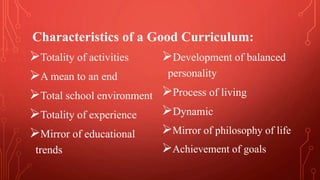
Totality of activities
A mean to an end
Total school environment
Totality of experience
Mirror of educational
trends
Development of balanced
personality
Process of living
Dynamic
Mirror of philosophy of life
Achievement of goals
Characteristics of a Good Curriculum:
DIFFERENCES BETWEEN CURRICULUM, SYLLABUS, COURSE
AND EDUCATIONAL PROGRAM
• Curriculum:
• According to K.A Leithwood (1981)
• Curriculum encompassed educational philosophy, values, objectives, organizational structure, materials,
teaching strategies, student experiences and assessment and learning outcomes.
• Syllabus:
• A list of the content of a course of the work simply means collection. It usually specifies the content,
learning outcomes and the time allocation for various topics.
• Course:
• It is defines as the series of planed units related to each other. In course of study organized subject is to
the covered with specified mind, teaching goods and suggestion for instructional strategies.
• Educational program:
• It concerns with the specific period of course of study.
NEED OF CURRICULUM:
Achievement of educational
aims
Fixing limits
Development of democratic
values
Development of citizenship
Development of character
Satisfaction of needs
Criteria of suitable teacher
Acquisition of knowledge
Development of personality
Reflects trends in education
Discoveries of and inventions
ELEMENTS OF CURRICULUM:
•Educational aims:
Educational aims refer to the overall purpose of education, which
represent the needs and aspiration in an educational policy.
•Goals:
Goals are the general purpose of the educational that normally
prepared for particular stage or level of the education system
•Objective:
Objective refer more precisely to the changes in behavior ,which
we hope will result from studying particular courses.
SUBJECT MATTER OR CONTENT
This is the element, which has been emphasized mainly in the past.
• Methodology:
It includes the methods adopted by the teacher during instruction and the
learning experience or activities performed by the students.
• Evaluation:
Give a judgment .decision about the worth, value or standard of
something according to some specific rules or regulation is called
evaluation.
FOUNDATION OF CURRICULUM:
Curriculum must take in to account the following consideration or
foundations otherwise it will remain bookish and divorced from life. A
curriculum that ignores these foundations does not serve any purpose. a
sound curriculum must be based on the needs and aspiration of the learners
as well as of the society.
• Philosophical Foundation:
Philosophy is the pursuit of wisdom and knowledge. It is study of realities
and general principles. It concerns with the research of internal truth. Every
society is held together by a common faith or “philosophy” which serves its
members as guide for living a good life.
• Psychological Foundation:
The psychology is derived from the Greek words “psyche” means soul and “logos” mean study.
Psychology is the scientific study of human behavior. Psychology attempts to describe. Explain and
predict human behavior. Psychology gives us an insight in to the child’s development and learning
and provides various techniques of inquiry for use in the curriculum area.
• Sociological Foundation :
Sociology as deemed in dictionaries is the science or study of society. A curriculum that
ignores sociology foundation does not serve any purpose. It results in wastages of time, energy and
resources. It will produce individual, who can’t play their role effectively enlightened members of a
society.
• Historical Foundation:
Every society has its own specific historical background. A curriculum that ignores historical
foundation does not fulfill any purpose. For example two nation theory is in the history of Pakistan.
PROCESS OF CURRICULUM DEVELOPMENT
IN PAKISTAN:
• Curriculum revision/development is ideally an ongoing, assessment, planning
and design, teacher training materials, implementation monitoring, feedback and
evaluation, the curricula renewal is based on the following broad areas of concern.
• Incorporating issues of global significance include environment change,
degradation, population control, gender issues and international understanding and
cooperation. Fostering respect for, prevention of cultural tradition, indigenous values
and ways of life. Fostering is the moral values through Islamic principle and ethics
among pupils. Promoting democratic value, respect for an appreciation of cultural
diversity that characterize Pakistani society and the broader global society. To
introduce competency based curricula by defining mini involved in learning
competence at both primary and secondary level.
FOLLOWING ARE THE STEPS INVOLVED IN
CURRICULUM DEVELOPMENT IN PAKISTAN.
• Curriculum wing request the provincial centers to prepare draft
curriculum for each subject taught in various classes up to the class XII.
Provincial curriculum committees prepare curriculum plane.
• The draft is sent to the curriculum wing. The national committee of
curriculum scrutinized the drafts in the light of the comments. The
committee submits its recommendation to the ministry approval. The
curriculum schemes duly approved are passed, on the provincial text
book.
NINE TYPES OF CURRICULUM
ADAPTATION:
1. Quantity:
• Adapt the number of items that the learner’s expected to learn or
number of activities student will complete prior to assessment for
mastery. For example, reduced the number of social studies terms a
learner must learn at any one time. Add more practice activities or
worksheets.
2. Time:
• Adapt the time allotted and allowed for learning, task completion or
testing, for example, individuals a timeline for completing the task, pace
learning difficulty for some learner.
3. Level of support:
• Increase the amount of personal assistance to keep the student on
task or to reinforce or prompt use of specific skills, enhance adult
student’s relationship, use physical space and environmental structure. For
example, assign peer buddies, teaching assistant, peer tutors or cross age
tutors, specify how to interact with the student or how to structure the
environment.
• 4. Input:
• Adapt the way instruction is delivered to the learner. For example,
use different visual aids, enlarge text, plan more concrete examples,
provides hands on activities place students in cooperative groups, pre
teach key concepts or terms before the lesson.
5. Difficulty:
• Adapt the skill level, problem type or the learner may approach the work.
For example allow the use of a calculator to figure math problems, simplify tasks
direction and change rules to accommodate learner needs.
6. Output:
• Adapt who the student can respond to instruction. For example instead of
answering questions in writing allow a verbal response, use a communication book
for some students, allow students to show knowledge with hands on materials.
7. Participation:
• Adapt the extent to which the learner is actively involved in the task. For
example, in geography have students hold the globe, while other point out location,
ask the students to lead a group. Have the student turn the pages while sitting on
your lap.
8. Alternate goals:
• Adapt the goals or outcome expectation while using the some
materials, when routinely utilized, this is only for student with moderate to
severe disabilities. For example, in a social studies lesson, expect a student
to be able to locate the colors of the states on a map, while other students
learn to locate each state and name the capital.
9. Substitute curriculum:
• Provide different instruction and materials to meet learner
individual’s goals. When routinely utilized, this is only for students with
moderate to serve disabilities. For example, during a language lesson a
student is learning toileting skills with an aide.
FACTORS AFFECTING CURRICULUM
DEVELOPMENT IN PAKISTAN:
• As curriculum revision in Pakistan is attempted adhoc basis and is
never based on adequate research, experimentation and formative
evaluation, the discussion about the failure or success of curriculum
implementation will be based on theoretical framework already
discussed. As for as desirable outcomes we have not been successful to
achieve thus the implementation of curriculum design in Pakistan seems
to be a failure.
• Teacher are reluctant to
accept the change
• Lack of in-service training
•Political interference
•Economic problems
•Inadequate evaluation
•Lack of commitment of
national philosophy
•Disapproval of the society
•Lack of sequence
•Curriculum is more
urbanized
•Lack of the teaching
materials
CURRICULUM DEVELOPMENT IN PAKISTAN
Curriculum
•Curriculum is properly designed to attain the National
Professional Standards for Teachers, is approved by the
competent authority and disseminated to all concerned. .
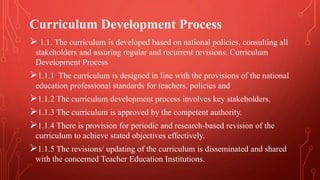
 1.1. The curriculum is developed based on national policies, consulting all
stakeholders and assuring regular and recurrent revisions. Curriculum
Development Process
1.1.1 The curriculum is designed in line with the provisions of the national
education professional standards for teachers. policies and
1.1.2 The curriculum development process involves key stakeholders.
1.1.3 The curriculum is approved by the competent authority.
1.1.4 There is provision for periodic and research-based revision of the
curriculum to achieve stated objectives effectively.
1.1.5 The revisions/ updating of the curriculum is disseminated and shared
with the concerned Teacher Education Institutions.
Curriculum Development Process
CURRICULUM CONTENT AND DESCRIPTION OF THE
PROGRAM
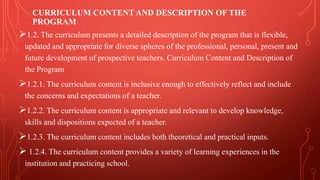
1.2. The curriculum presents a detailed description of the program that is flexible,
updated and appropriate for diverse spheres of the professional, personal, present and
future development of prospective teachers. Curriculum Content and Description of
the Program
1.2.1. The curriculum content is inclusive enough to effectively reflect and include
the concerns and expectations of a teacher.
1.2.2. The curriculum content is appropriate and relevant to develop knowledge,
skills and dispositions expected of a teacher.
1.2.3. The curriculum content includes both theoretical and practical inputs.
 1.2.4. The curriculum content provides a variety of learning experiences in the
institution and practicing school.
1.2.5 The curriculum content is compatible with the changing and emerging needs of
the society.
1.2.6 The curriculum document includes duration of the program (number of years,
semesters and credit hours) and course outlines.
1.2.7 The course credit hours and duration of the program meet the minimum
requirements of the Higher Education Commission.
1.2.8 The course credit hours and duration of concurrent degree program is equal to
relevant and equivalent degrees.
1.2.9 The program includes a mandatory course on application of Information and
Communication Technology.
1.2.10 The curriculum or its course outlines provide lists of web sites and
recommended books of recent editions for each course.
WHY ARE TEACHERS IMPORTANT IN THE
IMPLEMENTATION OF CURRICULUM?
•Teachers/educators are the major pillars in the teaching and
learning process. Without doubt, the most important person in
the practice curriculum is the teacher.
•With their knowledge , experience and competencies teachers
are central to any curriculum improvement effort, they are
responsible for introducing the curriculum in the classroom and
outside the classroom as well.
• Handal and Herrington (2003) also stress the central role of the
teachers in implementing the curriculum and call on policy
makers to take teachers attitudes and perceptions into account.
• A teacher does more than just implement curriculum. While
curriculum specialists, administrators and outside education
companies spend countless hours developing curriculum it is the
teachers who know best what the curriculum should look like.
After all, they work directly with the students who are meant to
benefit from the curriculum. In order to create strong curriculum
teachers must play an integral role in every step of the process.
TEACHER’S ROLE IN PLANNING THE
CURRICULUM:
•• Teachers know their students better than others involved in the
curriculum process. While the state often dictates the skills
covered by the curriculum, a teacher can provide insight into
the types of materials, activities and specific skills that need to
be included. Teachers from multiple grade levels may
collaborate to identify skills students need at each level and
ensure that the curriculum adequately prepares students to
advance to the next grade-level.
TEACHER’S ROLE IN THE CREATION OF
THE CURRICULUM:
•A teacher can gauge whether an activity will fit into a
specified time frame and engage students. All teachers should
be allowed to provide input during the creation stage.
•As teachers provide input they will gain ownership in the
product and feel more confident that the curriculum was
created with their concerns , and the needs of their students in
mind.
IMPLEMENTATION FROM THE TEACHER:
•Teachers must implement the curriculum in their own classroom
sticking to the plan that has taken so much time, careful planning
and effort to create. When a teacher fails to properly implement a
strong curriculum, she risks not covering standards or failing to
implement effective practices in the classroom.
•17. That does not mean a teacher can’t make minor changes. In fact
a strong curriculum is designed to allow a teacher to be flexible to
add a few personalized components, from a selection of activities.
REFLECTION BY THE TEAHCER:
•Reflection on a curriculum allows teachers and others involved
in the process to find any weaknesses in the curriculum, and
attempt to make it better. Teachers may reflect on curriculum in
multiple ways such as keeping a journal as they implement the
curriculum giving student reviews and surveys, analyzing results
and assessments, data about student’s individual performance.
Not only can reflection serve to improve a specific curriculum, it
may guide the creation of a new curriculum.
INVOLVING TEACHERS IN THE PROCESS OF
CURRICULUM DEVELOPMENT:
• In the absence of adequate teacher training, teachers may rely on their
prior beliefs and experiences in interpreting the new curriculum. This
will contribute to the mismatch between what the curriculum aims to
achieve and what actually happens inside the classroom.
• Teacher’s prior beliefs and practices can pose challenges, not only
because teachers are unwilling to change in the direction of the policy,
but also because their understandings may interfere with their ability to
interpret and implement the reforms in ways consistent with the
designer’s intent.
HOW CAN PROFESSIONAL DEVELOPMENT ENHANCE
TEACHERS ROLE IN DEVELOPMENT AND IMPLEMENTATION
OF CURRICULUM?
• It is the responsibility of teacher training and development programs to
provide teachers with opportunities to redirect their beliefs and reflect upon
their classroom practices, so that maximum targeted professional
development can be implemented.
• Without an appropriate focus on teachers, quality education is not feasible
at all. The quality of teachers explains differences in learning outcomes.
Proper recruitment and continuous professional development strategies
must be in place to endow those entrusted with teaching with the required
knowledge, skills, attitudes and values to retain them in the profession.
• The key to getting teachers committed to an innovation is to enhance their
knowledge of the programme. This means teachers need to be trained
through workshops organized for professional development. However, not all
teachers will have the benefit of such exposure due to insufficient funds. • A
successfully implemented curriculum can be ensured only through teacher
education programme with curriculum development as a major subject
• It is important for teachers to understand the philosophy behind the program
and how it may impact students, parents, administrators and stake holders.
• Teachers own interest, ability and competence to teach the curriculum i.e
confidence in teaching, attitudes and freeness to teach the subject.
Unit 6. Curriculum Development in Pakistan.pptx

Unit 6. Curriculum Development in Pakistan.pptx

  • 2.
    CURRICULUM DEVELOPMENT INPAKISTAN Curriculum • According to Ralph Taylor, • Curriculum means all those activities which are provides to students in the school or out of school in order to achieve the predetermined activities. • According to Smith, Stanely and Shore: • Curriculum includes all the activities organized by the school inside or outside the classroom. These activities are sequential in the nature. • According to j. f Kert: • All the learning which is planned or guided by the school is called curriculum.
  • 3.
    Totality of activities Amean to an end Total school environment Totality of experience Mirror of educational trends Development of balanced personality Process of living Dynamic Mirror of philosophy of life Achievement of goals Characteristics of a Good Curriculum:
  • 4.
    DIFFERENCES BETWEEN CURRICULUM,SYLLABUS, COURSE AND EDUCATIONAL PROGRAM • Curriculum: • According to K.A Leithwood (1981) • Curriculum encompassed educational philosophy, values, objectives, organizational structure, materials, teaching strategies, student experiences and assessment and learning outcomes. • Syllabus: • A list of the content of a course of the work simply means collection. It usually specifies the content, learning outcomes and the time allocation for various topics. • Course: • It is defines as the series of planed units related to each other. In course of study organized subject is to the covered with specified mind, teaching goods and suggestion for instructional strategies. • Educational program: • It concerns with the specific period of course of study.
  • 5.
    NEED OF CURRICULUM: Achievementof educational aims Fixing limits Development of democratic values Development of citizenship Development of character Satisfaction of needs Criteria of suitable teacher Acquisition of knowledge Development of personality Reflects trends in education Discoveries of and inventions
  • 6.
    ELEMENTS OF CURRICULUM: •Educationalaims: Educational aims refer to the overall purpose of education, which represent the needs and aspiration in an educational policy. •Goals: Goals are the general purpose of the educational that normally prepared for particular stage or level of the education system •Objective: Objective refer more precisely to the changes in behavior ,which we hope will result from studying particular courses.
  • 7.
    SUBJECT MATTER ORCONTENT This is the element, which has been emphasized mainly in the past. • Methodology: It includes the methods adopted by the teacher during instruction and the learning experience or activities performed by the students. • Evaluation: Give a judgment .decision about the worth, value or standard of something according to some specific rules or regulation is called evaluation.
  • 8.
    FOUNDATION OF CURRICULUM: Curriculummust take in to account the following consideration or foundations otherwise it will remain bookish and divorced from life. A curriculum that ignores these foundations does not serve any purpose. a sound curriculum must be based on the needs and aspiration of the learners as well as of the society. • Philosophical Foundation: Philosophy is the pursuit of wisdom and knowledge. It is study of realities and general principles. It concerns with the research of internal truth. Every society is held together by a common faith or “philosophy” which serves its members as guide for living a good life.
  • 9.
    • Psychological Foundation: Thepsychology is derived from the Greek words “psyche” means soul and “logos” mean study. Psychology is the scientific study of human behavior. Psychology attempts to describe. Explain and predict human behavior. Psychology gives us an insight in to the child’s development and learning and provides various techniques of inquiry for use in the curriculum area. • Sociological Foundation : Sociology as deemed in dictionaries is the science or study of society. A curriculum that ignores sociology foundation does not serve any purpose. It results in wastages of time, energy and resources. It will produce individual, who can’t play their role effectively enlightened members of a society. • Historical Foundation: Every society has its own specific historical background. A curriculum that ignores historical foundation does not fulfill any purpose. For example two nation theory is in the history of Pakistan.
  • 10.
    PROCESS OF CURRICULUMDEVELOPMENT IN PAKISTAN: • Curriculum revision/development is ideally an ongoing, assessment, planning and design, teacher training materials, implementation monitoring, feedback and evaluation, the curricula renewal is based on the following broad areas of concern. • Incorporating issues of global significance include environment change, degradation, population control, gender issues and international understanding and cooperation. Fostering respect for, prevention of cultural tradition, indigenous values and ways of life. Fostering is the moral values through Islamic principle and ethics among pupils. Promoting democratic value, respect for an appreciation of cultural diversity that characterize Pakistani society and the broader global society. To introduce competency based curricula by defining mini involved in learning competence at both primary and secondary level.
  • 11.
    FOLLOWING ARE THESTEPS INVOLVED IN CURRICULUM DEVELOPMENT IN PAKISTAN. • Curriculum wing request the provincial centers to prepare draft curriculum for each subject taught in various classes up to the class XII. Provincial curriculum committees prepare curriculum plane. • The draft is sent to the curriculum wing. The national committee of curriculum scrutinized the drafts in the light of the comments. The committee submits its recommendation to the ministry approval. The curriculum schemes duly approved are passed, on the provincial text book.
  • 12.
    NINE TYPES OFCURRICULUM ADAPTATION: 1. Quantity: • Adapt the number of items that the learner’s expected to learn or number of activities student will complete prior to assessment for mastery. For example, reduced the number of social studies terms a learner must learn at any one time. Add more practice activities or worksheets. 2. Time: • Adapt the time allotted and allowed for learning, task completion or testing, for example, individuals a timeline for completing the task, pace learning difficulty for some learner.
  • 13.
    3. Level ofsupport: • Increase the amount of personal assistance to keep the student on task or to reinforce or prompt use of specific skills, enhance adult student’s relationship, use physical space and environmental structure. For example, assign peer buddies, teaching assistant, peer tutors or cross age tutors, specify how to interact with the student or how to structure the environment. • 4. Input: • Adapt the way instruction is delivered to the learner. For example, use different visual aids, enlarge text, plan more concrete examples, provides hands on activities place students in cooperative groups, pre teach key concepts or terms before the lesson.
  • 14.
    5. Difficulty: • Adaptthe skill level, problem type or the learner may approach the work. For example allow the use of a calculator to figure math problems, simplify tasks direction and change rules to accommodate learner needs. 6. Output: • Adapt who the student can respond to instruction. For example instead of answering questions in writing allow a verbal response, use a communication book for some students, allow students to show knowledge with hands on materials. 7. Participation: • Adapt the extent to which the learner is actively involved in the task. For example, in geography have students hold the globe, while other point out location, ask the students to lead a group. Have the student turn the pages while sitting on your lap.
  • 15.
    8. Alternate goals: •Adapt the goals or outcome expectation while using the some materials, when routinely utilized, this is only for student with moderate to severe disabilities. For example, in a social studies lesson, expect a student to be able to locate the colors of the states on a map, while other students learn to locate each state and name the capital. 9. Substitute curriculum: • Provide different instruction and materials to meet learner individual’s goals. When routinely utilized, this is only for students with moderate to serve disabilities. For example, during a language lesson a student is learning toileting skills with an aide.
  • 16.
    FACTORS AFFECTING CURRICULUM DEVELOPMENTIN PAKISTAN: • As curriculum revision in Pakistan is attempted adhoc basis and is never based on adequate research, experimentation and formative evaluation, the discussion about the failure or success of curriculum implementation will be based on theoretical framework already discussed. As for as desirable outcomes we have not been successful to achieve thus the implementation of curriculum design in Pakistan seems to be a failure.
  • 17.
    • Teacher arereluctant to accept the change • Lack of in-service training •Political interference •Economic problems •Inadequate evaluation •Lack of commitment of national philosophy •Disapproval of the society •Lack of sequence •Curriculum is more urbanized •Lack of the teaching materials
  • 19.
    CURRICULUM DEVELOPMENT INPAKISTAN Curriculum •Curriculum is properly designed to attain the National Professional Standards for Teachers, is approved by the competent authority and disseminated to all concerned. .
  • 20.
     1.1. Thecurriculum is developed based on national policies, consulting all stakeholders and assuring regular and recurrent revisions. Curriculum Development Process 1.1.1 The curriculum is designed in line with the provisions of the national education professional standards for teachers. policies and 1.1.2 The curriculum development process involves key stakeholders. 1.1.3 The curriculum is approved by the competent authority. 1.1.4 There is provision for periodic and research-based revision of the curriculum to achieve stated objectives effectively. 1.1.5 The revisions/ updating of the curriculum is disseminated and shared with the concerned Teacher Education Institutions. Curriculum Development Process
  • 21.
    CURRICULUM CONTENT ANDDESCRIPTION OF THE PROGRAM 1.2. The curriculum presents a detailed description of the program that is flexible, updated and appropriate for diverse spheres of the professional, personal, present and future development of prospective teachers. Curriculum Content and Description of the Program 1.2.1. The curriculum content is inclusive enough to effectively reflect and include the concerns and expectations of a teacher. 1.2.2. The curriculum content is appropriate and relevant to develop knowledge, skills and dispositions expected of a teacher. 1.2.3. The curriculum content includes both theoretical and practical inputs.  1.2.4. The curriculum content provides a variety of learning experiences in the institution and practicing school.
  • 22.
    1.2.5 The curriculumcontent is compatible with the changing and emerging needs of the society. 1.2.6 The curriculum document includes duration of the program (number of years, semesters and credit hours) and course outlines. 1.2.7 The course credit hours and duration of the program meet the minimum requirements of the Higher Education Commission. 1.2.8 The course credit hours and duration of concurrent degree program is equal to relevant and equivalent degrees. 1.2.9 The program includes a mandatory course on application of Information and Communication Technology. 1.2.10 The curriculum or its course outlines provide lists of web sites and recommended books of recent editions for each course.
  • 23.
    WHY ARE TEACHERSIMPORTANT IN THE IMPLEMENTATION OF CURRICULUM? •Teachers/educators are the major pillars in the teaching and learning process. Without doubt, the most important person in the practice curriculum is the teacher. •With their knowledge , experience and competencies teachers are central to any curriculum improvement effort, they are responsible for introducing the curriculum in the classroom and outside the classroom as well.
  • 24.
    • Handal andHerrington (2003) also stress the central role of the teachers in implementing the curriculum and call on policy makers to take teachers attitudes and perceptions into account. • A teacher does more than just implement curriculum. While curriculum specialists, administrators and outside education companies spend countless hours developing curriculum it is the teachers who know best what the curriculum should look like. After all, they work directly with the students who are meant to benefit from the curriculum. In order to create strong curriculum teachers must play an integral role in every step of the process.
  • 25.
    TEACHER’S ROLE INPLANNING THE CURRICULUM: •• Teachers know their students better than others involved in the curriculum process. While the state often dictates the skills covered by the curriculum, a teacher can provide insight into the types of materials, activities and specific skills that need to be included. Teachers from multiple grade levels may collaborate to identify skills students need at each level and ensure that the curriculum adequately prepares students to advance to the next grade-level.
  • 26.
    TEACHER’S ROLE INTHE CREATION OF THE CURRICULUM: •A teacher can gauge whether an activity will fit into a specified time frame and engage students. All teachers should be allowed to provide input during the creation stage. •As teachers provide input they will gain ownership in the product and feel more confident that the curriculum was created with their concerns , and the needs of their students in mind.
  • 27.
    IMPLEMENTATION FROM THETEACHER: •Teachers must implement the curriculum in their own classroom sticking to the plan that has taken so much time, careful planning and effort to create. When a teacher fails to properly implement a strong curriculum, she risks not covering standards or failing to implement effective practices in the classroom. •17. That does not mean a teacher can’t make minor changes. In fact a strong curriculum is designed to allow a teacher to be flexible to add a few personalized components, from a selection of activities.
  • 28.
    REFLECTION BY THETEAHCER: •Reflection on a curriculum allows teachers and others involved in the process to find any weaknesses in the curriculum, and attempt to make it better. Teachers may reflect on curriculum in multiple ways such as keeping a journal as they implement the curriculum giving student reviews and surveys, analyzing results and assessments, data about student’s individual performance. Not only can reflection serve to improve a specific curriculum, it may guide the creation of a new curriculum.
  • 29.
    INVOLVING TEACHERS INTHE PROCESS OF CURRICULUM DEVELOPMENT: • In the absence of adequate teacher training, teachers may rely on their prior beliefs and experiences in interpreting the new curriculum. This will contribute to the mismatch between what the curriculum aims to achieve and what actually happens inside the classroom. • Teacher’s prior beliefs and practices can pose challenges, not only because teachers are unwilling to change in the direction of the policy, but also because their understandings may interfere with their ability to interpret and implement the reforms in ways consistent with the designer’s intent.
  • 30.
    HOW CAN PROFESSIONALDEVELOPMENT ENHANCE TEACHERS ROLE IN DEVELOPMENT AND IMPLEMENTATION OF CURRICULUM? • It is the responsibility of teacher training and development programs to provide teachers with opportunities to redirect their beliefs and reflect upon their classroom practices, so that maximum targeted professional development can be implemented. • Without an appropriate focus on teachers, quality education is not feasible at all. The quality of teachers explains differences in learning outcomes. Proper recruitment and continuous professional development strategies must be in place to endow those entrusted with teaching with the required knowledge, skills, attitudes and values to retain them in the profession.
  • 31.
    • The keyto getting teachers committed to an innovation is to enhance their knowledge of the programme. This means teachers need to be trained through workshops organized for professional development. However, not all teachers will have the benefit of such exposure due to insufficient funds. • A successfully implemented curriculum can be ensured only through teacher education programme with curriculum development as a major subject • It is important for teachers to understand the philosophy behind the program and how it may impact students, parents, administrators and stake holders. • Teachers own interest, ability and competence to teach the curriculum i.e confidence in teaching, attitudes and freeness to teach the subject.