Dr. Abdul Jabbar
Sr. Headmaster
What is Curriculum?
 What is Curriculum????????????
What is Curriculum?
It is (i) a proposed (ii) documented
(iii)plan for guiding learning that is
put into practice in the classroom
in a learning environment
(Glatthron, Boschee, & Whitehead, p. 5).
Basic Factors behind Changing
National Curriculum in 2006
The Curriculum was changed to:
 Ensure shift of emphasis
 Teacher centered to Student centered
 To know to do
 To know and to become
 Make curriculum more vibrant and responsive to:
 modern needs,
 socio-economic needs,
 Technical needs,
 professional needs and
 labour market needs
Important concepts/ terms
Developmental levels
Standards
Benchmarks
Student learning outcomes (SLOs)
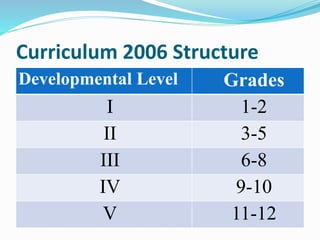
Curriculum 2006 Structure
Developmental Level Grades
I 1-2
II 3-5
III 6-8
IV 9-10
V 11-12
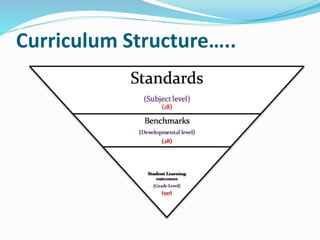
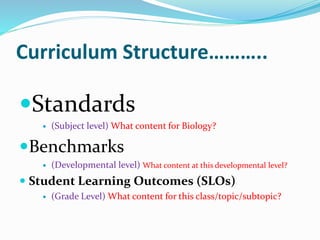
Curriculum Structure…..
Curriculum Structure………..
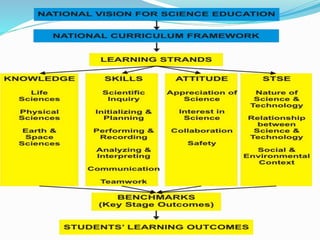
Standards
 (Subject level) What content for Biology?
Benchmarks
 (Developmental level) What content at this developmental level?
 Student Learning Outcomes (SLOs)
 (Grade Level) What content for this class/topic/subtopic?
Standards
 Standards (as defined in the National Curriculum )are:
 “what students should know and be able to do.
Standards are broad descriptions of
the knowledge and skills which
students should acquire in a subject
area”
Standards………Example
 Students will be able to understand the
principles of biology, diversity in life forms,
structure and functions of cells, the
processes of life, continuity in life, how
living things interact with each other and
their environment and the applications of
biology for human welfare.
Benchmarks
 Benchmarks are:
 descriptions of the knowledge and skills at
developmental level.
 Students will be able to understand the principles of
biology and diversity in life forms.
 They will be able to;
1. Describe the parameters of the study of life and the
levels of organization of life and relate the study of life
with the scientific methodology.
2. Describe the aims and principles of classification
systems and binomial nomenclature.
Students Learning outcomes
 Students Learning outcomes are:
 More specific and are given for each topic in the subject.
 These learning outcomes “determine how well students are performing
and will assure that all students are measured on the same knowledge
and skills using the same method of assessment”.
 These outcomes are “realistic, observable, achievable and measurable”
 Examples
1. Define biology its major divisions i.e. botany, zoology
and microbiology.
2. Define the branches of biology i.e. morphology, anatomy,
physiology, embryology, taxonomy, cell biology,
histology, paleontology, environmental biology,
biotechnology, socio-biology, parasitology, immunology,
entomology, genetics, pharmacology.
Components of Curriculum
Curriculum consists of following parts
1. Description of standards, benchmarks and students
learning outcomes
2. Themes
3. Teaching strategies
4. Teaching and learning resources (including guidance
for textbook writing, A. V. aids, Online resources,
materials and apparatus)
5. Assessment and evaluation
PROCESS OF
CURRICULUM
DEVELOPMENT
Levels of Curriculum Development
1. Societal/National/Provincial
2. Institutional
3. Instructional
4. Personal
(McNeil, 2006, pp. 89-91)
Before 18th Amendment
 Before ‘The Eighteenth Constitutional Amendment Act 2010’
(GOP, 2010). The ‘Federal Supervision of Curricula, Textbooks
and Maintenance of Standards of Education Act, 1976’
empowered Federal Ministry of Education [MOE] to supervise
the educational matters present on the concurrent list.
 National Bureau of Curriculum and textbooks [NBCT], working
under the Federal MOE, was a nominated ‘competent authority’
for performing the following functions from primary to higher
secondary level:
 Develop curricula, scheme of studies, and manuscripts of
textbooks
 Approve Textbooks’ manuscripts
 Modify/improve/ correct the curriculum and the textbooks or
reference materials.
Curriculum Bodies at Primary and
Secondary Levels
 IN PUNJAB : PUNJAB CURRICULUM and TEXTBOOK
BORAD [formerly PUNJAB CURRICULUM AUTHORTY
(PCA), Punjab Textbook Borad) is responsible to develop
curriculum for Punjab Province.
 IN SINDH: BUREAU OF CURRICULUM AND
EXTENSION WING (BCEW) is responsible for develop
curriculum for Sindh Province
 IN KPK: DIRECTORATE OF CURRICULUM AND
TEACHER EDUCATION(CTE) is responsible for develop
curriculum for Khyber Pakhtunkhwa Province.
 IN BALOCHISTAN: No Curriculum body its in process
 IN ICT, FATA, FANA and AJK: CURRICULUM WING is
responsible for the develop curriculum for these Areas.
Development Process
1. Situational Analysis
1. (Need Analysis/
2. availability of resources)
2. Development of Standards (Top down approach)
3. Development of Benchmarks.
4. Selection of themes (Scheme of studies)
5. Development of Student learning Outcomes
6. Recommendations/suggestions for resources
7. Teaching strategies
8. Assessment
SALIENT FEATURES OF THE
NATIONAL CURRICULUM
The curriculum provides to the students:
1. Challenges and Enjoyment
2. Breadth
3. Progression
4. Depth
5. Coherence among different grades and subjects
6. Relevance to the society
7. Science-technology Connection
8. Competitive with Curricula of advanced countries
Issues and Problems in Curriculum
1. Gap between curriculum development and its
implementation
2. Less reorganization of Individual differences
3. No allocation of resources according to the new
curriculum
4. Assessment not harmonious with curriculum
5. Teacher’s training
6. Less awareness of teachers/management about
curriculum
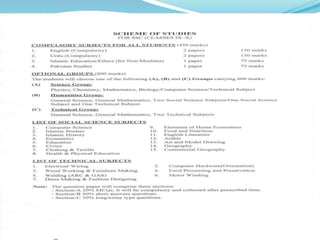
Scheme of Studies
It is based on three key factors:
• The Education policy
• Market Demand
• Global Issues Task work in this area is undertaken with
the participation of:
• Provincial government
• Research organizations and experts
• Feedback of the IBCC
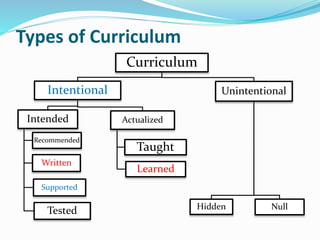
Types of Curriculum
Curriculum
Intentional
Intended
Recommended
Written
Supported
Tested
Actualized
Taught
Learned
Unintentional
Hidden Null
THANKS

National curriculum 2006 revised

  • 1.
  • 2.
    What is Curriculum? What is Curriculum????????????
  • 3.
    What is Curriculum? Itis (i) a proposed (ii) documented (iii)plan for guiding learning that is put into practice in the classroom in a learning environment (Glatthron, Boschee, & Whitehead, p. 5).
  • 4.
    Basic Factors behindChanging National Curriculum in 2006 The Curriculum was changed to:  Ensure shift of emphasis  Teacher centered to Student centered  To know to do  To know and to become  Make curriculum more vibrant and responsive to:  modern needs,  socio-economic needs,  Technical needs,  professional needs and  labour market needs
  • 5.
    Important concepts/ terms Developmentallevels Standards Benchmarks Student learning outcomes (SLOs)
  • 6.
    Curriculum 2006 Structure DevelopmentalLevel Grades I 1-2 II 3-5 III 6-8 IV 9-10 V 11-12
  • 7.
  • 8.
    Curriculum Structure……….. Standards  (Subjectlevel) What content for Biology? Benchmarks  (Developmental level) What content at this developmental level?  Student Learning Outcomes (SLOs)  (Grade Level) What content for this class/topic/subtopic?
  • 9.
    Standards  Standards (asdefined in the National Curriculum )are:  “what students should know and be able to do. Standards are broad descriptions of the knowledge and skills which students should acquire in a subject area”
  • 10.
    Standards………Example  Students willbe able to understand the principles of biology, diversity in life forms, structure and functions of cells, the processes of life, continuity in life, how living things interact with each other and their environment and the applications of biology for human welfare.
  • 11.
    Benchmarks  Benchmarks are: descriptions of the knowledge and skills at developmental level.  Students will be able to understand the principles of biology and diversity in life forms.  They will be able to; 1. Describe the parameters of the study of life and the levels of organization of life and relate the study of life with the scientific methodology. 2. Describe the aims and principles of classification systems and binomial nomenclature.
  • 12.
    Students Learning outcomes Students Learning outcomes are:  More specific and are given for each topic in the subject.  These learning outcomes “determine how well students are performing and will assure that all students are measured on the same knowledge and skills using the same method of assessment”.  These outcomes are “realistic, observable, achievable and measurable”  Examples 1. Define biology its major divisions i.e. botany, zoology and microbiology. 2. Define the branches of biology i.e. morphology, anatomy, physiology, embryology, taxonomy, cell biology, histology, paleontology, environmental biology, biotechnology, socio-biology, parasitology, immunology, entomology, genetics, pharmacology.
  • 13.
    Components of Curriculum Curriculumconsists of following parts 1. Description of standards, benchmarks and students learning outcomes 2. Themes 3. Teaching strategies 4. Teaching and learning resources (including guidance for textbook writing, A. V. aids, Online resources, materials and apparatus) 5. Assessment and evaluation
  • 14.
  • 15.
    Levels of CurriculumDevelopment 1. Societal/National/Provincial 2. Institutional 3. Instructional 4. Personal (McNeil, 2006, pp. 89-91)
  • 16.
    Before 18th Amendment Before ‘The Eighteenth Constitutional Amendment Act 2010’ (GOP, 2010). The ‘Federal Supervision of Curricula, Textbooks and Maintenance of Standards of Education Act, 1976’ empowered Federal Ministry of Education [MOE] to supervise the educational matters present on the concurrent list.  National Bureau of Curriculum and textbooks [NBCT], working under the Federal MOE, was a nominated ‘competent authority’ for performing the following functions from primary to higher secondary level:  Develop curricula, scheme of studies, and manuscripts of textbooks  Approve Textbooks’ manuscripts  Modify/improve/ correct the curriculum and the textbooks or reference materials.
  • 17.
    Curriculum Bodies atPrimary and Secondary Levels  IN PUNJAB : PUNJAB CURRICULUM and TEXTBOOK BORAD [formerly PUNJAB CURRICULUM AUTHORTY (PCA), Punjab Textbook Borad) is responsible to develop curriculum for Punjab Province.  IN SINDH: BUREAU OF CURRICULUM AND EXTENSION WING (BCEW) is responsible for develop curriculum for Sindh Province  IN KPK: DIRECTORATE OF CURRICULUM AND TEACHER EDUCATION(CTE) is responsible for develop curriculum for Khyber Pakhtunkhwa Province.  IN BALOCHISTAN: No Curriculum body its in process  IN ICT, FATA, FANA and AJK: CURRICULUM WING is responsible for the develop curriculum for these Areas.
  • 18.
    Development Process 1. SituationalAnalysis 1. (Need Analysis/ 2. availability of resources) 2. Development of Standards (Top down approach) 3. Development of Benchmarks. 4. Selection of themes (Scheme of studies) 5. Development of Student learning Outcomes 6. Recommendations/suggestions for resources 7. Teaching strategies 8. Assessment
  • 20.
    SALIENT FEATURES OFTHE NATIONAL CURRICULUM The curriculum provides to the students: 1. Challenges and Enjoyment 2. Breadth 3. Progression 4. Depth 5. Coherence among different grades and subjects 6. Relevance to the society 7. Science-technology Connection 8. Competitive with Curricula of advanced countries
  • 21.
    Issues and Problemsin Curriculum 1. Gap between curriculum development and its implementation 2. Less reorganization of Individual differences 3. No allocation of resources according to the new curriculum 4. Assessment not harmonious with curriculum 5. Teacher’s training 6. Less awareness of teachers/management about curriculum
  • 22.
    Scheme of Studies Itis based on three key factors: • The Education policy • Market Demand • Global Issues Task work in this area is undertaken with the participation of: • Provincial government • Research organizations and experts • Feedback of the IBCC
  • 24.
  • 25.