ELEMENTARY SCHOOL
MANAGEMENT
CODE No: 622
INTRODUCTION
New trends of school administration and management are
emerging and replacing the old ones. This course examines
school oversight, dynamics of administering and managing an
educational institution. Topics include best practices in
management, resource management, educational planning,
school education rules and regulations and school records. The
course explains resource management, management leadership,
educational planning, school records and regulations and school
discipline.
Organization and Administration
Unit–1
OBJECTIVES
1.Define the term “organization, school organization, and
administration” in their own words.
2.Support the need and scope of school organization in
elementary schools.
3.Explain the characteristic of school organization and
school administration.
4.Describe elements of school organization.
5.Explain the connection between school and home.
6.Explain relationship between school and the community.
Rights of the Children
 Satisfactory, and up to date, education
 Program that bridges the gap between home and school
 Schooling under healthy conditions
• Get for his educational needs the required funds from the
resources of community, state and nation.
• Educational service and guidance throughout the period of his
education
• Teachers, supervisors and administrators deal effectively with
his needs and problems
• Training through the school to participate in community life
and culture
• health services, educational and vocational guidance, library
facilities, and recreational activities.
SCHOOL ORGANIZATION
• Meaning of School
▫ Place for learning and education.
▫ Securing child’s development along desirable lines.
▫ centre of vigorous life.
• School organization
▫ organization as a machine for doing work
▫ administrative expression of educational theory
▫ practical measures which we take to ensure that
the system of work
CONCEPT OF SCHOOL ORGANIZATION
An organization is defined as the necessary combination of
human efforts, material equipments brought together in a
systematic and effective correlation to accomplish the
desired results Thus school organization means
• Organization of different types of activities of a school
• Organization of Material resources of a school
• Organization of a school personnel
CHARACTERISTICS OF AN IDEAL SCHOOL
ORGANIZATION
• Simplicity: clarity of roles, duties, responsibilities of the activities of the school
• Dynamism/Flexibility: change can take place without disturbing any other
activity.
• Stability: balance between rigidity and flexibility , norm or standard rules and
regulations
• Clarity about Powers and Duties: powers and duties of individuals
working together in a school.
• Coordination physical and human resources.
• Acceptance of human elements: free to express their feelings, opinions,
offer constructive suggestions
• Control: break to an activity and then evaluates the results
SCOPE AND IMPORTANCE OF SCHOOL ORGANIZATION
• Functions of the school
• Coordination of the educational programs,
• Brings efficiency, guide pupil to receive right
direction
• Great role of economy, men, and material to achieve
the desired objectives
• Building the nation
ELEMENTS OF ORGANIZATION
• Policy Making and Planning
• Financial Provisions
• Material Provisions
• Provision of Personnel
• Instructional Provisions
• Provision of Activities
• Provision for Experimentation
• Evaluation of End-Products
• Control, Direction and Co-Ordination
• Records and Reports
Organization vs Administration
School Organization
• Organization of a school
is the administrative
expression of educational
theory.
• Organization stands for
an organized body or
system or structure or
framework or manner of
being
School Administration
• Administration of a school
is employed in operating
the educational
organization in accordance
with established polices
• Administration stands for
running, hand-ling,
conducting, or controlling
of an organization. It gets
things done.
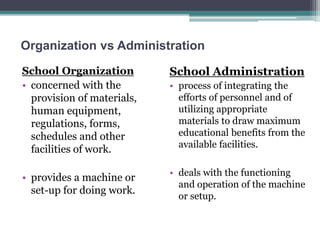
Organization vs Administration
School Organization
• concerned with the
provision of materials,
human equipment,
regulations, forms,
schedules and other
facilities of work.
• provides a machine or
set-up for doing work.
School Administration
• process of integrating the
efforts of personnel and of
utilizing appropriate
materials to draw maximum
educational benefits from the
available facilities.
• deals with the functioning
and operation of the machine
or setup.
Organization vs Administration
School Organization
• Organization provides
resources.
• agency by which we
achieve the desired
objectives.
• Organization is the pre-
execution stage.
School Administration
• Administration is the
management of these
resources.
• carries out educational
schemes, programs and
practice
• Administration is the
execution stage itself.
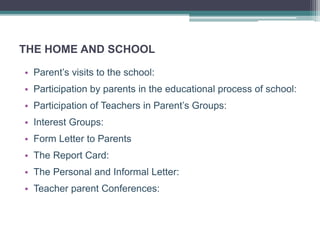
THE HOME AND SCHOOL
• Parent’s visits to the school:
• Participation by parents in the educational process of school:
• Participation of Teachers in Parent’s Groups:
• Interest Groups:
• Form Letter to Parents
• The Report Card:
• The Personal and Informal Letter:
• Teacher parent Conferences:
Organization and Administration

Organization and Administration

  • 1.
  • 2.
    INTRODUCTION New trends ofschool administration and management are emerging and replacing the old ones. This course examines school oversight, dynamics of administering and managing an educational institution. Topics include best practices in management, resource management, educational planning, school education rules and regulations and school records. The course explains resource management, management leadership, educational planning, school records and regulations and school discipline.
  • 3.
  • 4.
    OBJECTIVES 1.Define the term“organization, school organization, and administration” in their own words. 2.Support the need and scope of school organization in elementary schools. 3.Explain the characteristic of school organization and school administration. 4.Describe elements of school organization. 5.Explain the connection between school and home. 6.Explain relationship between school and the community.
  • 5.
    Rights of theChildren  Satisfactory, and up to date, education  Program that bridges the gap between home and school  Schooling under healthy conditions • Get for his educational needs the required funds from the resources of community, state and nation. • Educational service and guidance throughout the period of his education • Teachers, supervisors and administrators deal effectively with his needs and problems • Training through the school to participate in community life and culture • health services, educational and vocational guidance, library facilities, and recreational activities.
  • 6.
    SCHOOL ORGANIZATION • Meaningof School ▫ Place for learning and education. ▫ Securing child’s development along desirable lines. ▫ centre of vigorous life. • School organization ▫ organization as a machine for doing work ▫ administrative expression of educational theory ▫ practical measures which we take to ensure that the system of work
  • 7.
    CONCEPT OF SCHOOLORGANIZATION An organization is defined as the necessary combination of human efforts, material equipments brought together in a systematic and effective correlation to accomplish the desired results Thus school organization means • Organization of different types of activities of a school • Organization of Material resources of a school • Organization of a school personnel
  • 8.
    CHARACTERISTICS OF ANIDEAL SCHOOL ORGANIZATION • Simplicity: clarity of roles, duties, responsibilities of the activities of the school • Dynamism/Flexibility: change can take place without disturbing any other activity. • Stability: balance between rigidity and flexibility , norm or standard rules and regulations • Clarity about Powers and Duties: powers and duties of individuals working together in a school. • Coordination physical and human resources. • Acceptance of human elements: free to express their feelings, opinions, offer constructive suggestions • Control: break to an activity and then evaluates the results
  • 9.
    SCOPE AND IMPORTANCEOF SCHOOL ORGANIZATION • Functions of the school • Coordination of the educational programs, • Brings efficiency, guide pupil to receive right direction • Great role of economy, men, and material to achieve the desired objectives • Building the nation
  • 10.
    ELEMENTS OF ORGANIZATION •Policy Making and Planning • Financial Provisions • Material Provisions • Provision of Personnel • Instructional Provisions • Provision of Activities • Provision for Experimentation • Evaluation of End-Products • Control, Direction and Co-Ordination • Records and Reports
  • 11.
    Organization vs Administration SchoolOrganization • Organization of a school is the administrative expression of educational theory. • Organization stands for an organized body or system or structure or framework or manner of being School Administration • Administration of a school is employed in operating the educational organization in accordance with established polices • Administration stands for running, hand-ling, conducting, or controlling of an organization. It gets things done.
  • 12.
    Organization vs Administration SchoolOrganization • concerned with the provision of materials, human equipment, regulations, forms, schedules and other facilities of work. • provides a machine or set-up for doing work. School Administration • process of integrating the efforts of personnel and of utilizing appropriate materials to draw maximum educational benefits from the available facilities. • deals with the functioning and operation of the machine or setup.
  • 13.
    Organization vs Administration SchoolOrganization • Organization provides resources. • agency by which we achieve the desired objectives. • Organization is the pre- execution stage. School Administration • Administration is the management of these resources. • carries out educational schemes, programs and practice • Administration is the execution stage itself.
  • 14.
    THE HOME ANDSCHOOL • Parent’s visits to the school: • Participation by parents in the educational process of school: • Participation of Teachers in Parent’s Groups: • Interest Groups: • Form Letter to Parents • The Report Card: • The Personal and Informal Letter: • Teacher parent Conferences: