BY: ZUHEB AHMED SIDDIQUI (PT)
MPT (ORTHO)
DEFINITION
 Curriculum is derived from the Latin word ‘Currere’ which means
‘to run’.
 Curriculum means a chariot course, a kind of route over which the
learner travels.
 Thus curriculum is the path by which one realizes the goals and
objectives of a particular course.
 Curriculum is the tool in the hands of the artists (teachers) to mould
his material (learners) according to his desires (aims & objectives
of education). – Donald J. Cunningham
 Curriculum is the totality of experiences that pupils receive through the
manifold activities that go in the school, in the classroom, library,
laboratory, workshop, playground & numerous informal contacts
between teachers and pupils. - The Secondary Education Commission.
 The planned & guided learning experiences & intended learning
outcomes, formulated through the systematic reconstruction of
knowledge and experience, under the auspices of the school for the
learners’ continuous & willful growth in personal social competence. –
Tanner & Tanner
 All the experiences that learner has undertaken in the guidance of the
school. – Arthur W. Foshay
Bases of Curriculum
1. Aims of Education
2. Philosophy of Education
3. Sociological basis
4. Psychological basis
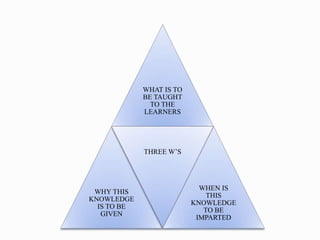
WHAT IS TO
BE TAUGHT
TO THE
LEARNERS
WHY THIS
KNOWLEDGE
IS TO BE
GIVEN
THREE W’S
WHEN IS
THIS
KNOWLEDGE
TO BE
IMPARTED
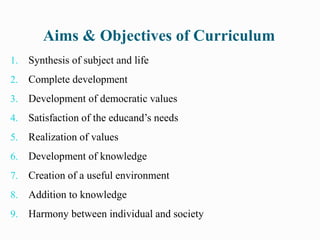
Aims & Objectives of Curriculum
1. Synthesis of subject and life
2. Complete development
3. Development of democratic values
4. Satisfaction of the educand’s needs
5. Realization of values
6. Development of knowledge
7. Creation of a useful environment
8. Addition to knowledge
9. Harmony between individual and society
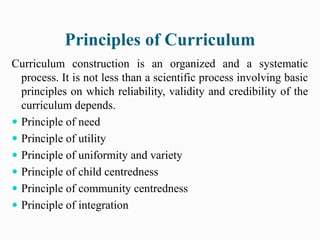
Principles of Curriculum
Curriculum construction is an organized and a systematic
process. It is not less than a scientific process involving basic
principles on which reliability, validity and credibility of the
curriculum depends.
 Principle of need
 Principle of utility
 Principle of uniformity and variety
 Principle of child centredness
 Principle of community centredness
 Principle of integration
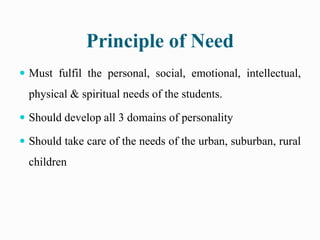
Principle of Need
 Must fulfil the personal, social, emotional, intellectual,
physical & spiritual needs of the students.
 Should develop all 3 domains of personality
 Should take care of the needs of the urban, suburban, rural
children
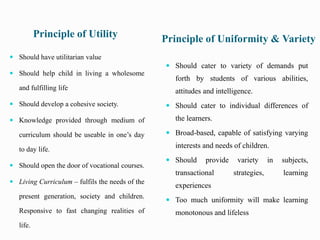
Principle of Utility Principle of Uniformity & Variety
 Should have utilitarian value
 Should help child in living a wholesome
and fulfilling life
 Should develop a cohesive society.
 Knowledge provided through medium of
curriculum should be useable in one’s day
to day life.
 Should open the door of vocational courses.
 Living Curriculum – fulfils the needs of the
present generation, society and children.
Responsive to fast changing realities of
life.
 Should cater to variety of demands put
forth by students of various abilities,
attitudes and intelligence.
 Should cater to individual differences of
the learners.
 Broad-based, capable of satisfying varying
interests and needs of children.
 Should provide variety in subjects,
transactional strategies, learning
experiences
 Too much uniformity will make learning
monotonous and lifeless
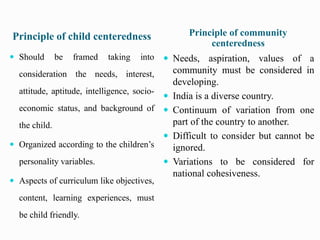
Principle of child centeredness Principle of community
centeredness
 Should be framed taking into
consideration the needs, interest,
attitude, aptitude, intelligence, socio-
economic status, and background of
the child.
 Organized according to the children’s
personality variables.
 Aspects of curriculum like objectives,
content, learning experiences, must
be child friendly.
 Needs, aspiration, values of a
community must be considered in
developing.
 India is a diverse country.
 Continuum of variation from one
part of the country to another.
 Difficult to consider but cannot be
ignored.
 Variations to be considered for
national cohesiveness.
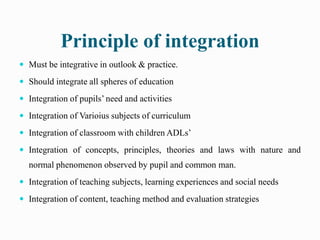
Principle of integration
 Must be integrative in outlook & practice.
 Should integrate all spheres of education
 Integration of pupils’ need and activities
 Integration of Varioius subjects of curriculum
 Integration of classroom with children ADLs’
 Integration of concepts, principles, theories and laws with nature and
normal phenomenon observed by pupil and common man.
 Integration of teaching subjects, learning experiences and social needs
 Integration of content, teaching method and evaluation strategies
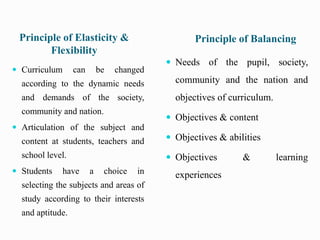
Principle of Elasticity &
Flexibility
Principle of Balancing
 Curriculum can be changed
according to the dynamic needs
and demands of the society,
community and nation.
 Articulation of the subject and
content at students, teachers and
school level.
 Students have a choice in
selecting the subjects and areas of
study according to their interests
and aptitude.
 Needs of the pupil, society,
community and the nation and
objectives of curriculum.
 Objectives & content
 Objectives & abilities
 Objectives & learning
experiences
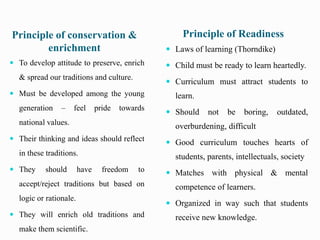
Principle of conservation &
enrichment
Principle of Readiness
 To develop attitude to preserve, enrich
& spread our traditions and culture.
 Must be developed among the young
generation – feel pride towards
national values.
 Their thinking and ideas should reflect
in these traditions.
 They should have freedom to
accept/reject traditions but based on
logic or rationale.
 They will enrich old traditions and
make them scientific.
 Laws of learning (Thorndike)
 Child must be ready to learn heartedly.
 Curriculum must attract students to
learn.
 Should not be boring, outdated,
overburdening, difficult
 Good curriculum touches hearts of
students, parents, intellectuals, society
 Matches with physical & mental
competence of learners.
 Organized in way such that students
receive new knowledge.
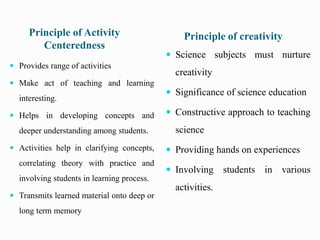
Principle of Activity
Centeredness
Principle of creativity
 Provides range of activities
 Make act of teaching and learning
interesting.
 Helps in developing concepts and
deeper understanding among students.
 Activities help in clarifying concepts,
correlating theory with practice and
involving students in learning process.
 Transmits learned material onto deep or
long term memory
 Science subjects must nurture
creativity
 Significance of science education
 Constructive approach to teaching
science
 Providing hands on experiences
 Involving students in various
activities.
Principle of Relevance
 Must be relevant to children’s personal and social needs.
 Should be relevant according to present situation and
demands of the society at local, regional, national and
international level.
 e.g. ICT – use of internet are most desired
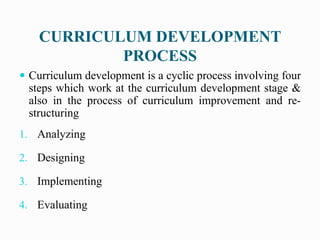
CURRICULUM DEVELOPMENT
PROCESS
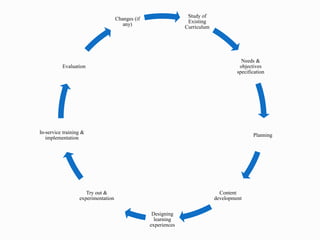
 Curriculum development is a cyclic process involving four
steps which work at the curriculum development stage &
also in the process of curriculum improvement and re-
structuring
1. Analyzing
2. Designing
3. Implementing
4. Evaluating
Study of
Existing
Curriculum
Needs &
objectives
specification
Planning
Content
development
Designing
learning
experiences
Try out &
experimentation
In-service training &
implementation
Evaluation
Changes (if
any)
CURRICULUM DEVELOPMENT &
ORGANIZATION APPROACHES
 Topical approach
 Logical and psychological approach
 Subject centered approach
 Activity centered approach
 Integrated approach
 Constructive approach
Topical Approach
 Simplest approach, carries lot of drawbacks
 Topics are selected from a specific subject and organized
in order of their relevance & difficulty
 Suitable topics are identified from higher classes or
upcoming areas of development and organized at lower
levels.
 Less balanced, more lopsided curriculum
Logical or Psychological Approach
 Follows theories of learning & development
 Follows psychology of the learners along with the
psychology of teaching and learning
 Contents of a particular subject of a particular class and
level and the learning experiences are properly organized.
 Age, intelligence, aptitude, attitude, interest of children,
personal & social significance is kept in mind.
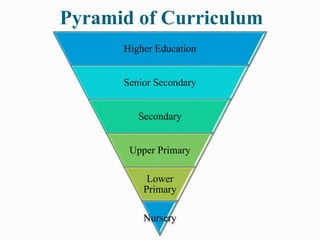
 Gives rise to a reverse pyramid depicting the arrangement
of content, learning experiences and evaluation
Pyramid of Curriculum
Higher Education
Senior Secondary
Secondary
Upper Primary
Lower
Primary
Nursery
Activity Centred Approach
 Process of science & product of
science
 Make students learn use process of
science – create new products.
 Merely providing knowledge is not
actual teaching
 Involve students in various
activities – understand, perceive
process of science
 Learning by doing approach
 Facts & principles taught should
be relevant to students' need and
society.
 Experimental approach must be
used
 Learning experiences to be based
on problem solving
 Observation and interpretation of
results must be part of the
activities
Integrated Approach
 Establishes a strong link between various subjects.
 Develop cohesive view of science subjects
 Teachers need to sit and plan curriculum
 Single teacher can teach
 Requires a good skilled teacher
 Reduce the need for labs and equipments
 Save time, manpower
Constructive Approach
 Aspires to make students create or construct knowledge
 Not imparted by teachers
 Created by individuals through self interpretation

Curriculum

  • 1.
    BY: ZUHEB AHMEDSIDDIQUI (PT) MPT (ORTHO)
  • 2.
    DEFINITION  Curriculum isderived from the Latin word ‘Currere’ which means ‘to run’.  Curriculum means a chariot course, a kind of route over which the learner travels.  Thus curriculum is the path by which one realizes the goals and objectives of a particular course.  Curriculum is the tool in the hands of the artists (teachers) to mould his material (learners) according to his desires (aims & objectives of education). – Donald J. Cunningham
  • 3.
     Curriculum isthe totality of experiences that pupils receive through the manifold activities that go in the school, in the classroom, library, laboratory, workshop, playground & numerous informal contacts between teachers and pupils. - The Secondary Education Commission.  The planned & guided learning experiences & intended learning outcomes, formulated through the systematic reconstruction of knowledge and experience, under the auspices of the school for the learners’ continuous & willful growth in personal social competence. – Tanner & Tanner  All the experiences that learner has undertaken in the guidance of the school. – Arthur W. Foshay
  • 4.
    Bases of Curriculum 1.Aims of Education 2. Philosophy of Education 3. Sociological basis 4. Psychological basis
  • 5.
    WHAT IS TO BETAUGHT TO THE LEARNERS WHY THIS KNOWLEDGE IS TO BE GIVEN THREE W’S WHEN IS THIS KNOWLEDGE TO BE IMPARTED
  • 6.
    Aims & Objectivesof Curriculum 1. Synthesis of subject and life 2. Complete development 3. Development of democratic values 4. Satisfaction of the educand’s needs 5. Realization of values 6. Development of knowledge 7. Creation of a useful environment 8. Addition to knowledge 9. Harmony between individual and society
  • 7.
    Principles of Curriculum Curriculumconstruction is an organized and a systematic process. It is not less than a scientific process involving basic principles on which reliability, validity and credibility of the curriculum depends.  Principle of need  Principle of utility  Principle of uniformity and variety  Principle of child centredness  Principle of community centredness  Principle of integration
  • 8.
    Principle of Need Must fulfil the personal, social, emotional, intellectual, physical & spiritual needs of the students.  Should develop all 3 domains of personality  Should take care of the needs of the urban, suburban, rural children
  • 9.
    Principle of UtilityPrinciple of Uniformity & Variety  Should have utilitarian value  Should help child in living a wholesome and fulfilling life  Should develop a cohesive society.  Knowledge provided through medium of curriculum should be useable in one’s day to day life.  Should open the door of vocational courses.  Living Curriculum – fulfils the needs of the present generation, society and children. Responsive to fast changing realities of life.  Should cater to variety of demands put forth by students of various abilities, attitudes and intelligence.  Should cater to individual differences of the learners.  Broad-based, capable of satisfying varying interests and needs of children.  Should provide variety in subjects, transactional strategies, learning experiences  Too much uniformity will make learning monotonous and lifeless
  • 10.
    Principle of childcenteredness Principle of community centeredness  Should be framed taking into consideration the needs, interest, attitude, aptitude, intelligence, socio- economic status, and background of the child.  Organized according to the children’s personality variables.  Aspects of curriculum like objectives, content, learning experiences, must be child friendly.  Needs, aspiration, values of a community must be considered in developing.  India is a diverse country.  Continuum of variation from one part of the country to another.  Difficult to consider but cannot be ignored.  Variations to be considered for national cohesiveness.
  • 11.
    Principle of integration Must be integrative in outlook & practice.  Should integrate all spheres of education  Integration of pupils’ need and activities  Integration of Varioius subjects of curriculum  Integration of classroom with children ADLs’  Integration of concepts, principles, theories and laws with nature and normal phenomenon observed by pupil and common man.  Integration of teaching subjects, learning experiences and social needs  Integration of content, teaching method and evaluation strategies
  • 12.
    Principle of Elasticity& Flexibility Principle of Balancing  Curriculum can be changed according to the dynamic needs and demands of the society, community and nation.  Articulation of the subject and content at students, teachers and school level.  Students have a choice in selecting the subjects and areas of study according to their interests and aptitude.  Needs of the pupil, society, community and the nation and objectives of curriculum.  Objectives & content  Objectives & abilities  Objectives & learning experiences
  • 13.
    Principle of conservation& enrichment Principle of Readiness  To develop attitude to preserve, enrich & spread our traditions and culture.  Must be developed among the young generation – feel pride towards national values.  Their thinking and ideas should reflect in these traditions.  They should have freedom to accept/reject traditions but based on logic or rationale.  They will enrich old traditions and make them scientific.  Laws of learning (Thorndike)  Child must be ready to learn heartedly.  Curriculum must attract students to learn.  Should not be boring, outdated, overburdening, difficult  Good curriculum touches hearts of students, parents, intellectuals, society  Matches with physical & mental competence of learners.  Organized in way such that students receive new knowledge.
  • 14.
    Principle of Activity Centeredness Principleof creativity  Provides range of activities  Make act of teaching and learning interesting.  Helps in developing concepts and deeper understanding among students.  Activities help in clarifying concepts, correlating theory with practice and involving students in learning process.  Transmits learned material onto deep or long term memory  Science subjects must nurture creativity  Significance of science education  Constructive approach to teaching science  Providing hands on experiences  Involving students in various activities.
  • 15.
    Principle of Relevance Must be relevant to children’s personal and social needs.  Should be relevant according to present situation and demands of the society at local, regional, national and international level.  e.g. ICT – use of internet are most desired
  • 16.
    CURRICULUM DEVELOPMENT PROCESS  Curriculumdevelopment is a cyclic process involving four steps which work at the curriculum development stage & also in the process of curriculum improvement and re- structuring 1. Analyzing 2. Designing 3. Implementing 4. Evaluating
  • 17.
    Study of Existing Curriculum Needs & objectives specification Planning Content development Designing learning experiences Tryout & experimentation In-service training & implementation Evaluation Changes (if any)
  • 18.
    CURRICULUM DEVELOPMENT & ORGANIZATIONAPPROACHES  Topical approach  Logical and psychological approach  Subject centered approach  Activity centered approach  Integrated approach  Constructive approach
  • 19.
    Topical Approach  Simplestapproach, carries lot of drawbacks  Topics are selected from a specific subject and organized in order of their relevance & difficulty  Suitable topics are identified from higher classes or upcoming areas of development and organized at lower levels.  Less balanced, more lopsided curriculum
  • 20.
    Logical or PsychologicalApproach  Follows theories of learning & development  Follows psychology of the learners along with the psychology of teaching and learning  Contents of a particular subject of a particular class and level and the learning experiences are properly organized.  Age, intelligence, aptitude, attitude, interest of children, personal & social significance is kept in mind.  Gives rise to a reverse pyramid depicting the arrangement of content, learning experiences and evaluation
  • 21.
    Pyramid of Curriculum HigherEducation Senior Secondary Secondary Upper Primary Lower Primary Nursery
  • 22.
    Activity Centred Approach Process of science & product of science  Make students learn use process of science – create new products.  Merely providing knowledge is not actual teaching  Involve students in various activities – understand, perceive process of science  Learning by doing approach  Facts & principles taught should be relevant to students' need and society.  Experimental approach must be used  Learning experiences to be based on problem solving  Observation and interpretation of results must be part of the activities
  • 23.
    Integrated Approach  Establishesa strong link between various subjects.  Develop cohesive view of science subjects  Teachers need to sit and plan curriculum  Single teacher can teach  Requires a good skilled teacher  Reduce the need for labs and equipments  Save time, manpower
  • 24.
    Constructive Approach  Aspiresto make students create or construct knowledge  Not imparted by teachers  Created by individuals through self interpretation