Lesson Design
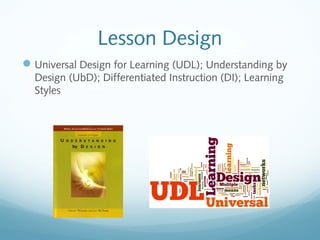
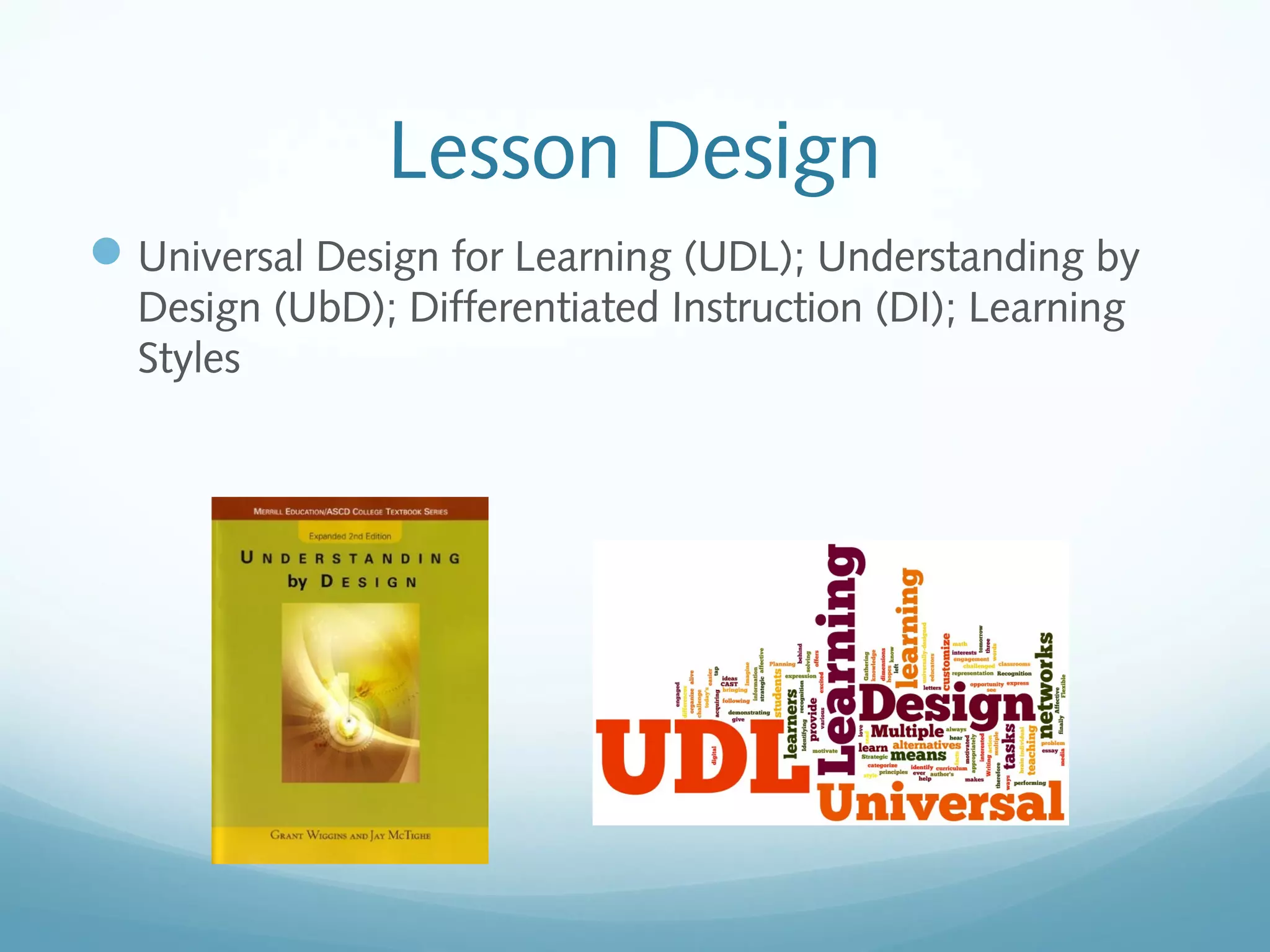
 Universal Design for Learning (UDL); Understanding by
Design (UbD); Differentiated Instruction (DI); Learning
Styles
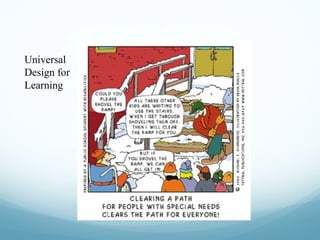
Universal
Design for
Learning
Universal Design for
Learning…
 UDL is a learning theory that has been developed by
Rose and Meyer, that strives to ensure that the learning
environment, including curriculum, assessment and
teaching and learning tools promote learning and remove
barriers to learning.

http://www.youtube.com/watch?v=bDvKnY0g6e4
UDL
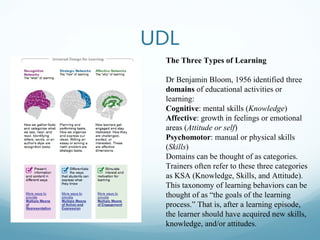
The Three Types of Learning
Dr Benjamin Bloom, 1956 identified three
domains of educational activities or
learning:
Cognitive: mental skills (Knowledge)
Affective: growth in feelings or emotional
areas (Attitude or self)
Psychomotor: manual or physical skills
(Skills)
Domains can be thought of as categories.
Trainers often refer to these three categories
as KSA (Knowledge, Skills, and Attitude).
This taxonomy of learning behaviors can be
thought of as “the goals of the learning
process.” That is, after a learning episode,
the learner should have acquired new skills,
knowledge, and/or attitudes.
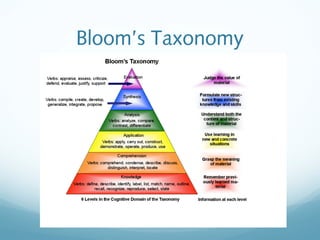
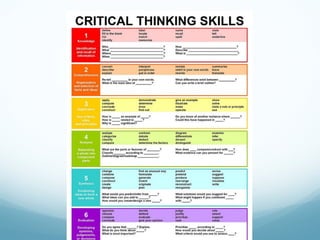
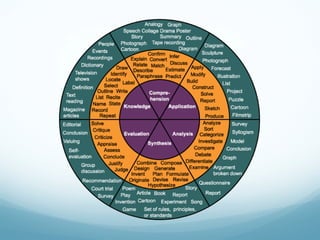
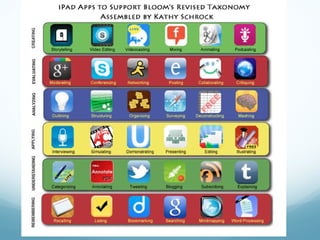
Bloom’s Taxonomy
Principles of UDL
 Multiple means of representation to give learners various
ways of acquiring information and knowledge,

 Multiple means of expression to provide learners
alternatives for demonstrating what they know, and

 Multiple means of engagement to tap into learners'
interests, challenge them appropriately, and motivate
them to learn
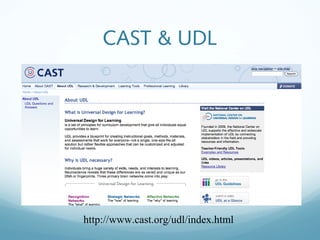
CAST & UDL

http://www.cast.org/udl/index.html
Differentiated Instruction…
 DI looks at the how and where we teach our students, focusing on
the best practices for each learner. In addition to content
expectations is the difficulty of meeting the diverse needs of today’s
classroom

 Languages, culture, gender, economic disparity, motivation,
disability, personal interests and learning styles as well as home
environments are just some of the many variables that students
bring to school with them.

 These variables can render ineffective even the best curriculum if the
diverse needs of the class are not met.

 Suggested Readings- Carole Tomlinson
http://www.caroltomlinson.com/
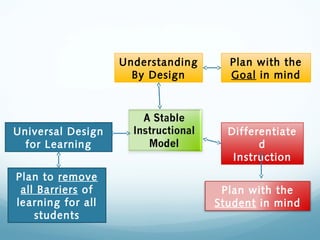
Understanding
By Design

Universal Design
for Learning
Plan to remove
all Barriers of
learning for all
students

Plan with the
Goal in mind

Differentiate
d
Instruction
Plan with the
Student in mind
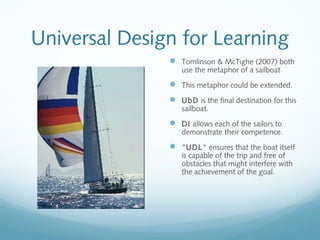
Universal Design for Learning
 Tomlinson & McTighe (2007) both
use the metaphor of a sailboat

 This metaphor could be extended.
 UbD is the final destination for this
sailboat.

 DI allows each of the sailors to

demonstrate their competence.

 "UDL" ensures that the boat itself
is capable of the trip and free of
obstacles that might interfere with
the achievement of the goal.
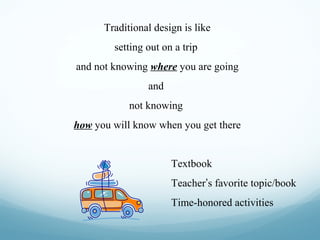
Traditional design is like
setting out on a trip
and not knowing where you are going
and
not knowing
how you will know when you get there

Textbook
Teacher’s favorite topic/book
Time-honored activities
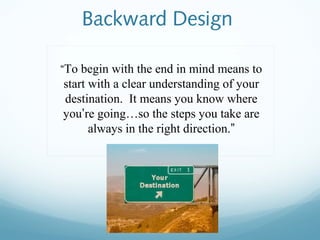
Backward Design
“To begin with the end in mind means to

start with a clear understanding of your
destination. It means you know where
you’re going…so the steps you take are
always in the right direction.”
What is
backward design?
It is thinking about
Determining/prioritizing desired
results and
Assessment before
deciding how you teach
BEFORE Planning instruction
How will the student prove he/she understands..?
It seems backward
because rather than creating
assessments near the end of a
unit of study (or relying on textbook
tests) we determine
assessment evidence as we
begin
to plan a unit
 Determine and prioritize desired results
 We must be “quite clear about which specific
understandings we are after and what such
understandings look like in practice”. – pg. 15

 Create the assessment

before
planning instruction!
Curriculum Planning
Key Concept:

The textbook or novel is not the course of study

The textbook or novel is only a resource that supports the desired
results

They are tools – not the syllabus
Coverage is like marching through the
textbook –”it’s a negative term”.
Challenges…
 We teach so that others may understand.
 Our challenges:

Finding time to ‘teach all standards’

and maintain the rigor (teaching for
understanding - not just ‘to cover’)
Making lessons meaningful
Engaging students in the learning
process
Three Stages of UbD
Stage 1: Identify the Desired Results
 Unpack the learning, prioritize learning goals, determine
expectations ….

Clarify Learning Outcomes – what must the student
know/understand/be able to do at the end of the
unit/lesson?
What content is worthy of understanding? Here we
make choices.
It is here we need to ask ourselves, "What are the
enduring understandings that the students must
obtain?”
Here we examine our content standards, examine
our goals and review the curriculum.
How to use Backward Design –
Stage 1
 Use national, state or industry content standards as a
starting point.

 “Unpack” the nouns and verbs in the standards to point
to the “big ideas”.

 Use the template as a tool for developing a coherent,
purposeful and efficient design for learning.
The Content
 Content standards have been designed to define the
knowledge, concepts, and skills that students should
acquire at each grade level. These are our goals. The
performance indicators (bulleted lists) represent possible
assessment evidence.
Content Standards
 Big Ideas are found in the nouns and adjectives of the
standard.

 Stated or implied real-world performances are found
in the verbs.
Understanding…
 The underlying assumption is that understandings are
constructed in the minds of the learner.

Understanding is the ability to transfer learning to new,
different and unique experiences.”

-Wiggins
Understandings
 Frame the desired understanding as a full-sentence
generalization in response to the phrase, “Students will
understand that…”.

 Beware of stating an understanding as a truism or a
vague generality. (ex: Triangles have 3 sides – The U.S. is
a complex country)

 Check to see that your understandings don’t end with an
adjective. (ex: Fractions are important)

 Avoid the phrase, “Students will understand how to…”
“Let the main ideas which are
introduced into a child’s education be
few and important, and let them be
thrown into every combination
possible.”
 -Alfred Whitehead, English mathematician and philosopher,
1929 – Inert Knowledge- is information a person can express
but not use.
A Big Idea … (bottom line)
 Provides a ‘lens for prioritizing’
 Serves as an organizer for facts, skills and actions …

focusing on big ideas, helps students see purpose and
relevance of pieces

 Support Transference … create coherence
 Manifest itself in many ways and in many content areas
 Requires Uncovering - its meaning is abstract, so it must
be discovered, constructed or inferred by learners
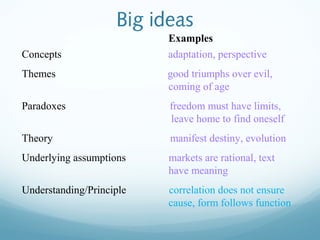
Big ideas
Concepts

Examples
adaptation, perspective

Themes

good triumphs over evil,
coming of age

Paradoxes

freedom must have limits,
leave home to find oneself

Theory

manifest destiny, evolution

Underlying assumptions

markets are rational, text
have meaning

Understanding/Principle

correlation does not ensure
cause, form follows function
To what extent does the idea, topic, or process represent a “big idea”
having enduring value beyond the classroom?
Enduring understandings go beyond discrete facts or skills to focus on
larger concepts, principles, or processes. As such, they are applicable to
new situations within or beyond the subject.

For example, we study the enactment of the Magna Carta as a specific
historical event because of its significance to a larger idea.
That idea is the rule of law, whereby written laws specify the limits of a
government's power and the rights of individuals—concepts such as due
process. This big idea transcends its roots in 13th century England to
become a cornerstone of modern democratic societies .

Does a student need to know this in adult life?
Essential Questions
“To question means to lay open, to place in the open. Only
a person who has questions can have real
understanding.”
Hans-Georg Gadamer, 1994
German Philosopher
Essential Questions
 Have no simple ‘right answer; they are meant to be
argued and discussed (discovered, uncovered)

 Designed to provoke and sustain inquiry
 Often address the foundational or historical issues of a
subject

 Lead to more questions
 Naturally come back again when learning
 Encourage ongoing re-thinking of big ideas, assumptions,
prior learning (transference…)

 Could be overarching or topical
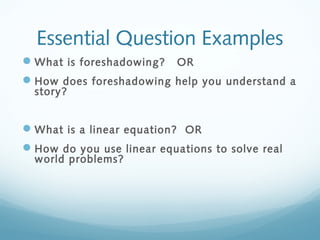
Essential Question Examples
 What is foreshadowing?

OR

 How does foreshadowing help you understand a
story?

 What is a linear equation? OR
 How do you use linear equations to solve real
world problems?
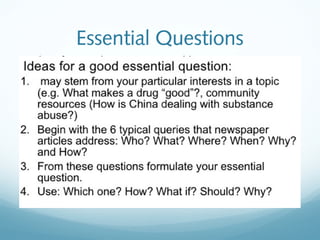
Essential Questions
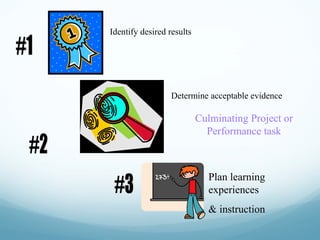
Identify desired results

Determine acceptable evidence

Culminating Project or
Performance task

Plan learning
experiences
& instruction
Stage 2: Determine Acceptable
Evidence
 Stage 1: Identify the Desired Results
 Stage 2: Determine Acceptable Evidence
 What evidence could be used to document and validate
the learning that has been achieved?

 Evidence is gathered throughout the learning timeincludes formative and summative assessments.
Stage 2 – Assessment Evidence
 Performance Task or Culminating Activity
 Provides evidence that students are able to use their
knowledge in context.

 This is the time to create the task.
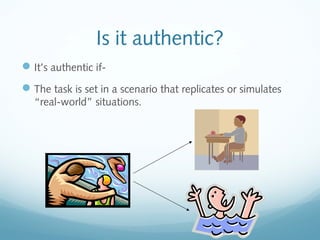
Is it authentic?
 It’s authentic if The task is set in a scenario that replicates or simulates
“real-world” situations.
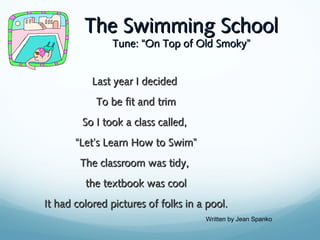
The Swimming School
Tune: “On Top of Old Smoky”

Last year I decided
To be fit and trim
So I took a class called,
“Let’s Learn How to Swim”
The classroom was tidy,
the textbook was cool
It had colored pictures of folks in a pool.
Written by Jean Spanko
I read every chapter, I read every line
I did all the worksheets- success would be mine.
The teacher said, “First thing,
We’ll learn not to drown.
I’d suggest you take notes now,
‘Cause this is profound.
The test will be Friday, it’s fill-in-the-blank
I grade on the bell curve
To see where you rank.”

Swimming School, pg. 2

Written by Jean Spanko
Well, wonder of wonders,
I got the best score
So now I was ready to swim shore to shore.
I rushed to the pool
Which was right down the block
I jumped in the water and sank like a rock.
The lifeguard who saved me
Was not too impressed
When I showed my grade card
That proved I was best.

Swimming School, pg. 3

Written by Jean Spanko
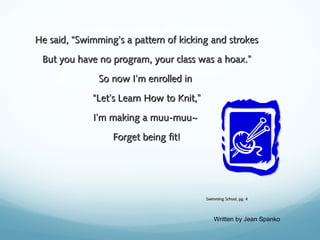
He said, “Swimming’s a pattern of kicking and strokes
But you have no program, your class was a hoax.”
So now I’m enrolled in
“Let’s Learn How to Knit,”
I’m making a muu-muu~
Forget being fit!

Swimming School, pg. 4

Written by Jean Spanko
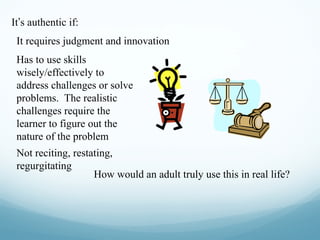
It’s authentic if:
It requires judgment and innovation
Has to use skills
wisely/effectively to
address challenges or solve
problems. The realistic
challenges require the
learner to figure out the
nature of the problem
Not reciting, restating,
regurgitating
How would an adult truly use this in real life?
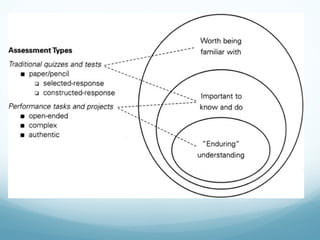
Performance Tasks and Projects
As complex challenges that mirror the issues and problems faced by
adults, they are authentic. Ranging in length from short-term tasks to
long-term, multi-staged projects, they require a production or
performance. They differ from prompts because they
•Feature a setting that is real or simulated: one that involves the kind
of constraints, background noise, incentives, and opportunities an
adult would find in a similar situation.
•Typically require the student to address an identified audience.
•Are based on a specific purpose that relates to the audience.
•Allow the student greater opportunity to personalize the task.
•Are not secure. Task, criteria, and standards are known in advance
and guide the student's work.
Criteria for evaluation
Culminating Activity/Project Rubric
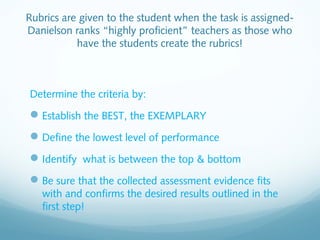
Rubrics are given to the student when the task is assignedDanielson ranks “highly proficient” teachers as those who
have the students create the rubrics!

Determine the criteria by:

 Establish the BEST, the EXEMPLARY
 Define the lowest level of performance
 Identify what is between the top & bottom
 Be sure that the collected assessment evidence fits
with and confirms the desired results outlined in the
first step!
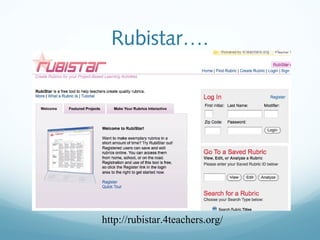
Rubistar….

http://rubistar.4teachers.org/
Why Assess?

 Assessments are not just to provide a ‘grade’
 Purpose of assessment:
 Determine if learner ‘got it’……Gather evidence which

demonstrates learning outcomes were achieved
 Help teachers determine extent of student understanding
 Guide next steps of instructions
 Provide appropriate scaffolding/differentiated instruction for
students throughout the learning experience
 Provide feedback to stakeholders (students/parents)
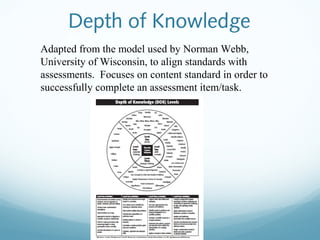
Depth of Knowledge
Adapted from the model used by Norman Webb,
University of Wisconsin, to align standards with
assessments. Focuses on content standard in order to
successfully complete an assessment item/task.
 Stage 1: Identify the Desired Results
 Stage 2: Determine Acceptable Evidence

Stage 3: Plan learning experiences
and instruction

 What specific content and skills must be ‘taught’ to

achieve desired results?
 What is the best way to ‘teach’ the content and skills?
(order and delivery)
 What resources will we need?
 How much time might be required for learning?
"Reduce your plan to writing... The moment you
complete this, you will have definitely given
concrete form to the intangible desire." - Napoleon
Hill
Lasting thought ….
“For any subject taught in primary school, we might ask [is
it] worth an adult’s knowing, and whether having known
it as a child makes a person a better adult. A negative or
ambiguous answer means the material is cluttering up
the curriculum.”
 Jerome Bruner (Cognitive Psychologist), 1960

Edpc605 chapter 1 2

  • 1.
    Lesson Design  UniversalDesign for Learning (UDL); Understanding by Design (UbD); Differentiated Instruction (DI); Learning Styles
  • 2.
  • 3.
    Universal Design for Learning… UDL is a learning theory that has been developed by Rose and Meyer, that strives to ensure that the learning environment, including curriculum, assessment and teaching and learning tools promote learning and remove barriers to learning. http://www.youtube.com/watch?v=bDvKnY0g6e4
  • 4.
    UDL The Three Typesof Learning Dr Benjamin Bloom, 1956 identified three domains of educational activities or learning: Cognitive: mental skills (Knowledge) Affective: growth in feelings or emotional areas (Attitude or self) Psychomotor: manual or physical skills (Skills) Domains can be thought of as categories. Trainers often refer to these three categories as KSA (Knowledge, Skills, and Attitude). This taxonomy of learning behaviors can be thought of as “the goals of the learning process.” That is, after a learning episode, the learner should have acquired new skills, knowledge, and/or attitudes.
  • 5.
  • 9.
    Principles of UDL Multiple means of representation to give learners various ways of acquiring information and knowledge,  Multiple means of expression to provide learners alternatives for demonstrating what they know, and  Multiple means of engagement to tap into learners' interests, challenge them appropriately, and motivate them to learn
  • 10.
  • 11.
    Differentiated Instruction…  DIlooks at the how and where we teach our students, focusing on the best practices for each learner. In addition to content expectations is the difficulty of meeting the diverse needs of today’s classroom  Languages, culture, gender, economic disparity, motivation, disability, personal interests and learning styles as well as home environments are just some of the many variables that students bring to school with them.  These variables can render ineffective even the best curriculum if the diverse needs of the class are not met.  Suggested Readings- Carole Tomlinson http://www.caroltomlinson.com/
  • 13.
    Understanding By Design Universal Design forLearning Plan to remove all Barriers of learning for all students Plan with the Goal in mind Differentiate d Instruction Plan with the Student in mind
  • 14.
    Universal Design forLearning  Tomlinson & McTighe (2007) both use the metaphor of a sailboat  This metaphor could be extended.  UbD is the final destination for this sailboat.  DI allows each of the sailors to demonstrate their competence.  "UDL" ensures that the boat itself is capable of the trip and free of obstacles that might interfere with the achievement of the goal.
  • 15.
    Traditional design islike setting out on a trip and not knowing where you are going and not knowing how you will know when you get there Textbook Teacher’s favorite topic/book Time-honored activities
  • 16.
    Backward Design “To beginwith the end in mind means to start with a clear understanding of your destination. It means you know where you’re going…so the steps you take are always in the right direction.”
  • 17.
    What is backward design? Itis thinking about Determining/prioritizing desired results and Assessment before deciding how you teach BEFORE Planning instruction How will the student prove he/she understands..?
  • 18.
    It seems backward becauserather than creating assessments near the end of a unit of study (or relying on textbook tests) we determine assessment evidence as we begin to plan a unit
  • 19.
     Determine andprioritize desired results  We must be “quite clear about which specific understandings we are after and what such understandings look like in practice”. – pg. 15  Create the assessment before planning instruction!
  • 20.
    Curriculum Planning Key Concept: Thetextbook or novel is not the course of study The textbook or novel is only a resource that supports the desired results They are tools – not the syllabus Coverage is like marching through the textbook –”it’s a negative term”.
  • 21.
    Challenges…  We teachso that others may understand.  Our challenges: Finding time to ‘teach all standards’ and maintain the rigor (teaching for understanding - not just ‘to cover’) Making lessons meaningful Engaging students in the learning process
  • 22.
    Three Stages ofUbD Stage 1: Identify the Desired Results  Unpack the learning, prioritize learning goals, determine expectations …. Clarify Learning Outcomes – what must the student know/understand/be able to do at the end of the unit/lesson? What content is worthy of understanding? Here we make choices. It is here we need to ask ourselves, "What are the enduring understandings that the students must obtain?” Here we examine our content standards, examine our goals and review the curriculum.
  • 23.
    How to useBackward Design – Stage 1  Use national, state or industry content standards as a starting point.  “Unpack” the nouns and verbs in the standards to point to the “big ideas”.  Use the template as a tool for developing a coherent, purposeful and efficient design for learning.
  • 24.
    The Content  Contentstandards have been designed to define the knowledge, concepts, and skills that students should acquire at each grade level. These are our goals. The performance indicators (bulleted lists) represent possible assessment evidence.
  • 25.
    Content Standards  BigIdeas are found in the nouns and adjectives of the standard.  Stated or implied real-world performances are found in the verbs.
  • 26.
    Understanding…  The underlyingassumption is that understandings are constructed in the minds of the learner. Understanding is the ability to transfer learning to new, different and unique experiences.” -Wiggins
  • 27.
    Understandings  Frame thedesired understanding as a full-sentence generalization in response to the phrase, “Students will understand that…”.  Beware of stating an understanding as a truism or a vague generality. (ex: Triangles have 3 sides – The U.S. is a complex country)  Check to see that your understandings don’t end with an adjective. (ex: Fractions are important)  Avoid the phrase, “Students will understand how to…”
  • 28.
    “Let the mainideas which are introduced into a child’s education be few and important, and let them be thrown into every combination possible.”  -Alfred Whitehead, English mathematician and philosopher, 1929 – Inert Knowledge- is information a person can express but not use.
  • 29.
    A Big Idea… (bottom line)  Provides a ‘lens for prioritizing’  Serves as an organizer for facts, skills and actions … focusing on big ideas, helps students see purpose and relevance of pieces  Support Transference … create coherence  Manifest itself in many ways and in many content areas  Requires Uncovering - its meaning is abstract, so it must be discovered, constructed or inferred by learners
  • 30.
    Big ideas Concepts Examples adaptation, perspective Themes goodtriumphs over evil, coming of age Paradoxes freedom must have limits, leave home to find oneself Theory manifest destiny, evolution Underlying assumptions markets are rational, text have meaning Understanding/Principle correlation does not ensure cause, form follows function
  • 31.
    To what extentdoes the idea, topic, or process represent a “big idea” having enduring value beyond the classroom? Enduring understandings go beyond discrete facts or skills to focus on larger concepts, principles, or processes. As such, they are applicable to new situations within or beyond the subject. For example, we study the enactment of the Magna Carta as a specific historical event because of its significance to a larger idea. That idea is the rule of law, whereby written laws specify the limits of a government's power and the rights of individuals—concepts such as due process. This big idea transcends its roots in 13th century England to become a cornerstone of modern democratic societies . Does a student need to know this in adult life?
  • 32.
    Essential Questions “To questionmeans to lay open, to place in the open. Only a person who has questions can have real understanding.” Hans-Georg Gadamer, 1994 German Philosopher
  • 33.
    Essential Questions  Haveno simple ‘right answer; they are meant to be argued and discussed (discovered, uncovered)  Designed to provoke and sustain inquiry  Often address the foundational or historical issues of a subject  Lead to more questions  Naturally come back again when learning  Encourage ongoing re-thinking of big ideas, assumptions, prior learning (transference…)  Could be overarching or topical
  • 34.
    Essential Question Examples What is foreshadowing? OR  How does foreshadowing help you understand a story?  What is a linear equation? OR  How do you use linear equations to solve real world problems?
  • 35.
  • 36.
    Identify desired results Determineacceptable evidence Culminating Project or Performance task Plan learning experiences & instruction
  • 37.
    Stage 2: DetermineAcceptable Evidence  Stage 1: Identify the Desired Results  Stage 2: Determine Acceptable Evidence  What evidence could be used to document and validate the learning that has been achieved?  Evidence is gathered throughout the learning timeincludes formative and summative assessments.
  • 38.
    Stage 2 –Assessment Evidence  Performance Task or Culminating Activity  Provides evidence that students are able to use their knowledge in context.  This is the time to create the task.
  • 39.
    Is it authentic? It’s authentic if The task is set in a scenario that replicates or simulates “real-world” situations.
  • 40.
    The Swimming School Tune:“On Top of Old Smoky” Last year I decided To be fit and trim So I took a class called, “Let’s Learn How to Swim” The classroom was tidy, the textbook was cool It had colored pictures of folks in a pool. Written by Jean Spanko
  • 41.
    I read everychapter, I read every line I did all the worksheets- success would be mine. The teacher said, “First thing, We’ll learn not to drown. I’d suggest you take notes now, ‘Cause this is profound. The test will be Friday, it’s fill-in-the-blank I grade on the bell curve To see where you rank.” Swimming School, pg. 2 Written by Jean Spanko
  • 42.
    Well, wonder ofwonders, I got the best score So now I was ready to swim shore to shore. I rushed to the pool Which was right down the block I jumped in the water and sank like a rock. The lifeguard who saved me Was not too impressed When I showed my grade card That proved I was best. Swimming School, pg. 3 Written by Jean Spanko
  • 43.
    He said, “Swimming’sa pattern of kicking and strokes But you have no program, your class was a hoax.” So now I’m enrolled in “Let’s Learn How to Knit,” I’m making a muu-muu~ Forget being fit! Swimming School, pg. 4 Written by Jean Spanko
  • 44.
    It’s authentic if: Itrequires judgment and innovation Has to use skills wisely/effectively to address challenges or solve problems. The realistic challenges require the learner to figure out the nature of the problem Not reciting, restating, regurgitating How would an adult truly use this in real life?
  • 45.
    Performance Tasks andProjects As complex challenges that mirror the issues and problems faced by adults, they are authentic. Ranging in length from short-term tasks to long-term, multi-staged projects, they require a production or performance. They differ from prompts because they •Feature a setting that is real or simulated: one that involves the kind of constraints, background noise, incentives, and opportunities an adult would find in a similar situation. •Typically require the student to address an identified audience. •Are based on a specific purpose that relates to the audience. •Allow the student greater opportunity to personalize the task. •Are not secure. Task, criteria, and standards are known in advance and guide the student's work.
  • 47.
    Criteria for evaluation CulminatingActivity/Project Rubric
  • 48.
    Rubrics are givento the student when the task is assignedDanielson ranks “highly proficient” teachers as those who have the students create the rubrics! Determine the criteria by:  Establish the BEST, the EXEMPLARY  Define the lowest level of performance  Identify what is between the top & bottom  Be sure that the collected assessment evidence fits with and confirms the desired results outlined in the first step!
  • 49.
  • 50.
    Why Assess?  Assessmentsare not just to provide a ‘grade’  Purpose of assessment:  Determine if learner ‘got it’……Gather evidence which demonstrates learning outcomes were achieved  Help teachers determine extent of student understanding  Guide next steps of instructions  Provide appropriate scaffolding/differentiated instruction for students throughout the learning experience  Provide feedback to stakeholders (students/parents)
  • 51.
    Depth of Knowledge Adaptedfrom the model used by Norman Webb, University of Wisconsin, to align standards with assessments. Focuses on content standard in order to successfully complete an assessment item/task.
  • 52.
     Stage 1:Identify the Desired Results  Stage 2: Determine Acceptable Evidence Stage 3: Plan learning experiences and instruction  What specific content and skills must be ‘taught’ to achieve desired results?  What is the best way to ‘teach’ the content and skills? (order and delivery)  What resources will we need?  How much time might be required for learning? "Reduce your plan to writing... The moment you complete this, you will have definitely given concrete form to the intangible desire." - Napoleon Hill
  • 53.
    Lasting thought …. “Forany subject taught in primary school, we might ask [is it] worth an adult’s knowing, and whether having known it as a child makes a person a better adult. A negative or ambiguous answer means the material is cluttering up the curriculum.”  Jerome Bruner (Cognitive Psychologist), 1960

Editor's Notes

  • #2 {"29":"H-out from wkbk pp. 65,66,72\n","52":"Have template (blank and with example available at this point) as well as Standards for self-assessment\n-ex within book p. 22-28\n-we don’t want to HOPE for learning!\n","21":"Among a thousand other challenges!!!!!\n"}