June 30, 2015
What does "intellectual property" mean?
Intellectual property (IP) refers
to creations of the mind:
inventions, literary and artistic
works, and symbols, names,
images, and designs used in
commerce.
June 30, 2015
It is imagination made real. It is the ownership
of dream, an idea, an improvement, an
emotion that we can touch, see, hear, and
feel. It is an asset just like your home, your
car, or your bank account.
Intellectual Property is...
There are 4 ways to protect
"intellectual property"
June 30, 2015
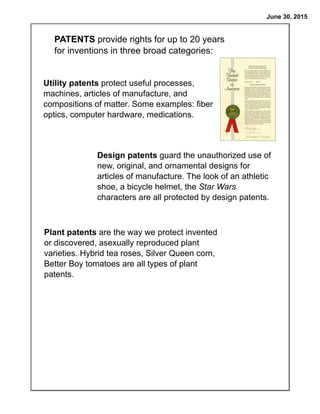
PATENTS provide rights for up to 20 years
for inventions in three broad categories:
Utility patents protect useful processes,
machines, articles of manufacture, and
compositions of matter. Some examples: fiber
optics, computer hardware, medications.
Design patents guard the unauthorized use of
new, original, and ornamental designs for
articles of manufacture. The look of an athletic
shoe, a bicycle helmet, the Star Wars
characters are all protected by design patents.
Plant patents are the way we protect invented
or discovered, asexually reproduced plant
varieties. Hybrid tea roses, Silver Queen corn,
Better Boy tomatoes are all types of plant
patents.
June 30, 2015
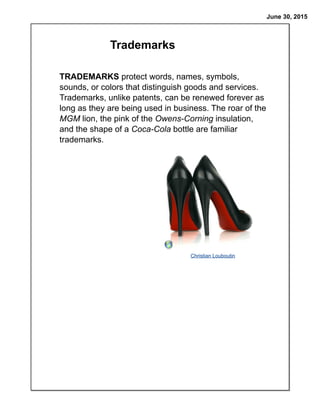
TRADEMARKS protect words, names, symbols,
sounds, or colors that distinguish goods and services.
Trademarks, unlike patents, can be renewed forever as
long as they are being used in business. The roar of the
MGM lion, the pink of the Owens-Corning insulation,
and the shape of a Coca-Cola bottle are familiar
trademarks.
Trademarks
Christian Louboutin
June 30, 2015
COPYRIGHTS protect works of authorship, such as
writings, music, and works of art that have been tangibly
expressed. Copyrights are registered which last the life
of the author plus 70 years. Gone With The Wind (the
book and the film), Beatles recordings, and video games
are all works that are copyrighted.
Copyrights
June 30, 2015
Nearly all the material on the Web is covered by
intellectual property laws. If you produce content in
your personal time, you automatically own the rights to
it. If you produce content at work, your agency likely
owns it.
Videos, blog posts, and music (especially music videos)
are all examples of works automatically protected by
copyright (and probably trademark law). They don’t
need to say “copyright” or have a “©” mark next to it,
either–once it’s created, it’s copyrighted.
Assume All Material is Copyrighted
June 30, 2015
June 30, 2015
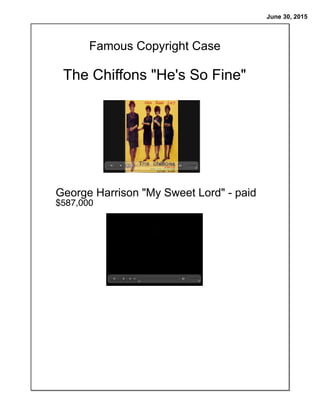
Famous Copyright Case
The Chiffons "He's So Fine"
George Harrison "My Sweet Lord" - paid
$587,000
June 30, 2015
TRADE SECRETS are information that companies keep
secret to give them an advantage over their competitors.
The formula for Coca-Cola is the most famous trade secret.
Trade Secrets
June 30, 2015
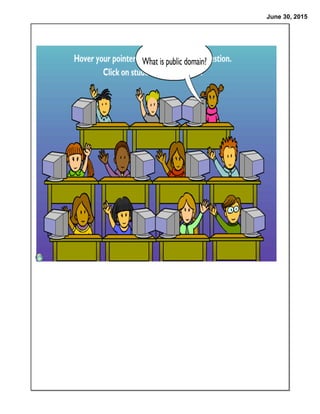
Public Domain
Once copyright has expired, works go into the Public Domain.
June 30, 2015
Creative Commons
June 30, 2015
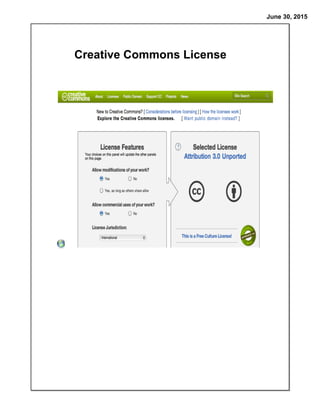
Creative Commons License
June 30, 2015
June 30, 2015
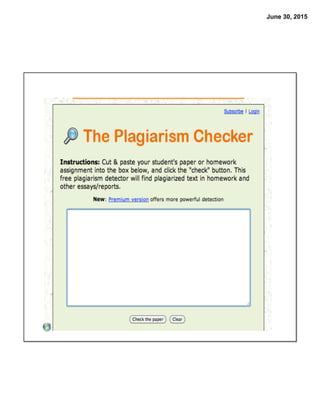
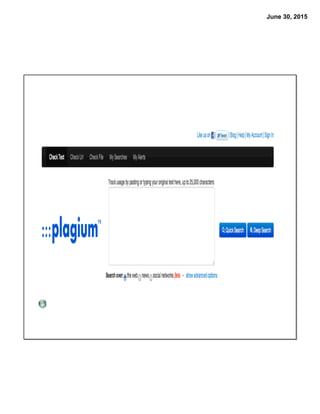
Plagiarism
Simply put, plagiarism is the use of another's
original words or ideas as though they were your
own. Any time you borrow from an original source
and do not give proper credit, you have
committed plagiarism and violated U.S. copyright
laws.
What is plagiarism?
June 30, 2015
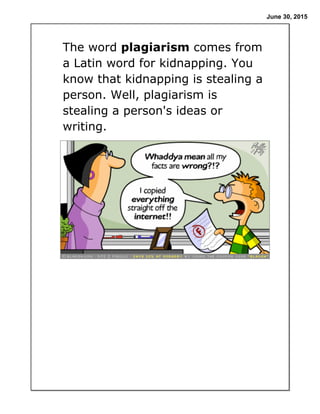
The word plagiarism comes from
a Latin word for kidnapping. You
know that kidnapping is stealing a
person. Well, plagiarism is
stealing a person's ideas or
writing.
June 30, 2015
June 30, 2015
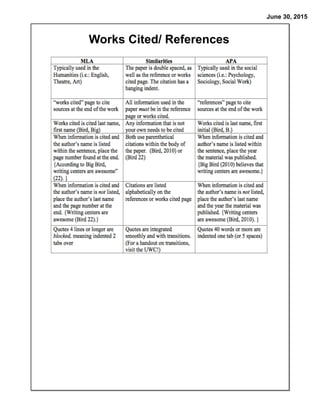
Works Cited/ References
June 30, 2015
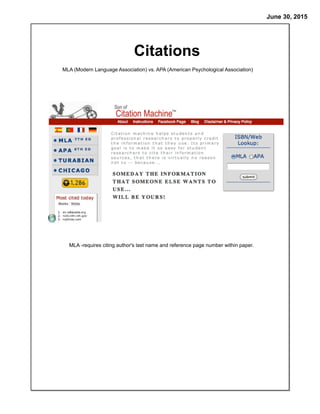
Citations
MLA (Modern Language Association) vs. APA (American Psychological Association)
MLA -requires citing author's last name and reference page number within paper.
June 30, 2015
Fair Use
Fair use is a limitation and exception to the
exclusive right granted by copyright law to the
author of a creative work.
In United States copyright law, fair use is a
doctrine that permits limited use of
copyrighted material without acquiring
permission from the rights holders.
Examples of fair use include commentary,
search engines, criticism, news reporting,
research, teaching, library archiving and
scholarship.
June 30, 2015
June 30, 2015
See Part 1 & Part 3
June 30, 2015
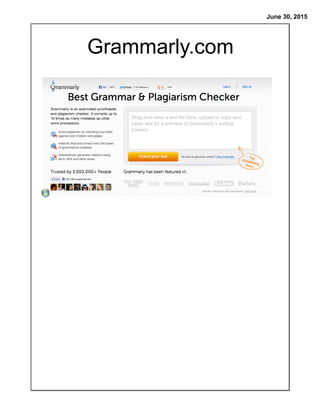
Grammarly.com
June 30, 2015
June 30, 2015
June 30, 2015
Peer-to-Peer File Sharing or Networks
P2P
The act of file sharing itself is not illegal and peer-to-peer
networks are also used for legitimate purposes; the legal
issues in file sharing involve violating the laws of
copyrighted material.
I-Tunes is not a peer-to-peer network
as it is a paid service
June 30, 2015
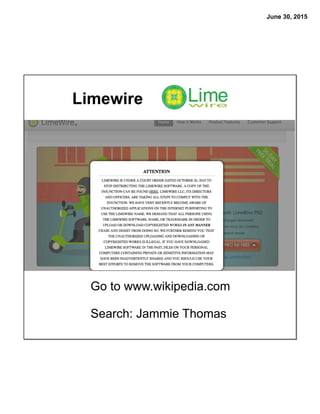
Limewire
Go to www.wikipedia.com
Search: Jammie Thomas
June 30, 2015
June 30, 2015
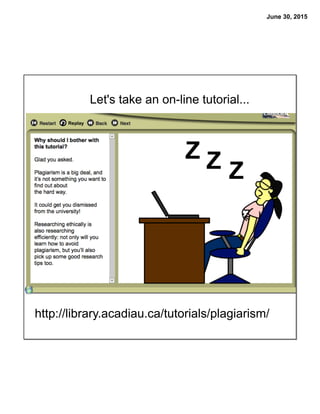
Let's take an on-line tutorial...
http://library.acadiau.ca/tutorials/plagiarism/
June 30, 2015
June 30, 2015
June 30, 2015

Intellectual property

  • 1.
    June 30, 2015 Whatdoes "intellectual property" mean? Intellectual property (IP) refers to creations of the mind: inventions, literary and artistic works, and symbols, names, images, and designs used in commerce.
  • 2.
    June 30, 2015 Itis imagination made real. It is the ownership of dream, an idea, an improvement, an emotion that we can touch, see, hear, and feel. It is an asset just like your home, your car, or your bank account. Intellectual Property is... There are 4 ways to protect "intellectual property"
  • 3.
    June 30, 2015 PATENTSprovide rights for up to 20 years for inventions in three broad categories: Utility patents protect useful processes, machines, articles of manufacture, and compositions of matter. Some examples: fiber optics, computer hardware, medications. Design patents guard the unauthorized use of new, original, and ornamental designs for articles of manufacture. The look of an athletic shoe, a bicycle helmet, the Star Wars characters are all protected by design patents. Plant patents are the way we protect invented or discovered, asexually reproduced plant varieties. Hybrid tea roses, Silver Queen corn, Better Boy tomatoes are all types of plant patents.
  • 4.
    June 30, 2015 TRADEMARKSprotect words, names, symbols, sounds, or colors that distinguish goods and services. Trademarks, unlike patents, can be renewed forever as long as they are being used in business. The roar of the MGM lion, the pink of the Owens-Corning insulation, and the shape of a Coca-Cola bottle are familiar trademarks. Trademarks Christian Louboutin
  • 5.
    June 30, 2015 COPYRIGHTSprotect works of authorship, such as writings, music, and works of art that have been tangibly expressed. Copyrights are registered which last the life of the author plus 70 years. Gone With The Wind (the book and the film), Beatles recordings, and video games are all works that are copyrighted. Copyrights
  • 6.
    June 30, 2015 Nearlyall the material on the Web is covered by intellectual property laws. If you produce content in your personal time, you automatically own the rights to it. If you produce content at work, your agency likely owns it. Videos, blog posts, and music (especially music videos) are all examples of works automatically protected by copyright (and probably trademark law). They don’t need to say “copyright” or have a “©” mark next to it, either–once it’s created, it’s copyrighted. Assume All Material is Copyrighted
  • 7.
  • 8.
    June 30, 2015 FamousCopyright Case The Chiffons "He's So Fine" George Harrison "My Sweet Lord" - paid $587,000
  • 9.
    June 30, 2015 TRADESECRETS are information that companies keep secret to give them an advantage over their competitors. The formula for Coca-Cola is the most famous trade secret. Trade Secrets
  • 10.
    June 30, 2015 PublicDomain Once copyright has expired, works go into the Public Domain.
  • 11.
  • 12.
    June 30, 2015 CreativeCommons License
  • 13.
  • 14.
    June 30, 2015 Plagiarism Simplyput, plagiarism is the use of another's original words or ideas as though they were your own. Any time you borrow from an original source and do not give proper credit, you have committed plagiarism and violated U.S. copyright laws. What is plagiarism?
  • 15.
    June 30, 2015 Theword plagiarism comes from a Latin word for kidnapping. You know that kidnapping is stealing a person. Well, plagiarism is stealing a person's ideas or writing.
  • 16.
  • 17.
    June 30, 2015 WorksCited/ References
  • 18.
    June 30, 2015 Citations MLA(Modern Language Association) vs. APA (American Psychological Association) MLA -requires citing author's last name and reference page number within paper.
  • 19.
    June 30, 2015 FairUse Fair use is a limitation and exception to the exclusive right granted by copyright law to the author of a creative work. In United States copyright law, fair use is a doctrine that permits limited use of copyrighted material without acquiring permission from the rights holders. Examples of fair use include commentary, search engines, criticism, news reporting, research, teaching, library archiving and scholarship.
  • 20.
  • 21.
    June 30, 2015 SeePart 1 & Part 3
  • 22.
  • 23.
  • 24.
  • 25.
    June 30, 2015 Peer-to-PeerFile Sharing or Networks P2P The act of file sharing itself is not illegal and peer-to-peer networks are also used for legitimate purposes; the legal issues in file sharing involve violating the laws of copyrighted material. I-Tunes is not a peer-to-peer network as it is a paid service
  • 26.
    June 30, 2015 Limewire Goto www.wikipedia.com Search: Jammie Thomas
  • 27.
  • 28.
    June 30, 2015 Let'stake an on-line tutorial... http://library.acadiau.ca/tutorials/plagiarism/
  • 29.
  • 30.
  • 31.