Los Dias de los Muertos
A WebQuest for Grade 8
Classes 801 & 803 – Due 10/20
Class 802 – Due 10/21
El Museo del Barrio
• SUPER SABADO! Día de los Muertos
Celebration
• Saturday, October 15, 2016
• 11:00 am - 5:00 pm
 Admission is free!
Click on the picture
For more information
Introduction
• Rather than a time of
mourning, los dias de los
muertos – the Days of the
Dead - observed every Nov.
1 and 2 - is a celebration of
life and death, when the
spirits of the dearly
departed return to Earth for
a family fiesta.
• Octavio Paz, a native of
Mexico and winner of the
1990 Nobel Prize in
literature, observes “The
word death is not
pronounced in New York, in
Paris, in London, because it
burns the lips. The Mexican,
in contrast, is familiar with
death, jokes about it,
caresses it, sleeps with it,
celebrates it, it is one of his
favorite toys and his most
steadfast love."
Introduction
• Day of the Dead is not a sad or scary
occasion, but a spirited holiday when
people remember and honor family
members who have died. All of this is
part of the philosophy that death is not
something to be feared, but a natural
part of life.
• People celebrate in their homes,
creating altars or oferings (called
ofrendas in Spanish) that display
portraits, favorite foods, and special
possessions of their loved ones.
• Altars or offerings are also decorated
with candles and marigolds—the light
of the candle and scent of the flowers
(called cempasuchitl) are said to attract
the souls of the deceased and draw
them back for a short time to take part
in the pleasures they once enjoyed in
life.
• Families also visit the graves of their
loved ones, cleaning the headstones,
and decorating with flowers, and
bringing food and music
• The roots of Day of the Dead are pre-
Colombian, and many of the symbols
and practices are derived from the
indigenous groups of Meso America
(Maya and Aztec, e.g.)
• Images of skeletons dancing or doing
other comical things are common.
Task
• There are 3 components for this task –
• 1st component –go through the entire WebQuest and explore each resource.
• 2nd component - Complete the attached document on “los dias de los muertos” as
an individual assignment.
• Your will find the answers located throughout this WebQuest.
• Submit your completed worksheet via the Dropbox on iLearn.
• 3rd component – Choose 1 of these options –
• 1/ In groups of 1-3 students, choose 1 of the vocabulary words from this
presentation and present it creatively to your class. You may make the item,
explain its significance and how you made it. Or, you may display the item and
explain how to make it and its significance for this holiday.
• 2/ You may choose to compare and contrast Dia de los Muertos with the United
states holiday of Halloween. See separate WebQuest for this option.
• All presentations and worksheets are due on 10/20 for Classes 801 & 803; 1021
for Class 802.
Vocabulary Word Projects
• José Guadalupe Posada
• La Catrina
• Calaveras
• Calacas
• Pan de muerto
• Cempazuchitl
• Cascarones
• Papel Picado
• Calaveras de azúcar/
Alfeniques
• Calaveras de Chocolates
• Copal
• La danza de los viejos
• The Monarch Butterflies
Migration
• Ofrenda
• Tamales
• Atole
• Mole
José Guadalupe Posada (1852–1913)
José Guadalupe Posada, an ingenious
artist, lived during one of the most
turbulent times in Mexico.
He knew how to capture the essence
of this turbulence in his lithographs to
the point that they became the icon of
Revolutionary Mexico.
Most of his imagery was meant to make
a satirical point about life in Mexico at
the time he lived.
Since his death, however, his images
have become associated with the
Mexican holiday, Dia de los Muertos, the
“Day of the Dead”.
Calavera de la Catrina
“La Catrina”
Catrina : Spanish word that means well
dressed, rich.
Posada used it as a way of criticizing the rich
society of Mexico.
Posada's best known works are his
calaveras (the Spanish word for
skeletons , which often assume various
costumes, such as the Calavera de la
Catrina, the “Calavera of the Female
Dandy”, which was meant to satirize the
life of the upper classes during the reign
of Portifico Diaz.
Examples of Posada’s Artwork
The Street Sweepers
"Gran fandango y francachella de todas las calaveras” -
The happy dance and wild party of all the skeletons.
A cemetery, presumably crowded with victims of the then fairly new electrical
conveyances. There were many disastrous accidents, one or which involved
the future artist Frida Kahlo, who spent most of the rest of her life in a
wheelchair due to a horrible trolley accident in which her spine was broken in
several places. Frida Kahlo later became an internationally acclaimed
surrealistic artist who was also known as the wife of Diego Rivera, a famous
muralist.
Calacas
• A calaca (a Mexican -Spanish name for
skeleton) is a figure of a skull or skeleton
(usually human) commonly used for
decoration during los dias de los muertos.
They are whimsical skeleton figures that
represent death.
• Tracing their origin from Aztec imagery,
calacas are frequently shown with marigold
flowers and foliage. As with other aspects of
the Day of the Dead festival, calacas are
generally depicted as joyous rather than
mournful figures.
• They are often shown wearing festive
clothing, dancing, and playing musical
instruments to indicate a happy afterlife. This
draws on the Mexican belief that no dead
soul likes to be thought of sadly, and that
death should be a joyous occasion. This goes
back to Aztec beliefs, one of the few
traditions to remain after the Spanish
conquest.
A calaca of La Catrina
Calacas
Pan de los muertos
(Bread of the Dead)
• The pan de muertos (Spanish for Bread of
the dead) (also called pan de los muertos) is
a type of bread traditionally baked in Mexico
during the weeks leading up to the Día de los
Muertos, which is celebrated on November
2. It is a sweetened soft bread shaped like a
bun, often decorated with bone-like pieces.
Pan de muertos is eaten on Día de los
Muertos, at the gravesite or altar of the
deceased. In some regions it is eaten for
months before the official celebration of Dia
de los Muertos. In Oaxaca, pan de muertos is
the same bread that is usually baked, with
the addition of decorations. As part of the
celebration, loved ones eat pan de muertos
as well as the relative's favorite foods. The
bones represent the lost one (difuntos or
difuntas) and there is normally a baked tear
drop on the bread to represent sorrow. The
bones are represented in a circle to portray
the circle of life.
Pan de los muertos
(Bread of the Dead)
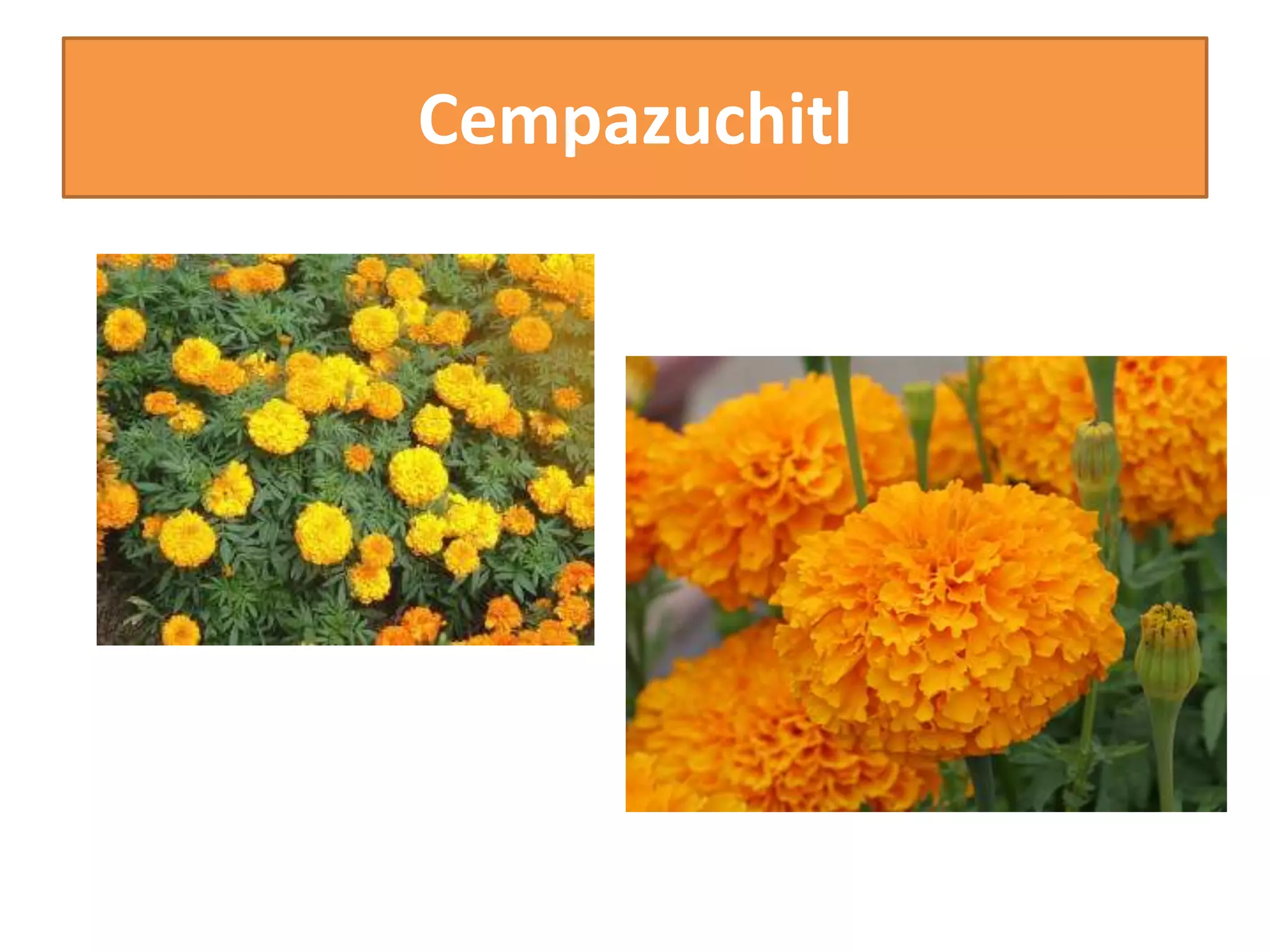
Cempazuchitl
• A marigold flower, a symbol of
death since the time of the
Aztecs, also known as
cempasuchil or zempasuchitl.
• They are used to decorate
graves and altars often in a
cross or arch pattern. They are
also popular as a pathway
marker to the altar.
• Also known as "the flower
with 400 lives”. It is believed
that the scent of the petals
forms a welcome path for the
spirits to return to their altar
or grave.
Cempazuchitl
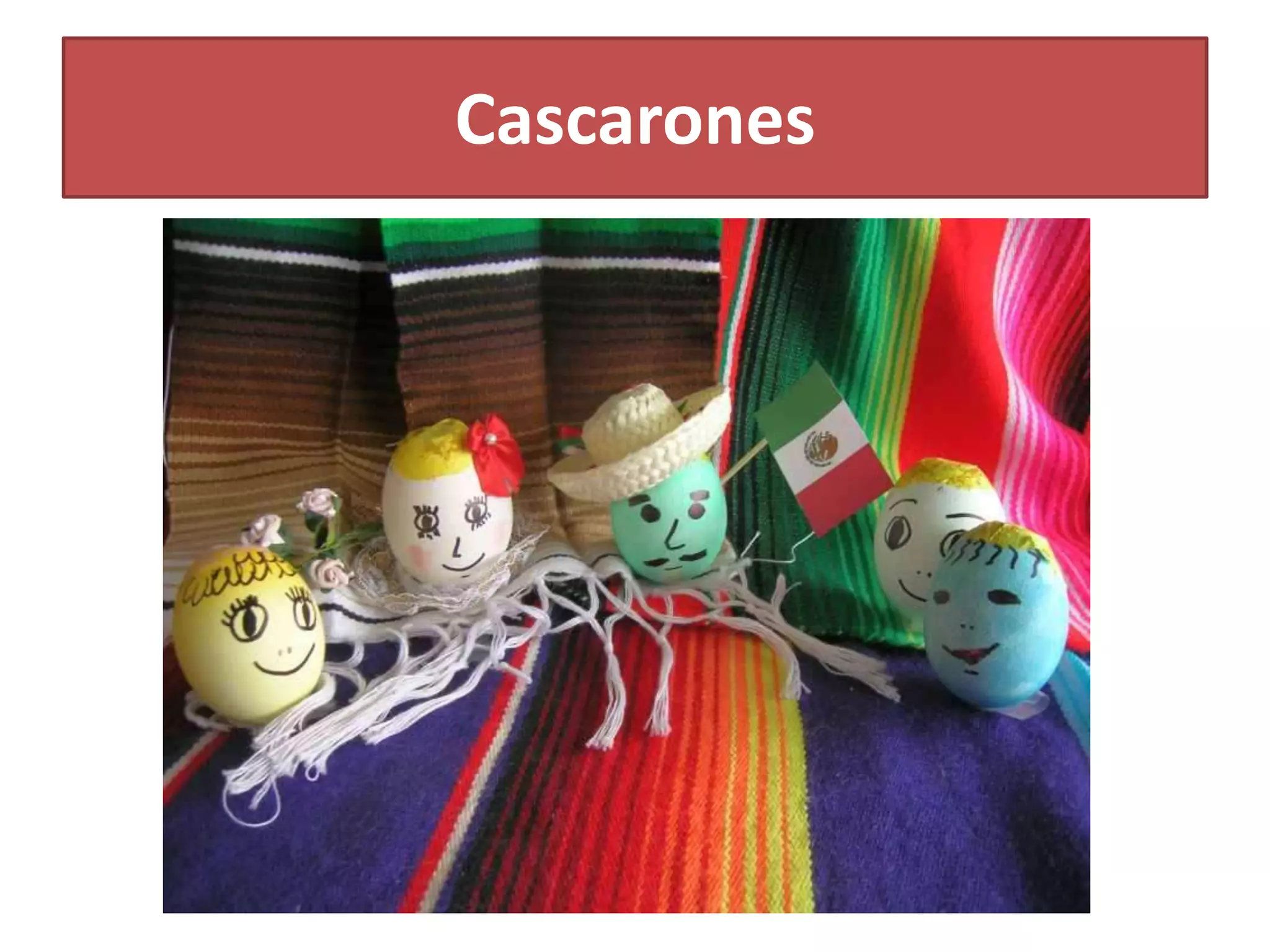
Cascarones
• In Spanish the word cáscara means
eggshell.
• They are decorated, confetti-filled
eggs, trimmed in glitter.
• In addition to Dia de los muertos,
cascarones have become popular for
other special occasions such as Cinco
de mayo, Pascua, weddings and
Quinceañeras.
• They are very popular in the
southwestern United States.
• Cascarones may be thrown or
crushed over the recipient's head to
shower him or her with confetti.
• Having a cascarón broken over one's
head is said to bring good luck.
Cascarones
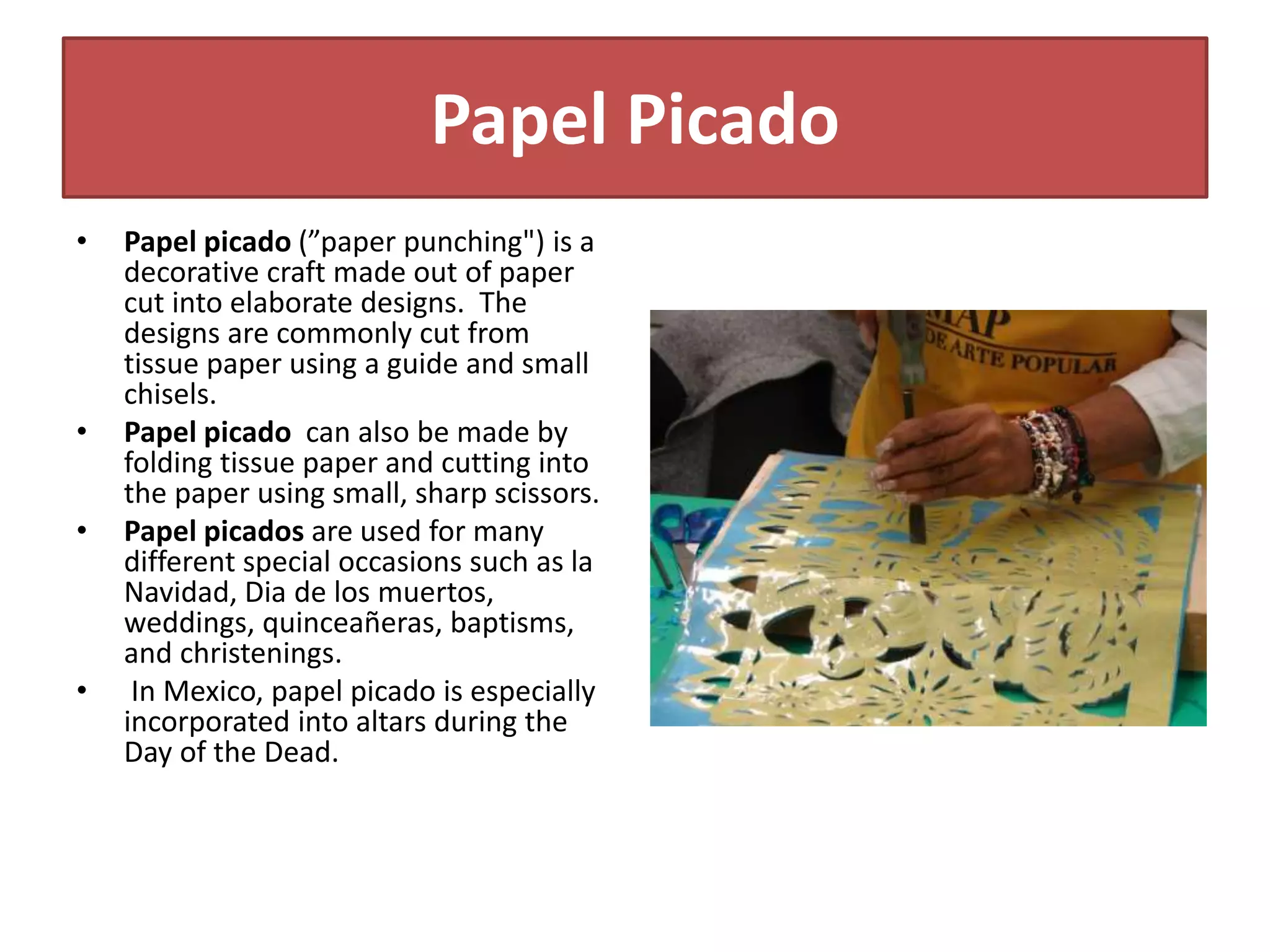
Papel Picado
• Papel picado (”paper punching") is a
decorative craft made out of paper
cut into elaborate designs. The
designs are commonly cut from
tissue paper using a guide and small
chisels.
• Papel picado can also be made by
folding tissue paper and cutting into
the paper using small, sharp scissors.
• Papel picados are used for many
different special occasions such as la
Navidad, Dia de los muertos,
weddings, quinceañeras, baptisms,
and christenings.
• In Mexico, papel picado is especially
incorporated into altars during the
Day of the Dead.
Papel Picado
Calaveras de azúcar/
Alfeniques (Mexican Day of the Dead
Sugar Skulls)• Sugar art was brought to the New World by
Italian missionaries in the 17th century. The first
Church mention of sugar art was from Palermo
at Easter time when little sugar lambs and
angels were made to adorn the side altars in the
Catholic Church.
• Mexico, abundant in sugar production and too
poor to buy fancy imported European church
decorations, learned quickly from the friars how
to make sugar art for their religious festivals.
Clay molded sugar figures of angels, sheep and
sugar skulls go back to the Colonial Period 18th
century. Sugar skulls represented a departed
soul, had the name written on the forehead and
was placed on the home ofrenda or gravestone
to honor the return of a particular spirit. Sugar
skull art reflects the folk art style of big happy
smiles, colorful icing and sparkly tin and glittery
adornments.
• Molded from a sugar paste, then decorated with
icing, glitter and foil, these skulls often are
placed on altars. The sugar represents the
sweetness of life, and the skull represents the
sadness of death.
Calaveras de azúcar/
Alfeniques (Mexican Day of the Dead
Sugar Skulls)
Calaveras de azúcar/
Alfeniques (Mexican Day of the Dead
Sugar Skulls)
Calaveras de Chocolates (Mexican Day of
the Dead Chocolate Skulls)
Copal
• Copal is a name given to tree
resin that is particularly
identified with the cultures of
the ancient peoples of Mexico
and Central America as an
incense.
• Copal is the traditional incense
made from the resin of the
copal tree.
• Copal incense is the dried
resin of the copal tree. The
incense is somewhat smoky
when burned and has sort of a
pine scent. It is burnt to
welcome the spirits of the
dead on altars.
La danza de los viejos
• A traditional dance
performed at this time
in Mexico is “la danza
de los viejos” (the
dance of the old men).
Click on the above picture to see and
hear “la danza de los viejos”.
The Monarch Butterflies Migration
• Every year at the time of Dias
de los muertos, thousands of
monarch butterflies arrive in
Mexico to spend the winter
there in the warm weather.
• Locals view their arrival as the
spirits of their ancestors
arriving in time to celebrate
Dias de los muertos.
• Many Mexicans believe that
every butterfly contains the
spirit of someone loved and
lost in our world, and
therefore, you should never
harm a butterfly.
Click on the above picture to view
A video of the migration of the
Monarch butterfly to Mexico.
Ofrendas
• The Day of the Dead is a time
for the dead to return home
and visit loved ones, feast on
their favorite foods and listen
to their favorite music.
• In the homes, family members
honor their deceased with
ofrendas or offerings which
may consist of photographs,
bread, other foods, flowers,
toys and other symbolic
offerings.
• Ofrendas usually contain
elements of wind (papel
picado); fire (candles); earth
(food) and water.
Ofrendas
• While some prefer to visit the
graves of loved ones, others build
an ofrenda (offering), or altar, in
their home. It consists of a photo
of the one being honored; prayer
candles in purple for pain, white
for hope and pink for the
celebration; pan de los muertos
(bread of the dead), a sweetened
bread baked in round loaves or
skull shapes; marigolds; sugar
skulls; papel picado (Mexican
tissue-paper decorations); copal
(incense to clear the path for
spirits return); a glass of water
and a bottle of beer.
Ofrendas mean “offerings” –
offerings for the spirits to welcome
them home.
Ofrendas
Click on the picture below to view the
different items that traditionally make
up Dia de los Muertos altars.
Build your own “Ofrenda”
Click on the above picture to build your own altar.
After the curtain opens, find “Build your own altar”
Traditional Foods for “la ofrenda”
Mole
• Traditional foods
associated with Day of
the Dead include mole,
tamales and atole.
Mole (Spanish
pronunciation: [ˈmole])(Mexican
Spanish, from Nahuatl
mulli or molli, "sauce" or "concoction” is
the generic name for a number
of sauces used iin Mexican cuisine, as
well as for dishes based on these sauces.
Mole is a chocolate based sauce made
with many herbs and spices, served with
chicken or turkey.
.
Tamales
• A tamale is a traditional
Latin American dish made
of masa (a starchy corn-
based dough, which is
steamed or boiled in a leaf
wrapper.
• The wrapping is discarded
before eating. Tamales can
themselves be filled with
meats, cheese, vegetables,
chilies or any preparation
according to taste, and both
the filling and the cooking
liquid may be seasoned.
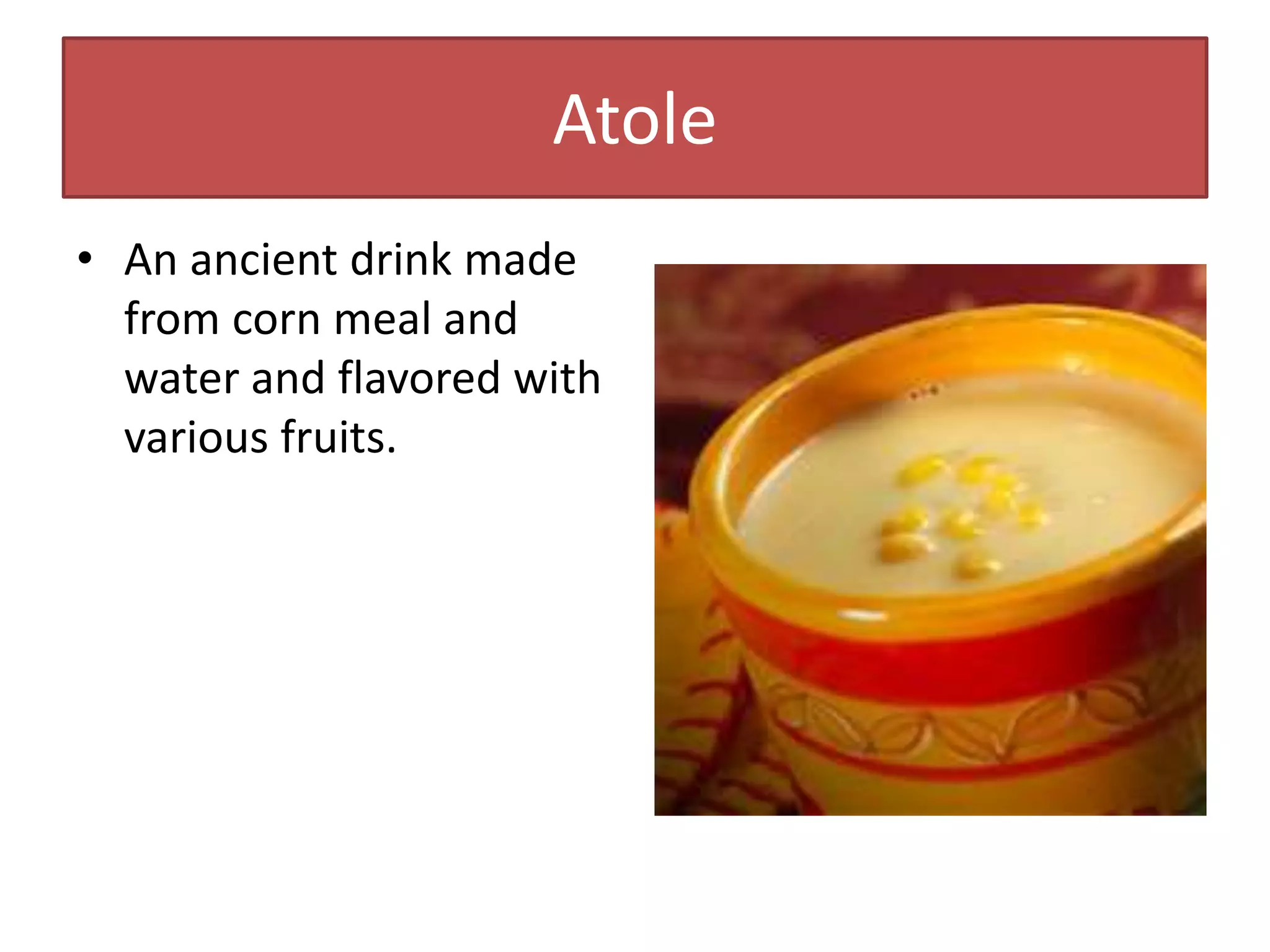
Atole
• An ancient drink made
from corn meal and
water and flavored with
various fruits.
Here’s some trivia on this holiday
Click on the picture to
learn some additional
Facts about this holiday.
Additional Resources
• http://www.azcentral.com/ent/dead/
• http://latino.si.edu/DayoftheDead/
• http://www.dayofthedead.com/
Conclusion
• This WebQuest was designed to acquaint you
with the Mexican holiday of “dia de los
muertos”. Share what you have learned with
your family and friends!

Diadelosmuertos 2016

  • 1.
    Los Dias delos Muertos A WebQuest for Grade 8 Classes 801 & 803 – Due 10/20 Class 802 – Due 10/21
  • 2.
    El Museo delBarrio • SUPER SABADO! Día de los Muertos Celebration • Saturday, October 15, 2016 • 11:00 am - 5:00 pm  Admission is free! Click on the picture For more information
  • 3.
    Introduction • Rather thana time of mourning, los dias de los muertos – the Days of the Dead - observed every Nov. 1 and 2 - is a celebration of life and death, when the spirits of the dearly departed return to Earth for a family fiesta. • Octavio Paz, a native of Mexico and winner of the 1990 Nobel Prize in literature, observes “The word death is not pronounced in New York, in Paris, in London, because it burns the lips. The Mexican, in contrast, is familiar with death, jokes about it, caresses it, sleeps with it, celebrates it, it is one of his favorite toys and his most steadfast love."
  • 4.
    Introduction • Day ofthe Dead is not a sad or scary occasion, but a spirited holiday when people remember and honor family members who have died. All of this is part of the philosophy that death is not something to be feared, but a natural part of life. • People celebrate in their homes, creating altars or oferings (called ofrendas in Spanish) that display portraits, favorite foods, and special possessions of their loved ones. • Altars or offerings are also decorated with candles and marigolds—the light of the candle and scent of the flowers (called cempasuchitl) are said to attract the souls of the deceased and draw them back for a short time to take part in the pleasures they once enjoyed in life. • Families also visit the graves of their loved ones, cleaning the headstones, and decorating with flowers, and bringing food and music • The roots of Day of the Dead are pre- Colombian, and many of the symbols and practices are derived from the indigenous groups of Meso America (Maya and Aztec, e.g.) • Images of skeletons dancing or doing other comical things are common.
  • 5.
    Task • There are3 components for this task – • 1st component –go through the entire WebQuest and explore each resource. • 2nd component - Complete the attached document on “los dias de los muertos” as an individual assignment. • Your will find the answers located throughout this WebQuest. • Submit your completed worksheet via the Dropbox on iLearn. • 3rd component – Choose 1 of these options – • 1/ In groups of 1-3 students, choose 1 of the vocabulary words from this presentation and present it creatively to your class. You may make the item, explain its significance and how you made it. Or, you may display the item and explain how to make it and its significance for this holiday. • 2/ You may choose to compare and contrast Dia de los Muertos with the United states holiday of Halloween. See separate WebQuest for this option. • All presentations and worksheets are due on 10/20 for Classes 801 & 803; 1021 for Class 802.
  • 6.
    Vocabulary Word Projects •José Guadalupe Posada • La Catrina • Calaveras • Calacas • Pan de muerto • Cempazuchitl • Cascarones • Papel Picado • Calaveras de azúcar/ Alfeniques • Calaveras de Chocolates • Copal • La danza de los viejos • The Monarch Butterflies Migration • Ofrenda • Tamales • Atole • Mole
  • 7.
    José Guadalupe Posada(1852–1913) José Guadalupe Posada, an ingenious artist, lived during one of the most turbulent times in Mexico. He knew how to capture the essence of this turbulence in his lithographs to the point that they became the icon of Revolutionary Mexico. Most of his imagery was meant to make a satirical point about life in Mexico at the time he lived. Since his death, however, his images have become associated with the Mexican holiday, Dia de los Muertos, the “Day of the Dead”.
  • 8.
    Calavera de laCatrina “La Catrina” Catrina : Spanish word that means well dressed, rich. Posada used it as a way of criticizing the rich society of Mexico. Posada's best known works are his calaveras (the Spanish word for skeletons , which often assume various costumes, such as the Calavera de la Catrina, the “Calavera of the Female Dandy”, which was meant to satirize the life of the upper classes during the reign of Portifico Diaz.
  • 9.
    Examples of Posada’sArtwork The Street Sweepers
  • 10.
    "Gran fandango yfrancachella de todas las calaveras” - The happy dance and wild party of all the skeletons.
  • 11.
    A cemetery, presumablycrowded with victims of the then fairly new electrical conveyances. There were many disastrous accidents, one or which involved the future artist Frida Kahlo, who spent most of the rest of her life in a wheelchair due to a horrible trolley accident in which her spine was broken in several places. Frida Kahlo later became an internationally acclaimed surrealistic artist who was also known as the wife of Diego Rivera, a famous muralist.
  • 12.
    Calacas • A calaca(a Mexican -Spanish name for skeleton) is a figure of a skull or skeleton (usually human) commonly used for decoration during los dias de los muertos. They are whimsical skeleton figures that represent death. • Tracing their origin from Aztec imagery, calacas are frequently shown with marigold flowers and foliage. As with other aspects of the Day of the Dead festival, calacas are generally depicted as joyous rather than mournful figures. • They are often shown wearing festive clothing, dancing, and playing musical instruments to indicate a happy afterlife. This draws on the Mexican belief that no dead soul likes to be thought of sadly, and that death should be a joyous occasion. This goes back to Aztec beliefs, one of the few traditions to remain after the Spanish conquest. A calaca of La Catrina
  • 13.
  • 14.
    Pan de losmuertos (Bread of the Dead) • The pan de muertos (Spanish for Bread of the dead) (also called pan de los muertos) is a type of bread traditionally baked in Mexico during the weeks leading up to the Día de los Muertos, which is celebrated on November 2. It is a sweetened soft bread shaped like a bun, often decorated with bone-like pieces. Pan de muertos is eaten on Día de los Muertos, at the gravesite or altar of the deceased. In some regions it is eaten for months before the official celebration of Dia de los Muertos. In Oaxaca, pan de muertos is the same bread that is usually baked, with the addition of decorations. As part of the celebration, loved ones eat pan de muertos as well as the relative's favorite foods. The bones represent the lost one (difuntos or difuntas) and there is normally a baked tear drop on the bread to represent sorrow. The bones are represented in a circle to portray the circle of life.
  • 15.
    Pan de losmuertos (Bread of the Dead)
  • 16.
    Cempazuchitl • A marigoldflower, a symbol of death since the time of the Aztecs, also known as cempasuchil or zempasuchitl. • They are used to decorate graves and altars often in a cross or arch pattern. They are also popular as a pathway marker to the altar. • Also known as "the flower with 400 lives”. It is believed that the scent of the petals forms a welcome path for the spirits to return to their altar or grave.
  • 17.
  • 18.
    Cascarones • In Spanishthe word cáscara means eggshell. • They are decorated, confetti-filled eggs, trimmed in glitter. • In addition to Dia de los muertos, cascarones have become popular for other special occasions such as Cinco de mayo, Pascua, weddings and Quinceañeras. • They are very popular in the southwestern United States. • Cascarones may be thrown or crushed over the recipient's head to shower him or her with confetti. • Having a cascarón broken over one's head is said to bring good luck.
  • 19.
  • 20.
    Papel Picado • Papelpicado (”paper punching") is a decorative craft made out of paper cut into elaborate designs. The designs are commonly cut from tissue paper using a guide and small chisels. • Papel picado can also be made by folding tissue paper and cutting into the paper using small, sharp scissors. • Papel picados are used for many different special occasions such as la Navidad, Dia de los muertos, weddings, quinceañeras, baptisms, and christenings. • In Mexico, papel picado is especially incorporated into altars during the Day of the Dead.
  • 21.
  • 22.
    Calaveras de azúcar/ Alfeniques(Mexican Day of the Dead Sugar Skulls)• Sugar art was brought to the New World by Italian missionaries in the 17th century. The first Church mention of sugar art was from Palermo at Easter time when little sugar lambs and angels were made to adorn the side altars in the Catholic Church. • Mexico, abundant in sugar production and too poor to buy fancy imported European church decorations, learned quickly from the friars how to make sugar art for their religious festivals. Clay molded sugar figures of angels, sheep and sugar skulls go back to the Colonial Period 18th century. Sugar skulls represented a departed soul, had the name written on the forehead and was placed on the home ofrenda or gravestone to honor the return of a particular spirit. Sugar skull art reflects the folk art style of big happy smiles, colorful icing and sparkly tin and glittery adornments. • Molded from a sugar paste, then decorated with icing, glitter and foil, these skulls often are placed on altars. The sugar represents the sweetness of life, and the skull represents the sadness of death.
  • 23.
    Calaveras de azúcar/ Alfeniques(Mexican Day of the Dead Sugar Skulls)
  • 24.
    Calaveras de azúcar/ Alfeniques(Mexican Day of the Dead Sugar Skulls)
  • 25.
    Calaveras de Chocolates(Mexican Day of the Dead Chocolate Skulls)
  • 26.
    Copal • Copal isa name given to tree resin that is particularly identified with the cultures of the ancient peoples of Mexico and Central America as an incense. • Copal is the traditional incense made from the resin of the copal tree. • Copal incense is the dried resin of the copal tree. The incense is somewhat smoky when burned and has sort of a pine scent. It is burnt to welcome the spirits of the dead on altars.
  • 27.
    La danza delos viejos • A traditional dance performed at this time in Mexico is “la danza de los viejos” (the dance of the old men). Click on the above picture to see and hear “la danza de los viejos”.
  • 28.
    The Monarch ButterfliesMigration • Every year at the time of Dias de los muertos, thousands of monarch butterflies arrive in Mexico to spend the winter there in the warm weather. • Locals view their arrival as the spirits of their ancestors arriving in time to celebrate Dias de los muertos. • Many Mexicans believe that every butterfly contains the spirit of someone loved and lost in our world, and therefore, you should never harm a butterfly. Click on the above picture to view A video of the migration of the Monarch butterfly to Mexico.
  • 29.
    Ofrendas • The Dayof the Dead is a time for the dead to return home and visit loved ones, feast on their favorite foods and listen to their favorite music. • In the homes, family members honor their deceased with ofrendas or offerings which may consist of photographs, bread, other foods, flowers, toys and other symbolic offerings. • Ofrendas usually contain elements of wind (papel picado); fire (candles); earth (food) and water.
  • 30.
    Ofrendas • While someprefer to visit the graves of loved ones, others build an ofrenda (offering), or altar, in their home. It consists of a photo of the one being honored; prayer candles in purple for pain, white for hope and pink for the celebration; pan de los muertos (bread of the dead), a sweetened bread baked in round loaves or skull shapes; marigolds; sugar skulls; papel picado (Mexican tissue-paper decorations); copal (incense to clear the path for spirits return); a glass of water and a bottle of beer. Ofrendas mean “offerings” – offerings for the spirits to welcome them home.
  • 31.
  • 32.
    Click on thepicture below to view the different items that traditionally make up Dia de los Muertos altars.
  • 33.
    Build your own“Ofrenda” Click on the above picture to build your own altar. After the curtain opens, find “Build your own altar”
  • 34.
    Traditional Foods for“la ofrenda” Mole • Traditional foods associated with Day of the Dead include mole, tamales and atole. Mole (Spanish pronunciation: [ˈmole])(Mexican Spanish, from Nahuatl mulli or molli, "sauce" or "concoction” is the generic name for a number of sauces used iin Mexican cuisine, as well as for dishes based on these sauces. Mole is a chocolate based sauce made with many herbs and spices, served with chicken or turkey. .
  • 35.
    Tamales • A tamaleis a traditional Latin American dish made of masa (a starchy corn- based dough, which is steamed or boiled in a leaf wrapper. • The wrapping is discarded before eating. Tamales can themselves be filled with meats, cheese, vegetables, chilies or any preparation according to taste, and both the filling and the cooking liquid may be seasoned.
  • 36.
    Atole • An ancientdrink made from corn meal and water and flavored with various fruits.
  • 37.
    Here’s some triviaon this holiday Click on the picture to learn some additional Facts about this holiday.
  • 38.
    Additional Resources • http://www.azcentral.com/ent/dead/ •http://latino.si.edu/DayoftheDead/ • http://www.dayofthedead.com/
  • 39.
    Conclusion • This WebQuestwas designed to acquaint you with the Mexican holiday of “dia de los muertos”. Share what you have learned with your family and friends!