Introduction to Backward
Design
Good design…is not so much about
gaining a few new technical skills as it is
about learning to be more thoughtful
and specific about our purposes and
what they imply (p. 14)

    - distinguishing interesting learning from
effective learning
Stages of Backward Design
   Stage 1: Identify desired results
    ◦ Requires clarity about priorities
    ◦ Must make choices
   Stage 2: Determine acceptable evidence
    ◦ Evidence gathered through a variety of formal and
      informal assessments during a unit of study, not
      just a culminating test or project
    ◦ Self-assessment (p. 25) – explain what you mean;
      describe the purpose of the self-assessment
Stages of Backward Design
   Stage 3: Plan learning experiences and
    instruction
    ◦ What activities will equip students with the
      needed knowledge and skills?
    ◦ What material and resources are best suited
      to accomplish these goals?
    ◦ “WHERETO” elements (p. 22)
      T = tailored to the different needs, interests, and
       abilities of learners  modifications
Key Points
   In actuality, it does not follow that this is
    a step-by-step process …Don’t confuse
    the logic of the final product with the
    messy process of design work.
   It doesn’t matter exactly where you start
    or how you proceed, as long as you end
    up with a coherent design reflecting the
    logic of the three stages (p. 29)
Unpacking Stage 1: Elements
   Established Goals: formal, long-term
    goals, such as state content standards,
    district program goals, departmental
    objectives, and exit-level outcomes
    ◦ Typically refer to academic aims (e.g., factual,
      conceptual, procedural)
    ◦ Also includes habits of mind (e.g., tolerance of
      ambiguity) and values and attitudes (e.g.,
      stepping in to mediate a playground dispute)
   Essential Questions: highlight the big ideas
    that are central to the design, ideas that the
    work will require students to address
    ◦ Are at the heart of the subject
    ◦ Raise more questions – provoking and sustaining
      engaged inquiry
    ◦ Because many of the truly essential questions
      recur and have no final resolution, it is
      appropriate to say that “seriously pursuing the
      question” as opposed to “answering” it is the
      desired result (p. 58)
   Understandings: a “moral of the story”
    about the big ideas
    ◦ What specific insights will students take away
      about the meaning of ‘content’ via big ideas?
    ◦ Understandings summarize the desired
      insights we want students to realize
    ◦ Specific generalizations about the “big ideas.”
      They summarize the key meanings, inferences,
      and importance of the ‘content’
    ◦ Deliberately framed as a full sentence “moral
      of the story” – “Students will understand
      THAT…”
   Knowledge: the straightforward facts and
    concepts that are to be gained from the
    learning and teaching activities
   Skill: identifies what students will be able to
    do by the unit’s end (the discrete techniques,
    complex procedures, and methods)
    ◦ Skill-related aims focus on techniques and
      approaches (e.g., long division, jumping rope),
      and processes (e.g., reading, problem solving), as
      opposed to performance goals, such as “writing
      persuasive essays,” which is a long-term outcome,
      requiring many units and courses of study
•   The targeted knowledge and skills can be of
    three different kinds (p. 57):
    – The building blocks for the desired understandings
    – The knowledge and skills stated or implied in the
      goals
    – The “enabling” knowledge and skills needed to
      perform the complex assessment tasks (identified
      in Stage 2)
•   We must always ask of knowledge and skill
    goals, “For what kinds of important capacities
    will this content actually equip us?” instead of
    merely asking, “What knowledge and skills are
    (potentially) important?”
    – Transferability
Key Point
 Although these categories are
 conceptually distinct, they often overlap
 in practice!
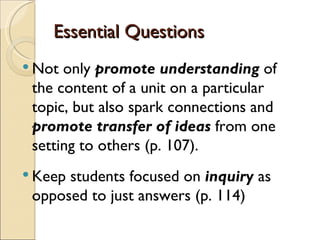
Essential Questions
 Not only promote understanding of
 the content of a unit on a particular
 topic, but also spark connections and
 promote transfer of ideas from one
 setting to others (p. 107).
 Keepstudents focused on inquiry as
 opposed to just answers (p. 114)
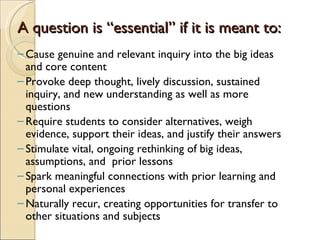
A question is “essential” if it is meant to:
– Cause genuine and relevant inquiry into the big ideas
  and core content
– Provoke deep thought, lively discussion, sustained
  inquiry, and new understanding as well as more
  questions
– Require students to consider alternatives, weigh
  evidence, support their ideas, and justify their answers
– Stimulate vital, ongoing rethinking of big ideas,
  assumptions, and prior lessons
– Spark meaningful connections with prior learning and
  personal experiences
– Naturally recur, creating opportunities for transfer to
  other situations and subjects
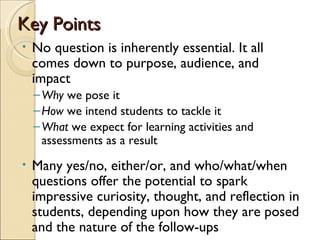
Key Points
•   No question is inherently essential. It all
    comes down to purpose, audience, and
    impact
    – Why we pose it
    – How we intend students to tackle it
    – What we expect for learning activities and
      assessments as a result
•   Many yes/no, either/or, and who/what/when
    questions offer the potential to spark
    impressive curiosity, thought, and reflection in
    students, depending upon how they are posed
    and the nature of the follow-ups
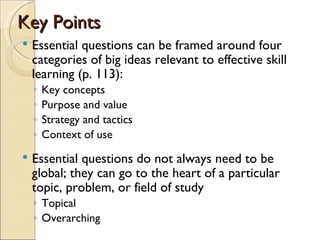
Key Points
   Essential questions can be framed around four
    categories of big ideas relevant to effective skill
    learning (p. 113):
    ◦   Key concepts
    ◦   Purpose and value
    ◦   Strategy and tactics
    ◦   Context of use
   Essential questions do not always need to be
    global; they can go to the heart of a particular
    topic, problem, or field of study
    ◦ Topical
    ◦ Overarching
Crafting Understandings
   As with essential questions, no statement is
    inherently a fact or understanding. It depends
    upon who the learners are and what their
    prior experience has been. (p. 136)
   The point of identifying understandings is to
    clearly frame our goals for ourselves, not to
    come up with an actual learning plan (Stage 3)
    – it’s a blueprint for the plan
Four Rules of Thumb:
• A desired understanding is a priority. A
  unit should focus on a small number of
  transferable big ideas about which
  understandings are stated.
• Desired understandings are best stated
  in propositional form: “Students will
  understand that…”
Four Rules of Thumb:
• Although pertaining to general or abstract
  ideas, the desired understandings must be
  stated in clear, unambiguous terms – as
  specific and insightful generalizations.
• Understandings are of two kinds, topical
  and overarching. Topical understandings
  are unit-specific, and overarching
  understandings are broader and offer a
  possible bridge to other units and courses.

Introduction to backward design 070212

  • 1.
  • 2.
    Good design…is notso much about gaining a few new technical skills as it is about learning to be more thoughtful and specific about our purposes and what they imply (p. 14) - distinguishing interesting learning from effective learning
  • 3.
    Stages of BackwardDesign  Stage 1: Identify desired results ◦ Requires clarity about priorities ◦ Must make choices  Stage 2: Determine acceptable evidence ◦ Evidence gathered through a variety of formal and informal assessments during a unit of study, not just a culminating test or project ◦ Self-assessment (p. 25) – explain what you mean; describe the purpose of the self-assessment
  • 4.
    Stages of BackwardDesign  Stage 3: Plan learning experiences and instruction ◦ What activities will equip students with the needed knowledge and skills? ◦ What material and resources are best suited to accomplish these goals? ◦ “WHERETO” elements (p. 22)  T = tailored to the different needs, interests, and abilities of learners  modifications
  • 5.
    Key Points  In actuality, it does not follow that this is a step-by-step process …Don’t confuse the logic of the final product with the messy process of design work.  It doesn’t matter exactly where you start or how you proceed, as long as you end up with a coherent design reflecting the logic of the three stages (p. 29)
  • 6.
    Unpacking Stage 1:Elements  Established Goals: formal, long-term goals, such as state content standards, district program goals, departmental objectives, and exit-level outcomes ◦ Typically refer to academic aims (e.g., factual, conceptual, procedural) ◦ Also includes habits of mind (e.g., tolerance of ambiguity) and values and attitudes (e.g., stepping in to mediate a playground dispute)
  • 7.
    Essential Questions: highlight the big ideas that are central to the design, ideas that the work will require students to address ◦ Are at the heart of the subject ◦ Raise more questions – provoking and sustaining engaged inquiry ◦ Because many of the truly essential questions recur and have no final resolution, it is appropriate to say that “seriously pursuing the question” as opposed to “answering” it is the desired result (p. 58)
  • 8.
    Understandings: a “moral of the story” about the big ideas ◦ What specific insights will students take away about the meaning of ‘content’ via big ideas? ◦ Understandings summarize the desired insights we want students to realize ◦ Specific generalizations about the “big ideas.” They summarize the key meanings, inferences, and importance of the ‘content’ ◦ Deliberately framed as a full sentence “moral of the story” – “Students will understand THAT…”
  • 9.
    Knowledge: the straightforward facts and concepts that are to be gained from the learning and teaching activities  Skill: identifies what students will be able to do by the unit’s end (the discrete techniques, complex procedures, and methods) ◦ Skill-related aims focus on techniques and approaches (e.g., long division, jumping rope), and processes (e.g., reading, problem solving), as opposed to performance goals, such as “writing persuasive essays,” which is a long-term outcome, requiring many units and courses of study
  • 10.
    The targeted knowledge and skills can be of three different kinds (p. 57): – The building blocks for the desired understandings – The knowledge and skills stated or implied in the goals – The “enabling” knowledge and skills needed to perform the complex assessment tasks (identified in Stage 2) • We must always ask of knowledge and skill goals, “For what kinds of important capacities will this content actually equip us?” instead of merely asking, “What knowledge and skills are (potentially) important?” – Transferability
  • 11.
    Key Point  Althoughthese categories are conceptually distinct, they often overlap in practice!
  • 12.
    Essential Questions  Notonly promote understanding of the content of a unit on a particular topic, but also spark connections and promote transfer of ideas from one setting to others (p. 107).  Keepstudents focused on inquiry as opposed to just answers (p. 114)
  • 13.
    A question is“essential” if it is meant to: – Cause genuine and relevant inquiry into the big ideas and core content – Provoke deep thought, lively discussion, sustained inquiry, and new understanding as well as more questions – Require students to consider alternatives, weigh evidence, support their ideas, and justify their answers – Stimulate vital, ongoing rethinking of big ideas, assumptions, and prior lessons – Spark meaningful connections with prior learning and personal experiences – Naturally recur, creating opportunities for transfer to other situations and subjects
  • 14.
    Key Points • No question is inherently essential. It all comes down to purpose, audience, and impact – Why we pose it – How we intend students to tackle it – What we expect for learning activities and assessments as a result • Many yes/no, either/or, and who/what/when questions offer the potential to spark impressive curiosity, thought, and reflection in students, depending upon how they are posed and the nature of the follow-ups
  • 15.
    Key Points  Essential questions can be framed around four categories of big ideas relevant to effective skill learning (p. 113): ◦ Key concepts ◦ Purpose and value ◦ Strategy and tactics ◦ Context of use  Essential questions do not always need to be global; they can go to the heart of a particular topic, problem, or field of study ◦ Topical ◦ Overarching
  • 16.
    Crafting Understandings  As with essential questions, no statement is inherently a fact or understanding. It depends upon who the learners are and what their prior experience has been. (p. 136)  The point of identifying understandings is to clearly frame our goals for ourselves, not to come up with an actual learning plan (Stage 3) – it’s a blueprint for the plan
  • 17.
    Four Rules ofThumb: • A desired understanding is a priority. A unit should focus on a small number of transferable big ideas about which understandings are stated. • Desired understandings are best stated in propositional form: “Students will understand that…”
  • 18.
    Four Rules ofThumb: • Although pertaining to general or abstract ideas, the desired understandings must be stated in clear, unambiguous terms – as specific and insightful generalizations. • Understandings are of two kinds, topical and overarching. Topical understandings are unit-specific, and overarching understandings are broader and offer a possible bridge to other units and courses.