EDDY CURRENT BREAKING
PRESENTED BY
SACHIN PRAKASH
U10EE084
ELECTRICAL DEPARTMENT
CONTENTS
•
•
•
•
•
•
•
•

Introduction
Theory Of Operation
Working Principle
Constructional Details
Classification of eddy current brakes
Advantages & Disadvantages
Applications
Conclusion
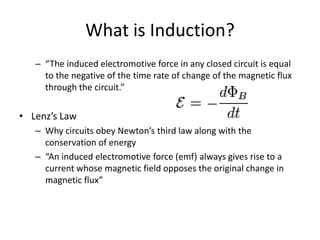
What is Induction?
– “The induced electromotive force in any closed circuit is equal
to the negative of the time rate of change of the magnetic flux
through the circuit.”

• Lenz’s Law
– Why circuits obey Newton’s third law along with the
conservation of energy
– “An induced electromotive force (emf) always gives rise to a
current whose magnetic field opposes the original change in
magnetic flux”
Eddy Current Brakes
• It slow an object by creating eddy currents
through emi which create resistance, and in
turn either heat or electricity.
• Braking action is made by varying the strength
of the magnetic field.

• A braking force is possible when electric current is
passed through the electromagnets.
Induction Currents = Eddy Currents
• Called “Eddy” since they are analogous to fluid eddies in
formation and behavior
• Responsible for the opposing magnetic fields that produce
drag and heating effects
• The drag effects give rise to induction braking
– Absent external potentials will result in the system coming to a
halt

• Heating effects are exploited by devices such as induction
cookers
– If left unchecked, then it could result in serious damage to
mechanical/circuit components
Check on Heat Effects
• High voltage circuits are constructed as a
series of “laminations” to reduce eddy
currents
• Solid conductors would suffer increased
resistivity and large energy losses (heat)
Drag Effects: Magnetic Braking
• Not to be confused with stellar magnetic braking
– The primary reason for slow stellar rotations

• Utilized in many practical applications:
–
–
–
–

Trains (Maglev and conventional) as a braking system
Some roller coasters
Braking Industrial equipment and power tools
Some exercise equipment
• Rowing or Spin machines… to increase resistance
– Determining structural defects in conductive materials
– Metal Detectors
THEORY OF OPERATION
• Eddy current brakes develop torque by the direct
magnetic linking of the rotor to the stator.
• This linking generates eddy currents in the driven rotor.
• Eddy current brakes must have a slip between the
rotor and the stator to generate torque.
• An eddy current brake having an electromagnetic pole
and the rotor is positioned in close proximity to the
stator with an air gap between them
 The stator comprises steel pole pieces with hollow cores
that establish a magnetic circuit for a magnetic flux field.

 The pole pieces have machine-wound electrical windings.
 The windings are fastened with pole caps.

 The hollow core reduces the weight and material of the
stator without significantly adversely affecting the braking
capacity.
 The pole caps reduce the magnetic saturation and increases
the overall brake torque output.
HOW DO THEY WORK ??
Working Principle
• Electromagnets produce magnetic field from
supplied current
• Change of magnetic flux (with time) induces eddy
currents in conductor (disc)
• Eddy Currents produce another magnetic field
opposing first field

• Opposing magnetic fields create force that
reduces velocity
Magnetic field lines across the
magnetic material inside a copper
tube
Direction of magnetic lines of force
due to magnet in copper tube
ARRANGEMENT OF DIFFERENT PARTS
IN EDDY CURRENT BRAKE
Types of Eddy current brake
• Circular eddy current brake
• Linear eddy current brake
CIRCULAR EDDY CURRENT BRAKING
SYSTEM
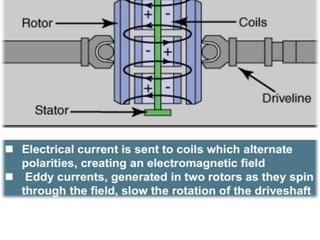
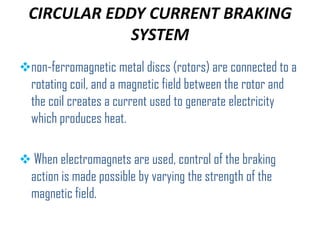
non-ferromagnetic metal discs (rotors) are connected to a

rotating coil, and a magnetic field between the rotor and
the coil creates a current used to generate electricity
which produces heat.
 When electromagnets are used, control of the braking

action is made possible by varying the strength of the
magnetic field.
The movement of the metal through the magnetic field of

the electromagnets creates eddy currents in the discs.
These eddy currents generate an opposing magnetic field

(Lenz's law), which then resists the rotation of the
discs, providing braking force which decelerate the moving
system.
The net result is to convert the motion of the rotors into

heat in the rotors.
Circular eddy current brakes
Linear eddy current brakes
It is first described by French physicist Foucault.
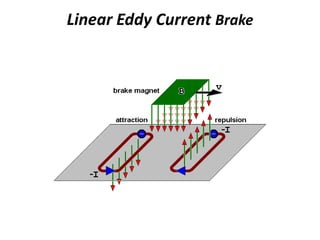
The linear eddy current brake consists of a magnetic yoke with
electrical coils positioned along the rail, which are being
magnetized alternating as south and north magnetic poles.
This magnet does not touch the rail, as with the magnetic brake,
but is held at a constant small distance from the rail
(approximately seven mm).
 When the magnet is moved along the rail, it generates a nonstationary magnetic field in the head of the rail, which then
generates electrical tension (Faraday's induction law), and causes
eddy currents.
These disturb the magnetic field in such a way that the magnetic
force is diverted to the opposite of the direction of the movement,
thus creating a horizontal force component, which works against
the movement of the magnet.
Linear Eddy Current Brake
Advantages. . .








Independent of wheel/rail adhesion.
No contact, therefore no wear or tear.
No noise or smell.
Adjustable brake force.
High brake forces at high speeds.
Used also as service brake.
It uses electromagnetic force and not friction
Non-mechanical (no moving parts, no friction)
Can be activated at will via electrical signal
Low maintenance
Light weight
DISADVANTAGES:-~
Braking force diminishes as speed diminishes
with no ability to hold the load in position at
standstill.
It can not be used at low speed vehicles or
vehicle running at low speed.
ECB is used with ordinary mechanical brakes.
Nowdays ECB is using only for safety purpose.
Applications
 It is used as a stopping mechanism in trains. ExJapanese Shinkansen trains
 It is also used in the smooth breaking and
functioning of roller coasters and such fast
moving machines.
Ex-Intamin roller coaster in Netherlands.

 To eliminate vibration from spacecraft.
Future Aspects
In future ordinary brakes can be replaced by
the ECB completely.
By the use of ECB in future we can control
high speed train completely.
By some new invention of extra mechanism
we can use ECB for slow speed vehicles also.
CONCLUSION
 The ordinary brakes which are being used now days,
stop the vehicle by means of mechanical blocking. This
causes skidding and wear and tear of the vehicle. If the
speed of the vehicle is very high, it cannot provide that
much high braking force and it will cause problems.
 These drawbacks of ordinary brakes can be overcome
by a simple and effective mechanism of braking system
'The eddy current brake'.
 It is an abrasion-free method for braking of vehicles
including trains. It makes use of the opposing tendency
of eddy current
THANK YOU

Eddy current braking

  • 1.
    EDDY CURRENT BREAKING PRESENTEDBY SACHIN PRAKASH U10EE084 ELECTRICAL DEPARTMENT
  • 2.
    CONTENTS • • • • • • • • Introduction Theory Of Operation WorkingPrinciple Constructional Details Classification of eddy current brakes Advantages & Disadvantages Applications Conclusion
  • 3.
    What is Induction? –“The induced electromotive force in any closed circuit is equal to the negative of the time rate of change of the magnetic flux through the circuit.” • Lenz’s Law – Why circuits obey Newton’s third law along with the conservation of energy – “An induced electromotive force (emf) always gives rise to a current whose magnetic field opposes the original change in magnetic flux”
  • 4.
    Eddy Current Brakes •It slow an object by creating eddy currents through emi which create resistance, and in turn either heat or electricity. • Braking action is made by varying the strength of the magnetic field. • A braking force is possible when electric current is passed through the electromagnets.
  • 5.
    Induction Currents =Eddy Currents • Called “Eddy” since they are analogous to fluid eddies in formation and behavior • Responsible for the opposing magnetic fields that produce drag and heating effects • The drag effects give rise to induction braking – Absent external potentials will result in the system coming to a halt • Heating effects are exploited by devices such as induction cookers – If left unchecked, then it could result in serious damage to mechanical/circuit components
  • 6.
    Check on HeatEffects • High voltage circuits are constructed as a series of “laminations” to reduce eddy currents • Solid conductors would suffer increased resistivity and large energy losses (heat)
  • 7.
    Drag Effects: MagneticBraking • Not to be confused with stellar magnetic braking – The primary reason for slow stellar rotations • Utilized in many practical applications: – – – – Trains (Maglev and conventional) as a braking system Some roller coasters Braking Industrial equipment and power tools Some exercise equipment • Rowing or Spin machines… to increase resistance – Determining structural defects in conductive materials – Metal Detectors
  • 8.
    THEORY OF OPERATION •Eddy current brakes develop torque by the direct magnetic linking of the rotor to the stator. • This linking generates eddy currents in the driven rotor. • Eddy current brakes must have a slip between the rotor and the stator to generate torque. • An eddy current brake having an electromagnetic pole and the rotor is positioned in close proximity to the stator with an air gap between them
  • 9.
     The statorcomprises steel pole pieces with hollow cores that establish a magnetic circuit for a magnetic flux field.  The pole pieces have machine-wound electrical windings.  The windings are fastened with pole caps.  The hollow core reduces the weight and material of the stator without significantly adversely affecting the braking capacity.  The pole caps reduce the magnetic saturation and increases the overall brake torque output.
  • 10.
    HOW DO THEYWORK ??
  • 12.
    Working Principle • Electromagnetsproduce magnetic field from supplied current • Change of magnetic flux (with time) induces eddy currents in conductor (disc) • Eddy Currents produce another magnetic field opposing first field • Opposing magnetic fields create force that reduces velocity
  • 13.
    Magnetic field linesacross the magnetic material inside a copper tube
  • 14.
    Direction of magneticlines of force due to magnet in copper tube
  • 16.
    ARRANGEMENT OF DIFFERENTPARTS IN EDDY CURRENT BRAKE
  • 17.
    Types of Eddycurrent brake • Circular eddy current brake • Linear eddy current brake
  • 18.
    CIRCULAR EDDY CURRENTBRAKING SYSTEM non-ferromagnetic metal discs (rotors) are connected to a rotating coil, and a magnetic field between the rotor and the coil creates a current used to generate electricity which produces heat.  When electromagnets are used, control of the braking action is made possible by varying the strength of the magnetic field.
  • 19.
    The movement ofthe metal through the magnetic field of the electromagnets creates eddy currents in the discs. These eddy currents generate an opposing magnetic field (Lenz's law), which then resists the rotation of the discs, providing braking force which decelerate the moving system. The net result is to convert the motion of the rotors into heat in the rotors.
  • 20.
  • 21.
    Linear eddy currentbrakes It is first described by French physicist Foucault. The linear eddy current brake consists of a magnetic yoke with electrical coils positioned along the rail, which are being magnetized alternating as south and north magnetic poles. This magnet does not touch the rail, as with the magnetic brake, but is held at a constant small distance from the rail (approximately seven mm).
  • 22.
     When themagnet is moved along the rail, it generates a nonstationary magnetic field in the head of the rail, which then generates electrical tension (Faraday's induction law), and causes eddy currents. These disturb the magnetic field in such a way that the magnetic force is diverted to the opposite of the direction of the movement, thus creating a horizontal force component, which works against the movement of the magnet.
  • 23.
  • 24.
    Advantages. . .        Independentof wheel/rail adhesion. No contact, therefore no wear or tear. No noise or smell. Adjustable brake force. High brake forces at high speeds. Used also as service brake. It uses electromagnetic force and not friction Non-mechanical (no moving parts, no friction) Can be activated at will via electrical signal Low maintenance Light weight
  • 25.
    DISADVANTAGES:-~ Braking force diminishesas speed diminishes with no ability to hold the load in position at standstill. It can not be used at low speed vehicles or vehicle running at low speed. ECB is used with ordinary mechanical brakes. Nowdays ECB is using only for safety purpose.
  • 26.
    Applications  It isused as a stopping mechanism in trains. ExJapanese Shinkansen trains  It is also used in the smooth breaking and functioning of roller coasters and such fast moving machines. Ex-Intamin roller coaster in Netherlands.  To eliminate vibration from spacecraft.
  • 27.
    Future Aspects In futureordinary brakes can be replaced by the ECB completely. By the use of ECB in future we can control high speed train completely. By some new invention of extra mechanism we can use ECB for slow speed vehicles also.
  • 28.
    CONCLUSION  The ordinarybrakes which are being used now days, stop the vehicle by means of mechanical blocking. This causes skidding and wear and tear of the vehicle. If the speed of the vehicle is very high, it cannot provide that much high braking force and it will cause problems.  These drawbacks of ordinary brakes can be overcome by a simple and effective mechanism of braking system 'The eddy current brake'.  It is an abrasion-free method for braking of vehicles including trains. It makes use of the opposing tendency of eddy current
  • 29.

Editor's Notes