CONTENTS :~













Introduction of eddy current
brake
Components And
Operational Features Of
Eddy Current Brakes
How eddy current brake
works?
Advantages
Disadvantages
Applications
Conclusion
Eddy currents are electric currents induced
in conductors when exposed to a changing magnetic field;
due to relative motion of the field source and conductor or
due to variations of the field with time.

This can cause a circulating flow of electrons, or current,
within the body of the conductor.
These circulating eddies of current have inductance and
thus induce magnetic fields.
Š Eddy current brakes, like conventional friction brakes, are
responsible for slowing an object, such as rotating machinery, a
moving train, or even a roller coaster.
These brakes make use of opposing tendency of eddy currents.
The drawbacks of ordinary brakes which uses mechanical
blocking could be eliminated by use of a more simple and
effective mechanism known as eddy current brakes.
Š There are two basic types:

(1)circular
(2)linear
LINEAR EDDY CURRENT BRAKES








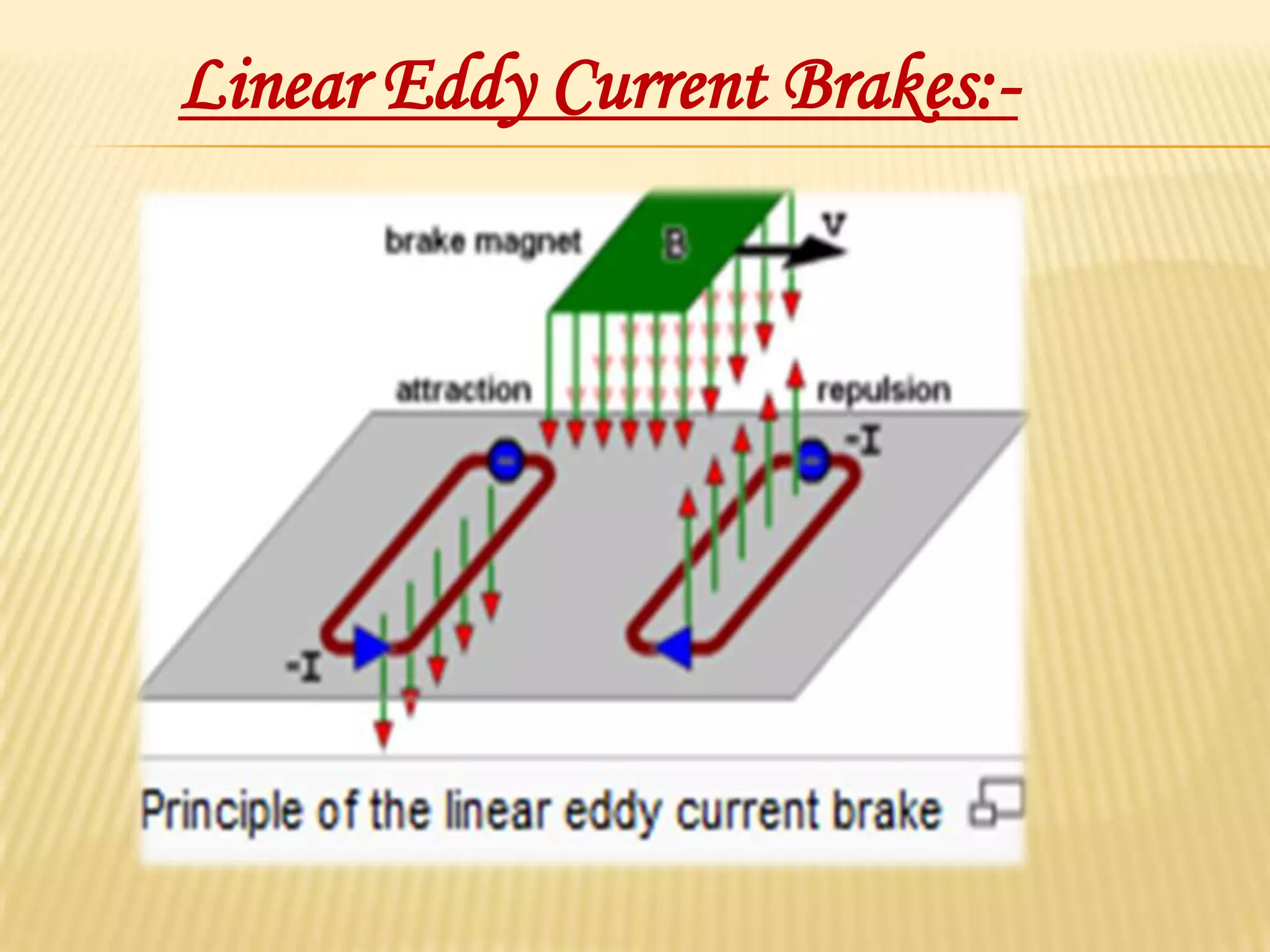
It consists of a magnetic yoke with electrical coils which are
being magnetized alternately.
This magnet does not touch the rail (held at approx 7 mm.)
When the magnet is moved along the rail, it generates a
non-stationary magnetic field which generates electrical
tension and causes eddy currents.
These disturb the magnetic field in such a way that the
magnetic force is diverted to the opposite of the direction of
the movement.
The braking energy of the vehicle is converted in eddy
current losses which lead to a warming of the rail.
CIRCULAR EDDY CURRENT BRAKES








When electromagnets are used, control of the braking
action is made possible by varying the strength of the
magnetic field.
A braking force is possible when electric current is
passed through the electromagnets. The movement of
the metal through the magnetic field of the
electromagnets creates eddy currents in the discs.
These eddy currents generate an opposing magnetic
field, which then resists the rotation of the discs,
providing braking force.
The net result is to convert the motion of the rotors into
heat in the rotors.
Circular Eddy Current Brakes:-
COMPONENTS AND CONSTRUCTIONAL
FEATURES OF EDDY CURRENT
BRAKES:-

 Electromagnets
 Cast Iron Core
 Conducting (Copper) Wire
 Mounting bolts
 Disc
 Mild steel machined from plates


Essentially the eddy current brake consists of two parts, a
stationary magnetic field system and a solid rotating part,
which include a metal disc.



Two members are separated by a short air gap, they're
being no contact between the two for the purpose of torque
transmission. Consequently there is no wear as in friction
Stator consists of pole core, pole shoe, and field winding.
The field winding is wounded on the pole core.
Pole core and pole shoes are made of east steel laminations and
fixed to the state of frames by means of screw or bolts.
Copper and aluminum is used as winding materials.

During braking, the metal disc is exposed to a magnetic field from
an electromagnet, generating eddy currents in the disc. The
magnetic interaction between the applied field and the eddy
currents slow down the rotating disc. Thus the wheels of the
vehicle also slow down since the wheels are directly coupled to
the disc of the eddy current brake, thus producing smooth
stopping motion.
Linear Eddy Current Brakes:-
HOW DOES AN EDDY CURRENT
BRAKE STOP SOMETHING MOVING?

 Suppose

we have a huge solid block of copper mounted on
wheels. It is moving at a very high speed and we need to stop it.
 Suppose

we place a giant magnet next to the track so that
train had to pass nearby.
As the copper approached the magnet eddy currents
would be generated inside the copper which would produce
their own magnetic field.
 As

the front part approached the magnet eddy currents in
that bit of copper would try to generate a repulsive magnetic
field to slow down copper’s approach to magnet.
 As

the front passed by, slowing down, the currents there
would reverse, generating an attractive magnetic field that
tried to pull the train back again. (again, slowing it down).
 The

copper would heat up the eddy currents swirled inside it,
gaining the kinetic energy lost by the train as it slowed down.


Eddy current brakes develop torque by the
direct magnetic linking of the rotor to the
stator.



This linking generates eddy currents in the
driven rotor.



Eddy current brakes must have a slip
between the rotor and the stator to generate
torque.



An eddy current brake having an
electromagnetic pole and the rotor is
positioned in close proximity to the stator


Electromagnets produce magnetic field
from supplied current



Change of magnetic flux (with time)
induces eddy currents in conductor (disc)



Eddy Currents produce another magnetic
field opposing first field



Opposing magnetic fields create force that
reduces velocity
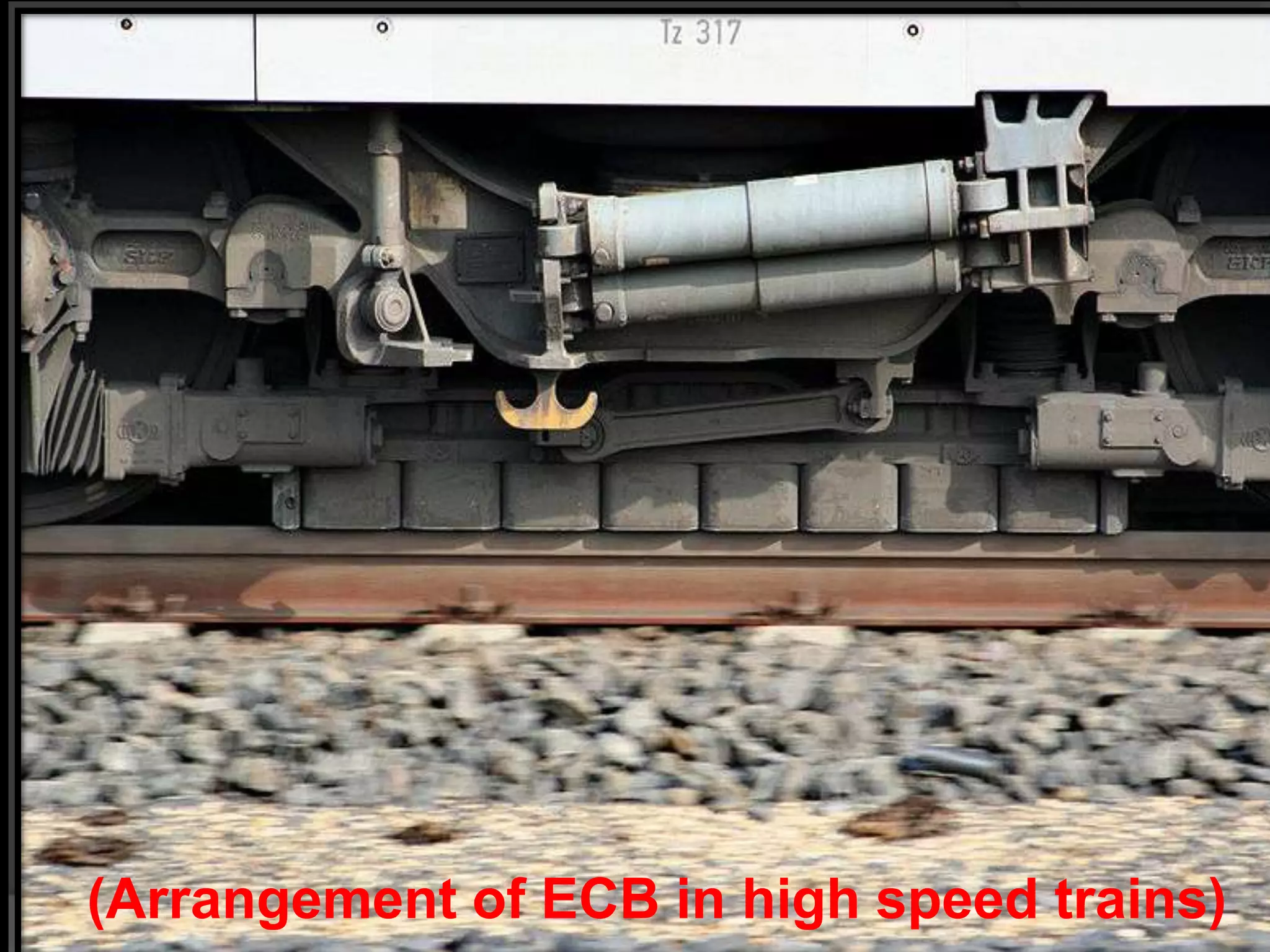
(Arrangement of ECB in high speed trains)
ADVANTAGES
It uses electromagnetic force and not mechanical
friction
 Non-mechanical (no moving parts, no friction)
 Can be activated at will via electrical signal
 Low maintenance
 Operates at any rotational speed
 Light weight
 Eddy-current brakes are quiet, frictionless, and
wear-free, and require little or no maintenance.
 They produce no smell or pollution (unlike friction
brakes, which can release toxic chemicals into the
All this makes them much more attractive than noisy friction
environment).
brakes that need regular inspection and routinely wear out. It's
been estimated that switching an electric train from friction brakes
to eddy-current brakes could halve the cost of brake operation and
maintenance over its lifetime.

DISADVANTAGES. . .


Braking force diminishes as speed diminishes
with no ability to hold the load in position at
standstill.



That could be considered to be a safety issue,
but it really means that friction braking may need
to be used as well.
Eddy-current brakes can only be used where the
infrastructure has been modified to accept them.
It can not be used at low speed vehicles or
vehicle running at low speed



APPLICATIONS:

For additional safety on long decants in mountain area



Eddy current brakes are best substitutes for ordinary brakes,
which are being used nowadays in road vehicles even in trains,
because of their jerk-free operation.



In mountain areas where continuous braking force is needed, for
a long time, the eddy current braking is very much useful for
working without overheating.



Eddy current brakes are very much useful for high-speed
passengers and good vehicles.
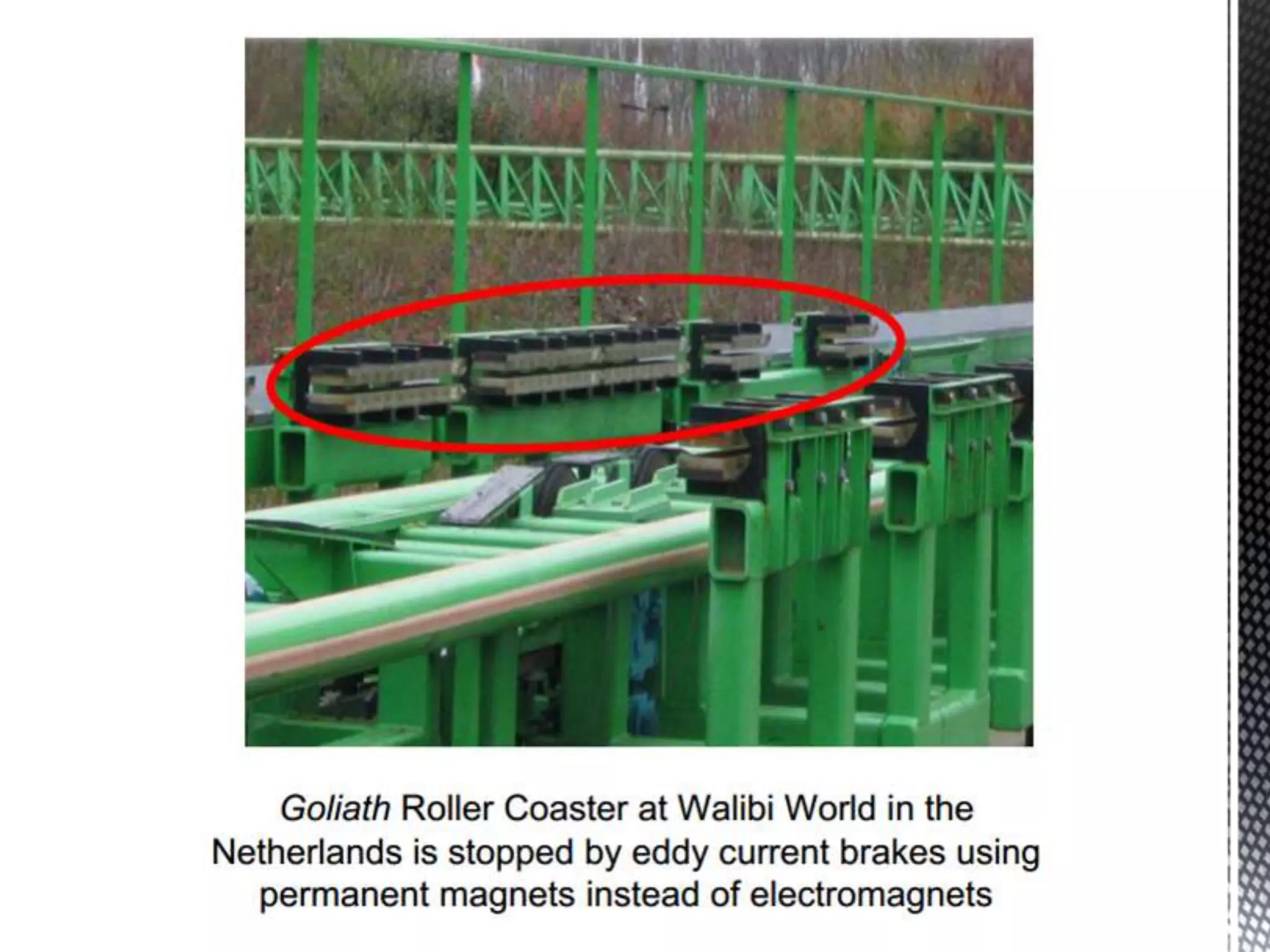
 It can also be used to slow down the trolleys of faster roller
coasters.
There are a number of major commercial applications of eddy
current brake technology in the mining, railroad, and elevator
industries.
 We'll also find eddy current brakes in all kinds of machines, such
as circular saws and other power equipment. And they're used in
things like rowing machines and gym machines to apply extra
resistance to the moving parts so your muscles have to work harder.
CONCLUSION:

The ordinary brakes which are being used now a days stop
the vehicle by means of mechanical blocking. This may
cause skidding and wear and tear of the vehicle.



And if the speed of the vehicle is very high the brake could
not provide that much high braking force and it will cause
problems.



These drawbacks can be eliminated by using a simple and
effective mechanism of braking system called eddy current
brakes.



It is an abrasion free method for braking of vehicles including
trains.
THE END
THANK YOU ALL

Eddycurrentbrakes

  • 2.
    CONTENTS :~         Introduction ofeddy current Introduction of eddy current brake Components And Operational Features Of Eddy Current Brakes How eddy current brake works? Advantages Disadvantages Applications Conclusion
  • 3.
    Eddy currents areelectric currents induced in conductors when exposed to a changing magnetic field; due to relative motion of the field source and conductor or due to variations of the field with time. This can cause a circulating flow of electrons, or current, within the body of the conductor. These circulating eddies of current have inductance and thus induce magnetic fields.
  • 4.
    Š Eddy currentbrakes, like conventional friction brakes, are responsible for slowing an object, such as rotating machinery, a moving train, or even a roller coaster. These brakes make use of opposing tendency of eddy currents. The drawbacks of ordinary brakes which uses mechanical blocking could be eliminated by use of a more simple and effective mechanism known as eddy current brakes. Š There are two basic types: (1)circular (2)linear
  • 5.
    LINEAR EDDY CURRENTBRAKES      It consists of a magnetic yoke with electrical coils which are being magnetized alternately. This magnet does not touch the rail (held at approx 7 mm.) When the magnet is moved along the rail, it generates a non-stationary magnetic field which generates electrical tension and causes eddy currents. These disturb the magnetic field in such a way that the magnetic force is diverted to the opposite of the direction of the movement. The braking energy of the vehicle is converted in eddy current losses which lead to a warming of the rail.
  • 6.
    CIRCULAR EDDY CURRENTBRAKES     When electromagnets are used, control of the braking action is made possible by varying the strength of the magnetic field. A braking force is possible when electric current is passed through the electromagnets. The movement of the metal through the magnetic field of the electromagnets creates eddy currents in the discs. These eddy currents generate an opposing magnetic field, which then resists the rotation of the discs, providing braking force. The net result is to convert the motion of the rotors into heat in the rotors.
  • 7.
  • 8.
    COMPONENTS AND CONSTRUCTIONAL FEATURESOF EDDY CURRENT BRAKES:-  Electromagnets  Cast Iron Core  Conducting (Copper) Wire  Mounting bolts  Disc  Mild steel machined from plates  Essentially the eddy current brake consists of two parts, a stationary magnetic field system and a solid rotating part, which include a metal disc.  Two members are separated by a short air gap, they're being no contact between the two for the purpose of torque transmission. Consequently there is no wear as in friction
  • 9.
    Stator consists ofpole core, pole shoe, and field winding. The field winding is wounded on the pole core. Pole core and pole shoes are made of east steel laminations and fixed to the state of frames by means of screw or bolts. Copper and aluminum is used as winding materials. During braking, the metal disc is exposed to a magnetic field from an electromagnet, generating eddy currents in the disc. The magnetic interaction between the applied field and the eddy currents slow down the rotating disc. Thus the wheels of the vehicle also slow down since the wheels are directly coupled to the disc of the eddy current brake, thus producing smooth stopping motion.
  • 12.
  • 13.
    HOW DOES ANEDDY CURRENT BRAKE STOP SOMETHING MOVING?  Suppose we have a huge solid block of copper mounted on wheels. It is moving at a very high speed and we need to stop it.  Suppose we place a giant magnet next to the track so that train had to pass nearby. As the copper approached the magnet eddy currents would be generated inside the copper which would produce their own magnetic field.
  • 14.
     As the frontpart approached the magnet eddy currents in that bit of copper would try to generate a repulsive magnetic field to slow down copper’s approach to magnet.  As the front passed by, slowing down, the currents there would reverse, generating an attractive magnetic field that tried to pull the train back again. (again, slowing it down).  The copper would heat up the eddy currents swirled inside it, gaining the kinetic energy lost by the train as it slowed down.
  • 15.
     Eddy current brakesdevelop torque by the direct magnetic linking of the rotor to the stator.  This linking generates eddy currents in the driven rotor.  Eddy current brakes must have a slip between the rotor and the stator to generate torque.  An eddy current brake having an electromagnetic pole and the rotor is positioned in close proximity to the stator
  • 16.
     Electromagnets produce magneticfield from supplied current  Change of magnetic flux (with time) induces eddy currents in conductor (disc)  Eddy Currents produce another magnetic field opposing first field  Opposing magnetic fields create force that reduces velocity
  • 18.
    (Arrangement of ECBin high speed trains)
  • 19.
    ADVANTAGES It uses electromagneticforce and not mechanical friction  Non-mechanical (no moving parts, no friction)  Can be activated at will via electrical signal  Low maintenance  Operates at any rotational speed  Light weight  Eddy-current brakes are quiet, frictionless, and wear-free, and require little or no maintenance.  They produce no smell or pollution (unlike friction brakes, which can release toxic chemicals into the All this makes them much more attractive than noisy friction environment). brakes that need regular inspection and routinely wear out. It's been estimated that switching an electric train from friction brakes to eddy-current brakes could halve the cost of brake operation and maintenance over its lifetime. 
  • 20.
    DISADVANTAGES. . .  Brakingforce diminishes as speed diminishes with no ability to hold the load in position at standstill.  That could be considered to be a safety issue, but it really means that friction braking may need to be used as well. Eddy-current brakes can only be used where the infrastructure has been modified to accept them. It can not be used at low speed vehicles or vehicle running at low speed  
  • 21.
    APPLICATIONS: For additional safetyon long decants in mountain area  Eddy current brakes are best substitutes for ordinary brakes, which are being used nowadays in road vehicles even in trains, because of their jerk-free operation.  In mountain areas where continuous braking force is needed, for a long time, the eddy current braking is very much useful for working without overheating.  Eddy current brakes are very much useful for high-speed passengers and good vehicles.
  • 22.
     It canalso be used to slow down the trolleys of faster roller coasters. There are a number of major commercial applications of eddy current brake technology in the mining, railroad, and elevator industries.  We'll also find eddy current brakes in all kinds of machines, such as circular saws and other power equipment. And they're used in things like rowing machines and gym machines to apply extra resistance to the moving parts so your muscles have to work harder.
  • 23.
    CONCLUSION: The ordinary brakeswhich are being used now a days stop the vehicle by means of mechanical blocking. This may cause skidding and wear and tear of the vehicle.  And if the speed of the vehicle is very high the brake could not provide that much high braking force and it will cause problems.  These drawbacks can be eliminated by using a simple and effective mechanism of braking system called eddy current brakes.  It is an abrasion free method for braking of vehicles including trains.
  • 25.