Delhi Technological University
Prepared By
• Shubham Singh
Term Paper – 1
Presentation
On
Contents
• What are brakes ?
• Need for a braking system.
• What are eddy currents ?
• What are eddy current brakes ?
• How are eddy current brakes different from electromagnetic brakes ?
• Principle
• Construction
• Working
• Applications
• Research
What are brakes ?
• An inevitable component of most of the mechanical systems.
• It is a way to control and inhibit motion.
• Conventional braking system uses mechanical blocking but has various
short comings.
• One of the solution is Eddy Current Brakes.
Need for a braking system.
Abrasion Free
• The conventional brakes used mechanical blocking which led to high levels of wear
and tear of the system especially in automobiles reducing the life of those systems.
Eco friendly
• Use of brake pad produces debris which are potential hazards to the environment
as
these may interact with DNA of living organisms
Be carcinogenic.
copper in braking pads often enter into the water bodies leading to mass death of algae and
other invertebrates as occurred in San Francisco Bay.
High Braking Force
• The ordinary braking system cannot produce high braking forces to inhibit systems
moving in high speed which gave rise to a need for an effective braking of high
speed machines.
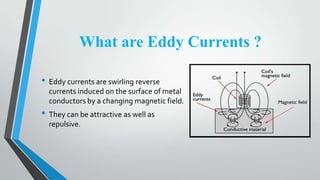
What are Eddy Currents ?
• Eddy currents are swirling reverse
currents induced on the surface of metal
conductors by a changing magnetic field.
• They can be attractive as well as
repulsive.
What are Eddy Current Brakes ?
• Eddy current braking system is an
unseen braking system which makes
use of the opposing tendency of eddy
currents to inhibit the motion of a
mechanical system.
Simplified circuit diagram showing connections
for an eddy current brake
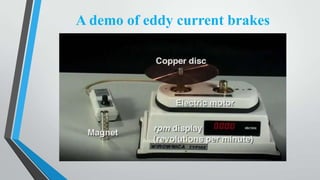
A demo of eddy current brakes
How are eddy current brakes different from
electromagnetic brakes ?
Eddy Current Brakes
• Eddy current brakes use
magnetic force directly for
inhibiting the motion of the
system.
• There is an air gap present to
prevent mechanical transmission
of torque.
Electromagnetic brakes
• Electromagnetic brakes use
electromagnetic circuit to implement
mechanical blocking and hence
ultimately use frictional force.
• There is a mechanical linkage to
transmit torque.
Principle involved
Principle involved
•
Principle involved
•
Construction
• A stationary magnetic field
• A solid rotatory disc
An eddy current brake basically consists of two members:
• Stator consists of pole core, pole shoe, and field winding.
• The field winding is wounded on the pole core.
• Pole core and pole shoes are made of east steel laminations and fixed to the
state of frames by means of screw or bolts.
• Copper and aluminium is used for winding material in the arrangement.
• Rotor generally composed of mild steel.
• sometimes also referred to as the secondary because the eddy currents are
induced in it.
• Stator and rotor are separated by a short air gap; there being no contact
between the two for the purpose of torque transmission.
• Consequently there is no wear as in friction brake.
Construction
Stator And Rotor
Parameters of Construction
PARAMETERS
Current
induced
Disc
material &
thickness
EM
turns
Air gap
Working
To explain the magnetic function of an electromagnetic retarder, the Maxwell
principles may be applied to the following physical arrangement:
• a ferro-magnetic disc with a permeability, m , and an electric conductivity, r
• rotates at the face of a ring of magnetic poles of alternate polarity.
• Each pole produces a magnetic excitation flux, NO which is proportional to
the excitation current within the coil as long as the core is not saturated.
• The lines of magnetic flux, N, form loops within the disc through the very
small air gap which is arranged between the discs and the poles
•
• Alternating eddy currents are created within the disc with a strength
proportional to the flux, N
• These currents wind themselves around the lines of flux.
• The electric conductivity, D, of the disc material causes these eddy currents
to produce heat within the disc.
• If a magnetic system is rotated about an axis normal to a conducting
sheet, the field of induced eddy currents will set up a retarding torque on the
system which is proportional to its angular speed.
• The braking torque is generally also a function of the flux and the excitation
current.
Applications
Trains
Motor test
stands
Applications
Rowing
machines
Roller
coaster
Free fall
tower rides
Research
• In ICE-V test train in the 1980s, it discovered that one of the biggest
obstacles to commercial application would be electromagnetic
compatibility with signalling and train control systems. This could result in
inter-ference or potentially even irrep-arable damage to the signalling
system by the electro-magnetic forces generated when the eddy-current
brake was activated.
• Even when not in use, there is a risk of physical interference between the
brake and signalling equipment when the brake assembly was in the
lowered position.
• incorrect solenoid coils or pole sequence errors.
• risks associated with having too small an air gap between the lowered eddy-
current brake and the track.
• even with the brake inactive, the magnetic field strength was only just
below the maximum permitted level which could result in incorrect
wheelset detection by the axle-counters.
• heating of the rails as a result of repeated brake applications, and the effect
that this might have on the track structure, turnouts and other critical
elements such as bridges.
• Till date the use of eddy current brakes for train is being done in few places
of Germany and it is aimed that over the next seven years it would be spread
out more. In Japan, these brakes are in use since 1980s. Tests are being
conducted in South Korea, Japan and in many countries of Europe to judge
the efficiency of the system to allow eddy current brakes in respective
countries. Present day progress conveys that the generation to come will
see widespread utilization of such brakes.

Eddy Current Brakes

  • 1.
    Delhi Technological University PreparedBy • Shubham Singh Term Paper – 1 Presentation On
  • 2.
    Contents • What arebrakes ? • Need for a braking system. • What are eddy currents ? • What are eddy current brakes ? • How are eddy current brakes different from electromagnetic brakes ? • Principle • Construction • Working • Applications • Research
  • 3.
    What are brakes? • An inevitable component of most of the mechanical systems. • It is a way to control and inhibit motion. • Conventional braking system uses mechanical blocking but has various short comings. • One of the solution is Eddy Current Brakes.
  • 4.
    Need for abraking system.
  • 5.
    Abrasion Free • Theconventional brakes used mechanical blocking which led to high levels of wear and tear of the system especially in automobiles reducing the life of those systems. Eco friendly • Use of brake pad produces debris which are potential hazards to the environment as these may interact with DNA of living organisms Be carcinogenic. copper in braking pads often enter into the water bodies leading to mass death of algae and other invertebrates as occurred in San Francisco Bay. High Braking Force • The ordinary braking system cannot produce high braking forces to inhibit systems moving in high speed which gave rise to a need for an effective braking of high speed machines.
  • 6.
    What are EddyCurrents ? • Eddy currents are swirling reverse currents induced on the surface of metal conductors by a changing magnetic field. • They can be attractive as well as repulsive.
  • 7.
    What are EddyCurrent Brakes ? • Eddy current braking system is an unseen braking system which makes use of the opposing tendency of eddy currents to inhibit the motion of a mechanical system.
  • 8.
    Simplified circuit diagramshowing connections for an eddy current brake
  • 9.
    A demo ofeddy current brakes
  • 10.
    How are eddycurrent brakes different from electromagnetic brakes ? Eddy Current Brakes • Eddy current brakes use magnetic force directly for inhibiting the motion of the system. • There is an air gap present to prevent mechanical transmission of torque. Electromagnetic brakes • Electromagnetic brakes use electromagnetic circuit to implement mechanical blocking and hence ultimately use frictional force. • There is a mechanical linkage to transmit torque.
  • 11.
  • 12.
  • 13.
  • 14.
    Construction • A stationarymagnetic field • A solid rotatory disc An eddy current brake basically consists of two members:
  • 15.
    • Stator consistsof pole core, pole shoe, and field winding. • The field winding is wounded on the pole core. • Pole core and pole shoes are made of east steel laminations and fixed to the state of frames by means of screw or bolts. • Copper and aluminium is used for winding material in the arrangement. • Rotor generally composed of mild steel. • sometimes also referred to as the secondary because the eddy currents are induced in it. • Stator and rotor are separated by a short air gap; there being no contact between the two for the purpose of torque transmission. • Consequently there is no wear as in friction brake. Construction
  • 16.
  • 17.
  • 18.
    Working To explain themagnetic function of an electromagnetic retarder, the Maxwell principles may be applied to the following physical arrangement: • a ferro-magnetic disc with a permeability, m , and an electric conductivity, r • rotates at the face of a ring of magnetic poles of alternate polarity. • Each pole produces a magnetic excitation flux, NO which is proportional to the excitation current within the coil as long as the core is not saturated. • The lines of magnetic flux, N, form loops within the disc through the very small air gap which is arranged between the discs and the poles
  • 19.
  • 20.
    • Alternating eddycurrents are created within the disc with a strength proportional to the flux, N • These currents wind themselves around the lines of flux. • The electric conductivity, D, of the disc material causes these eddy currents to produce heat within the disc. • If a magnetic system is rotated about an axis normal to a conducting sheet, the field of induced eddy currents will set up a retarding torque on the system which is proportional to its angular speed. • The braking torque is generally also a function of the flux and the excitation current.
  • 21.
  • 22.
    Research • In ICE-Vtest train in the 1980s, it discovered that one of the biggest obstacles to commercial application would be electromagnetic compatibility with signalling and train control systems. This could result in inter-ference or potentially even irrep-arable damage to the signalling system by the electro-magnetic forces generated when the eddy-current brake was activated. • Even when not in use, there is a risk of physical interference between the brake and signalling equipment when the brake assembly was in the lowered position. • incorrect solenoid coils or pole sequence errors. • risks associated with having too small an air gap between the lowered eddy- current brake and the track.
  • 23.
    • even withthe brake inactive, the magnetic field strength was only just below the maximum permitted level which could result in incorrect wheelset detection by the axle-counters. • heating of the rails as a result of repeated brake applications, and the effect that this might have on the track structure, turnouts and other critical elements such as bridges. • Till date the use of eddy current brakes for train is being done in few places of Germany and it is aimed that over the next seven years it would be spread out more. In Japan, these brakes are in use since 1980s. Tests are being conducted in South Korea, Japan and in many countries of Europe to judge the efficiency of the system to allow eddy current brakes in respective countries. Present day progress conveys that the generation to come will see widespread utilization of such brakes.