

Presented By :~ 
Sumit Kumar Singh
Contents :~ 
Introduction of eddy current 
Introduction of eddy current brake 
Circular eddy current brake 
Linear eddy current brake 
How eddy current brake works? 
Advantages 
Disadvantages 
Applications 
Future Aspects 
conclusion
Eddy currents are electric currents induced 
in conductors when exposed to a changing magnetic 
field; due to relative motion of the field source and 
conductor or due to variations of the field with time. 
This can cause a circulating flow of 
electrons, or current, within 
the body of the conductor. 
These circulating eddies 
of current have inductance and thus induce magnetic 
fields.
Š Eddy current brakes, like conventional friction 
brakes, are 
responsible for slowing an object, such as 
rotating machinery, a moving train, or even a 
roller coaster 
Š There are two basic types: (1)rotational 
(2)linear
circular eddy current 
brake system 
Eddy current brake works according to Faraday's law of 
electromagnetic induction. 
According to this law, whenever a conductor cuts 
magnetic lines of forces, an emf is induced in the 
conductor, the magnitude of which is proportional to the 
strength of magnetic field and the speed of the conductor. 
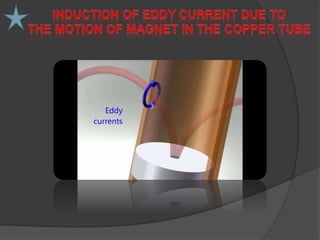
If the conductor is a disc, there will be circulatory currents 
i.e. eddy currents in the disc. According to Lenz's law, the 
direction of the current is in such a way as to oppose the 
cause, i.e. movement of the disc. 
Essentially the eddy current brake consists of two parts, a 
stationary magnetic field system and a solid rotating part, 
which include a metal disc.
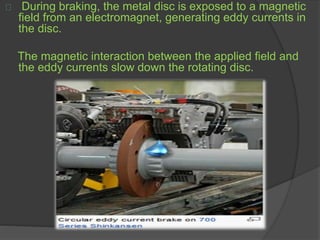
During braking, the metal disc is exposed to a magnetic 
field from an electromagnet, generating eddy currents in 
the disc. 
The magnetic interaction between the applied field and 
the eddy currents slow down the rotating disc.
LINEAR EDDY CURRENT 
BRAKE 
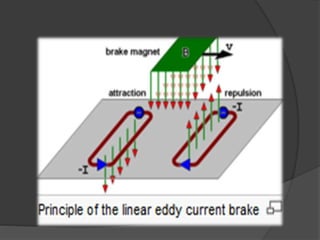
The principle of the linear eddy current brake has been 
described by the Foucault. 
The linear eddy current brake consists of a magnetic yoke 
with electrical coils positioned along the rail. 
This magnet does not touch the rail, as with the magnetic 
brake, but is held at a constant small distance from the rail 
(approximately seven mm). 
When the magnet is moved along the rail, it generates a 
non-stationary magnetic field in the head of the rail, which 
then generates electrical tension , and causes eddy 
currents. 
These disturb the magnetic field in such a way that the 
magnetic force is diverted to the opposite of the direction 
of the movement
Working Principle
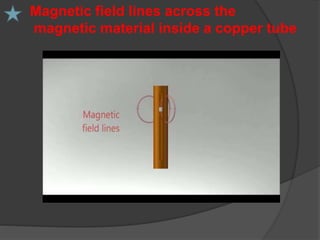
Magnetic field lines across the 
magnetic material inside a copper tube
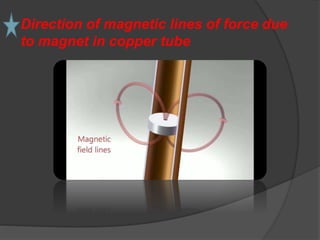
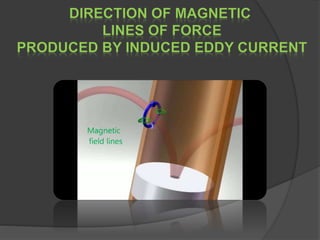
Direction of magnetic lines of force due 
to magnet in copper tube
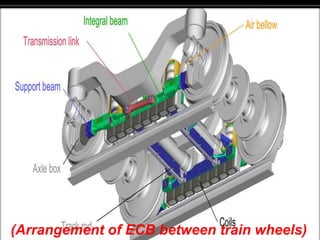
(Arrangement of ECB between train wheels)
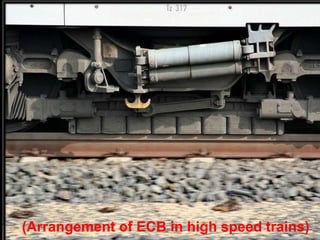
(Arrangement of ECB in high speed trains)
ADVANTAGES:~ 
Independent of wheel/rail support. 
No contact, therefore no wear or tear. 
No noise or smell. 
Adjustable brake force. 
High brake forces at high speeds 
It uses electromagnetic force and. 
not friction. 
Can be activated at will via electrical signal 
Low maintenance 
Light weight
DISADVANTAGES:-~ 
Braking force diminishes as speed 
diminishes with no ability to hold the load 
in position at standstill. 
It can not be used at low speed vehicles or 
vehicle running at low speed. 
ECB is used with ordinary mechanical 
brakes. 
Nowdays ECB is using only for safety 
purpose.
Applications:~ 
It is used as a stopping mechanism in 
trains. 
It is also used in the smooth breaking and 
functioning of roller coasters and such fast 
moving machines.
FUTURE ASPECT:-~ 
In future ordinary brakes will be replaced 
by the ECB completely. 
By the use of ECB in future we can 
control high speed train completely. 
By some new invention of extra 
mechanism we can use ECB for slow 
speed vehicles also.
CONCLUSION;~ 
ECB is a good invention for the speed 
control of high speed vehicles 
We can control the speed of high speed 
vehicles without wear and tear in parts 
of it. 
Drawback of ordinary mechanical 
braking system can be overcome by 
application of ECB. 
It makes use of opposing tendency 
of eddy current.
.

eddy current break system seminar ppt

  • 1.
    Presented By :~ Sumit Kumar Singh
  • 2.
    Contents :~ Introductionof eddy current Introduction of eddy current brake Circular eddy current brake Linear eddy current brake How eddy current brake works? Advantages Disadvantages Applications Future Aspects conclusion
  • 3.
    Eddy currents areelectric currents induced in conductors when exposed to a changing magnetic field; due to relative motion of the field source and conductor or due to variations of the field with time. This can cause a circulating flow of electrons, or current, within the body of the conductor. These circulating eddies of current have inductance and thus induce magnetic fields.
  • 4.
    Š Eddy currentbrakes, like conventional friction brakes, are responsible for slowing an object, such as rotating machinery, a moving train, or even a roller coaster Š There are two basic types: (1)rotational (2)linear
  • 5.
    circular eddy current brake system Eddy current brake works according to Faraday's law of electromagnetic induction. According to this law, whenever a conductor cuts magnetic lines of forces, an emf is induced in the conductor, the magnitude of which is proportional to the strength of magnetic field and the speed of the conductor. If the conductor is a disc, there will be circulatory currents i.e. eddy currents in the disc. According to Lenz's law, the direction of the current is in such a way as to oppose the cause, i.e. movement of the disc. Essentially the eddy current brake consists of two parts, a stationary magnetic field system and a solid rotating part, which include a metal disc.
  • 6.
    During braking, themetal disc is exposed to a magnetic field from an electromagnet, generating eddy currents in the disc. The magnetic interaction between the applied field and the eddy currents slow down the rotating disc.
  • 7.
    LINEAR EDDY CURRENT BRAKE The principle of the linear eddy current brake has been described by the Foucault. The linear eddy current brake consists of a magnetic yoke with electrical coils positioned along the rail. This magnet does not touch the rail, as with the magnetic brake, but is held at a constant small distance from the rail (approximately seven mm). When the magnet is moved along the rail, it generates a non-stationary magnetic field in the head of the rail, which then generates electrical tension , and causes eddy currents. These disturb the magnetic field in such a way that the magnetic force is diverted to the opposite of the direction of the movement
  • 9.
  • 10.
    Magnetic field linesacross the magnetic material inside a copper tube
  • 11.
    Direction of magneticlines of force due to magnet in copper tube
  • 14.
    (Arrangement of ECBbetween train wheels)
  • 15.
    (Arrangement of ECBin high speed trains)
  • 16.
    ADVANTAGES:~ Independent ofwheel/rail support. No contact, therefore no wear or tear. No noise or smell. Adjustable brake force. High brake forces at high speeds It uses electromagnetic force and. not friction. Can be activated at will via electrical signal Low maintenance Light weight
  • 17.
    DISADVANTAGES:-~ Braking forcediminishes as speed diminishes with no ability to hold the load in position at standstill. It can not be used at low speed vehicles or vehicle running at low speed. ECB is used with ordinary mechanical brakes. Nowdays ECB is using only for safety purpose.
  • 18.
    Applications:~ It isused as a stopping mechanism in trains. It is also used in the smooth breaking and functioning of roller coasters and such fast moving machines.
  • 19.
    FUTURE ASPECT:-~ Infuture ordinary brakes will be replaced by the ECB completely. By the use of ECB in future we can control high speed train completely. By some new invention of extra mechanism we can use ECB for slow speed vehicles also.
  • 20.
    CONCLUSION;~ ECB isa good invention for the speed control of high speed vehicles We can control the speed of high speed vehicles without wear and tear in parts of it. Drawback of ordinary mechanical braking system can be overcome by application of ECB. It makes use of opposing tendency of eddy current.
  • 21.