Chapter 1 - Professional
Communications
IT 5105 – Professional Issues in IT
Upekha Vandebona
upe.vand@gmail.com
[Writing]
Instructional Objectives
 Prepare and deliver an oral presentation for a
user audience.
 Prepare and deliver an oral presentation for a
management audience.
 Write a technical memo to management.
 Create user documentation for an IT system.
 Create a set of technical requirements for an IT
system.
 Compare and contrast technical writing and
expository writing.
Note
For the Chapter One, I’m going out from
the provided content, as you have already
covered those in 1st Semester. So before
the exam go through those again.
Throughout this lecture series
for Chapter One, it is something more for
your professional life.
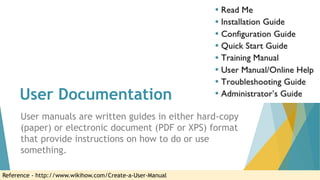
User Documentation
User manuals are written guides in either hard-copy
(paper) or electronic document (PDF or XPS) format
that provide instructions on how to do or use
something.
Reference - http://www.wikihow.com/Create-a-User-Manual
What is?
 Good user manuals educate users about the
product's features while teaching them how to use
those features effectively and are laid out to be
easily read and referred to.
 Most Visible Documentations in the SDLC
 Should easy to understand; But yet precise
 Keep revise and up-to-date
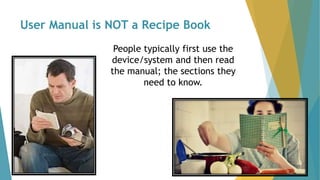
User Manual is NOT a Recipe Book
People typically first use the
device/system and then read
the manual; the sections they
need to know.
Focus for the Audience; Our User
Getting Started!
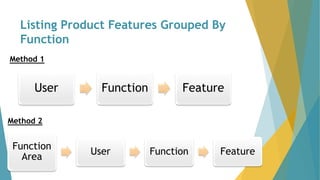
Listing Product Features Grouped By
Function
User Function Feature
Function
Area
User Function Feature
Method 1
Method 2
Offer a Feature as Solution to a General
Problem
 If the problem is a complex one, break it down
into smaller parts.
 List each part with the instructions on how to
solve or cope with it, and then follow with each
subsequent part in succession.
 Troubleshooting Tips
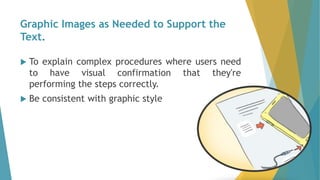
Graphic Images as Needed to Support the
Text.
 To explain complex procedures where users need
to have visual confirmation that they're
performing the steps correctly.
 Be consistent with graphic style
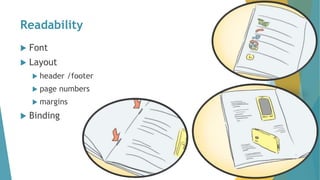
Readability
 Font
 Layout
 header /footer
 page numbers
 margins
 Binding
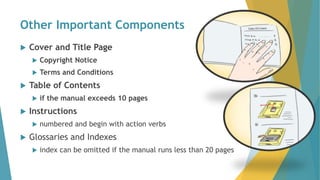
Other Important Components
 Cover and Title Page
 Copyright Notice
 Terms and Conditions
 Table of Contents
 if the manual exceeds 10 pages
 Instructions
 numbered and begin with action verbs
 Glossaries and Indexes
 index can be omitted if the manual runs less than 20 pages
Expository Writing vs. Technical
Writing
Expository writing shares thoughts, opinions, and
fleshed-out concepts, while technical writing is
usually aimed to get someone to follow directions or
understand a procedure.
Expository Writing
 Standard academic analytical writing that is used in a
lot of academic settings.
 Persuading someone to agree with a certain opinion
or to style an argument.
 Emphasis is on deriving how something works through
analysis, explanation, and exposition.
 Essays; focus on a single topic.
 Have strong coherent structure, facts arranged in a
logical order and details supporting the facts;
 Primary purpose is to communicate a conclusion
based on the facts, rather than the facts themselves.
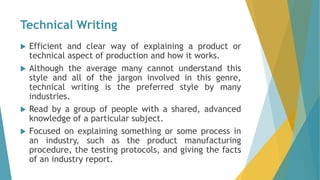
Technical Writing
 Efficient and clear way of explaining a product or
technical aspect of production and how it works.
 Although the average many cannot understand this
style and all of the jargon involved in this genre,
technical writing is the preferred style by many
industries.
 Read by a group of people with a shared, advanced
knowledge of a particular subject.
 Focused on explaining something or some process in
an industry, such as the product manufacturing
procedure, the testing protocols, and giving the facts
of an industry report.
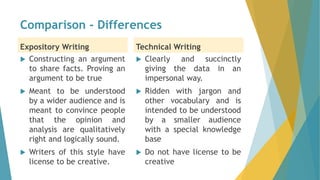
Comparison - Differences
Expository Writing
 Constructing an argument
to share facts. Proving an
argument to be true
 Meant to be understood
by a wider audience and is
meant to convince people
that the opinion and
analysis are qualitatively
right and logically sound.
 Writers of this style have
license to be creative.
Technical Writing
 Clearly and succinctly
giving the data in an
impersonal way.
 Ridden with jargon and
other vocabulary and is
intended to be understood
by a smaller audience
with a special knowledge
base
 Do not have license to be
creative
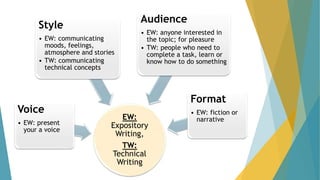
EW:
Expository
Writing,
TW:
Technical
Writing
Voice
• EW: present
your a voice
Style
• EW: communicating
moods, feelings,
atmosphere and stories
• TW: communicating
technical concepts
Audience
• EW: anyone interested in
the topic; for pleasure
• TW: people who need to
complete a task, learn or
know how to do something
Format
• EW: fiction or
narrative
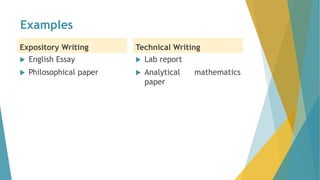
Examples
Expository Writing
 English Essay
 Philosophical paper
Technical Writing
 Lab report
 Analytical mathematics
paper

Professional Communication in Computing - Writing

  • 1.
    Chapter 1 -Professional Communications IT 5105 – Professional Issues in IT Upekha Vandebona upe.vand@gmail.com [Writing]
  • 2.
    Instructional Objectives  Prepareand deliver an oral presentation for a user audience.  Prepare and deliver an oral presentation for a management audience.  Write a technical memo to management.  Create user documentation for an IT system.  Create a set of technical requirements for an IT system.  Compare and contrast technical writing and expository writing.
  • 3.
    Note For the ChapterOne, I’m going out from the provided content, as you have already covered those in 1st Semester. So before the exam go through those again. Throughout this lecture series for Chapter One, it is something more for your professional life.
  • 4.
    User Documentation User manualsare written guides in either hard-copy (paper) or electronic document (PDF or XPS) format that provide instructions on how to do or use something. Reference - http://www.wikihow.com/Create-a-User-Manual
  • 5.
    What is?  Gooduser manuals educate users about the product's features while teaching them how to use those features effectively and are laid out to be easily read and referred to.  Most Visible Documentations in the SDLC  Should easy to understand; But yet precise  Keep revise and up-to-date
  • 6.
    User Manual isNOT a Recipe Book People typically first use the device/system and then read the manual; the sections they need to know.
  • 7.
    Focus for theAudience; Our User Getting Started!
  • 8.
    Listing Product FeaturesGrouped By Function User Function Feature Function Area User Function Feature Method 1 Method 2
  • 9.
    Offer a Featureas Solution to a General Problem  If the problem is a complex one, break it down into smaller parts.  List each part with the instructions on how to solve or cope with it, and then follow with each subsequent part in succession.  Troubleshooting Tips
  • 10.
    Graphic Images asNeeded to Support the Text.  To explain complex procedures where users need to have visual confirmation that they're performing the steps correctly.  Be consistent with graphic style
  • 11.
    Readability  Font  Layout header /footer  page numbers  margins  Binding
  • 12.
    Other Important Components Cover and Title Page  Copyright Notice  Terms and Conditions  Table of Contents  if the manual exceeds 10 pages  Instructions  numbered and begin with action verbs  Glossaries and Indexes  index can be omitted if the manual runs less than 20 pages
  • 13.
    Expository Writing vs.Technical Writing Expository writing shares thoughts, opinions, and fleshed-out concepts, while technical writing is usually aimed to get someone to follow directions or understand a procedure.
  • 14.
    Expository Writing  Standardacademic analytical writing that is used in a lot of academic settings.  Persuading someone to agree with a certain opinion or to style an argument.  Emphasis is on deriving how something works through analysis, explanation, and exposition.  Essays; focus on a single topic.  Have strong coherent structure, facts arranged in a logical order and details supporting the facts;  Primary purpose is to communicate a conclusion based on the facts, rather than the facts themselves.
  • 15.
    Technical Writing  Efficientand clear way of explaining a product or technical aspect of production and how it works.  Although the average many cannot understand this style and all of the jargon involved in this genre, technical writing is the preferred style by many industries.  Read by a group of people with a shared, advanced knowledge of a particular subject.  Focused on explaining something or some process in an industry, such as the product manufacturing procedure, the testing protocols, and giving the facts of an industry report.
  • 16.
    Comparison - Differences ExpositoryWriting  Constructing an argument to share facts. Proving an argument to be true  Meant to be understood by a wider audience and is meant to convince people that the opinion and analysis are qualitatively right and logically sound.  Writers of this style have license to be creative. Technical Writing  Clearly and succinctly giving the data in an impersonal way.  Ridden with jargon and other vocabulary and is intended to be understood by a smaller audience with a special knowledge base  Do not have license to be creative
  • 17.
    EW: Expository Writing, TW: Technical Writing Voice • EW: present youra voice Style • EW: communicating moods, feelings, atmosphere and stories • TW: communicating technical concepts Audience • EW: anyone interested in the topic; for pleasure • TW: people who need to complete a task, learn or know how to do something Format • EW: fiction or narrative
  • 18.
    Examples Expository Writing  EnglishEssay  Philosophical paper Technical Writing  Lab report  Analytical mathematics paper

Editor's Notes

  • #5 memorandum 
  • #7 If system design not sufficient enough to understand the functionality, people tend to throw it away even without reading the manual. Read it when a problem occurs Most manuals not comes with the product. Make available in online.