BACKGROUND

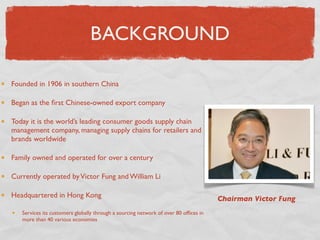
Founded in 1906 in southern China

Began as the first Chinese-owned export company

Today it is the world’s leading consumer goods supply chain
management company, managing supply chains for retailers and
brands worldwide

Family owned and operated for over a century

Currently operated by Victor Fung and William Li

Headquartered in Hong Kong                                                           Chairman Victor Fung
   Services its customers globally through a sourcing network of over 80 offices in
   more than 40 various economies
WHAT DO THEY DO
                                                    THE BUSINESS


- Supply value added services across the supply chain
Services Include:
- Product Development
-Raw Materials Sourcing
-Production Planning
-Factory Sourcing
-Manufacturing Control
-Quality Assurance
-Export Documentation
-Shipping Consolidation


-Product Mix includes hard and soft goods
Soft goods = apparel, woven and knit garments for men, women & children

Hard goods= fashion accessories, holiday products, furnishings, giftware, handicrafts, home products, fireworks, sporting
goods, toys, and travel goods


-Customers Include:
The Limited, Gymboree, American Eagle, Warner Brothers, Abercrombie & Fitch, Bed, Bath & Beyond, Tesco, Avon
Products, Levi-Strauss, Reebok, Royal Ahold, Guess Jeans, Bebe, Coke, Gap etc.
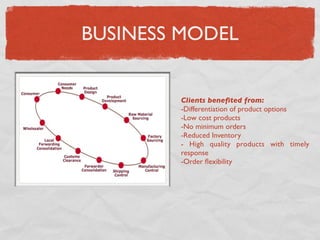
BUSINESS MODEL


        Clients benefited from:
        -Differentiation of product options
        -Low cost products
        -No minimum orders
        -Reduced Inventory
        - High quality products with timely
        response
        -Order flexibility
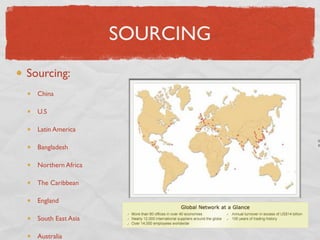
SOURCING
Sourcing:
  China

  U.S

  Latin America
                               ©

  Bangladesh                   ©


  Northern Africa

  The Caribbean

  England

  South East Asia

  Australia
COMPETITORS & THREATS

Competitors:
             UPS Supply Chain Solutions

             William E Connor & Associates

             APL Logistics


  Through strategic acquisitions to expand reach of service into new markets such
  as Europe and India, Li & Fung had grown to nearly five times that of its closest
  competitor by 2000.
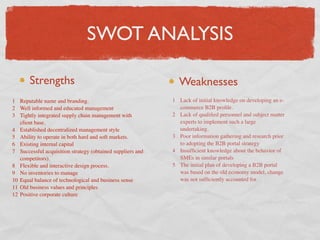
SWOT ANALYSIS

       Strengths                                              Weaknesses
1 Reputable name and branding.                              1 Lack of initial knowledge on developing an e-
2 Well informed and educated management                       commerce B2B profile.
3 Tightly integrated supply chain management with           2 Lack of qualified personnel and subject matter
   client base.                                               experts to implement such a large
4 Established decentralized management style                  undertaking.
5 Ability to operate in both hard and soft markets.         3 Poor information gathering and research prior
6 Existing internal capital                                   to adopting the B2B portal strategy
7 Successful acquisition strategy (obtained suppliers and   4 Insufficient knowledge about the behavior of
   competitors).                                              SMEs in similar portals
8 Flexible and interactive design process.                  5 The initial plan of developing a B2B portal
9 No inventories to manage                                    was based on the old economy model, change
10 Equal balance of technological and business sense          was not sufficiently accounted for.
11 Old business values and principles
12 Positive corporate culture
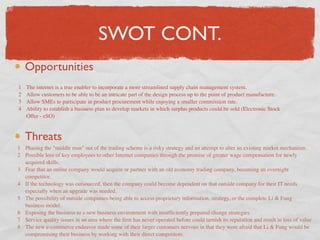
SWOT CONT.
    Opportunities
1   The internet is a true enabler to incorporate a more streamlined supply chain management system.
2   Allow customers to be able to be an intricate part of the design process up to the point of product manufacture.
3   Allow SMEs to participate in product procurement while enjoying a smaller commission rate.
4   Ability to establish a business plan to develop markets in which surplus products could be sold (Electronic Stock
    Offer - eSO)


    Threats
1 Phasing the "middle man" out of the trading scheme is a risky strategy and an attempt to alter an existing market mechanism.
2 Possible loss of key employees to other Internet companies through the promise of greater wage compensation for newly
  acquired skills.
3 Fear that an online company would acquire or partner with an old economy trading company, becoming an overnight
  competitor.
4 If the technology was outsourced, then the company could become dependent on that outside company for their IT needs
  especially when an upgrade was needed.
5 The possibility of outside companies being able to access proprietary information, strategy, or the complete Li & Fung
  business model.
6 Exposing the business to a new business environment with insufficiently prepared change strategies
7 Service quality issues in an area where the firm has never operated before could tarnish its reputation and result in loss of value
8 The new e-commerce endeavor made some of their larger customers nervous in that they were afraid that Li & Fung would be
  compromising their business by working with their direct competitors
REFERENCES


Laudon, K. & Kaudon, J. (2007). Management Information Systems: Managing the Digital     Firm. Information
systems, Organizations and Strategy (pp. 96-106). Upper Saddle River, NJ: Pearson Education, Inc.

http://conversation.cgu.edu/is329/page72:1202149828

Mcfarlan, W. & Young, F. (2005). Harvard Business School Cases: Li & Fung (A)(B) Internet issues (pp. 1-23).

Value Chain Framework of Li & Fung. Retrieved November 9, 2008, from web site: http://lifung.com/eng/business/
service_chain.php

Li & fung

  • 2.
    BACKGROUND Founded in 1906in southern China Began as the first Chinese-owned export company Today it is the world’s leading consumer goods supply chain management company, managing supply chains for retailers and brands worldwide Family owned and operated for over a century Currently operated by Victor Fung and William Li Headquartered in Hong Kong Chairman Victor Fung Services its customers globally through a sourcing network of over 80 offices in more than 40 various economies
  • 3.
    WHAT DO THEYDO THE BUSINESS - Supply value added services across the supply chain Services Include: - Product Development -Raw Materials Sourcing -Production Planning -Factory Sourcing -Manufacturing Control -Quality Assurance -Export Documentation -Shipping Consolidation -Product Mix includes hard and soft goods Soft goods = apparel, woven and knit garments for men, women & children Hard goods= fashion accessories, holiday products, furnishings, giftware, handicrafts, home products, fireworks, sporting goods, toys, and travel goods -Customers Include: The Limited, Gymboree, American Eagle, Warner Brothers, Abercrombie & Fitch, Bed, Bath & Beyond, Tesco, Avon Products, Levi-Strauss, Reebok, Royal Ahold, Guess Jeans, Bebe, Coke, Gap etc.
  • 4.
    BUSINESS MODEL Clients benefited from: -Differentiation of product options -Low cost products -No minimum orders -Reduced Inventory - High quality products with timely response -Order flexibility
  • 5.
    SOURCING Sourcing: China U.S Latin America © Bangladesh © Northern Africa The Caribbean England South East Asia Australia
  • 6.
    COMPETITORS & THREATS Competitors: UPS Supply Chain Solutions William E Connor & Associates APL Logistics Through strategic acquisitions to expand reach of service into new markets such as Europe and India, Li & Fung had grown to nearly five times that of its closest competitor by 2000.
  • 7.
    SWOT ANALYSIS Strengths Weaknesses 1 Reputable name and branding. 1 Lack of initial knowledge on developing an e- 2 Well informed and educated management commerce B2B profile. 3 Tightly integrated supply chain management with 2 Lack of qualified personnel and subject matter client base. experts to implement such a large 4 Established decentralized management style undertaking. 5 Ability to operate in both hard and soft markets. 3 Poor information gathering and research prior 6 Existing internal capital to adopting the B2B portal strategy 7 Successful acquisition strategy (obtained suppliers and 4 Insufficient knowledge about the behavior of competitors). SMEs in similar portals 8 Flexible and interactive design process. 5 The initial plan of developing a B2B portal 9 No inventories to manage was based on the old economy model, change 10 Equal balance of technological and business sense was not sufficiently accounted for. 11 Old business values and principles 12 Positive corporate culture
  • 8.
    SWOT CONT. Opportunities 1 The internet is a true enabler to incorporate a more streamlined supply chain management system. 2 Allow customers to be able to be an intricate part of the design process up to the point of product manufacture. 3 Allow SMEs to participate in product procurement while enjoying a smaller commission rate. 4 Ability to establish a business plan to develop markets in which surplus products could be sold (Electronic Stock Offer - eSO) Threats 1 Phasing the "middle man" out of the trading scheme is a risky strategy and an attempt to alter an existing market mechanism. 2 Possible loss of key employees to other Internet companies through the promise of greater wage compensation for newly acquired skills. 3 Fear that an online company would acquire or partner with an old economy trading company, becoming an overnight competitor. 4 If the technology was outsourced, then the company could become dependent on that outside company for their IT needs especially when an upgrade was needed. 5 The possibility of outside companies being able to access proprietary information, strategy, or the complete Li & Fung business model. 6 Exposing the business to a new business environment with insufficiently prepared change strategies 7 Service quality issues in an area where the firm has never operated before could tarnish its reputation and result in loss of value 8 The new e-commerce endeavor made some of their larger customers nervous in that they were afraid that Li & Fung would be compromising their business by working with their direct competitors
  • 9.
    REFERENCES Laudon, K. &Kaudon, J. (2007). Management Information Systems: Managing the Digital Firm. Information systems, Organizations and Strategy (pp. 96-106). Upper Saddle River, NJ: Pearson Education, Inc. http://conversation.cgu.edu/is329/page72:1202149828 Mcfarlan, W. & Young, F. (2005). Harvard Business School Cases: Li & Fung (A)(B) Internet issues (pp. 1-23). Value Chain Framework of Li & Fung. Retrieved November 9, 2008, from web site: http://lifung.com/eng/business/ service_chain.php

Editor's Notes