
Porter Forces and
eBusiness Models
UpekhaVandebona
upe.vand@gmail.com
 The Full-Service-Provider Model
 for value added service providing or product
bundling where the new comers find it difficult to
compete with
 Direct-to-Customer Model
 to give the customer a customized product
according to customer requirements
 EPortal Model
 where existing competitors get together use the
synergy to increase the product line making it
difficult for new entrants to survive in the market .
 DigitalValue Hub Model
 to have strong B2B strategic partnerships with
existing nodes in the supply chain such as
suppliers, manufacturers, dealers and customers.
Customer
Relationship
Partner with
Competitors and
Related Sectors
 Direct-to-Customer Model
 for better CRM and to provide a quicker convenient
service to any customer anywhere in the world
 The Full-Service-Provider Model
 to provide the supporting services using the concept
‘product bundling’
 Supply Chain Model
 to provide a better service to the customer including
order tracking, customised products/services, etc.
 eAuction Model
 to market the products in a new C2C market place
attracting new customers from a different market
segment.
 The Full-Service-Provider Model
 mainly for Product Bundling and Strategic
Alliances.This can also be used effectively for
discounted or low pricing strategies.
 The ePortal Model
 can also be used for many competitors to get
together and act as a Market Force using the
synergy mainly to market or promote the
products/services.
 The Supply-Chain Model
 which will increase the relationships with the
companies in the manufacturing process
tremendously. It can also deal with backward
integration effectively.
 The ePortal Model
 which could be used to get the advantage in bulk
ordering which could lower the cost of raw
material and the dependence on the suppliers.
 Direct-to-Customer Model
 has many advantages such as good CRM,
understanding the customer better, customized
product/service offering, being able to sell at a
lower price, rapid offering of the latest or the
newest products/services, etc.
 The Full-Service-Provider Model
 offering a bundled product making it convenient
for the customer to get all the services needed
from one company.
 EPortal Model
 where many competitors getting together in
order to cater to large orders or to increase the
collective product line to show that the company
is larger than in reality.
 EAuctions Models
 that can be used to market, advertise and sell
products with different client market segments
dealing with brand loyal and other customers
effectively.
Depending on which force is working on the company, the strategies are developed and the
suitable eBusiness models are being used.
Discuss whether the following statements are true
or false. Justify your answer.
i.When the bargaining power of suppliers are high,
it is appropriate to adapt a “revenue sharing
eBusiness model” to negate the force.
ii.When the rivalry among competitors are very
high, it is better to practice the “DigitalValue Hub”
eBusiness model to be competitive in the industry.
(40 Marks)
i)Yes
Using the revenue sharing model the companies
can get together and order as a team to negate
the force. Only if the competitors are willing to
work together.
ii) No
When rivalry is high you cannot use the Digital
value hub as the competitors in such situations
cannot effectively work together.
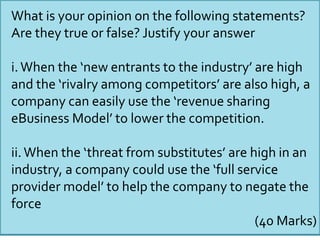
What is your opinion on the following statements?
Are they true or false? Justify your answer
i.When the ‘new entrants to the industry’ are high
and the ‘rivalry among competitors’ are also high, a
company can easily use the ‘revenue sharing
eBusiness Model’ to lower the competition.
ii.When the ‘threat from substitutes’ are high in an
industry, a company could use the ‘full service
provider model’ to help the company to negate the
force
(40 Marks)
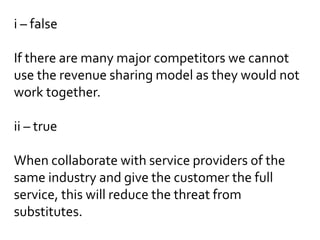
i – false
If there are many major competitors we cannot
use the revenue sharing model as they would not
work together.
ii – true
When collaborate with service providers of the
same industry and give the customer the full
service, this will reduce the threat from
substitutes.
Are the following statements true or false? Justify
your answer
i.When the ‘threat of new entrants’ are high in an
industry, existing companies can use the ‘full
service provider eBusiness Model’ to increase the
barriers of entry to the industry
Yes
When the threat of new entrants are high, we
have to develop obstacles for them and show our
strength in the industry. By collaboratively
working with the related businesses in the same
sector, we can gain a collaborative force.With
that, we can earn a brand image that we are
strongly plugged into the industry with related
other businesses, which would new entrants may
be fear.
Are the following statements true or false? Justify
your answer
i. When the “bargaining power of customers‟ is
high, a company can use the “full service
provider model‟ to lower the power of
customers.
(i) Yes
Offering a bundled product, makes it
convenient for the customer to get all the
services needed from one request.

Porter Forces and eBusiness Models

  • 1.
    Porter Forces and eBusinessModels UpekhaVandebona upe.vand@gmail.com
  • 3.
     The Full-Service-ProviderModel  for value added service providing or product bundling where the new comers find it difficult to compete with  Direct-to-Customer Model  to give the customer a customized product according to customer requirements
  • 4.
     EPortal Model where existing competitors get together use the synergy to increase the product line making it difficult for new entrants to survive in the market .  DigitalValue Hub Model  to have strong B2B strategic partnerships with existing nodes in the supply chain such as suppliers, manufacturers, dealers and customers.
  • 5.
  • 7.
     Direct-to-Customer Model for better CRM and to provide a quicker convenient service to any customer anywhere in the world  The Full-Service-Provider Model  to provide the supporting services using the concept ‘product bundling’  Supply Chain Model  to provide a better service to the customer including order tracking, customised products/services, etc.
  • 8.
     eAuction Model to market the products in a new C2C market place attracting new customers from a different market segment.
  • 10.
     The Full-Service-ProviderModel  mainly for Product Bundling and Strategic Alliances.This can also be used effectively for discounted or low pricing strategies.  The ePortal Model  can also be used for many competitors to get together and act as a Market Force using the synergy mainly to market or promote the products/services.
  • 13.
     The Supply-ChainModel  which will increase the relationships with the companies in the manufacturing process tremendously. It can also deal with backward integration effectively.  The ePortal Model  which could be used to get the advantage in bulk ordering which could lower the cost of raw material and the dependence on the suppliers.
  • 16.
     Direct-to-Customer Model has many advantages such as good CRM, understanding the customer better, customized product/service offering, being able to sell at a lower price, rapid offering of the latest or the newest products/services, etc.  The Full-Service-Provider Model  offering a bundled product making it convenient for the customer to get all the services needed from one company.
  • 17.
     EPortal Model where many competitors getting together in order to cater to large orders or to increase the collective product line to show that the company is larger than in reality.  EAuctions Models  that can be used to market, advertise and sell products with different client market segments dealing with brand loyal and other customers effectively.
  • 18.
    Depending on whichforce is working on the company, the strategies are developed and the suitable eBusiness models are being used.
  • 19.
    Discuss whether thefollowing statements are true or false. Justify your answer. i.When the bargaining power of suppliers are high, it is appropriate to adapt a “revenue sharing eBusiness model” to negate the force. ii.When the rivalry among competitors are very high, it is better to practice the “DigitalValue Hub” eBusiness model to be competitive in the industry. (40 Marks)
  • 20.
    i)Yes Using the revenuesharing model the companies can get together and order as a team to negate the force. Only if the competitors are willing to work together. ii) No When rivalry is high you cannot use the Digital value hub as the competitors in such situations cannot effectively work together.
  • 21.
    What is youropinion on the following statements? Are they true or false? Justify your answer i.When the ‘new entrants to the industry’ are high and the ‘rivalry among competitors’ are also high, a company can easily use the ‘revenue sharing eBusiness Model’ to lower the competition. ii.When the ‘threat from substitutes’ are high in an industry, a company could use the ‘full service provider model’ to help the company to negate the force (40 Marks)
  • 22.
    i – false Ifthere are many major competitors we cannot use the revenue sharing model as they would not work together. ii – true When collaborate with service providers of the same industry and give the customer the full service, this will reduce the threat from substitutes.
  • 23.
    Are the followingstatements true or false? Justify your answer i.When the ‘threat of new entrants’ are high in an industry, existing companies can use the ‘full service provider eBusiness Model’ to increase the barriers of entry to the industry
  • 24.
    Yes When the threatof new entrants are high, we have to develop obstacles for them and show our strength in the industry. By collaboratively working with the related businesses in the same sector, we can gain a collaborative force.With that, we can earn a brand image that we are strongly plugged into the industry with related other businesses, which would new entrants may be fear.
  • 25.
    Are the followingstatements true or false? Justify your answer i. When the “bargaining power of customers‟ is high, a company can use the “full service provider model‟ to lower the power of customers.
  • 26.
    (i) Yes Offering abundled product, makes it convenient for the customer to get all the services needed from one request.

Editor's Notes

  • #4  Direct-to-Customer Model for Customer Relationship Management (CRM) [1] strengthening the B2B partnerships with supplers to give the customer a customised product according to customer requirements
  • #5 EPortal Model for joint marketing, bulk buying of raw materials to get the competitive advantage through economies of scale and
  • #8 EPortal Model for a few competitors to get together for joint marketing, bulk ordering (to get economies of scale) and taking large orders using the revenue-sharing concept.
  • #9 EPortal Model for a few competitors to get together for joint marketing, bulk ordering (to get economies of scale) and taking large orders using the revenue-sharing concept.
  • #20 2014 - 4(b)
  • #22 2013 - 3(b)
  • #24 2011 - 3(b)
  • #26 2012 - 3(b)