

Freshwater
 is a naturally occurring water on the Earth’s surface and

underground and typically contains less than 1% sodium
chloride or low in salt concentration.
 It can be defined as water with less than 500 part per

million(ppm) of dissolved salts.
3 types of Freshwater
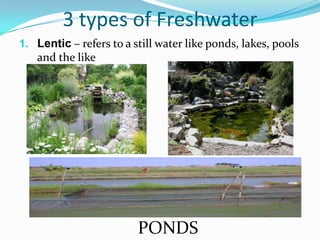
1. Lentic – refers to a still water like ponds, lakes, pools

and the like

PONDS
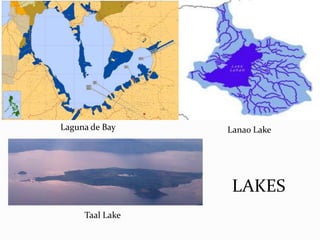
Laguna de Bay

Lanao Lake

LAKES
Taal Lake
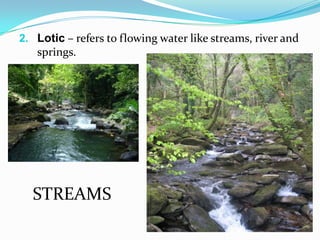
2. Lotic – refers to flowing water like streams, river and

springs.

STREAMS
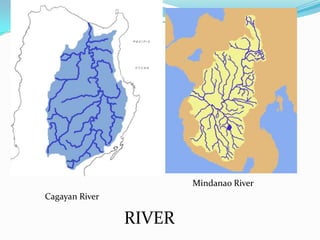
Mindanao River
Cagayan River

RIVER
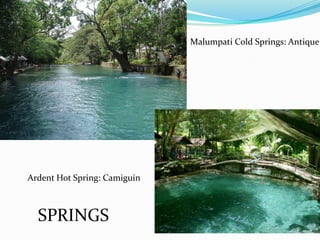
Malumpati Cold Springs: Antique

Ardent Hot Spring: Camiguin

SPRINGS
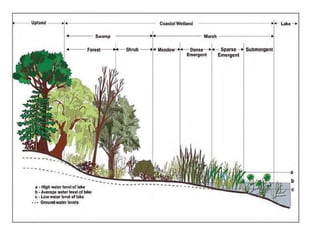
3. Wetlands – land area that is saturated with water
like swamps, marsh, fens and bogs.

SWAMPS

MARSH
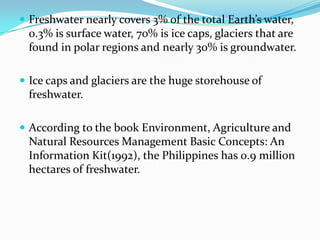
 Freshwater nearly covers 3% of the total Earth’s water,

0.3% is surface water, 70% is ice caps, glaciers that are
found in polar regions and nearly 30% is groundwater.
 Ice caps and glaciers are the huge storehouse of

freshwater.
 According to the book Environment, Agriculture and

Natural Resources Management Basic Concepts: An
Information Kit(1992), the Philippines has 0.9 million
hectares of freshwater.
Where does freshwater come?
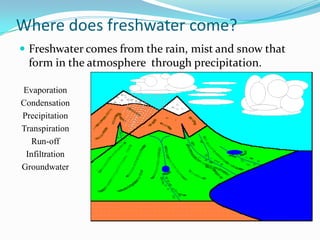
 Freshwater comes from the rain, mist and snow that

form in the atmosphere through precipitation.
Evaporation
Condensation
Precipitation
Transpiration
Run-off
Infiltration
Groundwater
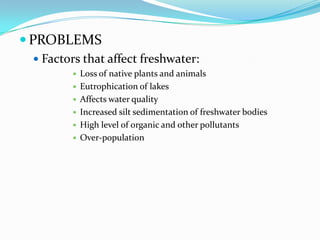
 PROBLEMS
 Factors that affect freshwater:









Loss of native plants and animals
Eutrophication of lakes
Affects water quality
Increased silt sedimentation of freshwater bodies
High level of organic and other pollutants
Over-population
 SOLUTIONS
 Don’t dispose waste into water.
 Use water properly in your daily consumption.
 Fix leaking pipes and drainage.

 People should be aware of the water problem

because even though the ocean contains
freshwater ,problems like pollution, flood, and
water contamination will occur.
Government Prevention
 Republic Act No. 9275
 An act providing for a comprehensive water quality
management and for other purposes.
 known as “Philippine Clean Water Act of 2004”
 Republic Act No. 9512
 An act to promote environmental awareness through
environmental education and for other purposes.
 Known as “Environmental Awareness and Education Act
of 2008
QUIZ
1. What is Freshwater?
2. What are the 3 types of freshwater?
3-5. Give 3 examples of freshwater areas in the
Philippines.
6. Out of all water on Earth, what percentage does
freshwater covers?
7. What is the process wherein rain, mist, and snow fall
from the atmosphere?
8-9. Give 2 problems that affect freshwater.
10. What republic act is known as “Philippine Clean
Water Act of 2004”?
 http://www.youtube.com/watch?v=Pz6AQXQGupQ

 http://www.youtube.com/watch?v=otrpxtAmDAk
 http://lifestyle.iloveindia.com/lounge/types-of-water-







10825.html
http://www.senate.gov.ph/republic_acts/ra%209512.p
df
http://www.lawphil.net/statutes/repacts/ra2004/ra_92
75_2004.html
http://en.wikipedia.org/wiki/Fresh_water
http://ww2010.atmos.uiuc.edu/%28Gh%29/guides/mt
r/hyd/smry.rxml

Jan. 23,2013

Freshwater

  • 2.
    Freshwater  is anaturally occurring water on the Earth’s surface and underground and typically contains less than 1% sodium chloride or low in salt concentration.  It can be defined as water with less than 500 part per million(ppm) of dissolved salts.
  • 3.
    3 types ofFreshwater 1. Lentic – refers to a still water like ponds, lakes, pools and the like PONDS
  • 4.
    Laguna de Bay LanaoLake LAKES Taal Lake
  • 5.
    2. Lotic –refers to flowing water like streams, river and springs. STREAMS
  • 6.
  • 7.
    Malumpati Cold Springs:Antique Ardent Hot Spring: Camiguin SPRINGS
  • 8.
    3. Wetlands –land area that is saturated with water like swamps, marsh, fens and bogs. SWAMPS MARSH
  • 11.
     Freshwater nearlycovers 3% of the total Earth’s water, 0.3% is surface water, 70% is ice caps, glaciers that are found in polar regions and nearly 30% is groundwater.  Ice caps and glaciers are the huge storehouse of freshwater.  According to the book Environment, Agriculture and Natural Resources Management Basic Concepts: An Information Kit(1992), the Philippines has 0.9 million hectares of freshwater.
  • 12.
    Where does freshwatercome?  Freshwater comes from the rain, mist and snow that form in the atmosphere through precipitation. Evaporation Condensation Precipitation Transpiration Run-off Infiltration Groundwater
  • 13.
     PROBLEMS  Factorsthat affect freshwater:       Loss of native plants and animals Eutrophication of lakes Affects water quality Increased silt sedimentation of freshwater bodies High level of organic and other pollutants Over-population
  • 14.
     SOLUTIONS  Don’tdispose waste into water.  Use water properly in your daily consumption.  Fix leaking pipes and drainage.  People should be aware of the water problem because even though the ocean contains freshwater ,problems like pollution, flood, and water contamination will occur.
  • 15.
    Government Prevention  RepublicAct No. 9275  An act providing for a comprehensive water quality management and for other purposes.  known as “Philippine Clean Water Act of 2004”  Republic Act No. 9512  An act to promote environmental awareness through environmental education and for other purposes.  Known as “Environmental Awareness and Education Act of 2008
  • 17.
  • 18.
    1. What isFreshwater? 2. What are the 3 types of freshwater? 3-5. Give 3 examples of freshwater areas in the Philippines. 6. Out of all water on Earth, what percentage does freshwater covers? 7. What is the process wherein rain, mist, and snow fall from the atmosphere? 8-9. Give 2 problems that affect freshwater. 10. What republic act is known as “Philippine Clean Water Act of 2004”?
  • 19.
     http://www.youtube.com/watch?v=Pz6AQXQGupQ  http://www.youtube.com/watch?v=otrpxtAmDAk http://lifestyle.iloveindia.com/lounge/types-of-water-     10825.html http://www.senate.gov.ph/republic_acts/ra%209512.p df http://www.lawphil.net/statutes/repacts/ra2004/ra_92 75_2004.html http://en.wikipedia.org/wiki/Fresh_water http://ww2010.atmos.uiuc.edu/%28Gh%29/guides/mt r/hyd/smry.rxml Jan. 23,2013