FLORIDA’S VALUE ADDED
       MODEL
                    Overview of
the Model to Measure Student Learning Growth on FCAT


                    January 2012
                                             1
NEW STANDARD FOR TEACHER
            EVALUATIONS
As set forth in the Student Success Act and Race to the
Top, teacher evaluations are:

• Designed to support effective instruction and student
  learning growth

• Used when developing district and school level
  improvement plans

• Used to identify professional development and other
  human capital decisions for instructional personnel
  and school administrators
                                                      2
NEW STANDARD FOR TEACHER
            EVALUATIONS

To support those objectives, the law sets forth that
teacher evaluations are to be based on sound
educational principles and contemporary research in
effective practices:

1. The performance of students – IPEGS Standard 1
2. Instructional practice and job responsibilities –
   IPEGS Standards 2-8 or 2-7

                                                   3
NEW STANDARD FOR TEACHER
            EVALUATIONS

Performance of Students. At least 50% of a performance
evaluation must be based upon data and indicators of
student learning growth assessed annually and
measured by statewide assessments or, for subjects and
grade levels not measured by statewide assessments, by
district assessments as provided in s. 1008.22(8), F.S.

                -Section 1012.34(3)(a)1., Florida Statutes


                                                      4
FLORIDA’S VALUE-ADDED MODEL
DEVELOPED BY FLORIDA EDUCATORS
• The Department convened a committee of stakeholders
  (Student Growth Implementation Committee –or SGIC) to
  identify the type of model and the factors that should be
  accounted for in Florida’s value-added models
• To provide technical expertise, the Department
  contracted with the American Institutes for Research
  (AIR) to help the SGIC develop the recommended model
  that was adopted.
• The SGIC’s recommended model was fully adopted by
  the Commissioner with no additions, deletions, or
  changes
                                                       5
FLORIDA’S VALUE-ADDED MODEL
   DEVELOPED BY FLORIDA EDUCATORS
• The Student Growth Implementation Committee (SGIC) is composed
  of 27 members from across the state. The group includes:
   – Teachers (across various subjects and grade levels, including exceptional
     student education)
   – School administrators
   – District-level administrators (Assessment and HR)
   – Postsecondary teacher educators
   – Representatives from the business community
   – Parents

• The SGIC met from March through June 2011
   – 2 two-day in-person meetings
   – 4 conference call meetings
                                                                         6
FLORIDA’S VALUE-ADDED MODEL
DEVELOPED BY FLORIDA EDUCATORS

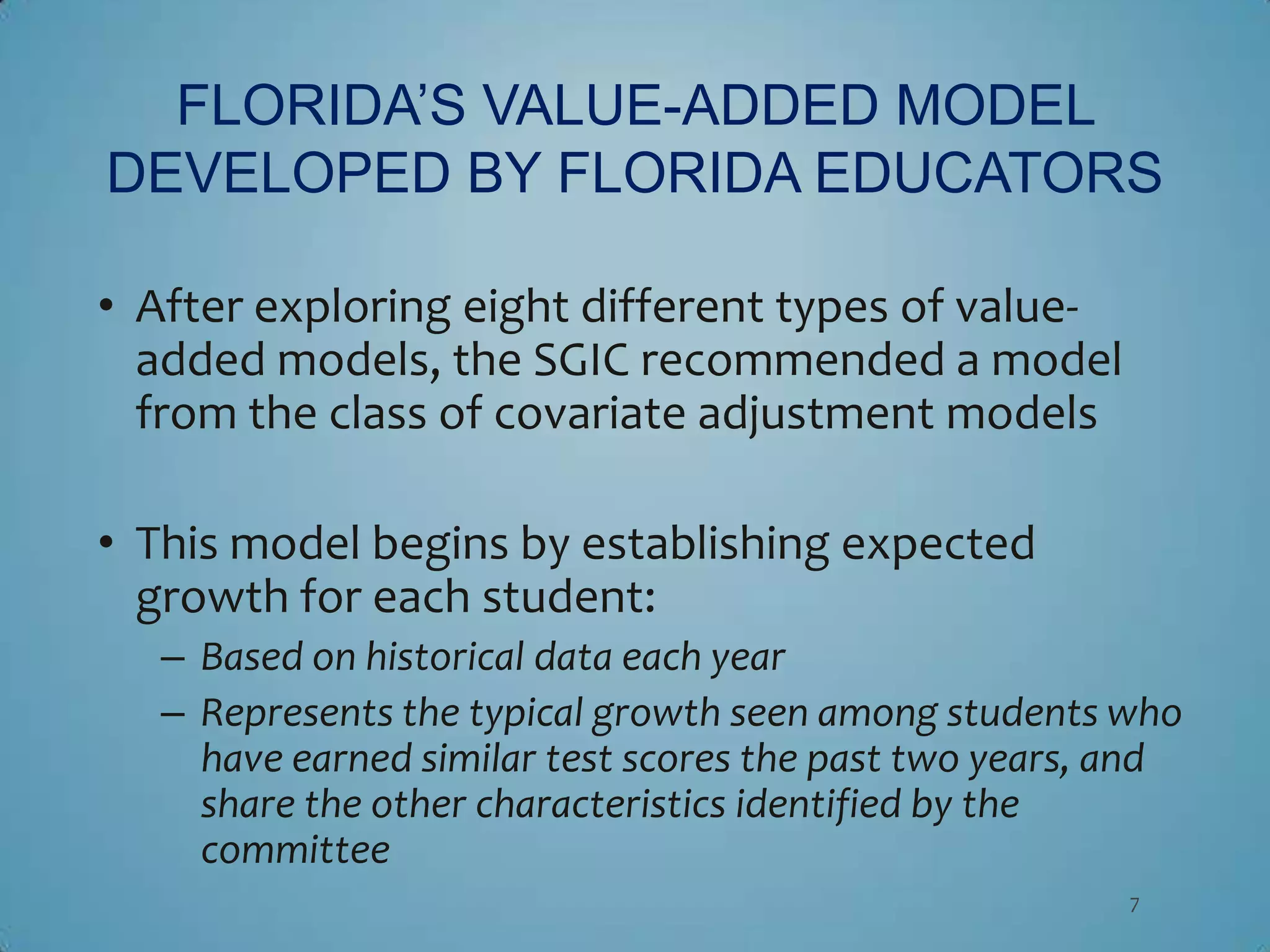
• After exploring eight different types of value-
  added models, the SGIC recommended a model
  from the class of covariate adjustment models

• This model begins by establishing expected
  growth for each student:
   – Based on historical data each year
   – Represents the typical growth seen among students who
     have earned similar test scores the past two years, and
     share the other characteristics identified by the
     committee
                                                         7
THE NEW MEASURE:
          VALUE-ADDED ANALYSIS
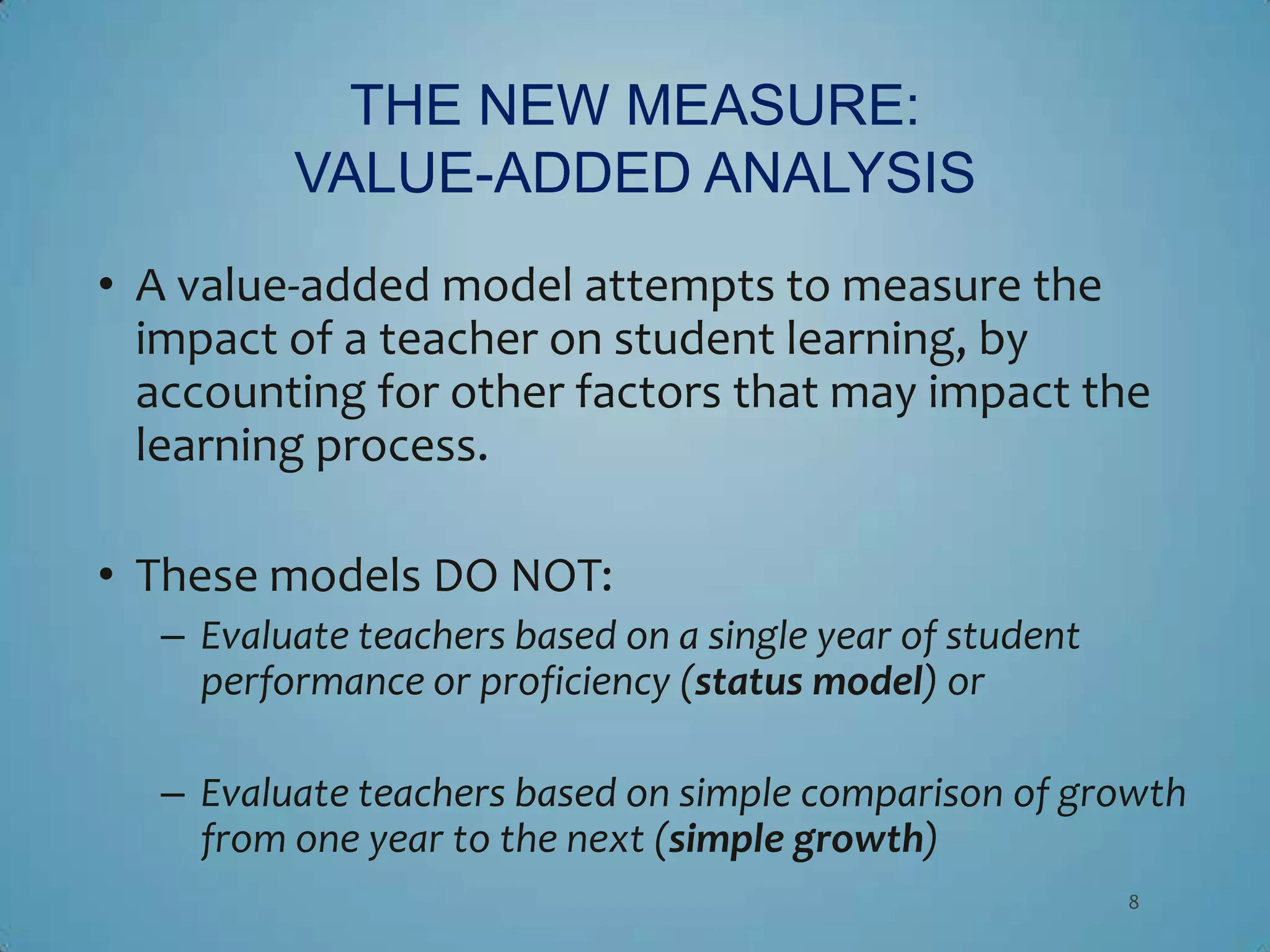
• A value-added model attempts to measure the
  impact of a teacher on student learning, by
  accounting for other factors that may impact the
  learning process.

• These models DO NOT:
   – Evaluate teachers based on a single year of student
     performance or proficiency (status model) or

   – Evaluate teachers based on simple comparison of growth
     from one year to the next (simple growth)
                                                           8
ADVANTAGES OF VALUE-ADDED
•
                           MODELS
    Teachers teach classes of students who enter with different
    levels of proficiency and possibly different student characteristics

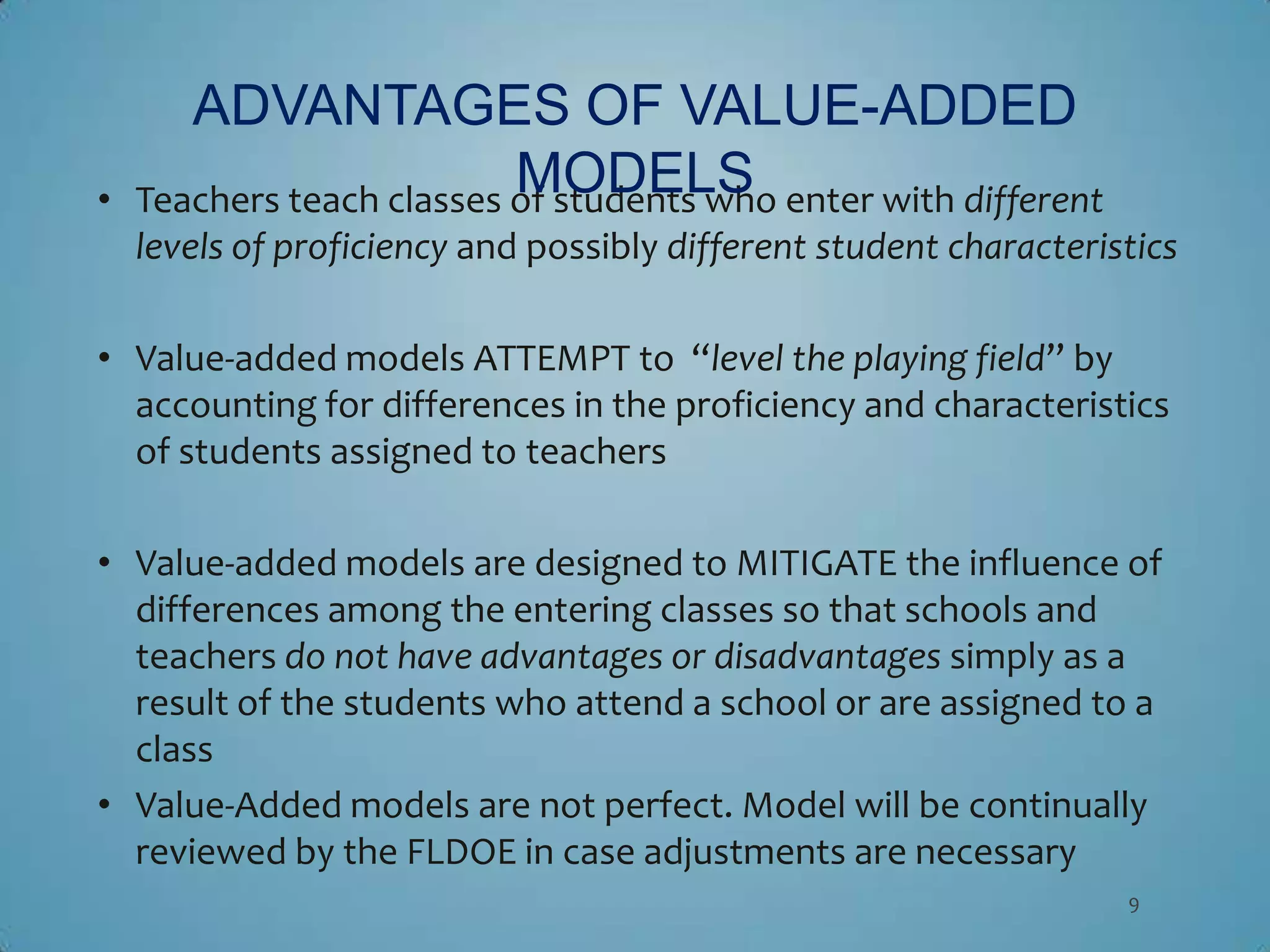
• Value-added models ATTEMPT to “level the playing field” by
  accounting for differences in the proficiency and characteristics
  of students assigned to teachers

• Value-added models are designed to MITIGATE the influence of
  differences among the entering classes so that schools and
  teachers do not have advantages or disadvantages simply as a
  result of the students who attend a school or are assigned to a
  class
• Value-Added models are not perfect. Model will be continually
  reviewed by the FLDOE in case adjustments are necessary
                                                                    9
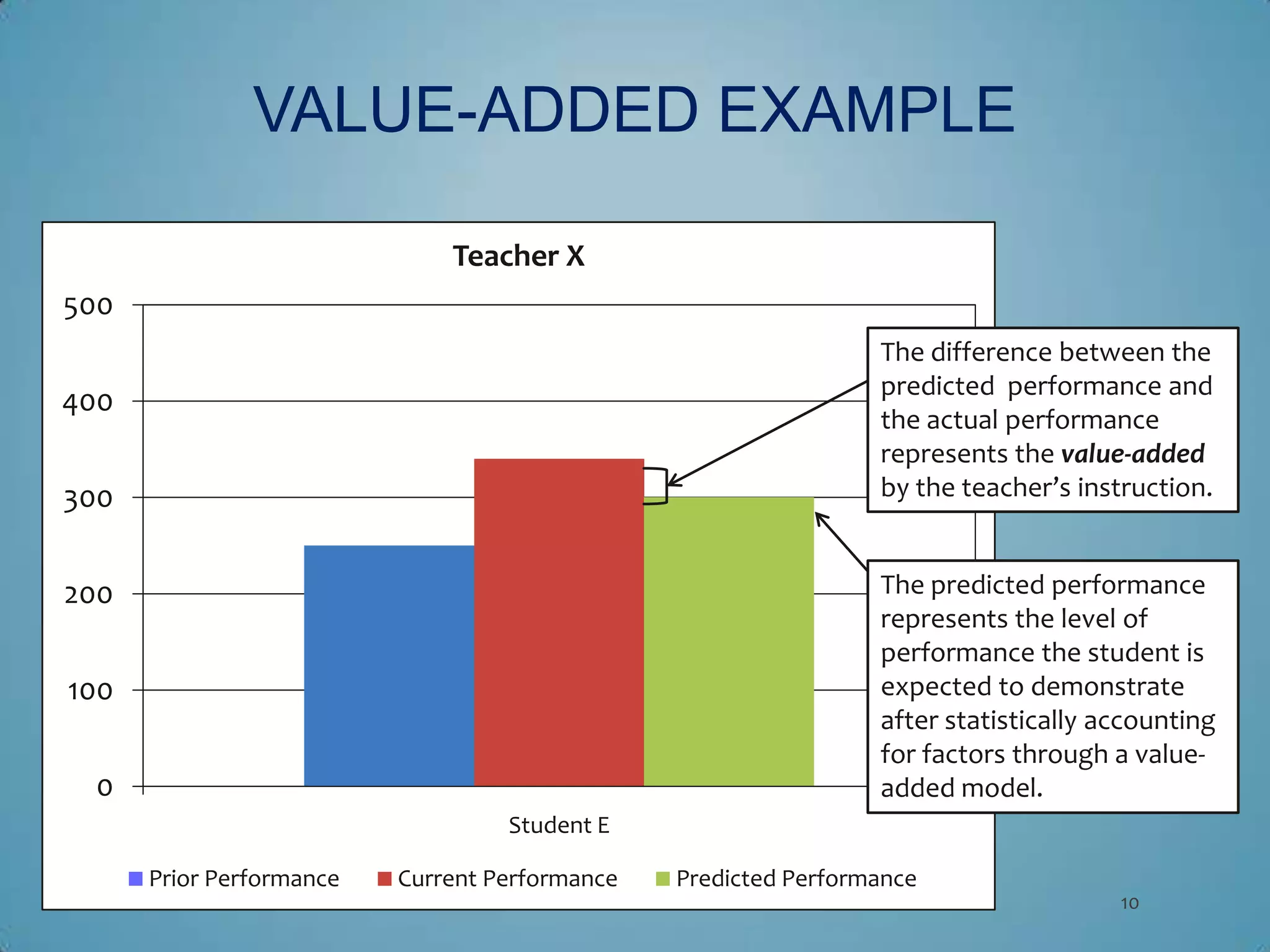
VALUE-ADDED EXAMPLE

                              Teacher X
500
                                                                 The difference between the
                                                                 predicted performance and
400
                                                                 the actual performance
                                                                 represents the value-added
300                                                              by the teacher’s instruction.


200                                                              The predicted performance
                                                                 represents the level of
                                                                 performance the student is
100                                                              expected to demonstrate
                                                                 after statistically accounting
                                                                 for factors through a value-
 0                                                               added model.
                                   Student E

      Prior Performance   Current Performance   Predicted Performance
                                                                                      10
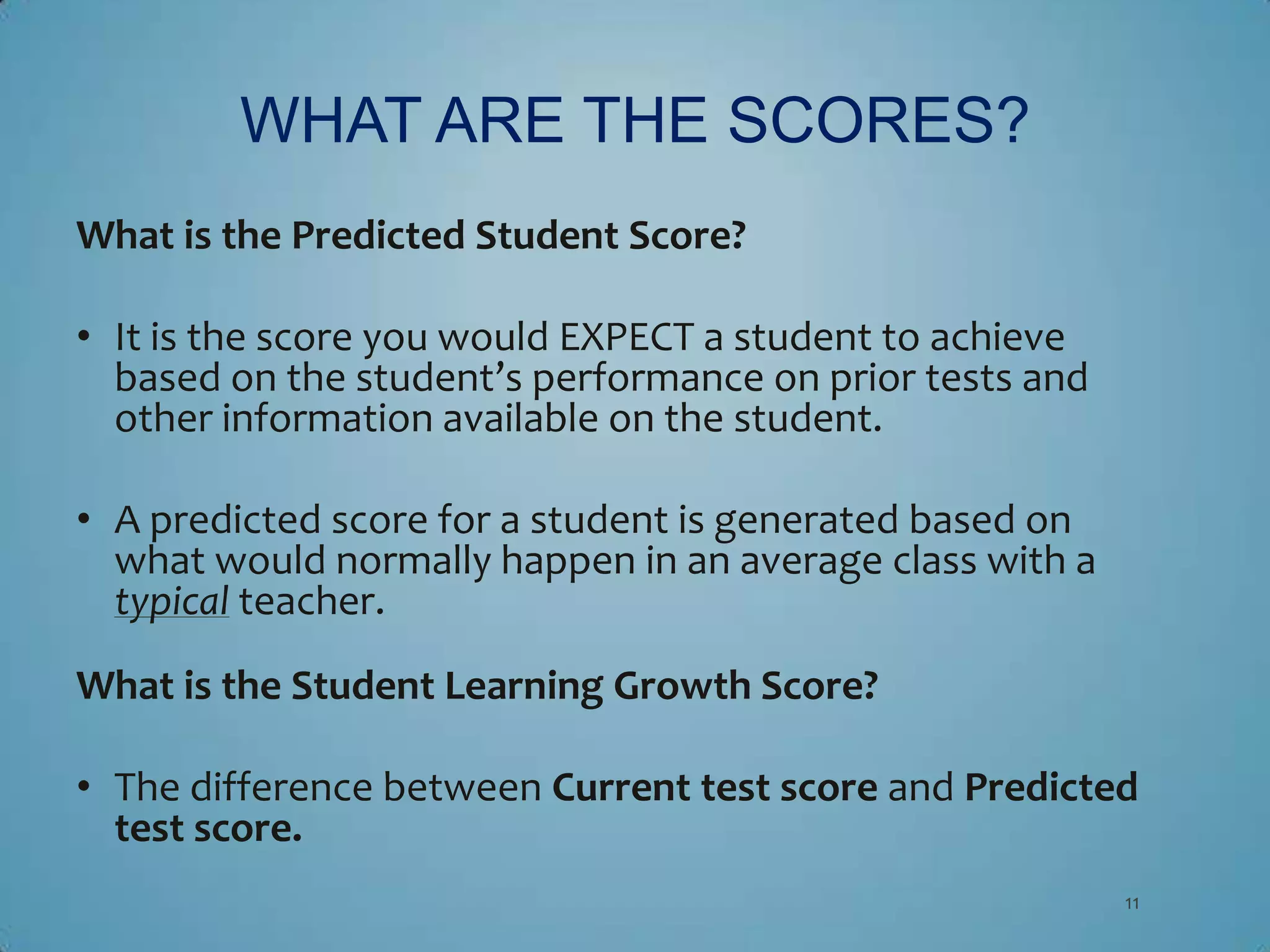
WHAT ARE THE SCORES?
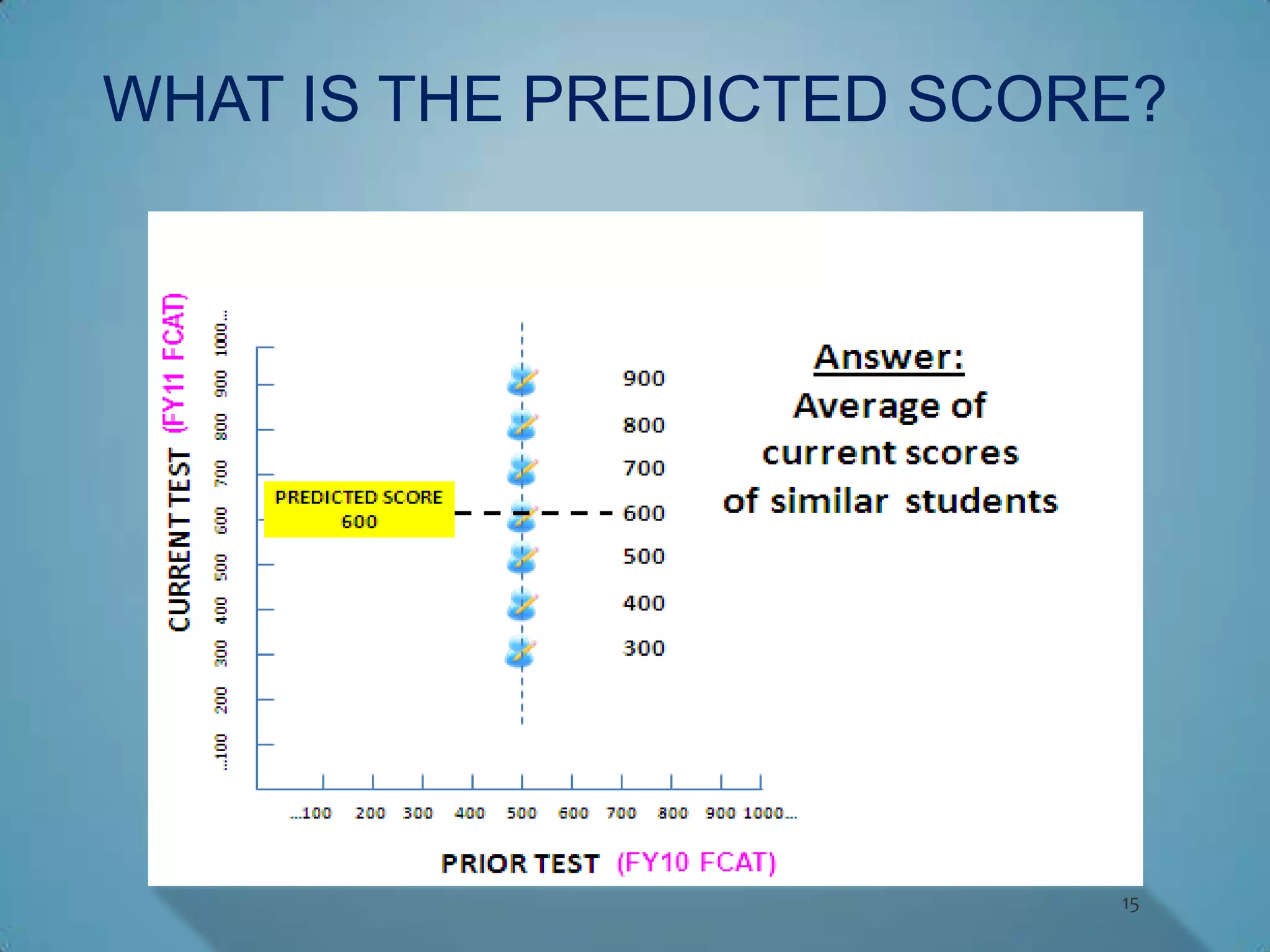
What is the Predicted Student Score?

• It is the score you would EXPECT a student to achieve
  based on the student’s performance on prior tests and
  other information available on the student.

• A predicted score for a student is generated based on
  what would normally happen in an average class with a
  typical teacher.

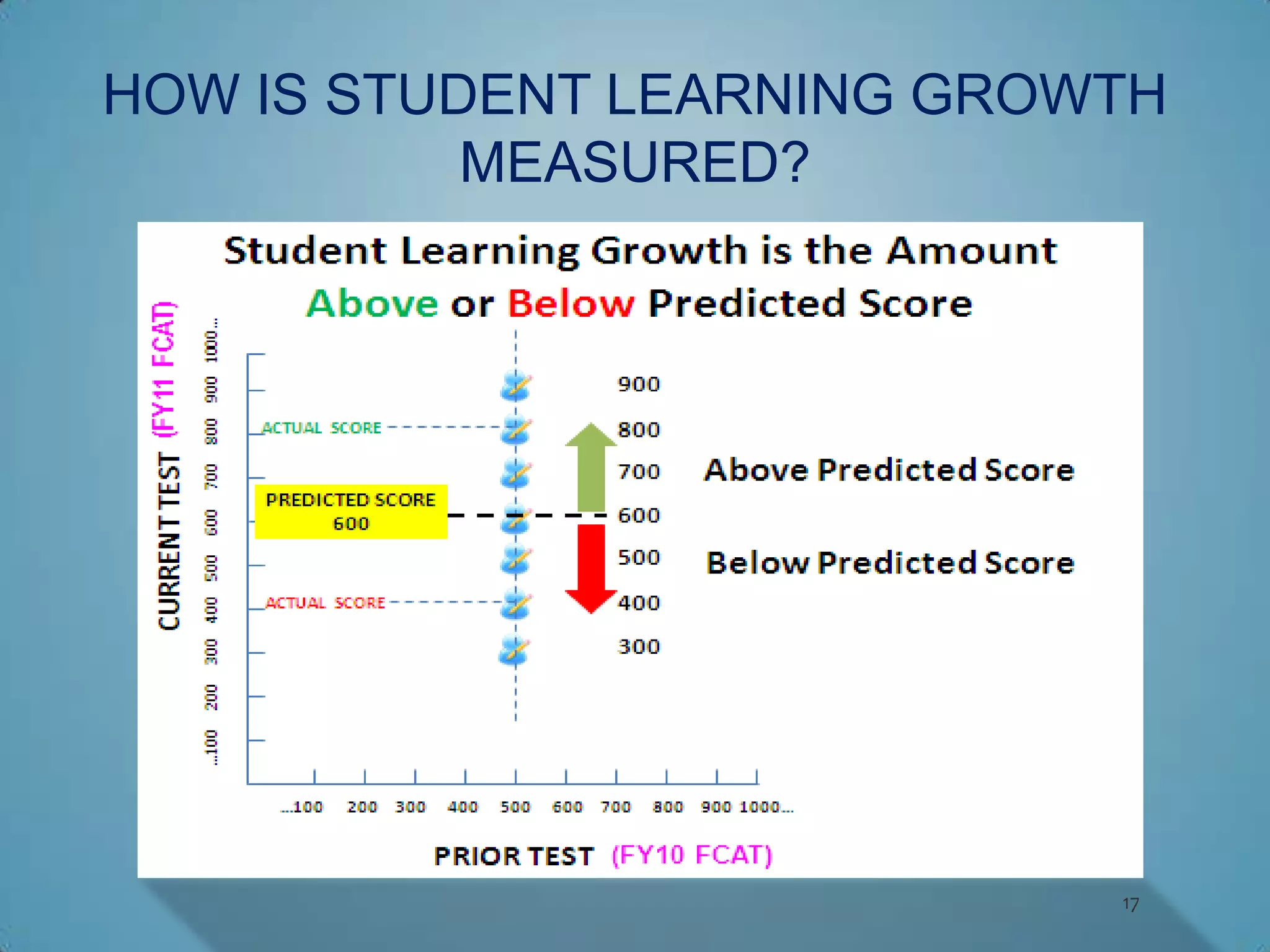
What is the Student Learning Growth Score?

• The difference between Current test score and Predicted
  test score.
                                                          11
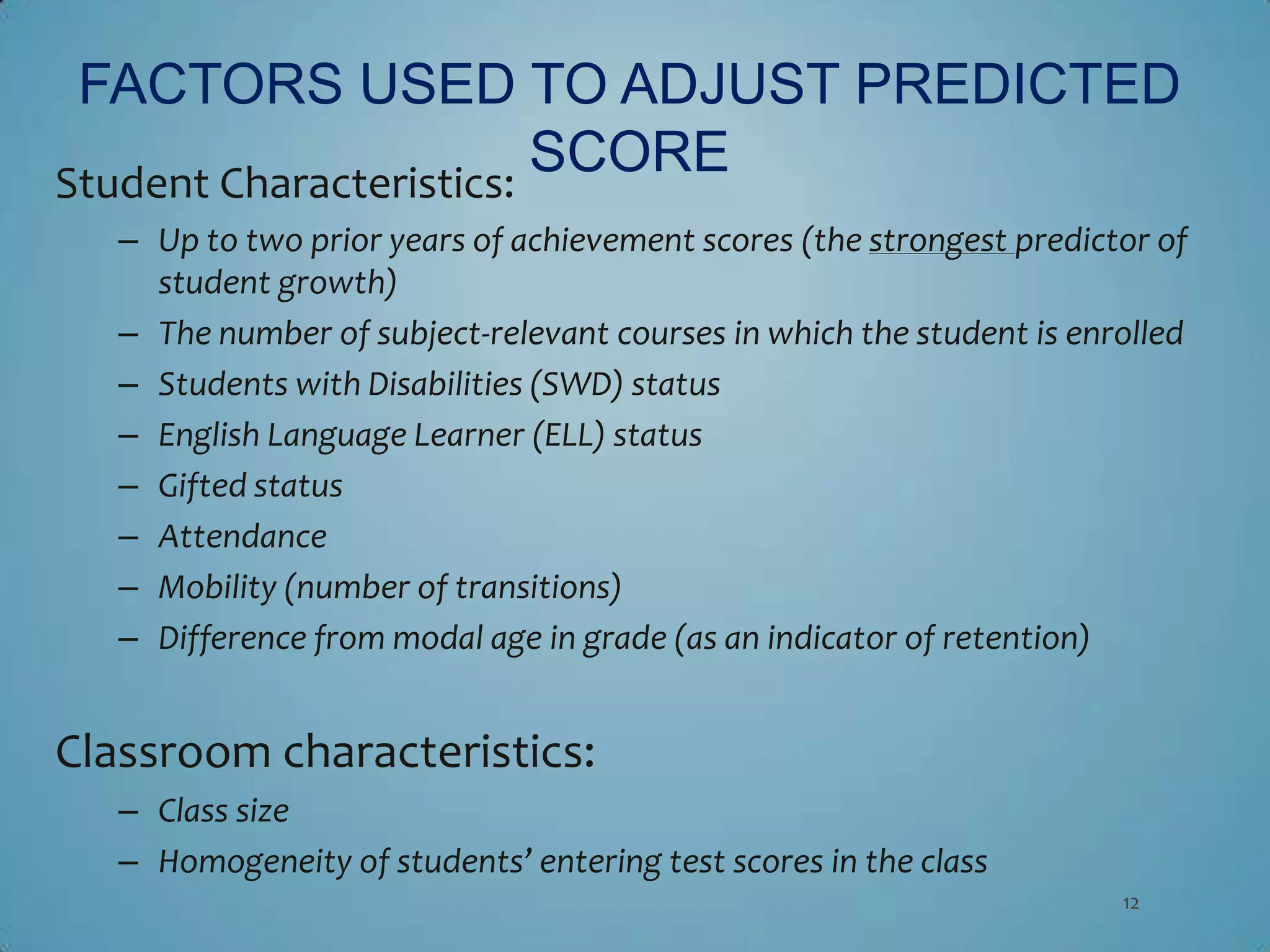
FACTORS USED TO ADJUST PREDICTED
Student Characteristics:
                         SCORE
   – Up to two prior years of achievement scores (the strongest predictor of
     student growth)
   – The number of subject-relevant courses in which the student is enrolled
   – Students with Disabilities (SWD) status
   – English Language Learner (ELL) status
   – Gifted status
   – Attendance
   – Mobility (number of transitions)
   – Difference from modal age in grade (as an indicator of retention)


Classroom characteristics:
   – Class size
   – Homogeneity of students’ entering test scores in the class
                                                                       12
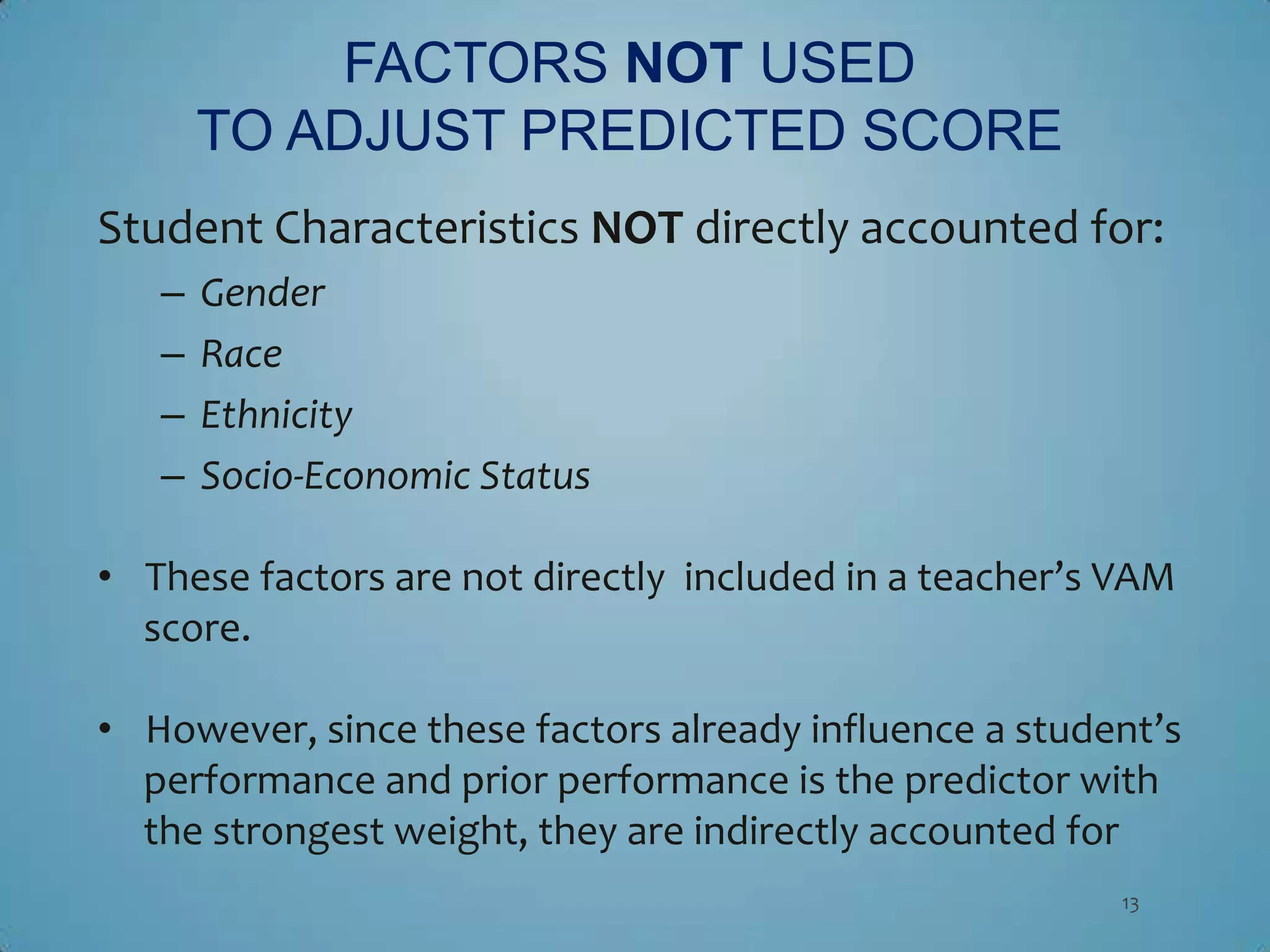
FACTORS NOT USED
       TO ADJUST PREDICTED SCORE
Student Characteristics NOT directly accounted for:
   –   Gender
   –   Race
   –   Ethnicity
   –   Socio-Economic Status

• These factors are not directly included in a teacher’s VAM
  score.

• However, since these factors already influence a student’s
  performance and prior performance is the predictor with
  the strongest weight, they are indirectly accounted for
                                                        13
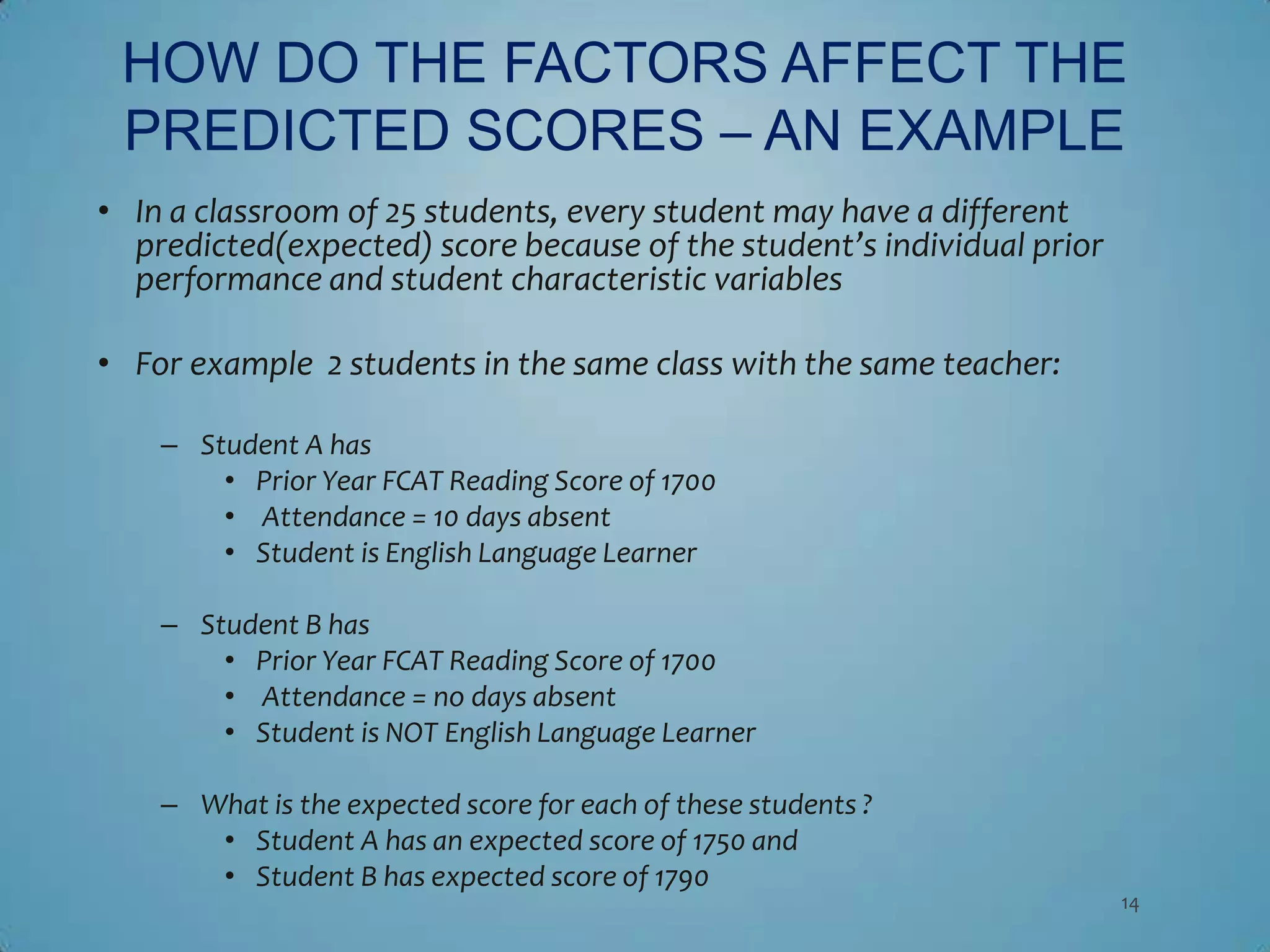
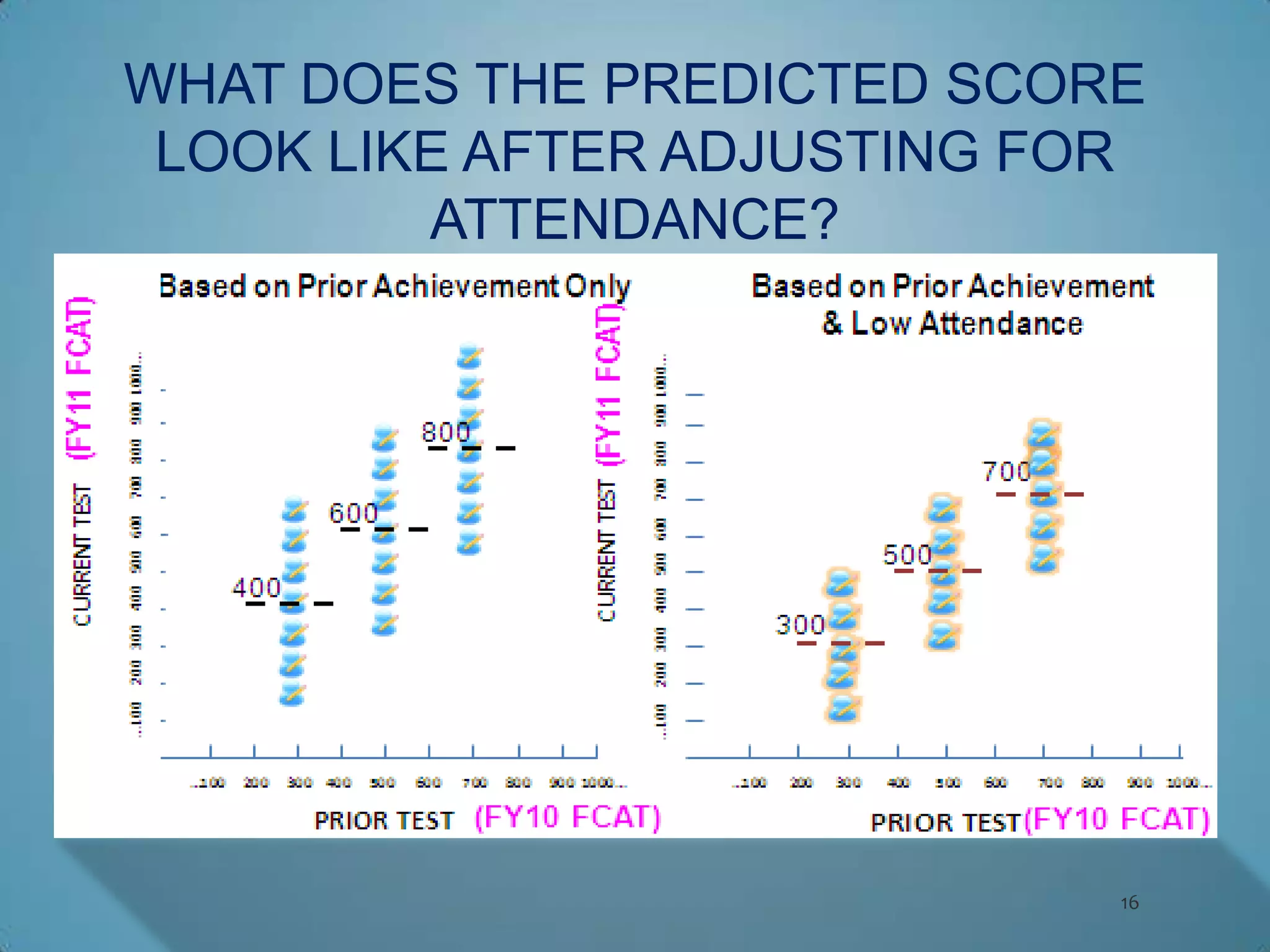
HOW DO THE FACTORS AFFECT THE
 PREDICTED SCORES – AN EXAMPLE
• In a classroom of 25 students, every student may have a different
  predicted(expected) score because of the student’s individual prior
  performance and student characteristic variables

• For example 2 students in the same class with the same teacher:

    – Student A has
        • Prior Year FCAT Reading Score of 1700
        • Attendance = 10 days absent
        • Student is English Language Learner

    – Student B has
        • Prior Year FCAT Reading Score of 1700
        • Attendance = no days absent
        • Student is NOT English Language Learner

    – What is the expected score for each of these students ?
       • Student A has an expected score of 1750 and
       • Student B has expected score of 1790
                                                                        14
WHAT IS THE PREDICTED SCORE?


                          15
WHAT DOES THE PREDICTED SCORE
 LOOK LIKE AFTER ADJUSTING FOR
         ATTENDANCE?


                             16
HOW IS STUDENT LEARNING GROWTH
           MEASURED?


                            17
HOW PRECISE IS THIS VAM SCORE?

• Precision in a VAM score is used to measure the
  consistency of the individual teacher VAM
  estimates.

• It is measuring how much individual teacher VAMS
  would change if they were computed over and
  over again.

      Example: Weighing yourself on a scale

                                                18
WHAT IS STANDARD ERROR IN A
          VAM SCORE?
• The standard error gives the uncertainty (error
  band) surrounding a teacher’s VAM score

• It can be used to prevent classifying teachers
  when that categorization would be uncertain

• Standard errors will be used when classifying
  teachers in the lowest tier to ensure that there is a
  high degree confidence on this categorization

                                                    19
COMPONENTS OF THE OVERALL
      TEACHER VAM ESTIMATES
The model recognizes that there is an independent
factor related to the school that impacts student
learning –a school component

• Calculated based on the predicted and observed
  scores of students in the school for each grade and
  subject while controlling for the students’ and
  classrooms’ factors mentioned previously

• May represent the impact of the school’s
  leadership, the culture of the school, or the
  environment of the school on student learning

                                                    20
COMPONENTS OF THE OVERALL
      TEACHER VAM ESTIMATES
SGIC decisions on the use of the school component

• The SGIC decided to include 50% of the school
  component in the measurement of the teacher’s
  effectiveness

• By attributing a portion of the school component to
  the teacher in the measurement of his/her
  effectiveness, one recognizes that the teacher
  contributes somewhat to the overall school
  component, but there are factors imbedded in that
  component that are beyond his/her direct control and
  that he/she should not directly be held accountable for
                                                     21
FLDOE’S CONCEPTUAL CALCULATION
 FOR A TEACHER VALUE-ADDED SCORE


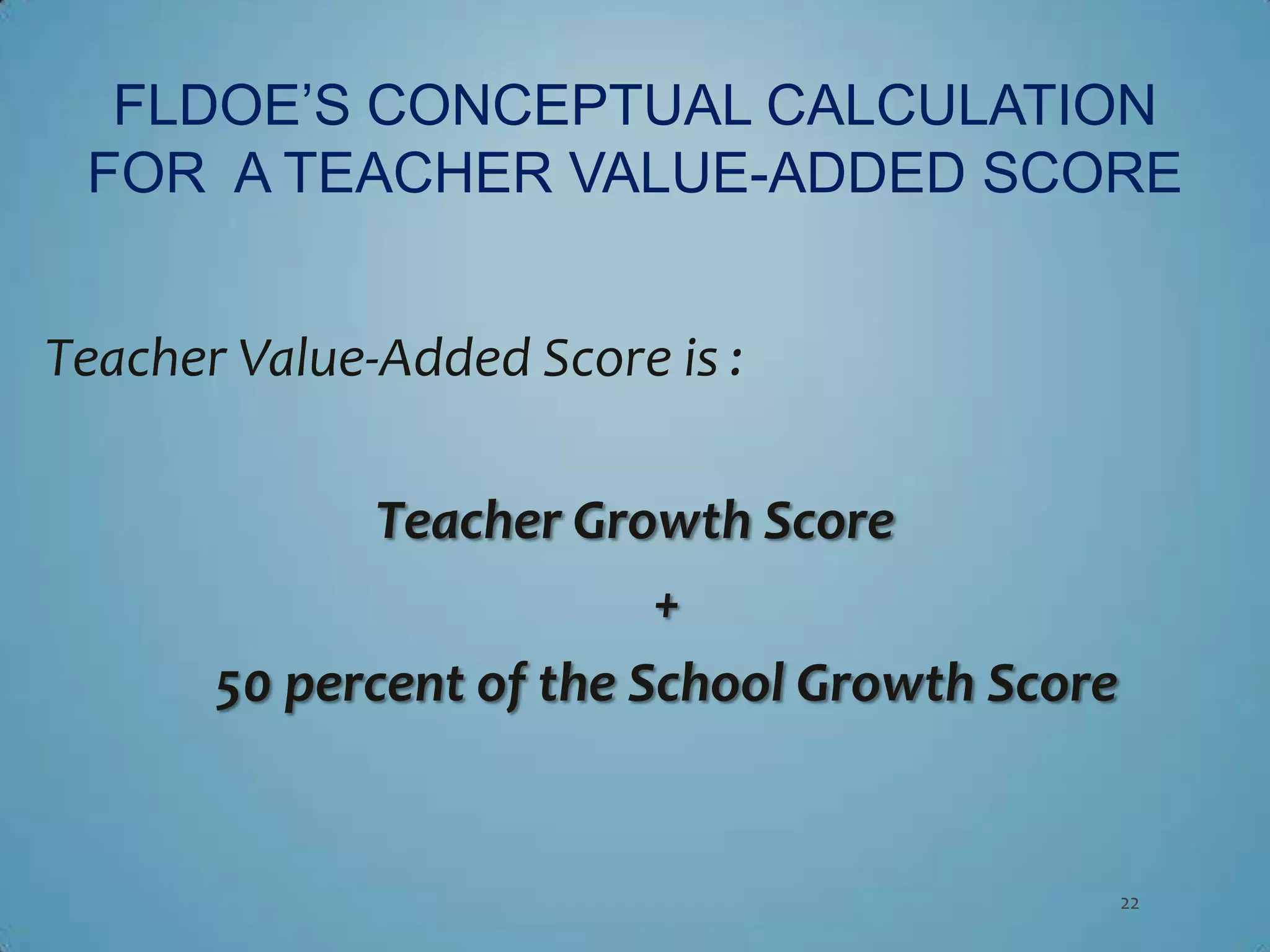
Teacher Value-Added Score is :

              Teacher Growth Score
                          +
       50 percent of the School Growth Score


                                               22
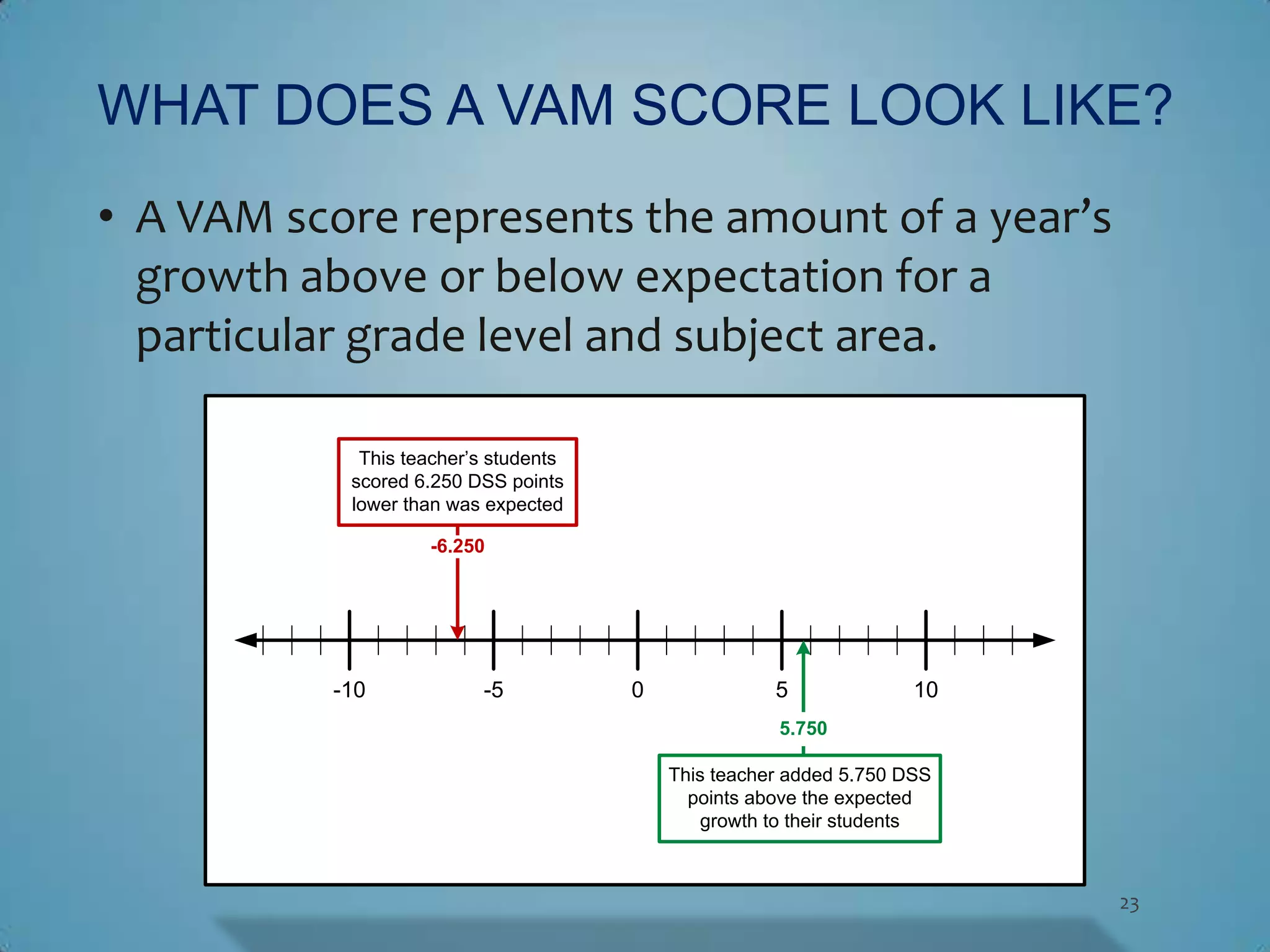
WHAT DOES A VAM SCORE LOOK LIKE?
• A VAM score represents the amount of a year’s
  growth above or below expectation for a
  particular grade level and subject area.

            This teacher’s students
           scored 6.250 DSS points
           lower than was expected

                   -6.250


          -10            -5           0              5              10
                                                     5.750

                                          This teacher added 5.750 DSS
                                            points above the expected
                                              growth to their students


                                                                         23
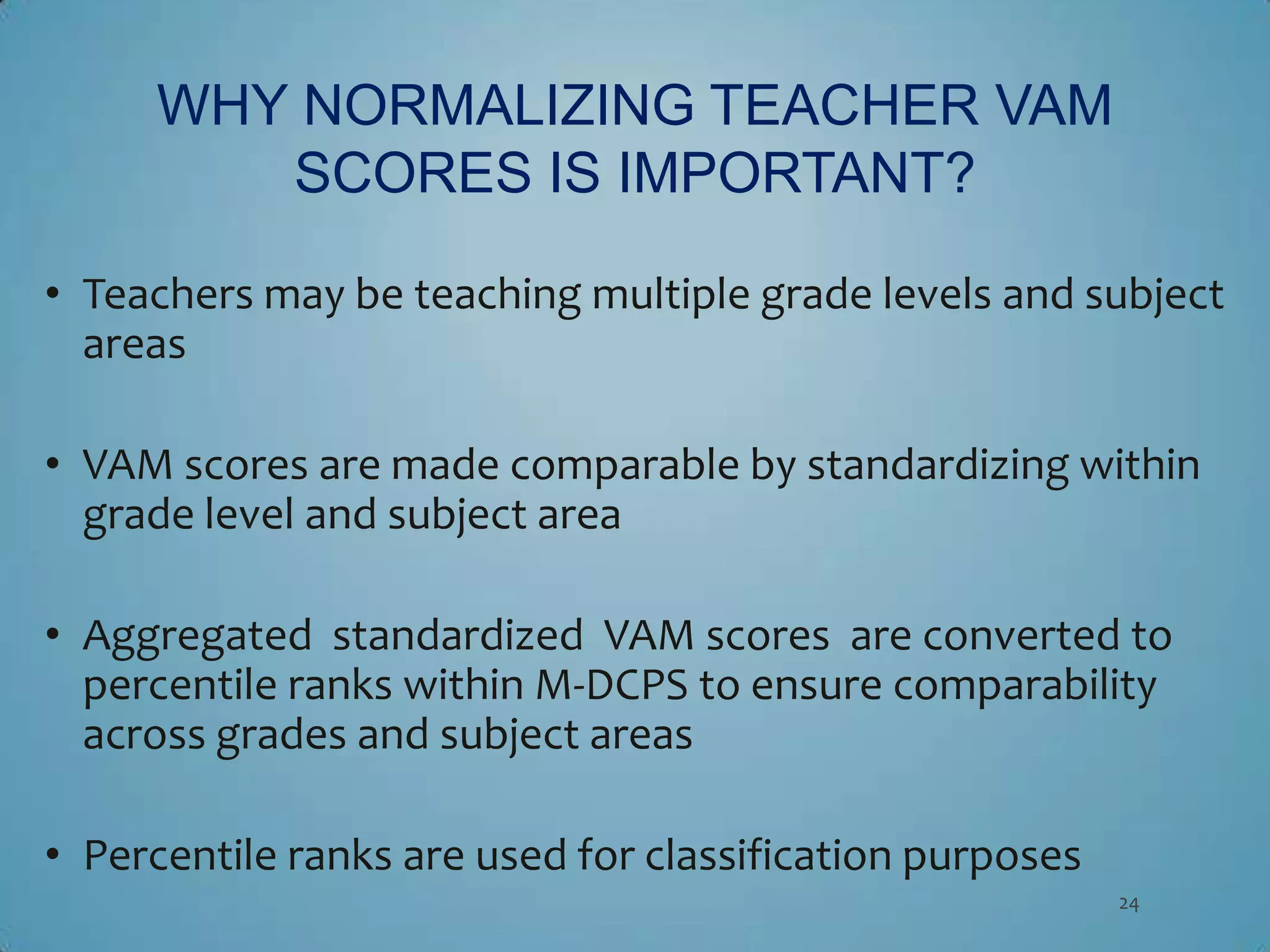
WHY NORMALIZING TEACHER VAM
        SCORES IS IMPORTANT?

• Teachers may be teaching multiple grade levels and subject
  areas

• VAM scores are made comparable by standardizing within
  grade level and subject area

• Aggregated standardized VAM scores are converted to
  percentile ranks within M-DCPS to ensure comparability
  across grades and subject areas

• Percentile ranks are used for classification purposes
                                                          24
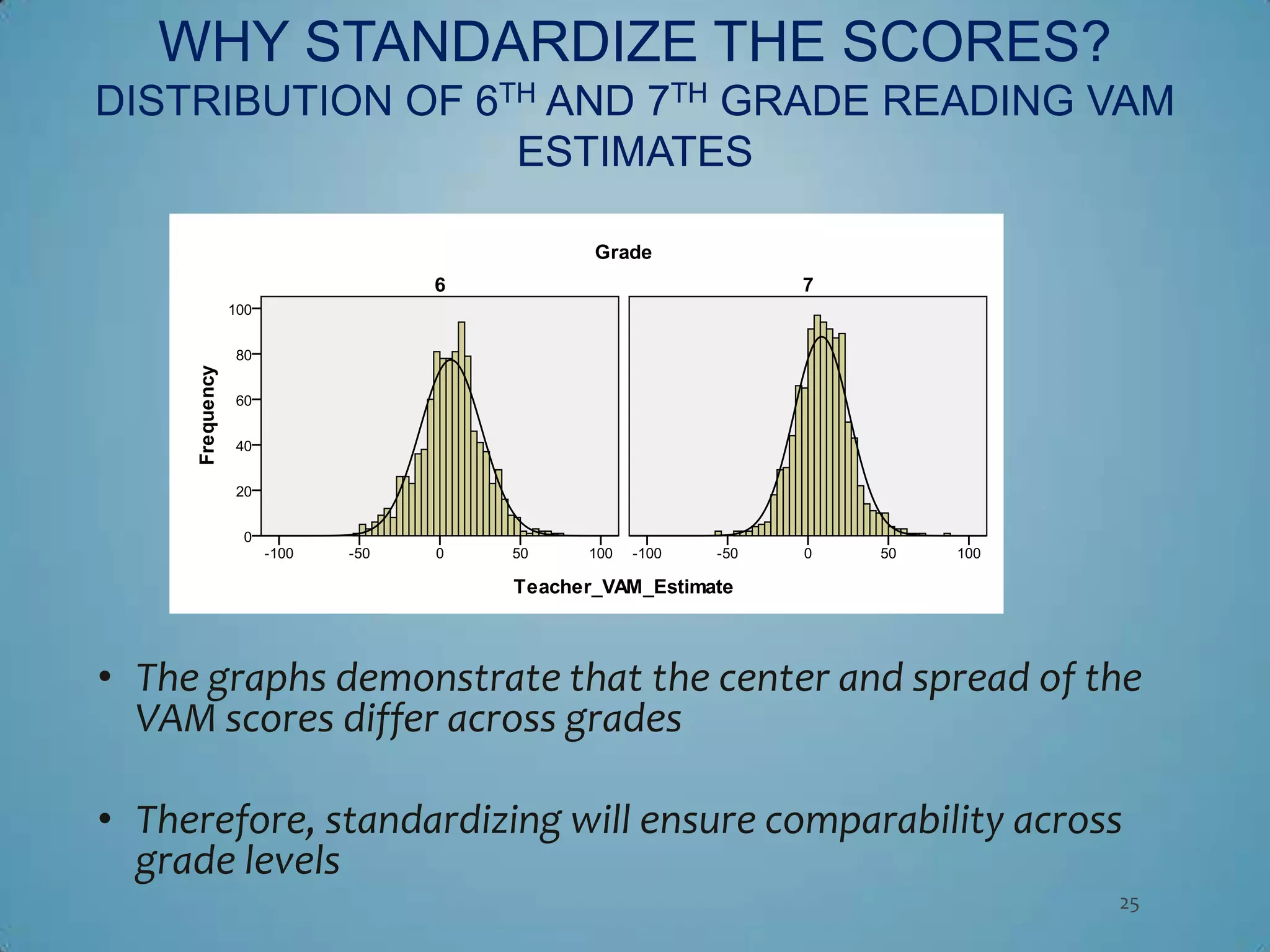
WHY STANDARDIZE THE SCORES?
DISTRIBUTION OF 6TH AND 7TH GRADE READING VAM
                  ESTIMATES


• The graphs demonstrate that the center and spread of the
  VAM scores differ across grades

• Therefore, standardizing will ensure comparability across
  grade levels
                                                          25
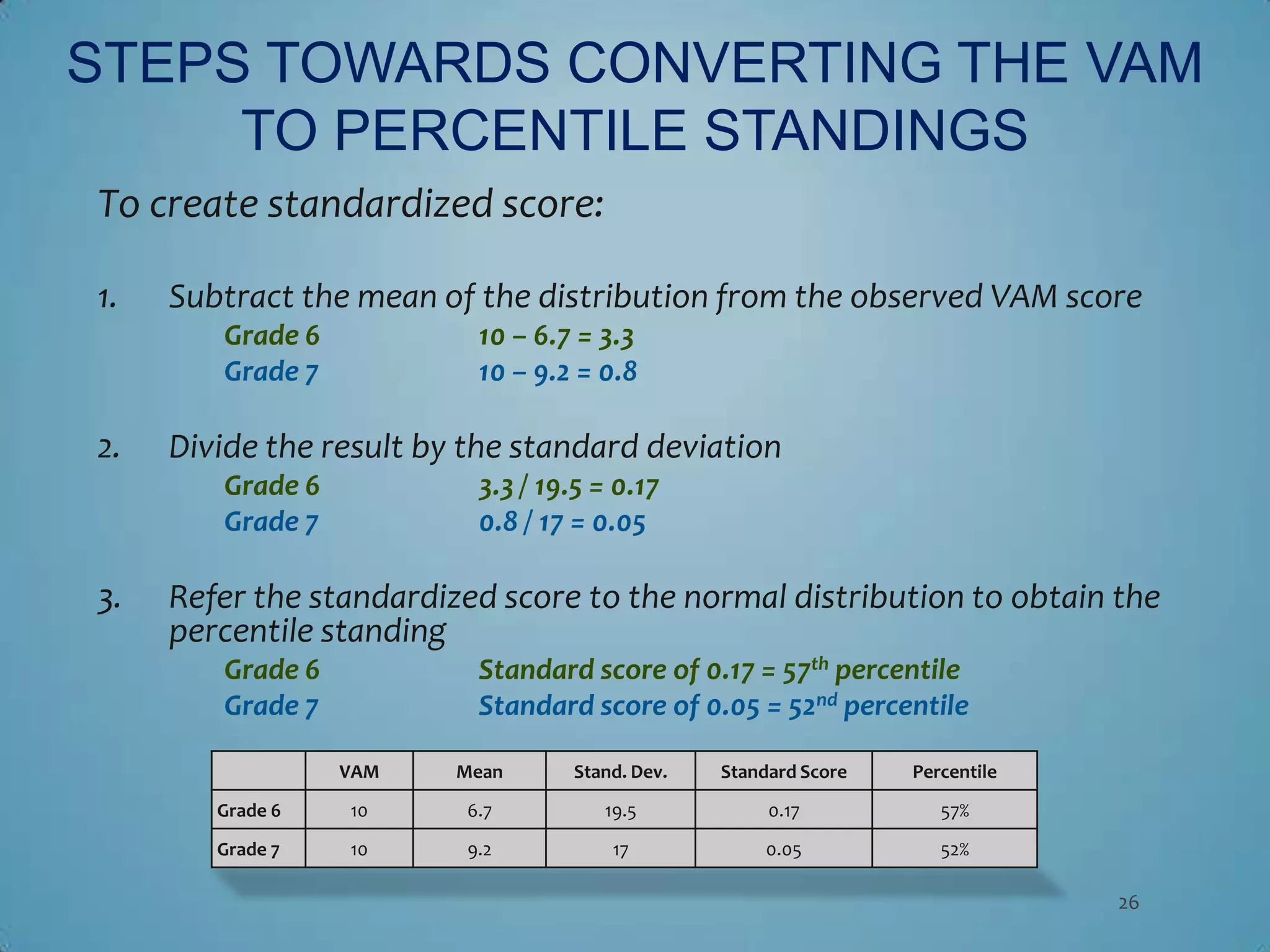
STEPS TOWARDS CONVERTING THE VAM
     TO PERCENTILE STANDINGS
To create standardized score:

1.   Subtract the mean of the distribution from the observed VAM score
        Grade 6           10 – 6.7 = 3.3
        Grade 7           10 – 9.2 = 0.8

2.   Divide the result by the standard deviation
        Grade 6           3.3 / 19.5 = 0.17
        Grade 7           0.8 / 17 = 0.05

3.   Refer the standardized score to the normal distribution to obtain the
     percentile standing
        Grade 6           Standard score of 0.17 = 57th percentile
        Grade 7           Standard score of 0.05 = 52nd percentile

                  VAM    Mean     Stand. Dev.   Standard Score   Percentile
        Grade 6   10     6.7         19.5            0.17           57%
        Grade 7   10     9.2          17             0.05           52%

                                                                              26
TEACHER FINAL EVALUATION

Teacher’s Unified Summative Rating includes two
components:

• Professional Practices - measured by IPEGS Standards 2-8
  or 2-7

• Quantifiable Student Data – IPEGS Standard 1
   – Measured using a VAM score that has been converted to a percentile
     rank which is currently the most accurate and objective measure
     available that can be used to measure student growth

   – The VAM measure takes into account multiple indicators and prior
     student performance to predict a teacher’s value–added
     contribution to a student’s academic growth
                                                                  27
FLORIDA’S VALUE ADDED
       MODEL

       Questions

                   28
29

Utdvam presentation final

  • 1.
    FLORIDA’S VALUE ADDED MODEL Overview of the Model to Measure Student Learning Growth on FCAT January 2012 1
  • 2.
    NEW STANDARD FORTEACHER EVALUATIONS As set forth in the Student Success Act and Race to the Top, teacher evaluations are: • Designed to support effective instruction and student learning growth • Used when developing district and school level improvement plans • Used to identify professional development and other human capital decisions for instructional personnel and school administrators 2
  • 3.
    NEW STANDARD FORTEACHER EVALUATIONS To support those objectives, the law sets forth that teacher evaluations are to be based on sound educational principles and contemporary research in effective practices: 1. The performance of students – IPEGS Standard 1 2. Instructional practice and job responsibilities – IPEGS Standards 2-8 or 2-7 3
  • 4.
    NEW STANDARD FORTEACHER EVALUATIONS Performance of Students. At least 50% of a performance evaluation must be based upon data and indicators of student learning growth assessed annually and measured by statewide assessments or, for subjects and grade levels not measured by statewide assessments, by district assessments as provided in s. 1008.22(8), F.S. -Section 1012.34(3)(a)1., Florida Statutes 4
  • 5.
    FLORIDA’S VALUE-ADDED MODEL DEVELOPEDBY FLORIDA EDUCATORS • The Department convened a committee of stakeholders (Student Growth Implementation Committee –or SGIC) to identify the type of model and the factors that should be accounted for in Florida’s value-added models • To provide technical expertise, the Department contracted with the American Institutes for Research (AIR) to help the SGIC develop the recommended model that was adopted. • The SGIC’s recommended model was fully adopted by the Commissioner with no additions, deletions, or changes 5
  • 6.
    FLORIDA’S VALUE-ADDED MODEL DEVELOPED BY FLORIDA EDUCATORS • The Student Growth Implementation Committee (SGIC) is composed of 27 members from across the state. The group includes: – Teachers (across various subjects and grade levels, including exceptional student education) – School administrators – District-level administrators (Assessment and HR) – Postsecondary teacher educators – Representatives from the business community – Parents • The SGIC met from March through June 2011 – 2 two-day in-person meetings – 4 conference call meetings 6
  • 7.
    FLORIDA’S VALUE-ADDED MODEL DEVELOPEDBY FLORIDA EDUCATORS • After exploring eight different types of value- added models, the SGIC recommended a model from the class of covariate adjustment models • This model begins by establishing expected growth for each student: – Based on historical data each year – Represents the typical growth seen among students who have earned similar test scores the past two years, and share the other characteristics identified by the committee 7
  • 8.
    THE NEW MEASURE: VALUE-ADDED ANALYSIS • A value-added model attempts to measure the impact of a teacher on student learning, by accounting for other factors that may impact the learning process. • These models DO NOT: – Evaluate teachers based on a single year of student performance or proficiency (status model) or – Evaluate teachers based on simple comparison of growth from one year to the next (simple growth) 8
  • 9.
    ADVANTAGES OF VALUE-ADDED • MODELS Teachers teach classes of students who enter with different levels of proficiency and possibly different student characteristics • Value-added models ATTEMPT to “level the playing field” by accounting for differences in the proficiency and characteristics of students assigned to teachers • Value-added models are designed to MITIGATE the influence of differences among the entering classes so that schools and teachers do not have advantages or disadvantages simply as a result of the students who attend a school or are assigned to a class • Value-Added models are not perfect. Model will be continually reviewed by the FLDOE in case adjustments are necessary 9
  • 10.
    VALUE-ADDED EXAMPLE Teacher X 500 The difference between the predicted performance and 400 the actual performance represents the value-added 300 by the teacher’s instruction. 200 The predicted performance represents the level of performance the student is 100 expected to demonstrate after statistically accounting for factors through a value- 0 added model. Student E Prior Performance Current Performance Predicted Performance 10
  • 11.
    WHAT ARE THESCORES? What is the Predicted Student Score? • It is the score you would EXPECT a student to achieve based on the student’s performance on prior tests and other information available on the student. • A predicted score for a student is generated based on what would normally happen in an average class with a typical teacher. What is the Student Learning Growth Score? • The difference between Current test score and Predicted test score. 11
  • 12.
    FACTORS USED TOADJUST PREDICTED Student Characteristics: SCORE – Up to two prior years of achievement scores (the strongest predictor of student growth) – The number of subject-relevant courses in which the student is enrolled – Students with Disabilities (SWD) status – English Language Learner (ELL) status – Gifted status – Attendance – Mobility (number of transitions) – Difference from modal age in grade (as an indicator of retention) Classroom characteristics: – Class size – Homogeneity of students’ entering test scores in the class 12
  • 13.
    FACTORS NOT USED TO ADJUST PREDICTED SCORE Student Characteristics NOT directly accounted for: – Gender – Race – Ethnicity – Socio-Economic Status • These factors are not directly included in a teacher’s VAM score. • However, since these factors already influence a student’s performance and prior performance is the predictor with the strongest weight, they are indirectly accounted for 13
  • 14.
    HOW DO THEFACTORS AFFECT THE PREDICTED SCORES – AN EXAMPLE • In a classroom of 25 students, every student may have a different predicted(expected) score because of the student’s individual prior performance and student characteristic variables • For example 2 students in the same class with the same teacher: – Student A has • Prior Year FCAT Reading Score of 1700 • Attendance = 10 days absent • Student is English Language Learner – Student B has • Prior Year FCAT Reading Score of 1700 • Attendance = no days absent • Student is NOT English Language Learner – What is the expected score for each of these students ? • Student A has an expected score of 1750 and • Student B has expected score of 1790 14
  • 15.
    WHAT IS THEPREDICTED SCORE? 15
  • 16.
    WHAT DOES THEPREDICTED SCORE LOOK LIKE AFTER ADJUSTING FOR ATTENDANCE? 16
  • 17.
    HOW IS STUDENTLEARNING GROWTH MEASURED? 17
  • 18.
    HOW PRECISE ISTHIS VAM SCORE? • Precision in a VAM score is used to measure the consistency of the individual teacher VAM estimates. • It is measuring how much individual teacher VAMS would change if they were computed over and over again. Example: Weighing yourself on a scale 18
  • 19.
    WHAT IS STANDARDERROR IN A VAM SCORE? • The standard error gives the uncertainty (error band) surrounding a teacher’s VAM score • It can be used to prevent classifying teachers when that categorization would be uncertain • Standard errors will be used when classifying teachers in the lowest tier to ensure that there is a high degree confidence on this categorization 19
  • 20.
    COMPONENTS OF THEOVERALL TEACHER VAM ESTIMATES The model recognizes that there is an independent factor related to the school that impacts student learning –a school component • Calculated based on the predicted and observed scores of students in the school for each grade and subject while controlling for the students’ and classrooms’ factors mentioned previously • May represent the impact of the school’s leadership, the culture of the school, or the environment of the school on student learning 20
  • 21.
    COMPONENTS OF THEOVERALL TEACHER VAM ESTIMATES SGIC decisions on the use of the school component • The SGIC decided to include 50% of the school component in the measurement of the teacher’s effectiveness • By attributing a portion of the school component to the teacher in the measurement of his/her effectiveness, one recognizes that the teacher contributes somewhat to the overall school component, but there are factors imbedded in that component that are beyond his/her direct control and that he/she should not directly be held accountable for 21
  • 22.
    FLDOE’S CONCEPTUAL CALCULATION FOR A TEACHER VALUE-ADDED SCORE Teacher Value-Added Score is : Teacher Growth Score + 50 percent of the School Growth Score 22
  • 23.
    WHAT DOES AVAM SCORE LOOK LIKE? • A VAM score represents the amount of a year’s growth above or below expectation for a particular grade level and subject area. This teacher’s students scored 6.250 DSS points lower than was expected -6.250 -10 -5 0 5 10 5.750 This teacher added 5.750 DSS points above the expected growth to their students 23
  • 24.
    WHY NORMALIZING TEACHERVAM SCORES IS IMPORTANT? • Teachers may be teaching multiple grade levels and subject areas • VAM scores are made comparable by standardizing within grade level and subject area • Aggregated standardized VAM scores are converted to percentile ranks within M-DCPS to ensure comparability across grades and subject areas • Percentile ranks are used for classification purposes 24
  • 25.
    WHY STANDARDIZE THESCORES? DISTRIBUTION OF 6TH AND 7TH GRADE READING VAM ESTIMATES • The graphs demonstrate that the center and spread of the VAM scores differ across grades • Therefore, standardizing will ensure comparability across grade levels 25
  • 26.
    STEPS TOWARDS CONVERTINGTHE VAM TO PERCENTILE STANDINGS To create standardized score: 1. Subtract the mean of the distribution from the observed VAM score Grade 6 10 – 6.7 = 3.3 Grade 7 10 – 9.2 = 0.8 2. Divide the result by the standard deviation Grade 6 3.3 / 19.5 = 0.17 Grade 7 0.8 / 17 = 0.05 3. Refer the standardized score to the normal distribution to obtain the percentile standing Grade 6 Standard score of 0.17 = 57th percentile Grade 7 Standard score of 0.05 = 52nd percentile VAM Mean Stand. Dev. Standard Score Percentile Grade 6 10 6.7 19.5 0.17 57% Grade 7 10 9.2 17 0.05 52% 26
  • 27.
    TEACHER FINAL EVALUATION Teacher’sUnified Summative Rating includes two components: • Professional Practices - measured by IPEGS Standards 2-8 or 2-7 • Quantifiable Student Data – IPEGS Standard 1 – Measured using a VAM score that has been converted to a percentile rank which is currently the most accurate and objective measure available that can be used to measure student growth – The VAM measure takes into account multiple indicators and prior student performance to predict a teacher’s value–added contribution to a student’s academic growth 27
  • 28.
    FLORIDA’S VALUE ADDED MODEL Questions 28
  • 29.