Different Types of Fault
Movements
Normal Dip Slip Fault
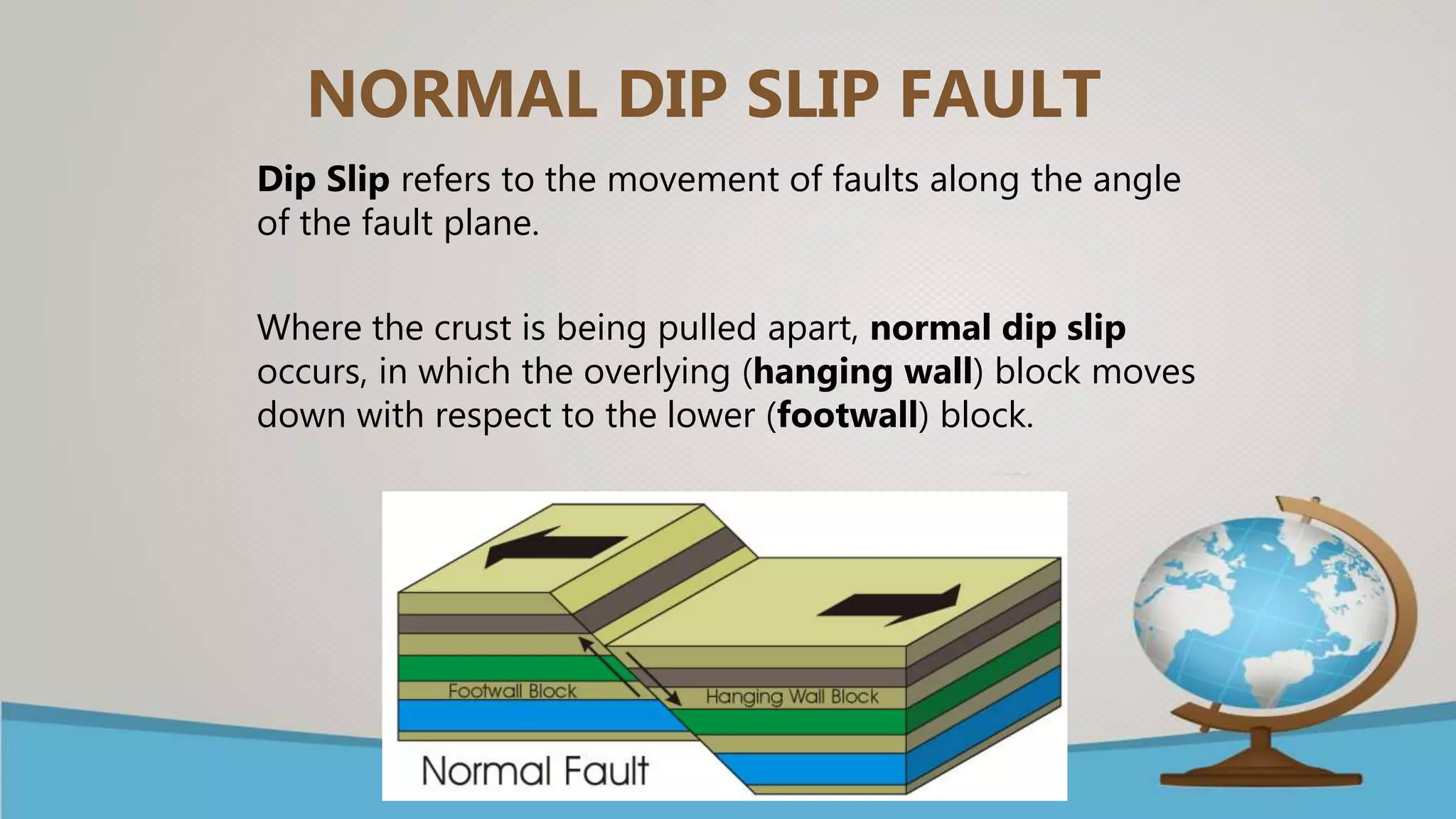
NORMAL DIP SLIP FAULT
Dip Slip refers to the movement of faults along the angle
of the fault plane.
Where the crust is being pulled apart, normal dip slip
occurs, in which the overlying (hanging wall) block moves
down with respect to the lower (footwall) block.
Reverse Dip
Slip Fault
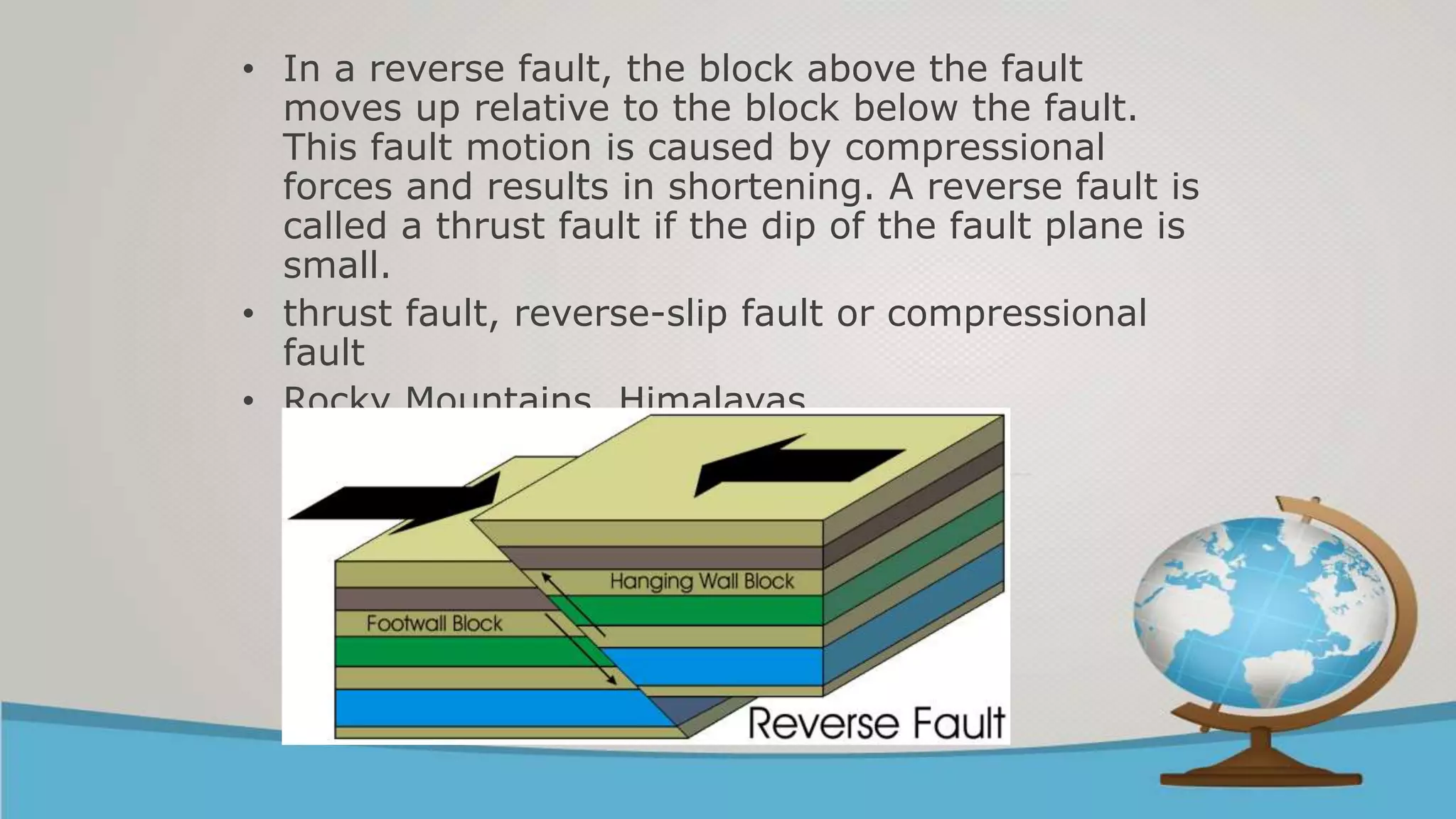
• In a reverse fault, the block above the fault
moves up relative to the block below the fault.
This fault motion is caused by compressional
forces and results in shortening. A reverse fault is
called a thrust fault if the dip of the fault plane is
small.
• thrust fault, reverse-slip fault or compressional
fault
• Rocky Mountains, Himalayas
OBLIQUE STRIKE SLIP
FAULT
• A fault which has a component of
dip-slip and a component of strike-
slip is termed an oblique-slip fault.
An oblique slip occurs when there is
a downward movement of the
earth's surface, like that experienced
with 'normal movement', while at
the same time having a sideways
movement. The sideways
movement would indicate that there
is a Transform Boundary present
and the two tectonic plates are
sliding past one another.
• Yet the downward
motion along with this
sideways movement
would indicate that there
is more happening with
these tectonic
plates. Some oblique
faults occur within
transtensional and
transpressional regimes,
others occur where the
direction of extension or
shortening changes
during the deformation
but the earlier formed
faults remain active.
• The hade angle is defined as
the complement of the dip
angle; it is the angle between
the fault plane and a vertical
plane that strikes parallel to
the fault
Strike Slip Fault
Strike Slip Fault
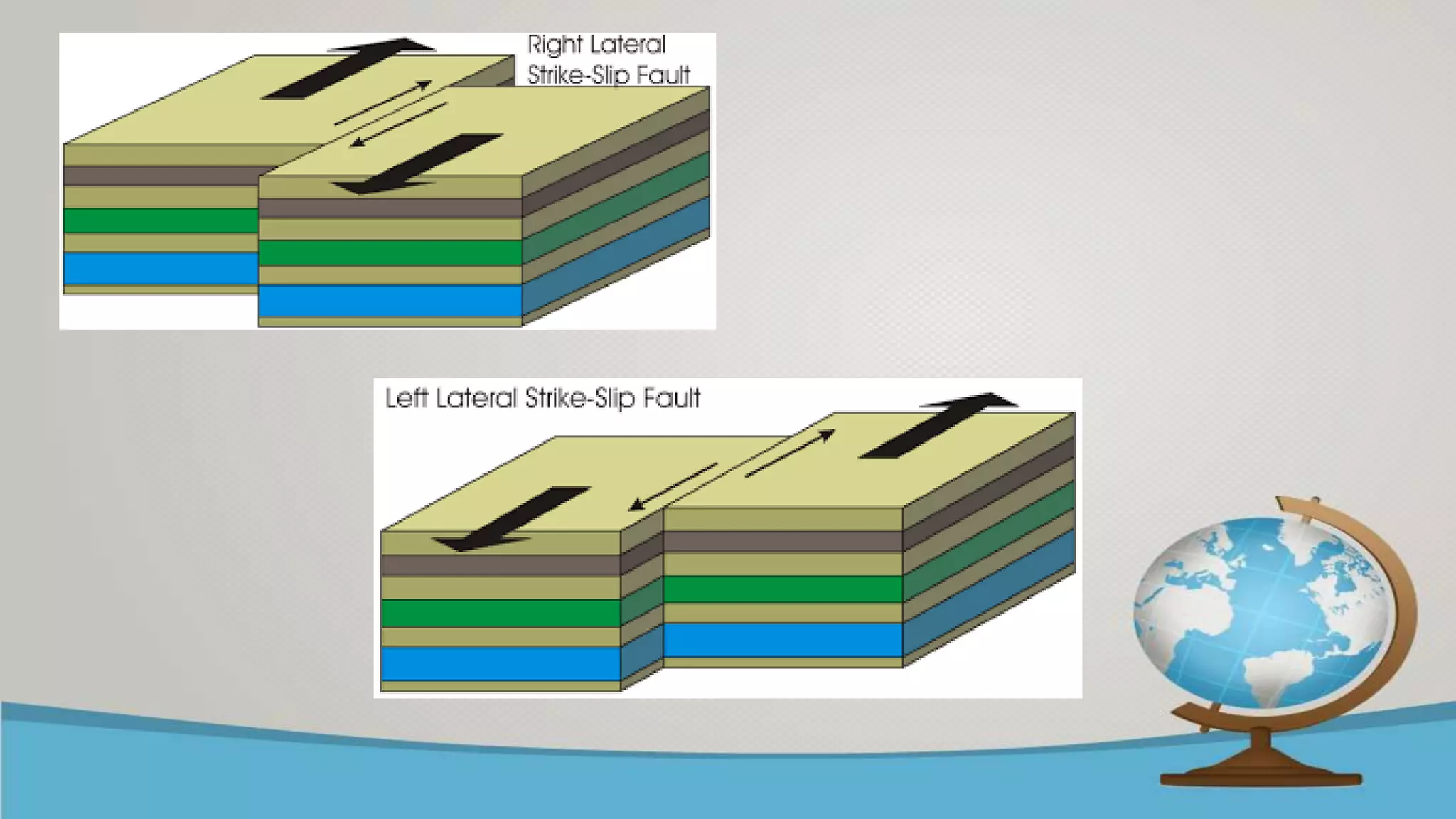
• Crustal blocks may also move sideways past each other,
usually along nearly-vertical faults.
• This ‘strike-slip’ movement is described as sinistral when
the far side moves to the left, and dextral, when the far
side moves to the right.
• If the block opposite an observer looking across the fault
moves to the right, the slip style is termed right lateral; if
the block moves to the left, the motion is termed left
lateral.

Different Types of Fault Movements

  • 1.
    Different Types ofFault Movements
  • 2.
  • 3.
    NORMAL DIP SLIPFAULT Dip Slip refers to the movement of faults along the angle of the fault plane. Where the crust is being pulled apart, normal dip slip occurs, in which the overlying (hanging wall) block moves down with respect to the lower (footwall) block.
  • 4.
  • 5.
    • In areverse fault, the block above the fault moves up relative to the block below the fault. This fault motion is caused by compressional forces and results in shortening. A reverse fault is called a thrust fault if the dip of the fault plane is small. • thrust fault, reverse-slip fault or compressional fault • Rocky Mountains, Himalayas
  • 7.
  • 8.
    • A faultwhich has a component of dip-slip and a component of strike- slip is termed an oblique-slip fault. An oblique slip occurs when there is a downward movement of the earth's surface, like that experienced with 'normal movement', while at the same time having a sideways movement. The sideways movement would indicate that there is a Transform Boundary present and the two tectonic plates are sliding past one another.
  • 9.
    • Yet thedownward motion along with this sideways movement would indicate that there is more happening with these tectonic plates. Some oblique faults occur within transtensional and transpressional regimes, others occur where the direction of extension or shortening changes during the deformation but the earlier formed faults remain active.
  • 10.
    • The hadeangle is defined as the complement of the dip angle; it is the angle between the fault plane and a vertical plane that strikes parallel to the fault
  • 11.
  • 12.
    Strike Slip Fault •Crustal blocks may also move sideways past each other, usually along nearly-vertical faults. • This ‘strike-slip’ movement is described as sinistral when the far side moves to the left, and dextral, when the far side moves to the right.
  • 14.
    • If theblock opposite an observer looking across the fault moves to the right, the slip style is termed right lateral; if the block moves to the left, the motion is termed left lateral.