CHAPTER EIGHT
8. Ecology and Conservation of Natural Resources
8.1 Definition of ecological terms and Basic concepts of Ecology
The word “Ecology‟ was coined from Greek word 'oikos' meaning 'house' or 'a place to
live' and 'logos' meaning study. Ecology is the study of the households of the planet earth.
Different Authors defined ecology differently. Some of them are:
 Ecology is the scientific study of the interactions between organisms and their
environments
 The study of the relationships, distribution, and abundance of organisms, or groups of
organisms, in an environment
Ecological terminologies and their definitions
1. Abiotic: all non-living components in the biosphere, e.g., air, water, soil, climate.2.
2. Autotrophic: when an organism is able to produce its own food using abiotic components.
3. Biotic: all the living components in the biosphere: animals, plants, micro- organisms, etc.
4.Biosphere: it is the global sum of all ecosystems, and is the zone where all living
organisms live on earth.
5.Biome: the biosphere is divided into millions of biomes, based on the specific climate of
each region, where the climate determines the unique plant and animal species that live
and are adapted to survive in a region.
6. Carnivores: animals that eat only meat. They are generally predators, like lions,
cheetahs etc., in a specific environment.
7.Ecosystem: the combined physical and biological components of a specific
habitat where animals and plants are interdependent on each other for survival.
8.Herbivores: animals that only eat plants, e.g., buck, cows, goats, sheep, rabbits
etc.
9.Heterotrophic: when an organism is unable to produce its own food, and must
eat other organisms
10.Omnivores: animals that eat both plant and animal matter, e.g., humans, pigs,
baboons.
•
11.Saprophytic organisms: organisms that live on dead organic matter because
they are able to decompose (break down) dead plant and animal matter.
12.Scavengers: animals that eat what is left over by predators. Examples are
hyenas, crayfish and vultures.
13.Photosynthesis: a process where plants use sunlight energy, water and CO2
from the air, to produce organic compounds like glucose and inorganic compounds
like O2.
14.Vegetation: the plant life that is found in a biome.
Branches of ecology
 Ecology can be divided depending on the following concepts:-
 Hierarchical organization –according to level of organization
 Taxonomic –according to organisms studied
 Time/Place -According to time/place
Many other ways to subdivide ecology:
• Hierarchic: organism, population, community, ecosystem, biosphere
• Taxonomic: plant ecology, animal ecology, microbial ecology, avian ecology, etc.
• Time/Place: marine ecology, tropical ecology, freshwater ecology
Hierarchical structure of ecological systems
• Organism: fundamental unit of ecology. No smaller unit in biology has an independent
life in the environment.
• Population: A group of organisms consisting of a number of different populations that
live in defined area and interact with each other.
• Community: A group of organisms consisting of a number of different species that live in
an area and interact with each other
Ecosystem: a biological community plus all of the abiotic factors influencing that
community. Biome: A distinct ecological community of plants and animals living together
in a particular climate.
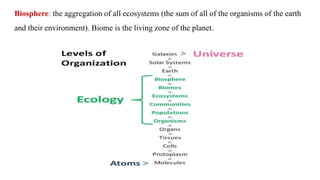
Biosphere: the aggregation of all ecosystems (the sum of all of the organisms of the earth
and their environment). Biome is the living zone of the planet.
Some examples of the above ecological branches are given below:
Population ecology (or Autecology)
• It is concerned with population growth including birth rates and death rates, fluctuation,
spread and interactions (scientific study of relationships between organisms of the same
species).
Community ecology (or Synecology)
• Community ecology is the scientific study of relationships between organisms of different
species.
Ecosystems ecology, having to do with the structure and function of the entire suite of
microbes, plants, and animals, and their abiotic environment, and how the parts interact to
generate the whole
• Evolutionary ecology, which may operate at any of these levels but most
commonly at the physiological or population level, is a rich and dynamic area of
ecology focusing on attempting to understand how natural selection developed the
structure and function of the organisms and ecosystems at any of these levels.
• Conservation ecology: -it deals with methods of proper management of natural
resources such as land, water, forests, sea, mines, etc., for the benefit of human
beings.
8. 1.1. Aquatic and terrestrial ecosystems
A. Aquatic ecosystem
An aquatic ecosystem is an ecosystem in a body of water. Communities of organisms
that are dependent on each other and on their environment live in aquatic ecosystems.
The two main types of aquatic ecosystems are:
1.Marine ecosystems
2.Freshwater ecosystems
1.Marine ecosystems cover approximately 71% of the earth's surface and contain
approximately 97% of the planet's water. They are distinguished from freshwater
ecosystems by the presence of dissolved compounds, especially salts, in the water.
Approximately 85% of the dissolved materials in seawater are sodium and chlorine.
2.Freshwater ecosystems (occupy only about 2% of earths surface). Example
• Rivers and streams: flowing-water ecosystems
• Lakes and ponds: standing-water ecosystems
• A large lake has three zones
3. Marshes and swamps: freshwater wetlands
• Grass like plants dominate in marshes, while woody trees and/or shrubs dominate
in swamps.
• Wetlands are valued wildlife habitats of migratory birds, beaver, otters, muskrats,
and game fishes; they provide natural flood control and serve as groundwater
recharging areas.
Estuaries: are where fresh and salt water meet.
• Estuaries are among the most fertile ecosystems in the world
Temperate estuaries usually contain salt marshes which are important in preventing
flood damage during storm surges
• Mangrove forests are the tropical equivalent of salt marshes; they cover nearly 70% of
tropical coastlines.
B. Terrestrial ecosystems. Terrestrial ecosystems include:
Forests
 Grasslands,
 Deserts and (d) tundra
A. Forests: are large areas supporting rich growth of trees. Depending on the climate
and type of trees they are generally grouped into:
• Tropical rain forests
• Temperate deciduous forests
• Boreal or north coniferous forests include
I. Tropical rain forest
• These are found in the high rain fall areas on either side of the equator Such forests
are found in the western coast of India, scattered in south East Asia, some parts of
Africa and South America
• Tropical rainforests occur in areas by having high temperature and high humidity
and receives above 200 cm of rainfall per year. Soil is rich in humus.
II. Temperate deciduous forests
• They occur mostly in the Northwest, Central and Eastern Europe, Eastern North
America, North China, Korea, Japan, far Eastern Russia and Australia. Trees of
deciduous forests shed their leaves in autumn and new foliage grow in spring.
temperature ranging but 10 to 200C. Common trees are oak, beach, heath, chest nut,
birch, pine..
III. Boreal or north coniferous forests:
• Coniferous forests are also known as “Taiga‟. They extend as a continuous belt
across north America and north Eurasia below the arctic tundra. annual temperature
below 00C. The soils are acidic and poor in nutrients forests are characterized by
evergreen, drought resistant and woody.
Grasslands
Grasslands are areas dominated by grasses. They occupy about 20% of the land on
the earth surface. Grasslands occur in both in tropical and temperate regions where
rainfall is not enough to support the growth of trees.
• dominating plants with scattered drought resistant thorny trees in the tropical
grasslands. Badgers, fox, ass, zebra, antelope are found grazing on grasslands
which support the dairy and leather industries.
Deserts
are hot and low rain areas suffering from water shortage and high wind velocity.
They show extremes of temperature. Globally deserts occupy about 1/7th of the earths
surface. Cacti, Acacia, Euphorbia and prickly pears are some of the common desert
plants.
8.1.2 Energy flow through ecosystems
8.1.2.1 The food chains
The transfer of food - energy from plants to animals and then to other animals by successive
stage of feeding is called a food chain. the sequence of organisms that are related to each other
for their source of food.
8.1.2.2. The food web
In an ecosystem there are a very large number of interlinked chains and forms a food web.
Stability of the ecosystem is maintained by food web.
8..1.3 Ecological pyramid.
Ecological pyramid is the graphic representation of the number, biomass and energy of the
successive trophic levels of an ecosystem
Types of ecological pyramid
i. Pyramid of number depicts the number of individual organisms at different trophic
levels of food chain.
ii. Pyramid of biomass depicts the amount of biomass at different trophic levels of food
chain or the total weight of living matter per unit area present in the ecosystem.
iii. Pyramid of energy depicts the amount of energy at different trophic levels of food
chain. It shows how energy moves throughout an ecosystem.
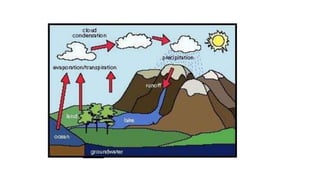
8.2 Cycling of Materials (Nutrients)
Every ecosystem has several interrelated mechanisms that affect human life. These are
the water cycle, the carbon cycle, the oxygen cycle, the nitrogen cycle and the energy
cycle
8.2.1Principles of conservation of natural resources.
For standard and general criteria for conservation and sustainable use of natural
resources, it should be developed at a local level and be adapted to local ecosystems,
cultures, values and social and economic conditions.
8.3 Environmental pollution and public health
Developmental activities such as construction, transportation and manufacturing not
only deplete the natural resources but also produce large amount of wastes that leads
to pollution of air, water, soil, and oceans; global warming and acid rains.
8.3.1 Pollution and pollutants:-Human activities directly or indirectly affect the
environment adversely. A stone crusher adds a lot of suspended particulate matter and
noise into the atmosphere. Automobiles emit from their tail pipes oxides of nitrogen,
sulphur dioxide, carbon dioxide, carbon monoxide and a complex mixture of unburnt
hydrocarbons and black soot which pollute the atmosphere.
Pollution may be of the following types:
• Air pollution
• Noise pollution
• Water pollution
• Soil pollution
• Thermal pollution
Global Warming and Greenhouse Effect
Atmospheric gases like carbon dioxide, methane, nitrous oxide, water vapour, and
chlorofluorocarbons are capable of trapping the out-going infrared radiation from
the earth.
Increase in temperature is observed in green houses, in the botanical gardens these
gases are known as greenhouse gases and the heating effect is known as
greenhouse effect. If greenhouse gases are not checked, by the turn of the century
the temperature may rise by 50C. This will melt the polar ice caps and increase the
sea level leading to coastal flooding, loss of coastal areas and ecosystems like
swamps and marshes, etc.

Bio chap- 8 (1012).pptx chap- 8 (1012).pptx

  • 1.
    CHAPTER EIGHT 8. Ecologyand Conservation of Natural Resources 8.1 Definition of ecological terms and Basic concepts of Ecology The word “Ecology‟ was coined from Greek word 'oikos' meaning 'house' or 'a place to live' and 'logos' meaning study. Ecology is the study of the households of the planet earth. Different Authors defined ecology differently. Some of them are:  Ecology is the scientific study of the interactions between organisms and their environments  The study of the relationships, distribution, and abundance of organisms, or groups of organisms, in an environment
  • 2.
    Ecological terminologies andtheir definitions 1. Abiotic: all non-living components in the biosphere, e.g., air, water, soil, climate.2. 2. Autotrophic: when an organism is able to produce its own food using abiotic components. 3. Biotic: all the living components in the biosphere: animals, plants, micro- organisms, etc. 4.Biosphere: it is the global sum of all ecosystems, and is the zone where all living organisms live on earth. 5.Biome: the biosphere is divided into millions of biomes, based on the specific climate of each region, where the climate determines the unique plant and animal species that live and are adapted to survive in a region.
  • 3.
    6. Carnivores: animalsthat eat only meat. They are generally predators, like lions, cheetahs etc., in a specific environment. 7.Ecosystem: the combined physical and biological components of a specific habitat where animals and plants are interdependent on each other for survival. 8.Herbivores: animals that only eat plants, e.g., buck, cows, goats, sheep, rabbits etc. 9.Heterotrophic: when an organism is unable to produce its own food, and must eat other organisms 10.Omnivores: animals that eat both plant and animal matter, e.g., humans, pigs, baboons. •
  • 4.
    11.Saprophytic organisms: organismsthat live on dead organic matter because they are able to decompose (break down) dead plant and animal matter. 12.Scavengers: animals that eat what is left over by predators. Examples are hyenas, crayfish and vultures. 13.Photosynthesis: a process where plants use sunlight energy, water and CO2 from the air, to produce organic compounds like glucose and inorganic compounds like O2. 14.Vegetation: the plant life that is found in a biome.
  • 5.
    Branches of ecology Ecology can be divided depending on the following concepts:-  Hierarchical organization –according to level of organization  Taxonomic –according to organisms studied  Time/Place -According to time/place Many other ways to subdivide ecology: • Hierarchic: organism, population, community, ecosystem, biosphere • Taxonomic: plant ecology, animal ecology, microbial ecology, avian ecology, etc. • Time/Place: marine ecology, tropical ecology, freshwater ecology
  • 6.
    Hierarchical structure ofecological systems • Organism: fundamental unit of ecology. No smaller unit in biology has an independent life in the environment. • Population: A group of organisms consisting of a number of different populations that live in defined area and interact with each other. • Community: A group of organisms consisting of a number of different species that live in an area and interact with each other Ecosystem: a biological community plus all of the abiotic factors influencing that community. Biome: A distinct ecological community of plants and animals living together in a particular climate.
  • 7.
    Biosphere: the aggregationof all ecosystems (the sum of all of the organisms of the earth and their environment). Biome is the living zone of the planet.
  • 8.
    Some examples ofthe above ecological branches are given below: Population ecology (or Autecology) • It is concerned with population growth including birth rates and death rates, fluctuation, spread and interactions (scientific study of relationships between organisms of the same species). Community ecology (or Synecology) • Community ecology is the scientific study of relationships between organisms of different species. Ecosystems ecology, having to do with the structure and function of the entire suite of microbes, plants, and animals, and their abiotic environment, and how the parts interact to generate the whole
  • 9.
    • Evolutionary ecology,which may operate at any of these levels but most commonly at the physiological or population level, is a rich and dynamic area of ecology focusing on attempting to understand how natural selection developed the structure and function of the organisms and ecosystems at any of these levels. • Conservation ecology: -it deals with methods of proper management of natural resources such as land, water, forests, sea, mines, etc., for the benefit of human beings. 8. 1.1. Aquatic and terrestrial ecosystems A. Aquatic ecosystem
  • 10.
    An aquatic ecosystemis an ecosystem in a body of water. Communities of organisms that are dependent on each other and on their environment live in aquatic ecosystems. The two main types of aquatic ecosystems are: 1.Marine ecosystems 2.Freshwater ecosystems 1.Marine ecosystems cover approximately 71% of the earth's surface and contain approximately 97% of the planet's water. They are distinguished from freshwater ecosystems by the presence of dissolved compounds, especially salts, in the water. Approximately 85% of the dissolved materials in seawater are sodium and chlorine.
  • 11.
    2.Freshwater ecosystems (occupyonly about 2% of earths surface). Example • Rivers and streams: flowing-water ecosystems • Lakes and ponds: standing-water ecosystems • A large lake has three zones 3. Marshes and swamps: freshwater wetlands • Grass like plants dominate in marshes, while woody trees and/or shrubs dominate in swamps. • Wetlands are valued wildlife habitats of migratory birds, beaver, otters, muskrats, and game fishes; they provide natural flood control and serve as groundwater recharging areas.
  • 12.
    Estuaries: are wherefresh and salt water meet. • Estuaries are among the most fertile ecosystems in the world Temperate estuaries usually contain salt marshes which are important in preventing flood damage during storm surges • Mangrove forests are the tropical equivalent of salt marshes; they cover nearly 70% of tropical coastlines. B. Terrestrial ecosystems. Terrestrial ecosystems include: Forests  Grasslands,  Deserts and (d) tundra
  • 13.
    A. Forests: arelarge areas supporting rich growth of trees. Depending on the climate and type of trees they are generally grouped into: • Tropical rain forests • Temperate deciduous forests • Boreal or north coniferous forests include I. Tropical rain forest • These are found in the high rain fall areas on either side of the equator Such forests are found in the western coast of India, scattered in south East Asia, some parts of Africa and South America
  • 14.
    • Tropical rainforestsoccur in areas by having high temperature and high humidity and receives above 200 cm of rainfall per year. Soil is rich in humus. II. Temperate deciduous forests • They occur mostly in the Northwest, Central and Eastern Europe, Eastern North America, North China, Korea, Japan, far Eastern Russia and Australia. Trees of deciduous forests shed their leaves in autumn and new foliage grow in spring. temperature ranging but 10 to 200C. Common trees are oak, beach, heath, chest nut, birch, pine..
  • 15.
    III. Boreal ornorth coniferous forests: • Coniferous forests are also known as “Taiga‟. They extend as a continuous belt across north America and north Eurasia below the arctic tundra. annual temperature below 00C. The soils are acidic and poor in nutrients forests are characterized by evergreen, drought resistant and woody. Grasslands Grasslands are areas dominated by grasses. They occupy about 20% of the land on the earth surface. Grasslands occur in both in tropical and temperate regions where rainfall is not enough to support the growth of trees.
  • 16.
    • dominating plantswith scattered drought resistant thorny trees in the tropical grasslands. Badgers, fox, ass, zebra, antelope are found grazing on grasslands which support the dairy and leather industries. Deserts are hot and low rain areas suffering from water shortage and high wind velocity. They show extremes of temperature. Globally deserts occupy about 1/7th of the earths surface. Cacti, Acacia, Euphorbia and prickly pears are some of the common desert plants. 8.1.2 Energy flow through ecosystems
  • 17.
    8.1.2.1 The foodchains The transfer of food - energy from plants to animals and then to other animals by successive stage of feeding is called a food chain. the sequence of organisms that are related to each other for their source of food. 8.1.2.2. The food web In an ecosystem there are a very large number of interlinked chains and forms a food web. Stability of the ecosystem is maintained by food web. 8..1.3 Ecological pyramid. Ecological pyramid is the graphic representation of the number, biomass and energy of the successive trophic levels of an ecosystem
  • 18.
    Types of ecologicalpyramid i. Pyramid of number depicts the number of individual organisms at different trophic levels of food chain. ii. Pyramid of biomass depicts the amount of biomass at different trophic levels of food chain or the total weight of living matter per unit area present in the ecosystem. iii. Pyramid of energy depicts the amount of energy at different trophic levels of food chain. It shows how energy moves throughout an ecosystem. 8.2 Cycling of Materials (Nutrients) Every ecosystem has several interrelated mechanisms that affect human life. These are the water cycle, the carbon cycle, the oxygen cycle, the nitrogen cycle and the energy cycle
  • 20.
    8.2.1Principles of conservationof natural resources. For standard and general criteria for conservation and sustainable use of natural resources, it should be developed at a local level and be adapted to local ecosystems, cultures, values and social and economic conditions. 8.3 Environmental pollution and public health Developmental activities such as construction, transportation and manufacturing not only deplete the natural resources but also produce large amount of wastes that leads to pollution of air, water, soil, and oceans; global warming and acid rains.
  • 21.
    8.3.1 Pollution andpollutants:-Human activities directly or indirectly affect the environment adversely. A stone crusher adds a lot of suspended particulate matter and noise into the atmosphere. Automobiles emit from their tail pipes oxides of nitrogen, sulphur dioxide, carbon dioxide, carbon monoxide and a complex mixture of unburnt hydrocarbons and black soot which pollute the atmosphere. Pollution may be of the following types: • Air pollution • Noise pollution • Water pollution • Soil pollution • Thermal pollution
  • 22.
    Global Warming andGreenhouse Effect Atmospheric gases like carbon dioxide, methane, nitrous oxide, water vapour, and chlorofluorocarbons are capable of trapping the out-going infrared radiation from the earth. Increase in temperature is observed in green houses, in the botanical gardens these gases are known as greenhouse gases and the heating effect is known as greenhouse effect. If greenhouse gases are not checked, by the turn of the century the temperature may rise by 50C. This will melt the polar ice caps and increase the sea level leading to coastal flooding, loss of coastal areas and ecosystems like swamps and marshes, etc.