Ecology Of Grasslands
Ecosystem Functions And Services
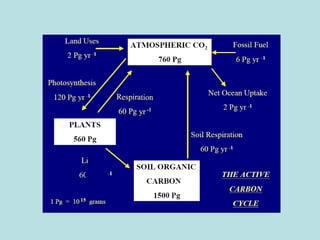
1. Carbon Storage
2. Nutrient re-cycling
3. Habitat For Grazers
4. Buffer Between Deserts and Forests
5. Useful For Grain Crop Agriculture
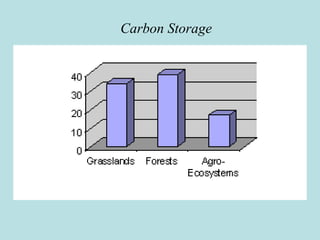
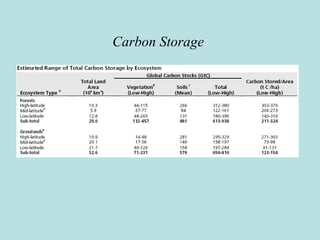
Carbon Storage
Carbon Storage
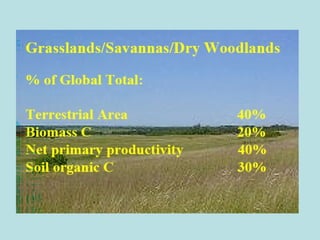
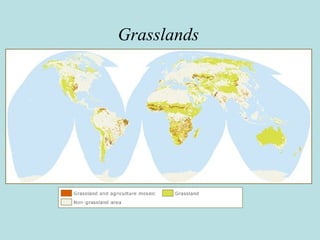
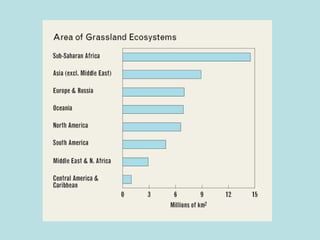
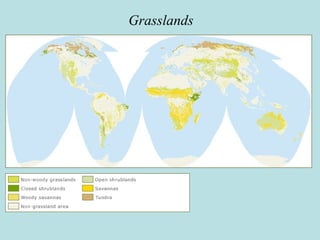
Grasslands
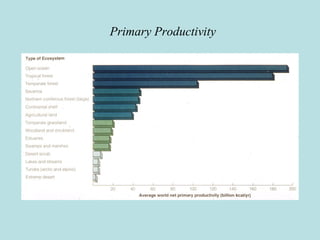
Primary Productivity
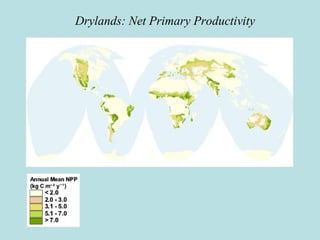
Drylands: Net Primary Productivity
Grasslands
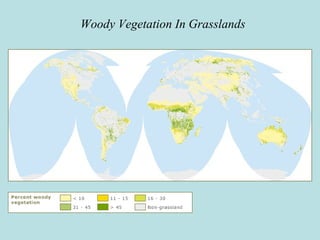
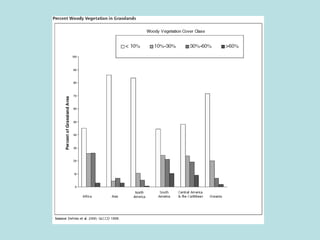
Woody Vegetation In Grasslands
FIRE ECOLOGY OR ADAPTATIONS:
In grassland ecosystems, fires may occur in any year, provided the grass is cured and ready
to burn. In the plains grasslands, mean fire intervals likely range from 4 to 20 years depending
on climates and ignition sources. Fire in grasslands can burn over large areas until a break in
terrain or a change in weather stops the fire. In desert grasslands where blue grama may
dominate, reductions in fire frequency result in shrub invasion and substantially less grass cover.
Fire occurring during periods of drought combined with wind erosion may retard the
process of succession.
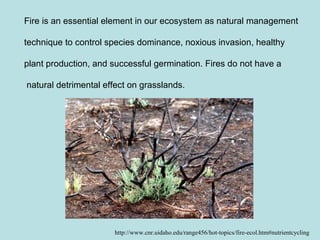
Fire is an essential element in our ecosystem as natural management
technique to control species dominance, noxious invasion, healthy
plant production, and successful germination. Fires do not have a
natural detrimental effect on grasslands.
http://www.cnr.uidaho.edu/range456/hot-topics/fire-ecol.htm#nutrientcycling
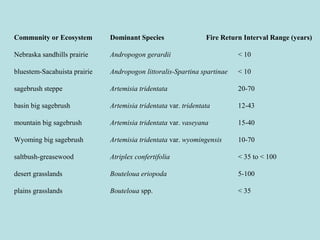
Community or Ecosystem Dominant Species Fire Return Interval Range (years)
Nebraska sandhills prairie Andropogon gerardii < 10
bluestem-Sacahuista prairie Andropogon littoralis-Spartina spartinae < 10
sagebrush steppe Artemisia tridentata 20-70
basin big sagebrush Artemisia tridentata var. tridentata 12-43
mountain big sagebrush Artemisia tridentata var. vaseyana 15-40
Wyoming big sagebrush Artemisia tridentata var. wyomingensis 10-70
saltbush-greasewood Atriplex confertifolia < 35 to < 100
desert grasslands Bouteloua eriopoda 5-100
plains grasslands Bouteloua spp. < 35
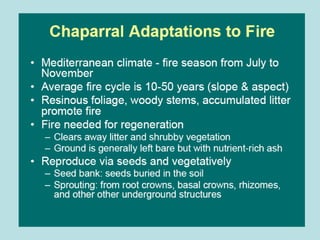
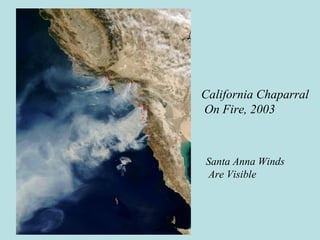
California Chaparral
On Fire, 2003
Santa Anna Winds
Are Visible
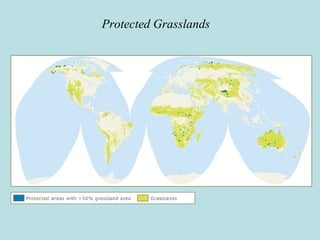
Protected Grasslands
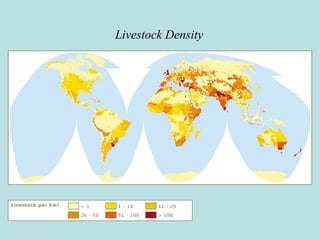
Livestock Density
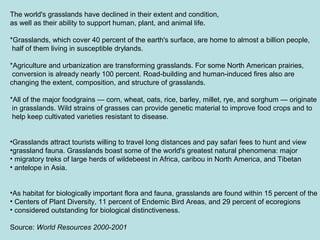
The world's grasslands have declined in their extent and condition,
as well as their ability to support human, plant, and animal life.
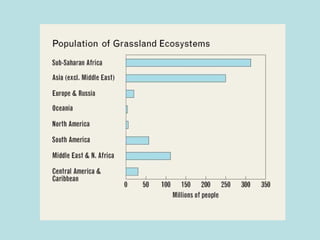
*Grasslands, which cover 40 percent of the earth's surface, are home to almost a billion people,
half of them living in susceptible drylands.
*Agriculture and urbanization are transforming grasslands. For some North American prairies,
conversion is already nearly 100 percent. Road-building and human-induced fires also are
changing the extent, composition, and structure of grasslands.
*All of the major foodgrains — corn, wheat, oats, rice, barley, millet, rye, and sorghum — originate
in grasslands. Wild strains of grasses can provide genetic material to improve food crops and to
help keep cultivated varieties resistant to disease.
•Grasslands attract tourists willing to travel long distances and pay safari fees to hunt and view
•grassland fauna. Grasslands boast some of the world's greatest natural phenomena: major
• migratory treks of large herds of wildebeest in Africa, caribou in North America, and Tibetan
• antelope in Asia.
•As habitat for biologically important flora and fauna, grasslands are found within 15 percent of the
• Centers of Plant Diversity, 11 percent of Endemic Bird Areas, and 29 percent of ecoregions
• considered outstanding for biological distinctiveness.
Source: World Resources 2000-2001
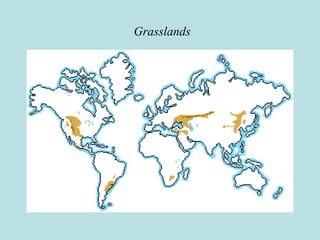
Grasslands
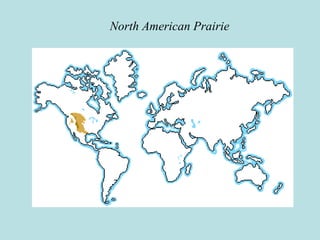
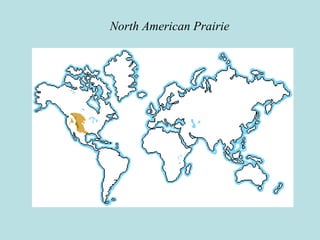
North American Prairie
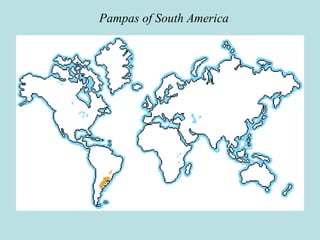
Pampas of South America
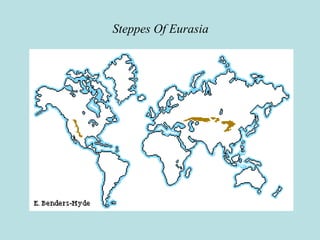
Steppes Of Eurasia
North American Prairie
(Alberta, Saskatchewan, Manitoba
North and South Dakota, Nebraska,
Colorado. Minnesota, Montana)
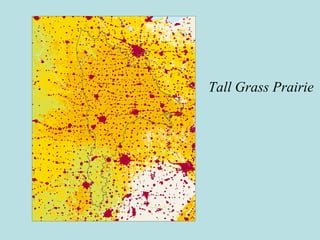
Tall Grass Prairie
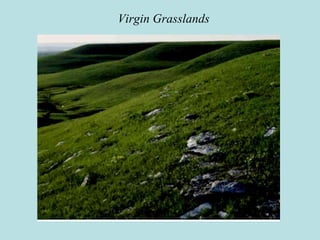
Virgin Grasslands
What Ever Happened To The “Dust Bowl”?*
*read: Grapes Of Wrath
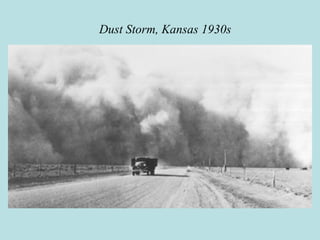
Dust Storm, Kansas 1930s
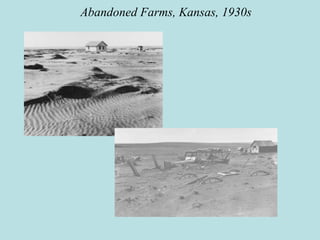
Abandoned Farms, Kansas, 1930s
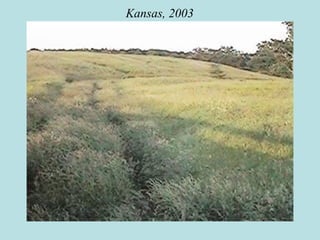
Kansas, 2003
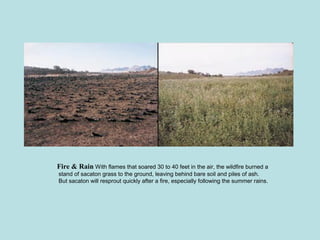
Fire & Rain With flames that soared 30 to 40 feet in the air, the wildfire burned a
stand of sacaton grass to the ground, leaving behind bare soil and piles of ash.
But sacaton will resprout quickly after a fire, especially following the summer rains.
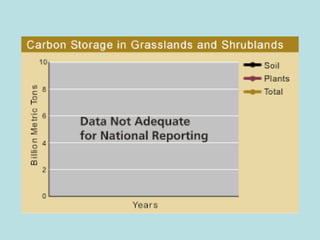
Technical Note for Grasslands and Shrublands Indicator: Carbon Storage  
The Indicator
This indicator seeks to track long-term changes in carbon sequestration in grasslands and
shrublands. Measurements of this indicator through time can provide information on whether
the ecosystem is a net source or a net sink of atmospheric carbon dioxide. An ecosystem
accruing carbon is one contributing to a reduction in greenhouse gases. White et al. (2000)
have estimated that grassland ecosystems worldwide store an amount of carbon that is about
of that stored by the world’s forests and roughly equivalent to that stored by agricultural systems.
http://www.heinzctr.org/ecosystems/grass_technotes/grass_crbn_strg.shtml
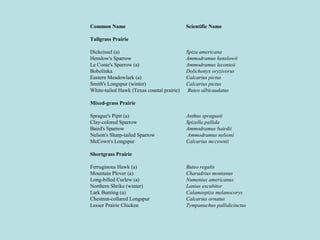
Biodiversity Of Birds Utilizing Prairie Habitats
Common Name Scientific Name
Tallgrass Prairie
Dickcissel (a) Spiza americana
Henslow's Sparrow Ammodramus henslowii
Le Conte's Sparrow (a) Ammodramus leconteii
Bobolinka Dolichonyx oryzivorus
Eastern Meadowlark (a) Calcarius pictus
Smith's Longspur (winter) Calcarius pictus
White-tailed Hawk (Texas coastal prairie) Buteo albicaudatus
Mixed-grass Prairie
Sprague's Pipit (a) Anthus spragueii
Clay-colored Sparrow Spizella pallida
Baird's Sparrow Ammodramus bairdii
Nelson's Sharp-tailed Sparrow Ammodramus nelsoni
McCown's Longspur Calcarius mccownii
Shortgrass Prairie
Ferruginous Hawk (a) Buteo regalis
Mountain Plover (a) Charadrius montanus
Long-billed Curlew (a) Numenius americanus
Northern Shrike (winter) Lanius excubitor
Lark Bunting (a) Calamospiza melanocorys
Chestnut-collared Longspur Calcarius ornatus
Lesser Prairie Chicken Tympanuchus pallidicinctus
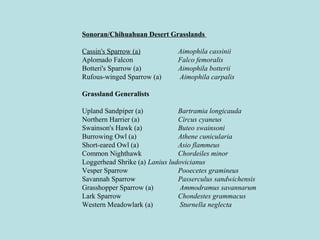
Sonoran/Chihuahuan Desert Grasslands
Cassin's Sparrow (a) Aimophila cassinii
Aplomado Falcon Falco femoralis
Botteri's Sparrow (a) Aimophila botterii
Rufous-winged Sparrow (a) Aimophila carpalis
Grassland Generalists
Upland Sandpiper (a) Bartramia longicauda
Northern Harrier (a) Circus cyaneus
Swainson's Hawk (a) Buteo swainsoni
Burrowing Owl (a) Athene cunicularia
Short-eared Owl (a) Asio flammeus
Common Nighthawk Chordeiles minor
Loggerhead Shrike (a) Lanius ludovicianus
Vesper Sparrow Pooecetes gramineus
Savannah Sparrow Passerculus sandwichensis
Grasshopper Sparrow (a) Ammodramus savannarum
Lark Sparrow Chondestes grammacus
Western Meadowlark (a) Sturnella neglecta
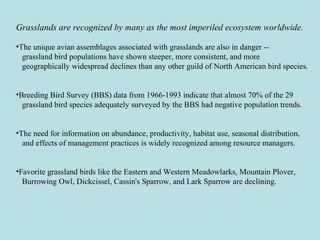
Grasslands are recognized by many as the most imperiled ecosystem worldwide.
•The unique avian assemblages associated with grasslands are also in danger --
grassland bird populations have shown steeper, more consistent, and more
geographically widespread declines than any other guild of North American bird species.
•Breeding Bird Survey (BBS) data from 1966-1993 indicate that almost 70% of the 29
grassland bird species adequately surveyed by the BBS had negative population trends.
•The need for information on abundance, productivity, habitat use, seasonal distribution,
and effects of management practices is widely recognized among resource managers.
•Favorite grassland birds like the Eastern and Western Meadowlarks, Mountain Plover,
Burrowing Owl, Dickcissel, Cassin's Sparrow, and Lark Sparrow are declining.
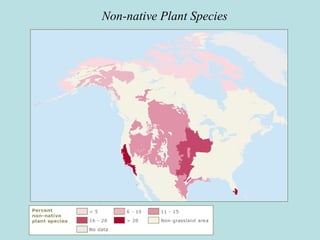
Non-native Plant Species
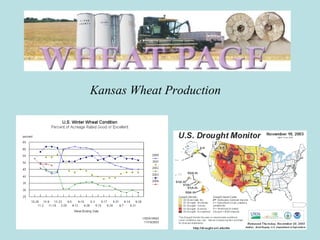
Kansas Wheat Production
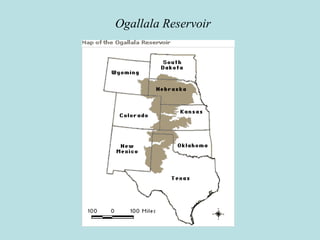
Ogallala Reservoir
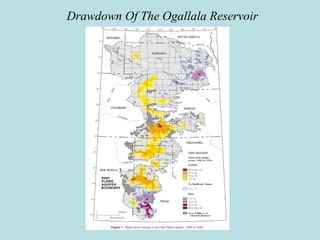
Drawdown Of The Ogallala Reservoir
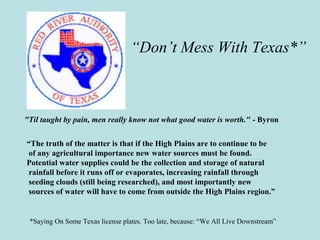
“The truth of the matter is that if the High Plains are to continue to be
of any agricultural importance new water sources must be found.
Potential water supplies could be the collection and storage of natural
rainfall before it runs off or evaporates, increasing rainfall through
seeding clouds (still being researched), and most importantly new
sources of water will have to come from outside the High Plains region.”
"Til taught by pain, men really know not what good water is worth." - Byron
“Don’t Mess With Texas*”
*Saying On Some Texas license plates. Too late, because: “We All Live Downstream”

Grasslands slides

  • 1.
  • 3.
    Ecosystem Functions AndServices 1. Carbon Storage 2. Nutrient re-cycling 3. Habitat For Grazers 4. Buffer Between Deserts and Forests 5. Useful For Grain Crop Agriculture
  • 4.
  • 5.
  • 6.
  • 10.
  • 11.
  • 13.
  • 14.
  • 17.
    FIRE ECOLOGY ORADAPTATIONS: In grassland ecosystems, fires may occur in any year, provided the grass is cured and ready to burn. In the plains grasslands, mean fire intervals likely range from 4 to 20 years depending on climates and ignition sources. Fire in grasslands can burn over large areas until a break in terrain or a change in weather stops the fire. In desert grasslands where blue grama may dominate, reductions in fire frequency result in shrub invasion and substantially less grass cover. Fire occurring during periods of drought combined with wind erosion may retard the process of succession.
  • 18.
    Fire is anessential element in our ecosystem as natural management technique to control species dominance, noxious invasion, healthy plant production, and successful germination. Fires do not have a natural detrimental effect on grasslands. http://www.cnr.uidaho.edu/range456/hot-topics/fire-ecol.htm#nutrientcycling
  • 20.
    Community or EcosystemDominant Species Fire Return Interval Range (years) Nebraska sandhills prairie Andropogon gerardii < 10 bluestem-Sacahuista prairie Andropogon littoralis-Spartina spartinae < 10 sagebrush steppe Artemisia tridentata 20-70 basin big sagebrush Artemisia tridentata var. tridentata 12-43 mountain big sagebrush Artemisia tridentata var. vaseyana 15-40 Wyoming big sagebrush Artemisia tridentata var. wyomingensis 10-70 saltbush-greasewood Atriplex confertifolia < 35 to < 100 desert grasslands Bouteloua eriopoda 5-100 plains grasslands Bouteloua spp. < 35
  • 22.
    California Chaparral On Fire,2003 Santa Anna Winds Are Visible
  • 23.
  • 25.
  • 26.
    The world's grasslandshave declined in their extent and condition, as well as their ability to support human, plant, and animal life. *Grasslands, which cover 40 percent of the earth's surface, are home to almost a billion people, half of them living in susceptible drylands. *Agriculture and urbanization are transforming grasslands. For some North American prairies, conversion is already nearly 100 percent. Road-building and human-induced fires also are changing the extent, composition, and structure of grasslands. *All of the major foodgrains — corn, wheat, oats, rice, barley, millet, rye, and sorghum — originate in grasslands. Wild strains of grasses can provide genetic material to improve food crops and to help keep cultivated varieties resistant to disease. •Grasslands attract tourists willing to travel long distances and pay safari fees to hunt and view •grassland fauna. Grasslands boast some of the world's greatest natural phenomena: major • migratory treks of large herds of wildebeest in Africa, caribou in North America, and Tibetan • antelope in Asia. •As habitat for biologically important flora and fauna, grasslands are found within 15 percent of the • Centers of Plant Diversity, 11 percent of Endemic Bird Areas, and 29 percent of ecoregions • considered outstanding for biological distinctiveness. Source: World Resources 2000-2001
  • 27.
  • 28.
  • 29.
  • 30.
  • 31.
  • 32.
    North American Prairie (Alberta,Saskatchewan, Manitoba North and South Dakota, Nebraska, Colorado. Minnesota, Montana)
  • 36.
  • 38.
  • 40.
    What Ever HappenedTo The “Dust Bowl”?* *read: Grapes Of Wrath
  • 41.
  • 42.
  • 43.
  • 44.
    Fire & RainWith flames that soared 30 to 40 feet in the air, the wildfire burned a stand of sacaton grass to the ground, leaving behind bare soil and piles of ash. But sacaton will resprout quickly after a fire, especially following the summer rains.
  • 45.
    Technical Note forGrasslands and Shrublands Indicator: Carbon Storage   The Indicator This indicator seeks to track long-term changes in carbon sequestration in grasslands and shrublands. Measurements of this indicator through time can provide information on whether the ecosystem is a net source or a net sink of atmospheric carbon dioxide. An ecosystem accruing carbon is one contributing to a reduction in greenhouse gases. White et al. (2000) have estimated that grassland ecosystems worldwide store an amount of carbon that is about of that stored by the world’s forests and roughly equivalent to that stored by agricultural systems. http://www.heinzctr.org/ecosystems/grass_technotes/grass_crbn_strg.shtml
  • 47.
    Biodiversity Of BirdsUtilizing Prairie Habitats
  • 48.
    Common Name ScientificName Tallgrass Prairie Dickcissel (a) Spiza americana Henslow's Sparrow Ammodramus henslowii Le Conte's Sparrow (a) Ammodramus leconteii Bobolinka Dolichonyx oryzivorus Eastern Meadowlark (a) Calcarius pictus Smith's Longspur (winter) Calcarius pictus White-tailed Hawk (Texas coastal prairie) Buteo albicaudatus Mixed-grass Prairie Sprague's Pipit (a) Anthus spragueii Clay-colored Sparrow Spizella pallida Baird's Sparrow Ammodramus bairdii Nelson's Sharp-tailed Sparrow Ammodramus nelsoni McCown's Longspur Calcarius mccownii Shortgrass Prairie Ferruginous Hawk (a) Buteo regalis Mountain Plover (a) Charadrius montanus Long-billed Curlew (a) Numenius americanus Northern Shrike (winter) Lanius excubitor Lark Bunting (a) Calamospiza melanocorys Chestnut-collared Longspur Calcarius ornatus Lesser Prairie Chicken Tympanuchus pallidicinctus
  • 49.
    Sonoran/Chihuahuan Desert Grasslands Cassin'sSparrow (a) Aimophila cassinii Aplomado Falcon Falco femoralis Botteri's Sparrow (a) Aimophila botterii Rufous-winged Sparrow (a) Aimophila carpalis Grassland Generalists Upland Sandpiper (a) Bartramia longicauda Northern Harrier (a) Circus cyaneus Swainson's Hawk (a) Buteo swainsoni Burrowing Owl (a) Athene cunicularia Short-eared Owl (a) Asio flammeus Common Nighthawk Chordeiles minor Loggerhead Shrike (a) Lanius ludovicianus Vesper Sparrow Pooecetes gramineus Savannah Sparrow Passerculus sandwichensis Grasshopper Sparrow (a) Ammodramus savannarum Lark Sparrow Chondestes grammacus Western Meadowlark (a) Sturnella neglecta
  • 50.
    Grasslands are recognizedby many as the most imperiled ecosystem worldwide. •The unique avian assemblages associated with grasslands are also in danger -- grassland bird populations have shown steeper, more consistent, and more geographically widespread declines than any other guild of North American bird species. •Breeding Bird Survey (BBS) data from 1966-1993 indicate that almost 70% of the 29 grassland bird species adequately surveyed by the BBS had negative population trends. •The need for information on abundance, productivity, habitat use, seasonal distribution, and effects of management practices is widely recognized among resource managers. •Favorite grassland birds like the Eastern and Western Meadowlarks, Mountain Plover, Burrowing Owl, Dickcissel, Cassin's Sparrow, and Lark Sparrow are declining.
  • 51.
  • 52.
  • 53.
  • 54.
    Drawdown Of TheOgallala Reservoir
  • 55.
    “The truth ofthe matter is that if the High Plains are to continue to be of any agricultural importance new water sources must be found. Potential water supplies could be the collection and storage of natural rainfall before it runs off or evaporates, increasing rainfall through seeding clouds (still being researched), and most importantly new sources of water will have to come from outside the High Plains region.” "Til taught by pain, men really know not what good water is worth." - Byron “Don’t Mess With Texas*” *Saying On Some Texas license plates. Too late, because: “We All Live Downstream”