This document provides an overview of watershed development. It defines a watershed as an area of land that drains water to a common point. It describes the characteristics of watersheds including size, shape, physiography, slope, climate, drainage, vegetation, geology and soils, hydrology, and socioeconomics. It outlines the objectives, advantages, management measures, types, and aims of watershed development programs. It also discusses rainwater harvesting, development work carried out in watersheds, economic assessment, and the role of cooperative societies in watershed management.
Introduction to watershed development and the key topics covered including definitions, characteristics, and advantages.
Definition of watershed as drainage basins, characteristics, types, and its implications on water flow.
Detailed characteristics influencing watershed management including size, climate, vegetation, and hydrology.
Environmental benefits of watershed management including economic value and community involvement.
Emphasizes the necessity of community involvement for successful watershed management and development programs.
Overview of key measures for effective watershed management focused on soil and vegetation preservation.
Classification of watersheds into small and large categories based on area and specific characteristics.
The importance of rainwater harvesting amid climate change and water shortages to capture and manage rain.
Essential objectives and need for rainwater harvesting emphasizing population growth and water scarcity.
Criteria for selecting sites suitable for watershed treatment focusing on environment and community needs.
Various development activities carried out as part of watershed treatment including construction and surveys.Analysis of the economic considerations for watershed projects, looking at benefits, costs, and feasibility.
Importance of cooperatives in promoting community engagement and effective watershed management.
INDEX
What isWatershed
Charecteristics of Watershed
Advantages of Watershed
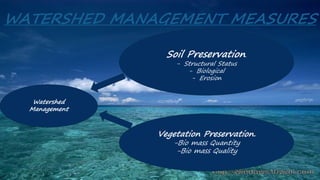
Watershed Management Measures
Types of Watershed
Objectives of Watershed
Aims of Watershed
Rainwater Harvesting
Development work carried out under Watershed treatment
Economical Assessment of Watershed Project
Role of Co-operative Society in Watershed Management
4.
WHAT IS WATERSHED
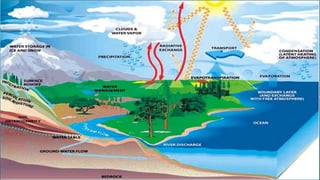
A watershed can be defined as the drainage basin or catchment
area of a particular stream or river. It refers to the area from
where the water to the particular drainage system, like river or
stream comes from. The topmost portion of the watershed is
known as ridge.
The line joining the ridge portion along the boundry of the
watershed is called a RIDGE LINE.
A water shed may be nearly flat or may include hills, hillocks,
or mountain.
6.
It carries rainwaterfalling on it drop by drop and channels it into soil,

rivulets and streams flowing into large rivers and in due course sea.
It affects the people living downstream
It is a synonym of catchment or basin of a river coined for an area
restricted to 2000sq. Km.
A watershed is a basin like landform defined by peaks which are connected
by ridges that descend into lower elevations and small valleys.
CHARACTERISTICS OF WATERSHEDS
Allcharacteristics affect the disposal of water.
SIZE: It helps in computing parameters like precipitation
received, retained, drained off.
SHAPE: Different shapes based on morphological parameters like
geology and structure, eg. pear, elongated etc.
PHISIOGRAPHY: Lands altitude and physical disposition.
SLOPE: It controls the rainfall distribution and movement:
CLIMATE: It decides the quantitative approach.
DRAINAGE: It determines the flow characteristics and so the
erosion behavior.
9.
VEGETATION: Informationof species gives a sure ground for
selection plants and crops.
GEOLOGY AND SOILS: Their nature determines size, shape,
physiographic, drainage and groundwater conditions. Soils,
derivative of rocks are the basic to greenery
HYDROLOGY: Basic to final goal of growing greenery in a
watershed. It helps in quantification of water available.
HYDROGEOLOGY: Availability of groundwater.
SOCIOECONOMICS: Statistics on people and their health,
hygiene, wants and wishes are important in managing water.
10.
ADVANTAGES OF WATERSHED
ENVIRONMENTAL FRIENDLY
SAVES TIME AND MONEY
GREATER PEOPLES PARTICIPATION
11.
Watersheds sustain life,in more ways than one. According to the
Environmental Protection Agency, more than $450 billion in foods, fiber,
manufactured goods and tourism depend on clean, healthy watersheds. That
is why proper watershed protection is necessary to you and your
community.
Be part of our community! Every month, the Conservancy’s Great Places e-
newsletter brings you conservation updates from Indiana and around the
world — plus incredible nature photos and green living tips you can use. Join
today — it's free!
Watershed protection is a means of protecting a lake, river, or stream by
managing the entire watershed that drains into it. Clean, healthy
watersheds depend on an informed public to make the right decisions when
it comes to the environment and actions made by the community.
WATERSHED IN ENVIRONMENT
FRIENDLY
13.
GREATER PEOPLES PARTICIPITION
Thesuccess of any developmental program depends upom the
direct participation of the beneficiaries. Any developmental
program without peoples participation remains only as
governmental program paper.
The points consider in this are:
The peoples benefited by the project must be poor
There should be primary evidence regarding attempts made by
peoples to solve their problems.
There should be at least 5% contribution of the total cost of the
project from local villagers
Selected work must be technically sound.
14.
The matterdecided for the development should be simple so
that people can easily understand it.
There should be resolution regarding consent of grampanchayat
for maintenance & management of facilities to be developed.
There should be a resolution passed in the grampanchayat that
the benefits of the project will be shared by all the categories of
people such as women SC/ST, etc.
i. Small Watersheds:
TheSmall Watershed — A program created under
the Watershed Protection and Flood Prevention Act ) and 1 of 3
programs that are combined into the Watershed and Flood
Prevention Operations Program. The Small Watershed Program is
available in watersheds that are smaller than 250,000 acres
(1,000 km2). Currently, there are 515 active projects in this
program.
Watersheds generally contains design such as culverts, storm
sewers, small bridges.
18.
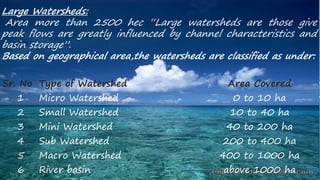
Large Watersheds:
Area morethan 2500 hec “Large watersheds are those give
peak flows are greatly influenced by channel characteristics and
basin storage”.
Based on geographical area,the watersheds are classified as under:
Sr. No Type of Watershed Area Covered
1 Micro Watershed 0 to 10 ha
2 Small Watershed 10 to 40 ha
3 Mini Watershed 40 to 200 ha
4 Sub Watershed 200 to 400 ha
5 Macro Watershed 400 to 1000 ha
6 River basin above 1000 ha
19.
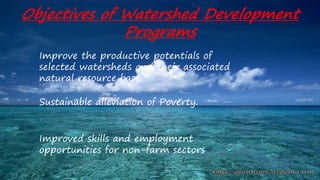
Improve the productivepotentials of
selected watersheds and their associated
natural resource base.
Sustainable alleviation of Poverty.
Improved skills and employment
opportunities for non-farm sectors
Objectives of Watershed Development
Programs
AIMS OF WATERSHEDDEVELOPMENT
- The aims of watershed development are:
To preserve ecological balance.
To retard the adverse effects of drought.
Social and economic upliftment of poor and backward class
peoples.
To increase per capita income of the village people.
To increase employment opportunities in the selected villages.
To increase biomass production.
23.
COMPONENTS OF WATERSHED
DEVELOPMENT
Themain consonants of watershed development are:
Soil and land management
Water management- talavdi
Crop management
Afforestation
Rural management
Farm and non-farm value addition activities
24.
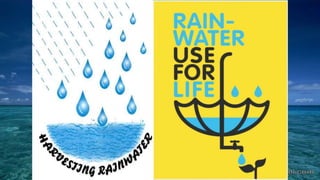
Rainwater Harvesting:
Extreme conditionsin future, human society will be
bound to use different means of adaptation due to
climatic changes. Old people said ‘capture water when it
rains’. It is also true in the present context of water crisis.
Today, the world is facing serious water shortage. Every
drop of water is valuable because ‘where there is water
there is life’. There has been increased aridity in India
over the last few decades. Water scarcity is likely to
increase in India due to increasing population.
25.
Objectives of RainwaterHarvesting:
1.To reduce loss from surface runoff
2. To avoid flooding
3. To meet the increasing demands of water
4. To raise the water-table by recharging groundwater
5. To reduce groundwater contamination
26.
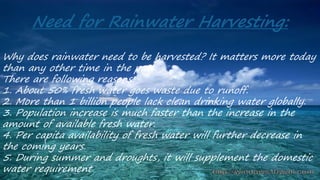
Need for RainwaterHarvesting:
Why does rainwater need to be harvested? It matters more today
than any other time in the past.
There are following reasons:
1. About 50% fresh water goes waste due to runoff.
2. More than 1 billion people lack clean drinking water globally.
3. Population increase is much faster than the increase in the
amount of available fresh water.
4. Per capita availability of fresh water will further decrease in
the coming years.
5. During summer and droughts, it will supplement the domestic
water requirement.
28.
6. Climatic changesalso lead to increase in precipitation,
evaporation, transpiration, occurrence of storms and changes in
biogeochemical processes affecting water quality.
7. It is essential to reduce groundwater pollution and improve the
quality of water.
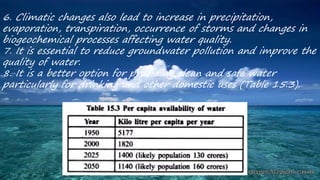
8. It is a better option for providing clean and safe water
particularly for drinking and other domestic uses (Table 15.3).
29.
POINTS KEPT INMIND WHILE
SELECTING SITE FOR WATERSHED
Where Large Area Of Land Barren.
Where There Is scarcity Of Drinking Water.
Where Large Area Of Land Is Under group Ownership.
Where Major Group Of People Belongs SC/ST Community.
Undeveloped Area.
The Area Under Grampanchayat.
30.
DEVELOPMENT WORK CARRIEDOUT
UNDER WATERSHED TREATMENT :
1. Construction of small Water Storage Works, Like
Check Dams
Khet Talavadi
2. Flood Control Measures, Like
Flood Control Reservoirs
Re-Vegetation
31.
3. Afforestation
NurseryDevelopment
Fodder Development
4. To Conduct Various Type Of Surveys, Like
Contour Survey
Hydrological Survey
Ground Water Study
32.
5. Agriculture Development
Crop Rotation
Study of soil Chemistry
Suitability of crop
6. Erosion control measures
Erosion control structures
Contours terracing in hilly areas
Re-vegetation
33.
7. Fisheries Development
Ponds
Tanks
Farm Pond.
8. Promotion of Non-Conventional Energies
energy Sources
Energy conservation
Bio-Fuel Plantation
34.
Economical Assessment ofwatershed Project
Aims :
• Budget impact
• The project increase economic stability.
• Project attractive to private entities.
• Long term work of inter-generation benefits
• Multiple use and multi products
• Externalities- indirect
• Spatial distribution of costs and benefits
• Difficulties in qualification and valuation
35.
Factors and limitsof Economic Assessment
• Project worth
• Project feasibility and attractions
• Risk factors
• Project design and various alternatives
• Limitations
• All benefits cannot be quantified
• Depends on data
• Major Techniques
• With and without project approach
• Discount – future value
• Cost and benefit analysis
36.
ROLE OF CO-OPERATIVESOCIETY IN
WATERSHED MANAGEMENT
The points considered in this management are as under:
1) To increase faith of people in the government projects.
2) To encourage people for research
3) To encourage skill of people.
4) To give new direction to the peoples viewpoints
5) To explain importance of water to the people
6) To give contribution in the form of labour