AUTECOLOGY
RIZA JOY D. PALOMAR
Discussant
EdD SE 714 | Advance Ecology
TABLE OF CONTENTS
DISTRIBUTION
AND ABUNDANCE
OF ORGANISM
TRADE-OFFS
01
02
HABITAT AND
ECOLOGICAL
NICHE
02
DISTRIBUTION AND
ABUNDANCE OF
ORGANISM
DISTRIBUTION
Distribution refers to the region where an
organism is found.
Biogeography is the study of geological species
distribution, which is influenced by both biotic and
abiotic factors.
● A species range is the area where a particular species can be
found during its lifetime. Species range includes areas where
individuals or communities may migrate or hibernate.
● Every living species on the planet has its own unique geographic
range.
● Some species have a wide range, while others live in a very
limited area.
Range
COSMOPOLITAN DISTRIBUTION
● Species with ranges that cover most of the Earth.
● It does not include areas of extreme weather, such as
the Antarctic and Arctic, within its definition.
Range Distribution
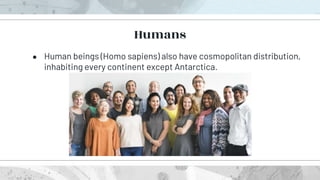
● Human beings (Homo sapiens) also have cosmopolitan distribution,
inhabiting every continent except Antarctica.
Humans
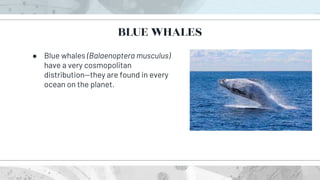
● Blue whales (Balaenoptera musculus)
have a very cosmopolitan
distribution—they are found in every
ocean on the planet.
BLUE WHALES
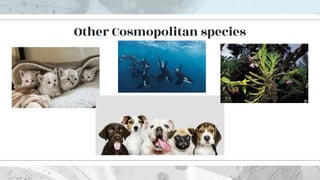
Other Cosmopolitan species
ENDEMIC DISTRIBUTION
● Species with limited range.
● Confinement of a particular species, genus, or groups
of plants and animals to a particular area.
● Only where there is a considerable restriction in the
area of distribution.
Range Distribution
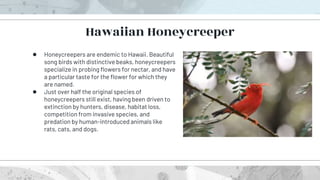
● Honeycreepers are endemic to Hawaii. Beautiful
song birds with distinctive beaks, honeycreepers
specialize in probing flowers for nectar, and have
a particular taste for the flower for which they
are named.
● Just over half the original species of
honeycreepers still exist, having been driven to
extinction by hunters, disease, habitat loss,
competition from invasive species, and
predation by human-introduced animals like
rats, cats, and dogs.
Hawaiian Honeycreeper
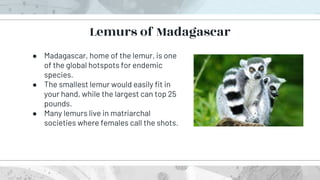
● Madagascar, home of the lemur, is one
of the global hotspots for endemic
species.
● The smallest lemur would easily fit in
your hand, while the largest can top 25
pounds.
● Many lemurs live in matriarchal
societies where females call the shots.
Lemurs of Madagascar
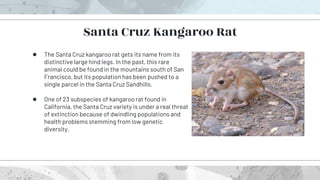
● The Santa Cruz kangaroo rat gets its name from its
distinctive large hind legs. In the past, this rare
animal could be found in the mountains south of San
Francisco, but its population has been pushed to a
single parcel in the Santa Cruz Sandhills.
● One of 23 subspecies of kangaroo rat found in
California, the Santa Cruz variety is under a real threat
of extinction because of dwindling populations and
health problems stemming from low genetic
diversity.
Santa Cruz Kangaroo Rat
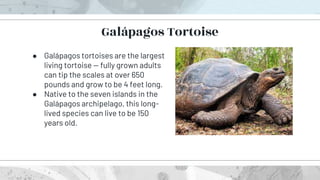
● Galápagos tortoises are the largest
living tortoise — fully grown adults
can tip the scales at over 650
pounds and grow to be 4 feet long.
● Native to the seven islands in the
Galápagos archipelago, this long-
lived species can live to be 150
years old.
Galápagos Tortoise
PHILIPPINE SPECIES
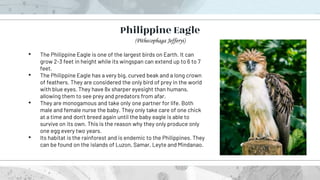
• The Philippine Eagle is one of the largest birds on Earth. It can
grow 2-3 feet in height while its wingspan can extend up to 6 to 7
feet.
• The Philippine Eagle has a very big, curved beak and a long crown
of feathers. They are considered the only bird of prey in the world
with blue eyes. They have 8x sharper eyesight than humans,
allowing them to see prey and predators from afar.
• They are monogamous and take only one partner for life. Both
male and female nurse the baby. They only take care of one chick
at a time and don’t breed again until the baby eagle is able to
survive on its own. This is the reason why they only produce only
one egg every two years.
• Its habitat is the rainforest and is endemic to the Philippines. They
can be found on the islands of Luzon, Samar, Leyte and Mindanao.
Philippine Eagle
(Pithecophaga Jefferyi)
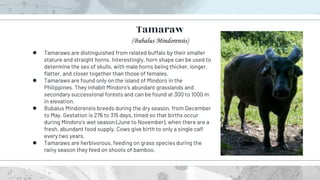
● Tamaraws are distinguished from related buffalo by their smaller
stature and straight horns. Interestingly, horn shape can be used to
determine the sex of skulls, with male horns being thicker, longer,
flatter, and closer together than those of females.
● Tamaraws are found only on the island of Mindoro in the
Philippines. They inhabit Mindoro’s abundant grasslands and
secondary successional forests and can be found at 300 to 1000 m
in elevation.
● Bubalus Mindorensis breeds during the dry season, from December
to May. Gestation is 276 to 315 days, timed so that births occur
during Mindoro’s wet season (June to November), when there are a
fresh, abundant food supply. Cows give birth to only a single calf
every two years.
● Tamaraws are herbivorous, feeding on grass species during the
rainy season they feed on shoots of bamboo.
Tamaraw
(Bubalus Mindorensis)
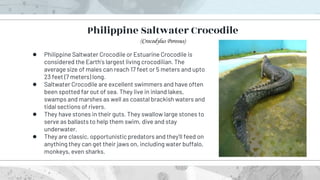
● Philippine Saltwater Crocodile or Estuarine Crocodile is
considered the Earth’s largest living crocodilian. The
average size of males can reach 17 feet or 5 meters and upto
23 feet (7 meters) long.
● Saltwater Crocodile are excellent swimmers and have often
been spotted far out of sea. They live in inland lakes,
swamps and marshes as well as coastal brackish waters and
tidal sections of rivers.
● They have stones in their guts. They swallow large stones to
serve as ballasts to help them swim, dive and stay
underwater.
● They are classic, opportunistic predators and they’ll feed on
anything they can get their jaws on, including water buffalo,
monkeys, even sharks.
Philippine Saltwater Crocodile
(Crocodylus Porosus)
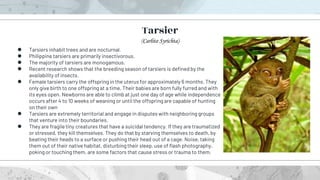
● Tarsiers inhabit trees and are nocturnal.
● Philippine tarsiers are primarily insectivorous.
● The majority of tarsiers are monogamous.
● Recent research shows that the breeding season of tarsiers is defined by the
availability of insects.
● Female tarsiers carry the offspring in the uterus for approximately 6 months. They
only give birth to one offspring at a time. Their babies are born fully furred and with
its eyes open. Newborns are able to climb at just one day of age while independence
occurs after 4 to 10 weeks of weaning or until the offspring are capable of hunting
on their own
● Tarsiers are extremely territorial and engage in disputes with neighboring groups
that venture into their boundaries.
● They are fragile tiny creatures that have a suicidal tendency. If they are traumatized
or stressed, they kill themselves. They do that by starving themselves to death, by
beating their heads to a surface or pushing their head out of a cage. Noise, taking
them out of their native habitat, disturbing their sleep, use of flash photography,
poking or touching them, are some factors that cause stress or trauma to them.
Tarsier
(Carlito Syrichta)
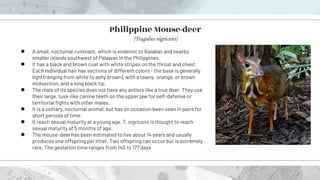
● A small, nocturnal ruminant, which is endemic to Balabac and nearby
smaller islands southwest of Palawan in the Philippines.
● It has a black and brown coat with white stripes on the throat and chest.
Each individual hair has sections of different colors - the base is generally
light (ranging from white to ashy brown), with a tawny, orange, or brown
midsection, and a long black tip.
● The male of its species does not have any antlers like a true deer. They use
their large, tusk-like canine teeth on the upper jaw for self-defense or
territorial fights with other males.
● It is a solitary, nocturnal animal, but has on occasion been seen in pairs for
short periods of time.
● It reach sexual maturity at a young age. T. nigricans is thought to reach
sexual maturity at 5 months of age.
● The mouse-deer has been estimated to live about 14 years and usually
produces one offspring per litter. Two offspring can occur but is extremely
rare. The gestation time ranges from 140 to 177 days
Philippine Mouse-deer
(Tragulus nigricans)
DISJUNCT DISTRIBUTION
● Species with two or more ranges that do not connect
with each other.
● Mountain ranges, deserts, or oceans sometimes
separate the ranges of these species.
Range Distribution
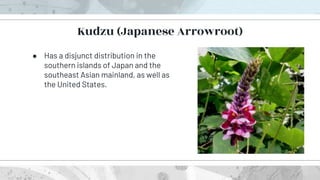
● Has a disjunct distribution in the
southern islands of Japan and the
southeast Asian mainland, as well as
the United States.
Kudzu (Japanese Arrowroot)
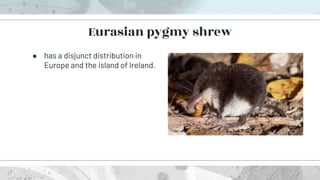
● has a disjunct distribution in
Europe and the island of Ireland.
Eurasian pygmy shrew
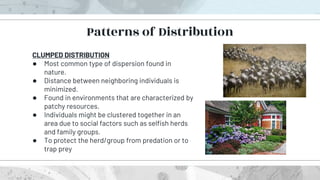
CLUMPED DISTRIBUTION
● Most common type of dispersion found in
nature.
● Distance between neighboring individuals is
minimized.
● Found in environments that are characterized by
patchy resources.
● Individuals might be clustered together in an
area due to social factors such as selfish herds
and family groups.
● To protect the herd/group from predation or to
trap prey
Patterns of Distribution
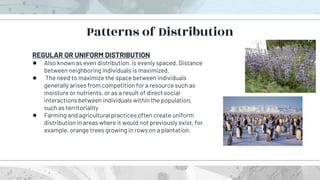
REGULAR OR UNIFORM DISTRIBUTION
● Also known as even distribution, is evenly spaced. Distance
between neighboring individuals is maximized.
● The need to maximize the space between individuals
generally arises from competition for a resource such as
moisture or nutrients, or as a result of direct social
interactions between individuals within the population,
such as territoriality
● Farming and agricultural practices often create uniform
distribution in areas where it would not previously exist, for
example, orange trees growing in rows on a plantation.
Patterns of Distribution
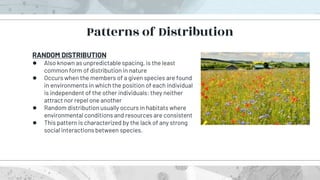
RANDOM DISTRIBUTION
● Also known as unpredictable spacing, is the least
common form of distribution in nature
● Occurs when the members of a given species are found
in environments in which the position of each individual
is independent of the other individuals: they neither
attract nor repel one another
● Random distribution usually occurs in habitats where
environmental conditions and resources are consistent
● This pattern is characterized by the lack of any strong
social interactions between species.
Patterns of Distribution
ABUNDANCE
The abundance of a species relates to how
many members of a species is present within an
ecosystem. Abundance can be measured by counting
all the individual organisms that occur within the
organism
It is usually described as density - the number
on individuals in a certain area - as this gives an idea
of crowding.
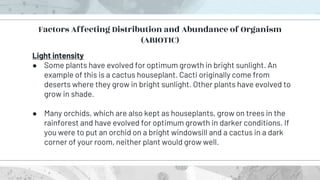
Light intensity
● Some plants have evolved for optimum growth in bright sunlight. An
example of this is a cactus houseplant. Cacti originally come from
deserts where they grow in bright sunlight. Other plants have evolved to
grow in shade.
● Many orchids, which are also kept as houseplants, grow on trees in the
rainforest and have evolved for optimum growth in darker conditions. If
you were to put an orchid on a bright windowsill and a cactus in a dark
corner of your room, neither plant would grow well.
Factors Affecting Distribution and Abundance of Organism
(ABIOTIC)
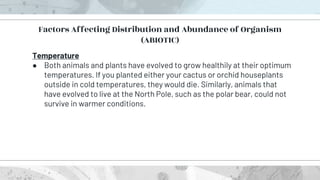
Temperature
● Both animals and plants have evolved to grow healthily at their optimum
temperatures. If you planted either your cactus or orchid houseplants
outside in cold temperatures, they would die. Similarly, animals that
have evolved to live at the North Pole, such as the polar bear, could not
survive in warmer conditions.
Factors Affecting Distribution and Abundance of Organism
(ABIOTIC)
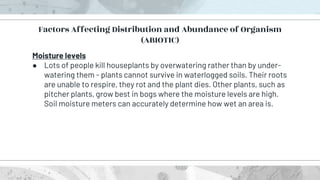
Moisture levels
● Lots of people kill houseplants by overwatering rather than by under-
watering them - plants cannot survive in waterlogged soils. Their roots
are unable to respire, they rot and the plant dies. Other plants, such as
pitcher plants, grow best in bogs where the moisture levels are high.
Soil moisture meters can accurately determine how wet an area is.
Factors Affecting Distribution and Abundance of Organism
(ABIOTIC)
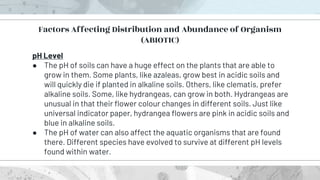
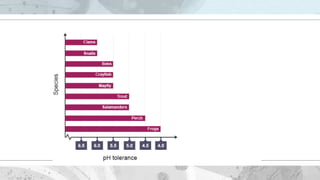
pH Level
● The pH of soils can have a huge effect on the plants that are able to
grow in them. Some plants, like azaleas, grow best in acidic soils and
will quickly die if planted in alkaline soils. Others, like clematis, prefer
alkaline soils. Some, like hydrangeas, can grow in both. Hydrangeas are
unusual in that their flower colour changes in different soils. Just like
universal indicator paper, hydrangea flowers are pink in acidic soils and
blue in alkaline soils.
● The pH of water can also affect the aquatic organisms that are found
there. Different species have evolved to survive at different pH levels
found within water.
Factors Affecting Distribution and Abundance of Organism
(ABIOTIC)
Salinity
● The amount of salt in aquatic environments affects the organisms that
are found there. Freshwater organisms could not survive in the salt
water of the sea and the reverse for saltwater organisms.
Factors Affecting Distribution and Abundance of Organism
(ABIOTIC)
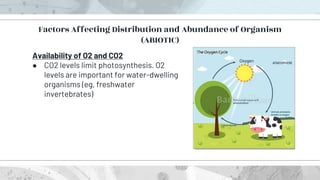
Availability of O2 and CO2
● CO2 levels limit photosynthesis. O2
levels are important for water-dwelling
organisms (eg, freshwater
invertebrates)
Factors Affecting Distribution and Abundance of Organism
(ABIOTIC)
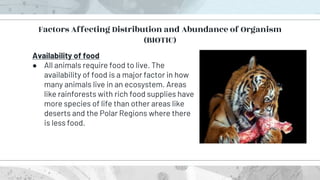
Availability of food
● All animals require food to live. The
availability of food is a major factor in how
many animals live in an ecosystem. Areas
like rainforests with rich food supplies have
more species of life than other areas like
deserts and the Polar Regions where there
is less food.
Factors Affecting Distribution and Abundance of Organism
(BIOTIC)
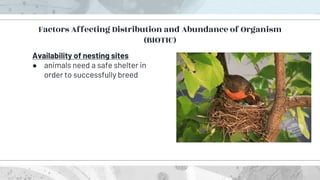
Availability of nesting sites
● animals need a safe shelter in
order to successfully breed
Factors Affecting Distribution and Abundance of Organism
(BIOTIC)
New predators
● The arrival of new predators in an ecosystem can have a devastating
effect. In balanced ecosystems, predators and prey have evolved
together. Predators can catch enough prey to survive, but not so many
that they kill all of their food.
Factors Affecting Distribution and Abundance of Organism
(BIOTIC)
New pathogens
● When organisms inhabit new ecosystems, they often bring new
pathogens. As an example, Europeans first colonized North America,
and introduced new pathogens, like the influenza virus. Many Native
Americans had not developed immunity to new diseases such as this,
and so many were killed by them.
Factors Affecting Distribution and Abundance of Organism
(BIOTIC)
New pathogens
● When organisms inhabit new ecosystems they often bring new
pathogens. As an example, Europeans first colonised North America,
and introduced new pathogens, like the influenza virus. Many Native
Americans had not developed immunity to new diseases such as this,
and so many were killed by them.
Factors Affecting Distribution and Abundance of Organism
(BIOTIC)
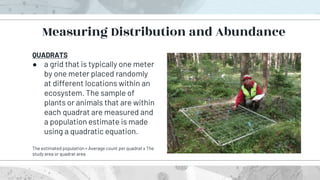
QUADRATS
● a grid that is typically one meter
by one meter placed randomly
at different locations within an
ecosystem. The sample of
plants or animals that are within
each quadrat are measured and
a population estimate is made
using a quadratic equation.
The estimated population = Average count per quadrat x The
study area or quadrat area
Measuring Distribution and Abundance
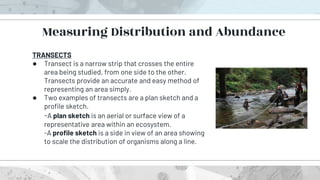
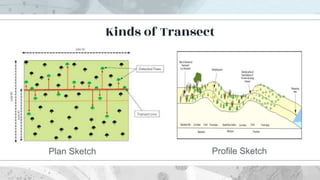
TRANSECTS
● Transect is a narrow strip that crosses the entire
area being studied, from one side to the other.
Transects provide an accurate and easy method of
representing an area simply.
● Two examples of transects are a plan sketch and a
profile sketch.
-A plan sketch is an aerial or surface view of a
representative area within an ecosystem.
-A profile sketch is a side in view of an area showing
to scale the distribution of organisms along a line.
Measuring Distribution and Abundance
Kinds of Transect
Plan Sketch Profile Sketch
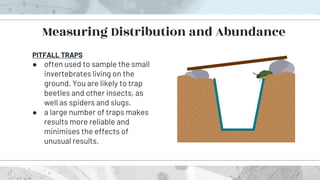
PITFALL TRAPS
● often used to sample the small
invertebrates living on the
ground. You are likely to trap
beetles and other insects, as
well as spiders and slugs.
● a large number of traps makes
results more reliable and
minimises the effects of
unusual results.
Measuring Distribution and Abundance
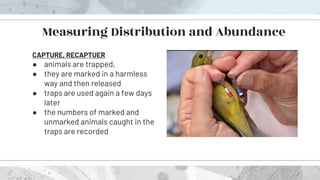
CAPTURE, RECAPTUER
● animals are trapped,
● they are marked in a harmless
way and then released
● traps are used again a few days
later
● the numbers of marked and
unmarked animals caught in the
traps are recorded
Measuring Distribution and Abundance
Scale in Measuring Distribution and Abundance
Semi-Quantitive Abundance ratings
● These are measurement methods which involve
estimation based on viewing a specific area of a
designated size. The two Semi-Quantitive Abundance
ratings used are known as the D.A.F.O.R, and the
A.C.F.O.R
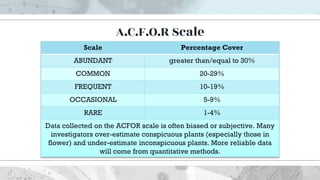
A.C.F.O.R Scale
Scale Percentage Cover
ABUNDANT greater than/equal to 30%
COMMON 20-29%
FREQUENT 10-19%
OCCASIONAL 5-9%
RARE 1-4%
Data collected on the ACFOR scale is often biased or subjective. Many
investigators over-estimate conspicuous plants (especially those in
flower) and under-estimate inconspicuous plants. More reliable data
will come from quantitative methods.
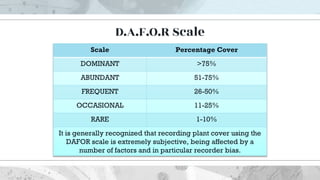
D.A.F.O.R Scale
Scale Percentage Cover
DOMINANT >75%
ABUNDANT 51-75%
FREQUENT 26-50%
OCCASIONAL 11-25%
RARE 1-10%
It is generally recognized that recording plant cover using the
DAFOR scale is extremely subjective, being affected by a
number of factors and in particular recorder bias.
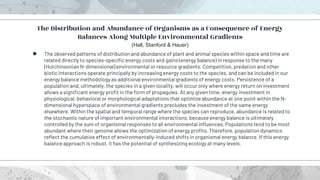
● The observed patterns of distribution and abundance of plant and animal species within space and time are
related directly to species-specific energy costs and gains (energy balance) in response to the many
(Hutchinsonian N-dimensional) environmental or resource gradients. Competition, predation and other
biotic interactions operate principally by increasing energy costs to the species, and can be included in our
energy balance methodology as additional environmental gradients of energy costs. Persistence of a
population and, ultimately, the species in a given locality, will occur only where energy return on investment
allows a significant energy profit in the form of propagules. At any given time, energy investment in
physiological, behavioral or morphological adaptations that optimize abundance at one point within the N-
dimensional hyperspace of environmental gradients precludes the investment of the same energy
elsewhere. Within the spatial and temporal range where the species can reproduce, abundance is related to
the stochastic nature of important environmental interactions, because energy balance is ultimately
controlled by the sum of organismal responses to all environmental influences. Populations tend to be most
abundant where their genome allows the optimization of energy profits. Therefore, population dynamics
reflect the cumulative effect of environmentally-induced shifts in organismal energy balance. If this energy
balance approach is robust, it has the potential of synthesizing ecology at many levels.
The Distribution and Abundance of Organisms as a Consequence of Energy
Balances Along Multiple Environmental Gradients
(Hall, Stanford & Hauer)
HABITAT AND
ECOLOGICAL NICHE
HABITAT
● A habitat is a place where an organism makes its home. A habitat
meets all the environmental conditions an organism needs to
survive.
● For an animal, that means everything it needs to find and gather
food, select a mate, and successfully reproduce.
● For a plant, a good habitat must provide the right combination of
light, air, water, and soil.
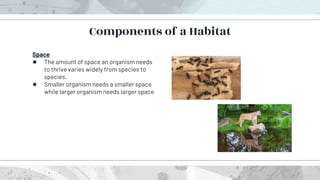
Space
● The amount of space an organism needs
to thrive varies widely from species to
species.
● Smaller organism needs a smaller space
while larger organism needs larger space
Components of a Habitat
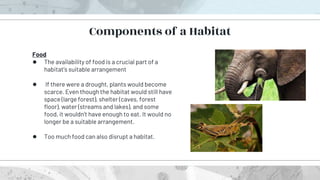
Food
● The availability of food is a crucial part of a
habitat’s suitable arrangement
● If there were a drought, plants would become
scarce. Even though the habitat would still have
space (large forest), shelter (caves, forest
floor), water (streams and lakes), and some
food, it wouldn’t have enough to eat. It would no
longer be a suitable arrangement.
● Too much food can also disrupt a habitat.
Components of a Habitat
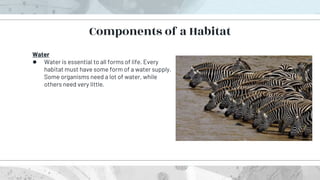
Water
● Water is essential to all forms of life. Every
habitat must have some form of a water supply.
Some organisms need a lot of water, while
others need very little.
Components of a Habitat
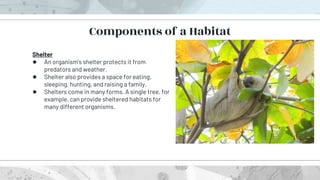
Shelter
● An organism’s shelter protects it from
predators and weather.
● Shelter also provides a space for eating,
sleeping, hunting, and raising a family.
● Shelters come in many forms. A single tree, for
example, can provide sheltered habitats for
many different organisms.
Components of a Habitat
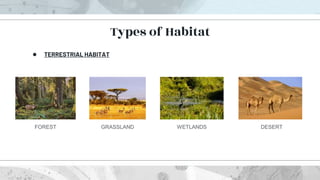
● TERRESTRIAL HABITAT
Types of Habitat
FOREST GRASSLAND WETLANDS DESERT
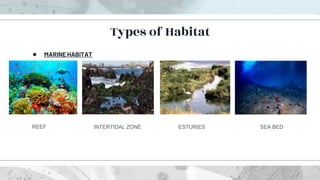
● MARINE HABITAT
Types of Habitat
REEF INTERTIDAL ZONE ESTURIES SEA BED
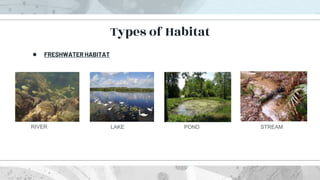
● FRESHWATER HABITAT
Types of Habitat
RIVER LAKE POND STREAM
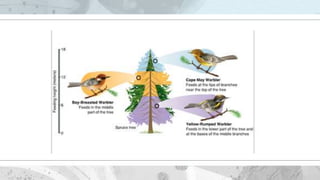
ECOLOGICAL NICHE
● Ecological niche is a term for the position of a species within an ecosystem,
describing both the range of conditions necessary for persistence of the
species, and its ecological role in the ecosystem.
● Grinnell (1917) define it as a habitat requirements of a species for it to survive and
reproduce.
● Elton (1927) define it as "the position or status of an organism within its
community and ecosystem as a result of the organism's structural and functional
adaptations.
● Hutchinson (1959) define it as multidimensional space of resources available to
and utilised by a species
● All living beings that inhabit the earth play a role in their environment.
● It depends on the function and place of a living being in the environment.
● Animals in the ecological niche have different and unique functions.
● If there are two species playing the same role, an interspecific competition will
be created.
● The correct description of a niche can include descriptions of life, habitat and
the place of the organism in the food chain.
● It includes how to feed, compete, hunt and defend.
● It is closely related to habitat.
● The niche of a species is basically an ecological function or a set of conditions,
resources and interactions it needs to survive
Characteristics
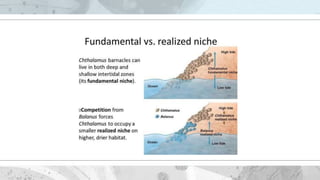
FUNDAMENTAL NICHE
● The fundamental niche is defined as different species’ positions in the ecosystem or
environmental condition. The fundamental niche is referred to as the span of the
environmental condition where all species survive.
● It elaborates on the role of the species in the environment. It also refers to a span of
conditions, resources with which animals grow, survive, and reproduce, and roles. This
fundamental niche tells the experience of the species and how it handles a particular
condition. It is the full span of environmental condition which a group of species can use and
occupy.
Types of Ecological Niche
REALIZED NICHE
● The term realized niche is defined as the range in the environment condition in that all
groups of species live. The realized niche elaborates on what the animal does in the
ecosystem. It grows, and it is a subset of a fundamental niche.
● It is to believe that when species come to interact with other species and get pressured
from the other species, then the realized niche is formed. In realized niche animal is well
adopted, and thus species are well adopted in this niche.
Types of Ecological Niche
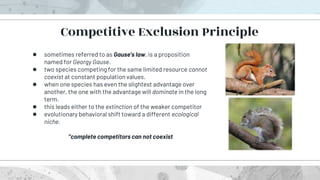
● sometimes referred to as Gause's law, is a proposition
named for Georgy Gause.
● two species competing for the same limited resource cannot
coexist at constant population values.
● when one species has even the slightest advantage over
another, the one with the advantage will dominate in the long
term.
● this leads either to the extinction of the weaker competitor
● evolutionary behavioral shift toward a different ecological
niche.
"complete competitors can not coexist
Competitive Exclusion Principle
● Both fundamental niche and realized niche expresses what is the condition of the
environment or position of different species in the ecosystem.
● The term fundamental niche is defined as an entire set of conditions through which an
animal can live and reproduce. On the other hand, a realized niche is a set of conditions
mainly used by the animal after interacting with other species.
● The fundamental niche is also called a pre-competitive niche. On the other hand, the
realized niche is also posting a competitive niche.
● A fundamental niche is a type of theoretical niche. On the other hand, the realized niche is
the range where species live.
● In the fundamental niche, there is no competition for the resources or predators. On the
other hand, a realized niche is a range where competition occurs for both resources and
predators.
● The fundamental niche is generally large or wide in size. On the other hand, the realized
niche is generally smaller in size.
Main Differences Between Fundamental Niche and
Realized Niche
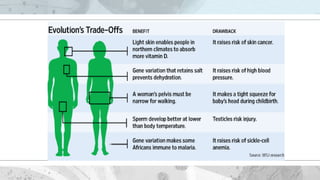
ECOLOGICAL TRADE-OFF
Central to most theories that explain the biodiversity is
that organisms face trade‐offs.
Trade‐off relationship affects evolutionary predictions.
● In biology and microbiology, trade-offs occur when a beneficial change
in one trait is linked to a detrimental change in another trait
(Keen, E. C., 2014, Tradeoffs in bacteriophage life histories").
● Evolving organisms are subject to trade-off (Fox, 2011).
■ speciation
■ adaptive radiation
■ competitive coexistence
Allocation
● a unit of energy, material, or time that
an organism uses to do
● e.g. defensive structure, cannot be used
to do something else e.g. reproduction
Reason why expect trade-offs
Antagonistic Pleiotropy
● mutation that improves one function
often degrades another
Mutational Decay
● degrades an unused function will be
selectively neutral
● Over time, expect organism to remain
good at what they selected to be good at.
Laws of Physics
● for the physical reasons between rate and efficiency
with which an organism can perform work
e.g. fast-but-inefficient vs slow-but-efficient life history
strategies.
Constraints on phenotypes
(species’ visible characteristics)
Allocation, antagonistic pleiotropy, mutational decay,
and the laws of physics are reasons why organisms
cannot build or maintain certain phenotypes.
Competition among genotypes (or species)
purges the less-fit, so that only the most-
fit remain. And the phenotypes of the
most-fit are likely to exhibit a trade-off,
even in an absence of constraints.
Environmental change can alter trade-off and
that different physiological mechanisms.
Interaction between environment and trade-off
affect ecological and evolutionary dynamics.
(Bohannan & Jessup, The Shape of an Ecological Trade-Off Varies with Environment).
Evolutionary Trade-offs
Trade-off shapes eco-evolutionary dynamics. Species are competing in
a well-mixed system, and their evolution in interaction trait space is subject
to a life-history trade-off between replication rate and competitive ability.
(https://elifesciences.org/articles/36273).
Single-trait trade-off
Example:
Weight of a new born baby. A higher birth weight provides a higher chance of
survival in the first few weeks, but babies that are too large have higher mortality rate
(Karn & Penrose, 1951).
Thus there is a trade-off in the birth weight that greatly impacts the chance of survival.
Multiple-trait trade-off
Example: Different species of howler monkeys
The bigger a male’s vocal organ and louder the roar, the smaller their testes resulting
in less sperm production.
Trade-offs have been experimentally manipulated in
both the lab and field, measured such as phenotypic or
genetic correlations.
There are three life history tasks: reproduction,
resource accumulation, and survival.
Life History Trade Off
In many animal species, the expression of sexually selected traits is negatively
correlated with traits associated with survival such as immune function, a relationship termed a
'trade-off'. But an alternative in which sexually selected traits are positively correlated with
survival traits is also widespread. The nature of intertrait relationships is largely determined by
overall energy expenditure, energy availability and trait flexibility, with trade-offs expected when
individuals are subject to energy constraints. This hypothesis was tested in Ephippiger diurnus, a
European bushcricket in which males are distinguished by two prominent sexually selected
traits, acoustic calls and a large spermatophore transferred to the female at mating, and where
immune function may be critical in survival. Ephippiger diurnus are distributed as small, isolated
populations that are differentiated genetically and behaviourally. Songs and spermatophores are
analyzed and the immune function in male individuals from eight populations spanning a range of
song types. As predicted, trade-offs where found in those populations that expended more
energy on song and were less flexible in their ability to adjust that expenditure. Ultimately,
energy constraints and resulting trade-offs may limit the evolution of song exaggeration in E.
diurnus populations broadcasting long calls comprised of multiple 'syllables'.
When do trade-offs occur? The roles of energy constraints and trait flexibility in
bushcricket populations
F Barbosa, D Rebar, M D Greenfield
Whether studying individual behavior or formulating sensible policies, it is necessary
to understand the trade-offs involved. So what are the trade-offs involved in the middle of a
pandemic? It turns out that there are many, some for the individual citizen and some for society
as a whole.
For the individual, the central trade-off is one of balancing the risks and benefits of
exposing oneself to infection. On the one hand, going shopping or going for a walk may be
attractive, but on the other hand, it exposes people to increased infection risk. The strengths of
these effects are likely to differ depending on the stage of the epidemic. They may also differ
from person to person.
What are the main economic-epidemiological trade-offs that we face now?
Trade-offs play an important role in evolution. Without trade-offs, evolution would
maximize fitness of all traits leading to a “master of all traits”. The shape of trade-offs has been
shown to determine evolutionary trajectories and is often assumed to be static and independent
of the actual evolutionary process. Here we propose that coevolution leads to a dynamical trade-
off. We test this hypothesis in a microbial predator–prey system and show that the bacterial
growth-defense trade-off changes from concave to convex, i.e., defense is effective and cheap
initially, but gets costly when predators coevolve. We further explore the impact of such
dynamical trade-offs by a novel mathematical model incorporating de novo mutations for both
species. Predator and prey populations diversify rapidly leading to higher prey diversity when the
trade-off is concave (cheap). Coevolution results in more convex (costly) trade-offs and lower
prey diversity compared to the scenario where only the prey evolves.
Dynamical trade-offs arise from antagonistic coevolution and decrease
intraspecific diversity
(Weini Huang, Arne Traulsen, Benjamin Werner, Teppo Hiltunen & Lutz Becks)

Distribution and abundance

  • 1.
    AUTECOLOGY RIZA JOY D.PALOMAR Discussant EdD SE 714 | Advance Ecology
  • 2.
    TABLE OF CONTENTS DISTRIBUTION ANDABUNDANCE OF ORGANISM TRADE-OFFS 01 02 HABITAT AND ECOLOGICAL NICHE 02
  • 4.
  • 5.
    DISTRIBUTION Distribution refers tothe region where an organism is found. Biogeography is the study of geological species distribution, which is influenced by both biotic and abiotic factors.
  • 6.
    ● A speciesrange is the area where a particular species can be found during its lifetime. Species range includes areas where individuals or communities may migrate or hibernate. ● Every living species on the planet has its own unique geographic range. ● Some species have a wide range, while others live in a very limited area. Range
  • 7.
    COSMOPOLITAN DISTRIBUTION ● Specieswith ranges that cover most of the Earth. ● It does not include areas of extreme weather, such as the Antarctic and Arctic, within its definition. Range Distribution
  • 8.
    ● Human beings(Homo sapiens) also have cosmopolitan distribution, inhabiting every continent except Antarctica. Humans
  • 9.
    ● Blue whales(Balaenoptera musculus) have a very cosmopolitan distribution—they are found in every ocean on the planet. BLUE WHALES
  • 10.
  • 11.
    ENDEMIC DISTRIBUTION ● Specieswith limited range. ● Confinement of a particular species, genus, or groups of plants and animals to a particular area. ● Only where there is a considerable restriction in the area of distribution. Range Distribution
  • 12.
    ● Honeycreepers areendemic to Hawaii. Beautiful song birds with distinctive beaks, honeycreepers specialize in probing flowers for nectar, and have a particular taste for the flower for which they are named. ● Just over half the original species of honeycreepers still exist, having been driven to extinction by hunters, disease, habitat loss, competition from invasive species, and predation by human-introduced animals like rats, cats, and dogs. Hawaiian Honeycreeper
  • 13.
    ● Madagascar, homeof the lemur, is one of the global hotspots for endemic species. ● The smallest lemur would easily fit in your hand, while the largest can top 25 pounds. ● Many lemurs live in matriarchal societies where females call the shots. Lemurs of Madagascar
  • 14.
    ● The SantaCruz kangaroo rat gets its name from its distinctive large hind legs. In the past, this rare animal could be found in the mountains south of San Francisco, but its population has been pushed to a single parcel in the Santa Cruz Sandhills. ● One of 23 subspecies of kangaroo rat found in California, the Santa Cruz variety is under a real threat of extinction because of dwindling populations and health problems stemming from low genetic diversity. Santa Cruz Kangaroo Rat
  • 15.
    ● Galápagos tortoisesare the largest living tortoise — fully grown adults can tip the scales at over 650 pounds and grow to be 4 feet long. ● Native to the seven islands in the Galápagos archipelago, this long- lived species can live to be 150 years old. Galápagos Tortoise
  • 16.
  • 17.
    • The PhilippineEagle is one of the largest birds on Earth. It can grow 2-3 feet in height while its wingspan can extend up to 6 to 7 feet. • The Philippine Eagle has a very big, curved beak and a long crown of feathers. They are considered the only bird of prey in the world with blue eyes. They have 8x sharper eyesight than humans, allowing them to see prey and predators from afar. • They are monogamous and take only one partner for life. Both male and female nurse the baby. They only take care of one chick at a time and don’t breed again until the baby eagle is able to survive on its own. This is the reason why they only produce only one egg every two years. • Its habitat is the rainforest and is endemic to the Philippines. They can be found on the islands of Luzon, Samar, Leyte and Mindanao. Philippine Eagle (Pithecophaga Jefferyi)
  • 18.
    ● Tamaraws aredistinguished from related buffalo by their smaller stature and straight horns. Interestingly, horn shape can be used to determine the sex of skulls, with male horns being thicker, longer, flatter, and closer together than those of females. ● Tamaraws are found only on the island of Mindoro in the Philippines. They inhabit Mindoro’s abundant grasslands and secondary successional forests and can be found at 300 to 1000 m in elevation. ● Bubalus Mindorensis breeds during the dry season, from December to May. Gestation is 276 to 315 days, timed so that births occur during Mindoro’s wet season (June to November), when there are a fresh, abundant food supply. Cows give birth to only a single calf every two years. ● Tamaraws are herbivorous, feeding on grass species during the rainy season they feed on shoots of bamboo. Tamaraw (Bubalus Mindorensis)
  • 19.
    ● Philippine SaltwaterCrocodile or Estuarine Crocodile is considered the Earth’s largest living crocodilian. The average size of males can reach 17 feet or 5 meters and upto 23 feet (7 meters) long. ● Saltwater Crocodile are excellent swimmers and have often been spotted far out of sea. They live in inland lakes, swamps and marshes as well as coastal brackish waters and tidal sections of rivers. ● They have stones in their guts. They swallow large stones to serve as ballasts to help them swim, dive and stay underwater. ● They are classic, opportunistic predators and they’ll feed on anything they can get their jaws on, including water buffalo, monkeys, even sharks. Philippine Saltwater Crocodile (Crocodylus Porosus)
  • 20.
    ● Tarsiers inhabittrees and are nocturnal. ● Philippine tarsiers are primarily insectivorous. ● The majority of tarsiers are monogamous. ● Recent research shows that the breeding season of tarsiers is defined by the availability of insects. ● Female tarsiers carry the offspring in the uterus for approximately 6 months. They only give birth to one offspring at a time. Their babies are born fully furred and with its eyes open. Newborns are able to climb at just one day of age while independence occurs after 4 to 10 weeks of weaning or until the offspring are capable of hunting on their own ● Tarsiers are extremely territorial and engage in disputes with neighboring groups that venture into their boundaries. ● They are fragile tiny creatures that have a suicidal tendency. If they are traumatized or stressed, they kill themselves. They do that by starving themselves to death, by beating their heads to a surface or pushing their head out of a cage. Noise, taking them out of their native habitat, disturbing their sleep, use of flash photography, poking or touching them, are some factors that cause stress or trauma to them. Tarsier (Carlito Syrichta)
  • 21.
    ● A small,nocturnal ruminant, which is endemic to Balabac and nearby smaller islands southwest of Palawan in the Philippines. ● It has a black and brown coat with white stripes on the throat and chest. Each individual hair has sections of different colors - the base is generally light (ranging from white to ashy brown), with a tawny, orange, or brown midsection, and a long black tip. ● The male of its species does not have any antlers like a true deer. They use their large, tusk-like canine teeth on the upper jaw for self-defense or territorial fights with other males. ● It is a solitary, nocturnal animal, but has on occasion been seen in pairs for short periods of time. ● It reach sexual maturity at a young age. T. nigricans is thought to reach sexual maturity at 5 months of age. ● The mouse-deer has been estimated to live about 14 years and usually produces one offspring per litter. Two offspring can occur but is extremely rare. The gestation time ranges from 140 to 177 days Philippine Mouse-deer (Tragulus nigricans)
  • 22.
    DISJUNCT DISTRIBUTION ● Specieswith two or more ranges that do not connect with each other. ● Mountain ranges, deserts, or oceans sometimes separate the ranges of these species. Range Distribution
  • 23.
    ● Has adisjunct distribution in the southern islands of Japan and the southeast Asian mainland, as well as the United States. Kudzu (Japanese Arrowroot)
  • 24.
    ● has adisjunct distribution in Europe and the island of Ireland. Eurasian pygmy shrew
  • 25.
    CLUMPED DISTRIBUTION ● Mostcommon type of dispersion found in nature. ● Distance between neighboring individuals is minimized. ● Found in environments that are characterized by patchy resources. ● Individuals might be clustered together in an area due to social factors such as selfish herds and family groups. ● To protect the herd/group from predation or to trap prey Patterns of Distribution
  • 26.
    REGULAR OR UNIFORMDISTRIBUTION ● Also known as even distribution, is evenly spaced. Distance between neighboring individuals is maximized. ● The need to maximize the space between individuals generally arises from competition for a resource such as moisture or nutrients, or as a result of direct social interactions between individuals within the population, such as territoriality ● Farming and agricultural practices often create uniform distribution in areas where it would not previously exist, for example, orange trees growing in rows on a plantation. Patterns of Distribution
  • 27.
    RANDOM DISTRIBUTION ● Alsoknown as unpredictable spacing, is the least common form of distribution in nature ● Occurs when the members of a given species are found in environments in which the position of each individual is independent of the other individuals: they neither attract nor repel one another ● Random distribution usually occurs in habitats where environmental conditions and resources are consistent ● This pattern is characterized by the lack of any strong social interactions between species. Patterns of Distribution
  • 28.
    ABUNDANCE The abundance ofa species relates to how many members of a species is present within an ecosystem. Abundance can be measured by counting all the individual organisms that occur within the organism It is usually described as density - the number on individuals in a certain area - as this gives an idea of crowding.
  • 29.
    Light intensity ● Someplants have evolved for optimum growth in bright sunlight. An example of this is a cactus houseplant. Cacti originally come from deserts where they grow in bright sunlight. Other plants have evolved to grow in shade. ● Many orchids, which are also kept as houseplants, grow on trees in the rainforest and have evolved for optimum growth in darker conditions. If you were to put an orchid on a bright windowsill and a cactus in a dark corner of your room, neither plant would grow well. Factors Affecting Distribution and Abundance of Organism (ABIOTIC)
  • 30.
    Temperature ● Both animalsand plants have evolved to grow healthily at their optimum temperatures. If you planted either your cactus or orchid houseplants outside in cold temperatures, they would die. Similarly, animals that have evolved to live at the North Pole, such as the polar bear, could not survive in warmer conditions. Factors Affecting Distribution and Abundance of Organism (ABIOTIC)
  • 31.
    Moisture levels ● Lotsof people kill houseplants by overwatering rather than by under- watering them - plants cannot survive in waterlogged soils. Their roots are unable to respire, they rot and the plant dies. Other plants, such as pitcher plants, grow best in bogs where the moisture levels are high. Soil moisture meters can accurately determine how wet an area is. Factors Affecting Distribution and Abundance of Organism (ABIOTIC)
  • 32.
    pH Level ● ThepH of soils can have a huge effect on the plants that are able to grow in them. Some plants, like azaleas, grow best in acidic soils and will quickly die if planted in alkaline soils. Others, like clematis, prefer alkaline soils. Some, like hydrangeas, can grow in both. Hydrangeas are unusual in that their flower colour changes in different soils. Just like universal indicator paper, hydrangea flowers are pink in acidic soils and blue in alkaline soils. ● The pH of water can also affect the aquatic organisms that are found there. Different species have evolved to survive at different pH levels found within water. Factors Affecting Distribution and Abundance of Organism (ABIOTIC)
  • 34.
    Salinity ● The amountof salt in aquatic environments affects the organisms that are found there. Freshwater organisms could not survive in the salt water of the sea and the reverse for saltwater organisms. Factors Affecting Distribution and Abundance of Organism (ABIOTIC)
  • 35.
    Availability of O2and CO2 ● CO2 levels limit photosynthesis. O2 levels are important for water-dwelling organisms (eg, freshwater invertebrates) Factors Affecting Distribution and Abundance of Organism (ABIOTIC)
  • 36.
    Availability of food ●All animals require food to live. The availability of food is a major factor in how many animals live in an ecosystem. Areas like rainforests with rich food supplies have more species of life than other areas like deserts and the Polar Regions where there is less food. Factors Affecting Distribution and Abundance of Organism (BIOTIC)
  • 37.
    Availability of nestingsites ● animals need a safe shelter in order to successfully breed Factors Affecting Distribution and Abundance of Organism (BIOTIC)
  • 38.
    New predators ● Thearrival of new predators in an ecosystem can have a devastating effect. In balanced ecosystems, predators and prey have evolved together. Predators can catch enough prey to survive, but not so many that they kill all of their food. Factors Affecting Distribution and Abundance of Organism (BIOTIC)
  • 39.
    New pathogens ● Whenorganisms inhabit new ecosystems, they often bring new pathogens. As an example, Europeans first colonized North America, and introduced new pathogens, like the influenza virus. Many Native Americans had not developed immunity to new diseases such as this, and so many were killed by them. Factors Affecting Distribution and Abundance of Organism (BIOTIC)
  • 40.
    New pathogens ● Whenorganisms inhabit new ecosystems they often bring new pathogens. As an example, Europeans first colonised North America, and introduced new pathogens, like the influenza virus. Many Native Americans had not developed immunity to new diseases such as this, and so many were killed by them. Factors Affecting Distribution and Abundance of Organism (BIOTIC)
  • 41.
    QUADRATS ● a gridthat is typically one meter by one meter placed randomly at different locations within an ecosystem. The sample of plants or animals that are within each quadrat are measured and a population estimate is made using a quadratic equation. The estimated population = Average count per quadrat x The study area or quadrat area Measuring Distribution and Abundance
  • 42.
    TRANSECTS ● Transect isa narrow strip that crosses the entire area being studied, from one side to the other. Transects provide an accurate and easy method of representing an area simply. ● Two examples of transects are a plan sketch and a profile sketch. -A plan sketch is an aerial or surface view of a representative area within an ecosystem. -A profile sketch is a side in view of an area showing to scale the distribution of organisms along a line. Measuring Distribution and Abundance
  • 43.
    Kinds of Transect PlanSketch Profile Sketch
  • 44.
    PITFALL TRAPS ● oftenused to sample the small invertebrates living on the ground. You are likely to trap beetles and other insects, as well as spiders and slugs. ● a large number of traps makes results more reliable and minimises the effects of unusual results. Measuring Distribution and Abundance
  • 45.
    CAPTURE, RECAPTUER ● animalsare trapped, ● they are marked in a harmless way and then released ● traps are used again a few days later ● the numbers of marked and unmarked animals caught in the traps are recorded Measuring Distribution and Abundance
  • 46.
    Scale in MeasuringDistribution and Abundance Semi-Quantitive Abundance ratings ● These are measurement methods which involve estimation based on viewing a specific area of a designated size. The two Semi-Quantitive Abundance ratings used are known as the D.A.F.O.R, and the A.C.F.O.R
  • 47.
    A.C.F.O.R Scale Scale PercentageCover ABUNDANT greater than/equal to 30% COMMON 20-29% FREQUENT 10-19% OCCASIONAL 5-9% RARE 1-4% Data collected on the ACFOR scale is often biased or subjective. Many investigators over-estimate conspicuous plants (especially those in flower) and under-estimate inconspicuous plants. More reliable data will come from quantitative methods.
  • 48.
    D.A.F.O.R Scale Scale PercentageCover DOMINANT >75% ABUNDANT 51-75% FREQUENT 26-50% OCCASIONAL 11-25% RARE 1-10% It is generally recognized that recording plant cover using the DAFOR scale is extremely subjective, being affected by a number of factors and in particular recorder bias.
  • 49.
    ● The observedpatterns of distribution and abundance of plant and animal species within space and time are related directly to species-specific energy costs and gains (energy balance) in response to the many (Hutchinsonian N-dimensional) environmental or resource gradients. Competition, predation and other biotic interactions operate principally by increasing energy costs to the species, and can be included in our energy balance methodology as additional environmental gradients of energy costs. Persistence of a population and, ultimately, the species in a given locality, will occur only where energy return on investment allows a significant energy profit in the form of propagules. At any given time, energy investment in physiological, behavioral or morphological adaptations that optimize abundance at one point within the N- dimensional hyperspace of environmental gradients precludes the investment of the same energy elsewhere. Within the spatial and temporal range where the species can reproduce, abundance is related to the stochastic nature of important environmental interactions, because energy balance is ultimately controlled by the sum of organismal responses to all environmental influences. Populations tend to be most abundant where their genome allows the optimization of energy profits. Therefore, population dynamics reflect the cumulative effect of environmentally-induced shifts in organismal energy balance. If this energy balance approach is robust, it has the potential of synthesizing ecology at many levels. The Distribution and Abundance of Organisms as a Consequence of Energy Balances Along Multiple Environmental Gradients (Hall, Stanford & Hauer)
  • 50.
  • 51.
    HABITAT ● A habitatis a place where an organism makes its home. A habitat meets all the environmental conditions an organism needs to survive. ● For an animal, that means everything it needs to find and gather food, select a mate, and successfully reproduce. ● For a plant, a good habitat must provide the right combination of light, air, water, and soil.
  • 52.
    Space ● The amountof space an organism needs to thrive varies widely from species to species. ● Smaller organism needs a smaller space while larger organism needs larger space Components of a Habitat
  • 53.
    Food ● The availabilityof food is a crucial part of a habitat’s suitable arrangement ● If there were a drought, plants would become scarce. Even though the habitat would still have space (large forest), shelter (caves, forest floor), water (streams and lakes), and some food, it wouldn’t have enough to eat. It would no longer be a suitable arrangement. ● Too much food can also disrupt a habitat. Components of a Habitat
  • 54.
    Water ● Water isessential to all forms of life. Every habitat must have some form of a water supply. Some organisms need a lot of water, while others need very little. Components of a Habitat
  • 55.
    Shelter ● An organism’sshelter protects it from predators and weather. ● Shelter also provides a space for eating, sleeping, hunting, and raising a family. ● Shelters come in many forms. A single tree, for example, can provide sheltered habitats for many different organisms. Components of a Habitat
  • 56.
    ● TERRESTRIAL HABITAT Typesof Habitat FOREST GRASSLAND WETLANDS DESERT
  • 57.
    ● MARINE HABITAT Typesof Habitat REEF INTERTIDAL ZONE ESTURIES SEA BED
  • 58.
    ● FRESHWATER HABITAT Typesof Habitat RIVER LAKE POND STREAM
  • 59.
    ECOLOGICAL NICHE ● Ecologicalniche is a term for the position of a species within an ecosystem, describing both the range of conditions necessary for persistence of the species, and its ecological role in the ecosystem. ● Grinnell (1917) define it as a habitat requirements of a species for it to survive and reproduce. ● Elton (1927) define it as "the position or status of an organism within its community and ecosystem as a result of the organism's structural and functional adaptations. ● Hutchinson (1959) define it as multidimensional space of resources available to and utilised by a species
  • 60.
    ● All livingbeings that inhabit the earth play a role in their environment. ● It depends on the function and place of a living being in the environment. ● Animals in the ecological niche have different and unique functions. ● If there are two species playing the same role, an interspecific competition will be created. ● The correct description of a niche can include descriptions of life, habitat and the place of the organism in the food chain. ● It includes how to feed, compete, hunt and defend. ● It is closely related to habitat. ● The niche of a species is basically an ecological function or a set of conditions, resources and interactions it needs to survive Characteristics
  • 61.
    FUNDAMENTAL NICHE ● Thefundamental niche is defined as different species’ positions in the ecosystem or environmental condition. The fundamental niche is referred to as the span of the environmental condition where all species survive. ● It elaborates on the role of the species in the environment. It also refers to a span of conditions, resources with which animals grow, survive, and reproduce, and roles. This fundamental niche tells the experience of the species and how it handles a particular condition. It is the full span of environmental condition which a group of species can use and occupy. Types of Ecological Niche
  • 62.
    REALIZED NICHE ● Theterm realized niche is defined as the range in the environment condition in that all groups of species live. The realized niche elaborates on what the animal does in the ecosystem. It grows, and it is a subset of a fundamental niche. ● It is to believe that when species come to interact with other species and get pressured from the other species, then the realized niche is formed. In realized niche animal is well adopted, and thus species are well adopted in this niche. Types of Ecological Niche
  • 65.
    ● sometimes referredto as Gause's law, is a proposition named for Georgy Gause. ● two species competing for the same limited resource cannot coexist at constant population values. ● when one species has even the slightest advantage over another, the one with the advantage will dominate in the long term. ● this leads either to the extinction of the weaker competitor ● evolutionary behavioral shift toward a different ecological niche. "complete competitors can not coexist Competitive Exclusion Principle
  • 66.
    ● Both fundamentalniche and realized niche expresses what is the condition of the environment or position of different species in the ecosystem. ● The term fundamental niche is defined as an entire set of conditions through which an animal can live and reproduce. On the other hand, a realized niche is a set of conditions mainly used by the animal after interacting with other species. ● The fundamental niche is also called a pre-competitive niche. On the other hand, the realized niche is also posting a competitive niche. ● A fundamental niche is a type of theoretical niche. On the other hand, the realized niche is the range where species live. ● In the fundamental niche, there is no competition for the resources or predators. On the other hand, a realized niche is a range where competition occurs for both resources and predators. ● The fundamental niche is generally large or wide in size. On the other hand, the realized niche is generally smaller in size. Main Differences Between Fundamental Niche and Realized Niche
  • 67.
  • 68.
    Central to mosttheories that explain the biodiversity is that organisms face trade‐offs. Trade‐off relationship affects evolutionary predictions.
  • 69.
    ● In biologyand microbiology, trade-offs occur when a beneficial change in one trait is linked to a detrimental change in another trait (Keen, E. C., 2014, Tradeoffs in bacteriophage life histories"). ● Evolving organisms are subject to trade-off (Fox, 2011). ■ speciation ■ adaptive radiation ■ competitive coexistence
  • 70.
    Allocation ● a unitof energy, material, or time that an organism uses to do ● e.g. defensive structure, cannot be used to do something else e.g. reproduction Reason why expect trade-offs
  • 71.
    Antagonistic Pleiotropy ● mutationthat improves one function often degrades another
  • 72.
    Mutational Decay ● degradesan unused function will be selectively neutral ● Over time, expect organism to remain good at what they selected to be good at.
  • 73.
    Laws of Physics ●for the physical reasons between rate and efficiency with which an organism can perform work e.g. fast-but-inefficient vs slow-but-efficient life history strategies.
  • 74.
    Constraints on phenotypes (species’visible characteristics) Allocation, antagonistic pleiotropy, mutational decay, and the laws of physics are reasons why organisms cannot build or maintain certain phenotypes.
  • 75.
    Competition among genotypes(or species) purges the less-fit, so that only the most- fit remain. And the phenotypes of the most-fit are likely to exhibit a trade-off, even in an absence of constraints.
  • 76.
    Environmental change canalter trade-off and that different physiological mechanisms. Interaction between environment and trade-off affect ecological and evolutionary dynamics. (Bohannan & Jessup, The Shape of an Ecological Trade-Off Varies with Environment).
  • 77.
    Evolutionary Trade-offs Trade-off shapeseco-evolutionary dynamics. Species are competing in a well-mixed system, and their evolution in interaction trait space is subject to a life-history trade-off between replication rate and competitive ability. (https://elifesciences.org/articles/36273).
  • 78.
    Single-trait trade-off Example: Weight ofa new born baby. A higher birth weight provides a higher chance of survival in the first few weeks, but babies that are too large have higher mortality rate (Karn & Penrose, 1951). Thus there is a trade-off in the birth weight that greatly impacts the chance of survival.
  • 79.
    Multiple-trait trade-off Example: Differentspecies of howler monkeys The bigger a male’s vocal organ and louder the roar, the smaller their testes resulting in less sperm production.
  • 81.
    Trade-offs have beenexperimentally manipulated in both the lab and field, measured such as phenotypic or genetic correlations. There are three life history tasks: reproduction, resource accumulation, and survival. Life History Trade Off
  • 82.
    In many animalspecies, the expression of sexually selected traits is negatively correlated with traits associated with survival such as immune function, a relationship termed a 'trade-off'. But an alternative in which sexually selected traits are positively correlated with survival traits is also widespread. The nature of intertrait relationships is largely determined by overall energy expenditure, energy availability and trait flexibility, with trade-offs expected when individuals are subject to energy constraints. This hypothesis was tested in Ephippiger diurnus, a European bushcricket in which males are distinguished by two prominent sexually selected traits, acoustic calls and a large spermatophore transferred to the female at mating, and where immune function may be critical in survival. Ephippiger diurnus are distributed as small, isolated populations that are differentiated genetically and behaviourally. Songs and spermatophores are analyzed and the immune function in male individuals from eight populations spanning a range of song types. As predicted, trade-offs where found in those populations that expended more energy on song and were less flexible in their ability to adjust that expenditure. Ultimately, energy constraints and resulting trade-offs may limit the evolution of song exaggeration in E. diurnus populations broadcasting long calls comprised of multiple 'syllables'. When do trade-offs occur? The roles of energy constraints and trait flexibility in bushcricket populations F Barbosa, D Rebar, M D Greenfield
  • 83.
    Whether studying individualbehavior or formulating sensible policies, it is necessary to understand the trade-offs involved. So what are the trade-offs involved in the middle of a pandemic? It turns out that there are many, some for the individual citizen and some for society as a whole. For the individual, the central trade-off is one of balancing the risks and benefits of exposing oneself to infection. On the one hand, going shopping or going for a walk may be attractive, but on the other hand, it exposes people to increased infection risk. The strengths of these effects are likely to differ depending on the stage of the epidemic. They may also differ from person to person. What are the main economic-epidemiological trade-offs that we face now?
  • 84.
    Trade-offs play animportant role in evolution. Without trade-offs, evolution would maximize fitness of all traits leading to a “master of all traits”. The shape of trade-offs has been shown to determine evolutionary trajectories and is often assumed to be static and independent of the actual evolutionary process. Here we propose that coevolution leads to a dynamical trade- off. We test this hypothesis in a microbial predator–prey system and show that the bacterial growth-defense trade-off changes from concave to convex, i.e., defense is effective and cheap initially, but gets costly when predators coevolve. We further explore the impact of such dynamical trade-offs by a novel mathematical model incorporating de novo mutations for both species. Predator and prey populations diversify rapidly leading to higher prey diversity when the trade-off is concave (cheap). Coevolution results in more convex (costly) trade-offs and lower prey diversity compared to the scenario where only the prey evolves. Dynamical trade-offs arise from antagonistic coevolution and decrease intraspecific diversity (Weini Huang, Arne Traulsen, Benjamin Werner, Teppo Hiltunen & Lutz Becks)

Editor's Notes

  • #48 10 ORIGLY TAGGEDX20NEWCAPTURED/5NUMBER OF TAGGED=ESTIMATED/NUMBER OF TAGGED CAUGHT
  • #49 10 ORIGLY TAGGEDX20NEWCAPTURED/5NUMBER OF TAGGED=ESTIMATED/NUMBER OF TAGGED CAUGHT